App Referral Fraud Prevention: Controls That Preserve Growth
A referral programme becomes a payment system the moment rewards have value. This guide shows founders how to model abuse, validate qualifying events, use device integrity safely, control reward release, investigate clusters and protect legitimate advocates.

On this page
- What counts as app referral fraud?
- How do you threat-model a referral programme?
- What server-side referral ledger do you need?
- When should a referred user qualify for a reward?
- How should you use App Attest and Play Integrity?
- Which risk signals find referral abuse?
- How do you design risk-based reward decisions?
- How should you investigate referral rings?
- How do you handle false positives and appeals?
- Which referral fraud metrics should founders track?
- Frequently Asked Questions
What counts as app referral fraud?
Referral fraud is coordinated or deceptive activity that earns a reward without creating the legitimate new-user value the programme intended to buy. It includes self-referrals and farms, but also payment reversal, duplicate identity, collusive rings and reward claims tied to users who never become economically valid.
Define abuse relative to programme rules rather than labelling every unusual pattern fraudulent. A household sharing one device may be legitimate; twenty accounts completing identical payment flows from one device cluster may not. Separate suspicious, prevented and confirmed cases.
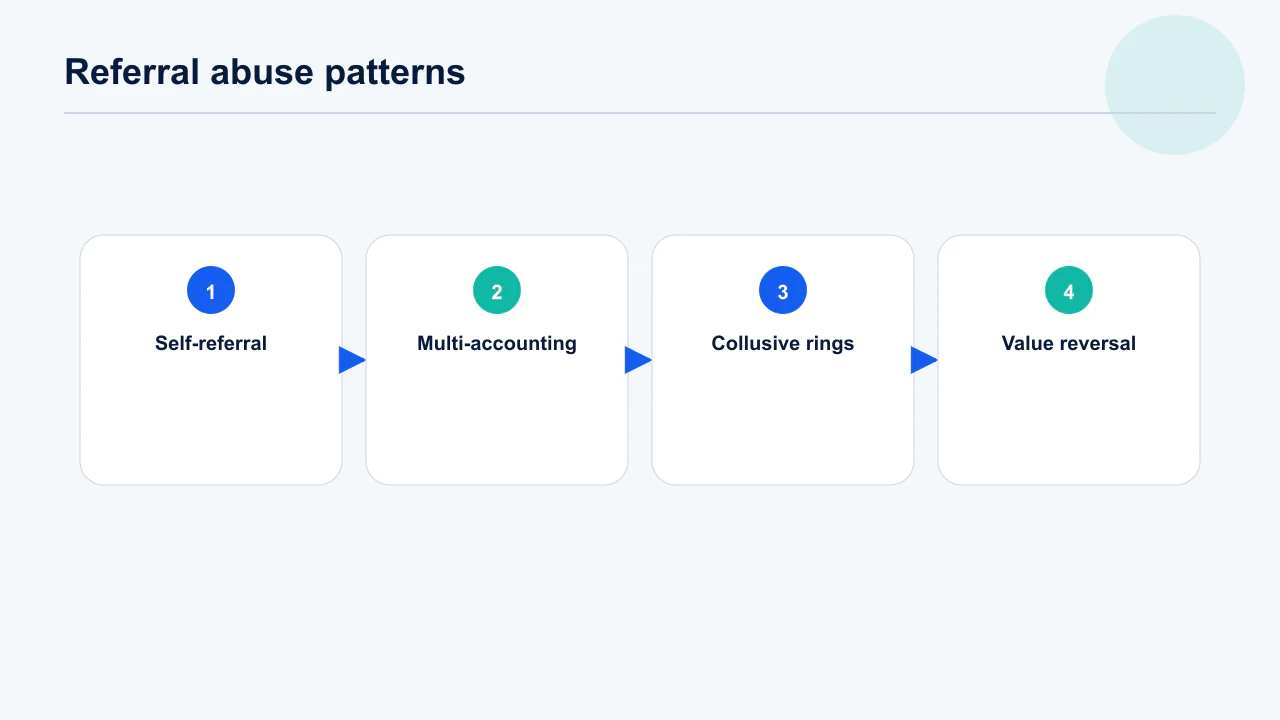
- Self-referral: One person creates or controls both sides to harvest rewards. Identity and ownership evidence matters.
- Multi-accounting: One actor creates many recipient accounts across devices or emulators. Look for graph and velocity patterns.
- Collusion: Several real people rotate referrals without genuine acquisition. Shared payout and behaviour can reveal rings.
- Value reversal: A qualifying purchase is refunded, charged back or cancelled after reward release. Reconcile downstream lifecycle.
Decision rule: Write a case definition with required evidence before calculating “fraud rate”.
We have seen teams call every shared IP fraudulent and block apartment buildings, universities and offices. Network overlap is a weak signal; behaviour and value flow make it meaningful.
Separate abuse from enthusiasm before you write a single rule, because the controls differ. A user who invites forty genuine colleagues looks statistically similar to a user farming forty fake accounts, and a programme that punishes both loses its best advocates. The distinguishing evidence is downstream: do the referred accounts behave like users afterwards, or do they stop at the qualifying event? Build the definition around post-reward behaviour rather than around invitation volume. Apple's DeviceCheck documentation describes the server-side validation that makes device-level repetition visible at all. In our portfolio the clearest early indicator has been a referrer whose invitees all qualify within minutes of each other and none of whom open the app again that week.
Write the abuse definitions down before launch — retrofitting them onto an active programme means changing rules on users mid-flight. Ad fraud shares much of this toolkit.
How do you threat-model a referral programme?
Trace invite creation, attribution, qualification, reward approval, payout and reversal, then ask how an attacker can replay, automate, fabricate or transfer each event. Model the smallest profitable attack and the highest-loss coordinated attack.
Include client, API, backend, analytics, payment provider, store and support tools. List assets, actors, trust boundaries and controls. Calculate attacker cost versus obtainable reward because generous instant cash makes weak identity controls economically exploitable.
- Entry: Codes, links, campaigns and deep links can leak or be enumerated. Use unguessable identifiers and expiry where suitable.
- Attribution: Client parameters can be modified and installs can be reset. Resolve ownership server-side.
- Qualification: Events may be replayed, fabricated or reversed. Validate authoritative sources.
- Payout: Destinations can concentrate rewards and support can bypass controls. Log overrides and limits.
Decision rule: If one script and one inexpensive device can earn more per hour than legitimate work, strengthen cost, delay or evidence before launch.
The threat model should include support agents and internal tools. A manual “mark qualified” button without dual control can become the easiest reward API in the system.
Work through the programme as an attacker would, in the order they will. Where is the cheapest place to create an account, and what does it cost? Which step is client-side and therefore forgeable? What is the minimum work needed to reach the qualifying event? How quickly does money leave the system, and is it reversible? The answers usually reveal that qualification is far too cheap relative to the reward, which is the single most common design fault. App integrity establishment closes the forgeable-client gap but does not fix an underpriced qualifying event.
Price the reward below the realistic cost of manufacturing a fake qualification. Every control below assumes that inequality holds.
What server-side referral ledger do you need?
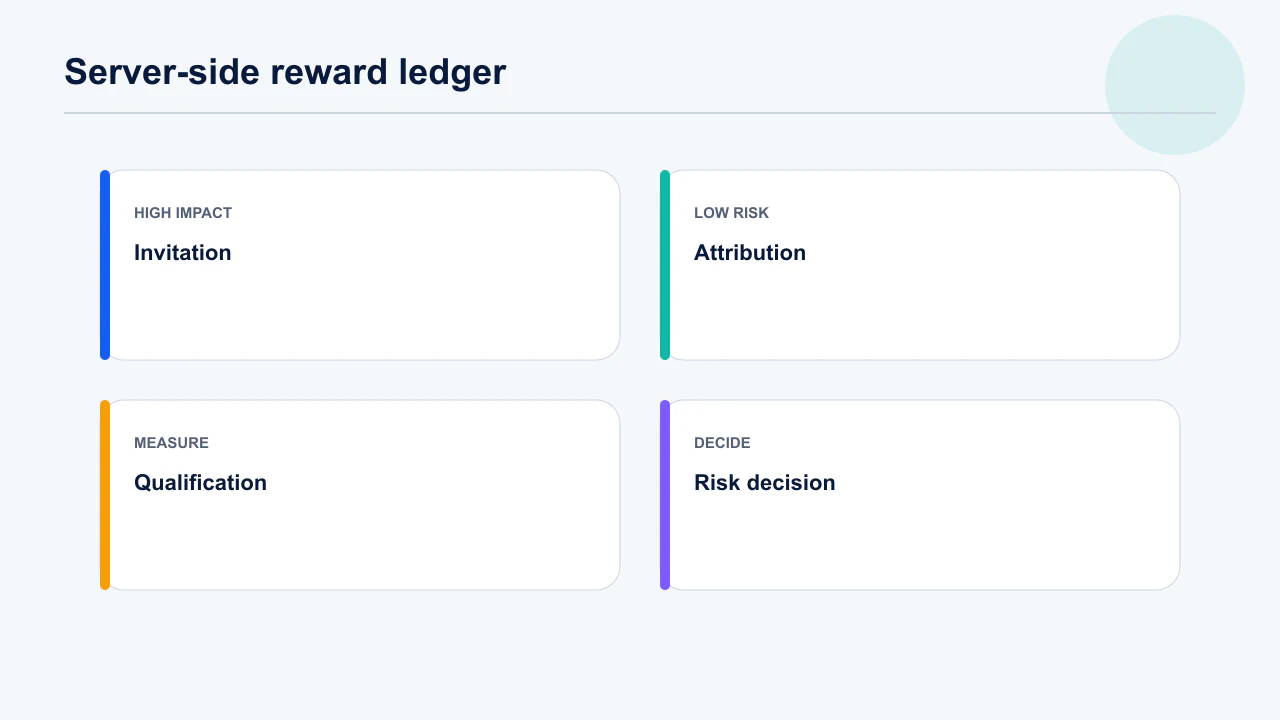
Use an append-only ledger linking invitation, attribution, qualification, risk decision, reward and reversal events under stable identifiers. Do not let analytics events or editable user-profile fields become the payout source of truth.
Every command needs an idempotency key and explicit state transition. Store referrer, recipient, campaign, reward rule version and authoritative evidence references. Keep money values in integer minor units and reconcile issued, pending, available, paid and reversed balances.
- Invitation: Create a unique referral instance and rule version. Separate public code from internal ID.
- Attribution: Record the accepted referrer once under declared conflict rules. Prevent later overwrites.
- Qualification: Attach server-verified business event and maturity state. Never trust client success alone.
- Reward: Record risk outcome, approval actor and balance transition. Duplicate delivery must be harmless.
Decision rule: A repeated request, delayed webhook or worker retry must never issue the same economic reward twice.
We apply payment-grade invariants because a referral credit is a liability even when it is not withdrawable cash. Reconstructable ledgers also make customer disputes answerable.
Model the ledger as an append-only event log rather than mutable counters, because disputes and investigations both need history. Record invitation issued, install attributed, qualification reached and reward released as separate events with timestamps, actor references and the decision inputs at that moment. Counters alone cannot answer why a reward was granted three weeks ago under rules that have since changed. Keep the reward release as a distinct step with its own authorisation, so a qualification bug does not automatically become a payout incident. Play Integrity verdicts belong in that log as recorded evidence, not just as a pass-or-fail gate.
Reconcile the ledger against actual payouts monthly. Post-reward uninstalls are a useful abuse signal.
When should a referred user qualify for a reward?
Qualification should occur after a server-verified event that predicts enough durable value to repay both rewards and expected fraud loss. Install and registration are usually too cheap to automate and too distant from business value.
Choose first completed order, settled payment, verified subscription period, meaningful usage milestone or another value event suited to the product. Add a maturity window for refunds or chargebacks. Show users pending status and expected timing so safety delay does not look like failure.
- Value event: Tie qualification to the unit economics that funded the programme. Avoid vanity milestones.
- Authority: Use backend, payment processor or validated store transaction evidence. Client events are hints.
- Maturity: Wait through relevant cancellation or reversal risk. Do not delay longer than necessary.
- Uniqueness: Define new customer across account, identity, payment and prior entitlement. Publish fair household rules.
Decision rule: Expected gross contribution from the qualified user should exceed rewards, servicing cost and risk-adjusted abuse loss.
A ₹500 dual-sided reward on email verification invites automation. The same reward after a settled, non-refunded order with identity and device checks changes the attacker economics.
Set qualification at a value event the referred user would only reach if they genuinely wanted the product, and add a maturity delay before the reward becomes irreversible. Registration is far too cheap; a completed core action several days in is much harder to fake at scale. The delay matters as much as the event: it lets refunds, chargebacks and early uninstalls surface before money leaves, and it converts a real-time fraud problem into a batch one you can actually review. Standard integrity requests are suitable for this kind of periodic check where a real-time verdict is not required.
Make the qualifying event visible to the referrer so the rule feels fair rather than arbitrary. The activation moment is usually the right anchor.
How should you use App Attest and Play Integrity?
Use attestation and integrity verdicts as server-validated risk signals at valuable actions, then combine them with account and transaction evidence. Apple’s App Attest guidance uses server challenges and assertions; Google says Play Integrity should be one part of a broader anti-abuse strategy.
Bind the verdict to the exact request with a nonce, request hash or server challenge, verify on the backend and prevent replay. Collect telemetry before enforcement because device populations differ. Provide a recoverable route for unsupported or inconclusive states.
- Critical moments: Request stronger evidence at qualification, payout or suspicious account creation. Avoid unnecessary calls.
- Server binding: Verify authenticity, freshness and request context centrally. Never accept a client boolean.
- Layering: Combine app integrity with identity, velocity, payment and graph signals. No verdict proves a human is honest.
- Fallback: Delay or step up rather than permanently blocking every failed verdict. Measure false positives.
Decision rule: Integrity evidence can raise or lower risk but should not alone define fraud for irreversible account action.
Google explicitly recommends observing the existing audience before enforcement. We ship signal collection first, inspect coverage and only then attach graduated responses.
Attest at the moments that carry money, not on every request, because attestation has latency and quota costs. Reward qualification and reward release are worth protecting; browsing is not. Bind the attestation to a server-generated nonce and to the specific transaction, or an attacker replays a valid attestation from a genuine device against a fabricated request. Treat the verdict as one weighted signal rather than a gate: attestation legitimately fails on rooted development devices, some enterprise configurations and older hardware. OWASP's transaction authorisation guidance covers binding an approval to the exact operation it authorises.
Define the fallback before launch: what a legitimate user does when attestation cannot succeed. Backend design determines where these checks can live.
Which risk signals find referral abuse?
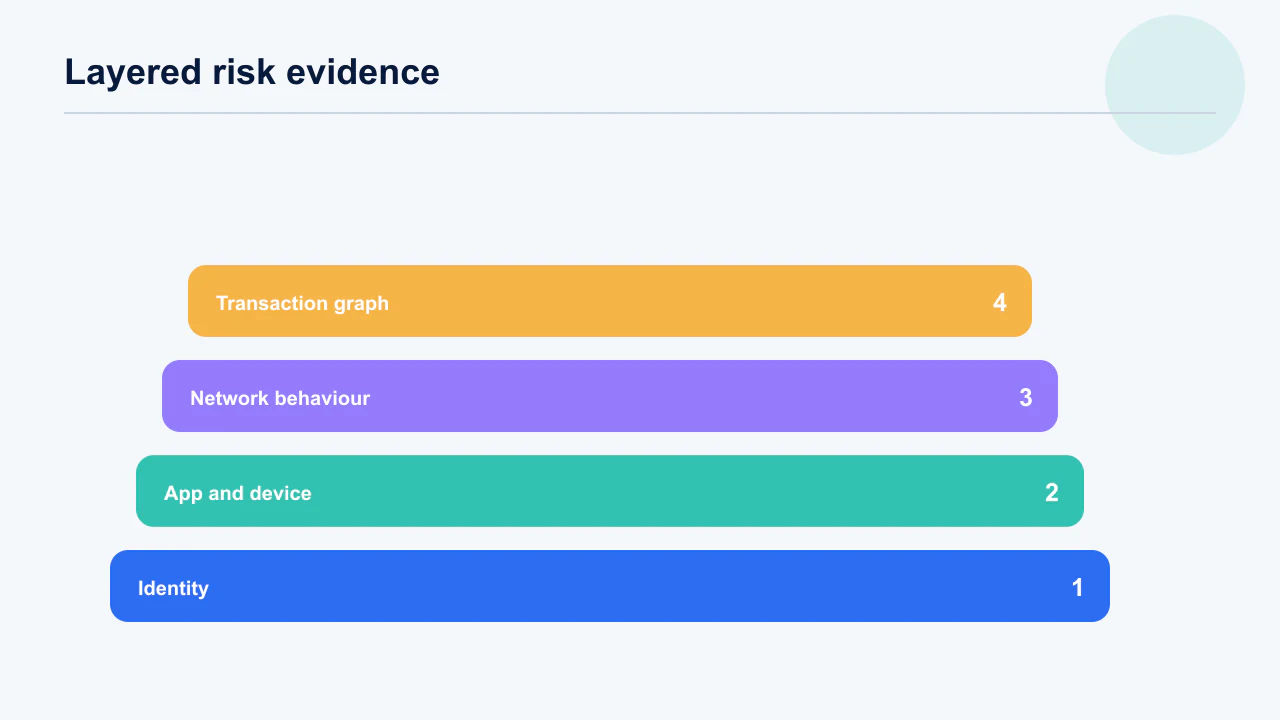
Combine identity, device, network, behaviour, transaction and relationship-graph signals over appropriate time windows. Each family contains legitimate edge cases, so calibrated combinations are stronger than brittle single rules.
Use velocity and reuse features rather than storing invasive raw values indefinitely. Build features for recipient and referrer: account age, referrals sent, qualification rate, payout concentration and prior reversals. Monitor model drift after campaigns and geography changes.
- Identity: Verified ownership reuse, impossible profile patterns and rapid account cycling. Respect lawful data minimisation.
- Device and app: Integrity verdicts, device reuse, emulator risk and app version anomalies. Expect families and shared devices.
- Network: Datacentre ranges, impossible movement and dense bursts. Carrier NAT makes IP weak alone.
- Graph and money: Shared payment instruments, payout destinations, mutual rings and refund clusters. Financial relationships are powerful.
Decision rule: Require multiple independent signals or authoritative invalid value before a high-impact denial.
A common office IP plus different devices and real payments may be healthy growth. The same IP plus one payout account, seconds-apart actions and refunds is a very different graph.
Combine weak signals rather than trusting strong ones, because any single signal has a straightforward evasion. Device reuse is defeated by fresh hardware, IP clustering by proxies, timing patterns by adding jitter — but defeating all three simultaneously raises the attacker's cost far more than hardening one. Weight signals by how expensive they are to evade rather than by how well they separate your current data, since the population adapts once enforcement begins. Graph structure is the most durable: money and referral relationships are the thing the attacker cannot fake without changing their economics. OWASP's REST security guidance covers protecting the endpoints these signals depend on.
Never expose which signal triggered a decision. Detection detail leaks directly into evasion.
How do you design risk-based reward decisions?
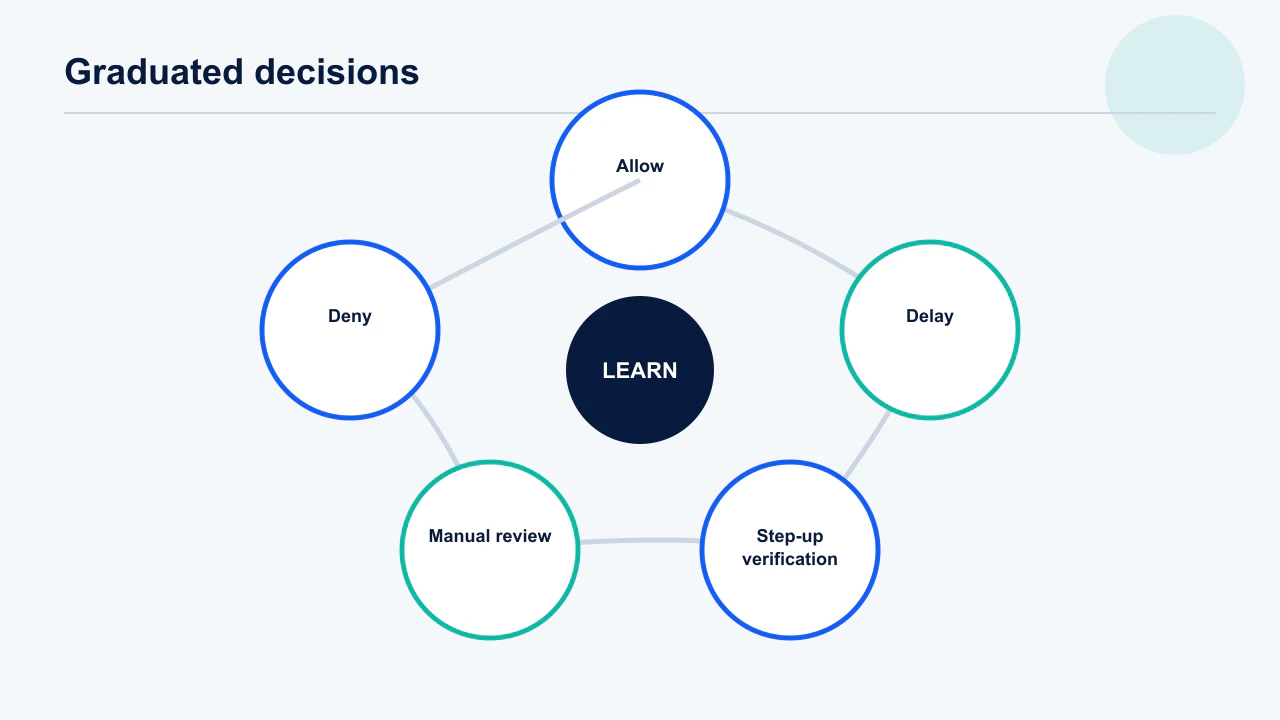
Use graduated outcomes—allow, delay, step up, review or deny—based on expected loss and evidence confidence. Binary blocking wastes ambiguous cases and reveals a sharp threshold attackers can probe.
Low-risk events can release normally. Medium risk can remain pending through a maturity window or require payment or identity confirmation already proportionate to the product. High-confidence invalid value can be denied, while linked severe abuse may justify account restrictions under published terms.
- Allow: Release after ordinary qualification and reconciliation. Continue passive monitoring.
- Delay: Hold reward while reversal risk matures or signals settle. Show a clear pending state.
- Step up: Request proportionate additional verification for a valuable action. Do not collect unrelated data.
- Review or deny: Send ambiguous high-value cases to trained review; deny proven invalid claims. Preserve appeal evidence.
Decision rule: Increase friction only when expected prevented loss exceeds legitimate conversion and support cost.
A risk score is not a moral score. It routes evidence and action. We never show internal score language to users; we explain the specific programme status they can resolve.
Build a graded response instead of a binary block, because a single threshold forces you to choose between paying fraud and punishing customers. Low risk releases immediately; moderate risk delays the payout and re-evaluates after the maturity window; higher risk asks for a step-up such as verification; only the top band is denied outright with review available. Set the bands by expected loss against false-positive cost rather than by score percentile, and revisit them as the attacker population shifts. NIST's digital identity guidelines are a sound reference for choosing proportionate verification rather than demanding identity documents by default. Publish the bands internally with worked examples, so a support agent can explain why a payout is delayed without guessing.
Log the band and the inputs for every decision, so appeals are reviewable. Trial abuse responds to the same graded approach.
How should you investigate referral rings?
Build a time-bounded relationship graph around referrers, recipients, devices, payment instruments, payout destinations and qualifying events. Investigate clusters with shared value flow and coordinated timing, not merely users who know one another.
Start from a suspicious reward or reversal and expand one edge at a time. Preserve raw evidence access narrowly and use derived relationship counts for routine review. Compare the cluster with known legitimate households, campuses, employers and creator communities.
- Seed: Choose a confirmed or high-confidence anomalous event. Record why it entered review.
- Expand: Add shared device, instrument, payout, address or timing edges. Weight evidence quality.
- Timeline: Order invitations, sign-ups, qualification, payout and reversal. Automation often leaves rhythm.
- Decision: Act on specific invalid rewards and accounts under policy. Avoid guilt by association.
Decision rule: A graph edge starts an inquiry; a documented invalid-value pattern supports enforcement.
Creator campaigns naturally form dense referral stars. Fraud rings often add reciprocal referrals, reused value instruments and rapid post-payout reversal. Context distinguishes them.
Investigate outward from a confirmed case rather than sampling suspicious accounts, because rings are found through connections. Take one confirmed fraudulent account as a seed, expand along shared signals to its neighbours, then expand again — and stop when new accounts stop sharing evidence rather than when the set looks large enough. Build a timeline before acting: rings usually show a creation burst, a qualification burst and a withdrawal attempt, and that shape distinguishes coordination from coincidence. Play's developer policies also constrain how incentivised installs may be promoted, which is worth checking before your own programme becomes the violation.
Act on the whole ring at once. Attribution sources help distinguish organic clusters from manufactured ones.
How do you handle false positives and appeals?
Give consequential reward denials a clear reason category, a proportionate appeal route and review by someone able to overturn the decision. Attack resistance does not justify an opaque system that permanently punishes legitimate shared devices or unusual travel.
Do not expose exact detection thresholds, but explain the unmet programme condition or required verification. Track appeals, reversal rate, time to resolution and affected segments. A cluster of successful appeals signals a rule, data or training defect.
- Notice: State pending, denied or reversed status and the programme basis. Avoid accusing the user of a crime.
- Evidence request: Ask only for information relevant to resolving the condition. Offer secure submission.
- Independent review: Give reviewers full context and authority to correct. Do not auto-confirm the model.
- Remediation: Release legitimate rewards and repair account restrictions promptly. Feed learning into controls.
Decision rule: The more valuable and irreversible the action, the stronger the review and appeal evidence must be.
False positives have growth cost beyond one reward: they target the advocates most willing to recommend the product. We include lost legitimate referrals in control economics.
Assume your controls will catch real users and design that path deliberately, because the reputational cost is asymmetric. A wrongly denied reward becomes a one-star review and a support thread; a wrongly paid reward costs the reward. Give notice that names the decision and the route to contest it without disclosing detection logic, ask for evidence a genuine user can actually supply, and route the review to someone other than the person who made the original call. Track reversal rate by rule — a rule reversing frequently is miscalibrated. Server-side validation records give the reviewer something concrete to re-examine.
Restore withheld rewards promptly when a review succeeds. Enforcement mistakes show up in your store rating quickly.
Which referral fraud metrics should founders track?
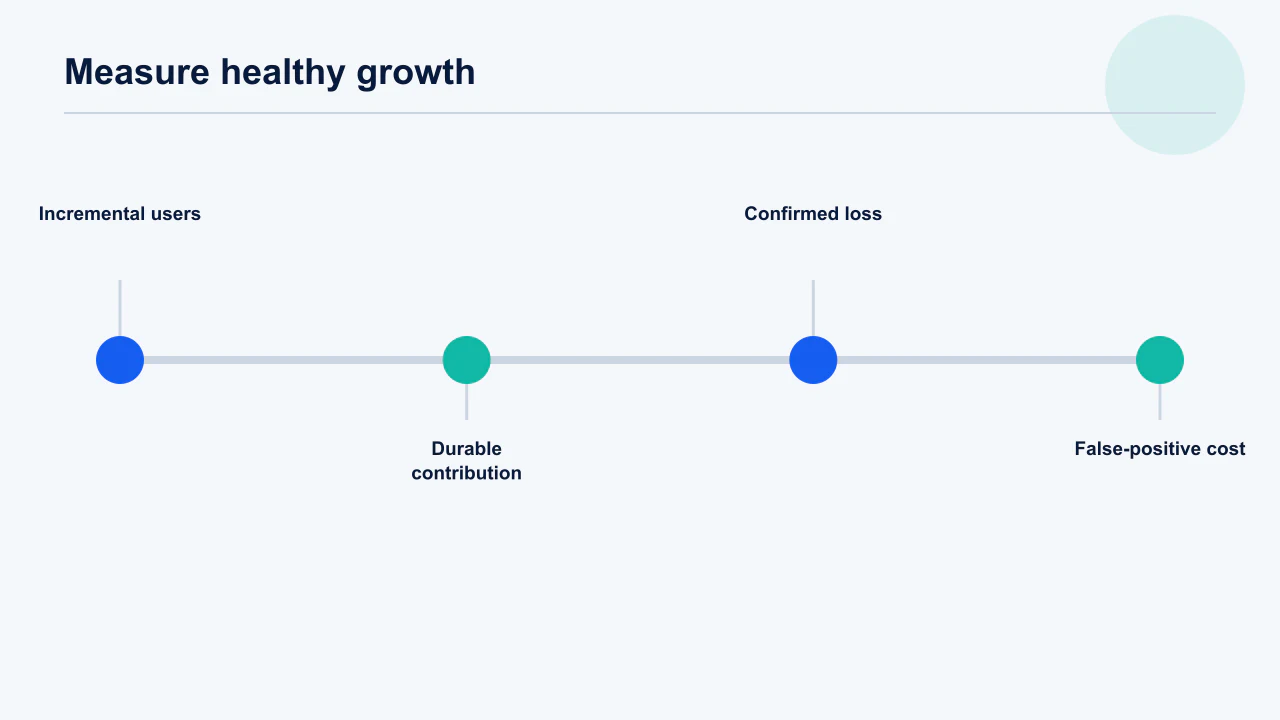
Track programme growth, financial exposure, confirmed loss, control precision, user friction and operational cost in one scorecard. A falling payout total is not success if legitimate referral conversion collapsed.
Use cohorts by rule version, campaign, geography and referrer tenure. Separate prevented exposure from confirmed saved loss; a blocked high-value attempt is not automatically money saved. Reconcile rewards with qualified users and later reversals.
- Growth: Invites, attributed recipients, qualified users, incremental lift and retained value. Use a holdout where feasible.
- Loss: Confirmed invalid rewards, reversals and outstanding pending exposure. Avoid speculative totals.
- Control quality: Review confirmation, appeal rate, reversal and false-positive estimate. Sample allowed cases too.
- Operations: Review age, handling cost, user contact rate and integrity-call coverage. Include vendor expense.
Decision rule: Optimise incremental contribution after rewards, confirmed abuse loss and operating cost, subject to a legitimate-user friction guardrail.
A programme can show excellent viral coefficient while paying rings that would have joined anyway. Incrementality and durable contribution belong beside fraud rate.
Pair every growth metric with its loss metric, or the programme optimises toward fraud. Referral volume beside fraudulent-payout rate; qualification rate beside post-reward retention of referred users; approval rate beside reversal rate on appeal. Referred users who never return after the qualifying event are the clearest signal that the qualification bar is too low, regardless of what the fraud rules caught. Review the whole set monthly and be willing to change the qualifying event rather than adding another detection rule to a programme that is fundamentally underpriced. Integrity checks reduce cheap abuse but cannot rescue bad reward economics.
Compare referred-user value against paid acquisition for the same cohort. ROAS and CAC give the benchmark that decides whether the programme is worth running.
Frequently Asked Questions
What is the most common app referral fraud?+
Self-referral and multi-accounting are common because they are easy when rewards trigger at sign-up. The costly patterns depend on reward value, identity, geography, payment and withdrawal design.
Should referral rewards be paid at install?+
Usually no. Installs are cheap to automate and distant from durable value. Trigger after a server-verified business event and appropriate maturity window that matches programme economics.
Can App Attest or Play Integrity stop referral fraud alone?+
No. They help verify genuine app and device context, but do not prove human identity or legitimate economic intent. Both should feed a layered server-side risk decision.
Is blocking every shared device safe?+
No. Families, schools, offices and refurbished devices can be legitimate. Device reuse should combine with identity, behaviour, graph and transaction evidence.
How long should referral rewards stay pending?+
Long enough for the qualifying value to become reliable—such as settlement, minimum use or a refund window—but no longer than necessary. Publish the pending condition clearly.
How should a user appeal a denied referral reward?+
Explain the programme condition without revealing detection thresholds, request only relevant evidence, use an independent reviewer and promptly release legitimate rewards or repair restrictions.
Which referral fraud KPI matters most?+
Optimise incremental contribution after rewards, confirmed abuse loss and operating cost, while guarding legitimate conversion and appeal reversals. A single fraud-rate percentage is insufficient.
Sources
- Apple Developer — Validating apps that connect to your server — App Attest challenge, attestation and assertion validation.
- Apple Developer — Establishing your app integrity — App Attest integration and server trust model.
- Android Developers — Play Integrity overview — Verdicts, telemetry-first enforcement and layered anti-abuse guidance.
- Android Developers — Make a standard Play Integrity request — Request hashing, backend verification and standard requests.
- OWASP — Transaction Authorization Cheat Sheet — Independent authorisation, server enforcement and transaction binding.
- OWASP — REST Security Cheat Sheet — API authentication, replay resistance and secure error handling.
- NIST — Digital Identity Guidelines — Primary public guidance on identity proofing and authentication.
- Google Play — Developer Program Policies — Current platform policy reference.
About the author
Amol Pomane — Founder, Vmobify
Amol leads Vmobify, a mobile app growth agency that has driven 30M+ downloads and ranked 54K+ keywords across 300+ apps since 2013. He writes about ASO, paid user acquisition, retention, and the operational reality of scaling mobile apps in India and global markets.
Model an install budget
Turn CPI and activation assumptions into acquisition scenarios.
Open free tool