Free Trial Conversion Rates: Benchmarks by Model & Trial Length
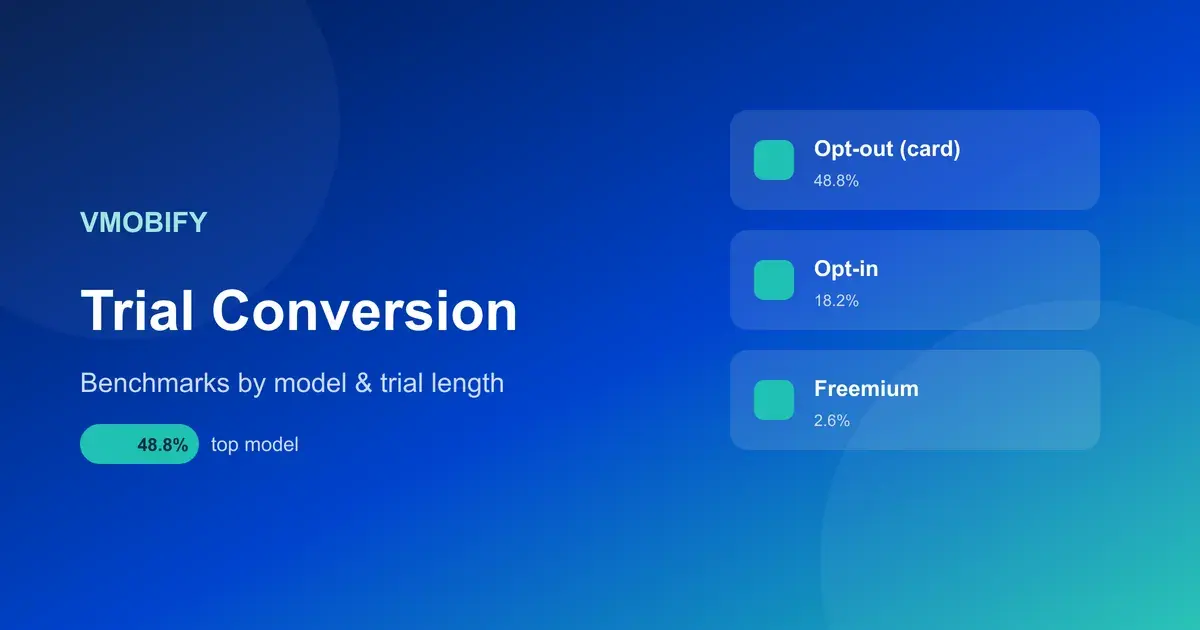
A 'good' free-trial conversion rate is meaningless without the model attached: freemium converts at 2.6%, a no-card opt-in trial at 18.2%, and a card-gated opt-out trial at 48.8%. Here are the 2026 benchmarks by model, vertical and trial length — and why card-gated trials quietly fail in India until you swap the card for UPI Autopay.
On this page
- What is a good free-trial conversion rate?
- Opt-in vs opt-out — how much does requiring a card change conversion?
- What are trial-to-paid benchmarks by vertical?
- Freemium or free trial — which model converts better?
- How does trial length affect conversion?
- Why do card-gated trials fail in India — and how does UPI Autopay fix it?
- How do you measure trial conversion correctly?
- What trial reminder and conversion sequence converts best?
- Which trial-conversion pitfalls cost the most?
- Frequently Asked Questions
What is a good free-trial conversion rate?
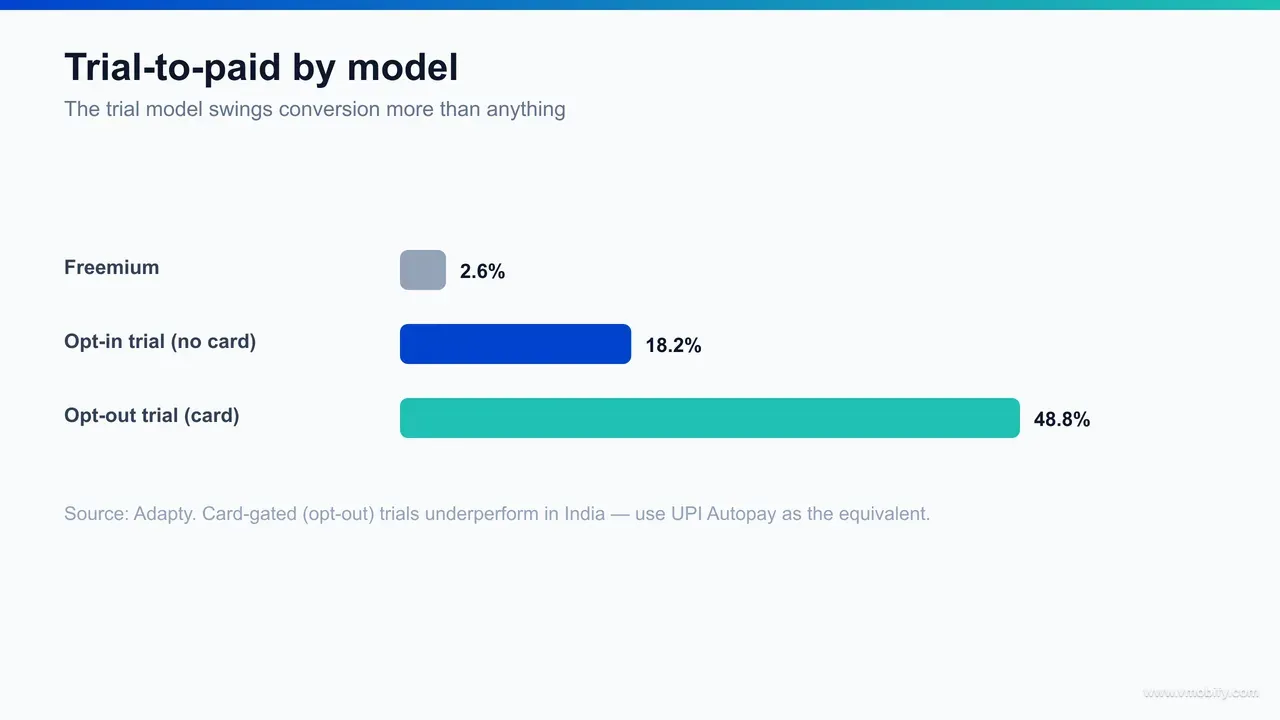
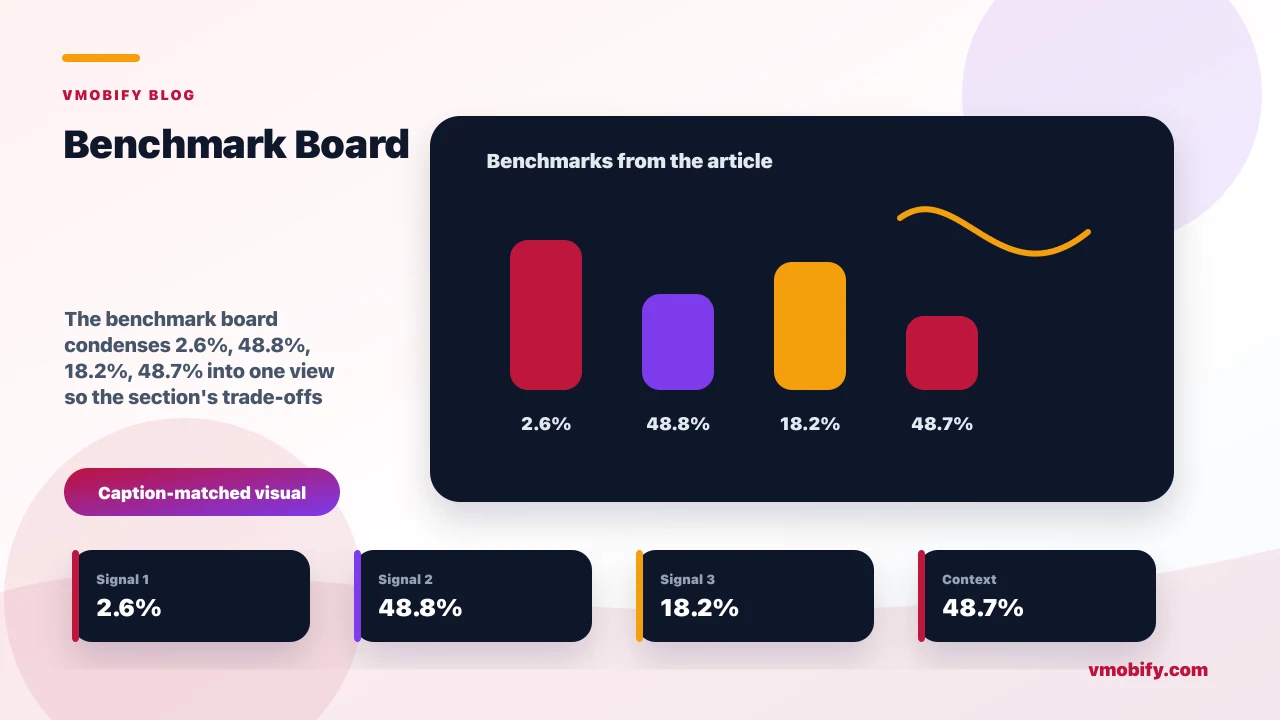
There is no single "good" free-trial conversion rate — the number is meaningless until you attach the model that produced it, because the spread between models is enormous: freemium converts to paid at about 2.6%, a no-card opt-in trial at 18.2%, and a card-required opt-out trial at 48.8%, per Adapty. Quote any one of those as "the benchmark" and you will mislead yourself by an order of magnitude.
This is the first thing to get straight, because "what is a good trial conversion rate?" is the most common monetisation question we field and almost always the wrong one. A 20% trial-to-paid rate is excellent if you run a no-card opt-in trial and disappointing if you require a card up front. The same raw percentage describes a triumph and a failure depending on how the trial was structured. Before you compare yourself to anything, you have to know which mechanism you are running.
The three numbers above come from Adapty's analysis of trial conversion rates, and they map cleanly onto three distinct commitment levels. Freemium asks for no payment commitment at all, so almost everyone "tries" and very few convert. An opt-in trial asks the user to start a trial but takes no card, so it filters for some intent and converts an order of magnitude better. An opt-out trial takes the card up front and bills automatically unless the user cancels, so it filters hardest, converts highest — and, as we will see, breaks in markets where cards are rare.
It helps to think of the rate as the product of two things: how many people start the trial, and what share of those starts convert. The three models trade these against each other. Freemium maximises starts and minimises conversion; opt-out minimises starts and maximises conversion; opt-in sits in between. That is why the headline rate alone tells you so little — a model can post a "low" conversion rate while producing more total subscribers than a "high" one, simply because it filled the top of the funnel with far more starts. The benchmark you should care about is the one for your model, read together with how many trials that model actually generates.
Across our 300+ apps managed since 2013, the single most expensive monetisation mistake we see is teams chasing a benchmark from the wrong model. A founder reads that "free trials convert at 45%", launches a no-card trial, lands at 18%, and concludes the product is broken — when 18% is exactly what a well-run no-card trial should do. The benchmark was real; it just belonged to a different mechanism. The rest of this guide ties each number to its model, its vertical and its trial length so you can judge your own rate against the right comparison — and links to our broader app monetisation work for putting it into practice.
Opt-in vs opt-out — how much does requiring a card change conversion?
Requiring a card up front is the single biggest lever on trial conversion: Adapty finds an opt-out trial that asks for the card converts to paid at 48.8%, while an opt-in trial that takes no card converts at 18.2% — a gap of more than 30 percentage points from one product decision. Nothing else you do to a trial moves the number that far.
The mechanics explain the gap. In an opt-out trial, the user enters payment details before the free period begins and is billed automatically when it ends unless they actively cancel. That up-front card requirement filters out casual triallists, so fewer people start — but those who do start have signalled real intent, and the default path is to become a paying customer. Inertia works in your favour: the user has to take an action to avoid paying. In an opt-in trial, no card is taken; at the end of the trial the user is asked to actively choose to pay. Far more people start the trial, but now inertia works against you, because the default path is to walk away.
Read the two numbers as a trade between volume and rate, not as "one is better":
Opt-out (card required)
- Trial-to-paid: ~48.8%
- Trade: fewer trial starts, dramatically higher conversion of those starts, and revenue that begins by default.
- Best when: intent is high, the value is obvious before the trial, and cards are widely held.
Opt-in (no card)
- Trial-to-paid: ~18.2%
- Trade: many more trial starts, lower conversion of each, and a larger pool of engaged free users you can re-market to.
- Best when: the product needs to be experienced to be believed, or when a card wall would block the trial start entirely.
Freemium
- To paid: ~2.6%
- Trade: the lowest-commitment entry of all, covered in its own section below, where the "trial" is really an indefinite free tier.
The catch — and the reason this section is not simply "always require a card" — is that the opt-out advantage assumes the user can present a card. In India, where card penetration is only around 8%, the card wall does not filter for intent; it blocks the trial start outright. That is the entire subject of the India section below, and it is why the highest-converting model on paper can be the worst-performing model in practice on the wrong rails. For the deeper structural choices around how this paywall is built, our guide to paywall optimisation benchmarks covers trial structure as one of the highest-win-rate levers there is.
What are trial-to-paid benchmarks by vertical?
Trial-to-paid conversion varies widely by category: RevenueCat's 2025 data puts the median at 48.7% for Travel, 43.8% for Media & Entertainment and 39.9% for Health & Fitness, with the top decile of apps reaching around 68.3% — so the same conversion rate can be top-quartile in one vertical and below median in another. Benchmark against your category, not against "apps" in general.
These figures come from RevenueCat's State of Subscription Apps 2025, drawn from a large population of subscription apps on its platform — a different dataset from Adapty's, measured on a different population. That distinction matters: do not take RevenueCat's vertical medians and compare them against Adapty's by-model numbers as if they were the same scale. They answer different questions. Adapty's 2.6% / 18.2% / 48.8% tells you what the trial mechanism does; RevenueCat's vertical medians tell you what the category does. Use each for its own purpose.
Why do verticals diverge this far? It comes down to how clearly the value lands and how strong the intent is at the moment of the trial:
- Travel (~48.7%): high purchase intent, a concrete and time-bound need, and a clear before-the-trip payoff. Users arrive with a job to do, which lifts conversion.
- Media & Entertainment (~43.8%): immediate, obvious value — content the user can consume on day one — and a familiar subscription mental model from streaming.
- Health & Fitness (~39.9%): strong initial motivation but value that compounds over weeks, so the trial has to bridge the gap between sign-up enthusiasm and a habit that justifies the renewal.
There is a practical warning buried in these medians, too. A category median is the rate of an app that has already solved onboarding, pricing and the trial sequence to an average standard — it is not a starting point you should expect to hit on day one. A new entrant in Health & Fitness landing at 25% is not failing the 39.9% median by some catastrophic margin; it is an early-stage funnel with obvious headroom, and the work is to close the gap to the median and then push toward the top decile. Treat the vertical median as the bar a competent operator clears, not a floor you fall through.
The top-decile figure of around 68.3% is the more useful target. It says that within any category, the best operators convert far above the median through better onboarding, sharper trial framing, correct local pricing and a disciplined reminder sequence — not through some category they happened to be born into. In our portfolio the difference between a median performer and a top-decile one in the same vertical is almost never the product; it is the trial structure and the conversion sequence around it. For how conversion feeds the numbers that actually decide profitability, pair this with our work on app ARPU and LTV benchmarks — a high trial conversion on a low-LTV plan can still lose money.
Freemium or free trial — which model converts better?
A time-boxed free trial converts to paid far better than open-ended freemium — Adapty puts freemium at about 2.6% to paid against 18.2% for a no-card trial and 48.8% for a card-gated one — but conversion rate alone does not decide the model, because freemium and trials are pursuing different jobs. The right choice depends on what you need the free tier to do for the business.
Freemium gives users an indefinite free version and asks them to upgrade for premium features. Because there is no deadline and no commitment, only a small fraction ever convert — but the free base itself can be the asset, fuelling word-of-mouth, network effects, ad revenue, or a top-of-funnel you monetise later. A free trial, by contrast, grants full access for a fixed window and forces a decision at the end. The deadline manufactures urgency, which is precisely why trials convert a multiple of what freemium does.
Use this framing to choose:
- Choose a free trial when the full product can demonstrate its value inside a fixed window, your category has clear willing-to-pay intent, and you want revenue per user rather than a large free base. Most premium-utility, productivity, travel and content apps sit here.
- Choose freemium when the free tier creates value on its own — virality, network effects, ad inventory, or data — and you are willing to convert a small percentage of a very large base. Social, communication and some prosumer tools sit here.
- Consider a hybrid — a freemium product that offers a time-boxed trial of premium at the moment a user hits a paid feature — when you want freemium's reach and the trial's urgency at the point of intent.
The deeper point is that the 2.6% freemium figure is not a failure state; it is a different equation. A freemium app converting 2.6% of ten million users earns more than a trial app converting 45% of fifty thousand. We have seen teams panic-migrate from freemium to a hard trial, watch top-of-funnel collapse, and end up with less revenue despite a "better" conversion rate. The decision belongs in your unit economics, not on a benchmark chart. We go a level deeper on this trade-off in our dedicated comparison of freemium versus free trial, and on structuring the offer itself in our app subscription monetisation strategy.
How does trial length affect conversion?
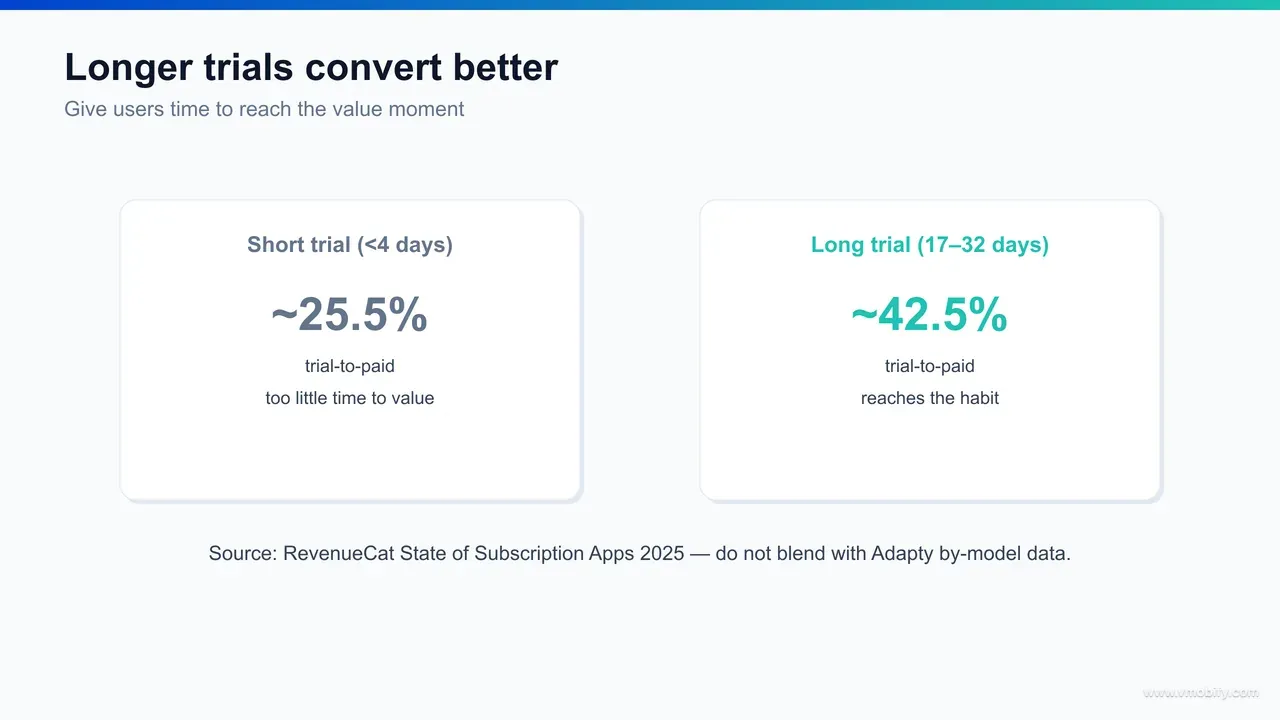
Trial length is a real lever, not a cosmetic one: RevenueCat's 2025 data shows longer trials of 17–32 days converting at around 42.5% median trial-to-paid, versus roughly 25.5% for very short trials under four days — so a too-short trial can leave a large share of conversion unclaimed. Longer is not automatically better, but very short trials rarely give the user time to reach the moment that justifies paying.
The intuition is straightforward. Most products have a "value moment" — the point at which a user has done enough with the app to understand why it is worth paying for. A three-day trial often ends before a busy user has even returned for a second session, let alone reached that moment. A trial in the 17–32 day band gives the habit time to form and the value to land, which is why RevenueCat's State of Subscription Apps 2025 finds the longer band converting markedly higher. The standard 7-day trial sits between these poles and is a reasonable default, but it is a default to test, not a law.
That said, "longer always wins" is the wrong lesson, and here is the nuance:
- Match length to your value moment. If users reach value in two days, a 30-day trial mostly delays revenue and gives more time to forget you. If they need three weeks to form a habit, a 7-day trial converts the wrong people and discards the rest.
- Longer trials need a stronger sequence. A 30-day trial only converts well if the reminder cadence keeps the user engaged and warns them before the charge. Without that, the extra days just widen the gap between sign-up and decision.
- Length interacts with the model. A long opt-out (card-gated) trial converts on inertia even if engagement fades; a long opt-in (no-card) trial depends entirely on re-engagement, because the user must actively choose to pay at the end.
In our portfolio, trial length is one of the highest-return things to test precisely because teams set it once and never revisit it. The right answer is empirical and product-specific: instrument when your users actually reach value, set the trial to comfortably clear that point, and let the conversion data — not a blog benchmark — settle the exact number. Treat the 17–32 day band as evidence that erring slightly long usually beats erring short, not as a target to copy blindly.
Why do card-gated trials fail in India — and how does UPI Autopay fix it?
The opt-out (card-required) trial is the highest-converting model on paper, but in India it quietly fails, because card penetration is only around 8% — so the card wall does not filter for intent, it blocks the trial start itself. The fix is UPI Autopay, the structurally equivalent opt-out mechanism built on rails Indians actually use. Copying a Western card-gated playbook into India is how good products get near-zero trial starts.
Recall why opt-out converts at 48.8% in the first place: the user enters a card up front, the trial bills automatically unless cancelled, and inertia carries them to paid. Every part of that depends on the user being able and willing to enter a card. In a market where roughly nine in ten people do not hold a credit card, the "ask for the card" step is not a gentle intent filter — it is a hard wall that most of your audience cannot clear. The trial-to-paid rate looks irrelevant when the trial-start rate has already collapsed. You are not converting a smaller, higher-intent pool; you are turning away the whole market at the door.
UPI Autopay is the answer because it reproduces the opt-out mechanic on Indian rails. Built on the e-mandate framework (see NPCI's UPI Autopay), it lets a user authorise a recurring debit once, after which renewals are collected automatically — the same "bill by default unless cancelled" inertia that makes card-gated trials convert, but reachable by hundreds of millions of UPI users rather than the card-holding minority. It is the difference between a payment method 8% of your market has and one a majority can use in seconds from an app they already trust.
The practical playbook for India-first apps:
- Do not default to a credit-card opt-out trial. It will look like a broken product when the real problem is the payment instrument.
- Offer UPI Autopay as the opt-out path so you keep the inertia advantage that drives high conversion, on rails your users actually hold.
- Keep a no-card opt-in option alongside it for users not ready to set up a mandate, accepting the lower ~18% conversion in exchange for far more trial starts.
- Remember the store layer. In-app subscriptions sold through Apple and Google use store billing, which already supports UPI as a payment method in India — your trial mechanics still need to respect each store's trial and mandate rules.
We have run this exact migration for India-focused subscription apps in our portfolio: swap the card wall for UPI Autopay, hold the opt-out structure, and the trial-start collapse disappears while the high opt-out conversion largely survives. The full mechanics — mandate setup, store-billing interaction and renewal handling — are covered in our deep dive on UPI Autopay for app subscriptions.
How do you measure trial conversion correctly?
Measure trial-to-paid as the share of users who started a trial and became paying customers within a defined window — segmented by trial model — and never blend two vendors' datasets, because Adapty and RevenueCat measure different populations on different definitions. Most "our trial conversion looks wrong" problems are measurement problems, not product problems.
Start with the denominator, which is where most errors live. Trial-to-paid should be measured against the cohort that started the trial, not against installs, not against paywall views, and not against trial starts plus freemium users lumped together. If you put trial starts in the numerator but installs in the denominator, you will report a number far below the benchmarks and conclude the trial is failing when it is simply being measured against the wrong base. Define the cohort precisely and measure consistently over time.
Then respect these distinctions before you compare to anything:
- Segment by model first. An opt-out and an opt-in rate are not comparable — one should land near 48.8%, the other near 18.2%. Blend them and the average describes nothing real. Report them as separate funnels.
- Pick one conversion window and hold it. Trial-to-paid for a 7-day trial is read days after the trial ends; for a 30-day trial it is read weeks later. Comparing a 7-day window to a 30-day window is a definitional mismatch, not a performance difference.
- Account for refunds and grace periods. A user who pays then refunds inside the window is not a clean conversion. Decide whether you count gross or net trial-to-paid and apply it consistently.
- Read conversion alongside LTV, never alone. A softer offer can lift conversion while lowering revenue per user. Apple's own guidance on subscriptions and introductory offers and Google's Play subscription documentation both make clear that trial terms and renewal behaviour are part of the same system — the conversion number only means something next to what the converted user is worth.
It is also worth instrumenting the funnel one step earlier than the trial start. Two apps can report the same trial-to-paid rate while earning very different revenue, because one converts a far larger share of paywall views into trial starts in the first place. If your trial-to-paid looks healthy but revenue is flat, the leak is usually upstream — at the paywall view-to-start step — not in the trial itself. Track paywall view → trial start → paid as three connected stages, so you can tell whether a weak result is a trial problem or a paywall problem before you spend a sprint fixing the wrong one.
The cardinal sin is mixing sources. Adapty's by-model figures and RevenueCat's by-vertical and by-length figures each come from that vendor's own platform population, measured their own way. Cite each to its source, compare like with like, and use one of them as your primary yardstick rather than averaging across both. We have seen teams "reconcile" two vendors' numbers into a single blended benchmark and then chase a target that exists in neither dataset.
What trial reminder and conversion sequence converts best?
The reminder sequence between trial start and the charge is the most under-built lever in trial conversion: the pre-renewal notification — which both Apple and Google require — is the single most important touchpoint, and the apps that convert in the top decile treat the whole trial window as a deliberate sequence, not dead air. Conversion is decided early but reinforced throughout, and silence in the middle is where it leaks.
The job of the sequence is to make sure the user reaches the value moment before the trial ends and is not surprised by the charge. A surprise charge produces refunds, chargebacks and one-star reviews; an expected charge from a user who has felt the value produces a renewal. The difference between those two outcomes is almost entirely communication. A sensible sequence looks like this:
- Day 0 — confirm and orient. Acknowledge the trial start, state plainly when it ends and what happens then, and point the user at the single action that delivers first value. Clarity here pre-empts the cancellations that come from confusion rather than disinterest.
- Mid-trial — drive the value moment. If the user has not yet reached the action that justifies paying, this is the nudge that gets them there. For longer trials this is the most important engagement touch, because it closes the gap between sign-up and decision.
- Pre-renewal — the required reminder. Before billing, both stores mandate a notification of the upcoming charge. Do not treat it as a compliance checkbox: framed well, it is a confident reminder of the value the user is about to keep, and it is your highest-impact moment to convert intent into a retained subscriber.
- Post-conversion or post-cancel — close the loop. Welcome the new subscriber and reinforce the decision, or, for cancellers, capture the reason and open a win-back path for later.
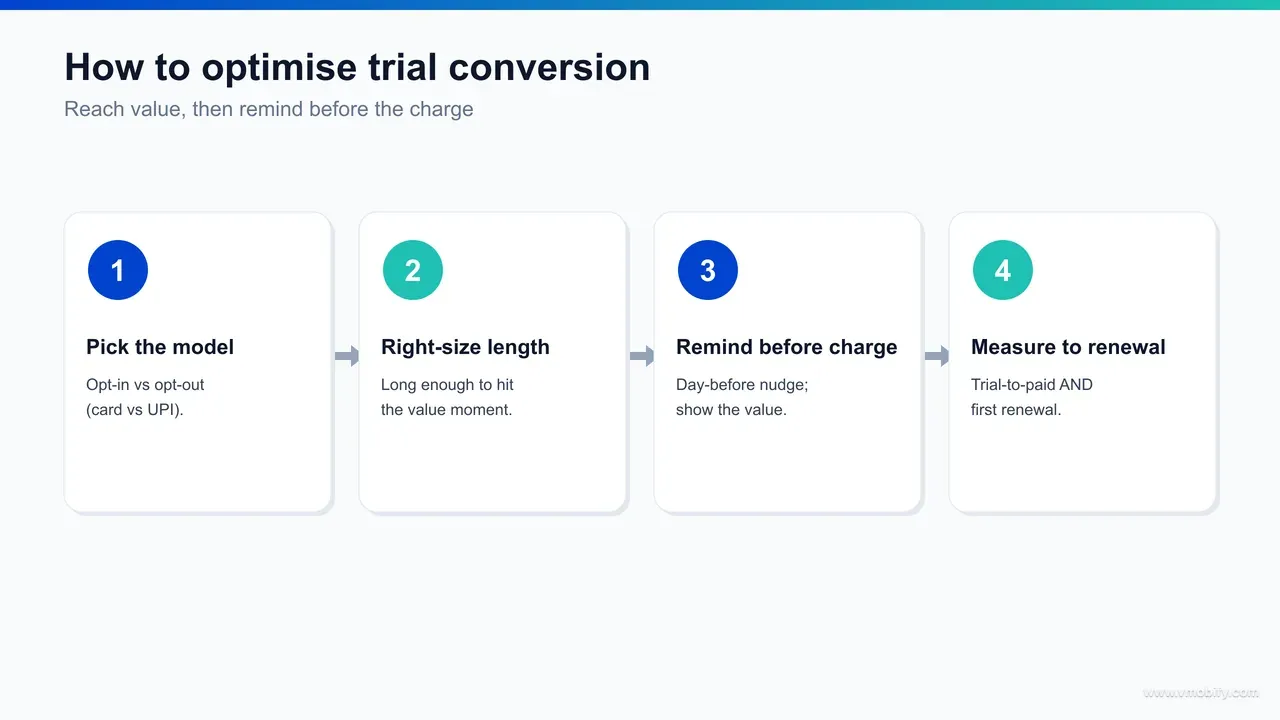
The model changes which step does the heavy lifting. In an opt-out (card-gated or UPI Autopay) trial, the pre-renewal reminder is doing the work of retaining a conversion that happens by default — clarity reduces refunds and cancellations. In an opt-in (no-card) trial, the mid-trial engagement and the end-of-trial ask are doing the work of creating a conversion that will not happen on its own. Build the sequence for the model you actually run. In our portfolio, simply adding a well-framed pre-renewal reminder and a single mid-trial value nudge is one of the cheapest, fastest conversion lifts available — it is configuration and copy, not engineering.
Which trial-conversion pitfalls cost the most?
The costliest trial-conversion mistakes are structural, not cosmetic: chasing a benchmark from the wrong model, defaulting to a card wall in a card-poor market, setting the trial shorter than the value moment, and judging conversion without LTV. Each one quietly caps conversion in a way no amount of paywall redesign can recover.
- Comparing yourself to the wrong model's benchmark. Holding a no-card opt-in trial to the 48.8% opt-out figure makes a healthy 18% look like a failure, and provokes panic changes that make things worse. Always benchmark against your own model first.
- Defaulting to a credit-card opt-out trial in India. With card penetration near 8%, the card wall blocks trial starts rather than filtering intent. Use UPI Autopay as the opt-out mechanism so you keep the inertia advantage on rails your users hold.
- Setting the trial shorter than the value moment. Very short trials convert around 25.5% versus ~42.5% for the 17–32 day band in RevenueCat's data, largely because users never reach the action that justifies paying. Instrument when value lands and set length to clear it.
- Leaving the trial window silent. No mid-trial nudge and a perfunctory pre-renewal notice means conversions you earned through onboarding leak away through neglect. The sequence is part of the product.
- Optimising conversion in isolation from LTV. A softer offer or a cheaper default can lift trial-to-paid while lowering revenue per user. Judge conversion next to lifetime value, not on its own.
- Blending datasets. Averaging Adapty's by-model numbers with RevenueCat's by-vertical numbers produces a target that exists in neither. Cite each to its source and pick one as your yardstick.
In our portfolio, the pattern that recurs most often is a strong product with a structurally mismatched trial — usually the wrong model for the market, or a trial too short to reach value — where the team has spent months redesigning the paywall skin while the real cap sits in the structure underneath. Fixing the model, the length and the payment rail typically moves conversion further in one release than a quarter of cosmetic tests.
If you want this set up and measured properly for an India-focused subscription app — the right model, UPI Autopay where it belongs, a trial length matched to your value moment, and a reminder sequence that actually converts — that is exactly the work our monetisation team runs. You can talk to us directly about your trial funnel, and read how we approach the surrounding paywall and pricing decisions in our paywall optimisation guide.
Frequently Asked Questions
What is a good free-trial conversion rate?+
It depends entirely on the model. Adapty puts freemium at about 2.6% trial-to-paid, a no-card opt-in trial at 18.2%, and a card-required opt-out trial at 48.8%. Compare your rate against your own model first — a number that is excellent for one mechanism is poor for another.
What is the difference between an opt-in and an opt-out trial?+
An opt-in trial takes no card and asks the user to actively choose to pay at the end, converting around 18.2%. An opt-out trial takes the card up front and bills automatically unless the user cancels, converting around 48.8% in Adapty's data. The card requirement is the single biggest conversion lever.
What are trial-to-paid benchmarks by vertical?+
RevenueCat's 2025 data shows median trial-to-paid of 48.7% for Travel, 43.8% for Media & Entertainment and 39.9% for Health & Fitness, with the top decile around 68.3%. These are a different dataset from Adapty's by-model figures, so do not compare the two directly.
Does a longer free trial convert better?+
Often, up to a point. RevenueCat finds 17–32 day trials convert at about 42.5% median versus roughly 25.5% for trials under four days, mainly because short trials end before users reach the value moment. The right length is the one that comfortably clears your product's value moment, not simply the longest.
Why do card-gated free trials fail in India?+
Because card penetration is only around 8%, an up-front card requirement blocks the trial start for most of the market rather than filtering for intent. UPI Autopay is the structurally equivalent opt-out mechanism — it preserves the bill-by-default inertia that makes opt-out trials convert, on rails the majority of Indians actually use.
How should I measure trial conversion?+
Measure trial-to-paid against the cohort that started the trial, segment opt-in and opt-out separately, hold one conversion window consistently, and read conversion alongside LTV. Never blend Adapty and RevenueCat figures — each comes from that vendor's own platform population on its own definitions.
What does Vmobify do on trial conversion specifically?+
We set up and measure the full trial funnel for India-focused subscription apps — choosing the right model, deploying UPI Autopay where a card wall would block starts, matching trial length to the value moment, and building the reminder sequence. See /services/monetization or contact us about your trial funnel.
Sources
- Adapty — Trial conversion rates for in-app subscriptions — Trial-to-paid by model: freemium 2.6%, opt-in (no card) 18.2%, opt-out (card required) 48.8%
- RevenueCat — State of Subscription Apps 2025 — Trial-to-paid medians by vertical (Travel 48.7%, Media 43.8%, Health & Fitness 39.9%, top decile ~68.3%) and by trial length (17–32 days ~42.5% vs <4 days ~25.5%)
- NPCI — UPI Autopay — Recurring e-mandate rails — the India-native opt-out equivalent to a card-gated trial
- Apple — Auto-renewable subscriptions and introductory offers — Store trial terms, introductory offers and required pre-renewal notification
- Google Play — Subscriptions and free trials — Play subscription and free-trial mechanics, including pre-renewal reminders
- Adapty — High-Performing Paywall Report 2026 — Trial structure as one of the highest-win-rate paywall levers
About the author
Amol Pomane — Founder, Vmobify
Amol leads Vmobify, a mobile app growth agency that has driven 30M+ downloads and ranked 54K+ keywords across 300+ apps since 2013. He writes about ASO, paid user acquisition, retention, and the operational reality of scaling mobile apps in India and global markets.