Freemium vs Free Trial vs Hard Paywall: Which Model Fits Your App?
Freemium, free trial, and hard paywall are not interchangeable defaults — they are three different bets on how your app earns. Hard paywalls convert roughly 6x freemium but reach far fewer people; soft paywalls convert better yet hard paywalls return more lifetime value. Here is how to pick the model that fits your app, with 2026 benchmarks and the India card-versus-UPI lens that changes the maths.
On this page
- Why does your monetisation model decide everything?
- What exactly are freemium, free trial, and hard paywall?
- What is the conversion-versus-reach trade-off?
- When is freemium a trap rather than a strategy?
- When does a hard paywall win outright?
- Why can the lower-converting model make more money?
- How do you choose the right model for your app?
- Are free trials the safe middle path?
- How does the India market change the maths?
- How do you test which model actually fits?
- Which pitfalls cost teams the most?
- Frequently Asked Questions
Why does your monetisation model decide everything?
Your monetisation model — freemium, free trial, or hard paywall — is the single most consequential decision in a subscription app, because it sets the ceiling on both how many people convert and how much each one is worth before you have written a line of paywall copy. Teams obsess over button colours and headline wording, but the model underneath decides the maths those tweaks operate within.
The reason this matters more than almost any later optimisation is that the three models do not just convert at different rates — they reach different numbers of people and produce different lifetime values. A model can convert beautifully and still earn less than a model that converts worse, because it earns from a smaller pool or retains for fewer renewals. Get the model wrong and no amount of paywall A/B testing recovers the gap; get it right and even a mediocre paywall makes money.
It also sets your acquisition economics. The model determines your download-to-paid rate, which determines how much you can afford to pay for an install. An app that converts 2% of downloads can pay roughly a tenth of what an app converting 10% can pay for the same user — so the model quietly decides which user-acquisition channels are even viable for you. A freemium app priced for reach can sustain cheap, broad install sources; a hard-paywall app priced for conversion needs intent-led channels that cost more per click but pay back faster. Choose the model in isolation and you will discover, too late, that it has already chosen your entire growth strategy for you.
Across our 300+ apps managed since 2013, the single most expensive monetisation mistake we see is not a bad paywall — it is the wrong model chosen by default, usually copied from whichever competitor the founder admires. This guide breaks down what the three models actually are, the two trade-offs that govern the choice (reach and lifetime value), a decision framework, and the India-specific payment realities that quietly break Western playbooks. For the paywall design layer that sits on top of the model, pair this with our deeper paywall optimisation benchmarks.
What exactly are freemium, free trial, and hard paywall?
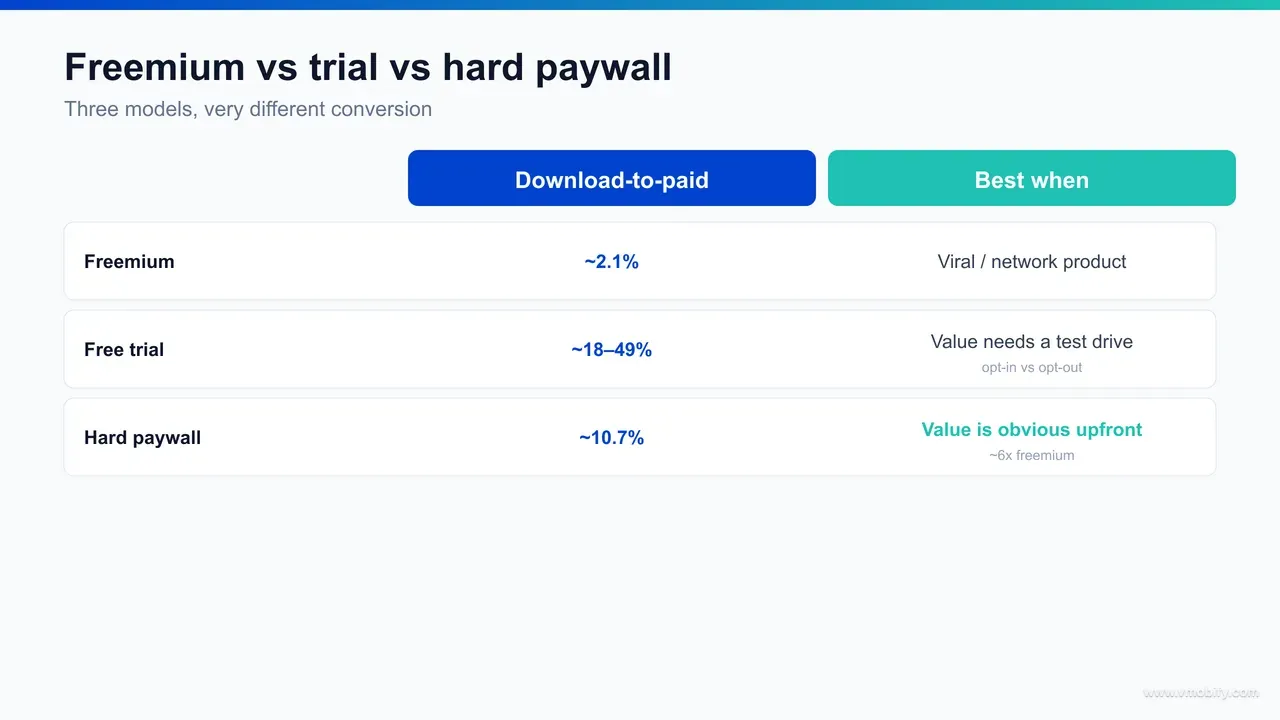
Freemium gives away the core value indefinitely and charges for extras; a free trial gives full paid access for a limited window and then charges; a hard paywall asks for payment before the user sees the value at all. They sit on a spectrum from most-open to most-closed, and each makes a different promise to the user about when they pay.
Freemium
- The app is genuinely usable for free, forever. Money comes from a minority who upgrade for advanced features, higher limits, or an ad-free experience.
- Spotify, LinkedIn, and most note-taking apps run this.
- The free tier is the marketing — it has to be good enough to retain, but not so good that nobody upgrades.
Free trial
- The user gets the full paid product for a set period — commonly 3, 7, or 14 days — and is charged when it ends unless they cancel.
- Trials split into two sub-types that behave very differently: an opt-in trial (no card required to start, the user actively chooses to pay later) and an opt-out trial (card captured upfront, billing is automatic unless cancelled).
- That distinction matters enormously, as the conversion numbers later show.
Hard paywall
- The user must subscribe or pay before using the app meaningfully. There is no free tier and no trial — value is gated behind payment from the first screen.
- Many premium utilities, fitness, and content apps run this when their value is obvious and screenshot-able in the store.
A fourth term worth defining because it gets confused with these: the soft paywall. A soft paywall is a hard-paywall screen the user can dismiss — it interrupts and asks for payment, but lets them continue using a limited app if they decline. It is structurally closer to freemium-with-a-prompt than to a true hard gate, and it converts differently from both, which is why we treat conversion and lifetime value as separate questions below.
The practical takeaway is that "should we charge?" is the wrong first question. The right one is "when, in the user's journey, does our value become undeniable — and does our model ask for money before or after that moment?" Everything that follows is an elaboration of that single timing question.
What is the conversion-versus-reach trade-off?
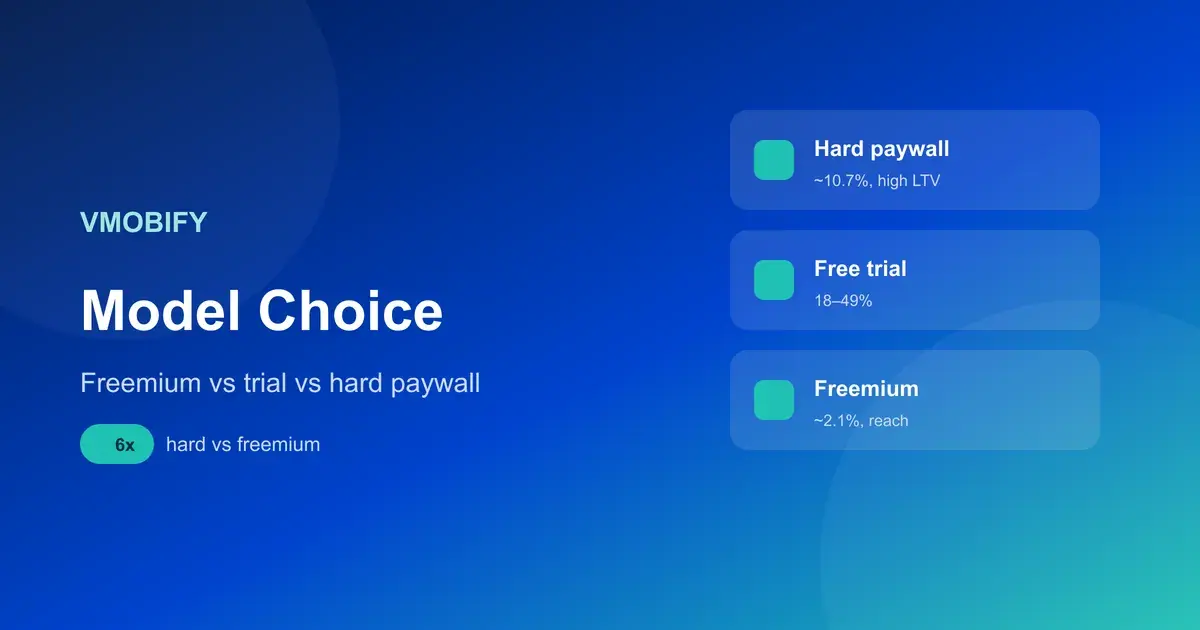
The first trade-off is brutal and unavoidable: the more access you demand upfront, the higher your conversion rate but the smaller your reach — hard paywalls convert roughly 6x better than freemium (a 10.7% median download-to-paid versus 2.1%) precisely because they only earn from people willing to commit before seeing the product. Those figures come from RevenueCat's State of Subscription Apps 2025, drawn from tens of thousands of apps, and they are the cleanest way to see the trade-off in a single comparison.
Read carelessly, "6x conversion" sounds like the hard paywall is six times better. It is not. Conversion rate is a ratio, not a revenue figure. A hard paywall converting 10.7% of a self-selected, high-intent audience can easily generate fewer paying users in absolute terms than a freemium app converting 2.1% of a vastly larger installed base — because the hard paywall scares off everyone who wanted to try before they buy, and that is most people.
The way to think about it is in two stages. Freemium maximises the top of the funnel: more installs survive the first screen because nothing is asked of them, so your reach and your organic word-of-mouth surface are larger. A hard paywall maximises the conversion of whoever survives the first screen, but the screen itself is a filter that removes most of the funnel. Your total paying users are reach multiplied by conversion — and the two move in opposite directions as you tighten access.
This is why the headline conversion number alone never settles the decision. In our portfolio, we have watched apps switch from freemium to a hard paywall, triple their conversion rate, and shrink their total revenue — because the install base that fed everything, including paid acquisition efficiency and organic ranking, collapsed when the front door was locked. Conversion is the seductive metric; reach is the one that quietly funds the business. The model that wins is the one whose product of the two is largest, and that depends entirely on your app — which the decision framework below makes concrete.
When is freemium a trap rather than a strategy?
Freemium becomes a trap when your free tier is good enough that nobody needs to upgrade, or when your value is obvious enough that giving it away simply forfeits revenue you could have collected at the door. Freemium is not a default safe choice — it is a deliberate bet that reach today converts to revenue later, and that bet fails in two common situations.
The first failure mode is the too-generous free tier. Because freemium converts only around 2-3% of users to paid, the entire model depends on a free experience that is useful enough to retain but incomplete enough to create a real reason to pay. Teams routinely overshoot the first half and undershoot the second: they build a free tier so capable that the paid tier feels like a tax on people who were already happy. You then carry the full server, support, and infrastructure cost of a huge free base while monetising a sliver of it — the worst of both worlds.
The second failure mode is giving away value that was sellable upfront. If a user can tell within thirty seconds of the store listing that your app is worth paying for — a clean utility, a premium content library, a tool that obviously saves time or money — then freemium leaves money on the table. You are training high-intent users to expect free access to something they would happily have paid for, and clawing that back later is far harder than charging from the start. This is exactly the population a hard paywall or trial captures.
Freemium also imposes a hidden organisational cost: it splits your product roadmap into "features that retain free users" and "features that justify paying", and those two roadmaps fight for the same engineering time. Apps that monetise through a trial or paywall keep a single product and a single quality bar. If you cannot clearly articulate which features live behind the wall and why a free user would eventually need them, you do not have a freemium strategy — you have a free app with an upgrade button, and those rarely clear 1% conversion. The test is uncomfortable but clarifying: write down the exact moment a happy free user hits a wall they will pay to cross. If you cannot name it, freemium is a trap for you.
When does a hard paywall win outright?
A hard paywall wins outright when your value is obvious before download, your audience is high-intent rather than casual, and your unit economics need every install to either pay or leave — situations where filtering out tyre-kickers is a feature, not a cost. The same 10.7% median conversion that looks like a filter from the reach perspective is exactly what makes a hard paywall the highest-quality-revenue model when the conditions fit.
The clearest fit is the obvious-value premium app: a focused utility, a paid content product, or a tool whose benefit a user can judge from the store screenshots alone. If someone is downloading a habit-tracker, a specialised camera app, or a meditation library because they already decided they want it, asking for payment upfront does not lose them — it just collects from the people who were always going to pay, sooner. The store listing does the convincing; the paywall does the collecting.
The second fit is high-intent acquisition. When you drive installs from search ads, branded keywords, or content where the user arrived with a specific problem to solve, the audience is pre-qualified. A hard paywall converts that intent immediately rather than diluting it across a free experience where the urgency cools. The flip side is that a hard paywall punishes broad, low-intent acquisition — if your installs come from cheap, untargeted channels, gating them upfront wastes most of the spend.
The third and most underrated fit is lifetime value, which we treat in full in the next section. A user who pays before experiencing the product is, on average, a more committed user — and that commitment shows up in renewals, not just the first transaction. For apps where retained revenue is the whole game, the hard paywall's filtered, committed cohort can be worth more per head than a larger soft-paywalled crowd.
The rule of thumb we give clients: if you can defend your price from the store listing, and your acquisition is intent-led, test a hard paywall first — you can always soften it, but it is far harder to re-train a free audience to pay.
Why can the lower-converting model make more money?
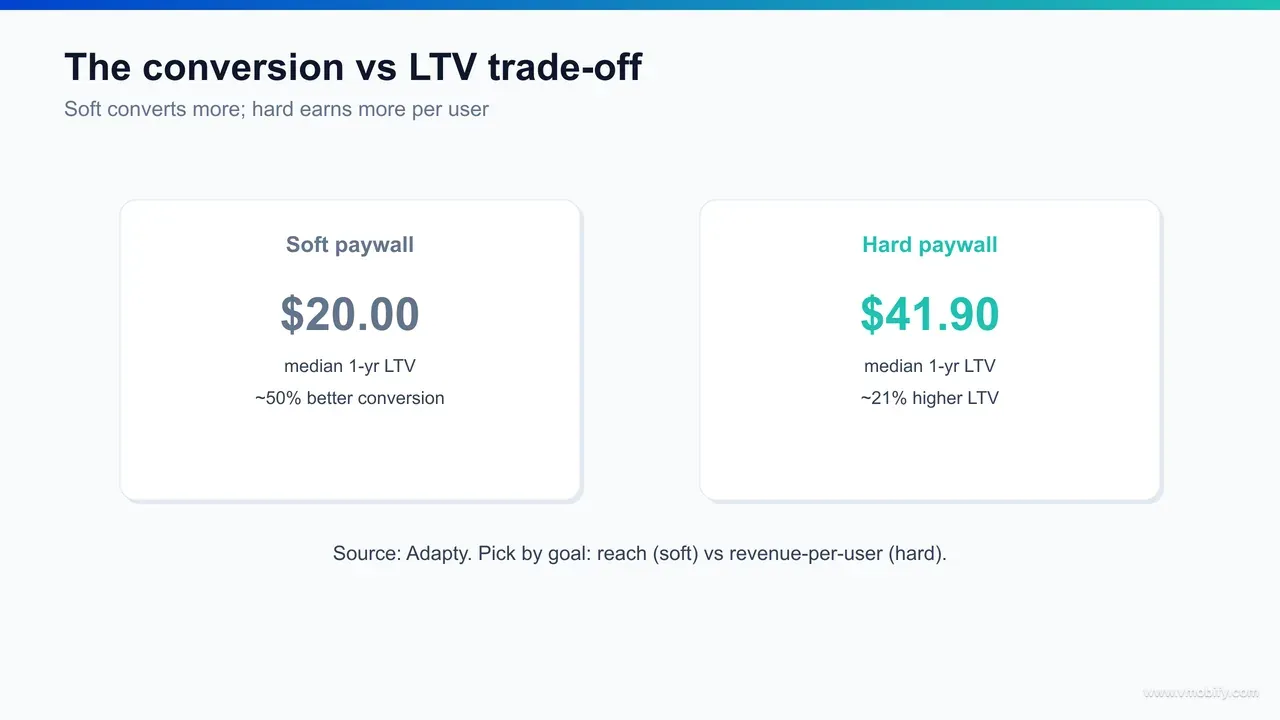
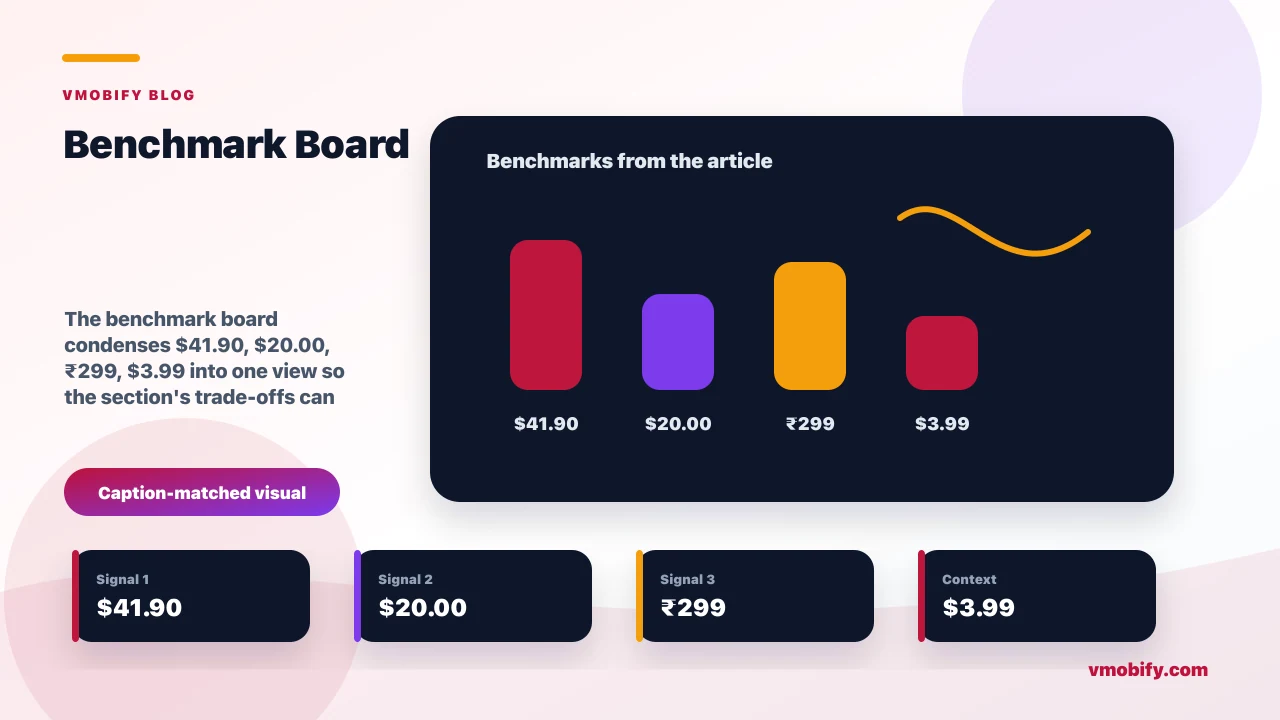
The second trade-off is the one that ends most "soft versus hard" arguments: soft paywalls convert roughly 50% better than hard ones on raw rate, yet hard paywalls return about 21% higher one-year lifetime value — a $41.90 median versus $20.00 — so the model that signs up fewer people can still out-earn the one that signs up more. Those lifetime-value figures come from Adapty's high-performing paywall analysis, and they are the single most important corrective to "just optimise for conversion".
The mechanism is selection. A hard paywall makes the user commit before they have the product in hand, so the people who clear it skew toward genuine intent and stick around longer — they renew, they churn less, and each retained renewal compounds their value. A soft paywall lets more people in by being easy to dismiss, but a chunk of those extra conversions are softer commitments that lapse after the first period. More sign-ups, lower average durability.
This is why judging a model on Day-1 conversion is actively misleading. A soft paywall or a generous trial can win the conversion screenshot and lose the year. We have seen apps celebrate a conversion uplift from softening their paywall, then watch one-year revenue per user fall because the marginal converts they added churned faster than the committed base they already had. The headline went up; the bank balance went down.
The correct way to compare models is therefore on lifetime value per install, not conversion rate — reach multiplied by conversion multiplied by retained value per payer. That single number reconciles both trade-offs at once: it rewards a model for the people it reaches, the share it converts, and how long they stay. For the benchmarks and the formula behind that calculation, see our breakdown of app ARPU and LTV benchmarks, which is the metric this whole decision should ultimately be judged on.
Do not blend datasets to make a point, either — RevenueCat's 10.7%-versus-2.1% conversion gap and Adapty's $41.90-versus-$20.00 lifetime-value gap come from different samples and measure different things; use each for what it actually shows.
How do you choose the right model for your app?
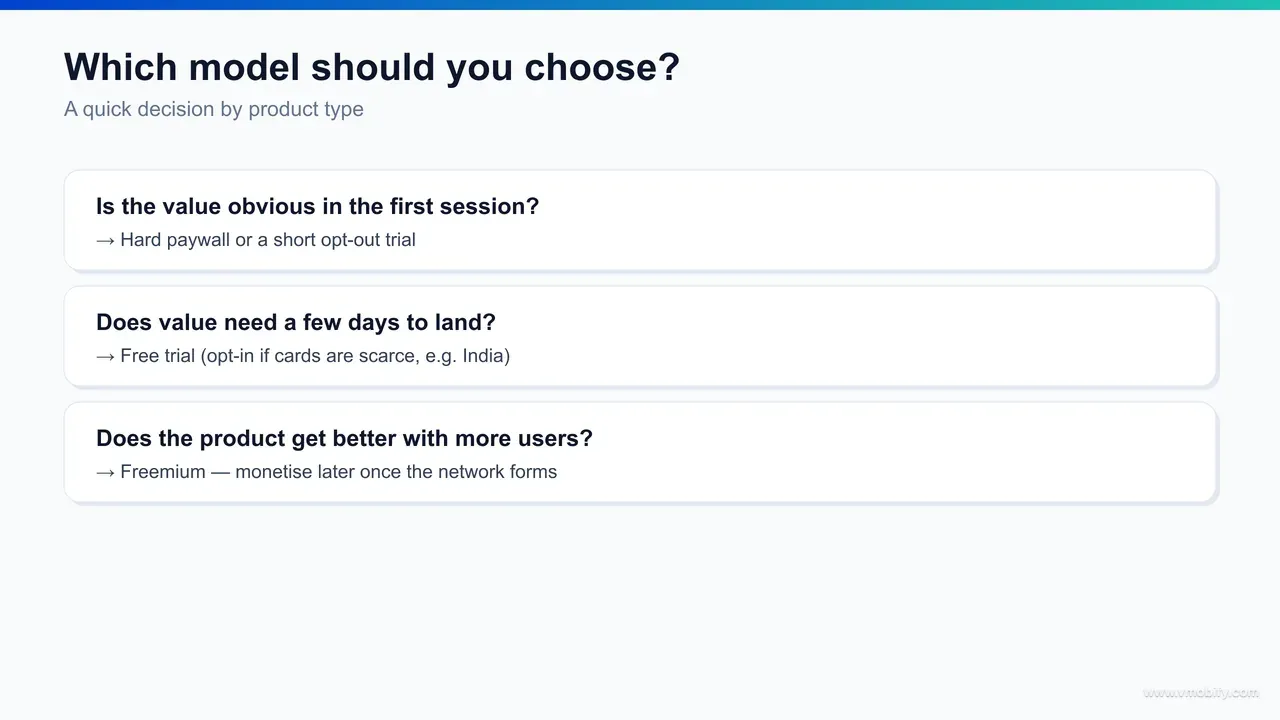
The decision turns on one question — is your value obvious in the first session, or does it need network effects, content depth, or virality to emerge — and that single answer points you at hard paywall or trial on one side, and freemium on the other. Almost every model mistake we untangle traces back to answering this question wrong, usually by copying a competitor whose value profile is different from yours.
- If value is obvious upfront, lean hard paywall or free trial. When a user can judge your worth from the store listing or the first screen — a focused tool, a premium library, an intent-led utility — collect at or near the door. A hard paywall if your price is defensible from the listing; an opt-out trial if users need to feel the value for a few days before committing.
- If value emerges over time or with scale, lean freemium. When your app gets better as more people join (social, marketplaces, communities), as the user invests data into it (productivity, finance trackers), or as a content library is explored, you need the free reach first. The model has to let people in long enough for the value to compound, then monetise the engaged minority who hit a real wall.
- If your acquisition is high-intent, weight toward paywalls; if it is broad, weight toward freemium. Search ads and branded traffic pre-qualify users a paywall can convert immediately; cheap, untargeted installs need a free experience to warm up before any ask.
- If retained revenue is the whole game, weight toward the model with higher lifetime value per install — which, per the section above, often favours the more-closed model even when it converts less.
A worked example: a personal-finance app where the value is "see all your accounts in one place" is not obvious until the user has connected accounts and lived with it for a week — that is a freemium or generous-trial product. A specialised video editor whose output a user can see in the store screenshots is an obvious-value product — that is a hard-paywall or short-trial candidate. Same category sometimes, opposite models, because the timing of value differs. Resist the urge to default; answer the value-timing question honestly, and the model chooses itself.
Are free trials the safe middle path?
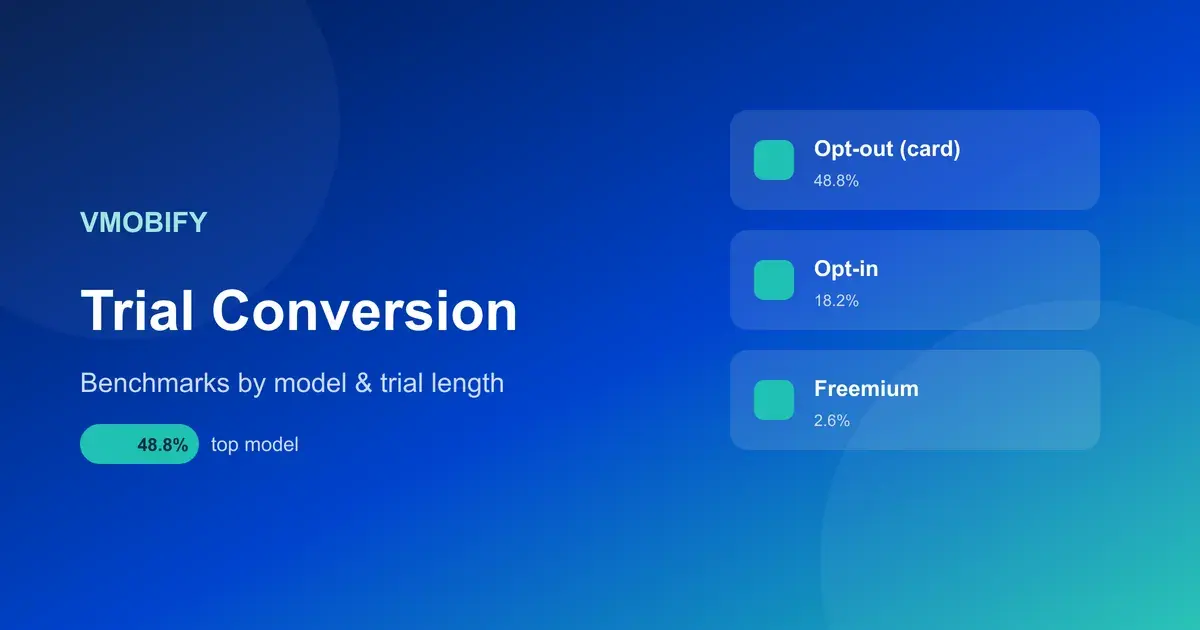
Free trials are the most popular compromise because they capture the conversion lift of letting users feel the value while keeping a paywall's commitment ask — and the data is striking: freemium converts about 2.6%, an opt-in trial 18.2%, and an opt-out trial 48.8%, per Adapty. But "safe" is the wrong word, because the gap between the two trial types hides the entire catch.
The headline 48.8% opt-out figure is real, and it is why opt-out trials dominate Western subscription apps. The mechanism is friction asymmetry: the card is already captured, billing is automatic, and cancelling requires the user to act — so inertia converts a large share of triallists into payers whether or not they consciously decided to. It is the single most powerful conversion structure in the subscription playbook.
It is also the structure with the most strings attached. An opt-out trial demands a stored, chargeable payment method at the moment of sign-up — which is precisely where the model collides with markets that are not card-first. It can also generate refund requests and chargebacks from users who forgot they signed up, and both Apple and Google Play have tightened the disclosure and cancellation rules around auto-renewing trials, so the inertia advantage comes with a compliance and trust cost you have to manage honestly. An opt-in trial (no card upfront) sidesteps the friction and the resentment but gives up much of the conversion lift — 18.2% is excellent next to freemium, but it is less than half the opt-out rate.
So trials are not a single, safe answer — they are a spectrum from low-friction-lower-conversion to high-friction-higher-conversion, and where you should sit depends on your audience's payment behaviour and how much cancellation friction your brand can carry without eroding trust. For the mechanics of trial length, conversion timing, and how to design the cancellation flow without burning goodwill, our guide to free trial conversion rates goes deeper than we can here. The headline for the model decision: a trial is the right middle path only if your users can and will store a payment method — and in India, that "if" is doing a lot of work.
How does the India market change the maths?
India breaks the standard opt-out-trial playbook because the model assumes a stored card, and India is a UPI-first market where card-on-file penetration is low — so the 48.8% opt-out conversion benchmark does not transfer, and freemium, opt-in trials, and UPI-native payment paths often fit better. This is the single most common monetisation mistake we see Indian apps import wholesale from Western templates.
The structural reason is payment behaviour. UPI processes the overwhelming majority of India's digital retail transactions — over 18 billion transactions a month, per NPCI's UPI product statistics — but UPI is built around active, per-transaction authorisation, not the silent recurring card charge that an opt-out trial relies on. The user expects to approve each payment, which is the opposite of the inertia that makes opt-out trials convert. Recurring UPI exists through UPI Autopay e-mandates, but it carries per-mandate caps, an explicit approval step, and far less ubiquity than a stored card in a Western app store account — so the frictionless auto-renew the benchmark assumes simply is not there for most Indian users.
That has three practical consequences for the model choice. First, opt-out card trials underperform in India relative to the global number, because a smaller share of users have a chargeable card on file to even start one. Second, freemium and opt-in trials travel better, because they do not gate sign-up on a stored payment method — they let the large, price-sensitive Indian base in and monetise intent later. Third, one-time and short-duration payments via UPI often outperform forced recurring subscriptions, because they match how Indian users already pay for everything else.
Across the India-first apps in our portfolio, the pattern repeats: the team that copied an opt-out card trial from a US competitor saw a fraction of the benchmark conversion, while the team that offered a UPI-friendly one-time unlock or a UPI Autopay subscription alongside an opt-in trial captured far more of the same audience. Currency framing matters too — a ₹299 monthly ask reads very differently from a $3.99 one even at the same exchange rate, and pricing in round UPI-friendly amounts converts better than literal conversions of dollar prices. The lesson is not that subscriptions fail in India; it is that the payment rail dictates the model, and the model that ignores UPI leaves most of the market unserved.
How do you test which model actually fits?
You test the model the way you test a paywall — by running it as a real experiment against lifetime value per install, not conversion rate, over at least one renewal window — but model tests are heavier than paywall tests, so you size them carefully and change one structural variable at a time. The goal is a decision you can defend, not a screenshot of a conversion uplift.
- Pick lifetime value per install as the primary metric, not Day-1 conversion. Because the whole point of this decision is that the higher-converting model can earn less, judging on conversion alone guarantees the wrong call. Instrument reach, conversion, and retained value as three separate numbers and multiply them.
- Change one structural variable per test. Freemium versus trial, opt-in versus opt-out, hard versus soft — test these one at a time. If you change the model and the price and the trial length at once, you learn nothing about which lever moved the number.
- Run it for a full renewal cycle. A model's true value shows up at the first renewal, where the committed and the casual separate. A monthly subscription needs at least 30-60 days of observation before you trust the result; killing a test on Day 1 conversion is how teams pick the model that loses the year.
- Segment by acquisition source and, in India, by payment method. High-intent search traffic and broad social traffic will prefer different models, and card-holders and UPI-only users will behave differently. An aggregate result can hide two opposite truths.
One caution: model tests are not infinitely runnable. You cannot show three radically different front doors to the same cohort without confusing your brand and your store conversion, so sequence them or split cleanly by new-install cohorts. In our portfolio, the teams that get this right treat the model as a decision they revisit once or twice a year with a proper experiment, then optimise the paywall continuously within the chosen model — exactly the structural-versus-cosmetic split we lay out across our monetisation work and the broader app subscription monetisation strategy guide.
Which pitfalls cost teams the most?
The costliest model mistakes are choosing by imitation instead of value-timing, optimising conversion while ignoring lifetime value, copying opt-out trials into UPI-first India, and treating the model as permanent rather than testable. Each one is avoidable, and each one quietly caps revenue long before any paywall tweak could rescue it.
- Copying a competitor's model: the most common and most expensive error. Your admired competitor may have a different value-timing profile, a different audience, or a different payment market. Their model is evidence, not instruction — answer the value-timing question for your own app.
- Optimising conversion instead of LTV: chasing the conversion screenshot leads teams to soften paywalls and over-generous trials that add low-durability converts and lower one-year revenue per user. Always judge a model change on retained value, not the sign-up rate.
- Importing opt-out card trials into India: the 48.8% benchmark assumes a stored card and silent renewal that most Indian users do not have. Forcing it leaves the large UPI-first audience unmonetised — test UPI Autopay, opt-in trials, and one-time unlocks instead.
- Too-generous freemium: a free tier so complete that the paid tier feels like a tax. If you cannot name the exact wall a happy free user will pay to cross, you have a free app, not a freemium strategy.
- Treating the model as permanent: the model is a testable decision, not a founding constant. Markets, audiences, and payment rails change; revisit the model on a real experiment once or twice a year rather than carrying a default chosen on day one forever.
The thread running through all five is the same: the model is a strategic bet about when your value becomes undeniable and how your audience pays, and it deserves to be chosen and tested with that seriousness — not inherited from a template. Get the bet right and ordinary paywall execution makes money; get it wrong and brilliant execution cannot save it. If you want help running the model-versus-LTV experiment properly for an India-first app — including the UPI and pricing realities most Western playbooks ignore — that is the core of what our growth team does, and you can talk to us directly about your specific app.
Frequently Asked Questions
Is freemium or a free trial better for a new app?+
It depends on when your value becomes obvious. If a user can judge your worth in the first session or from the store listing, a free trial converts far better — an opt-out trial reaches about 48.8% versus roughly 2.6% for freemium, per Adapty. If your value needs scale, content depth, or network effects to emerge, freemium wins the reach you need first.
How much better does a hard paywall convert than freemium?+
Roughly 6x on download-to-paid: a hard paywall converts at a 10.7% median versus 2.1% for freemium, per RevenueCat 2025. But that higher rate comes from a much smaller, self-selected audience, so it does not automatically mean more total revenue.
Why do hard paywalls make more money if soft paywalls convert better?+
Because lifetime value diverges from conversion rate. Soft paywalls convert about 50% better, but hard paywalls return roughly 21% higher one-year LTV ($41.90 versus $20.00 median, per Adapty), because users who commit before seeing the product retain and renew better. Judge models on LTV per install, not conversion rate.
What is the difference between an opt-in and an opt-out free trial?+
An opt-in trial requires no card to start and the user must actively choose to pay later; an opt-out trial captures the card upfront and bills automatically unless cancelled. Opt-out converts far higher (about 48.8% versus 18.2%) because of inertia, but it demands a stored payment method, which limits it in non-card markets.
Do free trials work in India given UPI is dominant?+
Opt-out card trials underperform in India because card-on-file penetration is low and UPI is built around active per-transaction approval, not silent recurring charges. Opt-in trials, freemium, UPI Autopay subscriptions, and one-time UPI unlocks usually fit the market better than imported opt-out card playbooks.
How do I decide which monetisation model to use?+
Answer one question: is your value obvious in the first session, or does it need network effects, content, or virality to emerge? Obvious-value, high-intent apps lean hard paywall or trial; apps whose value compounds over time or with scale lean freemium. Then test the choice against lifetime value per install.
What is the single biggest monetisation model mistake teams make?+
Copying a competitor’s model instead of answering the value-timing question for their own app, then optimising conversion rate while ignoring lifetime value. The wrong model caps revenue in a way no paywall A/B test can recover, so the model deserves to be chosen and tested deliberately.
Sources
- RevenueCat — State of Subscription Apps 2025 — Hard paywall 10.7% vs freemium 2.1% median download-to-paid conversion
- Adapty — High-Performing Paywalls 2026 — Soft vs hard conversion, hard-paywall LTV $41.90 vs $20.00, and trial conversion rates
- Apple — Offering auto-renewable subscriptions and free trials — Trial, introductory pricing and auto-renew disclosure rules on the App Store
- Google Play — Free trials and introductory offers — Trial and subscription billing policy for Google Play
- NPCI — UPI product statistics — UPI transaction volume evidencing India’s UPI-first payment behaviour
- RevenueCat — Paywalls and conversion best practices — Background on paywall structure and subscription benchmarks
- AppsFlyer — App marketing and subscription benchmarks — CPI and acquisition economics context for download-to-paid maths
About the author
Amol Pomane — Founder, Vmobify
Amol leads Vmobify, a mobile app growth agency that has driven 30M+ downloads and ranked 54K+ keywords across 300+ apps since 2013. He writes about ASO, paid user acquisition, retention, and the operational reality of scaling mobile apps in India and global markets.