App Support Operations and Review Mining: Founder Playbook
Reviews are public product evidence; support tickets contain deeper diagnostic context. This playbook unifies both into a privacy-aware operating loop for incident detection, helpful replies, theme analysis, roadmap evidence and release verification.

On this page
- Why combine app support and review mining?
- What intake schema should app support use?
- How should you triage app support cases?
- How should you reply to App Store and Play reviews?
- How do you build a useful review taxonomy?
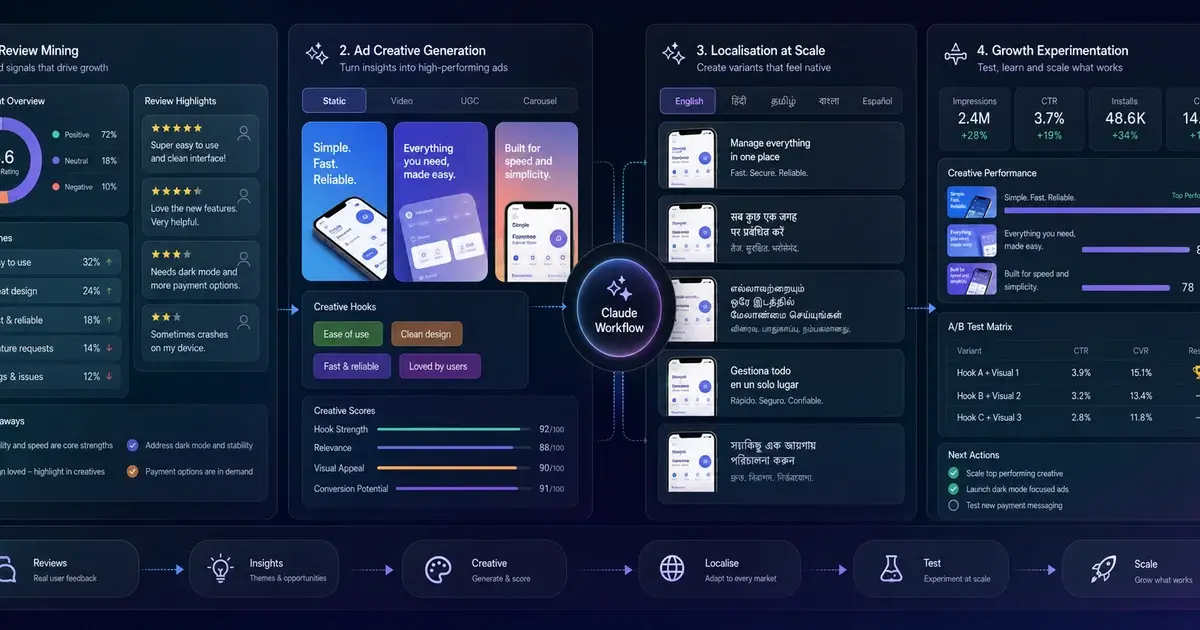
- How can AI help mine reviews safely?
- How do you measure review and support themes?
- How do support insights enter the product roadmap?
- How do you use feedback to verify a release?
- What weekly app support operating rhythm works?
- Frequently Asked Questions
Why combine app support and review mining?
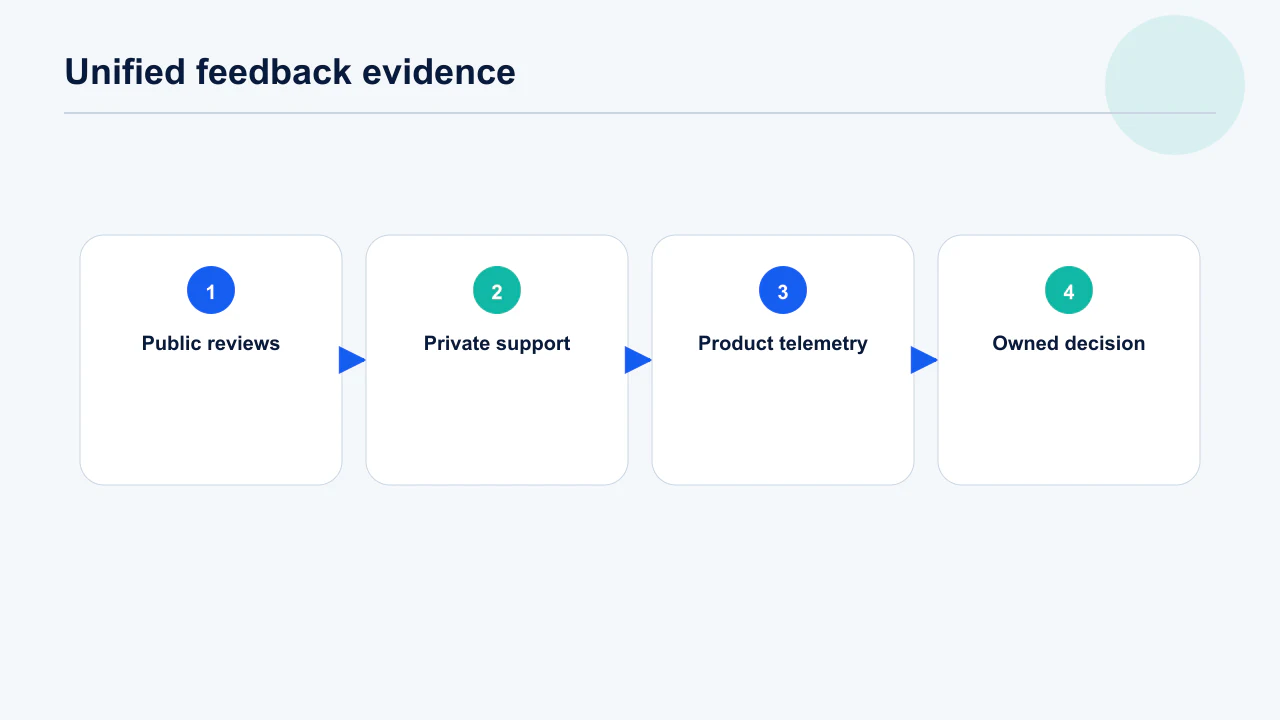
Combine them because reviews provide public, versioned market signals while support cases provide private context needed to diagnose and resolve them. Neither channel represents all users, so the goal is operational evidence rather than a popularity poll.
Reviews over-represent strong sentiment and vary by territory; tickets over-represent users who found and trusted the support route. Join themes, platform, version and journey without joining unnecessary identity. Product analytics supplies the denominator and behaviour.
- Reviews: Reveal public trust, store conversion risk and recurring language. They contain limited diagnostic context.
- Tickets: Provide steps, account state and a conversation. Protect personal details.
- Telemetry: Shows reach, failure rate and version concentration. It cannot explain intent alone.
- Decisions: Unify evidence under a named owner and outcome. Do not build parallel backlogs.
Decision rule: No source alone decides priority; combine harm, reach, trend, confidence and strategic importance.
We often see a review theme before a dashboard alert because users describe the outcome, not the exception. Support then supplies reproduction evidence and telemetry sizes the cohort.
The two channels are biased in opposite directions, which is precisely why they are useful together. Reviews over-represent extremes — delight and fury — and under-represent the quiet majority who simply stop opening the app. Tickets over-represent users motivated enough to find a contact form, which skews toward paying and long-tenured accounts. Telemetry sees everyone but cannot say why. Reading any one alone produces a distorted roadmap; reading all three against the same taxonomy is what turns anecdote into evidence. App Store Connect's review tools are the collection point for one of the three, not the whole picture.
Route all three into one taxonomy from day one — retrofitting categories onto historical data is rarely worth the effort. Ratings and reviews respond to how well this loop runs.
What intake schema should app support use?
Capture source, platform, app version, journey, issue type, severity, status, resolution and privacy-safe evidence in every case. The schema must be fast enough for agents to use and stable enough for trend analysis.
Auto-populate technical context from safe app diagnostics when the user consents, and never ask users to paste passwords, full payment credentials or secrets. Keep free text for nuance but drive reporting from controlled fields. Review the taxonomy monthly for overused “other” categories.
- Technical: OS, app version, device family, network and relevant correlation ID. Avoid invasive fingerprinting.
- Product: Journey, feature, expected outcome and actual outcome. Use user language.
- Operations: Severity, owner, status, first response and resolution timestamps. Separate solved from closed.
- Evidence: Reproduction steps, safe screenshots and linked incident or bug. Redact before sharing.
Decision rule: A case is triage-ready when another operator can understand impact and next action without asking the user to repeat everything.
Version should be automatic whenever possible. “It broke after the update” becomes useful only when the team can identify which update and affected path.
Capture the technical context automatically rather than asking the user for it, because the fields you need are the ones they cannot supply accurately. App version, OS version, device model, locale, account state and a recent session identifier should attach themselves when a ticket is created from inside the app. A support queue where every second reply is a request for the app version has doubled its own handling time and lost the users who could not be bothered to answer. Keep the free-text field short and the automatic payload complete. Apple's ratings and reviews documentation explains what metadata store reviews carry, which is far less.
Attach the same fields to in-app feedback prompts. A consistent event plan makes the session reference meaningful.
How should you triage app support cases?
Triage by harm and urgency first, then user reach, reproducibility and commercial impact. Star rating and emotional tone should not determine incident severity.
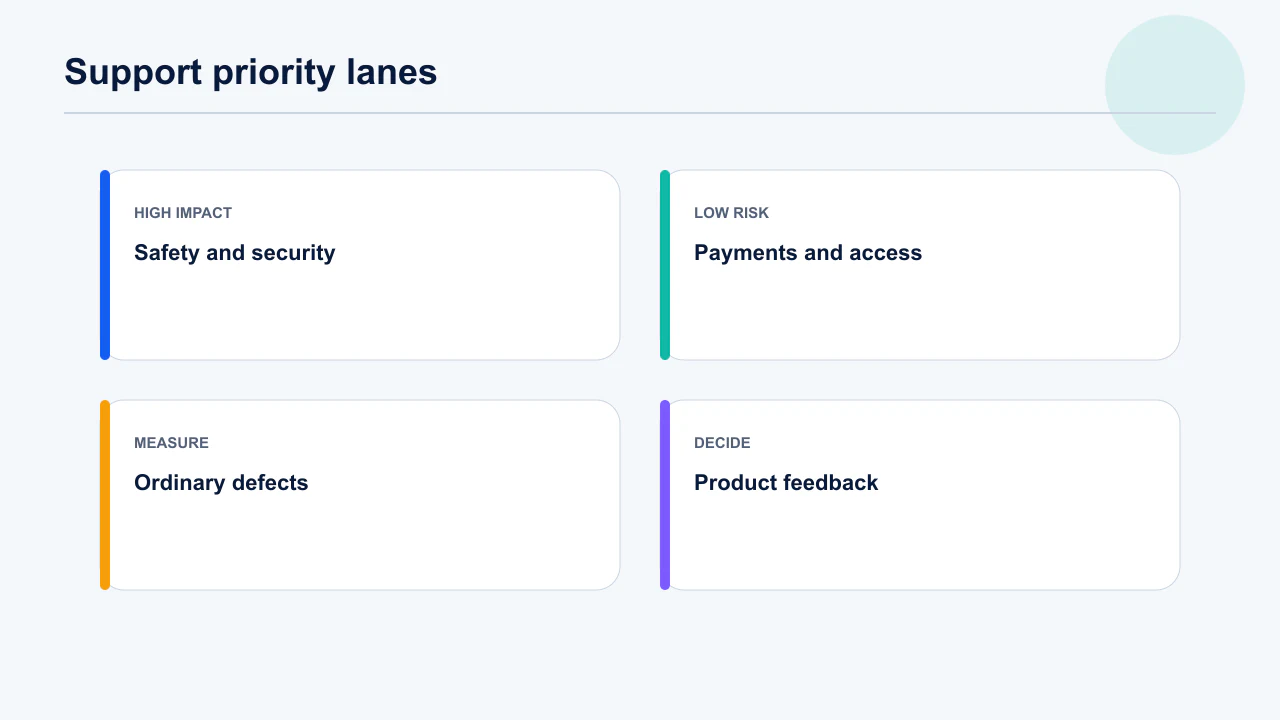
Create explicit emergency, high, normal and feedback lanes. Security, credible safety harm, lost data, widespread login failure and incorrect charges need specialist escalation. Tag potential incidents before root cause is known and merge duplicates without losing individual users who need updates.
- Emergency: Safety, security, privacy exposure, destructive data loss or systemic payment harm. Page the accountable owner.
- High: Blocked access, repeat purchase failure or severe regression with material reach. Set short response and update windows.
- Normal: How-to questions, isolated defects and account-specific troubleshooting. Use owned queues.
- Feedback: Requests, confusion and sentiment that require analysis rather than immediate repair. Close the loop visibly.
Decision rule: Severity is the plausible consequence if the report is true; confidence affects investigation, not whether severe harm is escalated.
A calm message saying “my private file appeared in another account” outranks a furious complaint about icon colour. Triage systems must resist tone bias.
Triage on user impact rather than on the tone of the message, because the angriest ticket is rarely the most severe one. A calm report of a failed payment outranks a furious complaint about a colour change, and a single message describing data loss outranks fifty about a confusing label. Define the tiers with examples and put a named response time against each, then measure breaches rather than averages — an average handling time of four hours can conceal a payment failure that waited two days. Play's user support requirements set the baseline contact expectations you must meet regardless of tier.
Review tier definitions quarterly against what actually turned out to be severe. Silent technical failures rarely generate proportionate contact volume.
How should you reply to App Store and Play reviews?
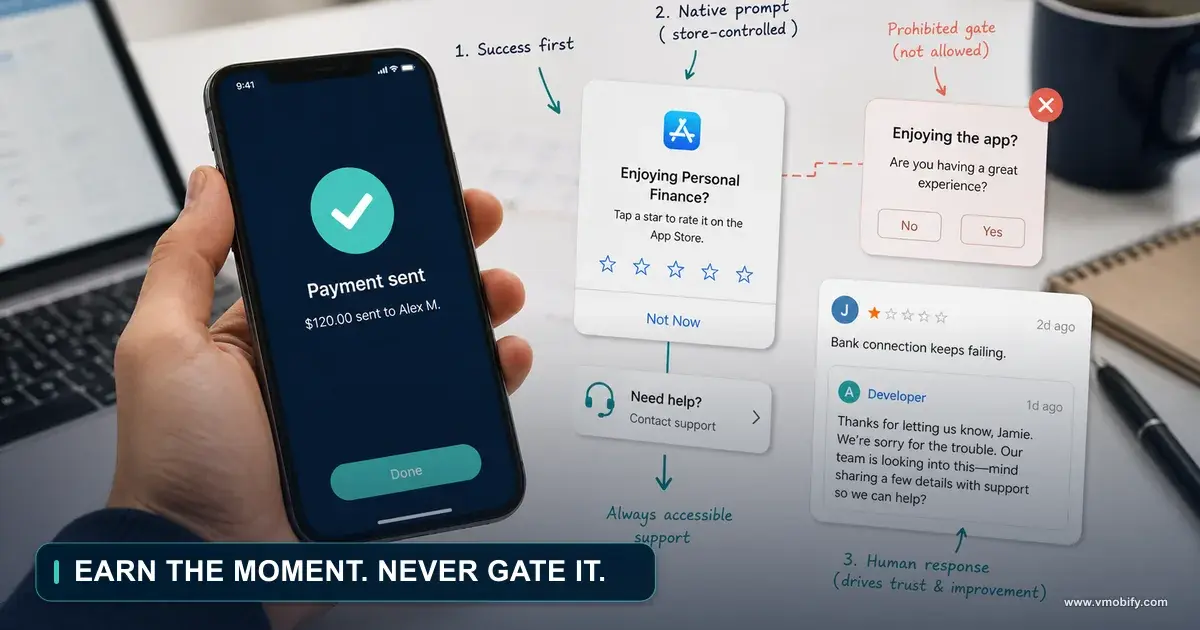
Acknowledge the described experience, give one accurate next step and move account-specific troubleshooting to a secure support channel. Apple’s review-response help says one response appears publicly, may take up to 24 hours to appear and can be edited or deleted.
Write for both the reviewer and future readers. Do not disclose account facts, argue, offer incentives or promise a rating change. Name a fixed app version only when it is actually available to that user’s territory and platform. Report spam or offensive content through store controls rather than escalating publicly.
- Acknowledge: Reflect the concrete issue without admitting unsupported facts. Avoid canned enthusiasm.
- Action: Offer a safe troubleshooting step or support route with reference. Never request secrets publicly.
- Status: State investigation or fixed version only when verified. Do not invent timelines.
- Close: Invite the user to update their experience after resolution without asking for stars. Respect their choice.
Decision rule: Every public response should remain appropriate if quoted alone by a regulator, journalist or future customer.
“Email us” alone transfers effort to an already frustrated user. A stronger reply names the issue, offers one immediate step and gives a case route that will recognise the context.
Reply publicly because the audience is future readers, not the reviewer. Most people who read your response are deciding whether to install, and a specific reply naming the fixed version does more for conversion than a generic apology repeated fifty times. Update the reply when the fix actually ships — both stores allow editing, and a review thread showing a problem raised and then resolved is stronger social proof than a review with no complaint at all. Never dispute the user's experience in public. Play's review reply guidance also covers what may not be requested in a response, including asking for a rating change.
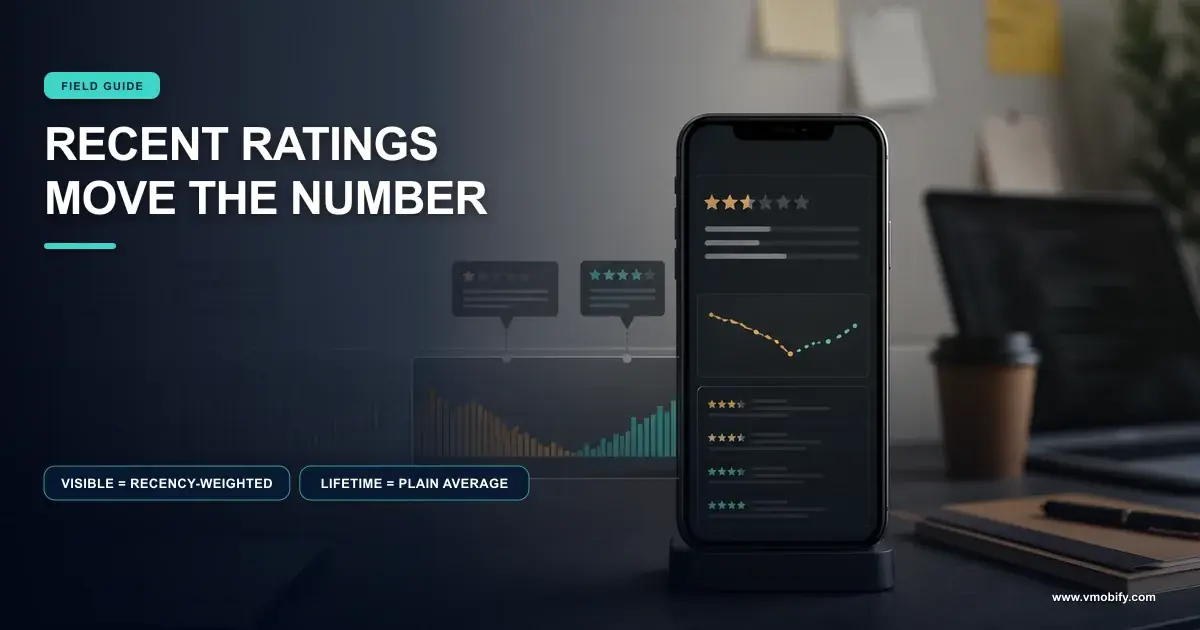
Track which replies precede a rating revision. Star averages move slowly, so early replies compound.
How do you build a useful review taxonomy?
Tag the user outcome, journey, cause confidence, sentiment, version and requested improvement separately. A single label such as “login negative” mixes symptom, area and emotion and cannot guide a fix.
Begin with ten to twenty product-language themes derived from real text, not a vendor’s generic categories. Allow multiple tags because one review can mention pricing, a crash and support. Preserve raw review text under store terms and internal privacy controls, while reports use aggregated themes.
- Outcome: Could not access, lost work, charged unexpectedly, confused or delighted. Prioritise consequence.
- Journey: Install, onboarding, login, core task, payment, renewal, notification or support. Match product ownership.
- Cause confidence: User-stated, reproduced, correlated or confirmed root cause. Do not convert guesses into facts.
- Request: Fix, explanation, feature, pricing change or policy objection. Separate ask from diagnosis.
Decision rule: A taxonomy is useful when the top theme names a decision a product owner can investigate.
“Negative sentiment” produces a chart. “Android 14 login loop after version 6.2” produces an incident hypothesis. Specificity is the difference between reporting and action.
Design the taxonomy so each label implies an owner, or it becomes a filing system nobody acts on. A category like 'app is slow' tells you nothing; 'launch time, Android, low-RAM devices' has an owner and a fix. Keep the top level short enough to apply consistently — eight to twelve categories is usually the limit for reliable human tagging — and record cause confidence separately from category, so a suspected root cause is never mistaken for a confirmed one in a later summary. The App Store Connect API lets you pull reviews programmatically so tagging happens in your own system rather than by hand in a console.
Re-tag a sample monthly to check agreement between taggers. Uninstall spikes should map onto a category, not sit unexplained.
How can AI help mine reviews safely?
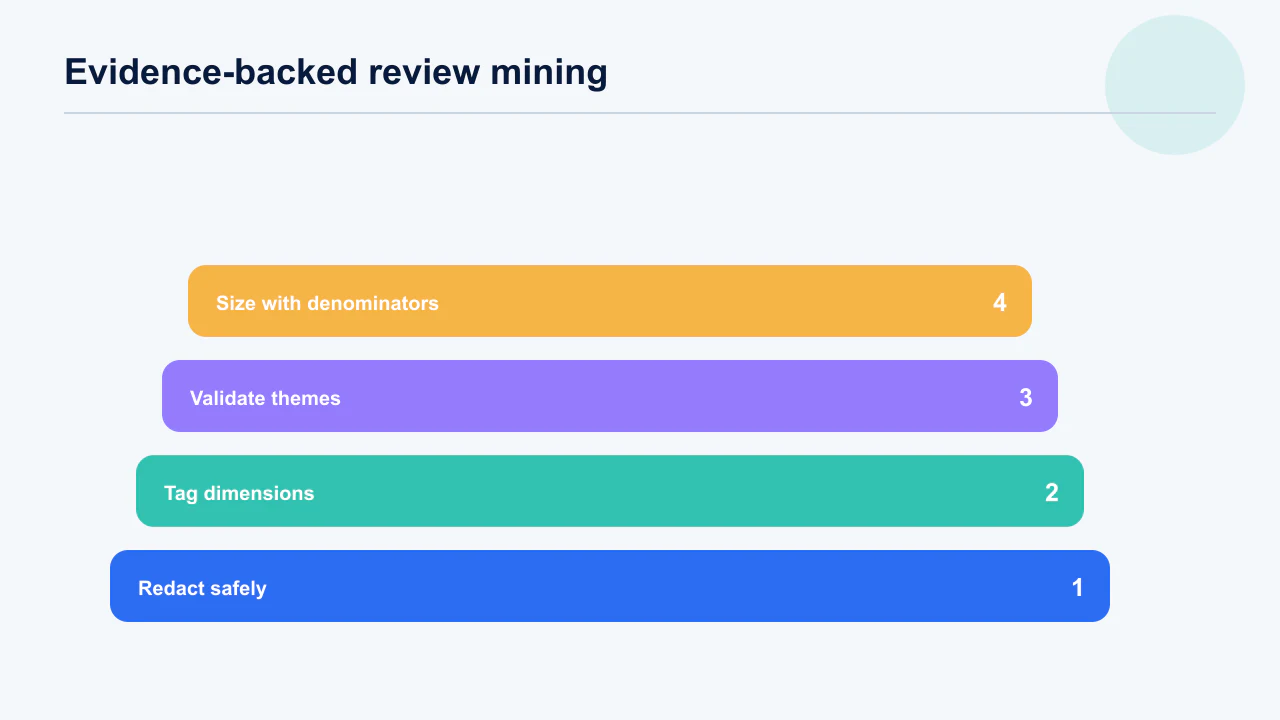
Use AI to suggest themes, summarise de-identified batches and retrieve representative examples, with human validation before product or enforcement decisions. Do not send private tickets, account identifiers or sensitive attachments to an unapproved model.
Define purpose, approved data boundary, retention and access before automation. Test the system across languages, short reviews, sarcasm and mixed themes. Store model version and prompt with generated classifications so changes can be audited. Sample both high- and low-confidence outputs.
- Minimise: Remove names, emails, transaction details and unnecessary free text. Public reviews can still contain personal data.
- Constrain: Use a fixed taxonomy and allow unknown rather than forcing a label. Confidence is not truth.
- Validate: Compare against trained human labels and inspect error by language and theme. Track drift.
- Use appropriately: Generate hypotheses and queue summaries, not unsupported customer facts. Humans own consequential action.
Decision rule: If a model output cannot be traced to source evidence and reviewed safely, it should not enter the roadmap as fact.
We ask the model for theme, evidence phrase and uncertainty, then audit the evidence phrase. Requiring grounding sharply reduces polished but unsupported summaries.
Constrain the model to summarising and clustering, and keep it away from the decision. Classification into your existing taxonomy, deduplication of near-identical reports and drafting a reply are all appropriate; deciding severity or asserting a root cause is not, because the model has no access to the telemetry that would confirm it. Strip personal data before sending anything to a third-party service, and validate on a labelled sample before trusting the output — measure agreement against human tagging rather than assuming it. The Play reply API can automate delivery, but a generated reply published without review is how a wrong or tone-deaf response reaches a public store listing.
Keep a human in the loop for anything published under your developer name. Review mining with AI assistance covers a workable division of labour.
How do you measure review and support themes?
Measure theme rate against relevant exposure, trend it by version and source, and keep raw counts visible. A hundred login tickets can be improvement if the app grew tenfold; ten can be severe if only fifty users reached login.
Choose denominators such as new installs, successful logins, purchase attempts or active subscribers. Compare like-for-like time windows and annotate releases, outages and campaigns. Use control charts or credible intervals at low counts rather than reacting to every weekly fluctuation.
- Count: Unique affected users, reviews or cases after principled deduplication. Retain original volume.
- Rate: Divide by users or attempts exposed to the journey. Do not use total MAU by habit.
- Trend: Compare versions and rolling baseline with uncertainty. Mark operational events.
- Severity: Weight safety and financial harm separately from frequency. Rare can still be urgent.
Decision rule: A theme becomes roadmap evidence when its definition, denominator, trend and user consequence are all stated.
“Billing complaints doubled” is ambiguous. “Duplicate-charge contacts rose from 2 of 18,400 attempts to 19 of 17,900 after version 4.1” is actionable.
Normalise before you compare, because raw counts track install growth rather than product quality. Express each theme as a rate per thousand active users or per thousand sessions on the affected surface, and the picture usually changes: a category that doubled in absolute volume while the user base tripled is improving. Weight by severity as well as reach, since ten reports of a failed payment matter more than two hundred about a preference that will not persist. Watch the trend against release annotations rather than reading any single week. NIST's privacy framework is a sensible reference for how long to retain the underlying text once themes are extracted.
Publish the same normalised view to the whole team. Funnel analytics tell you how many users the theme could plausibly affect.
How do support insights enter the product roadmap?
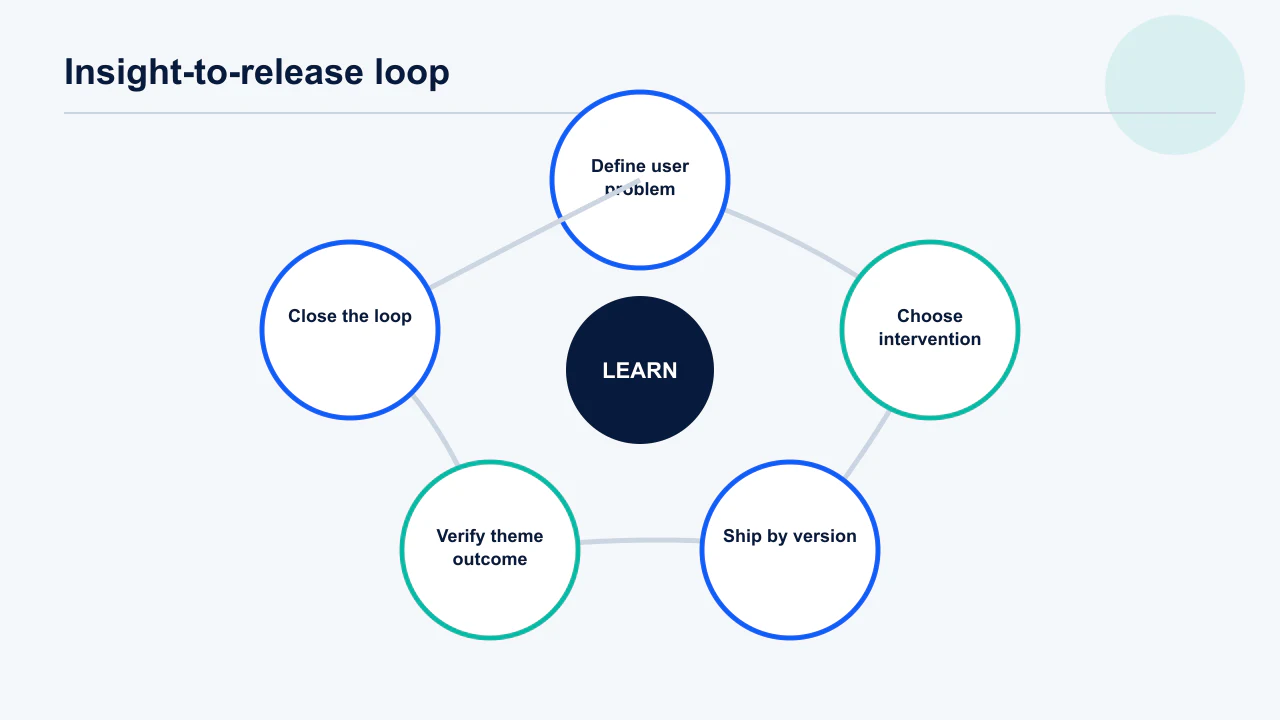
Convert a theme into a problem brief with evidence, affected cohort, consequence, owner, options and a measurable post-release result. Do not copy the loudest customer’s proposed feature directly into the backlog.
Separate the underlying job from the suggested solution. Combine theme data with behaviour, commercial strategy, engineering risk and accessibility. Prioritise the problem, then discover the smallest intervention. Tell support what was decided so agents can close conversations honestly.
- Problem: State what users cannot accomplish and under which conditions. Use evidence, not a feature title.
- Reach and harm: Quantify exposed users, severity, trend and strategic segment. Show uncertainty.
- Options: Include copy, education, product, reliability and policy responses. Building is not always the answer.
- Validation: Name the metric and version that will show improvement. Schedule a readout.
Decision rule: No support-derived item enters delivery without an owner and a falsifiable expected user outcome.
Requests for “a resend button” may reveal delayed email, unclear state or address typos. Solving the mechanism can remove the request without adding another control.
Bring a problem statement with reach, harm and evidence rather than a feature request, because the roadmap conversation goes badly when support arrives asking for a specific solution. State how many users are affected, what it costs them, how confident you are in the cause and what would falsify it. Options and trade-offs belong to product and engineering. The most common failure is the opposite: a single vocal customer's request becomes a roadmap item because it was repeated loudly, while a larger silent problem with no advocate never reaches the discussion. NIST's AI risk framework is worth consulting if model-generated clustering is informing prioritisation.
Keep rejected items with their reasoning. Validation discipline applies to support-sourced ideas too.
How do you use feedback to verify a release?
Define the target theme before release, tag the fixed version and compare exposed-user rate after enough adoption and observation time. Closing tickets at shipment confuses implementation with outcome.
Support needs the version, rollout state, expected effect, known limitations and escalation route before users receive it. Watch adjacent themes for displacement: a login-loop fix might create password-reset confusion. Contact users who consented to follow-up without pressuring them to change a rating.
- Baseline: Freeze the theme definition and denominator for prior versions. Save representative cases.
- Release annotation: Record availability, rollout percentage and target cohort. Support must know who can receive it.
- Outcome: Compare rate, severity and reproduction on the fixed version. Wait for adequate exposure.
- Close loop: Update agents, issue records and users where appropriate. Document residual cases.
Decision rule: Declare the support problem fixed only when the affected outcome improves on the released cohort and no compensating issue appears.
A drop in tickets before rollout reaches most users can be calendar noise. We calculate target-version exposure before interpreting silence as success.
Annotate releases in the same system that holds the themes, so the before-and-after comparison is a query rather than a reconstruction. Set the baseline in the two weeks before the release, watch the specific category the change targeted rather than overall sentiment, and allow for the lag: store reviews trail the rollout by days because users write them after the problem recurs, not when they update. Close the loop explicitly by replying to the original reporters when the fix ships. App Store Connect retains the thread, so that follow-up lands where the complaint was made.
A release that fixed nothing measurable should be recorded as such. Staged rollout gives you a cleaner comparison window.
What weekly app support operating rhythm works?
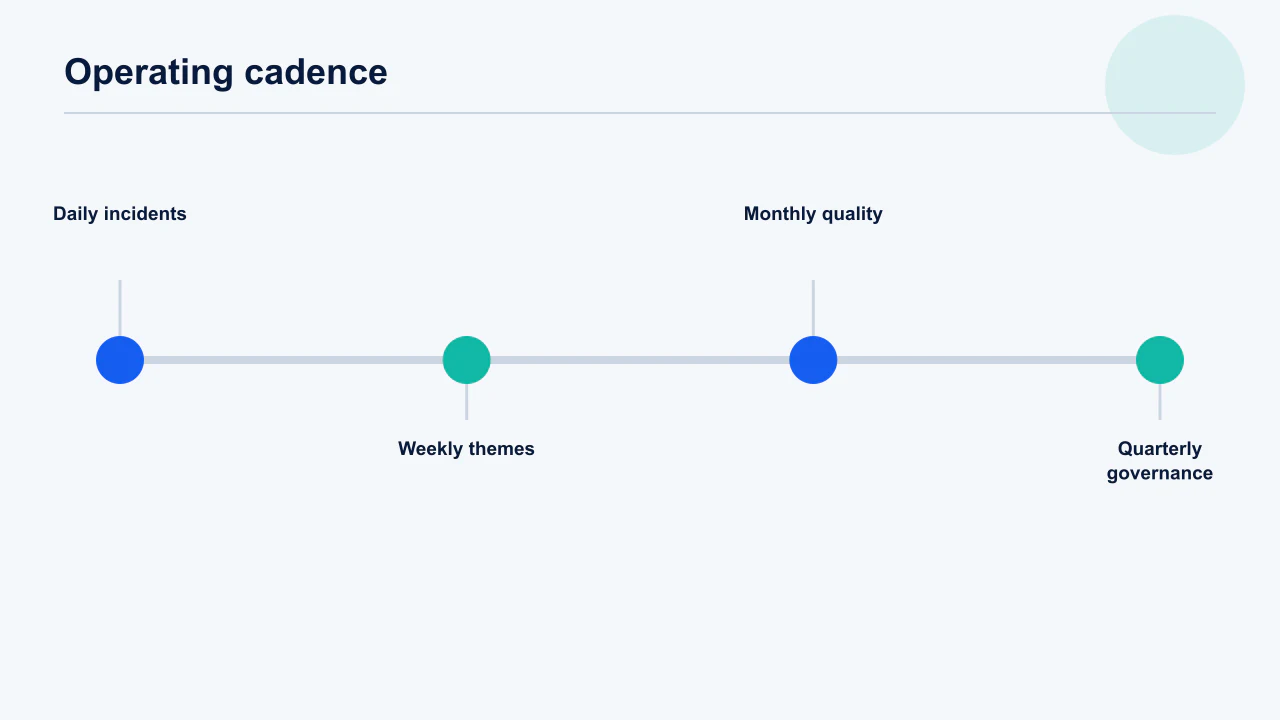
Run daily safety and incident triage, a weekly cross-functional theme review and a monthly taxonomy and quality review. The rhythm should create decisions without turning product teams into a live ticket queue.
Support owns individual resolution; incident owners coordinate urgent clusters; product owners decide themes. Use an agenda that begins with severe harm, then changed trends, unresolved aged cases, release verification and top user language. End with owner and due date for each action.
- Daily: Review emergency and high-severity queues, incident signals and store responses needing correction. Protect users first.
- Weekly: Examine top normalised themes, version changes and open product decisions. Limit the meeting to evidence and action.
- Monthly: Audit tags, response quality, privacy, appeal or escalation outcomes and automation errors. Retrain from real cases.
- Quarterly: Review staffing, contact design, store roles, vendor access and retention. Test end-to-end intake.
Decision rule: Every recurring report must end in an action, explicit watch condition or documented no-action decision.
A dashboard sent to twenty people is not an operating process. Our weekly review names one person who will investigate, change, verify or consciously defer each material theme.
Match the rhythm to the size of the team so it survives a busy week. Daily is a queue check and severity sweep, not a full read. Weekly is theme review against normalised rates and any release annotations. Monthly is taxonomy maintenance and a roadmap hand-off. Quarterly is the harder question of whether the categories still describe the product, since a taxonomy written before a major feature will quietly stop fitting. Give each cadence a named owner and a fixed slot; a support rhythm that depends on someone finding time is the first thing to lapse under pressure. Apple's guidance is a reasonable agenda for the monthly review.
Keep the artefacts short and searchable. This loop only compounds if past decisions can be found again.
Frequently Asked Questions
Should an app reply to every store review?+
Not necessarily. Prioritise current technical issues, low ratings, safety or payment concerns and reviews where a useful next step exists. Never trade speed for an inaccurate or privacy-invasive reply.
How quickly do Apple review responses appear?+
Apple says responses may take up to 24 hours to appear. Until then they show as pending in App Store Connect. Edited replies are marked as edited.
Can app reviews be used in marketing?+
Apple says customer reviews may be used in marketing only with the reviewer’s permission. Also verify the other store’s terms and applicable privacy or advertising rules before reuse.
What is the best way to tag app reviews?+
Separate outcome, product journey, cause confidence, sentiment, app version and requested improvement. Multi-label tagging is more useful than one broad category such as negative login.
Can AI analyse customer support tickets?+
Yes, within an approved privacy and security boundary. Minimise and redact data, validate across languages and themes, keep model and prompt versions, and require human review before consequential decisions.
How do you know whether a review theme is increasing?+
Compare unique cases against a relevant exposure denominator by version and time window. Keep counts visible, annotate releases and campaigns, and express uncertainty at low volume.
When is a support-reported bug fixed?+
When the target outcome and theme rate improve for adequately exposed users on the fixed version, without an adjacent regression. Shipment alone is not outcome evidence.
Sources
- Apple — Respond to reviews — Roles, public responses, editing, deletion and publication delay.
- Apple — Ratings, reviews, and responses — Response practices, reviewer notification, reporting and marketing permission.
- Google Play Console Help — Reply to app reviews — Play Console review response workflow and guidance.
- Google Play Console Help — Analyse ratings and reviews — Review analysis and comparison features.
- Apple — App Store Connect API — Official automation surface for App Store Connect workflows.
- Google Play Developer API — Reply to reviews — Official programmatic review response interface.
- NIST — Privacy Framework — Primary framework for governing personal-data processing.
- NIST — AI Risk Management Framework — Governance reference for AI-assisted classification and decisions.
About the author
Amol Pomane — Founder, Vmobify
Amol leads Vmobify, a mobile app growth agency that has driven 30M+ downloads and ranked 54K+ keywords across 300+ apps since 2013. He writes about ASO, paid user acquisition, retention, and the operational reality of scaling mobile apps in India and global markets.