Mobile App Referral Programme: Engineering Viral Growth & K-Factor
A well-engineered referral programme can make every new user you acquire bring in another — lowering your blended CPI, raising LTV, and compounding growth exponentially. This guide covers the K-factor formula, incentive design, WhatsApp-first sharing in India, fraud prevention, and how referrals fit alongside a paid UA stack.
On this page
- What Is the K-Factor and Why Does K>1 Change Everything?
- How Do You Design a Referral Incentive That Motivates Users?
- One-Sided vs Two-Sided Rewards: Which Drives More Installs?
- How Do You Implement Deep-Link Attribution for Referral Tracking?
- Why WhatsApp Beats Every Other Share Channel in India?
- How Do You Prevent Referral Fraud Without Killing Your Programme?
- What Referral Programme Benchmarks Should You Expect by Category?
- How Do You Build a Referral Programme That Complements Paid UA?
- Frequently Asked Questions
What Is the K-Factor and Why Does K>1 Change Everything for App Growth?
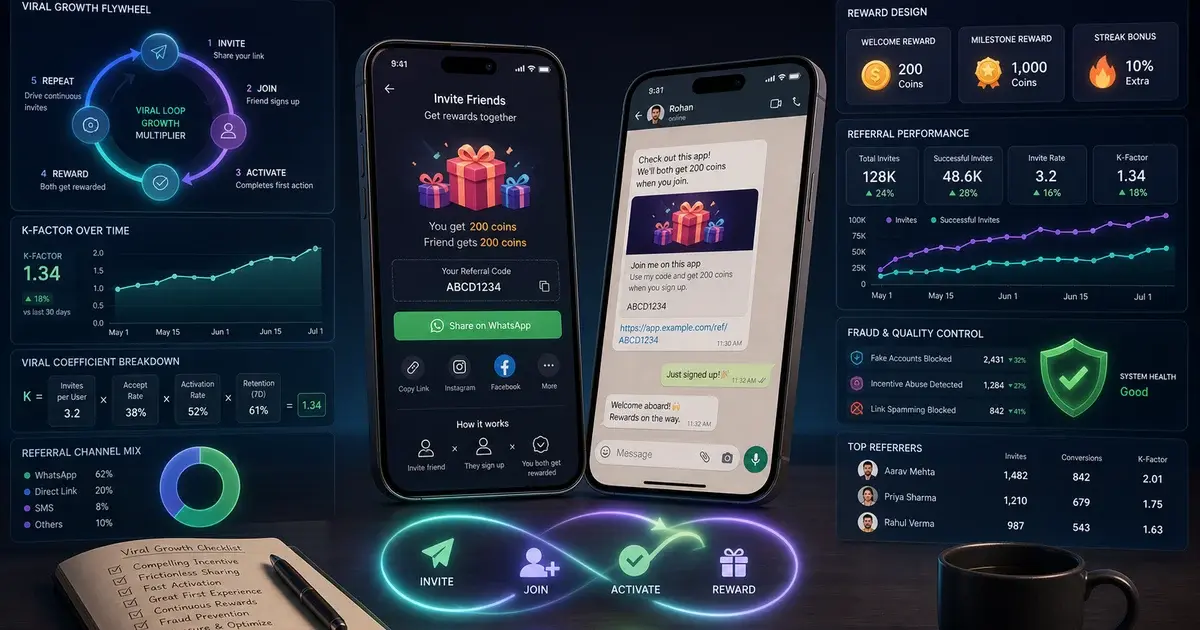
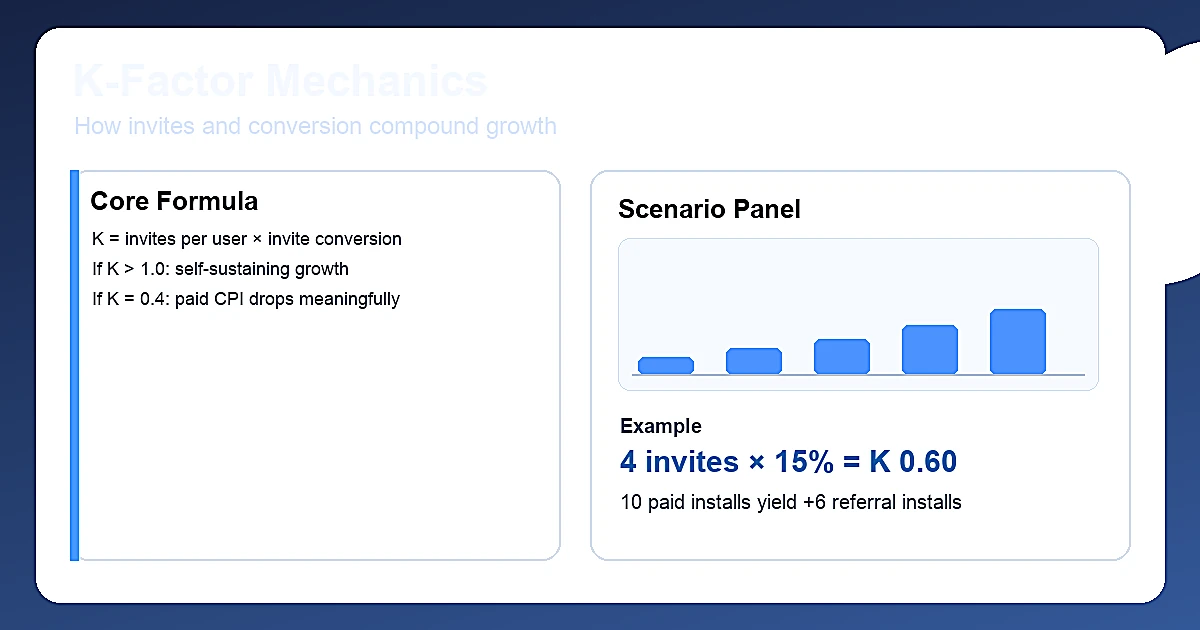
The K-factor is the single most important metric in referral programme design: it measures how many additional users each existing user brings in, and any K above 1.0 means your user base grows exponentially without additional paid spend. The formula is deceptively simple:
K = i × c
Where i is the average number of invites sent per user and c is the conversion rate of those invites into installs. If your average user sends 4 invites and 15% of those invitees install, your K-factor is 0.6 — meaning every 10 paid installs generate 6 additional free ones.
At K = 1.0, growth is linear and self-sustaining. Above K = 1.0, growth is exponential: each cohort of users is larger than the last, entirely funded by the previous cohort's sharing behaviour.
The classic case study is Dropbox: by offering additional storage to both the referrer and the new user, they engineered a K-factor that drove exponential user growth without traditional advertising. Airbnb's referral overhaul in 2014 produced a reported +300% increase in sign-ups at the point of launch — a result driven entirely by tightening the incentive structure and sharing mechanics, not by increasing paid spend.
Most apps sit at K = 0.2–0.4 without an explicit referral programme. Building a well-designed programme typically lifts K to 0.5–0.8 for consumer apps, and occasionally beyond 1.0 for social or community-driven apps. Even the difference between K = 0.2 and K = 0.6 means your effective paid CPI drops by 37.5% in blended terms — every 10 paid installs now generate 6 free ones instead of 2.
Across our portfolio of 300+ apps managed since 2013, the apps that most efficiently scaled past 1 million installs were overwhelmingly those that achieved K ≥ 0.5 before significantly scaling their paid user acquisition budget. A strong referral loop is not a replacement for paid UA — it is what makes paid UA economically self-sustaining at scale. See our guide on how to reach 1 million downloads for how referrals fit into the broader growth architecture.
How Do You Design a Referral Incentive That Actually Motivates Users to Share?
An effective referral incentive must clear three bars simultaneously: it must be valuable enough to motivate action, cost-effective enough to remain profitable at scale, and structurally tied to a user behaviour that signals genuine engagement rather than gaming.
The most common design mistake is setting the incentive value too low. Teams optimise for cost-per-referral and set rewards at ₹10 or $0.50 — amounts that feel insulting rather than motivating. The rule of thumb from sustained growth-hacking programmes is that the incentive should represent at least 20–30% of the value a new user delivers in their first 7 days.
Incentive type matters as much as value. The three formats that convert best:
- In-app currency or premium feature unlock: Best for apps with a clear value ladder — games, productivity tools, streaming. The incentive feels native to the product and costs you nothing in marginal cash terms. Duolingo's "one week of Super Duolingo free" referral reward is the textbook example: high perceived value, zero marginal cost to the business.
- Cash or wallet credit: Best for fintech, food delivery, e-commerce, and ride-hailing. In India, ₹50–₹100 cash or wallet credit per referred install is the validated sweet spot for mid-tier apps — enough to feel meaningful, calibrated against a typical first-order value of ₹200–₹500. Apps offering below ₹30 see negligible sharing behaviour; apps offering above ₹150 attract disproportionate fraud.
- Subscription time extension: Best for SaaS and subscription utility apps. "Give a friend a free month, get a free month" is simple to understand, simple to deliver, and ties the incentive directly to the product's core value.
Critically, the incentive must be displayed at a moment of peak user satisfaction — immediately after a user completes their first meaningful in-app action, after a positive milestone notification, or during the post-purchase confirmation screen. Showing the referral prompt at the wrong moment (mid-onboarding, during an error state, or randomly) cuts conversion by 40–60% relative to showing it at a satisfaction peak.
In our portfolio, the highest-performing referral prompts combine three elements:
- A clear value statement: "Give ₹75, Get ₹75"
- A single-tap share CTA: pre-populated with a personalised message
- A scarcity cue: "Offer valid for your next 5 friends only"
The scarcity element alone typically lifts sharing rate by 15–25% in A/B tests.
One-Sided vs Two-Sided Referral Rewards: Which Drives More Installs?
Two-sided referral rewards — where both the referrer and the new user receive an incentive — consistently outperform one-sided programmes by 30–50% on install conversion rate, and the evidence for this is overwhelming across categories and geographies.
The psychology is straightforward: a one-sided reward (only the referrer benefits) creates a transactional dynamic that feels exploitative to the new user and vaguely embarrassing to share. A two-sided reward reframes the referral as a genuine gift — "I'm sending you something valuable" — which dramatically lowers the social friction of sharing and increases the likelihood the recipient acts on the invite.
Uber's dual-sided referral model — where the referrer received ride credit and the new rider received their first ride free — is the canonical example of two-sided design done at scale. The programme drove viral growth loops that made it the most cost-efficient growth channel during Uber's early expansion. Every market they entered with the referral programme active saw faster initial adoption than markets where it was launched after the paid UA campaign.
Practical two-sided structures by category:
Fintech / wallet apps
- Referrer gets ₹75 cashback after friend's first transaction; friend gets ₹75 on first transaction.
- Both rewards are contingent on a meaningful action, not just install.
Gaming
- Referrer gets 500 premium gems when referred friend reaches level 10; friend starts with a bonus 200 gems.
- Tying the referrer reward to the friend's engagement milestone creates an organic incentive for the referrer to actually help their friend succeed in the game.
Subscription apps
- Referrer gets +30 days free when friend starts a paid plan; friend gets their first month at 50% off.
- The friend's discount reduces conversion friction; the referrer's reward only triggers on paid conversion, so the programme is self-funding.
E-commerce
- Referrer gets ₹100 off next order when friend spends ₹300+; friend gets ₹100 off first order over ₹300.
- The spend threshold ensures the economics remain positive.
One-sided rewards have a narrow valid use case: apps where the "referrer" is in a power position relative to the "referee" (enterprise SaaS with admin invitations, for example). In consumer apps, there is no justification for a one-sided programme when the data consistently shows two-sided outperforms it by 30–50%.
How Do You Implement Deep-Link Attribution for Referral Tracking?
Without robust deep-link attribution, your referral programme cannot accurately credit referrers, cannot survive the App Store's install journey, and cannot produce the data you need to optimise incentive structures — making attribution the non-negotiable technical foundation of any referral programme.
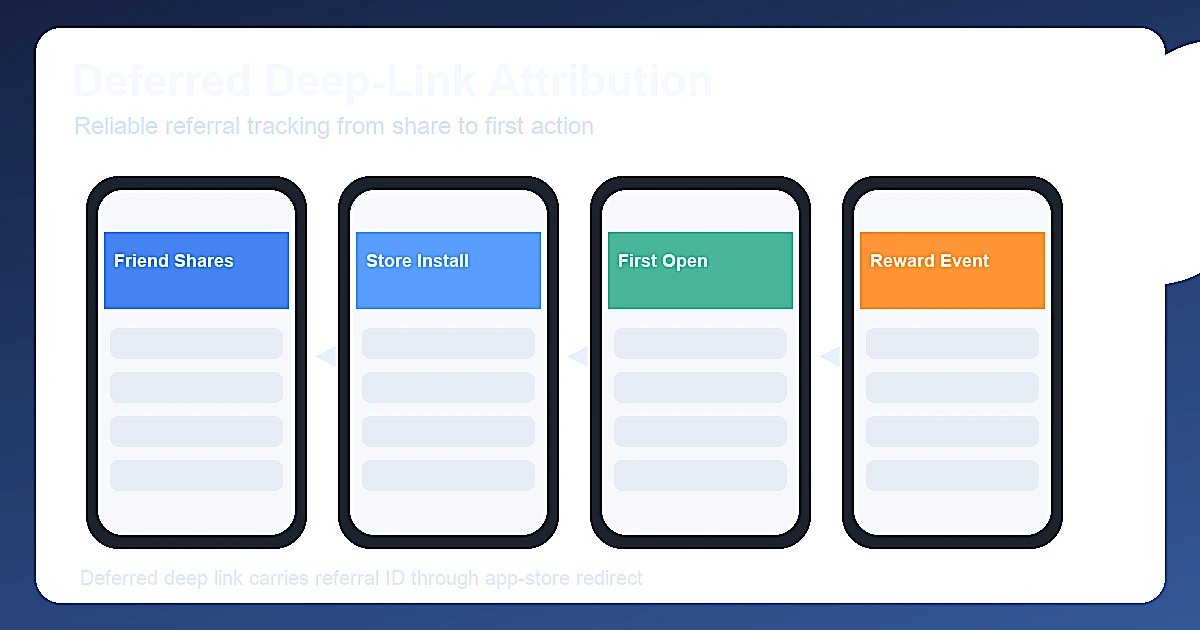
The core challenge is that mobile app install attribution breaks across a two-step journey: the user clicks a referral link on their phone, gets redirected to the App Store or Play Store, installs the app, and then opens it. That store redirect breaks standard URL-based attribution. Deep linking solves this by encoding the referrer identity into a deferred deep link that survives the store redirect and resolves when the app opens for the first time.
The standard implementation stack:
- Branch.io or AppsFlyer OneLink for deferred deep link generation and resolution. Both platforms handle iOS App Clips, Android Instant Apps, and standard install flows. Branch's deferred deep linking is the industry standard; AppsFlyer OneLink is the best choice if you are already using AppsFlyer as your MMP.
- Unique referral codes per user, encoded into the deep link URL as a parameter. Each user gets a personalised link that encodes their user ID; when the app opens post-install, the SDK reads that parameter and registers the attribution. Store this code in your backend on link generation, not on link click.
- Fingerprinting fallback for cases where the deep link resolution fails (device privacy restrictions, older OS versions). IP + device fingerprinting is less accurate but captures attribution that would otherwise be lost, typically recovering 10–15% of referral conversions.
- Server-side reward validation: Never trigger referral rewards on the client side. The reward credit event should be generated server-side after the deep link attribution resolves and the new user completes the qualifying action. Client-side reward triggers are trivially exploitable.
A common mistake in referral tracking is attributing the referral at install rather than at first meaningful action. Install-level attribution inflates your K-factor metric (looks great on a dashboard) but creates a programme that pays out rewards for users who install and immediately uninstall. Tying attribution payouts to first meaningful action — first purchase, first session completion, first transaction — cleans the data and ensures your K-factor metric reflects genuine engaged users, not install-and-churn.
For apps with significant India audience, test your deep link resolution across Jio, Airtel, and BSNL networks. Carrier-level proxies on Indian mobile networks can interfere with certain deep link resolution patterns; testing across the three major carriers before launch catches edge cases that will affect a large fraction of your user base.
Why Does WhatsApp Beat Every Other Share Channel for Referrals in India?
WhatsApp referral shares convert to installs at 3× the rate of social media sharing in India — a gap so large it should determine the entire share-mechanics design of any Indian consumer app's referral programme.
The trust mechanics are the explanation. A WhatsApp message arrives from a known contact in a private conversation. The recipient sees the sender's name, the sender's personal message, and the referral link — in a context where the default assumption is that the sender is recommending something genuinely useful. A social media post, by contrast, arrives in a feed alongside brand advertisements, political content, and algorithmic noise; the signal-to-noise ratio for personal recommendations is fundamentally lower.
India-specific factors that amplify this gap:
- WhatsApp penetration: With over 500 million active users in India, WhatsApp reaches a larger share of the adult smartphone population than any other messaging or social platform. The referral channel that reaches everyone beats a channel that reaches a subset of everyone.
- Family and community group dynamics: Indian WhatsApp usage is characterised by dense family group chats and neighbourhood/community groups with 50–200+ members. A single referral share in a family group effectively becomes a broadcast to 20–100 people who have the highest possible trust in each other.
- Language accessibility: WhatsApp's interface is widely used in regional languages, enabling referrals to flow through communities that are poorly served by English-first social platforms.
Designing for WhatsApp-first sharing:
- Pre-populate the WhatsApp share message with a personalised, conversational text — not marketing copy. "Hey, I've been using [App Name] and saved ₹400 this month — here's ₹75 cashback for you to try it: [link]" converts at 2–3x the rate of "Download [App Name] using my referral code for a bonus."
- Include a WhatsApp share button as the primary CTA on your referral screen, above all other share options. The visual hierarchy signals to users which channel the app recommends — and most will follow that cue.
- Use a link preview image that renders correctly in WhatsApp (1200×630px OG image with the incentive value prominently displayed). WhatsApp renders link previews for referral URLs; an optimised preview card lifts click-through rate by 20–35% over a plain text link.
- Test share messages in Hindi and regional languages for non-metro audiences. Apps that localise their referral message copy to Hindi see a 25–40% lift in WhatsApp share-to-install conversion in Tier-2/3 markets vs English-only copy.
This WhatsApp advantage is India-specific. In Western markets, SMS and iMessage drive similar trust-based conversion dynamics. In Southeast Asia, LINE and Telegram play equivalent roles. But in India in 2026, designing your referral programme's share mechanics around WhatsApp is not optional — it is the primary growth lever.
How Do You Prevent Referral Fraud Without Killing Your Programme?
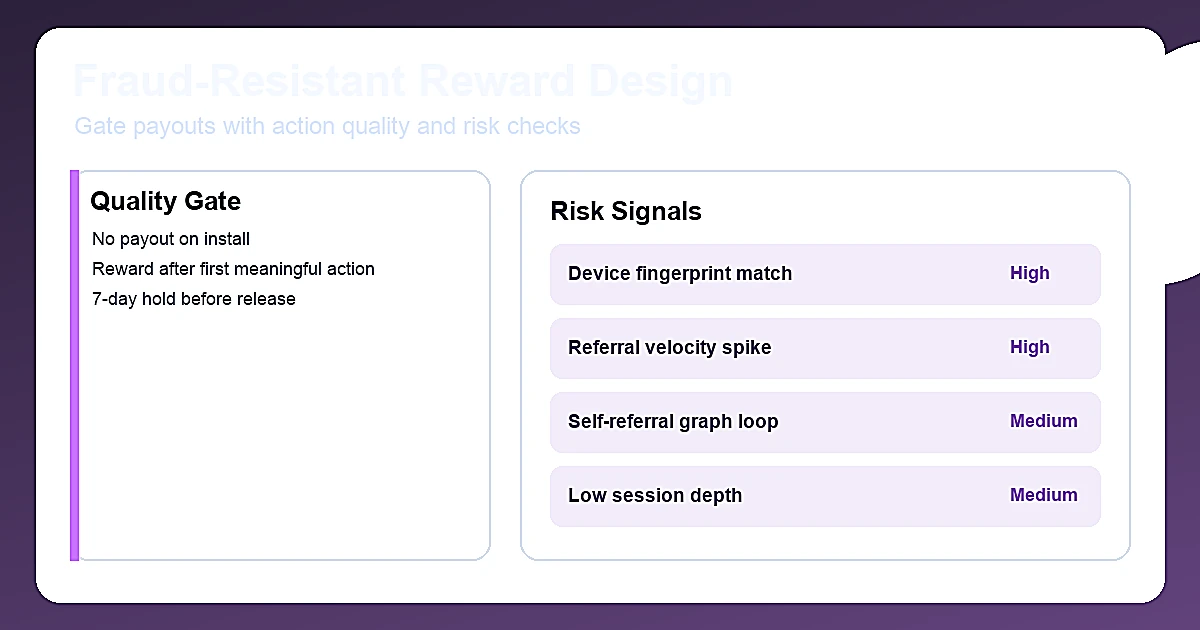
Referral fraud — where users create fake accounts, use secondary devices, or coordinate with friends to generate fictitious referrals purely for the reward — is the single most common reason referral programmes are shut down prematurely, and virtually all of it can be eliminated through structural programme design rather than manual policing.
The core principle is straightforward: never pay out a referral reward on install. Pay it out only after the referred user completes a first meaningful in-app action that a genuine user would take — a first purchase, a first completed session, a first successful transaction, a first-week retention event. This single rule eliminates the economics of fake referrals in one step: a fraudster who spins up 50 fake accounts and refers them all now needs each fake account to complete a genuine in-app action, which requires either real effort or automated bots sophisticated enough to mimic real in-app behaviour.
Layered fraud prevention architecture:
- Device fingerprinting at install: Flag any device that has previously been associated with a different account. A legitimate new user is on a genuinely new device; a fraudster using secondary phones or emulators generates device fingerprint patterns that differ from legitimate new user behaviour. Tools like AppsFlyer Protect360 or Adjust's fraud prevention suite handle this automatically.
- Velocity limits: Cap the number of valid referrals per user per day (5–10 is reasonable for most consumer apps) and per week (15–30). Legitimate users rarely refer more than 3–5 people in a week; any account generating 20+ referrals in 24 hours is almost certainly a fraud vector and should be flagged for manual review.
- Time-delay payouts: Add a 7–14 day hold between the qualifying action and the reward credit. This window allows your fraud-detection system to observe the referred user's behaviour and cancel the payout if the account shows churn or bot patterns before the hold expires. In our portfolio, a 7-day hold reduces fraudulent payout claims by over 60% without measurable impact on genuine referrer satisfaction — most referrers do not notice the delay if it is communicated clearly upfront.
- Referral graph analysis: Monitor the social graph of your referral network. Legitimate referrals form natural social clusters (friends refer friends who know each other). Fraud rings produce star patterns (one account referring hundreds of disconnected new accounts) or ring patterns (accounts referring each other in loops). Graph anomalies are easy to detect and should trigger automatic holds.
- Phone number verification: Require SMS OTP verification before the referral reward credits. A single SIM card cannot be associated with multiple referral rewards. This is slightly higher friction for new users but eliminates the entire class of multi-account fraud that does not involve multiple physical devices.
The economics of fraud prevention matter as much as the technical implementation. If your referral incentive is set correctly — say, ₹75 reward per referred install qualifying action — the value to a fraudster of generating 100 fake installs is ₹7,500. The cost of generating 100 genuine-looking fake accounts that each complete a meaningful in-app action is considerably higher than ₹7,500 for most app categories. Structural fraud prevention simply needs to raise the cost of fraud above the value of the reward.
What Referral Programme Benchmarks Should You Expect by App Category?
Referral programme performance varies significantly by app category, primarily because sharing motivation and trust dynamics differ — a fintech app that saves users money is shareable in a way that a casual game or utility app is not, and benchmark expectations must be calibrated accordingly.
Benchmarks from viral growth strategy data and our own portfolio performance across the India market:
- Fintech / payments / lending: K-factor range 0.4–0.8. Invite-to-install conversion 12–20%. Referral share rate (% of users who share) 8–15%. Cost per referred install ₹30–₹80. Referral-acquired user LTV premium over paid-acquired: +16%. High sharing motivation (saving money, earning credit) and high trust requirements (users only share financial apps with people they genuinely trust) create a natural quality filter.
- Food delivery / quick commerce: K-factor range 0.5–1.0. Invite-to-install conversion 15–25%. Share rate 12–20%. Cost per referred install ₹25–₹60. The high frequency of use and universal product appeal make food delivery apps among the most referral-friendly categories; the "first order free" mechanics are universally understood.
- Gaming (mid-core and social): K-factor range 0.3–0.6. Invite-to-install conversion 8–15%. Share rate 5–10%. Cost per referred install ₹20–₹50. Gaming referrals are driven by multiplayer mechanics and competition; programmes tied to in-game advantages for both referrer and referee (as opposed to cash) perform significantly better.
- Health and fitness: K-factor range 0.2–0.4. Share rate 4–8%. Cost per referred install ₹40–₹100. Sharing motivation is present (recommending something that worked for you) but social friction is higher (fitness is personal). Programmes that frame the referral as a wellness gift rather than a monetary transaction outperform.
- Utility / productivity: K-factor range 0.1–0.3. Share rate 2–5%. Cost per referred install ₹50–₹120. Utility apps are the hardest referral category — low emotional engagement means low sharing motivation. Premium feature unlocks outperform cash incentives in this category because users share for the benefit of their contact, not for their own reward.
Compared to India paid CPI benchmarks — typically ₹80–₹200 for mid-tier apps across Meta and Google — a functioning referral programme delivering installs at ₹30–₹80 represents a 50–75% cost reduction per install. The quality premium compounds this further: referral-acquired users carry a 16% higher LTV than paid-acquired users across categories, meaning the effective CPA advantage of referral installs over paid installs is even larger than the install-cost differential alone suggests.
These benchmarks assume a well-designed two-sided programme with WhatsApp as primary share channel and time-delay payout fraud controls. Programmes missing any of these elements will perform below the ranges above. See our LTV-to-CAC calculator guide for how to model referral programme economics against your specific unit economics.
How Do You Build a Referral Programme That Complements Your Paid UA Stack?
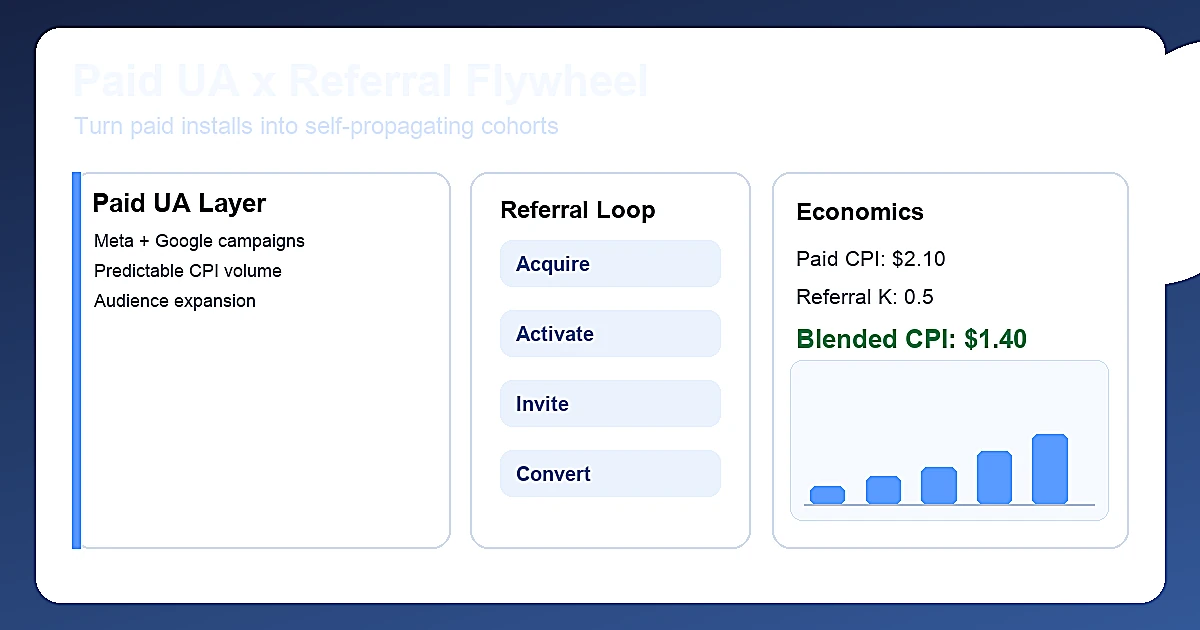
The most effective growth stacks treat referral programmes and paid UA not as alternatives competing for the same budget, but as interlocking systems where every paid install becomes a potential referral seed — a compounding dynamic that fundamentally changes the economics of both channels.
The integration logic works like this: your paid UA campaigns (Google App Campaigns, Meta Advantage+, CPI networks) acquire users at a known CPI. Those users are immediately entered into your referral programme. If K = 0.5, every 10 paid installs generate 5 free referral installs in the following 30 days. Your effective blended CPI is therefore paid CPI ÷ 1.5 — not a theoretical model but a measurable reduction in unit acquisition cost that compounds as your user base grows.
Practical integration patterns from growth hacking frameworks:
- Referral trigger in the paid UA onboarding flow: The moment a paid-acquired user completes their first meaningful action, surface the referral prompt. The satisfaction peak at first success is the highest-probability moment for a share; most apps miss this by surfacing the referral prompt only in a settings menu or days after first use.
- Retargeting referral non-sharers: Segment paid-acquired users who have not shared after 7 days and serve them a retargeting message (push notification or in-app) reminding them of the incentive. A single well-timed reminder lifts referral share rates by 20–30% among users who were initially hesitant.
- Using referral data to improve paid targeting: Analyse the demographic and behavioural profile of users who refer the most (your "referral champions"). These users are your highest-value segment. Use their profile to build paid UA lookalike audiences — you are specifically buying more people like your most naturally viral users, creating a reinforcing loop where paid UA increasingly targets users predisposed to refer.
- Burst campaigns as referral seeding events: A paid mass user acquisition burst that installs 30,000 users in 72 hours does not just move your store ranking — it seeds your referral programme with 30,000 new potential referrers simultaneously. In our portfolio, the 30-day referral volume following a burst campaign is consistently 2–3× the baseline referral volume, because the burst creates a critical mass of new users whose sharing behaviour compounds in the weeks after the burst.
- Referral programme as retention signal: Users who have successfully referred at least one friend have dramatically higher 90-day retention than users who have not referred anyone — typically 25–40% higher in our portfolio data. This is partially selection bias (highly engaged users refer more) but also a genuine causal effect (referring someone creates social accountability). This means your referral programme is not just a UA tool — it is an indirect retention strategy.
The key budget question is straightforward: how much should referral reward spend be relative to paid UA? A practical starting point is to allocate referral reward budget equal to 10–20% of your monthly paid UA budget. At that ratio, if your programme achieves K ≥ 0.3 (which a well-designed programme should), the referral channel pays for itself within 60 days as the compounding effect of referral cohorts begins to materialise.
For apps earlier in their growth journey, the sequencing matters: get your first 5,000–10,000 retained users via paid UA before activating referrals. A referral programme launched into a user base of 200 people has almost no statistical seed mass to generate meaningful K-factor; the same programme launched into 10,000 active users can generate thousands of referral installs in the first month. If you are at the early stage, see our guide on reaching your first million downloads for the sequencing.
Talk to our team if you want a referral programme architecture built on top of an existing or planned paid UA stack — the integration design is where most of the compounding value is created or lost.
Frequently Asked Questions
What is a good K-factor for a mobile app referral programme?+
Any K-factor above 0.3 represents a meaningful referral contribution that reduces your blended paid CPI. K above 0.5 is considered strong for most consumer app categories. K above 1.0 — where the app grows exponentially from referrals alone — is achievable for social, community, and fintech apps with the right incentive structure, but should not be treated as the baseline expectation. Focus first on achieving K ≥ 0.4; that alone cuts your effective acquisition cost by 28% in blended terms.
How much should I offer as a referral incentive for an Indian audience?+
For fintech, food delivery, and e-commerce apps, ₹50–₹100 cash or wallet credit per referred user completing their first qualifying action is the validated sweet spot for mid-tier Indian consumer apps. Below ₹30, sharing motivation drops significantly. Above ₹150, fraud rate increases materially. For gaming and utility apps, in-app currency or premium feature unlocks outperform cash, with the equivalent perceived value at roughly 2–3 days of premium features.
Should I pay the referral reward on install or on a later event?+
Always pay on a meaningful post-install event, not on install. The qualifying action should be the earliest event that indicates genuine intent — first purchase, first completed session, first successful transaction, or a first-week retention event. Install-triggered rewards are trivially exploitable by anyone with a secondary device or a friend willing to install and immediately delete. Time-delay payouts (7–14 days after the qualifying action) further reduce fraud without meaningfully impacting genuine user experience.
Why is WhatsApp more effective than social media for referrals in India?+
WhatsApp messages arrive from known contacts in a private, high-trust context. The recipient sees the sender's name and personal message before any referral link — creating a fundamentally different trust signal than a social media post appearing in an algorithmic feed alongside brand advertisements. This trust differential translates directly into a 3× higher install conversion rate for WhatsApp referral shares versus social sharing for Indian audiences. Dense family and community group chats further amplify reach: a single share can reach 20–100 people who all have maximum trust in the sender.
How do I prevent fake referrals without adding friction for real users?+
The most effective fraud prevention is structural: require a first meaningful in-app action before paying out rewards, add a 7–14 day hold period, cap daily and weekly referrals per user, and use device fingerprinting to flag multi-account patterns. None of these controls require real users to do anything extra — they operate invisibly in the background. The only visible control is SMS OTP verification, which adds one step but eliminates an entire class of multi-account fraud. Together these measures reduce fraudulent payouts by over 60% without measurable impact on genuine referrer satisfaction.
When should I launch a referral programme — at app launch or later?+
Launch your referral programme after you have a base of 5,000–10,000 retained active users. A referral programme launched into a very small user base has insufficient seed mass to generate meaningful K-factor — the compounding only works when there are enough active users sharing simultaneously. Use paid UA to reach the 5,000–10,000 retained user threshold first, optimise your onboarding and early retention, and then activate referrals into that established base. The exception is apps with a genuinely viral core mechanic (inviting friends to play, collaborate, or compete is the core product loop) — these can and should activate referrals from day one.
Sources
- Tapp — Guide to Viral Loops in Mobile Apps — Comprehensive breakdown of K-factor mechanics, viral loop design, and referral programme architecture for mobile apps
- Molfar — Viral Loops: How Referral Growth Really Works — Analysis of two-sided referral mechanics, Uber and Airbnb referral case studies, and viral loop compounding dynamics
- AppMarketingPlus — Mobile App Growth Hacking Guide — Incentive design principles, referral programme best practices, and growth hacking frameworks for app marketers
- Wezom — How to Make a Mobile App Go Viral in 2026 — Category-specific viral growth strategies, referral programme benchmarks, and sharing channel performance data
- Prospeo — Growth Hacking Frameworks for Mobile — Practical growth hacking patterns including referral integration with paid UA stacks and lookalike audience building
- Growth Expertz — Does Growth Hacking Actually Work in 2026? — Evidence-based assessment of growth hacking efficacy including referral programme ROI across categories and geographies
- Meegle — Mobile App Growth Hacks: Referral and Viral Strategies — Tactical deep-dives on referral programme implementation, fraud prevention, and attribution for mobile growth teams
About the author
Amol Pomane — Founder, Vmobify
Amol leads Vmobify, a mobile app growth agency that has driven 30M+ downloads and ranked 54K+ keywords across 300+ apps since 2013. He writes about ASO, paid user acquisition, retention, and the operational reality of scaling mobile apps in India and global markets.