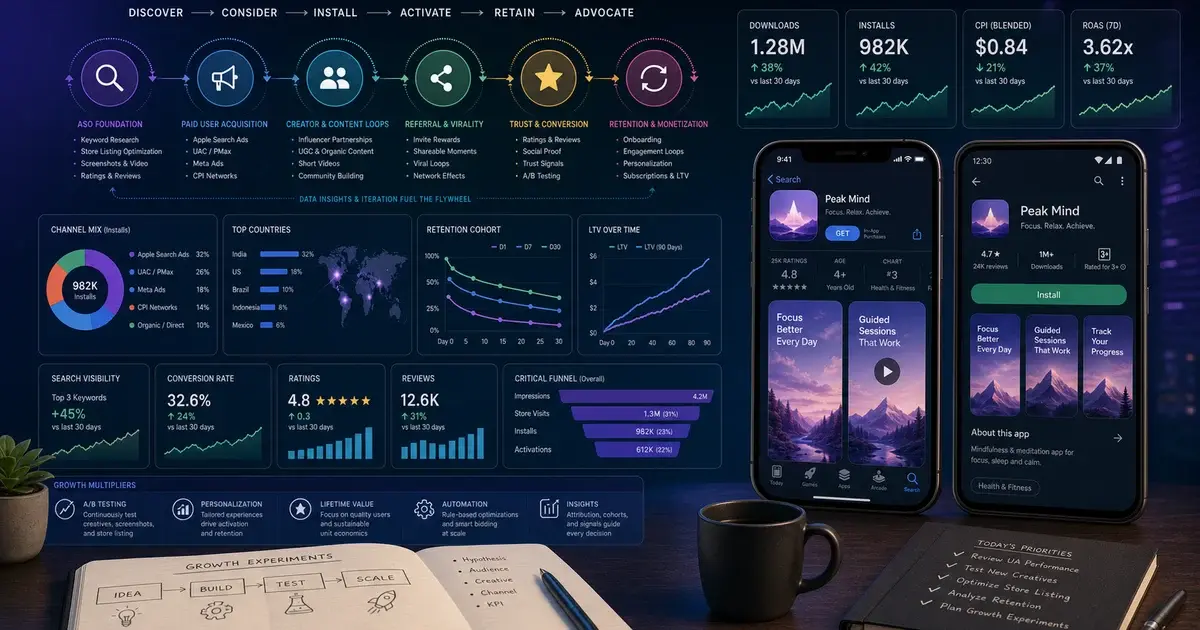
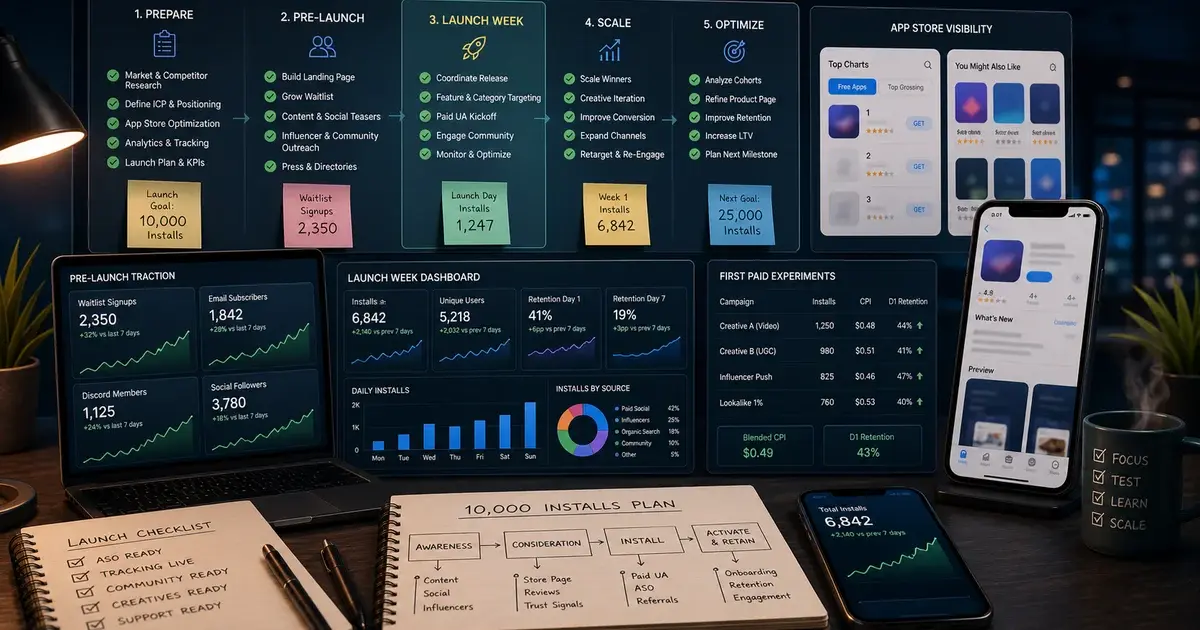
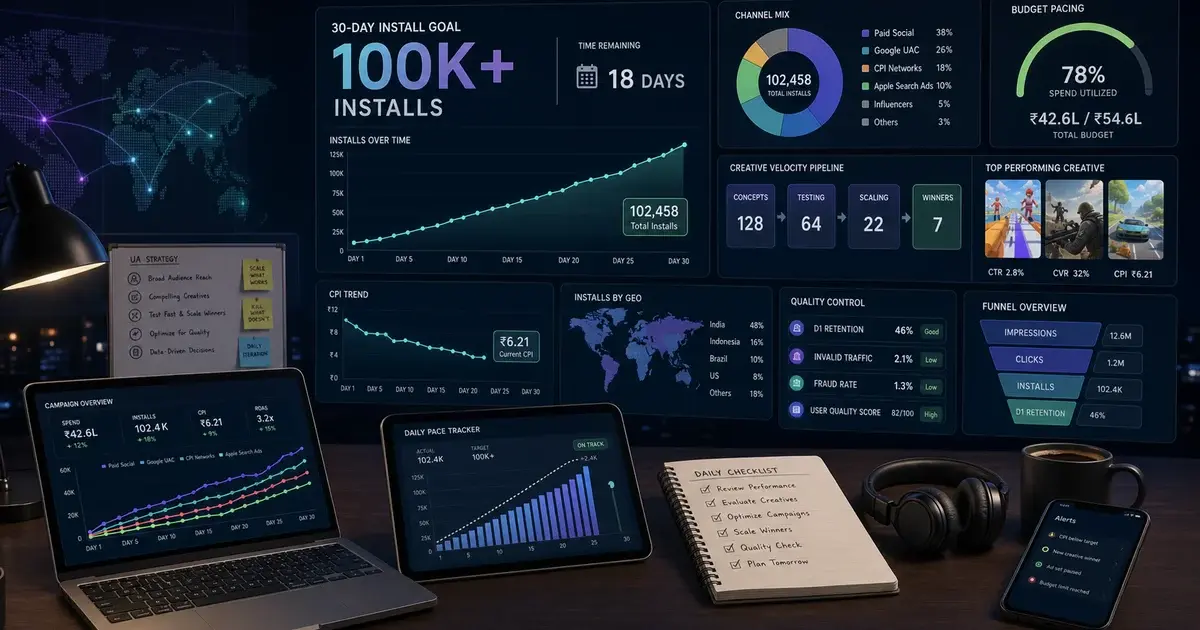
How to Get 1 Million App Downloads: The 2026 Scaling Playbook
Scaling from 10K to 1 million downloads is a categorically different game. This playbook covers the mindset shifts, channel stack, creative velocity, global expansion tactics, and retention mechanics that separate apps that plateau from the ones that compound to 1M.

On this page
- What mindset shifts are required at each milestone?
- Why is 40% D7 retention the prerequisite for scale?
- Which channel mix only works at scale?
- How do you build creative production at scale?
- How does global expansion multiply your install count?
- How does the 1M flywheel compound paid into organic?
- Why does earned media matter at the 500K to 1M stage?
- What does the 1M milestone signal to investors?
- Frequently Asked Questions
What mindset shifts are required at each milestone?
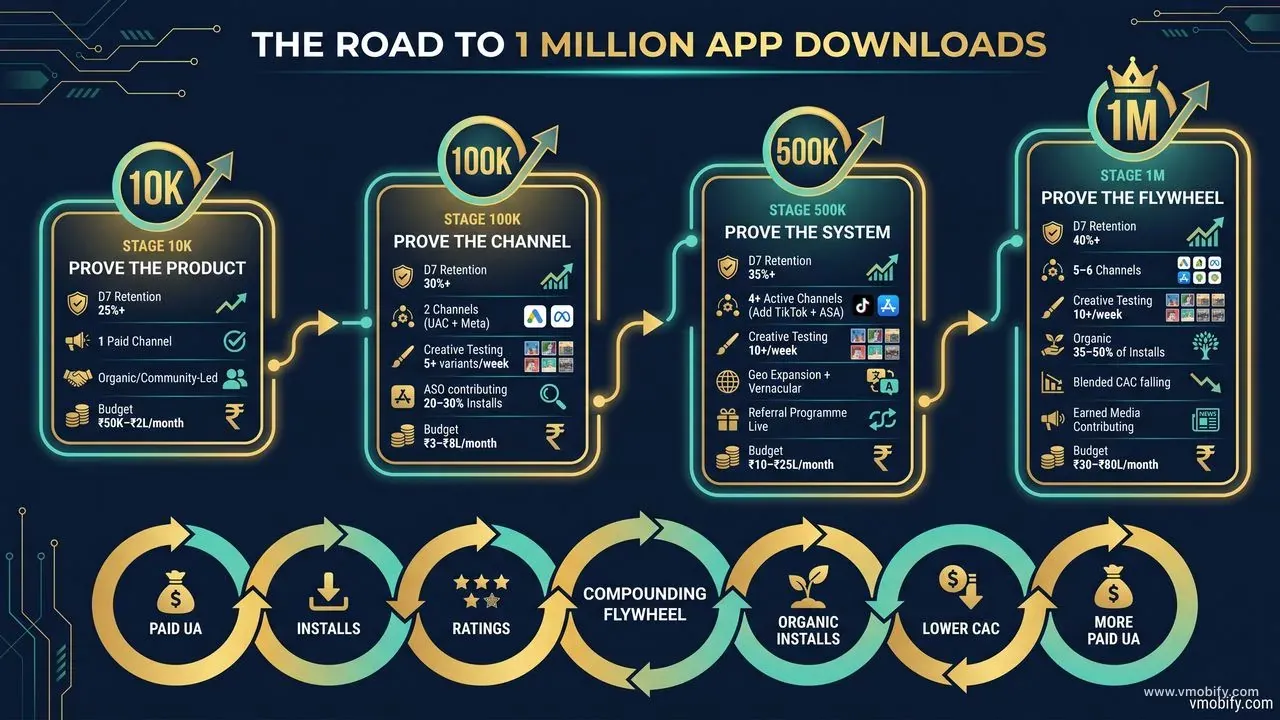
Getting to 1 million downloads is not one journey—it is four categorically different games played back to back, and the tactics that win at 10K will actively hurt you at 500K. The teams that plateau almost always try to scale a 10K playbook to 1M, burning money on channels that cannot handle the volume, or holding back on channels they are not yet ready to operate profitably.
Here is how the operating model actually changes across each stage:
0 → 10K: Prove the product
- Goal: confirm product-market fit, not scale
- Channels: community, referrals, Product Hunt, app store organic
- Obsess over: D7 retention and onboarding drop-off
- Budget: ₹50K–₹2L / $1K–$5K
- Red line: do NOT scale paid until D7 retention exceeds 25%
10K → 100K: Prove the channel
- Goal: find one paid channel with positive unit economics
- Channels: Meta Advantage+ or Google UAC — one at a time
- Obsess over: LTV:CAC ratio by cohort, not raw install volume
- Budget: ₹3L–₹10L / $5K–$20K per month
- Red line: do NOT add a second channel until the first is profitable
100K → 500K: Diversify the stack
- Goal: reduce channel concentration risk, expand geo
- Channels: add TikTok, Apple Search Ads, CPI networks, vernacular creatives
- Obsess over: blended CAC trend, creative fatigue signals, D30 by geo
- Budget: ₹15L–₹40L / $25K–$70K per month
- Red line: do NOT go global until you have localised store listings
500K → 1M: Run the flywheel
- Goal: compound paid into organic; let ASO and referrals carry 40%+ of volume
- Channels: full portfolio active; earned media and PR added
- Obsess over: organic-to-paid ratio, referral contribution, ratings velocity
- Budget: ₹50L–₹1.5Cr / $80K–$200K+ per month
- Red line: do NOT spend more on paid if blended CAC is rising; fix the flywheel first
Across our portfolio of 300+ apps, the median time from 100K to 1M installs is 9–14 months for consumer apps with D7 retention above 30%. For apps with D7 retention below 20%, we have never seen a cost-efficient path to 1M—only a very expensive one.
The single most common mistake we see is trying to shortcut the sequencing. A founder spends ₹30 lakh in month two on five simultaneous paid channels before any of them has enough data to optimise. The result is five under-performing campaigns, a rising blended CAC, and no signal about what actually works. Sequence the channels. Prove each one before layering the next.
Why is 40% D7 retention the prerequisite for scale?
Before you push spend beyond modest test budgets, you need one internal metric locked in: Day 7 retention at or above 40% for utility and productivity apps, or above 25% for broad consumer apps—because below these thresholds, every rupee you spend on acquisition is partially incinerated. The math is unforgiving: if you spend ₹15 per install with 20% D7 retention, your effective cost per 7-day-retained user is ₹75. Improve D7 to 40% and that same ₹15 delivers a retained user for ₹37.50—a 2x improvement in unit economics without touching a single ad.
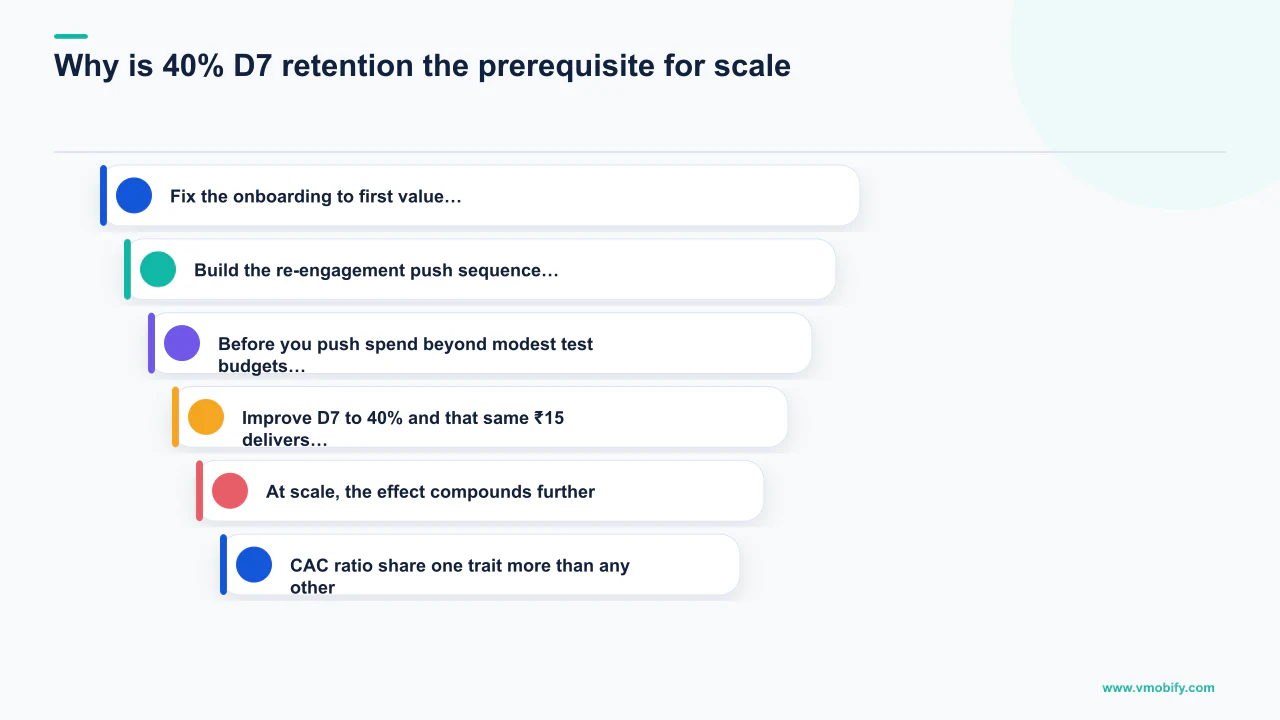
At scale, the effect compounds further. AppsFlyer's State of App Marketing consistently shows that the top quartile of consumer apps by LTV:CAC ratio share one trait more than any other: superior D7 and D30 retention. Volume follows retention quality; apps that retain well earn better ratings, better rankings, lower CPIs on paid channels (because the same spend generates more engaged users for the algorithm to optimise against), and more word-of-mouth.
Duolingo is the most studied example. The language-learning app did not scale paid UA aggressively until its streak mechanic—the single feature that drove D7 retention above 45%—was proven at small scale. Once that retention anchor was in place, TikTok and Meta spend compounded rapidly because every acquired user was genuinely sticking around, rating the app, and sharing it. The product team's obsession with the streak metric preceded the growth team's scaling by 18 months.
- Measure retention by cohort before scaling. Segment D1, D7, and D30 retention by acquisition channel and by onboarding path. If D7 differs by more than 15 percentage points between channels, your cheapest channel is probably bringing in the wrong users.
- Fix the onboarding to first value. The single biggest lever on D1 retention is time-to-first-value: how many steps between install and the first moment the user understands why the app exists. Reduce it. Cut permissions requests, skip optional profile fields, prefill examples. Every unnecessary step costs 3–8% of users in that session.
- Build the re-engagement push sequence. Users inactive for 3 days, 7 days, and 14 days need different re-engagement messages tied to their last in-app action—not a generic "We miss you." A personalised push referencing what the user last did converts at 4–6x the rate of a generic one.
A fintech app we work with spent 8 weeks optimising its onboarding before scaling paid UA—reducing the install-to-first-transaction flow from 11 steps to 4. D7 retention went from 18% to 37%. When we then scaled Google UAC, blended CAC fell by 44% versus the pre-optimisation baseline, because the algorithm was receiving stronger engagement signals from every acquired user cohort.
Which channel mix only works at scale?
The full channel portfolio—Google UAC, Meta Advantage+, Apple Search Ads, TikTok App Promotion, and organic ASO running simultaneously—does not make economic sense below roughly 500 installs per day; above that threshold, it becomes essential to avoid platform saturation and rising marginal CPIs. Each channel owns a distinct audience layer that the others cannot reach efficiently.
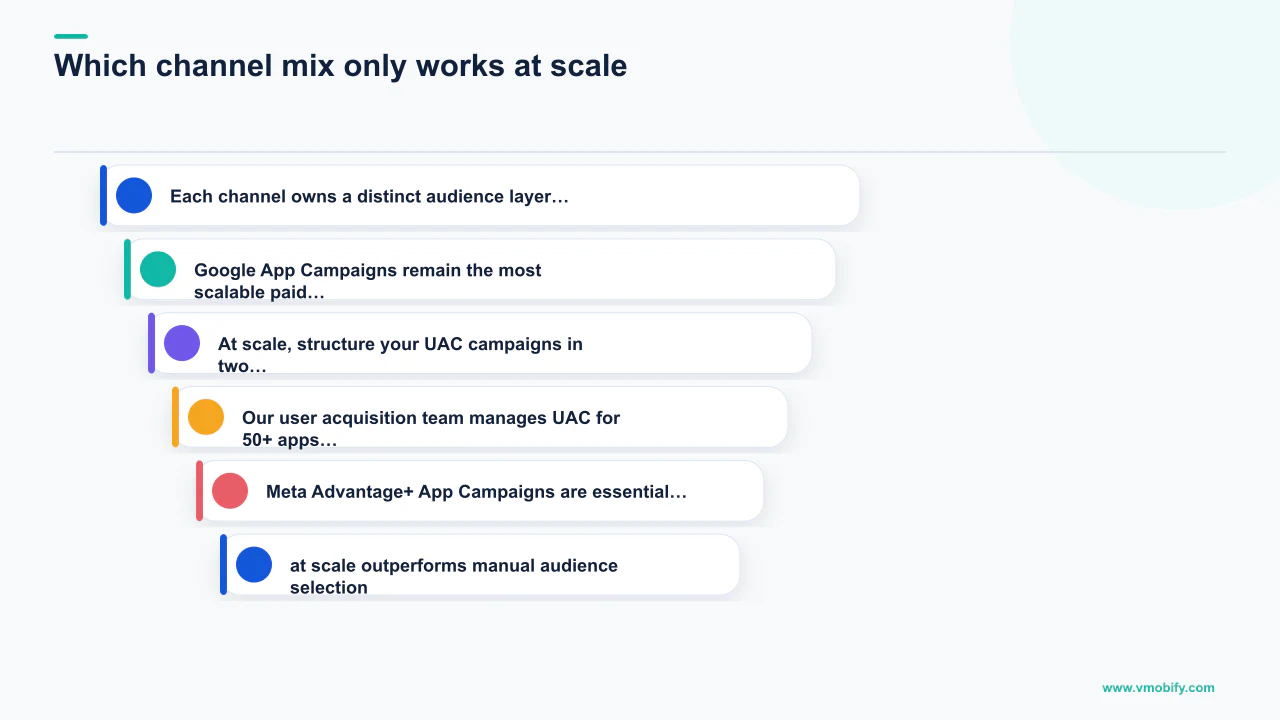
Google App Campaigns remain the most scalable paid channel for Android apps globally and the undisputed workhorse in India, Southeast Asia, and LATAM. At scale, structure your UAC campaigns in two buckets: installs (Target CPI bidding) and post-install events (Target CPA against a high-value action like registration, first deposit, or checkout completion). Feed each campaign at minimum 5 text assets, 5 image assets, and 5 video assets in portrait (9:16), landscape (16:9), and square (1:1) formats. Our user acquisition team manages UAC for 50+ apps and consistently achieves CPIs 30–40% below category benchmarks within the first 30 days by aggressive creative rotation and geo-layer structuring.
Meta Advantage+ App Campaigns are essential for consumer apps with compelling video creative. Advantage+ hands targeting almost entirely to the algorithm, which at scale outperforms manual audience selection because Meta's behavioural signals are far richer than any hand-built lookalike. Run one Advantage+ campaign as your primary volume driver, with 3–5 creative variations per ad set. Maintain a small manual-targeting campaign in parallel as a control for CRM custom audiences.
Apple Search Ads is the highest-intent paid channel on iOS. Volume ceiling is lower than Meta, but the user who taps your ad on a high-intent keyword has already declared purchase intent—D7 retention from Apple Search Ads traffic regularly runs 15–25 percentage points above the Meta average in our portfolio. At the 500K–1M stage, Apple Search Ads budget should account for 20–30% of your iOS spend.
TikTok App Promotion has become the breakout channel for consumer, gaming, and entertainment apps. The unique lever here is Spark Ads: boosting organic creator content as paid media. Spark Ads consistently outperform branded creative by 30–50% in our portfolio because users perceive them as authentic content, not advertisements. Duolingo built its TikTok presence around the now-iconic green owl persona, generating millions of organic views per week, then layered Spark Ads on top to compound reach at a fraction of the cost of produced brand campaigns. If your app has any organic TikTok presence—even 5–10 creator posts—Spark Ads is the highest-leverage paid activation available to you today.
The critical operational discipline at this stage is weekly budget reallocation based on contribution to retained users—not raw installs. An install from Apple Search Ads on a competitor keyword that converts at 40% D7 is worth 3x a cheap CPI network install that churns in 24 hours. Your MMP attribution must be configured to surface this contribution analysis, not just last-click install counts. See our guide to AppsFlyer vs Adjust vs Singular for how to structure this attribution correctly.
How do you build creative production at scale?
At 1 million downloads, creative is your primary performance lever—audiences are effectively unlimited, and the bottleneck is always creative fatigue. The teams that compound past 500K installs have one thing in common: a systematic, high-velocity creative operation that produces, tests, and kills new creative on a weekly cadence rather than quarterly.
The benchmark we target across our portfolio at this scale is 10+ new creative variants per week across all channels. This sounds aggressive until you break it down by format: 3–4 UGC-style phone-recorded testimonials, 2–3 product demo screen recordings, 2 static benefit cards, and 1–2 creator posts being prepared as Spark Ads. At this volume, you do not need a production agency for every asset—you need a system.
The creative testing flywheel looks like this:
- Launch 5–10 new variants every Monday. Brief is one sentence: "Show the app solving [specific problem] for [specific user] in 15 seconds." Keep production lean—phone-recorded UGC often beats polished studio creative by 2–3x on Meta and TikTok.
- Review performance at Day 7. Kill the bottom 50% by cost-per-retained-user (not cost-per-install). Pause immediately—do not let poor creative run for weeks while the algorithm tries to find an audience for it.
- Iterate on top performers at Day 14. Change one variable: the opening hook, the problem statement, the call-to-action, or the social proof element. This is where the compounding happens—top-performing creative structures last 4–6x longer when systematically refreshed rather than retired.
- Brief the next cohort from learnings at Day 21. Document which hooks, problems, and CTAs drove the lowest cost-per-retained-user. Feed these directly into the next week's brief. Over 12 weeks, you build a library of proven creative formulas unique to your app.
If you are spending more than ₹20 lakh / $30K per month on paid UA, a dedicated in-house creative producer pays for itself within 4–6 weeks. The ROI on a strong creative system at this scale is higher than adding any new paid channel.
Three creative formats that carry the weight at the 1M scale:
- UGC-style video (9:16 portrait). Authentic, phone-recorded content showing a real person using the app and reacting to the result. Low production cost, highest credibility on Meta Reels, Instagram Stories, and TikTok. The "before/after" structure—problem acknowledged in 3 seconds, app solution shown in 10 seconds, outcome celebrated in 2 seconds—is the template we return to most across our portfolio.
- Product demo / walkthrough (15–30 seconds). Screen recording showing the app solving one specific high-value problem. Essential for Google UAC and Display placements where the audience is discovery-mode rather than entertainment-mode. Annotate the recording with brief text callouts on the key steps.
- Static benefit card. Bold primary-benefit headline, clean app screenshot, star rating, and store download badge. Still highly effective for Search and Display. A well-designed static card requires 2–3 hours to produce and can drive installs for weeks—do not underestimate it in favour of video.
Across 300+ apps we manage, the apps that refresh creative on a weekly cadence consistently see 20–30% lower creative-fatigue-driven CPI increases quarter over quarter compared to apps on a monthly or quarterly refresh cycle. The velocity of the creative operation is a direct competitive moat.
How does global expansion multiply your install count?
Global expansion is the single highest-leverage multiplier on the path to 1 million downloads because it adds install volume at CPIs 40–70% below mature-market rates while simultaneously sending install-velocity signals that improve your App Store and Google Play rankings in every market. Most apps treating India as their primary market are sitting on 300K–500K untapped installs in Southeast Asia, LATAM, and MENA that require store listing localisation—not fundamentally different products.
The four expansion clusters that consistently deliver the highest ROI, ranked by ease of entry and install volume:
India: Tier-2 and Tier-3 cities
- Languages: Hindi, Tamil, Telugu, Bengali, Kannada, Marathi
- CPIs 40–60% below metro rates on Google UAC
- ~750M smartphone users (Statista)
- Best for: fintech, edtech, quick-commerce, utility
- Entry: vernacular store listing + vernacular creatives
Southeast Asia
- Languages: Bahasa Indonesia, Thai, Vietnamese, Filipino
- Mobile-first markets, rapid app adoption curves
- CPIs 50–65% below US rates across major channels
- Best for: gaming, social commerce, content, super-apps
- Entry: localised store listing; prioritise Indonesia first
LATAM
- Languages: Spanish (LATAM), Portuguese (Brazil)
- Brazil and Mexico account for 70%+ of regional volume
- Mid-range CPIs, strong fintech and gaming verticals
- Best for: fintech, gaming, streaming, marketplace
- Entry: Brazilian Portuguese store listing unlocks the largest single market
MENA
- Languages: Arabic (RTL), Turkish
- High disposable income in GCC, large youth population
- Mid-to-high CPI but strong LTV for premium apps
- Best for: gaming, streaming, luxury commerce, fintech
- Entry: Arabic RTL support required; Turkish is lower-friction starting point
The expansion sequencing that works across our portfolio: localise the store listing for your top three target markets first. Run a 30-day install measurement window. Only commit to full UI localisation for markets where store-listing-only conversion retains at parity with your home market. Localising a Hindi UI for an app whose Hindi-speaking users churn at twice the English rate is wasted engineering time—validate retention before the full build.
A critical and frequently overlooked lever in India specifically: vernacular creatives unlock tier-2 and tier-3 volume at zero incremental bidding strategy change. A Hindi translation of your best-performing English creative—with culturally adjusted visuals and a local social proof reference—regularly halves CPI in Hindi-belt cities on Google UAC. Tamil and Telugu creatives produce the same effect in south Indian markets. We have added 100K–200K installs to India-market apps using this lever alone, without touching bid strategies or budgets.
Calm demonstrated the global-first model at scale: early investment in Spanish, German, French, and Portuguese store listings, paired with localised meditation content, enabled the app to build meaningful user bases across Europe and LATAM that contributed to its eventual 100M+ download milestone—volume that a purely English-language strategy would have left on the table for years.
How does the 1M flywheel compound paid into organic?
The apps that reach 1 million downloads sustainably do not have the biggest ad budgets—they have a flywheel where every paid install generates downstream organic installs at zero marginal cost, and the ratio improves as scale increases. Understanding and actively managing this flywheel is the difference between apps that spend their way to 1M and apps that compound their way there.
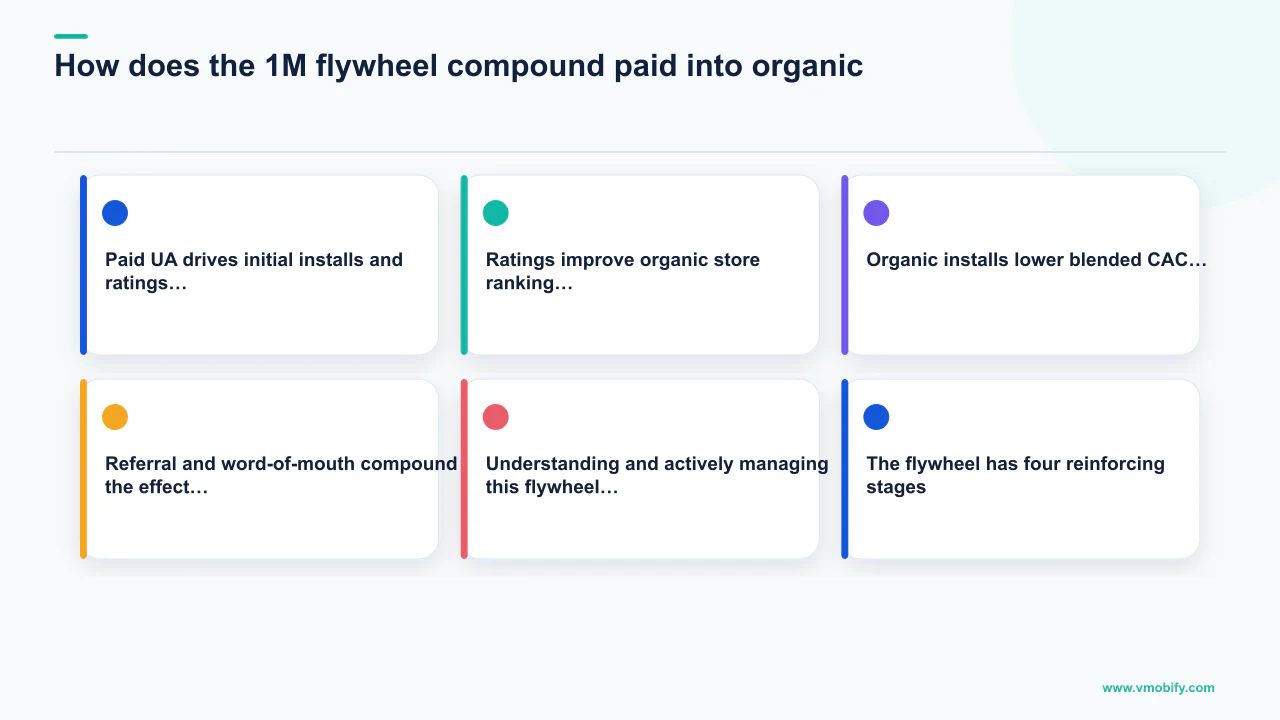
The flywheel has four reinforcing stages:
- Paid UA drives initial installs and ratings velocity. Each wave of paid installs, if the product retains well, generates a wave of in-app review prompts—and satisfied users who were brought to the review moment leave positive ratings. Ratings accumulate.
- Ratings improve organic store ranking. Both App Store and Google Play factor ratings and review velocity into search ranking and featuring algorithms. A 4.5★ app with 10,000 reviews ranks materially higher for category keywords than a 4.1★ app with 500 reviews—driving organic installs the paid campaign did not need to pay for.
- Organic installs lower blended CAC. As organic share of total installs increases—from 20% at 50K installs to 40%+ at 1M installs in well-managed portfolios—your blended cost per install falls. That freed budget can be redeployed into more paid UA or creative production, accelerating the flywheel further.
- Referral and word-of-mouth compound the effect. At 500K users, even a 1% monthly referral rate generates 5,000 installs per month at essentially zero marginal cost. Optimise your referral flow quarterly: test reward types, share moments, and sharing channels (WhatsApp, SMS, social share sheet). Cred, the Indian fintech app, built one of the most effective referral flywheels in the domestic market—an invite-only model that created genuine scarcity and social signalling, driving millions of organic installs before the app opened to public registration.
In our portfolio, apps that reach 40%+ organic install contribution at the 1M milestone have blended CACs 55–70% lower than apps of comparable scale still dependent on paid for 80%+ of volume. The flywheel is the business model, not a nice-to-have.
Push notifications are the retention layer that keeps the flywheel spinning. Re-engagement campaigns targeting users inactive for 3, 7, and 14 days—with personalised messages tied to their last in-app action—reactivate 10–20% of lapsed users at near-zero cost. At 500K total installs, a 15% reactivation rate on a 3-day lapsed cohort generates thousands of monthly active users the acquisition budget does not need to pay for again. See our dedicated push notification strategy guide for the segmentation and copy frameworks that drive the highest reactivation rates.
ASO is the compounding organic layer on top. At 1M download pace, you are accumulating keyword ranking data fast enough to identify new keyword clusters on page 2–3 and push them to page 1 through targeted metadata updates. A single new page-1 ranking for a 50K monthly search term adds 2,000–5,000 organic installs per month with no incremental paid spend. Our ASO team runs full metadata audits on every engagement and typically delivers a 15–30% organic install uplift within 60 days. For the full technical framework, see our ASO complete guide.
Why does earned media matter at the 500K to 1M stage?
Earned media—press coverage, podcast appearances, App Store featuring, and organic social virality—becomes a meaningful install driver at the 500K–1M stage for a specific reason: the install numbers are now large enough to make a compelling pitch to journalists, editors, and podcast hosts. A 10K-download app is not a story. A 500K-download app with a clear growth trajectory, a strong retention metric, and a named category is a story.
There are three earned media plays that consistently drive installs at this stage:
Press and journalist coverage. Consumer apps in fintech, health, productivity, and entertainment categories have genuine news hooks: funding rounds, major product milestones, data stories derived from aggregate anonymised user behaviour, and category trend angles. A well-timed press release to 5–10 journalists at TechCrunch, Economic Times, YourStory, Business Insider India, or category-specific publications can drive 20K–80K installs in a week—install spikes that also trigger App Store and Google Play ranking algorithms. The key is leading with data and user impact, not product features. "Our app helped 500,000 users save an average of ₹3,200/month" is a story. "We launched version 2.0 with a new UI" is not.
App Store and Google Play featuring. At 100K+ installs with a 4.5★+ rating and strong retention metrics, your app is eligible for editorial featuring consideration on both major stores. Apple's App Store editorial team actively hunts for well-designed apps with strong engagement signals; Google Play's Editors' Choice programme does the same. A single week of App Store featuring delivers 50K–200K installs depending on placement—volume that no paid channel can replicate at that cost point. Our team has successfully pitched featuring for multiple portfolio apps; the pitch requires clean store assets, a clearly articulated user benefit, and a direct relationship with platform editorial contacts.
Podcast and newsletter sponsorships as earned credibility signals. Category-specific podcasts and newsletters—personal finance, fitness, productivity, parenting—carry deep trust with their audiences. A sponsorship that includes a genuine founder interview or product demo (not just a 30-second ad read) drives installs at CPIs comparable to Apple Search Ads, with the added benefit of evergreen content that continues to deliver installs for months after the original publication. We treat well-structured podcast appearances as earned media rather than purely paid because the credibility signal they generate influences both conversion rate and retention for users who come via that channel.
A healthcare app we work with secured an Economic Times feature at the 400K-install milestone, timed to coincide with a product update. The feature drove 35,000 installs in 72 hours—equivalent to 3 weeks of paid UA at their prevailing CPI—and triggered a Google Play ranking surge that added 8,000–12,000 organic installs per month for the following 90 days.
The PR and earned media motion requires a 60–90 day lead time: relationships with journalists need to be built before you need them, and the story needs to be genuinely compelling to earn unsolicited coverage. Start building the press list and filing your first journalist outreach at the 200K–300K milestone, so the media relationships are warm by the time the 500K story is ready to tell.
What does the 1M milestone signal to investors?
One million downloads is not just a marketing milestone—it is a category-authority signal that materially changes how investors, partners, distribution platforms, and the press perceive your app, and the timing of hitting it relative to your funding rounds can be worth millions in valuation.
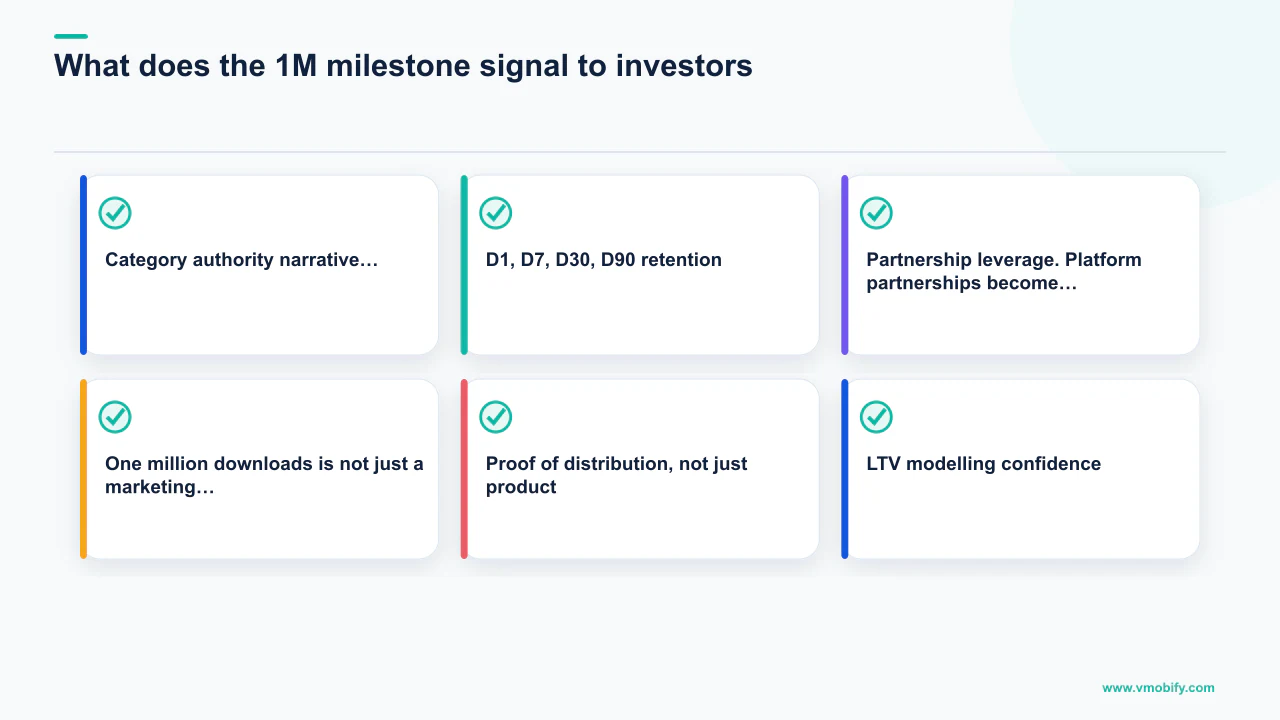
Here is what the 1M milestone specifically unlocks in investor conversations:
- Proof of distribution, not just product. Most seed-stage apps can demonstrate product-market fit with 10K–50K engaged users. The 1M milestone proves you have cracked distribution at scale—a fundamentally harder problem. Series A investors back businesses that have demonstrated both; the 1M threshold is often where investor conviction shifts from "interesting" to "fundable."
- Category authority narrative. "One of the top 5 budgeting apps in India by installs" is a claim that requires 1M+ downloads in most categories. That positioning simplifies the entire investor narrative: you are no longer explaining what the category is, you are demonstrating that you own a piece of it.
- LTV modelling confidence. At 1M installs, you have enough cohort data—D1, D7, D30, D90 retention by acquisition channel, geography, and user segment—to build credible LTV models with statistical confidence. Investors at Series A and beyond require this; apps with 50K installs are often asked to extrapolate, while apps with 1M installs are asked to explain.
- Partnership leverage. Platform partnerships (co-marketing with device OEMs like Samsung or Xiaomi, pre-install deals, bank or telecom bundle agreements) become accessible at the 1M threshold in most markets. These partnerships can add 200K–500K installs at near-zero marginal cost and represent a moat that later-stage competitors cannot easily replicate.
The 1M download number loses its signal value if it came from incentivised installs, CPI network fraud, or geographic markets with near-zero engagement. Investors increasingly ask for installs plus D30 active users plus revenue cohort data. Make sure your 1M installs include a compelling retention and revenue story, not just a headline number.
The practical implication: time your 1M milestone announcement—press release, LinkedIn post, pitch deck update—to coincide with a fundraising process or a strategic partnership negotiation. The number lands harder in context than as a standalone vanity post.
Vmobify has scaled multiple apps from zero to over 1 million downloads across fintech, OTT, edtech, and consumer categories. If you are building toward that milestone and want an expert team operating your channel stack, let us talk. You can explore the specific apps and verticals we have scaled on our case studies page. For teams earlier in the journey, our first 10K installs playbook covers the foundation you need to build before the scaling machine turns on.
Frequently Asked Questions
How long does it realistically take to reach 1 million app downloads?+
For consumer apps with D7 retention above 30% and a full paid channel stack, the median time from 10K to 1M installs in our portfolio is 9–14 months. Apps with D7 retention below 20% rarely reach 1M cost-efficiently—they either spend disproportionately on paid to compensate for poor retention, or plateau. Category matters too: gaming apps with viral loops can hit 1M in 3–4 months; B2C fintech apps in regulated categories often take 18–24 months.
What budget is required to reach 1 million downloads?+
Total paid UA spend to reach 1M depends heavily on organic contribution, retention quality, and category CPIs. Apps that build the flywheel well—strong ASO, referral programme, good ratings—typically spend ₹1.5Cr–₹4Cr ($200K–$500K) in blended paid UA to reach 1M because organic and referrals carry 30–40% of volume. Apps that rely purely on paid spend can require 2–3x that budget for the same install count. There is no shortcut around the flywheel.
Is the 1 million download milestone still meaningful in 2026?+
Yes, but context matters more than ever. One million downloads from a genuine user base with D30 retention above 15% and positive revenue cohorts is a strong signal. One million downloads from CPI network volume with 60% D1 churn is not. Investors, press, and platform editorial teams increasingly ask for installs plus engagement metrics—so pursue the milestone with quality, not just speed.
Which market is easiest to hit 1 million downloads in?+
India is the highest-volume, lowest-CPI market globally for most consumer app categories—a well-executed India-first strategy can reach 1M installs faster and more cost-efficiently than a US-first or EU-first approach. The trade-off is LTV: Indian users typically generate lower in-app revenue per user than US or EU users. For apps optimising for install volume and category leadership, India is the right primary market. For apps optimising for LTV and revenue, a US or EU primary market with India as a volume expansion market is more appropriate.
Should I pause paid UA once I hit 500K installs and let organic take over?+
No. The flywheel requires both paid and organic to keep spinning. Paid UA feeds the ratings and install-velocity signals that drive organic ranking; organic ranking and referrals lower blended CAC so paid UA becomes more efficient. Pausing paid at 500K typically causes a ranking regression that takes 3–6 months to recover from. What changes at 500K+ is the mix: reduce the share of budget going to broad prospecting, increase the share going to retargeting lapsed users and Spark Ads on proven organic content.
How important is App Store Optimisation at the 1M scale?+
Critically important—and more so than at earlier stages. At 1M download pace, you are accumulating keyword ranking data fast enough to identify page 2–3 clusters and push them to page 1 with targeted metadata updates. A single new page-1 keyword ranking for a 50K monthly search term adds 2,000–5,000 organic installs per month. Apps running paid UA at scale also benefit disproportionately from ASO improvements because every paid campaign that routes through the store listing converts at a higher rate after ASO work. We recommend running a full metadata audit every 90 days at this scale.
What role does creative play in reaching 1 million downloads?+
Creative is the primary performance variable above 500 installs per day. At that scale, the audience is large enough that creative fatigue—not audience saturation—is what drives rising CPIs. Teams that reach 1M consistently produce 10+ new creative variants per week, kill the bottom 50% by cost-per-retained-user every 7 days, and treat creative velocity as a competitive moat. A strong creative system at this scale typically delivers 20–30% lower CPI quarter-over-quarter compared to teams on a monthly or quarterly refresh cycle.
Sources
- AppsFlyer — State of App Marketing in India — Annual benchmark report on CPI, retention, and channel mix across global app markets.
- Apple Search Ads — Apple-native iOS keyword advertising — highest-intent paid iOS installs.
- Meta Advantage+ App Campaigns — Meta's automated app install product across Facebook and Instagram at scale.
- Google Ads App Campaigns Help — Official UAC setup, creative requirements, and bidding strategy documentation.
- Google Play Launch Best Practices — Store listing, experiments, in-app review API, and Play Store featuring guidance.
- Statista Smartphone Users India — Forecast data on India's 750M+ smartphone user base and growth trajectory.
- AppsFlyer Performance Index — Bi-annual ranking of paid UA channels by install volume, retention quality, and fraud rate.
- AppTweak ASO Blog — ASO research and keyword strategy guides used across our portfolio for metadata optimisation.
About the author
Amol Pomane — Founder, Vmobify
Amol leads Vmobify, a mobile app growth agency that has driven 30M+ downloads and ranked 54K+ keywords across 300+ apps since 2013. He writes about ASO, paid user acquisition, retention, and the operational reality of scaling mobile apps in India and global markets.
Model an install budget
Turn CPI and activation assumptions into acquisition scenarios.
Open free tool