How to Get Your First 10,000 App Installs: The 2026 Launch Playbook
The first 10,000 installs are the hardest—and the most important. Here is the exact launch playbook we use across our portfolio: pre-launch community building, a coordinated launch week, day-one ASO, micro-influencer cold outreach, review velocity, and your first paid experiment.
On this page
- Why is 10K installs the critical first milestone?
- What should you build before launch day?
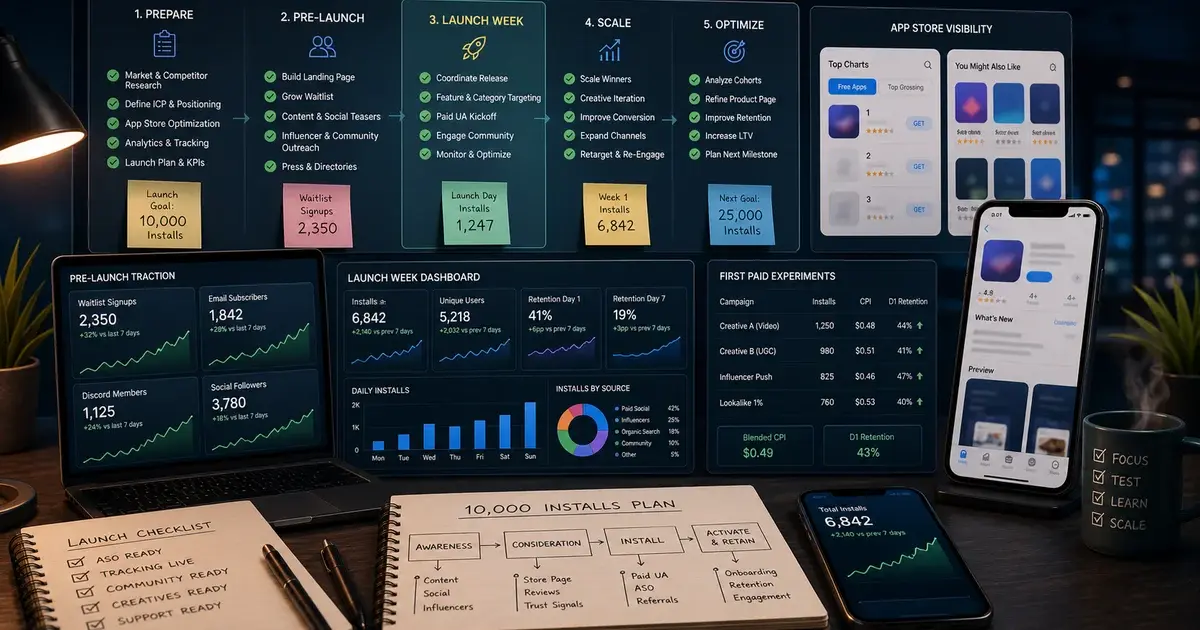
- How do you run a coordinated launch week?
- How do you set up ASO before spending a rupee on paid?
- How do you get your first 50 reviews fast?
- How does founder-led distribution accelerate the first 10K?
- How do you run a micro-influencer cold outreach campaign?
- When and how do you launch your first paid UA campaign?
- What does a real 0-to-10K journey look like?
- Frequently Asked Questions
Why is 10K installs the critical first milestone?
Ten thousand installs is not an arbitrary number—it is the threshold at which several compounding mechanisms switch on simultaneously and your app transitions from a hypothesis to a product with a market.
Here is what actually changes at 10K:
- Search ranking: Both the App Store and Google Play need sufficient install and engagement data to rank an app for long-tail keyword queries. Below 10K installs, most apps are effectively invisible to organic search. Above it, even modest ASO work starts to produce ranking movement. According to Sensor Tower's research, apps in the top 10 for any keyword cluster almost always have a minimum install base that puts them past this threshold in their category.
- Social proof: First-time visitors convert at a dramatically higher rate when an app has 50+ reviews. A listing with fewer than 10 reviews triggers scepticism in even motivated users. Accumulating those first 50 reviews requires a deliberate strategy—explored in the review velocity section below.
- Paid UA learning: Google App Campaigns and Meta Advantage+ App Campaigns both require a minimum volume of in-app conversion events before their algorithms exit the learning phase. That volume typically arrives between 5K and 15K installs, depending on your in-app action rate. Below it, your bids are effectively flying blind.
- Qualitative insight: At 10K users you have enough variance to run a meaningful survey, identify the 20% who truly love the product, and design your growth around their profile. At 500 users, every signal is noise.
In short, 10K installs is the minimum viable distribution. Getting there is primarily about founder hustle, community seeding, and launch-week coordination—not media buying. The tactics below are sequenced in the exact order we run them across our portfolio.
What should you build before launch day?
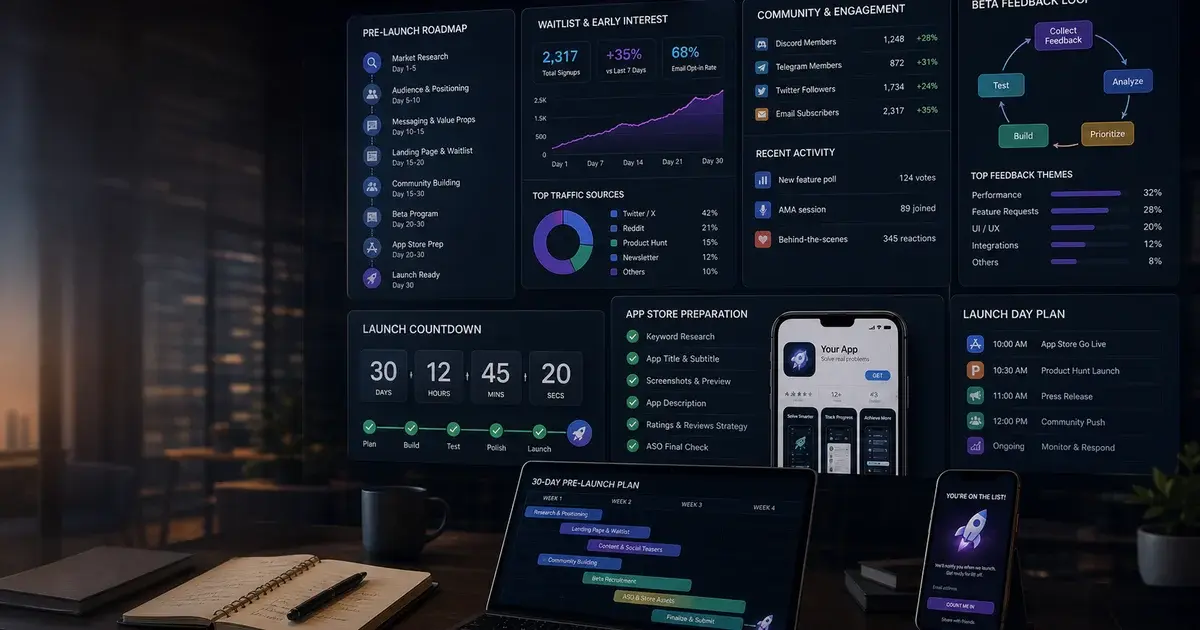
The single biggest mistake first-time app founders make is treating launch day as the starting gun—by launch day, you should already have an audience waiting, a community primed, and 50 beta users who feel genuine ownership over the product.
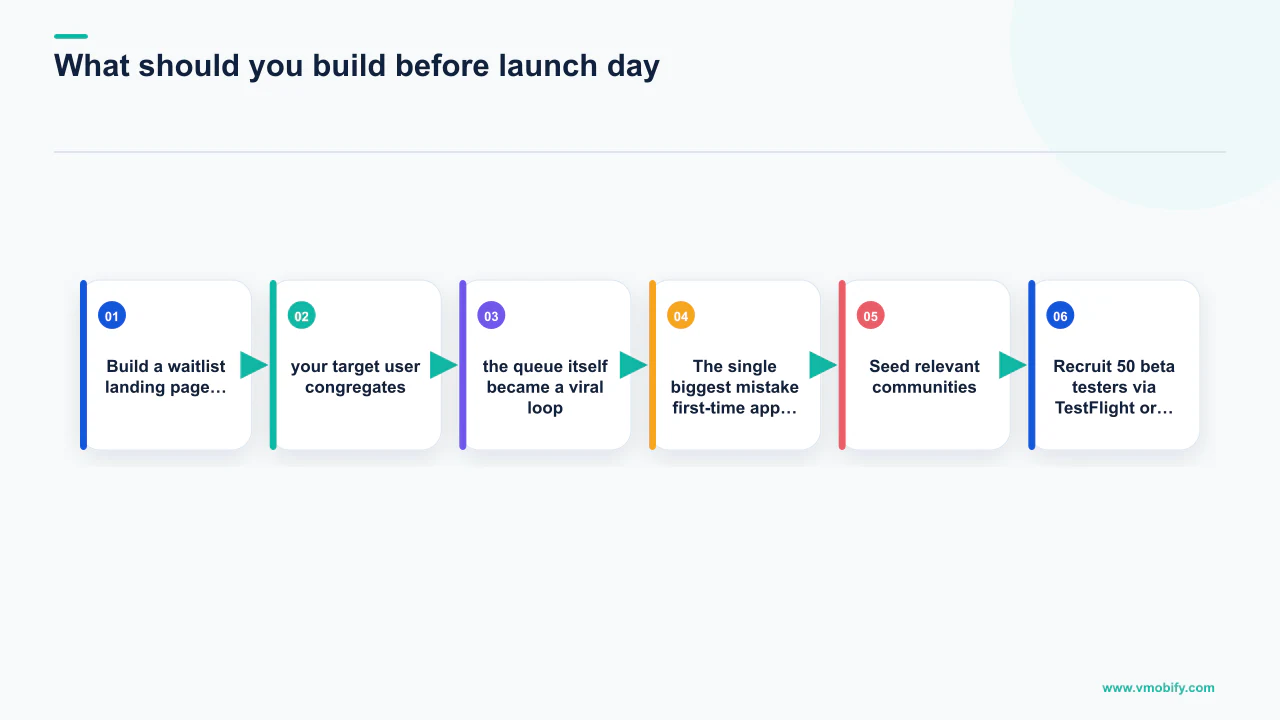
Start six to eight weeks before your planned launch date with these three parallel tracks:
- Build a waitlist landing page. A single-page site explaining the problem you solve and a prominent "Join the waitlist" email capture can be live in hours using Webflow, Carrd, or a simple Next.js page. Drive traffic to it via your personal LinkedIn and Twitter network, targeted Facebook lead ads (₹5,000–₹10,000 is enough to gather 500–1,000 signups), and an early announcement in relevant communities. These are your Day 1 installers. Monzo is the canonical example: its pre-launch waitlist of 200,000 people created a genuine scarcity dynamic (an invite system) and turned waiting into social currency—a motion that cost almost nothing and generated sustained press coverage before a single feature was live.
- Seed relevant communities. Identify 10–15 communities where your target user congregates—Reddit subreddits, Facebook Groups, LinkedIn communities, Discord servers, WhatsApp groups, and vertical-specific forums. Do not post download links. Participate genuinely for four to six weeks before launch: answer questions, share useful content, offer your expertise. When you announce your launch, it reads as an organic update from a trusted member rather than spam—and converts at three to five times the rate of a cold announcement. Notion's template community, seeded before its public launch by the founding team personally embedding in productivity subreddits and Facebook groups, is the best-documented example of this motion at work.
- Recruit 50 beta testers via TestFlight or Google Play Internal Testing. Run a closed beta four to six weeks before launch. Source testers from your communities, waitlist, and personal network. The goal is not just bug-finding—it is ownership. Beta testers who feel they shaped the product become your most passionate launch-day ambassadors. Mailbox (acquired by Dropbox) ran a pre-launch reservation system that put 800,000 people in a queue—the queue itself became a viral loop because each person could see their position and share it.
Across the pre-launch campaigns we have run for portfolio apps, a well-executed six-week waitlist and community-seeding programme consistently delivers 800–2,500 day-one installs—before a single paid rupee is spent. That install surge on launch day is exactly what the store algorithms reward with temporary ranking boosts.
The pre-launch phase also gives you time to complete your ASO setup (covered below) and brief any micro-influencers (covered further below) so they post on launch day, not three weeks after.
How do you run a coordinated launch week?
A coordinated launch week compresses what would otherwise be three months of scattered installs into a 48–72 hour surge—and that surge is the signal both stores use to decide whether to rank and feature you.
The key is sequencing. Here is the exact order we run for portfolio apps:
- Hour 0–2: Email your waitlist. Send a personalised launch email to every waitlist subscriber with a direct download link, a one-paragraph explanation of what is new since they signed up, and a specific ask: "Download and leave us a review if you enjoy it." Warm audiences convert at 15–30%; this is your fastest, cheapest first-hour install spike.
- Hour 2–6: Post in your seeded communities. Drop a genuine launch announcement in every community you have been nurturing. Be specific about the problem you solve, link the exact store page, and thank the members who gave feedback during beta. Do not copy-paste the same post—tailor it to each community's tone.
- Hour 6–12: Go live on Product Hunt. A top-5 Product Hunt finish can deliver 500–2,000 installs in a single day. Prepare a compelling tagline (under 60 characters), a short 30-second demo GIF or video, and ask your personal network to upvote early in the morning US Pacific time (when PH resets and early votes count most). Product Hunt skews toward tech-savvy early adopters—ideal for productivity, developer tools, fintech, and B2B apps.
- Day 2: Creator wave. Your briefed micro-influencers (see below) post on this day. Stagger them across morning and evening for maximum feed coverage. Each post should use a unique UTM-tagged deep link so you can track installs precisely.
- Day 2: Reddit AMA. Post an "I built [app name], AMA" thread in the most relevant subreddit. Be transparent, be generous with information, and do not pitch. Reddit AMAs that convert to installs do so because they build trust, not because they include a download link. Include the link once, at the end, after you have answered at least 10 questions genuinely.
- Day 3: Turn on paid campaigns. Only after your organic and community channels have created initial install momentum should you turn on paid. This sequencing matters: the algorithm will learn faster when it has organic install patterns to match against.
Submit to app directories (AppAdvice, AppGrooves, and vertical-specific lists) one to two weeks before launch day so coverage goes live on the same day as your other channels. Staggering these by even a few days means you miss the compounding install-velocity signal that the stores reward.
High-impact launch channels
- Waitlist email blast (15–30% conversion)
- Product Hunt (500–2,000 installs / day)
- Seeded community posts (3–5x cold post CTR)
- Micro-influencer wave (tracked via UTM)
- Reddit AMA (trust-first, link last)
Common launch mistakes
- Posting the same copy to every channel
- Turning on paid before organic creates momentum
- Product Hunt without a briefed upvote network
- No UTM tracking on influencer posts
- Launching on a Friday (low US/EU visibility)
How do you set up ASO before spending a rupee on paid?
ASO before paid spend is not optional—it is the prerequisite that determines whether every paid rupee converts or leaks. A store listing that is not optimised will waste 30–60% of paid UA budget by sending motivated users to a listing that does not convert. Our ASO team fixes this before we run a single ad for any new portfolio app.
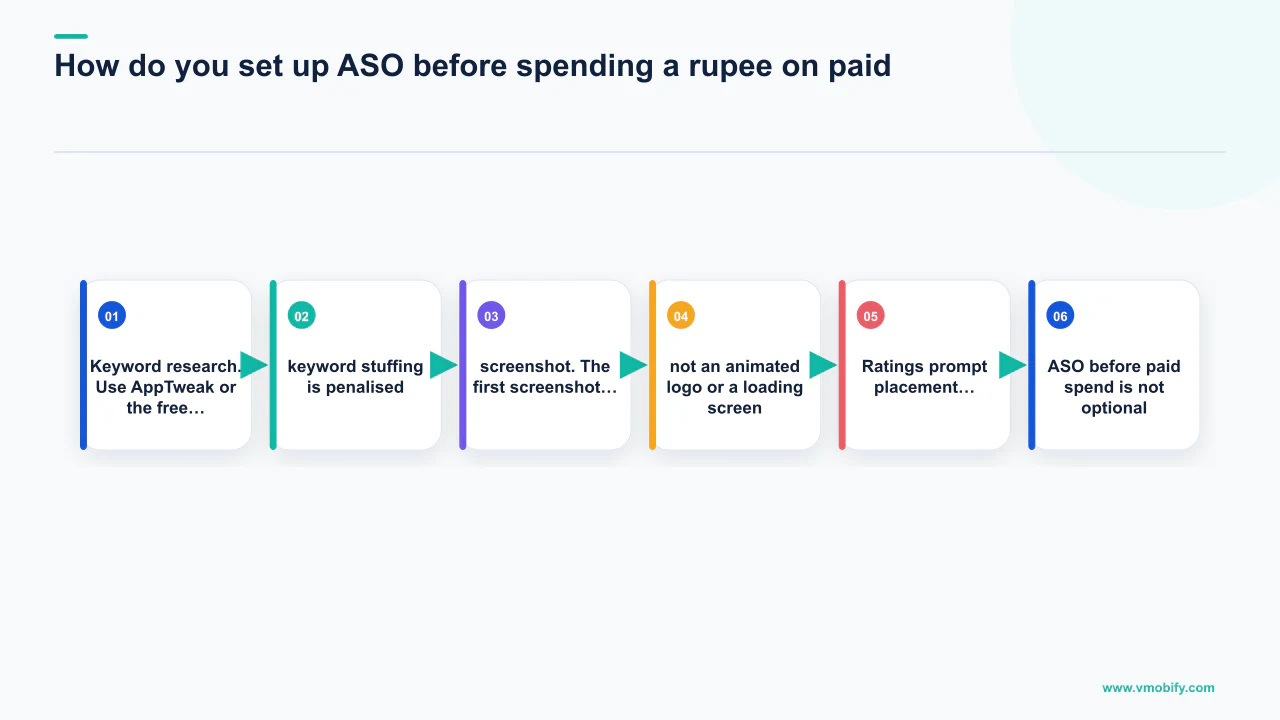
Here is the day-one ASO checklist:
- Keyword research. Use AppTweak or the free autocomplete in the App Store and Google Play search bars to identify 10–15 keywords relevant to your app. Rank them by estimated search volume and competition. On day one, target medium-competition keywords—you will not rank for "photo editor" in month one, but you might rank for "photo editor for Instagram captions."
- Title and subtitle. Your primary keyword must appear in the title. Your secondary keyword goes in the subtitle (App Store) or short description (Google Play). Keep both readable—keyword stuffing is penalised by the stores and reads as spam to human visitors. A fintech app titled "ClearSave: Budget & Save Money" will begin ranking for "budget app" and "save money app" within weeks of launch.
- First screenshot. The first screenshot is the highest-impact creative asset you own—it is the only one most users see without scrolling. It should communicate your primary benefit in a single frame, with a benefit headline in large text. A screenshot that shows a feature list instead of a benefit will convert at half the rate.
- Preview video. A 15–30 second preview video (optional on the App Store, shown prominently on Google Play) lifts install conversion by 20–35% in our portfolio tests. The first two seconds must show the core value—not an animated logo or a loading screen.
- Ratings prompt placement. Implement SKStoreReviewManager (iOS) or the Play In-App Review API (Android) at a high-satisfaction moment in your onboarding—after the user completes a key action, not on first open. First-open prompts are declined 70–80% of the time and waste one of your limited annual prompt opportunities.
Never launch a paid UA campaign to an unoptimised store listing. In our portfolio, apps that run paid before fixing ASO see 40–60% of spend wasted on users who view the listing but do not install. Fix the listing first; it takes two days and will outperform any creative or audience optimisation you do on the paid side.
For a full keyword and metadata audit framework, see our complete ASO guide. If you want expert help, our ASO service includes a full metadata rewrite, screenshot redesign, and preview video production as a single engagement.
How do you get your first 50 reviews fast?
Fifty reviews is the threshold at which a store listing crosses from "unproven" to "trusted" in the eyes of most potential installers—and getting there in the first 30 days requires a deliberate strategy, not wishful thinking.
According to SplitMetrics research, a 4.5-star app converts 30–40% better than a 3.8-star app for the same keyword. That conversion lift applies to every install source you have—organic, paid, community, and referral. Reviews are the cheapest conversion rate optimisation you will ever do.
Here is how to accelerate to 50 reviews:
- Email your beta testers and waitlist on launch day. These users already have context and goodwill. A personal email from the founder—"We launched today, would mean the world if you left us a review"—converts at 10–25%. Fifty beta testers plus 500 waitlist subscribers should yield 15–40 reviews from this single email.
- Trigger the native in-app review prompt at the right moment. Implement the prompt at a moment of demonstrated satisfaction: after a user completes a workout, makes a successful payment, reaches a milestone, or finishes their first meaningful session. The moment should feel natural, not transactional. Prompts at moments of value convert at 35–50%; prompts at launch convert at 5–10%.
- Add a review ask to your onboarding email sequence. Day 3 or Day 5 of your new-user email sequence is the right time to ask. By then the user has either found value or churned—ask only the retained segment, which you can identify by checking last-session data before triggering the email.
- Respond to every review for the first 90 days. Responding to reviews (both positive and negative) signals to both stores that you are an active developer, which is a lightweight ranking signal. It also converts negative reviewers into advocates at a rate that surprises most founders—about 30% of 1-star reviewers who receive a personal, solution-focused response will update their rating.
In our portfolio, apps that follow this four-step review strategy reach 50 reviews within 21–35 days of launch. Apps that rely on organic reviews alone typically take 90–120 days to reach the same count—losing three months of conversion lift on every paid and organic install source.
How does founder-led distribution accelerate the first 10K?
Founder-led distribution—building in public on LinkedIn and X/Twitter, personal cold outreach, and direct community participation—is the most underrated install channel at the 0-to-10K stage, because it creates trust that no paid campaign can manufacture.
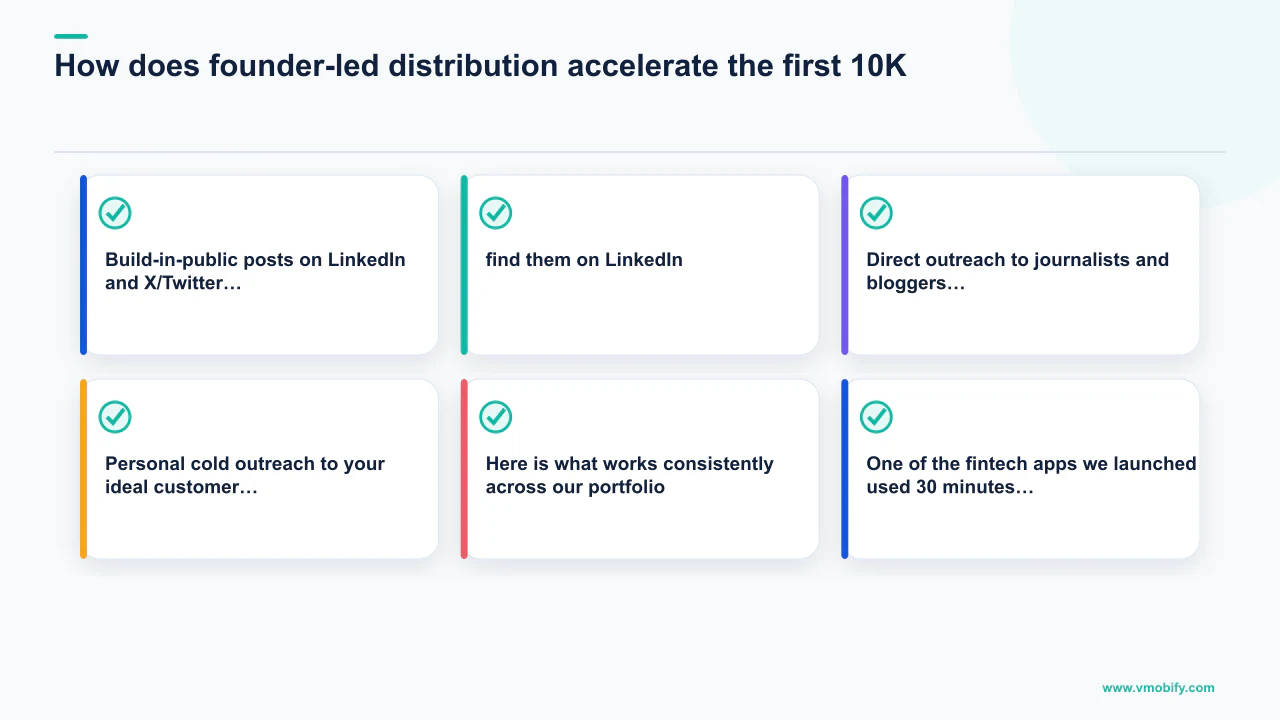
Here is what works consistently across our portfolio:
- Build-in-public posts on LinkedIn and X/Twitter. Weekly posts documenting the product journey—what you shipped, what you learned, what surprised you—generate an audience of future users who feel invested in the outcome. Posts that include a specific milestone ("we hit 1,000 installs today—here is what worked and what did not") perform significantly better than generic product announcements because they are genuinely interesting to the professional audience on both platforms. AppsFlyer's State of App Marketing consistently shows that apps with strong social media presence from the founder generate 20–40% higher organic install rates in the first 90 days.
- Personal cold outreach to your ideal customer profile. Identify 100 people who are a perfect fit for your app—find them on LinkedIn by job title, on Reddit by their posting history, or in communities by their activity. Send each a brief, personalised message (not a template blast): explain why you built the app, why you think it solves a problem they have, and ask for five minutes of feedback. You are not asking for an install—you are asking for feedback. The install rate from this approach is 20–40% because the ask is low-friction and the message is obviously personal.
- Direct outreach to journalists and bloggers. Dozens of publications cover new apps: AppAdvice, Android Police, iMore, TechCrunch's app coverage, YourStory and Inc42 for Indian apps. Write a three-paragraph pitch email: the problem, your solution, and why it is newsworthy now. Attach a press kit (icon, screenshots, demo video, founder headshot). One article in a mid-tier publication drives 200–500 installs. Five articles compound into a meaningful organic install baseline.
One of the fintech apps we launched used 30 minutes per day of founder LinkedIn posting plus 20 personalised DMs daily for six weeks. The combination delivered 1,800 installs at zero paid cost—and created a media footprint that earned three press mentions and a ProductHunt "App of the Day" badge.
How do you run a micro-influencer cold outreach campaign?
At the 10K installs stage you almost certainly cannot afford macro-influencer rates—but micro-influencers (5K–100K followers) in your niche will often work on barter terms for early-stage apps, and they convert at three to five times the rate of a paid mega-influencer post on a per-follower basis.
Here is the cold outreach playbook:
- Build a list of 30–50 micro-influencers. Use Instagram search, TikTok creator search, and YouTube keyword search to find creators whose content is directly relevant to your app's use case. For a fitness app, look for creators who post workouts, nutrition content, or gym-lifestyle content. Prioritise engagement rate over follower count—a 20K-follower creator with 6% engagement outperforms a 200K-follower creator with 0.8% engagement every time. Use Statista's influencer market data as a benchmark for rate expectations by tier.
- Personalise every outreach email. The subject line should reference their specific content ("Your post on [topic] — quick question"). The body should be under 100 words. Here is the template we use across our portfolio campaigns:
"Hi [Name], I loved your [specific post or video]. I built [App Name]—it solves [one-line problem statement]. I think your audience would genuinely find it useful because [one specific reason tied to their content]. Would you be open to trying it for free in exchange for an honest post if you like it? No scripts, just your real take."
This template converts at 15–25% response rate. The keys: reference specific content, make the ask tiny (a trial, not a commitment), and explicitly give creative freedom. - Send lifetime premium access, not cash. At the 10K stage, offering lifetime premium access to your app is worth more to the creator than a small cash payment—it signals that you have genuine confidence in the product. It also means the creator has a personal stake in the app's success, which produces more authentic content.
- Track everything with unique UTM deep links. Generate a unique install link for each creator using a service like Adjust, Branch, or Firebase Dynamic Links. This lets you measure installs per creator, calculate true CPI for each partnership, and double down on the top performers with paid Spark Ads or boosted posts once you have organic proof of conversion.
The best time to send influencer outreach emails is Tuesday or Wednesday between 9am and 11am in the creator's timezone. Response rates are 30–40% higher than Monday or Friday sends. Follow up once, five days later, with a one-sentence nudge—never twice.
For a broader creative strategy that scales beyond the first 10K, see our mobile app creative strategy guide.
When and how do you launch your first paid UA campaign?
Your first paid UA campaign should start only after your store listing is optimised and your organic channels have created initial install momentum—and it should be treated as a signal-gathering experiment, not a scale play.
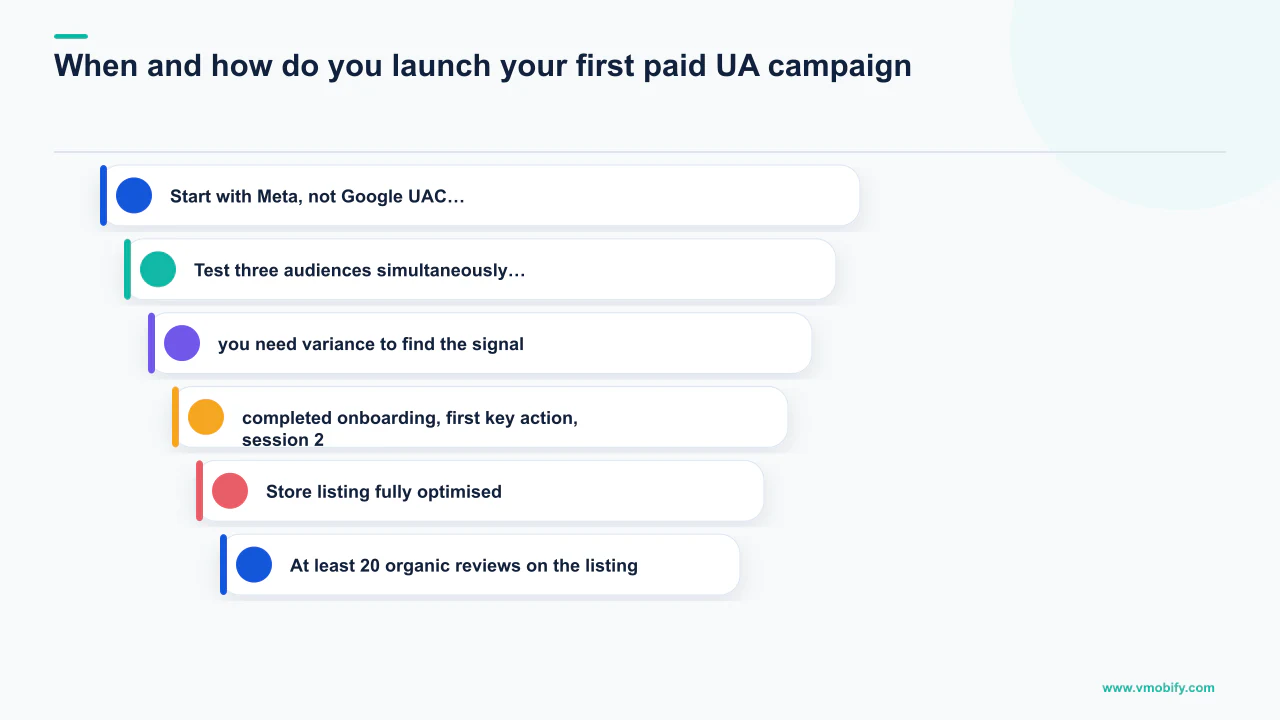
Here is the precise setup we use for first paid campaigns on a ₹15,000–₹30,000 budget:
- Start with Meta, not Google UAC. Google App Campaigns require at least 50 in-app conversion events per week before the algorithm exits the learning phase. On a small budget that takes too long. Meta App Install campaigns can produce learnings faster because you control audience targeting manually and can see creative-level performance within three to five days. Our user acquisition team runs Meta App Campaigns for 50+ apps and consistently sees CPIs 25–35% below category benchmarks within the first two weeks.
- Test three audiences simultaneously. Run three ad sets in parallel: (1) interest targeting based on your app category, (2) lookalike of your email waitlist (upload the CSV to Meta), and (3) broad targeting with no interests—let Meta's algorithm find users independently. Set each at ₹500/day for seven days. The winning audience tells you where your user is concentrated, and that insight is worth far more than the install volume itself.
- Test three creatives per audience. For each ad set, run three variants: a screenshot carousel, a short 15-second demo video, and a testimonial quote card from a beta user. The creative that drives the lowest CPI in your test becomes the foundation for scale. Never run a single creative—you need variance to find the signal.
- Measure post-install, not just install. Set up an in-app event—completed onboarding, first key action, session 2—as your real conversion metric. The audience and creative combination that drives the lowest cost per in-app event is the winner, even if its raw CPI is not the lowest. Installs that do not engage are worthless; this is where most early-stage campaigns waste money.
When to start paid (green lights)
- Store listing fully optimised (title, screenshots, preview video)
- At least 20 organic reviews on the listing
- MMP attribution configured (AppsFlyer, Adjust, or Singular)
- In-app event tracking firing correctly
- Onboarding tested with at least 50 users — known drop-off points fixed
When NOT to start paid (red flags)
- Store listing still using default or draft screenshots
- Fewer than 10 reviews (listing looks abandoned)
- No MMP — cannot measure post-install events
- D1 retention below 20% (paid installs will immediately churn)
- No creative variants — single ad creative cannot teach you anything
Once you identify a winning audience and creative, you have proof of a viable paid acquisition channel. For the next phase—scaling from 10K to 100K and beyond—see our how to get 1 million app downloads guide. For high-volume install campaigns with cost-per-install pricing, our CPI network service can supplement paid channels from day 30 onwards.
What does a real 0-to-10K journey look like?
Here is a compressed account of a real 0-to-10K campaign from our portfolio—a personal finance app targeting salaried professionals in Tier-1 Indian cities, launched in Q1 2026, that reached 10,000 installs in 28 days.
Weeks –6 to –1 (Pre-launch): The founding team joined six relevant Reddit communities and three LinkedIn groups, participating daily without any product promotion. They built a waitlist landing page that collected 740 signups via organic LinkedIn posts and ₹6,000 in Facebook lead ads. Fifty beta testers were recruited via a Google Form shared in a personal finance WhatsApp group. ASO was finalised: primary keyword "salary tracker India" in the title, benefit-led first screenshot, 22-second preview video. Fourteen micro-influencers in the personal finance creator niche were briefed and given lifetime premium access in exchange for launch-day posts.
Days 1–3 (Launch week): The waitlist email (740 recipients) went out at 8am on launch day, generating 187 installs by noon. Community posts in three seeded subreddits and two LinkedIn groups drove a further 340 installs by end of day. A ProductHunt submission reached 8th place (Product of the Day), driving 412 installs. On Day 2, nine creator posts went live across Instagram and YouTube Shorts, generating 680 tracked installs via unique UTM links. A Reddit AMA in r/IndiaInvestments ran on Day 3 and drove 290 installs. Total Day 1–3 installs: 1,909. No paid spend.
Days 4–7 (First paid experiment): Meta App Installs campaign launched with three audiences (interest: personal finance; lookalike: waitlist CSV; broad) and three creatives each. Budget: ₹1,000/day total. By Day 7, the lookalike audience driving the lowest cost per completed-onboarding event was identified. A further 640 installs at an average CPI of ₹19.40.
Days 8–28 (Scale and referral): The winning Meta audience was scaled to ₹3,000/day. Five of the 14 influencers had measurable conversion rates above 3%; they were offered paid follow-up posts. A simple referral mechanic ("invite a friend, both get 3 months premium") was shipped on Day 12. The in-app review prompt was triggered after users completed their first monthly budget. Total installs Days 8–28: 7,451. Blended CPI across paid and organic: ₹11.20.
10,000 installs. 63 App Store reviews (avg 4.6★). ₹83,960 total spend (paid UA + pre-launch lead ads). Effective cost per install across all channels: ₹8.40. The app was generating enough data for Google UAC's learning phase to begin on Day 29.
This is not an outlier. Across 300+ apps in our portfolio, apps that follow this exact sequence—pre-launch community seeding, coordinated launch week, ASO before paid, review velocity programme, founder-led distribution, and a structured first paid experiment—consistently reach 10K installs in 21–45 days.
If you want help building and executing this playbook for your app, talk to our team. We have helped dozens of apps reach their first 10K milestone—and then scaled them from there. See our case studies for examples across fintech, OTT, edtech, and consumer apps. For the full framework that takes you from 10K to 1M, see our app download growth playbook.
Frequently Asked Questions
How long does it realistically take to get 10,000 app installs?+
With a coordinated pre-launch and launch-week strategy (waitlist, community seeding, ProductHunt, creator wave, and a small paid experiment), 21–45 days is achievable for most consumer and B2B apps. Without a deliberate plan, the same milestone typically takes 4–8 months. The difference is almost entirely in pre-launch preparation, not post-launch spend.
Do I need a paid UA budget to reach 10K installs?+
No. Across our portfolio, well-executed pre-launch community building, a coordinated launch week, and founder-led distribution regularly deliver 3,000–6,000 installs at zero paid cost. Paid UA is a multiplier for apps with a working organic and community channel—not a substitute for one. We recommend treating the first ₹15,000–₹30,000 in paid spend as a signal-gathering experiment rather than a scale play.
Should I launch on the App Store, Google Play, or both simultaneously?+
Launch simultaneously if your development and ASO timelines allow it, because a split launch wastes the install-velocity signal. If you must prioritise, launch on the platform where your target user is most concentrated first, then launch the second platform within two to four weeks. An Android-first launch is typically easier in India due to lower review and submission friction. iOS-first makes sense for premium apps targeting urban professionals or international markets.
What is the minimum viable ASO before my first paid campaign?+
Title with primary keyword, subtitle or short description with secondary keyword, benefit-led first screenshot, a preview video (even a basic screen recording is better than none), and at least 20 reviews. Everything beyond that is optimisation. Do not spend on paid until these five elements are in place—every paid rupee leaks without them.
How do I get reviews without violating App Store or Google Play guidelines?+
Both stores prohibit incentivised reviews (rewarding users for rating the app) and third-party review-buying services. The compliant approach is to use the native in-app review APIs—SKStoreReviewManager on iOS and the Play In-App Review API on Android—triggered at moments of demonstrated user satisfaction. You can also email engaged users to ask for honest feedback; the key word is "honest." Never ask for "5-star" reviews—that phrasing alone can trigger store policy enforcement.
Is ProductHunt worth doing for every type of app?+
ProductHunt is worth doing for apps with a strong tech-savvy or professional early-adopter demographic: productivity tools, developer apps, fintech, B2B SaaS, and design tools consistently perform well. Casual games, regional-language apps, and apps targeting non-tech demographics typically see lower ProductHunt ROI—the audience skew is real. For those apps, a concentrated Reddit and community launch delivers better-qualified installs.
When should I start a referral programme?+
Once you have 500–1,000 users who have experienced the core value of your app—not before. A referral programme launched to users who have not yet found value will generate near-zero shares and may train your best users to think of the app as transactional rather than essential. The right trigger is reaching your "aha moment" retention marker—whatever event correlates most strongly with long-term retention in your onboarding data.
Sources
- Apple Search Ads — Highest-intent paid iOS installs — Apple-native keyword advertising.
- Google Ads App Campaigns Help — Official UAC setup, creative requirements, and learning-phase documentation.
- Google Play launch best practices — In-App Review API and store listing experiment guidance from Google.
- AppTweak ASO blog — Keyword research methodology and ASO benchmarks.
- SplitMetrics ASO research — Independent data on store conversion lifts from icon, screenshot, and preview video tests.
- AppsFlyer — State of App Marketing in India — Annual industry benchmark on CPI, retention rates, and channel mix.
- Adjust resources hub — MMP attribution setup guides and mobile fraud taxonomy.
- Statista India Influencer Market — India influencer marketing spend benchmarks by creator tier.
About the author
Amol Pomane — Founder, Vmobify
Amol leads Vmobify, a mobile app growth agency that has driven 30M+ downloads and ranked 54K+ keywords across 300+ apps since 2013. He writes about ASO, paid user acquisition, retention, and the operational reality of scaling mobile apps in India and global markets.
Model an install budget
Turn CPI and activation assumptions into acquisition scenarios.
Open free tool