Mobile App Creative Strategy 2026: Formats, Testing & Fatigue Signals
Creative is now the single most decisive variable in mobile UA — accounting for approximately 56% of incremental app installs. This guide covers every format in the 2026 taxonomy (UGC, AI-generated, polished produced, motion graphic, gameplay capture, testimonial), hook science, platform-native adaptation, creative refresh cycles, and AI tooling — with specific numbers for fintech, gaming, and India Tier 2/3.
On this page
- Why is creative now the #1 variable in mobile user acquisition?
- What are the five core creative formats and when should you use each?
- How do you engineer a high-performing hook in the first three seconds?
- How do you run creative testing at scale with Meta Advantage+, Google ACO, and TikTok ACO?
- What are the fatigue signals that tell you a creative needs replacing?
- How do you adapt creative to be platform-native across TikTok, Meta, YouTube, and AppLovin?
- How do you use AI tools to produce creative at 50× the volume without losing quality?
- How do you build a seasonal creative calendar for India and global markets?
- What are the creative rules specific to gaming and fintech apps?
- How do you source, brief, and manage UGC creators at scale?
- How do you combine all formats into a full-funnel creative architecture?
- Frequently Asked Questions
Why Is Creative Now the #1 Variable in Mobile User Acquisition?
Mobile UA in 2026 has one decisive battleground: the ad creative. According to Meta's own internal research, creatives now drive approximately 56% of incremental app installs — outweighing audience targeting, bidding strategy, and even budget size combined. This is a structural shift, not a cycle, and understanding why it happened is essential before optimising for it.
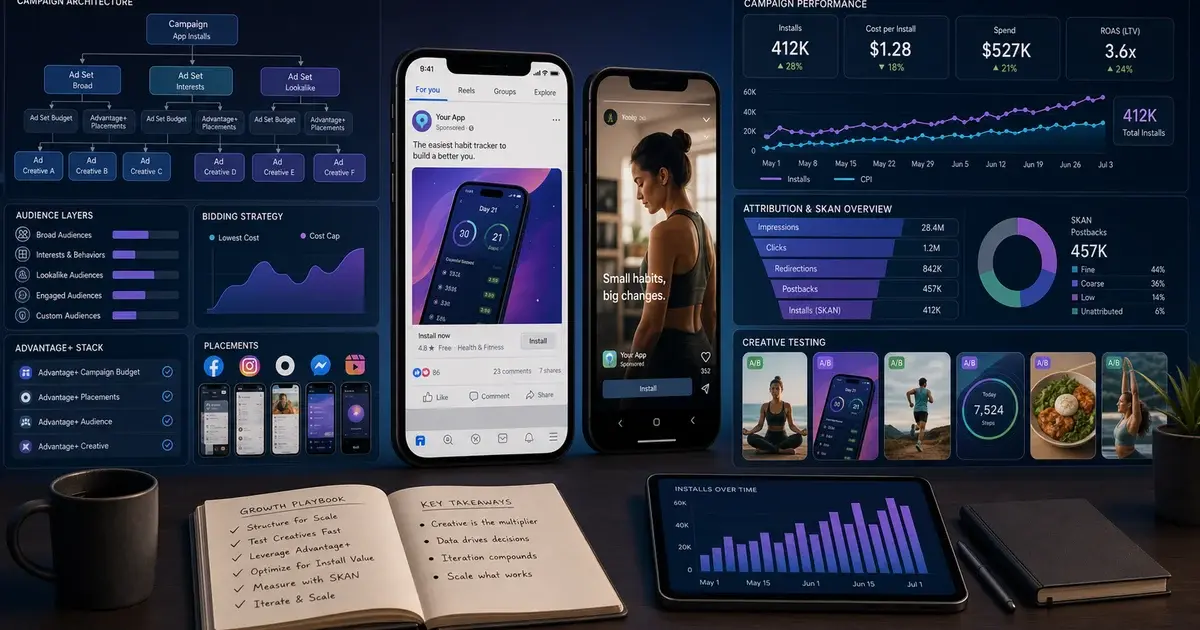
Three forces converged to produce this outcome. First, privacy deprecation: iOS ATT, the progressive removal of GAID-level targeting on Android, and the continued loss of third-party signal have homogenised the targeting capability available to any given advertiser. When you and your competitor are both running broad Advantage+ targeting into the same demographic cohort, the creative in the auction determines who wins — the targeting edge no longer exists. Singular's UA resources consistently document that creative variation now accounts for a greater share of CPI variance than any targeting parameter in privacy-restricted environments.
Second, algorithmic maturity. Meta Advantage+, Google App Campaigns, and TikTok's Smart Performance Campaigns have all shifted optimisation responsibility squarely to their models. Advertisers who fight the algorithm with manual audience stacking consistently underperform those who supply creative volume and let the platform's ML find buyers. The practical implication: your highest-leverage UA skill is creative production and testing, not audience segmentation.
Third, saturation. The average mobile user in a major market is served hundreds of app install ads weekly. Vanilla banner and static video creative no longer produce the thumb-stop rates that justify spend at competitive CPMs. Only formats with genuine engagement mechanics — interactive playables, authentic UGC, sharp narrative hooks — cut through at economics that work. Fast-growing companies now test 11× more creatives than average-performing peers, and teams launching 20–50 creative variations weekly are consistently out-competing those stuck in monthly batch-production cycles.
In our portfolio across 300+ app campaigns, the single most consistent finding is the correlation between creative investment — production velocity and test cadence — and blended CPI. Apps that treat creative as an infrastructure investment rather than a campaign line item outperform competitors by 30–50% on CPI at equivalent scale. For the full paid UA framework that this creative engine sits inside, see our user acquisition service.
What Are the Five Core Creative Formats and When Should You Use Each?
A mature creative programme in 2026 does not run a single format — it operates a portfolio of five distinct creative types, each optimised for different funnel positions, platforms, and audience states. Conflating them or running one exclusively is the most common structural mistake in mobile UA creative strategy.
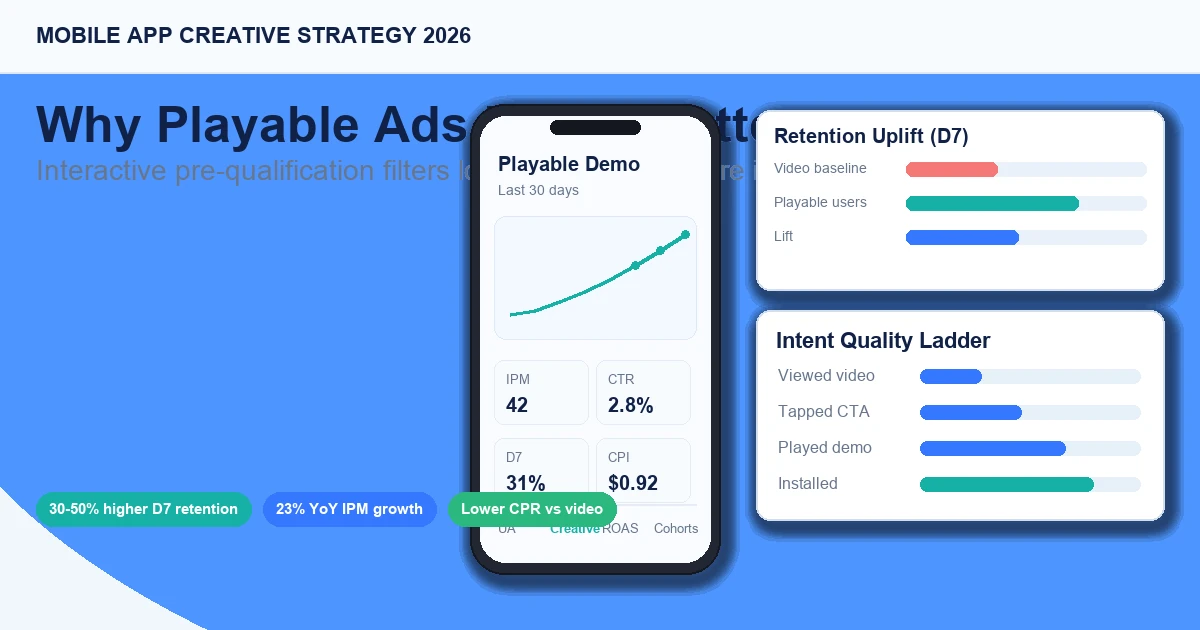
The highest-ROAS accounts in our portfolio run all five formats simultaneously, rotating budget across them based on fatigue signals and funnel position rather than committing to a single "best" format.
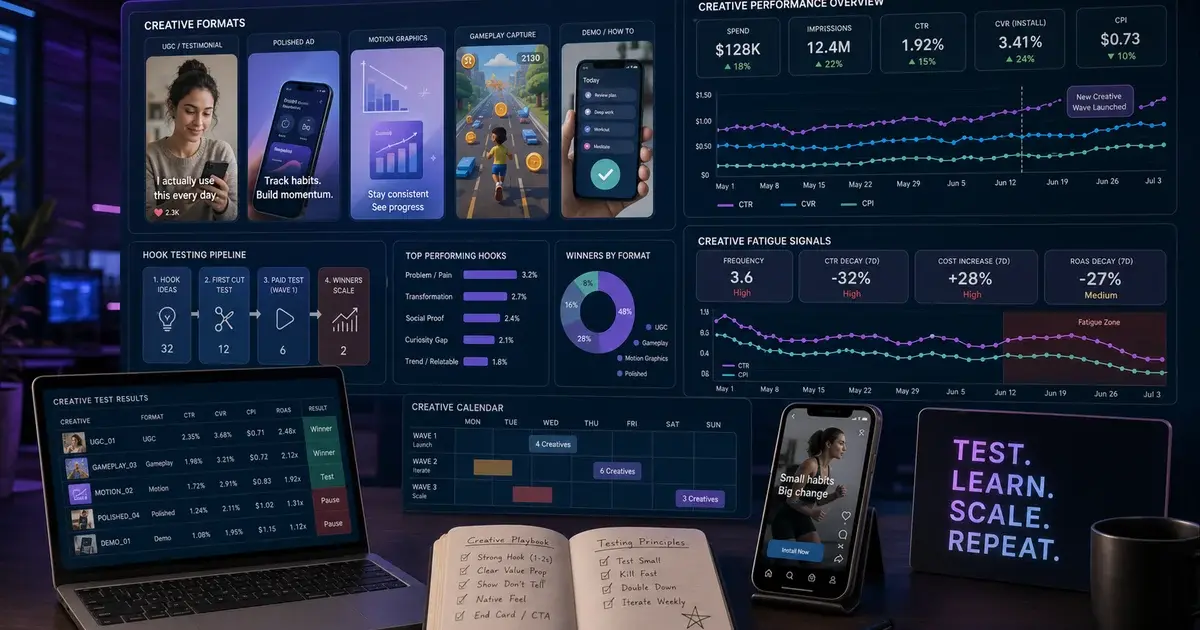
- UGC (User-Generated Content): Creator-to-camera video mimicking organic social content. No logo in the first two seconds, authentic aesthetic, feed-native feel. Best for: cold prospecting on Meta, TikTok, Instagram. Strength: thumb-stop rates and feed-nativeness. Weakness: fatigues in 7–10 days; requires continuous production pipeline. Ideal budget share: 40–50% of creative production spend.
- Polished Produced: Brand-directed video with professional production values, scripted voiceover, motion design. Best for: retargeting, YouTube pre-roll, brand-safety-sensitive placements, fintech and health where compliance review is required. Strength: durability (fatigues 2–3× slower than UGC), brand consistency. Weakness: high production cost, lower hook rate on social feed inventory. Ideal budget share: 15–20%.
- Motion Graphic: Animated explainer or benefit-showcase creative, typically 15–30 seconds. Best for: Google UAC Discovery placements, utility apps with features that are hard to demonstrate in talking-head video, and A/B testing messaging without a full shoot. Strength: fast iteration on messaging, low cost, platform-agnostic. Weakness: lower authenticity signal; performs poorly on TikTok where creator-native feel dominates. Ideal budget share: 15%.
- Gameplay Capture: Real gameplay footage, typically raw or lightly edited, for gaming apps. Best for: AppLovin MAX, ironSource, and TikTok gaming inventory. Strength: real gameplay footage delivers a median CTR of 4.27% on iOS versus 3.34% for stylised trailers. Weakness: requires frequent refresh as the same gameplay clip saturates your audience. Ideal budget share: 15% (gaming apps); 0% (non-gaming).
- Testimonial: Real user or expert speaking to outcomes. Best for: fintech, health, and education apps where trust is the primary purchase barrier; works in retargeting layers on Meta. Strength: credibility and social proof. Weakness: authenticity must be genuine — scripted testimonials read as scripted and underperform. Ideal budget share: 10–15%.
The distribution across formats should shift by funnel stage. Cold audiences respond best to UGC and gameplay capture (high thumb-stop, feed-native). Warm audiences (store page visitors, lapsed users) respond best to polished produced or testimonial formats that reinforce credibility. AppsFlyer's Performance Index data shows apps running multi-format creative portfolios achieving 20–35% better blended CPI than apps committed to a single format type.
How Do You Engineer a High-Performing Hook in the First Three Seconds?
The first three seconds of a mobile ad determine whether a user scrolls past or watches through — and on TikTok, the top-decile hook rate is 55% versus a median of 33%. Engineering that gap systematically is the highest-ROI creative skill in mobile UA.
Hook rate (the percentage of users who watch past the first 3 seconds) is now the leading indicator for full creative performance. According to data from Benly's 2026 ad creative benchmarks, UGC consistently outperforms polished produced creative on hook rate by 31–44% on Meta and TikTok — specifically because the organic visual language signals "this is not an ad" in the critical first half-second before the user's skip reflex activates. On Meta Reels, the platform delivering the highest median video CTR at 1.78%, strong hooks compound through the algorithm's secondary engagement signals (saves, shares) to generate organic reach on top of paid distribution.
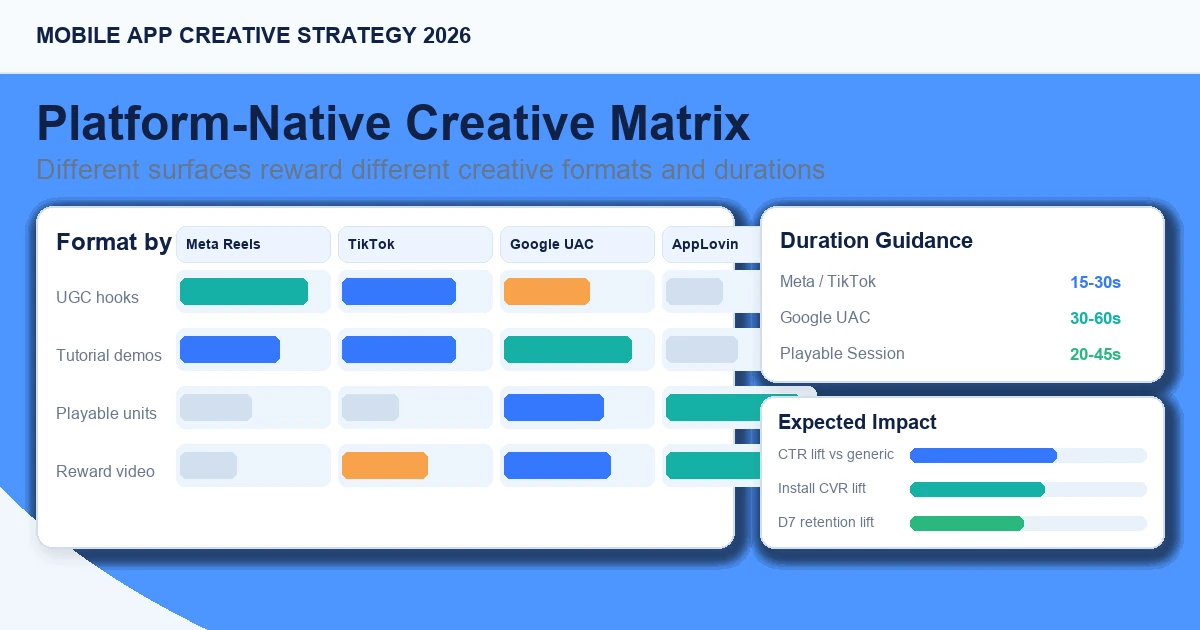
The five hook formulas that consistently produce above-median hook rates across our portfolio:
- The Confession Open: Creator reveals a relatable failure or frustration in the first two seconds. "I wasted ₹4 lakh on ads before I found this." Activates curiosity and empathy simultaneously. Works across all verticals but performs especially strongly for fintech and productivity apps.
- The Pattern Interrupt: Unexpected visual or audio in the first 0.5 seconds — a sudden noise, an unusual setting, an extreme close-up. Triggers the brain's novelty response before the skip decision is made. Works across all formats but is most effective on TikTok, where the feed trains users to expect predictable openings.
- The Before-State Show: Open on the problem, not the solution. Show the messy spreadsheet, the cluttered app, the frustration — before the product is introduced. Emotional resonance with the problem-state generates the motivation to watch the solution. Strong for utility, finance, and fitness apps.
- The Direct Challenge: "Stop scrolling if you're a gamer." "If you've tried every budgeting app and failed, watch this." Direct address that calls out a specific persona creates an identity-based hook that self-selects the exact audience you want to install. Excellent for reducing CPI by pre-qualifying audience intent at the hook stage.
- The Gameplay-First: For gaming apps, cut directly into the most visually stimulating moment of gameplay with no intro. TikTok research cited by Segwise's creative testing analysis found 25% higher view-through attribution when gameplay appears before 1.5 seconds versus after a branded intro.
One structural note: hook testing should be separated from body testing. Shoot five different hooks against the same product-demo body, test all five with a $30–$50 micro-budget over 48 hours, and advance only the hook with the highest 3-second view rate. This modular approach produces better data and cheaper creative volume than testing entirely new ads end-to-end each time.
How Do You Run Creative Testing at Scale With Meta Advantage+, Google ACO, and TikTok ACO?
Platform-native automated creative optimisation tools have fundamentally changed how creative testing works at scale — and teams still running manual A/B tests in siloed ad sets are leaving significant efficiency on the table. Each platform's ACO system has different mechanics, and optimising creative input for each produces materially different outcomes.
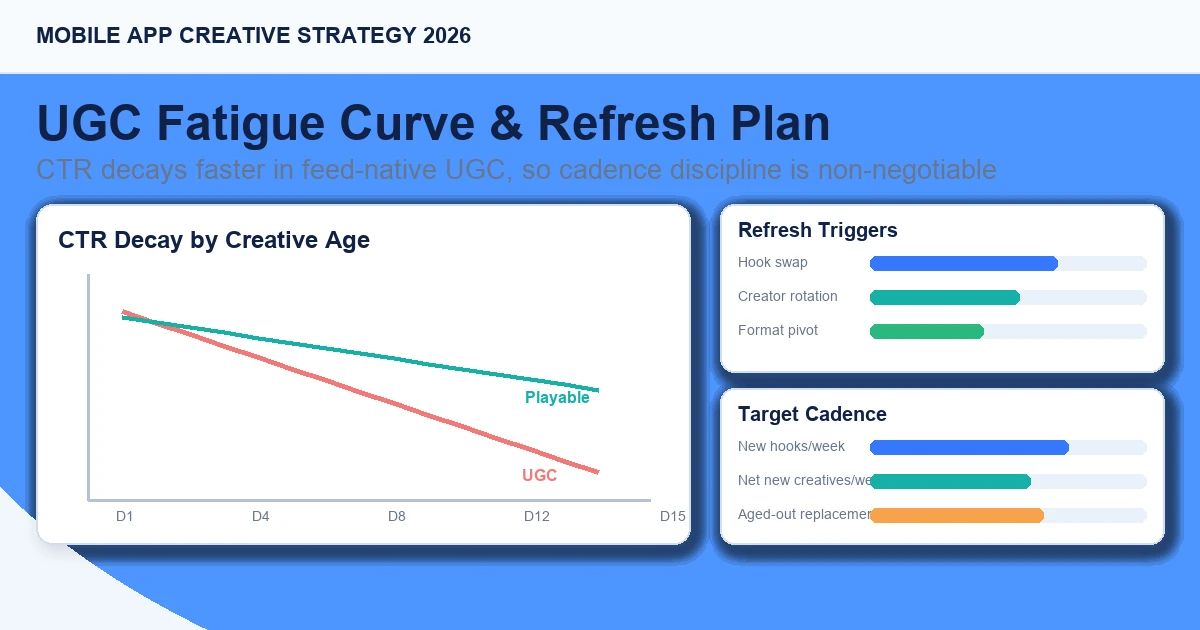
Across Meta, Google UAC, and TikTok, the algorithmic signal-to-noise ratio improves materially when creative pools contain 8–12 variants rather than 3–4. Apps at the 8–12 threshold consistently outperform those below it on blended CPI.
Meta Advantage+ Creative: Meta's system automatically tests creative combinations, applies dynamic enhancements (music, text overlays, brightness adjustments), and allocates budget toward winners in real time. The key input requirement: upload 8–12 creative variants at campaign launch across UGC, motion graphic, and static formats. Meta's official Advantage+ App Campaigns guidance is explicit that broad targeting combined with creative volume is the model's optimal input configuration — narrowing targeting or reducing creative inventory consistently degrades performance. For the full Advantage+ setup protocol, see our Meta app install campaigns guide.
Google App Campaign (UAC) Creative Optimisation: Google's algorithm ingests up to 20 images, 20 videos, and 5 HTML5 assets per ad group and tests combinations across all placements (YouTube, Discovery, Google Play, Display). The testing horizon is longer than Meta's — Google's model typically requires 50–100 conversions before it stabilises on winners. Google's UAC documentation recommends supplying all three creative types (video, static, HTML5) to enable placement-level optimisation rather than forcing the algorithm to serve video into placements where static converts better. Practical tip: define in-app events (not just installs) as conversion targets from day one to drive quality signals into the model early.
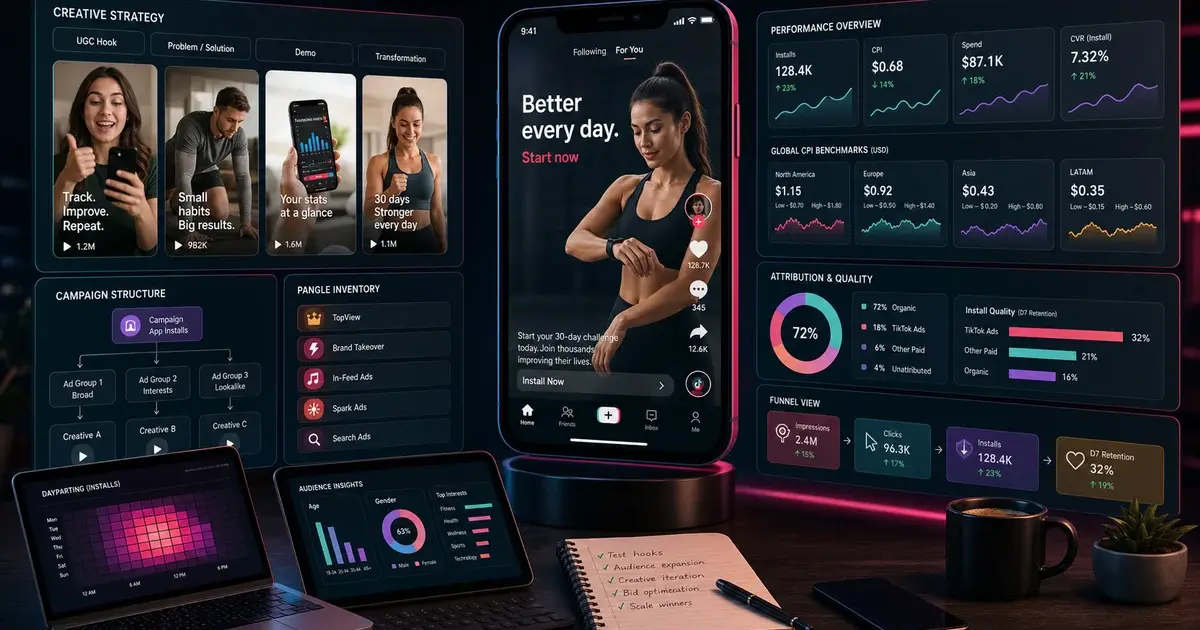
TikTok Automated Creative Optimisation (ACO): TikTok's ACO system generates ad combinations from a pool of uploaded videos, texts, and CTAs, then optimises delivery toward the combinations with the strongest performance signals. The feed refresh requirement is more aggressive than Meta: Segwise's 2026 analysis recommends refreshing the creative pool every 2–3 times per week on TikTok to prevent neurological fatigue — the platform's own research shows a 90% lift in neurological fatigue signal after approximately 15 exposures of the same creative within a week. Supply Spark Ads (boosted organic creator posts) alongside standard in-feed variants to give the algorithm authentic engagement signals, not just paid ones.
The three-layer testing cadence that compounds across all platforms:
- Weekly — Hook testing: Produce 4–6 new hooks (0–3 seconds) against your current best-performing body. Run each on a $20–$50 micro-budget for 48 hours. Advance the winner to full creative production. This layer is cheap (a creator shoots 6 hooks in one session for $200–$400) and identifies the highest-value variable in performance.
- Bi-weekly — Format testing: Test a new format type (skit vs tutorial vs expert commentary) against the current best performer. Use the winning hook from the weekly layer. This builds structural insight into which format fits your specific audience and product category.
- Monthly — Concept testing: Commission a fundamentally new creative concept — different positioning angle, different user persona, different problem frame. Budget $1,000–$3,000 per concept. One breakthrough concept per quarter that improves blended CPI by 20–30% pays for the entire testing infrastructure. This is the origin of every creative breakout in our portfolio.
What Are the Fatigue Signals That Tell You a Creative Needs Replacing?
Creative fatigue is predictable. The patterns are consistent enough across formats, platforms, and verticals that a systematic monitoring protocol — rather than intuition — should govern every replacement decision.
The primary fatigue benchmarks derived from Liftoff's mobile ad creative benchmarks and our own portfolio data:
- UGC creative: Average useful life of 7–10 days before CTR drops below 70% of day-1 baseline. Fatigue accelerates on TikTok (often 5–7 days) versus Meta (8–12 days) due to the platform's higher impression frequency per user.
- Polished produced video: Average useful life of 21–30 days at comparable spend. The slower fatigue rate is the primary ROI argument for the higher production cost at sustained scale.
- Motion graphic: 14–21 days before significant CTR decay.
- Static/image creative: 10–14 days, highly audience-dependent.
CTR drops >30% from day-1 baseline → Flag for imminent replacement within 48 hours.
CPC increases >40% from campaign launch → Creative fatigue is bidding your CPCs up; refresh immediately.
Hook rate drops below 20% on Meta or 25% on TikTok → Hook is no longer stopping the scroll; re-shoot the first 3 seconds before replacing the full creative.
Frequency >3.0 on Meta within 7 days → Audience saturation; creative refresh or audience expansion required in parallel.
The practical monitoring framework: track CTR by day-of-creative-age (not calendar date). A creative launched Monday should be evaluated against its own day-1 CTR baseline, not the account average. When day-7 CTR falls below 70% of day-1 CTR for that specific creative, schedule replacement within 2 business days regardless of absolute CPI. This relative metric is more actionable than absolute benchmarks because it corrects for seasonality, bid environment, and audience variance.
Three cost-tiered refresh options, in order of speed and cost:
- Hook-only re-shoot (fastest, cheapest): Keep the body — the product demo, the tutorial, the skit — and re-shoot only the first 3 seconds with a new opening line, different creator, or new visual pattern-interrupt. A hook swap at $200–$400 extends a creative's useful life by 5–7 additional days. This is the highest-ROI refresh lever in the stack.
- Creator rotation (moderate cost): Same script, different face. If the tutorial script converts well but the specific creator has fatigued, commissioning 2–3 additional creators to deliver the same hook-to-CTA structure typically restores performance to near-launch levels. Commission in batches of 3–5 from Billo, Insense, or a curated India creator roster.
- Format pivot (higher cost, full reset): When a format has fully fatigued, switch to a different format type while maintaining the same core value proposition. The audience's "this is that app" recognition resets when the format changes substantially — even if the underlying product benefit is identical.
For campaign-level refresh monitoring, Adjust's UA resources and Singular's resources both provide MMP-level creative performance tracking that surfaces fatigue signals across platforms in a single dashboard — critical for teams running creative across Meta, TikTok, and UAC simultaneously.
How Do You Adapt Creative to Be Platform-Native Across TikTok, Meta, YouTube, and AppLovin?
Platform-native creative is not a stylistic preference — it is a measurable performance variable. Repurposing a 16:9 YouTube pre-roll to TikTok without adaptation consistently produces 40–60% higher CPIs than native TikTok content. Each platform has distinct content grammar that the algorithm rewards and users expect.
Platform-by-platform native format requirements and performance benchmarks:
- Meta (Facebook + Instagram Reels): Vertical 9:16, no brand logo in the first 2 seconds, creator-to-camera hook, sub-30-second total length for feed, up to 60 seconds for Reels where watch-through is rewarded. Meta Reels delivers the highest median video CTR of any placement at 1.78%. The algorithm explicitly rewards saves and shares — creatives that prompt social sharing (shareable facts, "send this to a friend" CTAs, genuinely funny skits) compound through organic amplification on top of paid reach. Key performance markers: hook rate benchmark 28% median, 45% top decile.
- TikTok for Business: The most format-sensitive platform. Native TikTok creative (sound-on, trending or original audio, creator-style editing with caption text overlays, no letterboxing) dramatically outperforms repurposed Instagram content. Problem-solution skits, "POV: you tried X" formats, and native-feeling tutorials perform best. Spark Ads — which boost organic creator posts from real creator accounts — consistently outperform standard in-feed ads by 15–30% on CTR because they inherit the creator's organic engagement signal. Hook rate benchmark: 33% median, 55% top decile. Optimal ad length: 9–15 seconds.
- Google UAC (YouTube + Discovery + Play): Longer-form performs better here than on social. 30–60 second demo-focused videos with clear benefit exposition work for YouTube pre-roll, where users are in a lean-back mindset. HTML5 playables in Google Play placements deliver strong installs for games. Static creatives remain surprisingly competitive in Google Play install cards — high-clarity benefit headline over clean app screenshots consistently converts. Google's UAC documentation recommends uploading all three creative types (video, HTML5, static) to enable placement-level optimisation. Hook rate benchmark: 22% median on YouTube in-stream, 38% top decile.
- AppLovin MAX: Playable-first and reward video. AppLovin's network skews heavily toward gaming inventory where interactive ads are the native expectation. Playable ads consistently achieve 2–3× the IPM of video-only creative on MAX inventory. UGC is less differentiated on MAX because users are in an active gaming context rather than a passive social feed context — interactivity is the native register. For gaming apps spending $20K+ monthly, allocating 40–50% of AppLovin creative budget to HTML5 playables materially outperforms pure video.
- ironSource / Unity Ads: Playable end-cards are the cost-effective middle ground — a standard video body with a 15-second interactive end card — delivering interactive performance at a fraction of full playable production cost. Reward video (30-second incentivised) performs well for games with in-app economies. Same logic as AppLovin: the gaming context makes interactivity the expected norm.
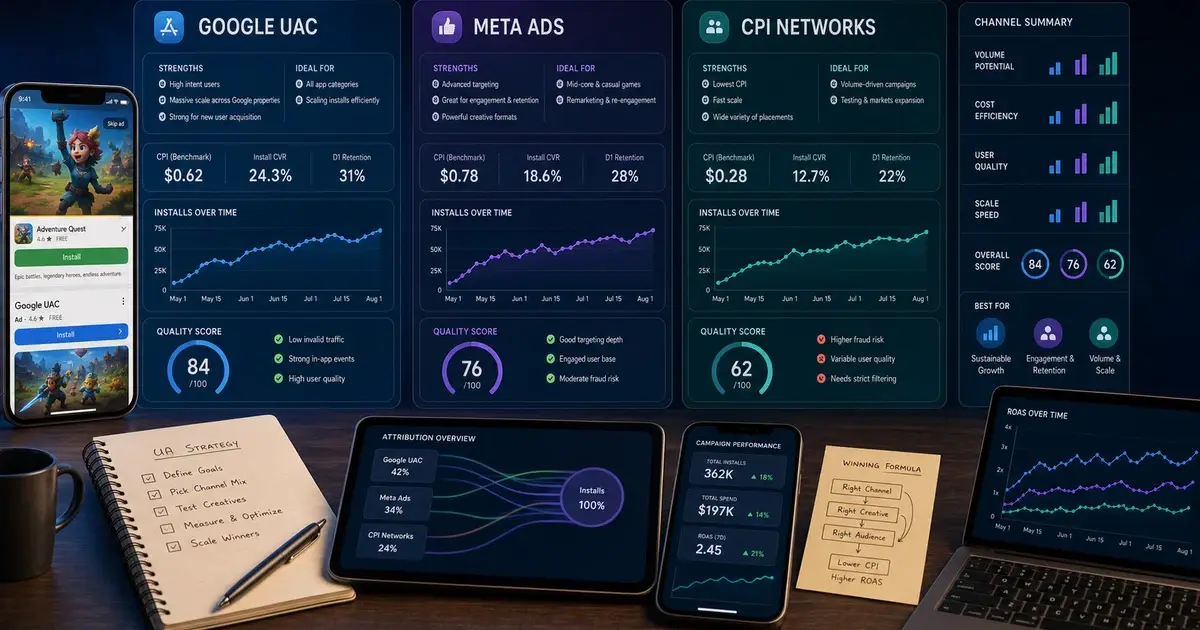
The production workflow: create your core creative in the format native to your highest-spend channel, then adapt — not repurpose — for secondary channels. Adaptation means re-cropping to 9:16, re-editing the hook to match platform pace norms, removing brand elements from the first 2 seconds for social, and adjusting audio for sound-on vs. sound-off environments. See our platform comparison data in the Google UAC vs Meta vs CPI network benchmarks guide and our detailed TikTok app install campaigns playbook.
How Do You Use AI Tools to Produce Creative at 50× the Volume Without Losing Quality?
AI-generated creative has closed the quality gap with traditionally produced content materially in 2026 — and AI UGC tools can now produce 50 different hook, angle, and messaging variations for the same cost as a single traditional video shoot. The teams compounding fastest are those that have integrated AI into every layer of creative production without abandoning human authenticity where it matters most.
According to Superscale's AI vs traditional UGC performance study, apps running AI UGC show a 63% increased likelihood of install after viewing, and AI-generated variants running alongside human UGC in creative pools consistently hold within 80–90% of human UGC performance on hook rate while delivering 5–10× the production volume at the same budget. The critical application is creative velocity, not creative replacement: AI handles iteration and scale; human creators handle the authenticity signal that no AI lip-sync tool yet fully replicates at the top end.
The AI creative production stack that works in 2026:
- Hook generation (AI script + human shoot): Use Claude or ChatGPT to generate 20–30 hook variants from a single creative brief — different problem framings, different personas, different emotional triggers. A human creator shoots the top 5–8 hooks in a single 2-hour session for $300–$500 total. AI multiplies the ideation bandwidth; human delivery preserves authenticity.
- AI video generation for non-human content: Motion graphics, animated product demos, and abstract benefit showcases can be fully AI-generated using tools like Runway, Kling, or Pika at $50–$200 per clip versus $500–$2,000 for a live shoot. Quality is production-grade for motion content and static. Human-face generation is still detectably artificial at the hook level and should be used for secondary placements rather than primary prospecting creative.
- Modular AI variation: A single human UGC shoot can be extended to 15–20 variants using AI tools to swap backgrounds, adjust colour grading, insert different CTAs, add translated subtitle overlays (critical for India regional language deployment), or re-pace the edit for different platform length requirements. Tools like AdCreative.ai, Motion, and Foreplay support this modular workflow at scale.
- AI playable production: Meta's automated creative tools, AppLovin Creative Studio, and Unity's playable builder all offer template-to-playable workflows where you supply game assets and logic and the platform generates the HTML5 ad unit. AI-generated playables now achieve within 80–90% of the IPM performance of custom-built units at costs of $500–$2,000 per unit versus the $15,000–$30,000 traditional custom playable price point.
Quality guardrails for AI creative: always run AI-generated creative against human-produced equivalents in a controlled split before committing budget. AI creative can produce uncanny-valley failure modes — faces that look almost-right, text overlays that feel unnatural, audio sync that is slightly off — that torpedo performance despite technically correct production. A 48-hour $50-per-variant test identifies failures before they waste meaningful budget. Never skip this validation step.
For fintech apps specifically, AI creative must also pass compliance review before running. AI-generated scripts may contain implied guarantees, unsubstantiated return claims, or regulatory-prohibited language that human compliance review must catch before the creative goes live. See the fintech creative rules in the vertical playbooks section below.
How Do You Build a Seasonal Creative Calendar for India and Global Markets?
Seasonal creative tied to cultural moments consistently outperforms evergreen creative by 30–60% on CTR during the relevant window — and it naturally creates a refresh cadence without requiring you to invent new angles from scratch. For India, the seasonal calendar is particularly rich and represents one of the highest-ROI creative levers available to apps targeting the market.
The India seasonal creative calendar (all dates approximate, check each year):
- January — Republic Day + Pongal/Makar Sankranti: Regional creative emphasis for South India (Pongal) and Maharashtra (Sankranti). Gaming and entertainment apps benefit from long-weekend viewing patterns.
- February — Valentine's Day: Dating, gifting, and social apps. Strong for UGC formats with creator-made romantic content.
- March–April — IPL Season: The single highest-reach period in Indian mobile advertising. Fantasy sports, gaming, fintech, and OTT apps all see CPM spikes but also audience engagement peaks. IPL-themed UGC (creator reactions to match moments) achieves 2–3× normal engagement. Budget premiums are steep — plan creative 6–8 weeks ahead to negotiate favourable creator rates before demand spikes.
- July–August — Independence Day + Raksha Bandhan: Patriotic and family-themed creative. Fintech gifting flows, e-commerce, and social apps.
- September–October — Navratri + Dussehra: Regional North and West India emphasis. Gaming and entertainment apps peak during festival evenings.
- October–November — Diwali: The highest-spend window in Indian mobile advertising. Every vertical runs seasonal creative. Apps that plan and produce Diwali creative 8–10 weeks ahead consistently outperform those scrambling in October. Produce distinct creative for Dhanteras (purchase intent peak) and Diwali day (celebration and gifting peak) — they are different emotional registers.
- December — Christmas + Year-End: Gaming and productivity apps benefit from holiday usage spikes. International-targeting apps align with global gift-season patterns.
Global seasonal markers for apps running international campaigns: Q4 is universally the highest CPM quarter but also the highest engagement quarter — plan creative budgets accordingly. Black Friday / Cyber Monday creative should be in production by early October. New Year hooks ("new year, new you") work across fitness, finance, and productivity apps in January globally and should be prepared as evergreen creative with date-relevant hooks layered on top.
The practical production rule: begin seasonal creative production 6 weeks before the campaign window, including creator briefing (2 weeks), shoot and review (1 week), iteration and compliance (1 week), and platform upload and review (2 weeks). IPL and Diwali require 8–10 weeks due to creator demand compression. Apps that miss the 6-week window frequently miss the window entirely. Explore how we manage seasonal creative calendars through our user acquisition service for India-focused apps.
What Are the Creative Rules Specific to Gaming and Fintech Apps?
Gaming and fintech are the two verticals with the most distinct creative requirements — and the most costly mistakes when those requirements are ignored. Both verticals have format preferences, compliance guardrails, and audience trust dynamics that differ materially from the general mobile app creative playbook.
Gaming Creative Specifics:
- Gameplay loops as primary hook: Real gameplay footage consistently outperforms animated trailers and polished produced creative for gaming apps. The 4.27% median iOS CTR for real gameplay versus 3.34% for stylised trailers cited across gaming UA research is consistent with our portfolio data. Show the core gameplay loop — not a cinematic intro — in the first 1.5 seconds.
- Fail ads and "fake difficulty": Deliberately showing a player losing or struggling at a task, followed by the reveal of how easy the game actually is, exploits challenge-response psychology to drive installs. The format has faced controversy — particularly on hyper-casual games where fake difficulty ads showed gameplay that bore no resemblance to the actual product — and both Apple and Google have updated their misleading advertising guidelines. Use only if the "fail state" shown genuinely exists in your game.
- Gameplay capture formats for AppLovin: Short (15–30 second) raw gameplay clips with minimal editing perform best on AppLovin MAX and ironSource gaming inventory, where users are already in a game-playing mindset and recognise authenticity. Refresh gameplay content weekly — the same clip fatigues faster on gaming networks than anywhere else because gaming audiences are shown high volumes of the same creative.
- Seasonal gaming creative (IPL, tournaments, global esports events): Tie in-game events to cultural calendar moments and reflect those events in ad creative. "New season, new characters, new modes" hooks tied to IPL or festive seasons significantly outperform evergreen gameplay capture during those windows.
Fintech Creative Specifics:
- Trust signals are mandatory, not optional: Fintech apps operate in a trust-deficit environment — users are being asked to connect their bank accounts or commit real money. Creative that leads with trust signals (RBI registration, bank partnerships, security certifications, user count milestones) consistently outperforms creative that leads with features or returns. Include at least one trust credential in the first 10 seconds of any fintech creative.
- Compliance guardrails: SEBI and RBI advertising guidelines for financial products in India prohibit guaranteed return claims, unqualified risk statements, and implied endorsements. All fintech creative scripts must pass compliance review before production — post-production compliance review is expensive (reshoots, re-edits) and pre-production review adds only 1–2 days. Build compliance into the brief, not the edit.
- India-specific credibility cues: "As seen in The Economic Times," "Trusted by X lakh users," and real user testimonials with income or savings milestones (verified and disclosed as such) consistently outperform generic product demo creative for Indian fintech audiences. Tier 2/3 city audiences respond particularly strongly to Hindi-language testimonials from users who sound like them — not metro polished spokespersons. Regional-language fintech UGC in Hindi, Marathi, and Tamil drives 2–3× better CTR in those markets compared to English-language equivalents at 30–40% lower creator CPM. See our results portfolio for specific fintech campaign case studies.
- Problem-framing over feature-selling: "Still using a salary account that earns 2%?" outperforms "Our app offers 7% interest." Lead with the financial pain, not the product feature. The tension framing generates the emotional engagement that drives click-through; the feature resolves it.
How Do You Source, Brief, and Manage UGC Creators at Scale?
A UGC programme that compounds is a production infrastructure, not a campaign. The teams consistently producing the lowest-CPI UGC creative run systematic sourcing, brief, and review processes — not ad-hoc creator outreach before each campaign.
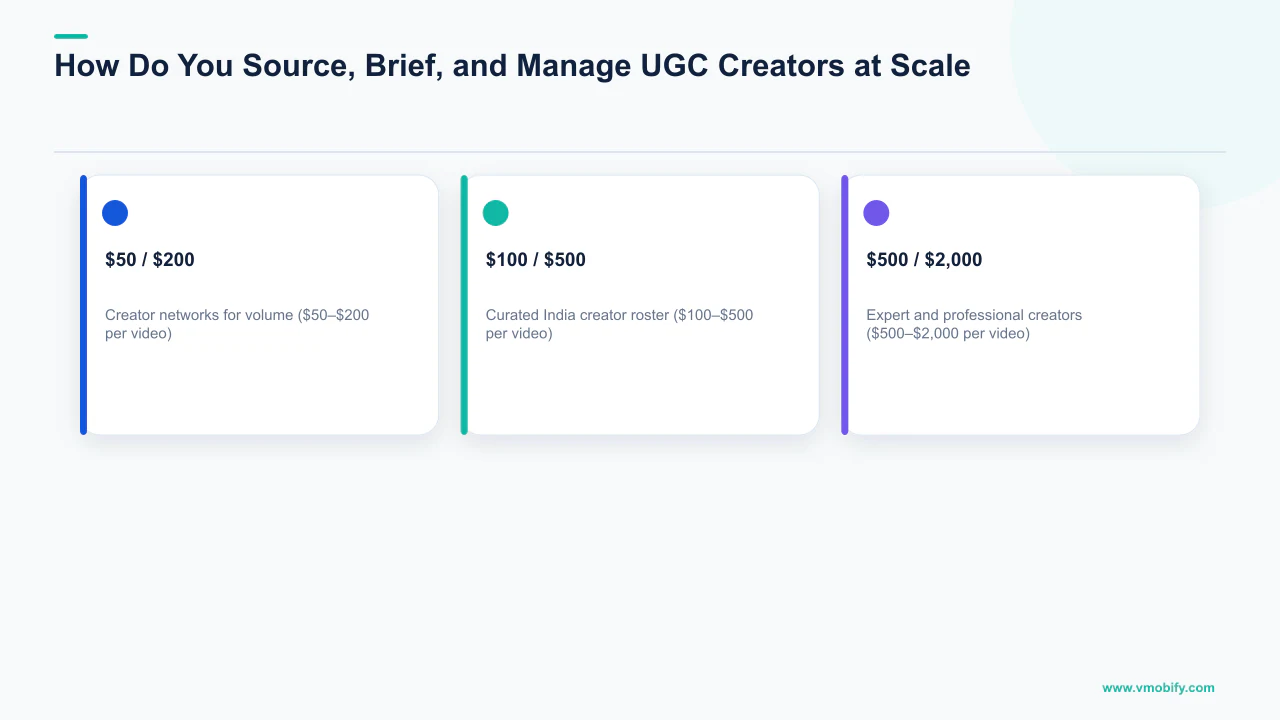
The sourcing tier that matches your scale:
- Creator networks for volume ($50–$200 per video): Platforms like Billo, Insense, Backstage, and Pepper Content (for India) maintain rosters of vetted creators who produce UGC-style content to brief. Turnaround is typically 48–72 hours for a batch of 5–10 raw videos. Best for: hook testing, format experimentation, and building a wide creative library quickly. Usage rights for paid advertising are typically included in the per-video rate.
- Curated India creator roster ($100–$500 per video): Direct relationships with 15–25 creators across Hindi, Tamil, Marathi, Telugu, and English who understand your product category. Slower to build (3–4 months to identify and vet) but produces materially more authentic content than creator network sourcing. Creator CPMs in regional language content are 30–40% lower than Hindi-national creators, making the economics strong for Tier 2/3 targeting.
- Expert and professional creators ($500–$2,000 per video): Credentialled professionals (financial advisors for fintech, fitness trainers for fitness apps, language teachers for edtech) who deliver authority-bias lift on top of standard UGC engagement. Essential for verticals where trust is the primary purchase barrier. Requires longer lead times (1–2 weeks) and more detailed brief documentation.
The brief structure that produces consistent, usable creative:
- Hook requirement: Specify exactly which hook formula to use (confession, pattern interrupt, before-state, direct challenge). Provide example hooks verbatim. Never leave the first 3 seconds to creator discretion on a paid UA brief — it is the highest-value variable and must be controlled.
- Core message (10–20 seconds): One specific benefit claim, one specific use case, demonstrated not just stated. "Show me setting up a SIP in under 60 seconds," not "explain the features."
- CTA (last 5 seconds): Exact wording: "Download [App Name] free — link in bio" or "Try it free for 7 days." Creators frequently soften CTAs to avoid feeling salesy; the brief must specify CTA language explicitly.
- Restrictions: List explicitly — no competitor mentions, no unsubstantiated return claims, no implied endorsements, must hold the phone vertically, must have clear audio.
Usage rights are the detail most teams neglect. Paid advertising rights (the right to run the content as a paid ad, not just organic) must be explicitly licensed. Whitelisting rights (the right to run ads from the creator's handle, as Spark Ads on TikTok) require a separate agreement. Exclusive rights (preventing the creator from producing similar content for competitors) are expensive but worth it for top-performing creative concepts. Get rights documentation before any content goes into production — retroactive licensing negotiation is slow and expensive. If you want a managed UGC sourcing and production system for your app, talk to our team.
How Do You Combine All Formats Into a Full-Funnel Creative Architecture?
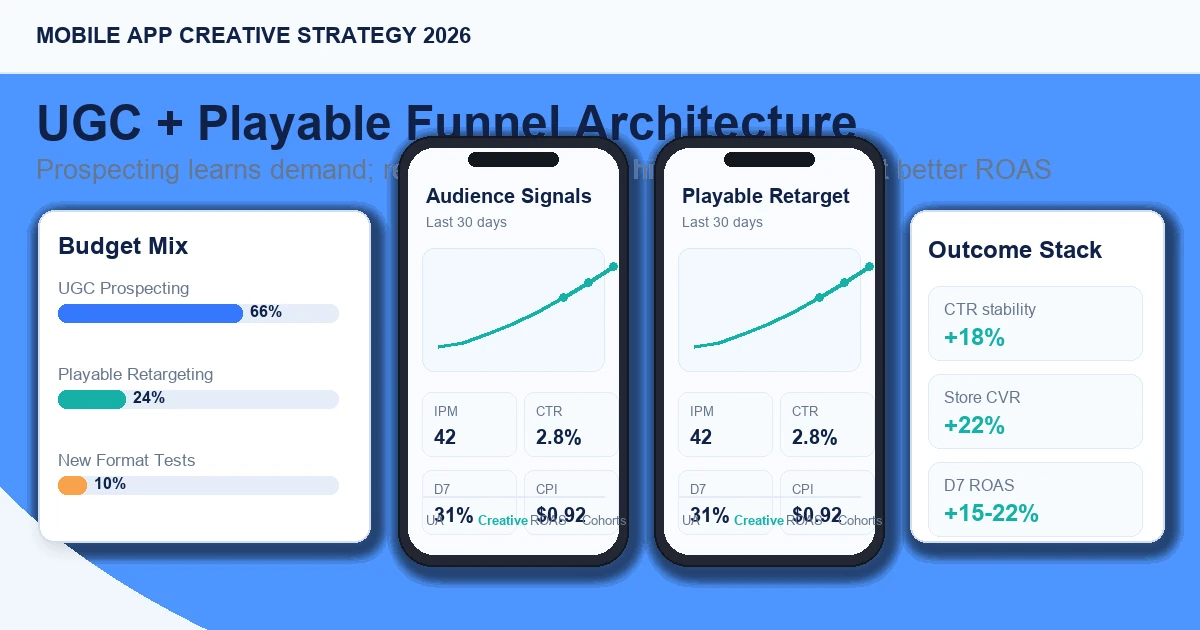
The highest-ROAS creative architecture in 2026 is not a single format — it is a format portfolio mapped to funnel stage, with systematic rotation governed by fatigue signals and performance data. Across our creative campaigns for 300+ apps, the combined architecture below consistently delivers 15–22% better D7 ROAS than either format running alone.
Full-funnel creative architecture:
- Top-of-funnel (cold audiences) — UGC + AI-generated variants: Feed-native UGC is optimised for first impressions with users who have never encountered your app. Run 8–12 variants (mix of human UGC and AI-generated variations of your top performers), rotate weekly based on hook rate decay, and use broad Advantage+ or UAC targeting to let the algorithm find buyers. Budget: 60–70% of total creative spend.
- Mid-funnel (engaged, not installed) — Playable or polished produced: Users who clicked your top-of-funnel ad, visited your store page, but did not install represent the highest-intent audience in your funnel. Playable ads — giving them the actual app experience before requiring install — convert this audience at rates standard video retargeting cannot match. For non-gaming apps, polished produced testimonial creative in this layer reinforces the credibility that hesitating users need. Budget: 20–25% of total creative spend.
- Re-engagement (installed, lapsed) — Playable or deep-link video: For users who installed but have not opened in 7+ days, playable re-engagement ads with deep links into specific features or game levels drive re-activation at 2–3× the rate of standard banner or static re-engagement. The interactive prompt reminds them of the specific experience they liked, not just the icon. Budget: 10–15% of total creative spend.
- Seasonal surges (event windows) — Dedicated seasonal UGC: During IPL, Diwali, or major cultural moments relevant to your audience, replace evergreen top-of-funnel creative with seasonal variants. The freshness signal and cultural relevance consistently drive 30–60% CTR lifts during the active window. Produce seasonal creative 6–8 weeks ahead to avoid campaign-launch delays.
Budget allocation across formats for a ₹15–40L monthly UA programme in India:
- 60–70% to UGC prospecting (₹9–28L) — highest volume, fastest iteration signal, lowest cost per creative test
- 20–25% to retargeting formats (₹3–10L) — highest ROAS per rupee, amortises playable production cost quickly
- 10–15% to format and concept experimentation (₹1.5–6L) — one breakthrough concept per quarter pays for the entire experimentation budget
One sequencing note that matters: build your UGC prospecting programme before investing heavily in playable production. The audience data generated from UGC prospecting — which hooks resonate, which demographics engage, which use cases drive installs — directly informs the design of your playable or polished retargeting creative. A playable built before UGC performance data exists is designed in a vacuum. A playable built from three months of UGC learning is engineered around the specific moments and value propositions your audience has already demonstrated they respond to.
For a detailed breakdown of how this funnel architecture plays out across a real 90-day launch campaign, see the case studies in our results portfolio. For a managed implementation of the full creative architecture — production, testing, platform management, and fatigue monitoring — talk to our team. The creative system is the compounding asset; it is worth building properly from the start.
Frequently Asked Questions
Why does creative quality matter more than audience targeting in 2026?+
Privacy changes (iOS ATT, Android GAID deprecation) have homogenised the targeting capability available to all advertisers. When everyone targets the same broad cohort, the creative in the auction determines who wins. Meta's internal research shows creatives now drive approximately 56% of incremental app installs — more than targeting and bidding combined. The advertiser who wins is the one with better creative, not better audience segmentation.
How many creative variants should I run per ad set?+
Run 8–12 creative variants per ad group or campaign to give the platform algorithm enough signal to optimise effectively. Apps at the 8–12 threshold consistently outperform those running 3–4 variants on blended CPI. The additional variants do not require proportionally larger budgets — the algorithm allocates spend toward winners automatically. The production cost of additional variants is typically recovered within 2–3 weeks through lower CPIs.
How do I know when a UGC creative has fatigued?+
Track CTR by day-of-creative-age, not calendar date. When a creative's day-7 CTR falls below 70% of its own day-1 CTR baseline, schedule replacement within 48 hours. Secondary trigger: CPC increasing more than 40% from launch baseline indicates creative fatigue is inflating your bids. On TikTok specifically, also watch for hook rate dropping below 25% — that signals the opening is no longer stopping the scroll and a hook-only re-shoot (3-second swap) should be prioritised over a full creative replacement.
Does AI-generated creative perform as well as human UGC?+
AI UGC holds within 80–90% of human UGC performance on hook rate while producing 5–10× the volume at the same budget — making it extremely valuable for creative velocity and testing breadth. The remaining 10–20% performance gap matters most in primary prospecting positions where hook authenticity is the key signal. The optimal architecture uses AI creative for rapid iteration, hook testing, and secondary placements, while human UGC anchors primary prospecting creative. Always validate AI creative variants in a 48-hour micro-budget test before scaling spend.
What are the most important creative rules for fintech apps in India?+
Three rules that are non-negotiable: (1) Include a trust signal (RBI registration, bank partnership, user count) in the first 10 seconds — fintech audiences in India will not install without credibility markers. (2) All scripts must pass compliance review before production — SEBI and RBI advertising guidelines prohibit guaranteed return claims and unqualified risk statements, and post-production fixes are expensive. (3) Hindi, Marathi, and Tamil-language UGC drives 2–3× better CTR in Tier 2/3 cities compared to English-language equivalents, at 30–40% lower creator CPM. Regional language testimonials from users who sound like the target audience are the highest-performing format.
How should I allocate budget between UGC prospecting and retargeting formats?+
For a growth-stage app at ₹15–40L monthly spend, allocate 60–70% to UGC prospecting (cold audience), 20–25% to retargeting formats (playable for gaming, polished produced testimonial for fintech/utility), and 10–15% to format experimentation. The prospecting layer generates the audience data that makes retargeting efficient — build it first and run it at scale before investing heavily in retargeting creative production. One breakthrough retargeting creative per quarter that improves D7 ROAS by 15–20% typically pays for the entire experimentation budget.
How far in advance should I produce seasonal creative for India campaigns?+
Begin seasonal creative production 6 weeks before the campaign window as a minimum: 2 weeks for creator briefing and scheduling, 1 week for shoot and initial review, 1 week for iteration and compliance, 2 weeks for platform upload and review. IPL and Diwali campaigns require 8–10 weeks due to creator demand compression during those periods — creator rates increase 40–60% when booked within 4 weeks of the event. Apps that miss the pre-production window frequently miss the campaign window entirely.
Sources
- Meta — Advantage+ App Campaigns — Official Meta guidance on broad targeting, creative volume input, and Advantage+ campaign structure
- AppsFlyer — App Marketing Performance Index — Quarterly benchmarks for install quality, retention signals, and creative impact on install economics
- Google Ads — App Campaigns (UAC) Help — UAC setup, creative format requirements, bidding, and conversion event guidance
- Adjust — UA and Creative Resources — MMP-level creative performance tracking, fatigue signal monitoring, and UA benchmarks
- Singular — Mobile UA Resources — Creative variation as primary CPI driver in privacy-restricted environments; cross-platform creative benchmarks
- Benly — Ad Creative Benchmarks 2026 — Hook rate, CTR, completion rate benchmarks by platform; UGC vs polished produced performance data
- Segwise — Creative Testing Strategies for Mobile UA 2026 — ACO/Advantage+ testing frameworks, TikTok creative refresh cadence, neurological fatigue threshold data
- Superscale — AI vs Traditional UGC Performance Study — 63% install likelihood lift from AI UGC; AI vs human UGC performance comparison across mobile app categories
About the author
Amol Pomane — Founder, Vmobify
Amol leads Vmobify, a mobile app growth agency that has driven 30M+ downloads and ranked 54K+ keywords across 300+ apps since 2013. He writes about ASO, paid user acquisition, retention, and the operational reality of scaling mobile apps in India and global markets.
Model an install budget
Turn CPI and activation assumptions into acquisition scenarios.
Open free tool