Meta App Install Campaigns: Setup & Measurement Guide
A practical guide to Meta app promotion: choose a meaningful conversion goal, validate your events, plan creative tests and judge results using acquisition quality and mature cohorts.
On this page
- When is Meta a useful app acquisition channel?
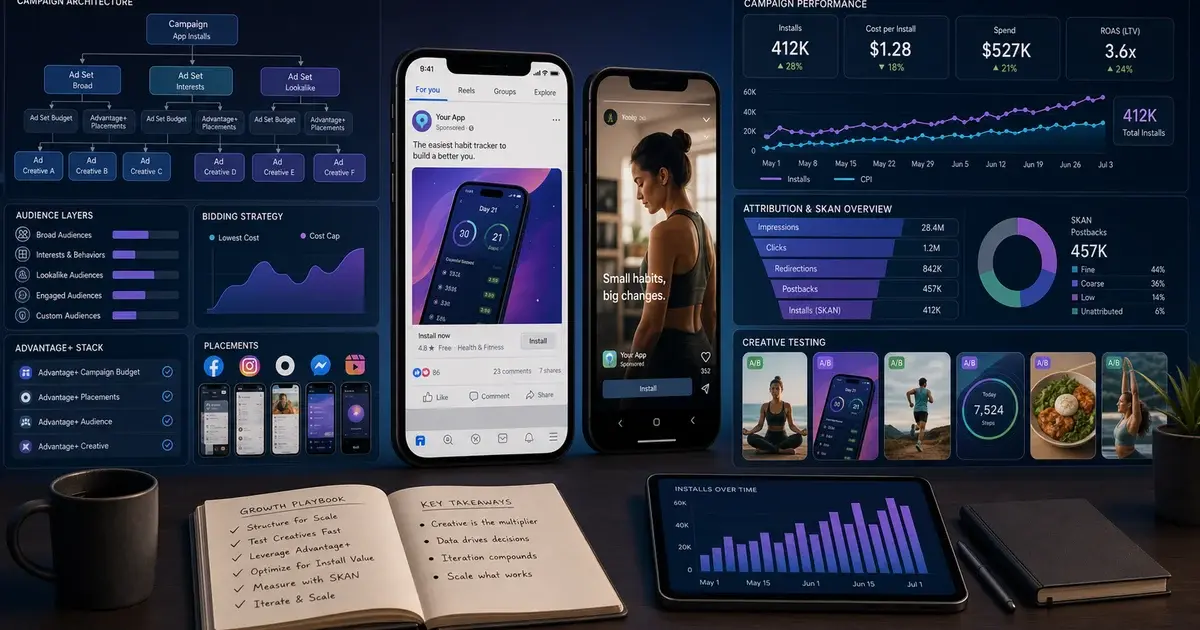
- How should you prepare and launch an app promotion campaign?
- How should you structure platforms and markets?
- What should a useful creative test include?
- How do you plan audiences without overcomplicating the test?
- How should you choose a budget and success criterion?
- How should you interpret iOS attribution?
- How do you validate Meta and MMP event reporting?
- What should you review before scaling?
- Frequently asked questions
When is Meta a useful app acquisition channel?
Meta app promotion campaigns can help introduce an app through Facebook and Instagram advertising. Whether the channel is a good fit depends on your audience, creative, store conversion and the value users create after installation. It should earn its place in the channel mix through measured results.
Write a campaign brief before opening Ads Manager: app and platform, market, user problem, conversion goal, allowable acquisition cost and available test budget. A subscription app might prioritise paid subscribers; a marketplace might prioritise a completed first order. Those outcomes can require different creative and measurement from an install-only launch.
Use this guide as an operating checklist. It does not promise a particular CPI, creative uplift or universal advantage over other channels. For broader channel planning, see our user acquisition services.
How should you prepare and launch an app promotion campaign?
Meta provides official training on Advantage+ app campaigns. Account interfaces and available controls change, so verify the options shown for your app rather than copying an old screenshot.
- Check access: confirm the correct business, ad account, app and people have the permissions needed to launch and inspect events.
- Validate the destination: open the correct store listing on the target device and market. Check the ad promise matches the actual onboarding experience.
- Validate app events: test the chosen integration and confirm successful actions appear with expected values.
- Select App promotion: choose the intended app, store destination and available performance goal. Record the Advantage+ settings and any controls you change.
- Define the test: set geography, budget, creative variants and a decision rule based on the business outcome.
- Review before publishing: check billing, schedules, URLs, event selection and reporting columns with a second team member.
Save a launch record with campaign IDs and settings. That makes later comparisons useful when budgets, attribution settings or creative change.
How should you structure platforms and markets?
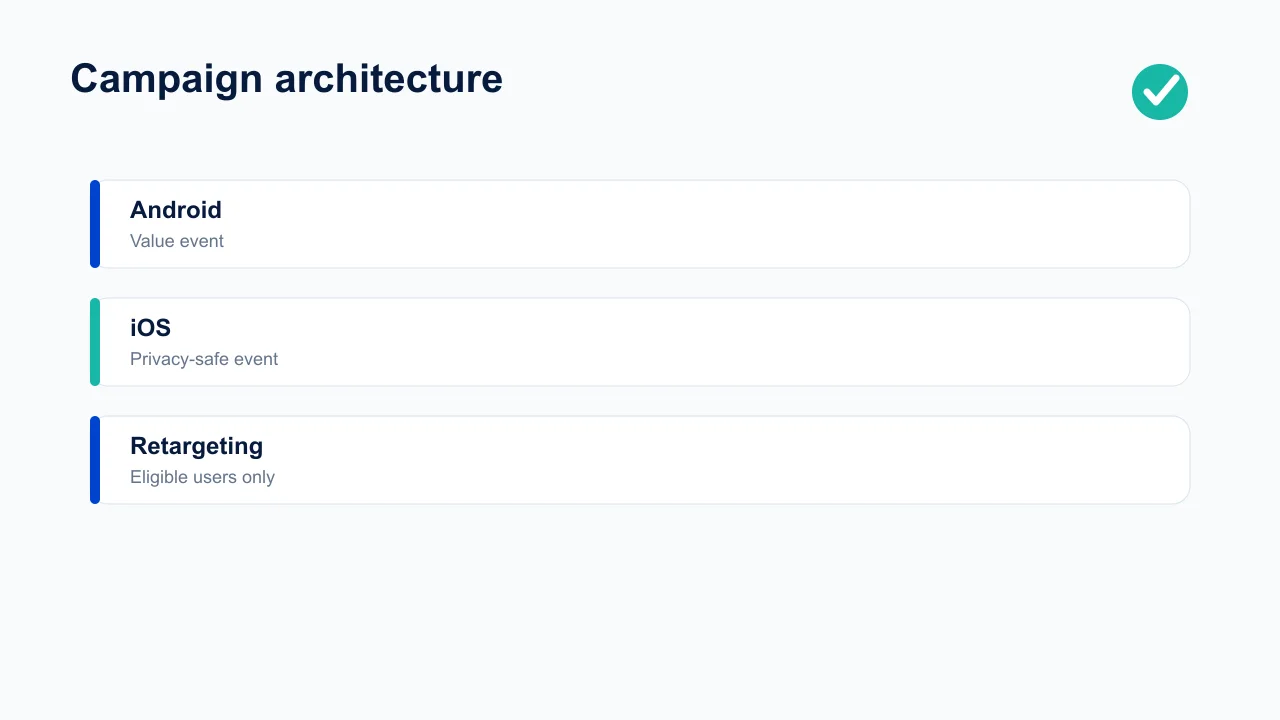
Plan iOS and Android separately because their store journeys, available signals and economics can differ. Keep the relevant budgets and reports identifiable. Reuse a strong creative concept where appropriate, but show the correct platform experience.
Split markets when you need separate budget control, language, availability or profitability targets. Avoid creating a campaign for every small audience if each receives too few relevant outcomes to inform a decision.
For an India launch, start from your product’s serviceable geography. A local delivery app cannot treat all national installs as equally valuable. For a nationwide app, compare acquisition and activation by the meaningful market breakdowns available in your reporting before assuming one city or language is inherently cheaper.
What should a useful creative test include?
Test distinct reasons to use the product, not just different background colours. Build the ad around a real action someone can complete after installing.
| Concept | What the ad shows | What to evaluate |
|---|---|---|
| Problem and solution | A recognisable user problem followed by the relevant app workflow. | Does the audience understand the benefit and complete the promised action? |
| Product demonstration | A legible recording of a short, useful task. | Does the store page continue the same story? |
| Use-case comparison | A truthful comparison of the old process and the app experience. | Does the promise attract qualified users rather than curiosity clicks? |
Adapt assets for the placements you use, with readable text and captions where appropriate. Test video and static creative; neither format wins every account. Do not invent customer quotes or portray a mock interface as a shipped feature.
Keep a creative log: concept, audience problem, launch date, spend, installs, activation and revenue where measurable. A higher click-through rate can be useful diagnostic evidence, but a creative that attracts clicks without activation should not win on CTR alone.
How do you plan audiences without overcomplicating the test?
Begin with eligibility and commercial constraints: serviceable locations, product suitability and the objective of acquisition versus re-engagement. Document the audience controls available in your campaign setup.
Where your account allows it, compare a broad eligible audience with a justified alternative under a controlled test. Existing-customer data should only be used through supported integrations and appropriate permissions. Do not assume every campaign type exposes the same exclusions or lookalike controls.
Choose one major hypothesis per test. Changing audience, creative, budget and optimisation goal together leaves you unable to explain the result. Where delivery does not distribute spend evenly, do not treat an ordinary ad-level report as a randomised experiment.
How should you choose a budget and success criterion?
Work backwards from a business outcome. Define the maximum acquisition cost your economics can support and the evidence you need before increasing spend. Use the bid options actually available for your selected performance goal.
Illustrative planning example: suppose a test budget is ₹30,000 and your planning estimate is ₹300 per activated user. The arithmetic implies 100 activations if that estimate holds. It is not a Meta minimum, forecast or statistical guarantee. If your spend cannot produce enough relevant outcomes to judge the test, simplify the structure, extend the planned window or choose an earlier meaningful event while revenue data develops.
Set a loss limit and identify the reasons you would stop immediately, such as a broken store link or missing purchase events. Otherwise evaluate at the planned decision point with reporting delays accounted for. Do not apply a fixed daily percentage budget increase as a universal scaling rule.
Cost per activated user equals spend divided by activated users. For example, ₹20,000 producing 1,000 installs and 100 activations means ₹20 per install and ₹200 per activation. Another campaign can have a higher CPI and still acquire activated users more efficiently.
How should you interpret iOS attribution?
iOS reporting can combine different measurement approaches. Separate observed events, privacy-preserving aggregate results and modelled estimates where your tools expose them. Do not add overlapping counts together.
For SKAdNetwork 4, Apple describes three conversion windows spanning days 0–2, 3–7 and 8–35, with up to three winning postbacks. Postbacks arrive after the relevant measurement window and delay; later-window outcomes cannot be evaluated as complete on the day of installation. Missing detail is not automatically a tracking failure.
Check your MMP and partner documentation for the SDK versions, conversion-value setup and AdAttributionKit support you use. Assign one owner for conversion-value updates. A dashboard label saying “SKAN” does not by itself validate the implementation.
For a fixed spend, fewer reported installs make calculated CPI higher, not lower. Investigate measurement differences before concluding that creative performance changed. See Apple’s documentation for the window definitions.
How do you validate Meta and MMP event reporting?
Choose a documented integration path for your app. If the SDK, server and MMP can each send an event, establish ownership and the integration’s supported duplicate-prevention method. Multiple integrations do not automatically produce more accurate reporting.
- Write the activation and purchase definitions, including cancellation and refund behaviour.
- Complete a test journey on each supported platform.
- Check event names, values and currency against the backend or store record.
- Confirm the intended events are shared through the partner integration.
- Inspect the available optimisation goal and verify the intended event is selected.
- Compare reports with matching timezones, windows and date bases, allowing for delays.
An MMP is useful for cross-channel decisions, but its totals need not exactly match Meta’s reporting. Keep a reconciliation note explaining known differences. Our MMP comparison includes an event checklist and vendor evaluation matrix; our analytics service covers implementation review.
What should you review before scaling?
Use daily operational checks for spend, delivery, broken destinations and event outages. Reserve performance decisions for cohorts mature enough to answer the question.
- Creative: which promise brings activated users, and what new concept should challenge it?
- Store journey: is the ad-to-listing message consistent, and where does conversion drop?
- User quality: compare activation, retention and revenue using consistent cohort ages.
- Economics: include management, creative and measurement costs when judging total acquisition efficiency.
- Next decision: expand, hold, change one variable or stop, with a written reason.
Scale only when the quality and economics remain acceptable as spend changes. If tracking is unreliable, repair it before treating the report as evidence for expansion. If installs are healthy but activation is weak, investigate onboarding and audience expectations.
For help planning the next test, send Vmobify your app link, target market, conversion goal and recent campaign results. We can scope campaign management, creative testing and measurement around the problem your data shows.
Frequently Asked Questions
What objective should I use for Meta app install ads?+
Start with App promotion and select the intended app and an available performance goal. Choose the goal based on validated events and business outcomes; available settings can vary by account.
What is a good CPI for Meta app campaigns?+
There is no universal good CPI. Compare acquisition cost with activation, retention and revenue for the same platform, market and cohort age. Use your own test to establish a workable range.
Do I need 50 installs every day to launch?+
Do not treat that number as a universal launch requirement. Use current account guidance for your selected goal and plan a budget that can produce enough meaningful outcomes to evaluate.
Why do Meta and my MMP report different results?+
They can use different attribution windows, date bases, privacy handling and models. Reconcile those definitions and event mappings before diagnosing a technical failure.
Sources
About the author
Amol Pomane — Founder, Vmobify
Amol leads Vmobify, a mobile app growth agency that has driven 30M+ downloads and ranked 54K+ keywords across 300+ apps since 2013. He writes about ASO, paid user acquisition, retention, and the operational reality of scaling mobile apps in India and global markets.
Model an install budget
Turn CPI and activation assumptions into acquisition scenarios.
Open free tool