How to Increase App Downloads: The 2026 Growth Playbook
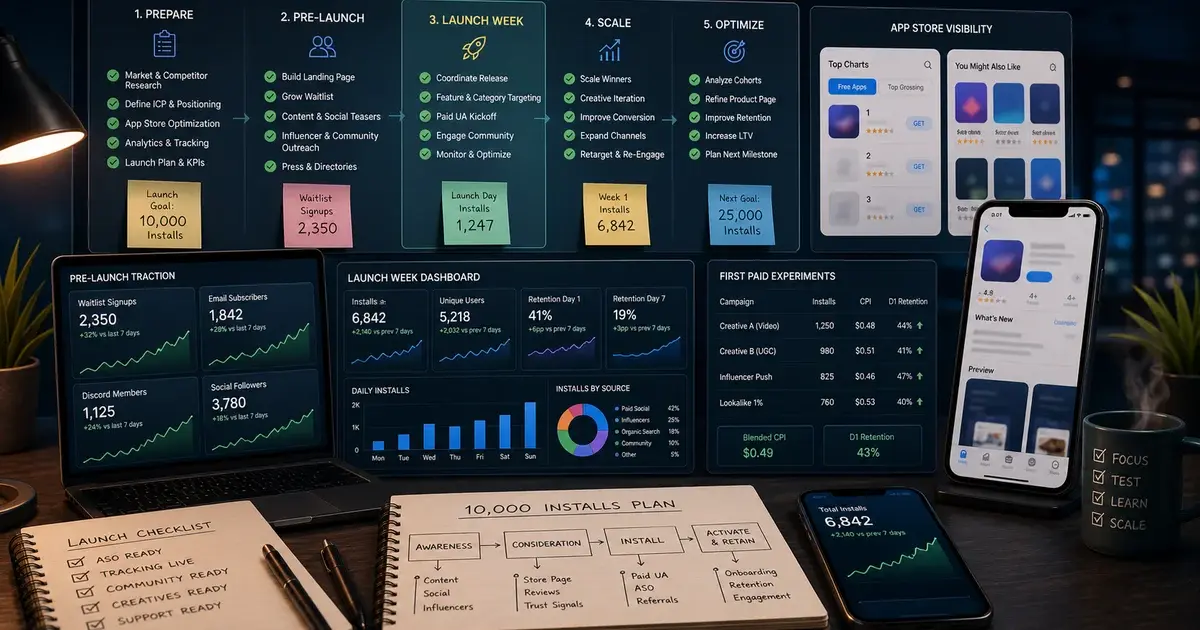
Downloads stalling? Here is the 2026 playbook we use across 300+ apps—covering ASO, paid UA, social and creator tactics, referrals, ratings, and retention loops that turn installs into compounding growth.
On this page
- Why do most apps stall after 90 days?
- What does the 2026 growth flywheel look like?
- How do you rank for high-intent keywords?
- Which store experiments move conversion the most?
- How should you split paid UA across channels?
- How do you run CPI networks without burning budget?
- How do creators, UGC, and Reddit drive installs?
- How do you engineer a referral loop that compounds?
- How do ratings and reviews compound into more downloads?
- How does retention lower your effective CPI?
- How do you scale internationally with localisation?
- How is AI changing app discovery in 2026?
- What is the 6-week implementation plan?
- Frequently Asked Questions
Why do most apps stall after 90 days?
Global app downloads crossed 257 billion in 2024 according to Sensor Tower's State of Mobile, but the distribution is brutally uneven—the top 1% of apps capture more than 70% of installs, and most launches plateau within 90 days as the initial burst of friends, family, and early adopters runs out. Daily installs fall to near zero, and founders blame the product when the real problem is distribution.
A download stall is rarely a product problem. The app can be excellent, but if the store listing is poorly optimised, paid budgets are sprayed across broad audiences, and no referral loop exists, growth flatlines. The fix requires working across three layers simultaneously: organic discoverability (ASO), paid acquisition across the major networks, and in-product mechanics that turn each user into a tiny acquisition channel.
Across our portfolio of 300+ apps managed since 2013, every successful scaling story has the same shape. Founders who reach a million downloads do not have a magic channel—they have a flywheel where each install funds the next one. The 13 strategies below address each layer of that flywheel. You do not need all of them on day one; you need to identify your current bottleneck and start there.
If your daily install volume is below 100, start with the ASO and creator sections—paid UA wastes money on apps without an optimised store listing. If you are above 500/day and stalled, the paid channel mix and retention sections are where the gains live.
Before trying anything in this guide, work out which of three things is true, because the fixes share nothing. Nobody is finding you: store listing visitors are near zero. That is a discovery problem — ASO, channels, and possibly an enforcement action restricting your visibility. People find you and do not install: visitors are healthy, installs are not. That is a conversion problem, and it lives in the icon, first two screenshots, rating and app size. Installs fell from a level they used to hold: that is a diagnostic question with seven documented causes, two of which restrict your distribution without removing your app, and one of which quietly makes you unavailable on newer devices — worked through in your app installs dropped overnight. Play Console gives you visitors and installs separately; reading them apart takes a minute and eliminates roughly two-thirds of the tactics on this page as irrelevant to your case.
What does the 2026 growth flywheel look like?
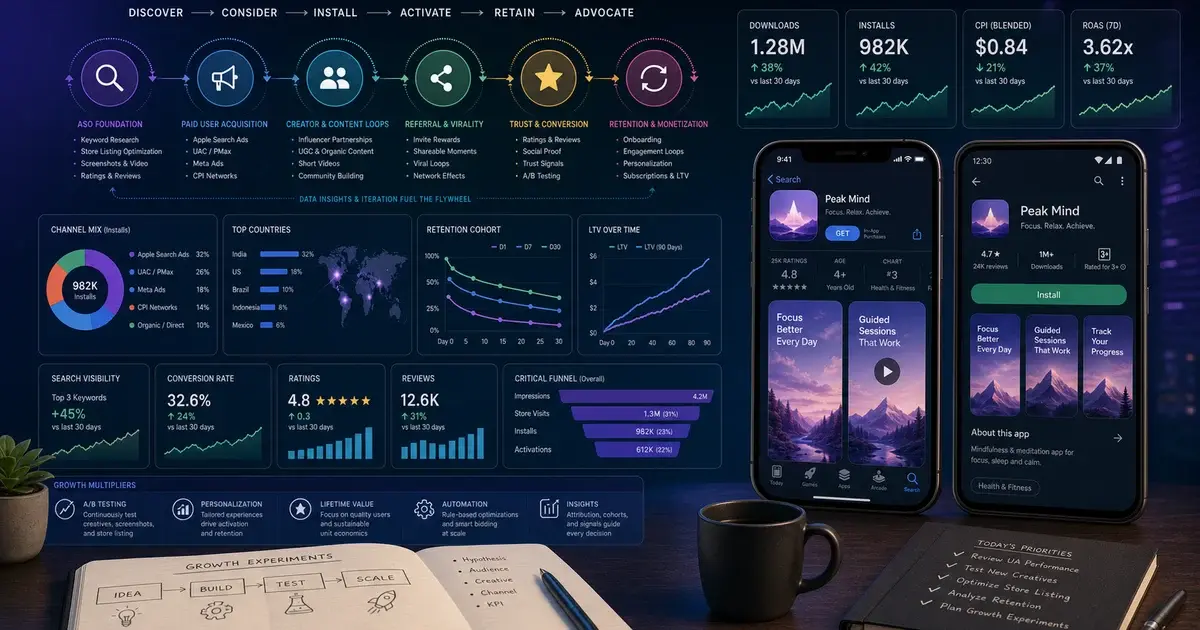
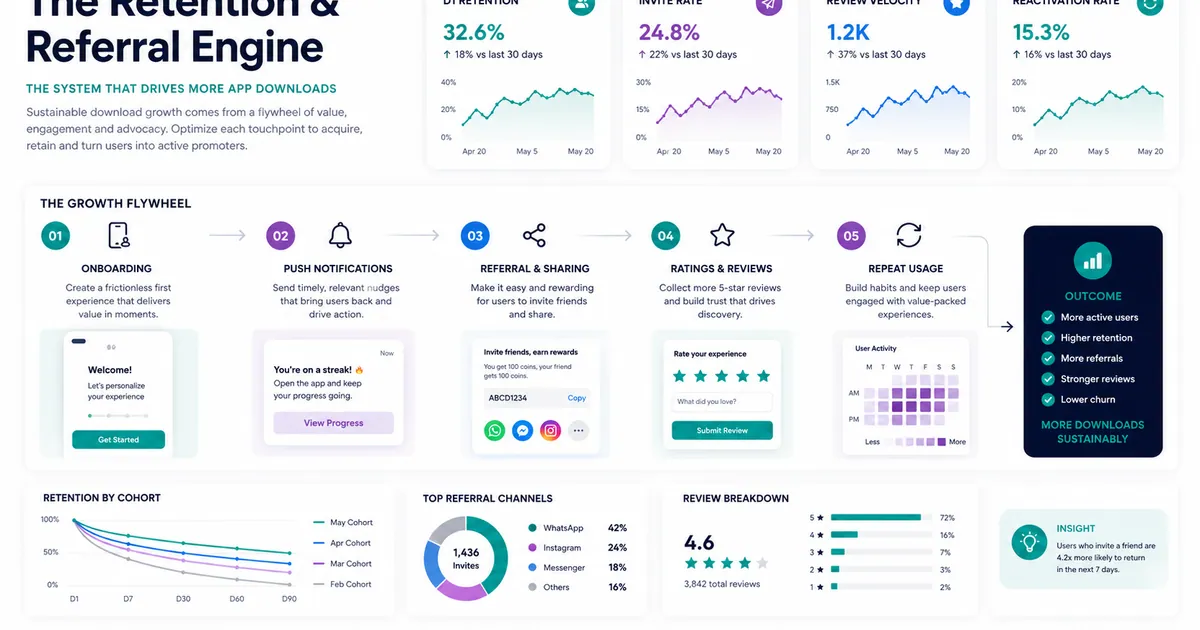
The 2026 app-growth flywheel has three reinforcing layers: ASO and store conversion drive cheap installs, paid UA layered on top scales the volume, and retention plus referrals compound those installs into more installs. Each layer reinforces the next.
The reason this matters in 2026 specifically is that the channel landscape has fragmented. Five years ago, an Android-first consumer app could scale on Google App Campaigns alone and an iOS-first app could lean almost entirely on Meta. That mono-channel era is over. SKAdNetwork 4 and AdAttributionKit have changed iOS attribution permanently, TikTok has become a top-three install driver for consumer apps, and Apple Search Ads now consistently delivers the highest-intent iOS installs in our portfolio.
The growth teams winning in 2026 think in terms of channel portfolios, not channel choices. A typical high-performing consumer app in our portfolio runs four to six channels in parallel, with budget shifted weekly based on contribution to retained users—not raw installs.
How do you rank for high-intent keywords in 2026?
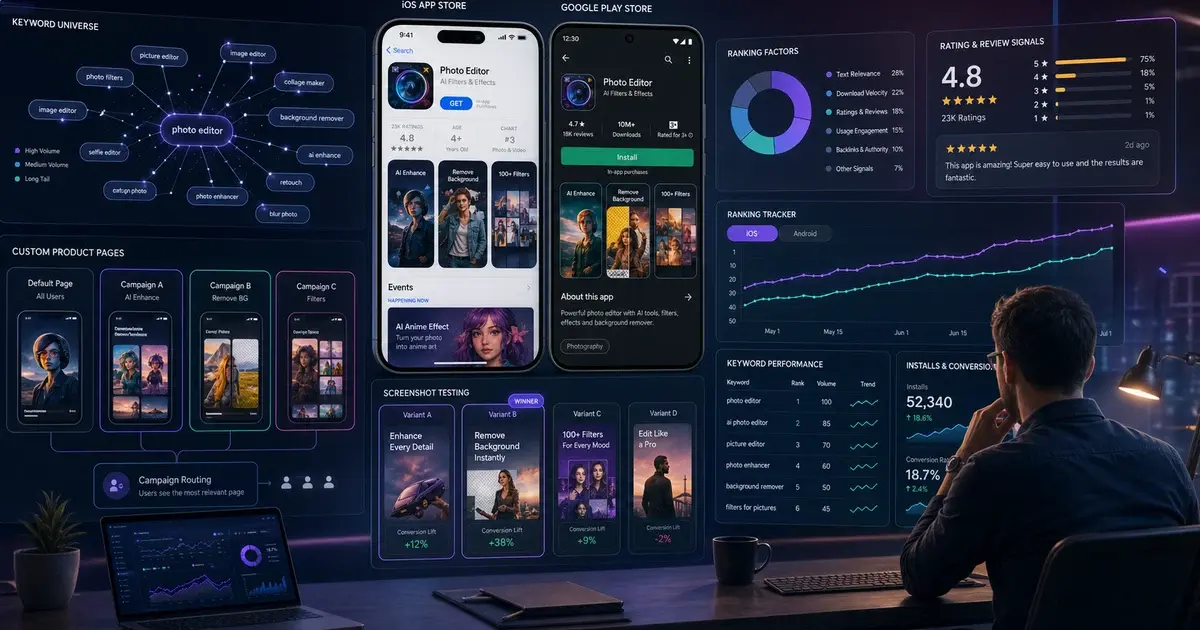
Ranking for high-intent keywords in 2026 means treating your title, subtitle, and Custom Product Page suite as a search-intent funnel—not a static listing. The title and subtitle carry the most weight on both stores, and Apple's Custom Product Pages now let you ship up to 35 variants per app, each tuned to a different keyword cluster or campaign source.
Start with a real keyword tool—we use AppTweak and Sensor Tower internally—and pick two or three high-volume, moderate-competition keywords that describe your core use case. Work the primary keyword into your title naturally. A fintech app titled "MoneyWise: Budget & Save Money" will rank for "budget app" and "save money app" organically with zero paid spend.
For Google Play, seed the full long description with semantic variants of your target keywords—used naturally, not stuffed. For the App Store, focus on the first 255 characters of the description (the above-the-fold preview) and the 100-character keyword field (comma-separated, no spaces, never repeat words already in your title). Our ASO service runs full metadata audits and rewrites on every engagement, and we typically see a 15–30% uplift in branded and category keyword rankings within 60 days.
A health app we work with went from ranking #47 to #4 for its primary keyword in 11 weeks—purely from title, subtitle, and description rewrites paired with three Custom Product Page variants tied to its top paid campaigns. No new spend, just disciplined ASO.
Which store-listing experiments move conversion the most?
Across the experiments we have run in our portfolio, icon changes deliver the largest single conversion lift, followed by the first two screenshots, then the preview video, then description. Even a 10% lift in store conversion compounds enormously because it applies to every install source you already have—organic, paid, and referral traffic alike.
Google Play's Store Listing Experiments and the App Store's Product Page Optimisation (PPO) both let you A/B test against live traffic for free. The discipline that separates good ASO teams from average ones is testing one element at a time and waiting for statistical significance—not running three changes in parallel and guessing which one worked.
The sequencing we recommend across our portfolio:
- Icon first—biggest visual weight in search results, biggest swing in conversion. Test bold colour variants against the current icon.
- Screenshots 1 and 2 next—they are the only ones most users see without scrolling. Lead with value, not feature lists.
- Preview video third—test having one vs. not having one before testing two variants.
- Description and feature graphic last—smallest swings, but worth squeezing once the bigger elements are locked in.
Research published by SplitMetrics consistently shows 10–25% conversion lifts from disciplined store testing—free downloads from the same organic and paid traffic you already have.
How should you split paid UA across Google, Meta, TikTok, and Apple Search Ads?
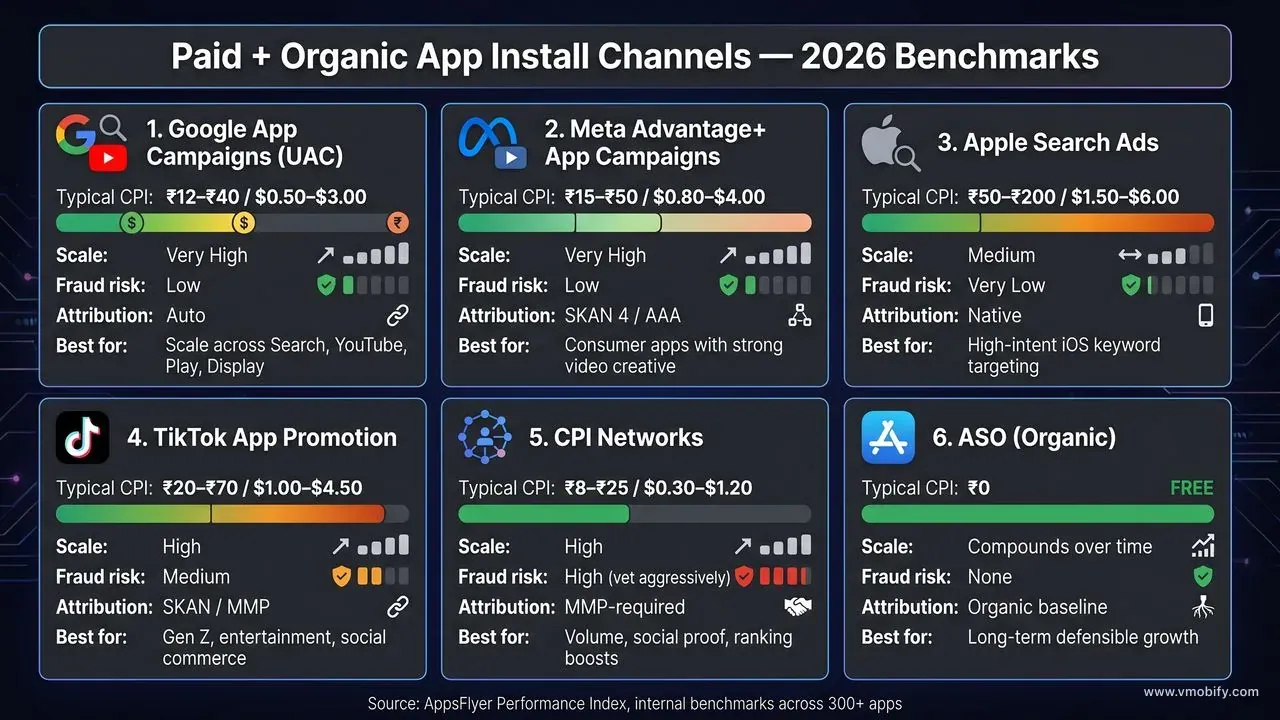
The right paid mix in 2026 runs four channels in parallel—Google UAC, Meta Advantage+, TikTok App Promotion, and Apple Search Ads—with weekly budget shifts based on contribution to retained users, not raw installs. Each channel owns a different audience layer, and dropping any one of them leaves volume on the table.
Google App Campaigns remain the most scalable paid channel for Android apps in India and most emerging markets. UAC automatically places across Search, Play Store, YouTube, Display, and Discover. Feed it at least 5 text assets, 5 image assets, and 5 video assets in 15s, 30s, and vertical formats. Start with a Target CPI bid 20% above your acceptable CPI to give the algorithm room to learn, then tighten as conversion data accumulates. Our user acquisition team runs UAC for 50+ apps and consistently delivers CPIs 30–40% below industry benchmarks within the first 30 days.
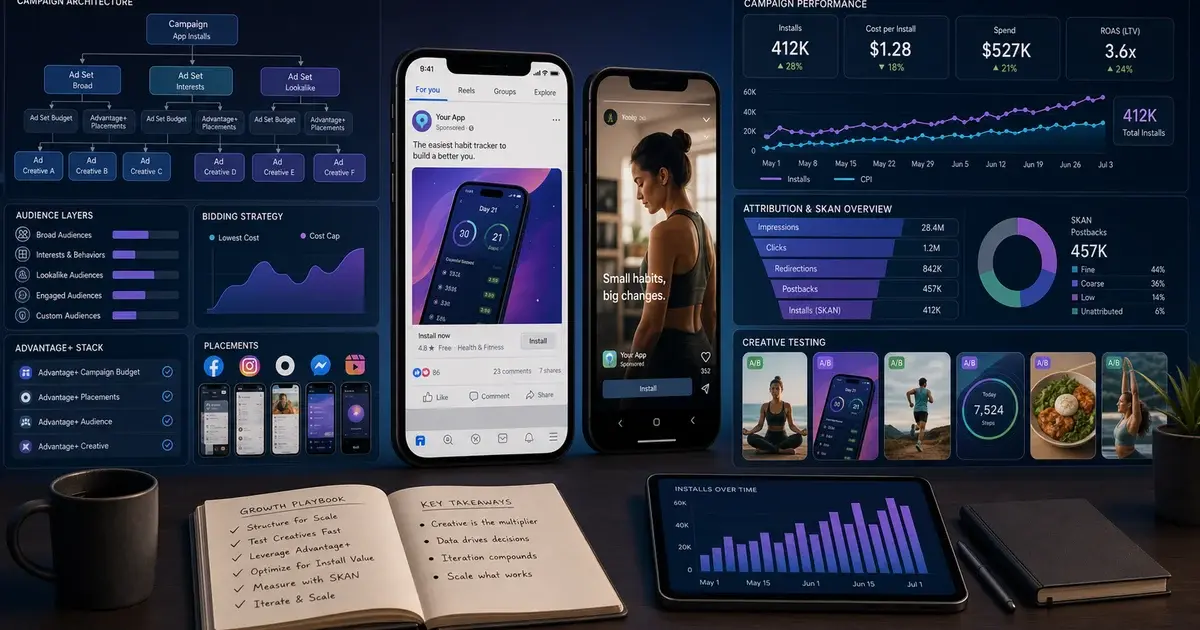
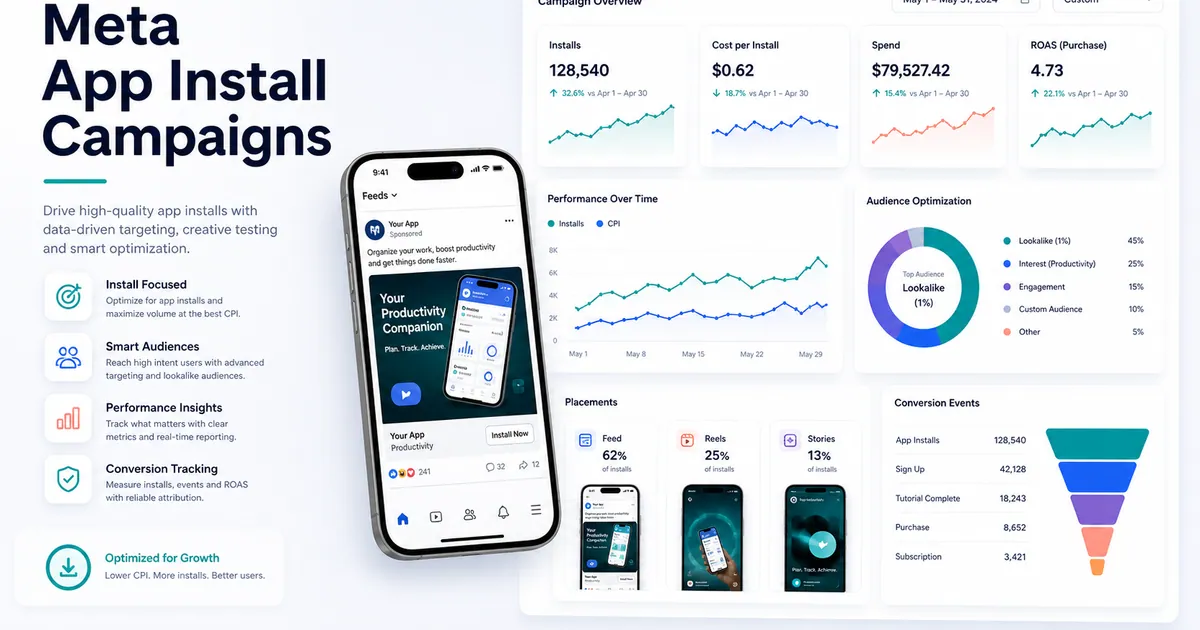
Meta Advantage+ App Campaigns are essential for consumer apps with strong video creative. Use Advantage+ for broad automated targeting, but layer in custom audiences from existing users and 1–3% lookalikes for higher-value cohorts. Video creatives outperform static by 2–3x on Meta—use short 6–15 second clips that show the app in action within the first two seconds. See our dedicated guide to Meta app install campaigns for a full setup walkthrough.
TikTok App Promotion has become the breakout channel for Gen Z and entertainment-adjacent apps. Spark Ads—boosting organic creator content—routinely outperform branded creative by 30–50% in our portfolio. Duolingo is the canonical case: the brand's TikTok account, built around a single mascot persona, drove millions of incremental installs without traditional UA spend, and the company now layers Spark Ads on top of its viral organic content to compound the reach. Apple Search Ads is the dark horse on iOS: smaller scale ceiling than Meta, but the highest-intent installs you can buy. OLX is the textbook case here—Apple Search Ads optimisation cut their CPI by 35% while lifting installs by 80% on iOS, driven by keyword-level bid management and competitor keyword targeting. A user who taps your ad on a competitor keyword has already declared intent.
Android playbook
- Lead with Google UAC + Meta Advantage+
- CPI networks viable at volume (vetted)
- ASO leans heavily on description keyword density
- Attribution: deterministic via MMP, fewer privacy constraints
- Geo opportunity: India, SEA, LATAM, MENA volume
iOS playbook
- Lead with Apple Search Ads + Meta with SKAN 4
- TikTok strong for Gen Z verticals
- ASO focused on title, subtitle, Custom Product Pages
- Attribution: SKAN 4 / AdAttributionKit aware MMP required
- Geo opportunity: US, EU, JP, AU — higher LTV per install
If your iOS reporting still relies on pre-SKAN 4 conversion windows, your Meta and TikTok performance is being systematically underreported. Migrate to SKAN 4 / AdAttributionKit-aware measurement before scaling iOS spend in 2026.
What is the right CPI network strategy without burning budget on fraud?
CPI networks are still one of the cheapest install sources available—but only if you vet networks for fraud signals before spending, and only if you measure post-install engagement, not raw installs. The networks that survive that filter are excellent for volume plays, ranking pushes, and filling a city or country's user base quickly.
When we run CPI network campaigns for portfolio apps, we require three things from every network before allocating budget:
- Publisher whitelists—the network must disclose which sub-publishers are delivering installs, and let you blacklist any source.
- Independent fraud detection—installs must be validated by an MMP (AppsFlyer, Adjust, Singular), not the network's own tooling. The fraud taxonomy in Adjust's fraud reports is the baseline we measure against.
- Post-install KPI thresholds—we pay only for installs that complete a defined action (open the app, complete onboarding, reach session 2). Networks that refuse this filter are the ones to walk away from.
The result is a network mix that delivers installs at ₹8–₹25 / $0.30–$1.20 with the same retention curve as Google UAC traffic. Skip the vetting and you will spend the same money on bots that uninstall within 24 hours.
How do creators, UGC, and Reddit communities drive installs in 2026?
Creator and community-led acquisition is the highest-leverage channel for consumer apps in 2026 because it stacks paid efficiency, organic ranking signals, and word-of-mouth into one motion. A single mid-tier creator can drive more qualified installs in a week than a small paid campaign delivers in a month.
Micro-influencers in the 10K–200K follower range typically charge ₹5,000–₹30,000 per integrated post and deliver highly engaged, niche-relevant audiences. The math is simple: for a fitness app, a 50K-follower fitness YouTuber outperforms a 5M-follower celebrity every time because the audience is already qualified. Track installs with unique promo codes or UTM-tagged deep links so you can measure ROI precisely and double down on the top performers.
Nano (1K–10K)
- Cost: ₹1K–₹5K / $50–$200 per post
- Engagement: 7–10%
- Best for: hyper-local, vertical niches, early validation
- Risk: low volume per creator, needs many in parallel
Micro (10K–200K)
- Cost: ₹5K–₹30K / $200–$1.5K per post
- Engagement: 3–6%
- Best for: most consumer apps — the sweet spot
- Risk: still needs UTM tracking discipline
Mid-tier (200K–1M)
- Cost: ₹30K–₹2L / $1.5K–$10K per post
- Engagement: 2–4%
- Best for: category-defining launches, brand awareness
- Risk: harder to attribute, fewer truly aligned creators
Macro / Celebrity (1M+)
- Cost: ₹2L+ / $10K+ per post
- Engagement: 1–2%
- Best for: mass-market consumer launches, mature scale
- Risk: rarely positive ROI vs. micro creators
Communities are the second half of this motion. Notion built one of the strongest organic install engines in software by seeding free templates, embedding tutorial videos, and letting power users become unpaid evangelists across Twitter, YouTube, and dedicated subreddits—a motion that still drives the majority of its new sign-ups despite ten-figure paid budgets being available. Subreddits like r/iOSProgramming, r/androiddev, and vertical-specific subs (r/personalfinance, r/fitness, r/Entrepreneur) routinely drive thousands of installs for apps that engage authentically—posting product updates, answering questions, running AMAs after a public launch. The pattern that works repeatedly across our portfolio:
- Build a waitlist landing page with a clear value proposition before launch.
- Post a "build in public" thread on LinkedIn, X/Twitter, and one relevant subreddit weekly during the run-up.
- Time a Product Hunt + Reddit AMA + creator wave to the same week as a TestFlight or open launch.
- Convert post-launch organic conversation into App Store reviews via the in-app review prompt at moments of demonstrated satisfaction.
500–1,000 genuine early adopters from this motion is enough to send strong day-one ranking signals to both stores—signals that paid UA cannot manufacture.
How do you engineer a referral loop that actually compounds?
A well-designed referral programme is the single highest-ROI growth lever available to any app—but only if the reward is tied to the app's core value, not generic cash, and only if the share flow is genuinely one-tap. Dropbox is the case study every founder eventually reads: a double-sided storage reward (referrer and invitee both got 500 MB) drove a 3,900% sign-up increase in 15 months, taking the company from 100,000 to nearly 4 million users without proportional marketing spend. The pattern still works in 2026; the variants we see across our portfolio just look different—the core mechanic of rewarding both sides with app-native value is unchanged.
Three rules separate referral programmes that compound from ones that flatline:
- Reward the app's currency, not money. A fintech app gives ₹100 cashback on a fixed deposit. A quick-commerce app gives ₹50 off the next two orders. A streaming app gives a free month. The reward must be something the user already values inside the app—not a generic Amazon voucher.
- Make the share frictionless. One tap to WhatsApp, SMS, or the device share sheet. The invite link must be a deep link that routes new users to the in-app screen where they collect the reward—not the home tab where they have to find it.
- Surface the reward at moments of value, not at app launch. The right time to prompt a referral is after the user has just experienced the core benefit (completed a workout, made a payment, finished a delivery). Prompting on first open kills both the share rate and the user's onboarding.
In our portfolio we have seen well-tuned referral loops drive 15–40% of total monthly installs at near-zero marginal cost—larger than any single paid channel.
How do ratings and reviews compound into more downloads?
App store ratings directly influence both search ranking and conversion rate, with a 4.5★ app converting 30–40% better than a 3.8★ app for the same keyword. Yet most apps still leave reviews to chance—which is the most expensive mistake a growth team can make, because ratings touch every install you have ever paid for or earned organically.
The right approach is to trigger the native in-app review prompt—SKStoreReviewManager on iOS, the Play In-App Review API on Android—at a moment of demonstrated satisfaction. After the user completes a key action, finishes a level, makes a successful payment, or reaches a milestone. Never on first open. Aim for at least 50 new ratings per month to maintain ranking stability; high-volume apps should target 200+.
For apps that have accumulated negative reviews, a structured review-velocity programme—reaching out to satisfied users via email or push and encouraging honest feedback—can shift the average upward by 0.3–0.8 stars within 60–90 days. The compounding effect is significant: each 0.1 star improvement above 4.0 typically delivers a 3–5% conversion lift across all your install sources.
If you spend ₹10 per install across 100,000 monthly installs at a 3.8★ rating, raising to 4.5★ delivers roughly 35,000 additional installs at the same spend. There is no paid channel that returns ROAS like that.
How does retention and re-engagement lower your effective CPI?
Every percentage-point improvement in D1 retention roughly halves your effective cost per retained user—which makes retention the single cheapest acquisition channel you own. Most growth teams treat retention as a product problem, separate from acquisition. That framing is wrong; retention is the multiplier on every rupee or dollar of UA spend.
The math is unforgiving. If you spend ₹10 to acquire a user with 20% D1 retention, your effective cost per retained user is ₹50. Improve D1 to 40% and that same ₹10 spend delivers a retained user for ₹25. Improve D7 in parallel and your LTV-to-CAC ratio doubles without changing a single ad. Optimise your onboarding relentlessly: reduce steps to first value, request permissions only after the user has experienced the benefit, and personalise the empty state with prefilled examples or a guided first action.
Re-engagement is the second multiplier. Users who installed but stopped using your app are your cheapest acquisition channel—they are already past the install friction. Push notification campaigns targeting users inactive for 7–14 days, with a compelling reason to return (new content, a limited offer, a social trigger), can reactivate 10–20% of churned users at near-zero marginal cost. Pair this with Meta retargeting campaigns against your app's lapsed-user custom audience. Reactivated users typically have 2–3x better LTV than fresh installs because they already understand the product.
How do you scale internationally with localisation?
Localisation is the single highest-leverage lever for scaling an app beyond its home market, with localised store listings consistently delivering 30–50% more downloads in target geographies versus English-only listings. The lift comes from both ranking (the store search algorithms favour native-language metadata) and conversion (users install at 2–3x the rate when screenshots and copy are in their language).
There are two layers to get right, and most teams stop at the first one. Store-listing localisation is the cheap, fast win: translated title, subtitle, description, screenshots, and the preview video. UI localisation is the harder, longer-payoff layer: translated in-app strings, locale-appropriate currency and number formatting, right-to-left support for Arabic and Hebrew, and culturally adjusted onboarding flows. Apps that localise only the store listing see installs but bleed users in the first session; apps that localise UI as well retain at parity with the home market.
Across our portfolio the highest-ROI markets to localise into first depend on your category, but four clusters consistently outperform:
India + South Asia
- Languages: Hindi, Tamil, Telugu, Bengali, Marathi
- ~750M smartphone users (Statista)
- Lowest CPI globally, highest install volume
- Best for: fintech, quick-commerce, gaming, edtech
Southeast Asia
- Languages: Bahasa Indonesia, Thai, Vietnamese, Filipino
- Mobile-first markets with rapid app adoption
- Mid-range CPI, strong retention in social and commerce apps
- Best for: super-apps, content, social commerce
LATAM
- Languages: Spanish (LATAM), Portuguese (BR)
- Brazil and Mexico drive the lion's share of installs
- Mid CPI, growing fintech and gaming verticals
- Best for: fintech, gaming, streaming, marketplace
MENA + Turkey
- Languages: Arabic (RTL), Turkish
- High disposable income in GCC, large youth populations
- Mid-high CPI, but strong LTV for premium apps
- Best for: gaming, streaming, luxury commerce, fintech
The pattern we see in our portfolio: localise the store listing first for the top three target markets, measure install lift over 30 days, and only commit to full UI localisation for the markets that deliver above-baseline retention. Localising a Hindi UI for an app that does not retain Hindi-speaking users is wasted engineering time. Use a real localisation platform—we use Lokalise and similar tools across portfolio apps—not ad-hoc spreadsheet workflows that drift out of sync with each release.
A fintech app we work with added Hindi, Tamil, and Telugu store listings ahead of a Tier-2/3 city push. Within 90 days, organic installs from those three languages alone matched 40% of the app's total English-language install volume—at zero incremental ad spend.
How is AI changing app discovery in 2026?
App discovery in 2026 is no longer just about ranking in the App Store and Google Play—it is increasingly about being cited by AI assistants, surfaced by Apple Intelligence, and recommended by Google's AI-powered Play Store. This is the white-space layer that most app marketers have not adapted to yet, and it is where the next ranking advantage lives.
Four shifts matter most for the rest of 2026 and into 2027:
- Apple Intelligence in App Store search. Apple's on-device intelligence is increasingly shaping App Store search results, weighting semantic relevance over keyword exact-match. Apps with clean, natural-language metadata and rich In-App Events outperform apps with stuffed keyword fields. The implication: rewrite your description in plain language about what the app does, not keyword-stuffed copy from 2019.
- Google Play's AI-powered listing recommendations. Google Play now uses generative AI to surface "apps you might like" across the Store homepage, search results, and Discover. The signals it weights heavily are install velocity, retention, and structured data in your store listing—not just keyword presence. Apps with high D7 retention now show up in surfaces where they previously could not.
- ChatGPT, Perplexity, and Claude as install sources. A growing share of category research happens inside AI assistants, not Google. When a user asks ChatGPT "what is the best budget tracking app for India," the assistant cites a handful of apps and links to their landing pages. Being cited there means showing up in indexable, citation-friendly content—long-form blog posts, comparison pages, and Reddit threads that AI engines crawl. This is why content marketing and Reddit community presence are now download channels, not just brand channels.
- Google AI Overviews citing app comparison content. When a user searches "best fitness tracker app 2026" on Google, the AI Overview at the top of the SERP cites 3–5 sources. Apps mentioned in those sources earn click-throughs that bypass the App Store entirely. The implication: your app needs to be present in the comparison content that the AI Overview is citing, not just in your own blog.
The teams winning at AI discovery in 2026 treat it as a parallel discipline to ASO—same fundamentals (relevance, retention, social proof), different surface. Across our portfolio we have started instrumenting referral traffic from chat.openai.com, perplexity.ai, and AI Overview clicks as a distinct attribution source. The volumes are small today but compounding fast.
If you publish even one high-quality, citation-friendly comparison post on your domain ("best [category] apps in India 2026"), you have a non-trivial chance of being cited by ChatGPT, Perplexity, or AI Overviews within 60 days. That is install traffic no competitor in the top 10 of "how to increase app downloads" is currently optimising for.
What is the 6-week implementation plan?
Here is the sequence we run for every new portfolio engagement—six weeks from audit to compounding installs. The order matters: ASO and store conversion before paid spend, paid spend before referral mechanics, and measurement before scaling.
- Week 1 — Audit and baseline. Pull current keyword rankings and metadata. Rewrite title, subtitle, and description. Submit a Store Listing Experiment on Google Play and a Custom Product Page variant on iOS. Confirm MMP attribution is configured for SKAN 4.
- Week 2 — Launch the paid base. Spin up Google UAC with full creative sets (5 text + 5 image + 5 video). Configure Meta Advantage+ App Campaigns with lookalike seeds. Start Apple Search Ads on branded and category keywords. Integrate the in-app review prompt at a high-satisfaction moment.
- Week 3 — Layer in creators and community. Identify 5–10 micro-influencers in your niche and initiate paid partnerships. Set up push notification sequences for new and churned users. Map your onboarding funnel and identify the biggest drop-off point.
- Week 4 — Add TikTok and tighten paid. Launch TikTok App Promotion with Spark Ads built on top of best-performing organic creator content. Pause underperforming Meta and UAC ad sets, scale winners. Apply the winning store experiment variant.
- Week 5 — Ship the referral loop. Specification, build, QA, and soft launch a double-sided referral. Wire deep links so invitees land on the reward screen. Add the referral CTA to the post-success moment in your core flow.
- Week 6 — Measure, reallocate, scale. Review contribution to retained users by channel. Shift 20–30% of budget from the bottom-quartile channel to the top-quartile channel. Lock in winning creatives and brief the next cohort.
Downloads compound over time when each channel reinforces the others: paid UA drives initial installs, those installs generate ratings and reviews, ratings improve organic ranking, ranking reduces CAC, lower CAC frees budget for more paid UA. The flywheel needs a push to start—but once moving, it accelerates.
If you want an expert team to build and run this playbook for your app, get in touch with Vmobify. We have driven over 30 million downloads for 300+ apps across India and globally—see our case studies for the verticals we have scaled, from fintech and quick-commerce to gaming and healthcare. Founders earlier in the journey may also find our first 10K installs playbook useful.
Frequently Asked Questions
What is a realistic cost per install (CPI) in 2026?+
CPIs vary by channel, geography, and vertical. In India, expect ₹12–₹40 on Google UAC, ₹15–₹50 on Meta, and ₹8–₹25 on vetted CPI networks. In the US/EU, expect $0.50–$3.00 on Google UAC, $0.80–$4.00 on Meta, and $1.50–$6.00 on Apple Search Ads. Verticals with higher LTV (fintech, gaming, dating) can profitably pay 3–5x these benchmarks.
How long does ASO take to show results?+
Title and subtitle changes typically show ranking impact within 7–14 days. Description and keyword field updates take 2–4 weeks. Store conversion experiments need 2–6 weeks for statistical significance depending on traffic volume. Expect a meaningful organic install lift within 60–90 days of disciplined ASO work.
Should I start with paid UA or ASO first?+
ASO first, always. Paid UA pushes traffic to your store listing—if the listing is unoptimised, you are paying to leak users. We see 30–60% of paid UA budget wasted on apps without a tuned store page. Get the listing right, then scale paid.
Is the Android or iOS strategy different in 2026?+
Yes. Android scales on Google UAC, Meta, and CPI networks, with ASO leaning heavily on description keyword density. iOS scales on Apple Search Ads, Meta with SKAN 4-aware measurement, and TikTok—with ASO focused on title, subtitle, and Custom Product Pages. Treat them as separate growth motions with shared creative.
How do I spot a fraudulent CPI network?+
Five red flags: refusal to provide a publisher whitelist, refusal to be measured by an independent MMP, unusually low CPIs versus the market, no post-install KPI guarantee, and install patterns clustered in suspicious geographies or device types. Any one of these is enough to walk away.
When does a referral programme fail?+
Referrals fail when the reward is generic cash (instead of app-native value), when the share flow takes more than one tap, or when the prompt fires at app launch instead of after a moment of value. Most failed referral programmes we audit have at least two of these three problems.
How has SKAN 4 changed iOS UA in 2026?+
SKAN 4 introduced multiple postback windows and coarse conversion values, which means optimisation signals reach ad networks more slowly and with less granularity than before. Campaigns built on pre-SKAN 4 measurement are now systematically underreported by 20–40% on Meta and TikTok. Modern iOS UA requires SKAN 4 / AdAttributionKit-aware MMPs and conversion value schemas designed for the new windows.
Sources
- Apple Search Ads — Apple-native iOS keyword advertising — highest-intent paid iOS installs.
- Apple Custom Product Pages — Up to 35 product page variants per app for source-specific conversion.
- Apple SKAdNetwork docs — Apple's privacy-preserving install attribution framework for iOS.
- Google Ads App Campaigns Help — Official UAC setup, creative requirements, and bidding documentation.
- Google Play launch best practices — Store listing, experiments, and in-app review API guidance from Google.
- Meta Advantage+ App Campaigns — Meta's automated app install product across Facebook and Instagram.
- AppsFlyer — State of App Marketing in India — Annual industry benchmark report on CPI, retention, and channel mix.
- SplitMetrics ASO research — Independent research on store conversion experiment uplift ranges.
About the author
Amol Pomane — Founder, Vmobify
Amol leads Vmobify, a mobile app growth agency that has driven 30M+ downloads and ranked 54K+ keywords across 300+ apps since 2013. He writes about ASO, paid user acquisition, retention, and the operational reality of scaling mobile apps in India and global markets.
Model an install budget
Turn CPI and activation assumptions into acquisition scenarios.
Open free tool