TikTok App Install Campaigns: The Complete 2026 Playbook
TikTok is no longer optional for mobile app user acquisition. This playbook covers campaign setup, creative formats, Pangle network, MMP integration, and the CPI benchmarks you should expect in 2026.
On this page
- Why has TikTok become a mandatory UA channel in 2026?
- How do you set up TikTok App Promotion campaigns?
- What changes when you run Smart+ App Campaigns?
- What creative formats drive the lowest CPI on TikTok?
- How do you use Pangle to extend TikTok reach?
- How do you integrate TikTok with your MMP?
- How do you optimise TikTok campaigns after 50 installs?
- What CPI and ROAS benchmarks should you expect in 2026?
- How do TikTok campaigns compare to Meta and Google UAC?
- Frequently Asked Questions
Why Has TikTok Become a Mandatory Channel for App User Acquisition in 2026?
TikTok has become a mandatory user acquisition channel in 2026 because it combines the largest under-30 audience on the planet with a short-form video format that is uniquely suited to demonstrating app value in under ten seconds. With global ad revenue projected at $34.8 billion in 2026, the platform has crossed the threshold from "interesting experiment" to "core infrastructure" for mobile app growth teams.
The audience composition is the engine. TikTok's user base skews heavily toward 18–34 year-olds — the segment with the highest mobile app install intent in virtually every category from fintech to fitness to gaming. Stackmatix's TikTok UA analysis shows that for consumer apps targeting audiences under 30, TikTok's cost-per-engaged-user frequently beats Meta by 25–40%, particularly in entertainment, lifestyle, and social categories.
The format advantage compounds the audience advantage. Short-form video is the native format for demonstrating what an app does — you show the interaction, not the features list. A 15-second TikTok can communicate the full value proposition of a photo-editing app, a budgeting tool, or a casual game more effectively than any static banner or search ad. The implication is direct: apps with a demonstrable use-case have a structural advantage on TikTok that does not exist on other channels.
The regulatory backdrop in India warrants a brief note. TikTok's direct presence in India remains limited, but the content consumption patterns and short-form video behaviours it established persist across Instagram Reels, YouTube Shorts, and Moj. In our portfolio across 300+ apps, we have consistently seen that creative frameworks developed for TikTok translate with minimal adaptation to Reels and Shorts — making the investment in TikTok creative infrastructure doubly useful for teams operating across markets. See our user acquisition services page for how we deploy this across channels.
The final argument for mandatory status is competitive: your competitors are already here. Across our managed portfolio, TikTok's share of total paid UA spend has grown from under 10% in 2023 to over 25% in 2026 for apps in lifestyle, social, and casual gaming categories. Teams that are not testing TikTok are ceding audience to those that are.
How Do You Set Up TikTok App Promotion Campaigns for Install Volume?
TikTok's App Promotion objective is the correct campaign type for install volume — it is purpose-built for app marketers and supports the full funnel from new installs through re-engagement of lapsed users via a single, unified interface. TikTok's official App Promotion documentation outlines three sub-goals within the objective: App Install, App Re-engagement, and a combined App Install + Re-engagement mode.
For new install campaigns, the setup sequence that consistently outperforms in our portfolio is:
- Campaign level — Budget and objective: Select App Promotion → App Install. Set a campaign-level daily budget of at least $100 or ₹8,000 — below this, TikTok's algorithm does not have enough spend to exit the learning phase in a reasonable timeframe.
- Ad group level — Audience targeting: Start with broad targeting: country, age band (18–34 or 18–44 depending on your app), and OS. Do not add interest or behaviour layers until you have at least 200 installs — early narrowing starves the algorithm of the signal it needs to self-optimise. Automatic placement (TikTok + Pangle) is the correct default for scale campaigns; manual placement makes sense only once you have data showing one placement dramatically outperforms.
- Ad group level — Bidding: Use Cost Cap bidding for install volume campaigns. Set your initial cap at 1.5x your target CPI to give the algorithm room to fill volume while keeping you within acceptable economics. Drop the cap incrementally — by 10–15% every 48 hours — as the campaign accumulates data.
- Ad group level — Optimisation event: Always link your MMP and optimise on a downstream in-app event (registration, first session, tutorial complete) rather than the install itself. Apps optimising on raw install events attract lower-quality users who uninstall immediately. Campaigns optimising on post-install events consistently produce better D7 and D30 retention across our portfolio.
- Ad level — Creative: Upload at least 3–5 video creatives per ad group at launch. TikTok's algorithm tests creative variants automatically, but it needs material to work with. More on creative format strategy in the next section.
One structural point that is easy to overlook: TikTok's ad account setup requires your app to be connected via a direct app store link (Google Play or App Store URL) before any App Promotion campaign can go live. Complete the app integration and MMP SDK event mapping before touching campaign structure — the reverse order creates delays that cost learning time. For a broader view of how TikTok sits within a full paid UA architecture, see our mass user acquisition strategy guide.
What changes when you run Smart+ App Campaigns?
You trade control for automation, and two of the things you give up are ones advertisers routinely assume they still have. Smart+ is TikTok's automated buying flow for app promotion, and it is worth knowing its constraints before you move a working campaign into it.
TikTok describes Smart+ as automating elements of your creatives — videos, text and call-to-action — to reduce creative fatigue and improve optimisation. Setup is deliberately short: select the app promotion objective, choose app install, and switch on the Smart+ toggle in Ads Manager.
Two documented constraints matter more than the setup:
- Placement is automatic, and you cannot override it. TikTok states that manually selecting placements is not supported by Smart+ campaigns, as it defaults to automatic placement selection. If your media plan depends on excluding a placement, Smart+ is not the vehicle for it.
- Spark and non-Spark ads cannot be mixed. TikTok states that Smart+ App Campaigns do not support mixing Spark ads and non-Spark ads in one campaign. If you run creator content as Spark ads alongside brand-produced assets, that is two campaigns, and your budget has to clear its floor twice.
That second constraint has a structural consequence for smaller budgets that is easy to miss. Splitting Spark and non-Spark into separate campaigns halves the signal each one receives, and automated bidding is least forgiving exactly when volume is thin. If your budget can only properly support one campaign, decide which creative approach you are actually testing rather than running both badly.
Automation changes what you can observe as well as what you control. Migrate a single campaign, run it long enough to clear its learning period, and compare against the manual campaign you kept — rather than converting the account and losing the baseline you would need to judge the result.
The wider point is that automated buying flows across every platform are converging on the same bargain: better performance in exchange for less granular control and less visible reporting. That is often a good trade. It is only a bad one when your strategy depends specifically on the control being removed — a placement exclusion, a creative separation, or a reporting cut you need for a decision you have already committed to making.
What Creative Formats Drive the Lowest CPI on TikTok?
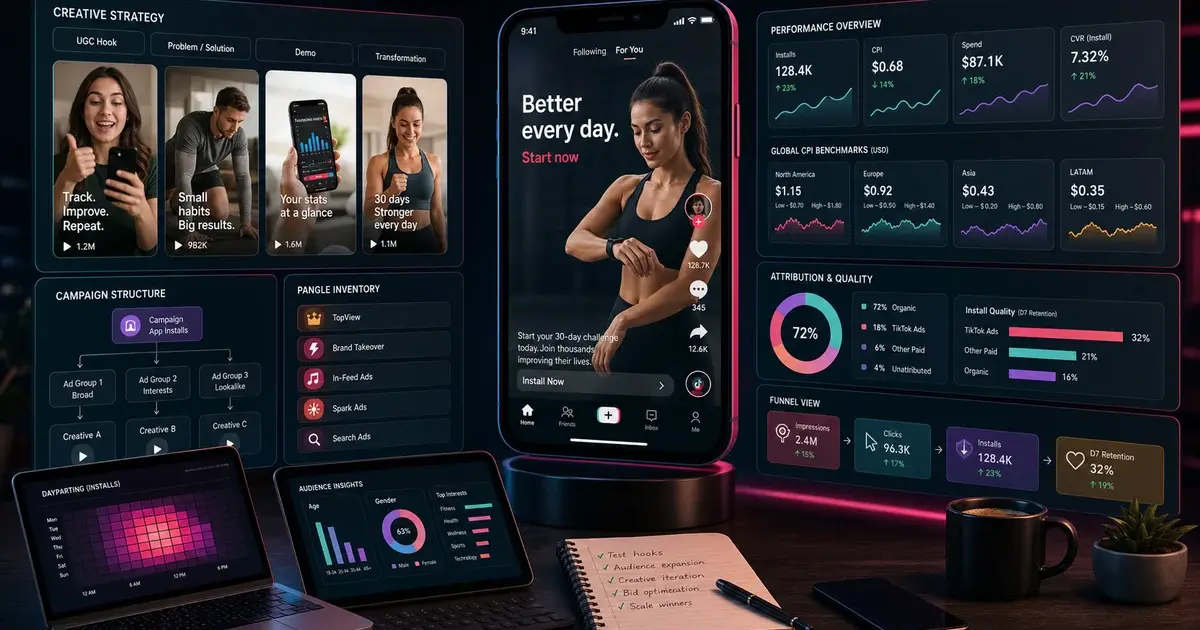
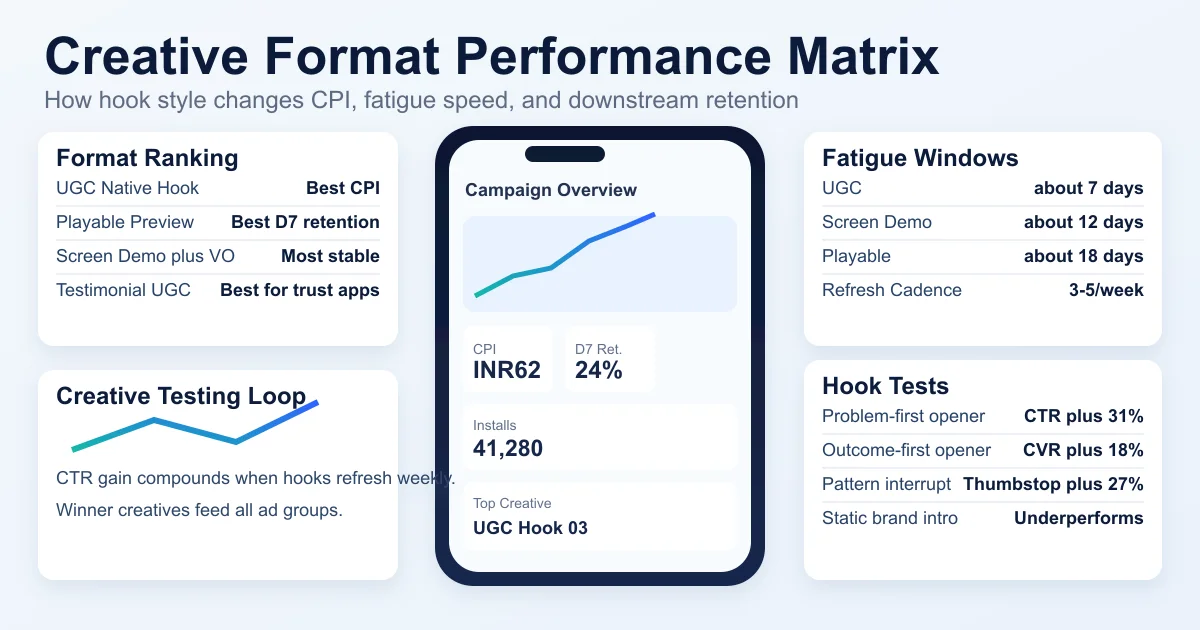
UGC-style video — shot to look like native TikTok content rather than polished advertising — consistently drives the lowest CPI on the platform, but it has a critical limitation: it fatigues in approximately 7.6 days and must be rotated continuously. RevenueCAT's analysis of UGC ads for apps confirms that authenticity signals — hand-held camera, natural lighting, direct-to-camera speech — outperform high-production creatives by a consistent margin in install rate, but the fatigue curve is steep.
The four formats ranked by typical CPI performance across our portfolio:
- UGC-style creator videos (lowest CPI, fastest fatigue): A creator or actor speaks directly to camera, demonstrates the app on-screen, and ends with a clear call-to-action. The hook — the first 3 seconds — determines both click-through rate and install rate. The same product demo with four different opening hooks will produce CPI variation of 2–4x between the best and worst performer. Test hooks aggressively; retire creatives at the first sign of CTR decline.
- Playable ads (higher-intent installs, better post-install retention): Playable ads allow users to interact with a stripped-down version of the app directly in the ad unit before committing to the install. iLogos's research on playable ad micro-games shows that users who install after engaging with a playable have materially higher D7 retention than those who install after a passive video — because they already know what the app does before they open it. The trade-off is production cost and lead time; playables take 2–4 weeks to build versus 48–72 hours for UGC.
- App demo screen-recordings with voiceover (reliable mid-tier CPI): A clean screen-recording of the app in use, overlaid with a conversational voiceover and on-screen text callouts. Lower production cost than playables, lower fatigue rate than UGC. Particularly effective for utility apps and tools where the product experience is self-explanatory. Singular's mobile ad creative report identifies screen-demo formats as a consistent top-three performer for non-gaming apps in Q1 2026.
- Testimonial-style UGC (strong for social proof-dependent verticals): A real or creator-played user describes the before-and-after experience of using the app. Strongest in health, finance, and productivity verticals where trust is a purchase barrier. Weakest in casual gaming where entertainment value is the purchase driver.
Creative rotation is not optional — it is the operational core of TikTok UA. Teams that treat creative as a one-time deliverable rather than a continuous production system will see their CPI climb week-over-week until the campaign becomes uneconomical. The minimum viable creative cadence is 3–5 new video variants per week per active ad group. See our Meta App Install Campaigns guide for how this creative rotation philosophy applies across platforms.
How Do You Use Pangle to Extend TikTok Reach Beyond the Main App?
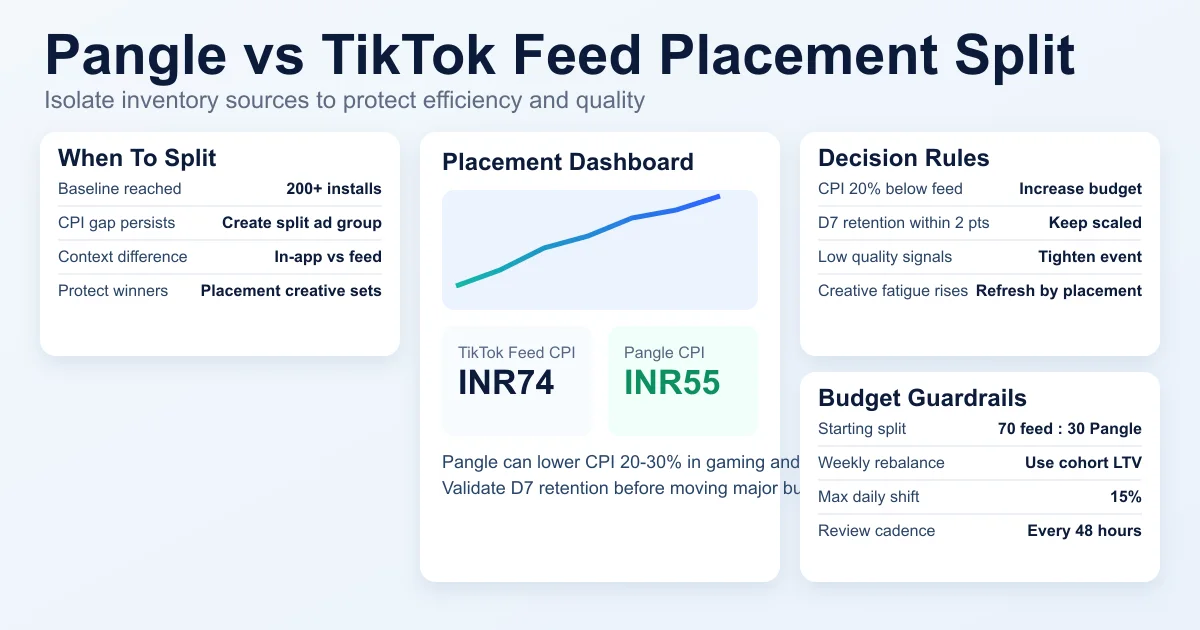
Pangle is TikTok's audience network — a publisher ecosystem of over 100,000 partner apps where TikTok's targeting and creative infrastructure can reach users who are not on TikTok itself, typically at CPI rates that are 20–30% lower than the main TikTok feed. For app marketers running at any meaningful scale, Pangle is not a supplementary placement — it is a material source of efficient installs that deserves its own budget allocation and creative set.
How Pangle works within TikTok Ads Manager:
- Placement: By default, when you select "Automatic Placement" in your ad group, TikTok includes Pangle inventory alongside the main feed. You can isolate Pangle as a standalone placement by selecting "Select Placement" and deselecting TikTok feed. This is worth doing once you have baseline data, so you can see Pangle's performance independently.
- Audience: Pangle inherits the same audience targeting and exclusion signals from your TikTok account, including custom audiences, lookalikes, and interest segments. The key difference is context — users are in a third-party app rather than the TikTok feed, so the creative must work without the native-content context that makes TikTok feed ads feel organic.
- Creative formats: Pangle supports interstitial video, native banner, rewarded video, and playable ads. Rewarded video — where users opt-in to watch an ad in exchange for an in-app reward in the publisher app — typically delivers strong install intent because opt-in users are actively engaged. Playable ads on Pangle frequently outperform the main feed in post-install metrics for gaming apps specifically.
- Bidding: Pangle's auction is separate from the main TikTok feed. In our portfolio, Pangle CPMs run 40–60% lower than the main feed for comparable audience segments, which is the primary driver of the CPI advantage. Start with a Pangle-specific ad group at your standard Cost Cap, then adjust based on observed CPI versus your main feed benchmark.
One nuance worth noting: Pangle's audience skews toward mobile gaming users, which makes it particularly effective for gaming, casual game, and entertainment apps. For B2B tools or niche professional apps, the audience match may be weaker and main-feed targeting more efficient. Test before assuming the CPI discount applies to your specific app category.
For apps operating in markets outside the US and Europe, Pangle also provides access to Southeast Asian publisher inventory that is not available through the main TikTok feed. This makes it a valuable channel for South-East Asian growth pushes alongside the broader LTV/CAC framework you should be running to validate those market expansions.
How Do You Integrate TikTok With Your MMP for Accurate Attribution?
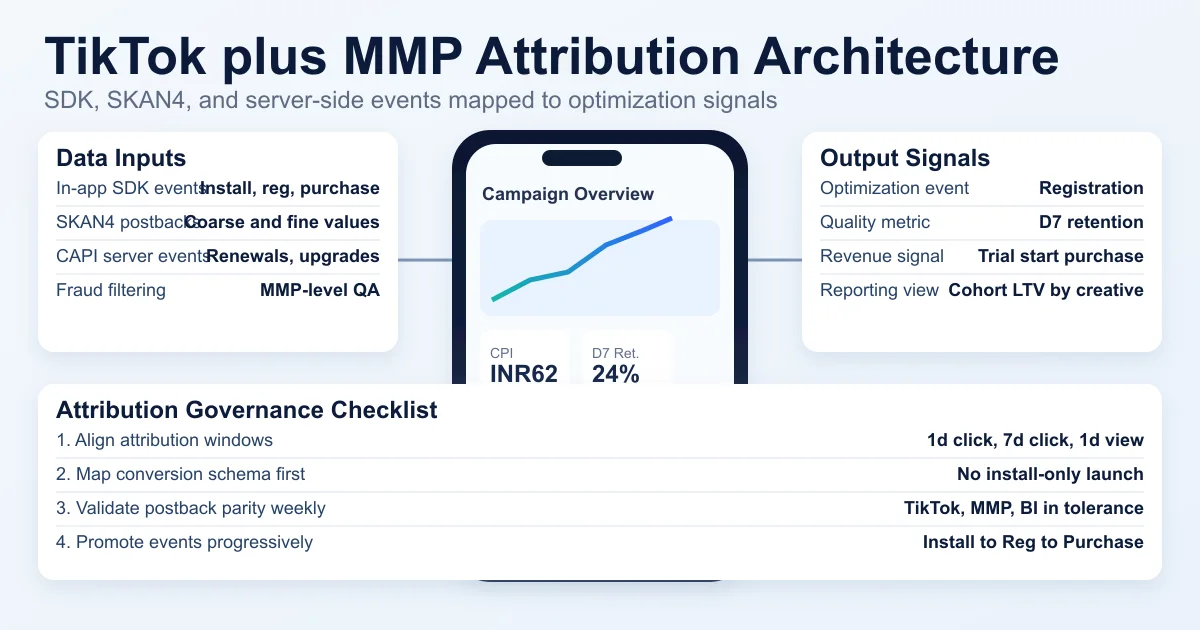
MMP integration — connecting TikTok to AppsFlyer, Adjust, or Singular — is not optional if you want TikTok's algorithm to optimise on real post-install behaviour rather than modelled installs, and it is the foundation of accurate cross-channel attribution across your entire paid UA stack. Without it, you are effectively flying blind on what your TikTok spend is actually producing.
The integration process has three layers:
- SDK integration: Your MMP's SDK must be installed in your app and sending events to both the MMP and TikTok's Events API simultaneously. For iOS, this requires configuring the TikTok SDK alongside your MMP to pass SKAN 4 postbacks correctly. For Android, standard in-app event tracking via the MMP SDK is sufficient — Android's attribution environment remains deterministic via Google Advertising ID (GAID).
- iOS — SKAN 4 configuration: Apple's SKAdNetwork 4 is the privacy-preserving attribution framework for iOS. TikTok supports SKAN 4 natively, but your conversion value schema must be configured carefully. Map your highest-value early post-install event — typically registration or first in-app purchase — to your conversion values. Poorly configured conversion schemas produce coarse attribution data that makes campaign optimisation unreliable. Your MMP (AppsFlyer, Adjust, or Singular) each provide SKAN 4 schema templates as a starting point.
- Server-side events (Conversions API): Beyond the SDK, connect TikTok's Conversions API to your backend to send purchase and subscription events server-to-server. This bypasses mobile tracking limitations, improves match rates for post-install events, and is essential for subscription apps where the conversion event (renewal, upgrade) may happen days after the install.
Once MMP integration is live, two reporting configurations make TikTok performance legible in the context of your full UA stack:
- Unified attribution window: Align your TikTok attribution window (1-day click, 7-day click, 1-day view) with the windows used in your other channels. Mixed attribution windows across channels make cross-channel CPI comparisons meaningless.
- Cohort reporting: Your MMP's cohort view shows D1/D7/D30 retention and LTV by channel and creative. This is the data that tells you whether TikTok's installs are worth the CPI — raw install counts never will. We consistently see TikTok installs from playable and UGC formats outperform raw install-count expectations in D7 retention when the creative selection is right.
For a full picture of how multi-channel attribution fits together, our Google UAC vs Meta vs CPI network comparison covers attribution methodology across all three channel types. And if you want to model the LTV against your acquisition costs before scaling, our LTV/CAC calculator guide provides the framework.
How Do You Optimise TikTok App Campaigns After the First 50 Installs?
The first 50 conversions in a TikTok App Promotion campaign are not a performance signal — they are the learning tax the algorithm must collect before it can begin finding your actual buyers. Cutting spend, restructuring ad groups, or changing bids before this threshold resets the learning phase and wastes the budget already spent to get there.
Once the 50-conversion threshold is crossed, the optimisation sequence that produces the best outcomes in our portfolio:
- Creative triage at day 7: Sort all active creatives by install rate (not just CTR). Pause anything in the bottom quartile. Creatives that are receiving impressions but converting below your floor CPI are consuming budget that your top performers could use more effectively. This single action typically reduces blended CPI by 15–25% in week two.
- Bid adjustment by performance band: Once you have 100+ conversions, identify the audience segments — age bands, placements, time-of-day — where CPI is running below your Cost Cap. Increase daily budget on ad groups driving below-target CPI first; do not force spend on struggling ad groups by lowering the Cost Cap prematurely.
- Lookalike audience expansion: Upload your highest-LTV user cohort (top 20% by revenue or retention) as a seed audience and create a TikTok Lookalike at 1–2% similarity. Layer this alongside your broad targeting in a separate ad group rather than replacing broad targeting — lookalike audiences typically narrow reach, which reduces volume even when improving quality.
- Post-install event migration: If you launched optimising on "install," migrate to a downstream event (registration, tutorial complete, first purchase) once you have enough post-install data for the algorithm to train on — typically at 30–50 post-install events per week. This shift reliably improves D30 LTV while holding or slightly raising CPI — a worthwhile trade for most app categories.
- Dayparting (advanced): Use your MMP's cohort data to identify which hours of day produce your highest D7 retention from TikTok installs. For most consumer apps, evening hours (7–11pm local time) drive the highest-quality installs. Enabling dayparting to concentrate spend in these windows can improve post-install metrics by 10–20% without changing creative or targeting.
What you should absolutely not do in this phase: restructure campaigns or ad groups in response to day-one or day-two numbers. Early CPI is noisy — the algorithm is still exploring. We have seen campaigns that showed $8 CPI on day two stabilise at $2.20 by day ten without any intervention. Patience through the learning phase is one of the most valuable decisions a UA manager can make.
What CPI and ROAS Benchmarks Should You Expect From TikTok in 2026?
TikTok's global CPI benchmarks for app install campaigns in 2026 sit at $1.75–$4.00 for most consumer app categories, with India's lifestyle and entertainment verticals running ₹40–₹90 per install — making TikTok one of the most cost-efficient paid channels for reaching audiences under 30 in high-growth markets.
Benchmark breakdown by category and geography, based on aggregated data from our managed portfolio and Prodigmar's 2026 TikTok campaign benchmarks:
- Casual gaming: $0.80–$2.50 globally; ₹30–₹70 India. Lowest CPI on the platform, driven by high creative volume and Pangle's gaming-skewed audience. ROAS window typically 30 days for ad-monetised games.
- Social and entertainment apps: $1.50–$3.00 globally; ₹40–₹90 India. Strong fit with TikTok's native audience — users already in a content-consumption mindset. Post-install retention tends to be above category baseline when creative format matches the app's core interaction.
- Fitness and health: $2.00–$4.50 globally; ₹60–₹120 India. Higher CPI reflects the higher subscription conversion rate — LTV per acquired user is typically the strongest of any consumer app category when MMP cohort data is analysed at 90 days.
- Fintech and finance: $3.50–$7.00 globally; ₹90–₹180 India. Highest CPI category on TikTok, but justified by the LTV upside. Playable-format ads and testimonial-style UGC consistently outperform standard video in this category because trust is the primary conversion barrier.
- E-commerce and shopping: $2.00–$5.00 globally; ₹50–₹130 India. Strong ROAS potential via TikTok Shop integration. Campaigns that tie into TikTok Shop catalogue frequently show 2–3x ROAS at 7 days versus standalone app install campaigns, because the purchase intent in-feed is higher.
ROAS benchmarks are harder to generalise because they depend on your monetisation model, average revenue per user, and attribution window. As a working target for subscription apps: a 3x ROAS at 30 days is the floor for a scalable TikTok channel. For ad-monetised games, 1.2–1.5x ROAS at 7 days is typically the correct early-stage benchmark. Liftoff's Mobile Ad Creative Report provides supporting benchmark data across gaming categories.
One benchmark that consistently surprises teams new to TikTok: Pangle installs often arrive at 20–30% lower CPI than the main feed while showing comparable or better D7 retention for gaming and entertainment categories. This is the clearest argument for budgeting Pangle separately rather than treating it as an incidental placement.
How Do TikTok App Campaigns Compare to Meta and Google UAC?
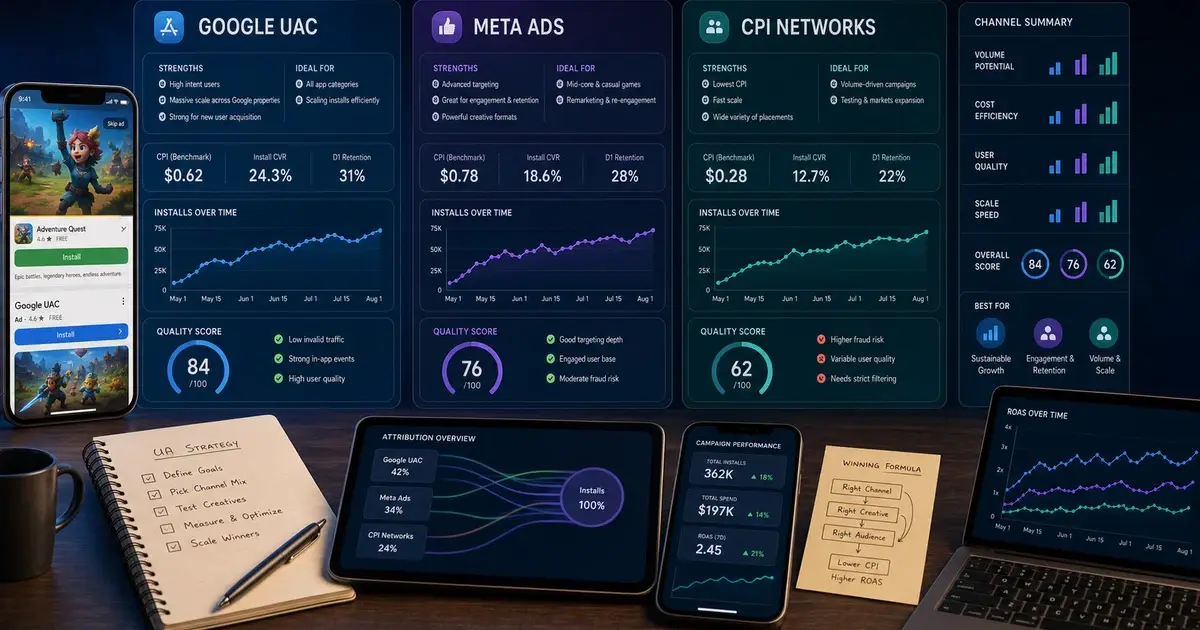
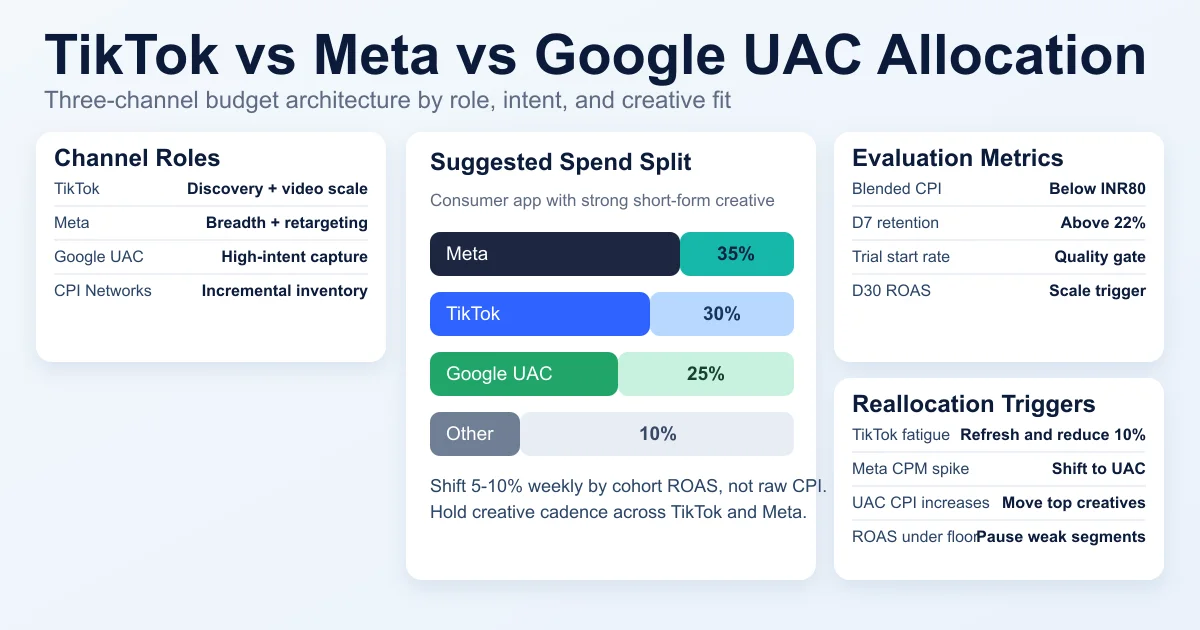
TikTok, Meta Advantage+, and Google UAC each have a structural role in a mature paid UA stack — and the teams that outperform are not those who pick one channel but those who understand what each channel does best and allocate budget accordingly.
A direct comparison across the four dimensions that matter most for app install campaigns:
- Audience: TikTok skews 18–34, entertainment-minded, mobile-first. Meta covers the broadest demographic range (18–65+) with deep interest-graph data. Google UAC reaches users with active intent — people searching for apps or app categories on Play and Search. TikTok wins on under-30 reach and cost-efficiency; Google wins on high-intent installs; Meta wins on demographic breadth and lookalike precision.
- Creative format: TikTok is the only channel where native short-form video is the dominant format — your creative either feels like TikTok content or it underperforms. Meta supports the widest creative format range (static, carousel, video, Stories, Reels). Google UAC accepts the broadest input type diversity (HTML5, YouTube video, static, responsive) and distributes across the most placements. If you have strong video creative, TikTok provides the highest upside; if you have heterogeneous creative assets, UAC provides the most flexible deployment.
- Algorithm and control: All three platforms have moved toward automation-first campaign structures. TikTok's App Promotion objective and Meta's Advantage+ both strongly favour broad targeting and automated placement. Google UAC is the most opaque — you have the least control over placement and audience within UAC, which is either a strength (fully automated optimisation) or a weakness (no ability to isolate what is working). TikTok's ad manager sits between the two in transparency.
- CPI benchmarks globally: Google UAC is typically lowest for search-driven install categories (tools, utilities, productivity). Meta is competitive across most consumer categories. TikTok delivers the lowest CPI for entertainment, social, and casual gaming categories — often 15–35% below Meta for the same app in the same market when creative quality is equivalent.
Our recommendation based on data across 300+ apps in our portfolio: treat TikTok and Meta as complementary video channels (different creative formats, different audience demographics), and Google UAC as the intent channel. A mature UA stack for a consumer app typically allocates 30–40% to Meta, 25–35% to TikTok, and 20–30% to Google UAC, with the remaining budget in CPI networks and influencer. The exact split shifts based on category, creative production capacity, and LTV cohort data from your MMP.
For a deeper head-to-head analysis, see our dedicated Google UAC vs Meta vs CPI network comparison. To discuss how these channels fit within a bespoke growth architecture for your app, speak to our team.
Frequently Asked Questions
How much budget do I need to start TikTok app install campaigns?+
The minimum daily budget per ad group that allows TikTok's algorithm to exit the learning phase in a reasonable timeframe is $100 or approximately ₹8,000. Below this, the algorithm struggles to collect the 50 conversions needed before it can optimise effectively. A meaningful test — enough to generate reliable CPI data across 2–3 creative formats — requires a minimum of $1,500–$3,000 or ₹120,000–₹250,000 over two to three weeks.
Should I use automatic or manual placement on TikTok?+
Start with automatic placement (TikTok feed + Pangle) for all new campaigns. Once you have 200+ installs, pull a placement-level breakdown from TikTok Ads Manager to compare TikTok feed CPI against Pangle CPI. If Pangle is running 20%+ below your feed CPI, create a separate Pangle-only ad group with its own budget to capture that efficiency at scale without competing with your main feed budget.
How do I stop TikTok creative from fatiguing so fast?+
UGC-style creatives on TikTok fatigue in approximately 7.6 days on average. The only reliable defence is a continuous production system: brief 3–5 new video variants per week per active ad group, test new hooks against your current best performers, and pause anything showing CTR decline for two consecutive days. Teams that treat creative as a project (finite deliverable) rather than a pipeline (continuous production) will always face escalating CPI after week two.
Is TikTok attribution reliable without a MMP?+
No. TikTok's native attribution is last-click and does not account for view-through conversions, cross-channel overlap, or post-install event quality. Without an MMP (AppsFlyer, Adjust, or Singular) you cannot see D7/D30 retention by creative, cohort LTV by audience segment, or how TikTok installs compare in quality to other channels. Running TikTok UA without MMP integration means optimising on install counts rather than retained users — a decision that reliably inflates apparent performance while delivering poor LTV.
Does TikTok work for non-gaming apps?+
Yes — TikTok is effective for any app category with a demonstrable use-case and an under-35 target audience. Health, fitness, social, finance, and e-commerce apps consistently show strong TikTok performance in our portfolio when the creative format matches the category. The channels that underperform on TikTok are niche B2B tools, professional services apps, and categories with audiences skewing above 45 — for those, Meta and Google UAC typically provide better audience match.
How long does the TikTok learning phase last?+
TikTok's learning phase continues until your campaign or ad group has collected 50 conversion events using your selected optimisation target. At a $100 daily budget with a $3 target CPI, this takes approximately 1.5–2 days. At lower budgets or with harder conversion events (first purchase rather than install), it can take 7–14 days. During this period, CPI will be volatile and above your steady-state target — this is expected and should not prompt restructuring.
Sources
- TikTok — App Promotion Objective — Official TikTok documentation on App Promotion campaign types, sub-goals, and setup
- Stackmatix — TikTok Advertising for Apps — TikTok user acquisition strategy guide covering targeting, creative, and CPI benchmarks
- RevenueCAT — UGC Ads for Apps — Analysis of UGC ad performance, fatigue timelines, and creative rotation strategies for app campaigns
- iLogos — Playable Ads & Micro-Games — Research on playable ad engagement rates, post-install retention uplift, and production frameworks
- Singular — Mobile Ad Creative Report — Quarterly creative performance benchmarks across mobile ad formats including screen demo and UGC
- Liftoff — Mobile Ad Creative Report 2025 — Industry benchmark data for mobile ad creative performance, CPI ranges, and ROAS by app category
- Prodigmar — TikTok Ads Profitable Campaigns Guide 2026 — CPI and ROAS benchmark data for TikTok app campaigns across verticals in 2026
About the author
Amol Pomane — Founder, Vmobify
Amol leads Vmobify, a mobile app growth agency that has driven 30M+ downloads and ranked 54K+ keywords across 300+ apps since 2013. He writes about ASO, paid user acquisition, retention, and the operational reality of scaling mobile apps in India and global markets.
Model an install budget
Turn CPI and activation assumptions into acquisition scenarios.
Open free tool