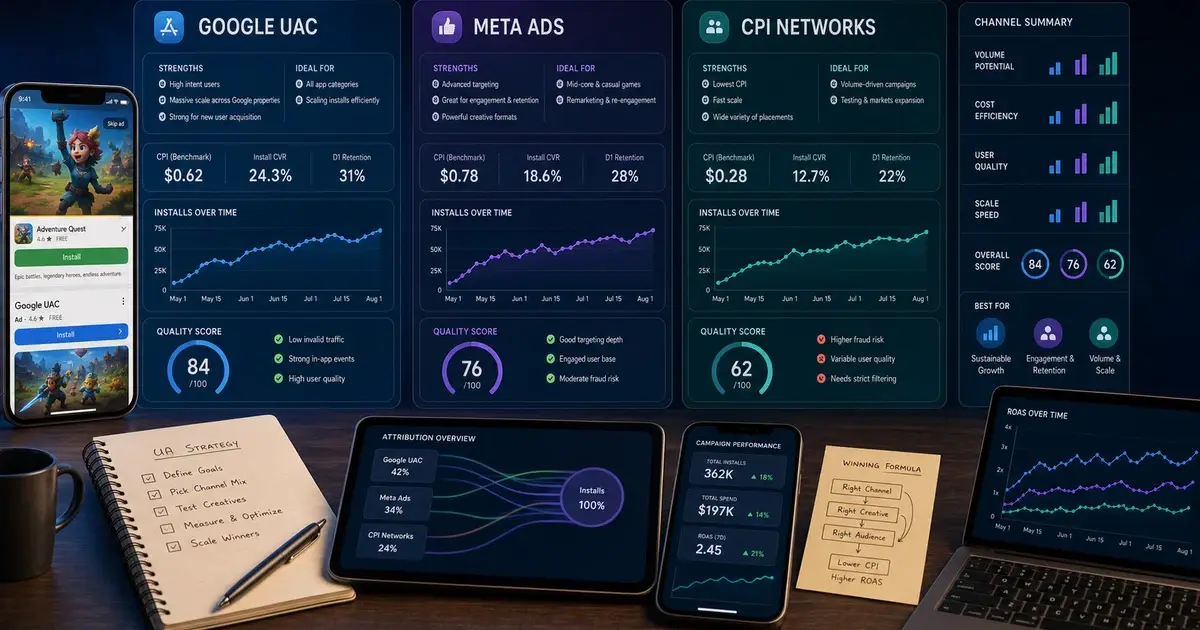
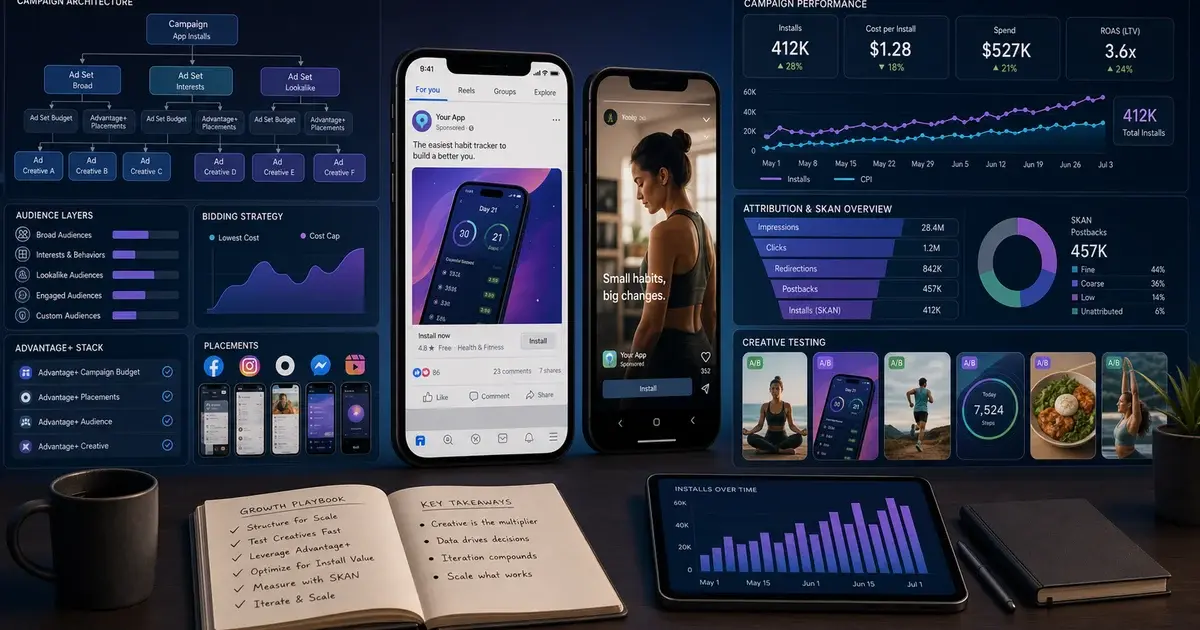
Mass User Acquisition: How to Drive 100K+ Installs in 30 Days
Mass UA is not about spending more — it is about building a system where every rupee multiplies. Here is the blueprint we use to scale apps past 100K installs per month.

On this page
- What does "mass UA" actually mean?
- Which foundations do you need before scaling?
- What channel mix actually holds at scale?
- How do you build a creative factory that keeps up?
- How should attribution work at mass UA scale?
- How should budget be allocated across channels?
- What does 100K installs actually cost in India?
- Why do most mass UA programs fail?
- Frequently Asked Questions
What does "mass UA" actually mean?
Mass user acquisition is the discipline of acquiring 50,000 to several million installs per month through a coordinated multi-channel paid programme — not "more ads," but a system where channels reinforce each other, creative production runs continuously, and every install attributes back to a source you can compound.
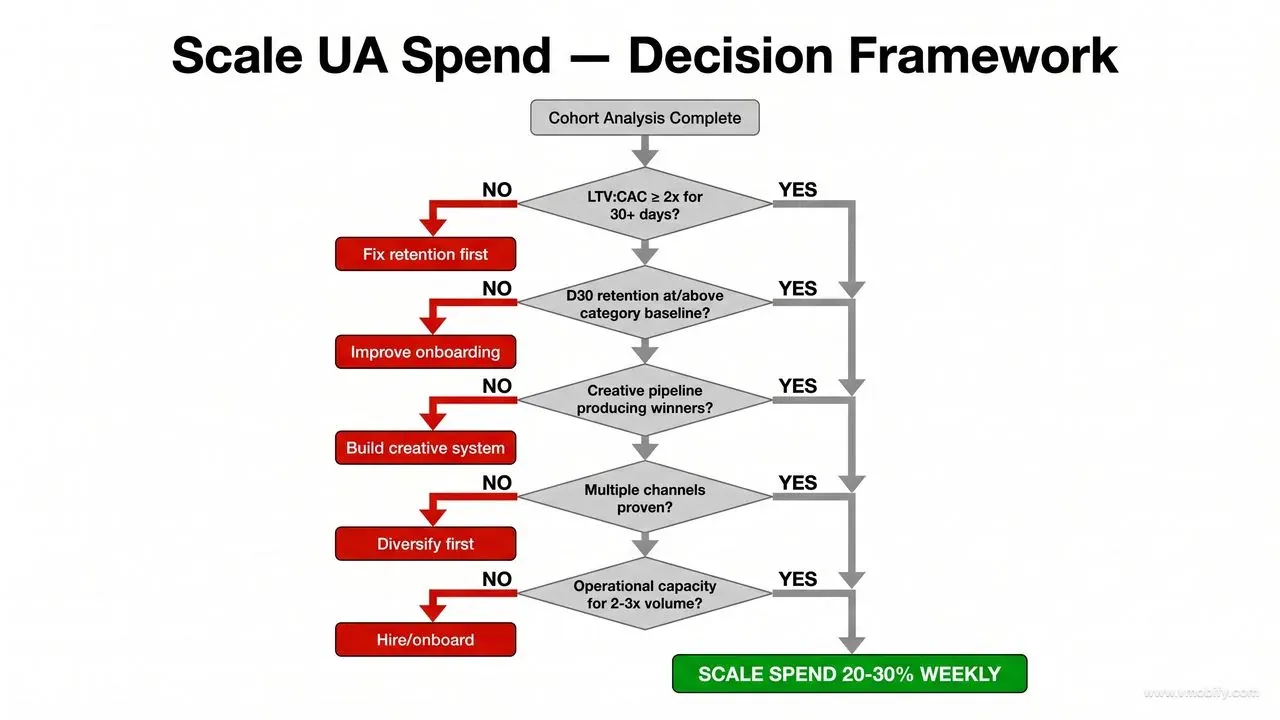
The teams running mass UA well share three traits. They have proven unit economics — a D30 LTV that exceeds blended paid CPI by a healthy margin. They have product-market fit strong enough that D7 retention sits at or above their category baseline as measured against AppsFlyer's annual State of App Marketing benchmarks. And they have the operational discipline to manage 20-100 active campaigns across five or more platforms without any single ad set going stale.
Mass UA is the wrong objective for almost every app under those thresholds. If your D7 retention sits below 15% or your LTV model is still guesswork, paid scaling amplifies the leaks instead of revenue. Across our portfolio of 300+ apps, every team that tried to "grow into" retention by buying more installs ended up burning 18-month runway in nine months. Start with our first 10K installs guide and lock down retention first.
This piece is the operating manual for the next stage — the move from a single performant channel to a defensible, multi-channel programme that scales past 100K installs per month without breaking. It is written for VPs of marketing and growth leads at Series A+ mobile startups making that transition right now, and it assumes you have already validated the basics: an active MMP, a tracked LTV, and a paid programme already spending into at least one channel profitably.
Read it as a sequence. The order matters — foundations before channel mix, channel mix before creative system, creative system before attribution, attribution before budget allocation. Skipping ahead is the most common way these programmes break.
Which foundations do you need before scaling?
Three foundations are non-negotiable before any meaningful scale: a mobile measurement partner wired correctly, in-app event tracking aligned to commercial value, and a proven LTV model. Skip any of these and your scaling effort will plateau, reverse, or quietly burn money in places nobody is measuring.
- Mobile Measurement Partner (MMP). AppsFlyer, Adjust, Singular, or Branch — pick one and integrate it properly. On Android you need deterministic install attribution and deep-linking for re-engagement. On iOS you need SKAdNetwork 4 postbacks configured with a deliberate conversion-value schema, not the default. Fraud rules — click flooding, device farms, install hijacking — should be live from day one. We have inherited campaigns where 12% of paid installs were SDK spoofing nobody had caught because fraud rules were left at their default thresholds.
- In-app event tracking aligned to commercial value. Paid channels optimise on whatever you send them. Send install only, and you get cheap installs that do not retain. Send a registration event that fires before the user has done anything meaningful, and you train algorithms to find low-intent users. The right set is install, qualified-session, key activation event, first monetisation event, and a D7-retained signal — pushed to each ad platform via the MMP, with SKAN conversion values mapped against the same hierarchy on iOS per Apple's SKAdNetwork documentation.
- Healthy unit economics. Know your D30 LTV by cohort and by channel. If LTV is unknown or sits below ₹50 in India or $1.50 globally, you cannot pay for paid installs profitably at scale. We will not take on a mass UA engagement at Vmobify without a validated LTV model — it is the single highest-leverage variable in the entire system.
Two weeks of foundation work saves three months of wasted ad spend. The teams that try to skip this step always pay it back later, usually at a 5-10x premium.
What channel mix actually holds at scale?
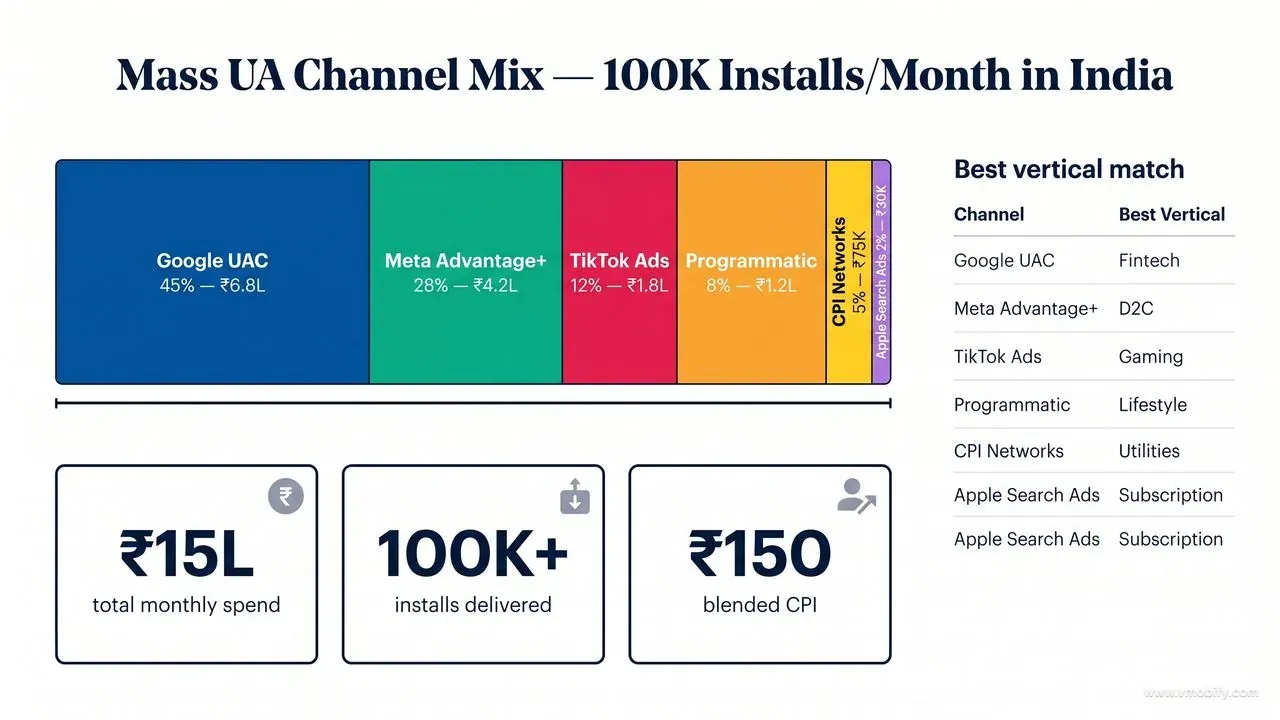
At mass UA scale no single channel works for long — audiences saturate, CPMs rise, creative fatigues, and platform algorithm changes can wipe out a quarter of performance overnight. The defensible mix spreads risk across six surfaces and treats no single channel as load-bearing.
- Google App Campaigns (UAC) — 40-55% of spend. Largest reach on the planet, most algorithmic, best for any vertical with a clear post-install conversion event. Google's UAC documentation describes inventory spanning Search, YouTube, Discover, Display, and Google Play — no other channel touches that breadth.
- Meta Advantage+ App Campaigns — 20-35% of spend. Stronger demographic resolution, faster creative testing cadence, generally better D7 retention quality in consumer categories. Per Meta's Advantage+ guidance, broad targeting consistently outperforms narrow targeting because the algorithm has more signal to work with.
- TikTok Ads — 10-20% of spend. Younger audiences, lowest CPMs in many markets, but creative-hungry to the point of being a different operating model. A TikTok programme without a dedicated UGC pipeline will not work. With one, it is the cheapest scale channel in the mix for the right categories.
- Programmatic / DSPs (Liftoff, AppLovin, Moloco) — 5-15% of spend. Reach inventory the walled gardens cannot. Best for apps with proven LTV that need scale beyond Meta + Google ceilings. Quality varies wildly by DSP — vet each one with a small test budget before committing.
- CPI Networks — 5-10% of spend. Burst ranking pushes, geographic fills, and category-specific traffic the auctions cannot deliver cheaply. See our CPI network service for the publisher-set vetting protocol.
- Apple Search Ads — 5-10% of spend (iOS apps). Highest-intent traffic on iOS by a wide margin. Lower volume than the auction channels but routinely the best-converting line item in any iOS budget. Apple Search Ads deserves a permanent line item in any iOS-significant mix.
Exact splits depend on vertical and geography. For an Indian fintech, UAC dominates and Apple Search Ads is small because iOS share is low. For a US dating app, Meta and TikTok dominate and UAC plays a supporting role. Across our portfolio the constant is that no programme above 100K installs per month relies on a single channel for more than 60% of spend without paying for it later.
How do you build a creative factory that keeps up?
Creative is the bottleneck at mass UA scale — not media buying, not bidding, not audience strategy. You need to ship 20-50 net-new creatives per major channel per month just to hold CPIs flat. Teams that try to scale spend without scaling creative production hit a ceiling inside 90 days and watch CPIs double in the quarter after.
What a working creative system looks like:
- UGC creator network of 5-15 contracted creators. Producing on-demand video assets with turnaround under five business days. Indian creator economics are uniquely favourable here — per Statista's India influencer market data, creator inventory is expanding faster than brand demand, keeping per-asset costs lower than any comparable market.
- Motion graphics studio (in-house or contract): 10-15 short motion videos per month for the slots UGC does not cover well — feature demos, gameplay loops, product walkthroughs.
- Static and playable production pipeline: Especially for gaming. Playables routinely move CPI by 30% or more when they hit; most mid-core gaming budgets in our portfolio depend on playables for the long tail of scalable spend.
- Weekly creative review: Pause anything below your CPI threshold after 5,000 impressions. Scale winners 2x weekly until they fatigue. We have run this exact cadence for clients managing 8-figure annual ad budgets across our 300+ app portfolio — the discipline of weekly pause-and-scale decisions is what compounds creative ROI over a year.
- Hook variation testing: Same product demo, four to six different opening hooks. The first two seconds determine 70-80% of total performance. This is the single highest-leverage creative experiment you can run, and most teams run it inconsistently or not at all.
The temptation when scale ambitions outrun creative supply is to recycle winners for longer. It does not work — fatigued creatives produce rising CPIs that look like "platform tax" but are actually creative debt being paid off in real time. Build the factory before you need the volume, not after.
How should attribution work at mass UA scale?
Mass UA dies without clean attribution — with dozens of active campaigns across six channels, guessing which source drove which install is not a viable operating model. Attribution at scale has three layers: deterministic on Android, SKAdNetwork-deliberate on iOS, and cohort-honest across both.
- SKAdNetwork conversion values, configured deliberately. iOS attribution is unforgiving. The default conversion-value schema your MMP ships with is almost certainly wrong for your business. Encode revenue tier + retention quality + key event completion into the six-bit conversion value, with the schema reviewed against actual cohort behaviour at least quarterly. Apple's SKAdNetwork documentation covers the postback mechanics; the schema decisions are yours to make.
- Deferred deep links for paid re-engagement campaigns, so re-installs and returning users route to the correct in-app destination. Broken deep links waste paid re-engagement spend silently — the click attributes, the install does not land where the creative promised, and conversion collapses.
- Fraud rules in the MMP from day one. Click flooding, device farms, install hijacking. AppsFlyer's Performance Index reports consistently show 5-15% of mass UA spend being absorbed by fraud where rules are absent or default. We treat fraud-rule configuration as the first deliverable on any new mass UA engagement — not the last.
- Weekly cohort reporting at channel + creative + geo grain. Identify cohorts where D30 retention sits at 2x category baseline and pour budget there. Identify cohorts where retention collapses and cut without sentiment. Reporting at install-count grain hides everything that matters at scale.
One unglamorous truth: most mass UA programmes that look broken on the dashboard are actually broken on the attribution layer. Fix attribution before reshuffling spend. Reshuffling spend on bad data just moves money from one wrong allocation to another.
How should budget be allocated across channels?
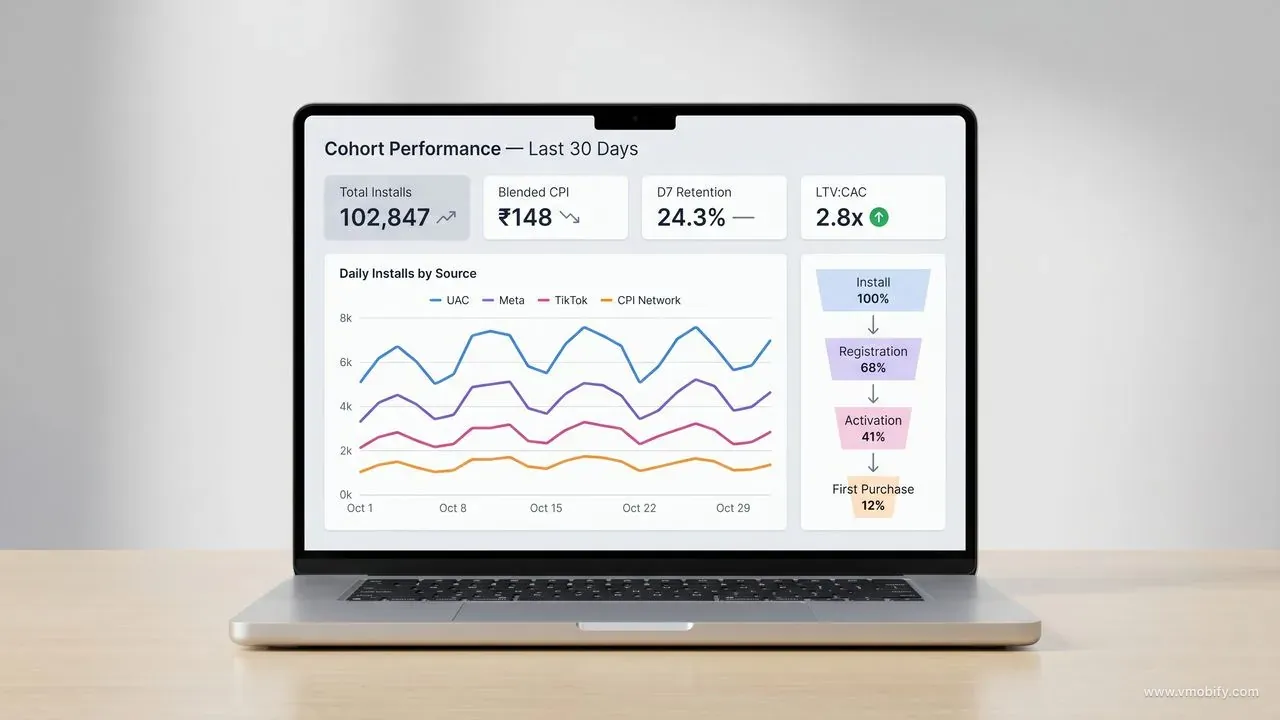
The default rule for mass UA budget allocation: 80% on proven channels measured on rolling 7-day blended CPA, 20% on experiments that protect against channel concentration risk. The experiment 20% is what keeps a programme alive when a major channel changes its algorithm or hikes prices.
Within the proven 80%, reallocate weekly based on blended CPA against the action that matters — purchase, subscription, qualified registration, not raw install. Channels hitting CPA targets get a 25% budget bump. Channels missing targets get a 25% cut. This rhythm is dull, mechanical, and outperforms every "rebuild the mix from scratch" exercise we have seen teams attempt under pressure.
The 20% experiment budget should always be live and always be testing something — a new DSP, a new geo, a new creative format, an emerging platform. The cost of running this 20% is real; the cost of not running it is catastrophic the first time a load-bearing channel underperforms.
Two further rules from across our 300+ app portfolio:
- Never cut a channel to zero based on one bad week. Auction dynamics, creative fatigue and seasonal demand all move CPAs week to week. Progressive cuts surface real underperformance; reactive cuts amplify noise.
- Never raise budgets faster than the algorithm can absorb. A 2x daily budget jump on a tROAS campaign resets the learning phase and produces 2-4 weeks of degraded performance. Scale at 25-30% per step, not 100%.
Budget allocation is the most over-engineered and under-disciplined part of mass UA. The teams that win run boring, mechanical reallocation on a weekly cadence and resist the temptation to optimise daily. Daily optimisation on noisy data reliably destroys value — most ad platforms need at least three to seven days of stable spend before their reported CPA reflects underlying audience reality, and reacting inside that window means you are responding to attribution lag rather than performance.
A final practical note: keep an "always-on" baseline budget for each proven channel that you do not touch during the weekly reallocation. The reallocation moves the marginal 25%, not the base. This prevents the trap of starving a channel of momentum during a temporary CPA spike and then having to spend three weeks rebuilding learning when you turn it back on.
What does 100K installs actually cost in India?
Real numbers from our portfolio for 100,000 installs in 30 days, India geography, by vertical:
- Utility / Productivity: Blended CPI ₹15-25. Total spend ₹15-25L.
- Hyper-casual game: Blended CPI ₹8-15. Total spend ₹8-15L.
- Mid-core game: Blended CPI ₹35-60. Total spend ₹35-60L.
- Ecommerce / D2C: Blended CPI ₹25-45. Total spend ₹25-45L.
- Fintech (regulated): Blended CPI ₹80-180. Total spend ₹80L-₹1.8Cr.
- Dating / Social: Blended CPI ₹40-80. Total spend ₹40-80L.
Three drivers move you within these bands. Tier-2 / Tier-3 India geographic focus runs 30-50% cheaper than metro-only targeting on the same creative. Strong store-listing conversion (above category baseline per SplitMetrics' aggregated ASO benchmarks) drops CPI 15-25% on the same paid spend — see our ASO service for the optimisation playbook. And creative quality above category median accounts for the rest of the variance.
Western markets run roughly 3-5x these numbers. The cheapest mass UA market on the planet for most verticals right now is Tier-2/3 India, followed by selected Southeast Asian markets. Regulated verticals (fintech, insurance subject to IRDAI oversight, broker apps under SEBI jurisdiction) sit at the top of the cost curve because creative restrictions, compliance review and KYC friction all compress conversion.
The figures above are blended CPIs — channel-level CPIs vary by 2-3x within a single vertical. Apple Search Ads on a fintech app might cost ₹250 per install with 4x retention; CPI network fills might cost ₹40 per install with 0.5x retention. The blended number is what your CFO sees; the per-channel numbers are what you actually manage.
Why do most mass UA programs fail?
Most mass UA programmes do not fail because channels stopped working. They fail for five predictable operational reasons — and avoiding all five turns mass UA into mostly a discipline problem rather than a marketing one.
- Single-channel concentration. 80% or more of spend on one channel. When that channel changes its algorithm, raises CPMs, or shifts ranking signals, the entire programme collapses overnight. We have onboarded clients where a single Meta policy change wiped out 60% of monthly installs the next morning.
- Creative starvation. Same five creatives running for months. CPIs slowly rise, then sharply rise, then double, then triple. The team blames "the platform" or "the algorithm" instead of recognising the creative pipeline has been the constraint for the entire quarter.
- No retention loop. Acquired users churn faster than CAC drops, LTV erodes, and scaling makes the bleed worse not better. Mass UA is a multiplier — it multiplies whatever your product is doing, including the leaks. Fix the leaks first.
- Broken iOS attribution. SKAdNetwork misconfigured, conversion-value schema mapped to events that fire too early, postbacks not flowing to ad platforms. iOS spend silently underperforms for months because nothing on the dashboard says "this is broken." Audit SKAN configuration quarterly.
- Zero experimentation budget. 100% of spend on "what works today" means no new channels for when current ones decline. The 20% experiment line item is insurance; teams that cut it for short-term efficiency pay 10x for the decision inside a year.
Across our 300+ app portfolio, programmes that avoid these five failure modes scale predictably. Programmes that hit even two of them stall or contract regardless of how good the underlying app is. Our UA team runs mass UA programmes for clients across India, SEA, and the US — happy to audit yours against this checklist. Get an audit or see the case studies for representative outcomes.
Frequently Asked Questions
At what point should I move from organic-only to mass UA?+
Once your D30 LTV is profitably above your projected paid CPI, and retention is at or above category median. Below those thresholds, paid scaling amplifies leaks instead of growth.
How much team headcount does mass UA require?+
For 100K+ installs / month: typically 1 paid media lead, 1-2 creative producers, 1 analytics lead, plus a part-time UGC coordinator if you run TikTok meaningfully. An agency engagement collapses this into one retainer.
Will mass UA hurt my organic install rate?+
It usually helps — paid volume triggers velocity signals that boost organic discovery. The exception is if paid users have much worse retention than organic; then store algorithms penalise the listing and organic rate contracts.
Is iOS or Android easier for mass UA in 2026?+
Android is still cheaper and more measurable at scale due to deterministic attribution. iOS economics improve once you have stable SKAdNetwork postbacks tuned and a deliberate conversion-value schema, but the learning curve is steeper and the audit cadence is higher.
What is a healthy LTV-to-CAC ratio for mass UA?+
D30 LTV ÷ blended CAC should be 1.5x minimum to sustain growth, 3x+ to compound profitably. Below 1.5x means scaling burns cash on every cohort and the programme cannot survive an auction-pricing shock.
How long before a new mass UA channel produces signal?+
Plan for 14-21 days of stable spend per new channel before judging it. Algorithmic channels need 50-100 conversions to exit the learning phase; cutting earlier produces noise, not insight.
How often should the channel mix be rebalanced?+
Run mechanical weekly reallocation at 25% step sizes based on rolling 7-day blended CPA. Do a structural mix review quarterly — that is when you decide whether to add or retire entire channels, not week to week.
Sources
- AppsFlyer Performance Index — Quarterly benchmarks for channel performance, retention and fraud rates by vertical and geography
- AppsFlyer — State of App Marketing in India — Annual category baselines for retention, CPI and ROAS used to gate mass UA readiness
- Apple — SKAdNetwork documentation — Official SKAN postback mechanics and conversion-value framework for iOS attribution at scale
- Google Ads — App Campaigns Help — UAC setup, bidding model selection, and creative volume guidance
- Meta — Advantage+ App Campaigns — Official Meta guidance on broad targeting, optimisation events and Advantage+ structure
- Apple Search Ads — High-intent iOS acquisition channel; permanent line item in any iOS-significant mix
- Adjust Resources Hub — MMP benchmark reports and fraud detection methodology used to calibrate attribution rules
- Statista — India Influencer Marketing Market Size — 25%+ YoY growth data underpinning Indian UGC creator economics
About the author
Amol Pomane — Founder, Vmobify
Amol leads Vmobify, a mobile app growth agency that has driven 30M+ downloads and ranked 54K+ keywords across 300+ apps since 2013. He writes about ASO, paid user acquisition, retention, and the operational reality of scaling mobile apps in India and global markets.
Model an install budget
Turn CPI and activation assumptions into acquisition scenarios.
Open free tool