LTV vs CAC: Calculator, Benchmarks, and How to Use the Ratio
LTV-to-CAC ratio is the single most important number for app marketing decisions. Here is how to calculate it correctly, the benchmarks for your category, and what to do when the ratio breaks.

On this page
- Why does the LTV-to-CAC ratio matter so much?
- How do you calculate LTV for a mobile app?
- How do you calculate CAC correctly?
- What does the full calculation look like end to end?
- How do you calculate LTV when you barely have any data?
- What are realistic LTV:CAC benchmarks by category?
- What should you do when the ratio is too low?
- Which calculation mistakes break the ratio most often?
- Frequently Asked Questions
Why does the LTV-to-CAC ratio matter so much?
LTV-to-CAC is the single most important number in app marketing because it tells you, in one ratio, whether each acquired user is worth more than you paid for them, by how much, and how aggressively you are allowed to scale. Every other metric — CPI, CTR, install volume, ROAS day-7 — is just an input that eventually rolls up into this one ratio.
The ratio breakpoints are unforgiving and well-understood across the industry:
- Ratio < 1: You lose money on every user you acquire. Scaling spend simply accelerates the bleed. Most teams in this zone do not realise it until 90 days of data lands.
- Ratio 1-1.5: Break-even territory. There is no margin to fund the next cohort of growth, salaries, or product investment. Functionally a no-go.
- Ratio 1.5-3: Healthy. Sustainable growth is fundable from operating cash flow and the business compounds.
- Ratio 3+: Exceptional. Scale aggressively — every rupee deployed into UA returns 3+ rupees of contribution margin.
This is not theoretical. AppsFlyer's State of App Marketing consistently shows that the apps which compound year after year sit in the 2.5-4x band, while the apps that flame out after a Series A typically had a sub-1.5x blended ratio they were quietly subsidising with venture money. The ratio is also the number every sophisticated investor will ask for first in a fundraise — sometimes before they ask what the app actually does.
Across the 300+ apps we have worked with at Vmobify since 2013, every successful scaling story has the same shape: founders measured LTV:CAC honestly, segmented it by channel, and made hard cuts on the losers. Every failure story involved either ignoring the ratio entirely or massaging the inputs to make it look better than it was. There is no third path.
One more nuance most teams miss: the ratio is a decision-making tool, not a vanity metric. It only matters if you actually change spend allocation based on what it tells you. A weekly LTV:CAC review that does not lead to channel-level budget shifts within 30 days is a ritual, not a system. The teams that win treat the ratio the way a trader treats a P&L — read it daily at the cohort level, act on it weekly at the channel level, and rebuild the model quarterly as retention curves and category CPIs move.
How do you calculate LTV for a mobile app?
The base LTV formula is ARPU × Average Customer Lifetime, but the version that survives contact with reality requires four additional refinements that most teams skip.
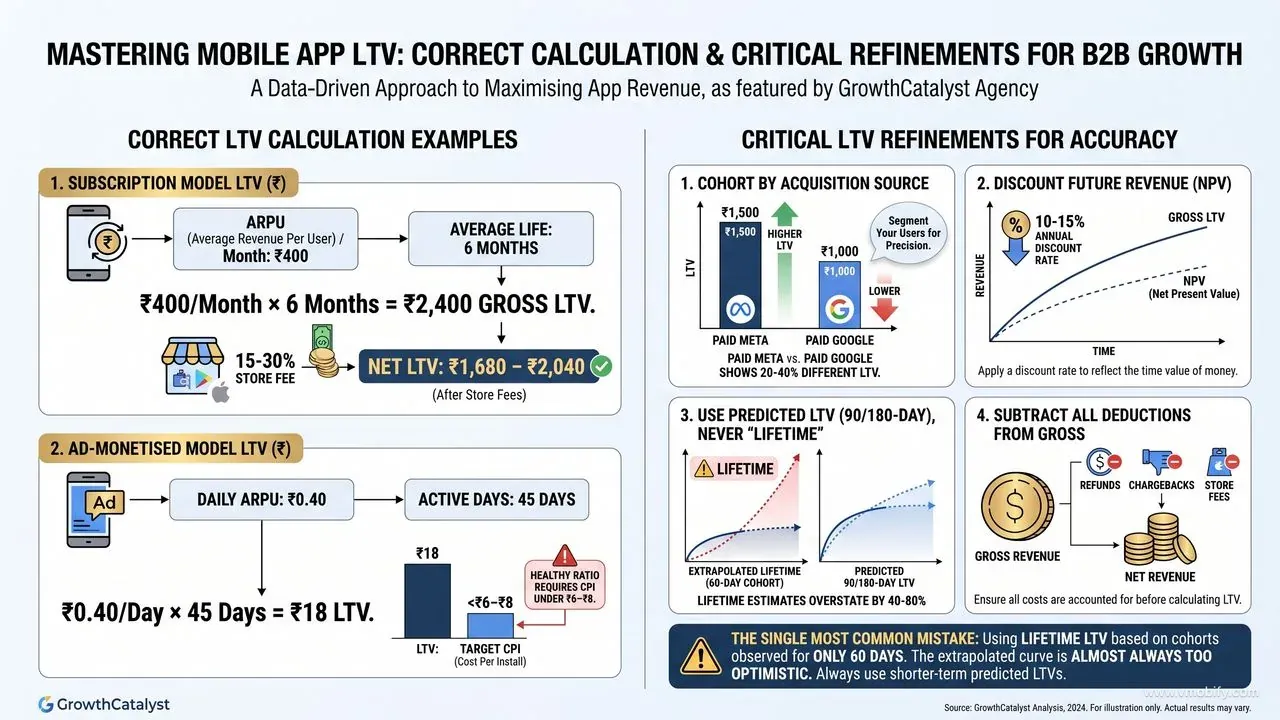
Subscription example: An OTT or fitness app with ₹400/month ARPU and a 6-month average subscription life produces ₹400 × 6 = ₹2,400 LTV per paying user. Net of Apple/Google's 15-30% store fee per App Store Connect's published commission structure, the take-home is closer to ₹1,680-₹2,040 — and that is the number that should feed your ratio, not the gross.
Ad-monetised example: A casual game earning ₹0.40 daily ARPU from rewarded video and interstitials, with users active 45 days on average, lands at ₹0.40 × 45 = ₹18 LTV. For an ad-monetised app that LTV has to support a CPI under roughly ₹6-8 to deliver a healthy ratio — a brutal constraint that explains why hyper-casual scaling is so dependent on India and other low-CPI geographies.
Refinements that separate real LTV from fantasy LTV:
- Cohort by acquisition source. Paid Meta users routinely show 20-40% different LTV than paid Google users for the same app. Blending them hides which channel deserves more budget. We segment all UA programmes at the source level by default.
- Discount future revenue. ₹1 today is worth more than ₹1 in 12 months. Apply a 10-15% annual discount rate when projecting beyond month 3. This is basic finance, frequently skipped in growth teams.
- Use 90-day or 180-day predicted LTV — never "lifetime." Lifetime estimates are unfalsifiable for 18+ months and reliably overstate value by 40-80%. Adjust's pLTV research shows model accuracy drops sharply past 180 days for almost every vertical.
- Subtract refunds, chargebacks, and store fees from gross revenue. Refund rates of 5-15% are common in EdTech and subscription apps; ignoring them inflates LTV by exactly that much.
In our portfolio, the single most common LTV mistake is using a "lifetime" number based on cohorts that have only been observed for 60 days. The model extrapolates a curve, and the curve is almost always too optimistic. We force every client model back to 90/180-day predictions before any scaling decision gets signed off.
How do you calculate CAC correctly?
CAC is total marketing spend divided by paying customers acquired in the same period — and the most damaging mistake in the entire ratio is confusing it with CPI. CPI is cost per install; CAC is cost per paying customer. If 5% of your installs convert to paid, your CAC is 20× your CPI. A ₹50 CPI quietly becomes a ₹1,000 CAC, and many teams have never honestly done that arithmetic.
What belongs inside the CAC numerator:
- All paid media spend — Google App Campaigns, Meta Advantage+, TikTok, programmatic DSPs, CPI networks, Apple Search Ads
- Creative production cost, amortised over the period it runs. UGC video shoots, motion design, and copy testing all count.
- Influencer and affiliate fees — both flat and performance
- Marketing technology spend (MMP licences such as AppsFlyer or Adjust, analytics tools, A/B testing platforms) — amortised per acquired customer
- Marketing salaries, amortised. Often excluded in early-stage CAC; always included in mature-company calculations and definitely included by any acquirer doing due diligence.
Blended CAC vs paid CAC: Blended divides total marketing spend by all new paying customers (paid + organic). Paid CAC divides paid spend by only paid-attributed paying customers. Use blended for board reporting and overall business health; use paid CAC for channel-level scaling decisions. Mixing the two — for example, dividing paid spend by all customers — is one of the most common ways teams flatter themselves into believing a channel is profitable when it is not.
For Indian apps specifically, blended CAC tends to look 30-60% better than paid CAC because organic install share is high. That is fine for narrative but dangerous for budget decisions. We covered the underlying CPI economics in detail in our India CPI benchmark guide.
Three India-specific realities distort the calculation further, and in our portfolio all three push in the same direction — CAC looks better than it is. First, the install mix skews heavily to Android, so the Play billing split rather than Apple's is what most of your revenue actually passes through; that lands in the LTV numerator, but teams modelling with iOS economics on an Android user base overstate net revenue per payer before they have made a single acquisition decision. Second, a large share of paid installs now come from Tier-2 and Tier-3 cities, where CPIs are visibly cheaper but install-to-paying-customer conversion is lower. Because CAC is CPI divided by that conversion rate, the cheaper city can produce the more expensive customer — and a blended national CAC hides it completely. Split CAC by metro versus non-metro before you conclude that Tier-2 targeting is working.
Third, vernacular creative is a real line item. Running Hindi, Tamil, Telugu, Marathi and Bengali cutdowns of the same video multiplies shoot, voiceover, subtitling and motion-design cost, and every one of those rupees belongs inside the CAC numerator. Teams that book the media spend but treat creative production as a fixed overhead understate CAC every single month, and the understatement grows with each language they add. And if your campaigns still bid on installs rather than on in-app purchase value, none of this reaches the auction at all — move your Google App Campaigns to a tCPA or tROAS goal keyed to a paying-customer event so the platform optimises towards the customers your CAC is measured against, not towards the cheapest installs it can find.
What does the full calculation look like end to end?
Run the subscription app from earlier all the way through — same ₹400 ARPU, same six-month life, same ₹50 CPI — and the ratio lands at roughly 1.5x, not the 2.4x the gross numbers suggest. The gap between those two figures is the entire point of doing the arithmetic properly.
- Gross LTV. ₹400 monthly ARPU × 6-month average subscription life = ₹2,400 per paying user. This is the number most decks stop at.
- Subtract the store fee. At the 30% end of the published 15-30% band, ₹2,400 becomes ₹1,680; at 15% it is ₹2,040. Model the worse case until your own tier is confirmed.
- Subtract refunds and chargebacks. Take the middle of the 5-15% band typical for subscription and EdTech apps as your working assumption — roughly 10% — and ₹1,680 becomes about ₹1,512 of net LTV.
- Convert CPI into CAC. A ₹50 CPI with 5% of installs converting to paying customers means you buy 20 installs per payer: ₹1,000 CAC.
- Divide. ₹1,512 ÷ ₹1,000 = 1.51x — sitting exactly on the line between break-even and healthy, with nothing spare to fund the next cohort.
Now look at what skipping two steps does. A team that runs step 1 and step 4 and ignores the store fee and refunds reports ₹2,400 ÷ ₹1,000 = 2.4x. Same app, same spend, same month — and the reported ratio says "scale aggressively" while the real one says "do not add a rupee until retention improves." This is the single most expensive arithmetic error we see, and it is invisible from the outside because every input in the flattering version is technically true. It surfaces about a quarter later, when the bank balance disagrees with the dashboard.
Spotting it early costs nothing. Reconcile one month of net payouts from App Store Connect and Play Console against the revenue your analytics stack reports for the same cohort. If the two differ by roughly the commission rate, your LTV is a gross number wearing a net label. Do that reconciliation once a quarter and the failure mode cannot survive.
Then test the levers against the same model, because that is where the retention argument stops being an opinion. Apply the 10-percentage-point D7 retention lift and its 30-60% LTV effect and net LTV moves from ₹1,512 to roughly ₹1,966-₹2,419 — a ratio of 1.97-2.42x. Apply the 10-25% subscription price rise instead and ARPU of ₹440-₹500 nets out at about ₹1,663-₹1,890, a ratio of 1.66-1.89x. Cut CPI by 30% and CAC falls to ₹700 for a ratio of 2.16x, which looks competitive with the retention route on paper.
It is not competitive in practice, and the reason matters. The CPI cut is a negotiation with an auction you do not control: it reverses the week a better-funded competitor raises bids, and it applies only to the cohorts you buy afterwards. The retention gain applies to every cohort you have ever acquired and every one you will, and it lifts the organic base at the same time. Rebuild this five-step model per channel — not blended — and the same worksheet tells you which channels to fund. If you would rather have it built and stress-tested against your own cohort data, our analytics team does exactly this as the first step of any engagement.
How do you calculate LTV when you barely have any data?
You do not calculate it — you bound it, then narrow the bound as cohorts age. A six-week-old app cannot know its lifetime value, and pretending otherwise produces a number that survives into a board deck and quietly misdirects a year of spending.
The honest starting position is that early LTV is a floor, not an estimate. What a cohort has paid you so far is a fact; what it will eventually pay is a projection with a wide interval. Treat the two differently in every document you write.
- Start with realised revenue per cohort, not projected. Take everyone who installed in a given week, divide the revenue they have generated to date by the number of installs, and label it clearly: "D30 revenue per install", never "LTV". The label is the discipline.
- Track how that number grows as each cohort ages. After two or three months you have a shape — how much D60 exceeds D30, how much D90 exceeds D60. That growth curve, from your own app, is worth more than any category benchmark.
- Use the curve to bound the projection. Subscription value in particular keeps accruing well past the first month; RevenueCat's 2025 benchmark set reports LTV rising by nearly 60% from month 1 to year 1 across all categories. Use an external figure like that to sanity-check your own curve, never to replace it.
- Decide against the floor, not the projection. If the business only works on the optimistic end of your interval, you do not have a working business yet — you have a hypothesis that needs another two months of data.
Annualising a first month. Multiplying month-one revenue by twelve assumes zero churn and is wrong by an order of magnitude. Averaging over installs that have not had time to pay. A cohort that is two weeks old cannot contribute a 30-day figure; including it drags the average down and hides the real curve. Blending platforms. iOS and Android monetise differently enough that a blended early LTV describes neither, and your acquisition mix then moves the number without anything changing.
There is a shortcut worth taking while you wait: move the question from lifetime to payback. You do not need to know what a user is worth forever to decide whether to keep spending. You need to know how long it takes to get your money back, which is answerable from realised revenue alone and becomes reliable months before LTV does. Our guide to ROAS, CAC and payback works that calculation through, and how much UA you can actually afford this month covers why the cash timing matters as much as the ratio.
In our portfolio the teams that get this right are the ones who put an explicit interval and an "as of" date next to every early LTV figure. It is a small formatting habit that stops a provisional number hardening into a planning assumption.
What are realistic LTV:CAC benchmarks by category?
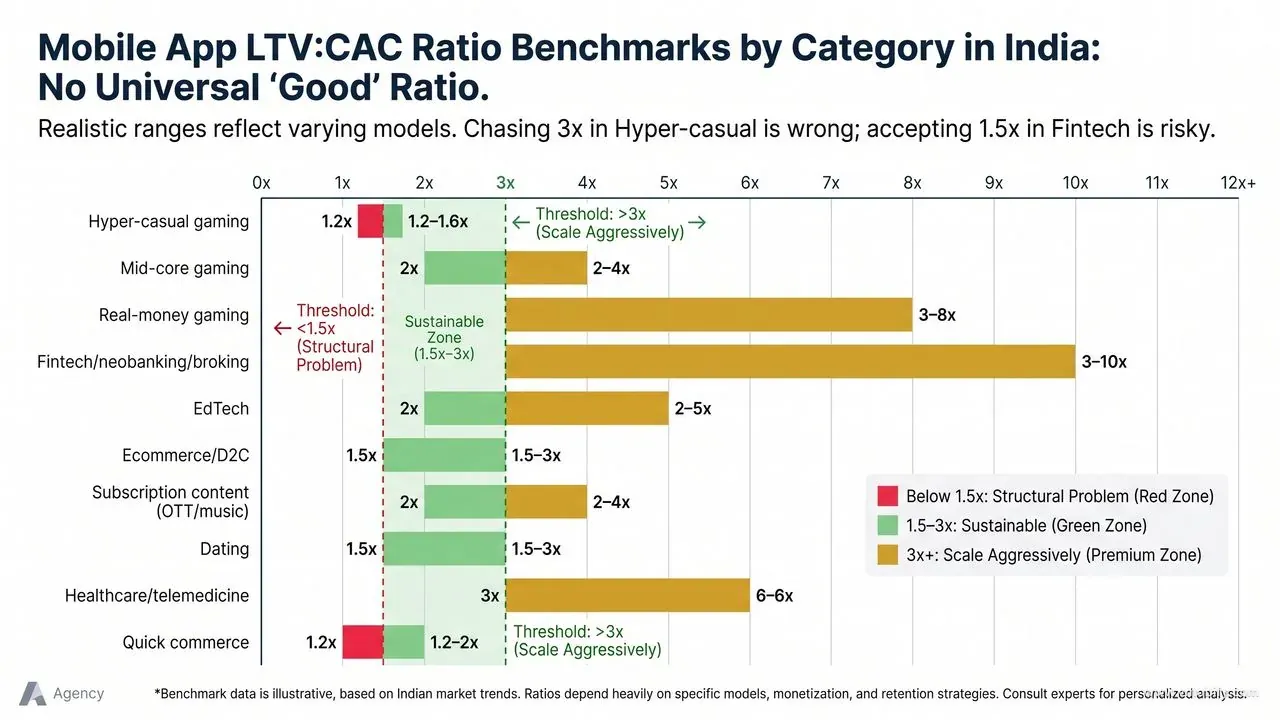
Sustainable LTV:CAC ratios vary wildly by category — there is no universal "good" number, and chasing a 3x ratio in a hyper-casual game is as wrong as accepting a 1.5x ratio in fintech. Here are the bands we see across our portfolio and corroborated by published industry data:
- Hyper-casual gaming: 1.2-1.6x — thin margins, scale to win, every percentage point of CPI matters
- Mid-core gaming: 2-4x — IAP-driven, depends heavily on whale retention
- Real-money gaming (RMG): 3-8x — highest LTV in the industry, also the highest CAC
- Fintech / neobanking / broking: 3-10x — long lifetimes, expensive to acquire, regulated environment per SEBI guidelines
- EdTech: 2-5x — wide range driven by refund rates and completion behaviour
- Ecommerce / D2C: 1.5-3x — frequency-led, dependent on repeat rate
- Subscription content (OTT, music, news): 2-4x — annual plans push ratios upward
- Dating: 1.5-3x — high churn caps LTV; lifecycle marketing is the lever
- Healthcare / telemedicine: 3-6x — long lifetimes once trust is established
- Quick commerce: 1.2-2x — frequency-led, thin per-order margin, profitable only at high order velocity
Anything below 1.5x sustained for more than two quarters indicates a structural problem in the business model, not a marketing problem. No amount of creative testing or bid optimisation will fix an LTV that is fundamentally too low for the category's CPI auction. Sensor Tower's category benchmarks regularly track CPI movement by vertical and are a useful cross-check on whether your numbers are at, above, or below the market norm.
What should you do when the ratio is too low?
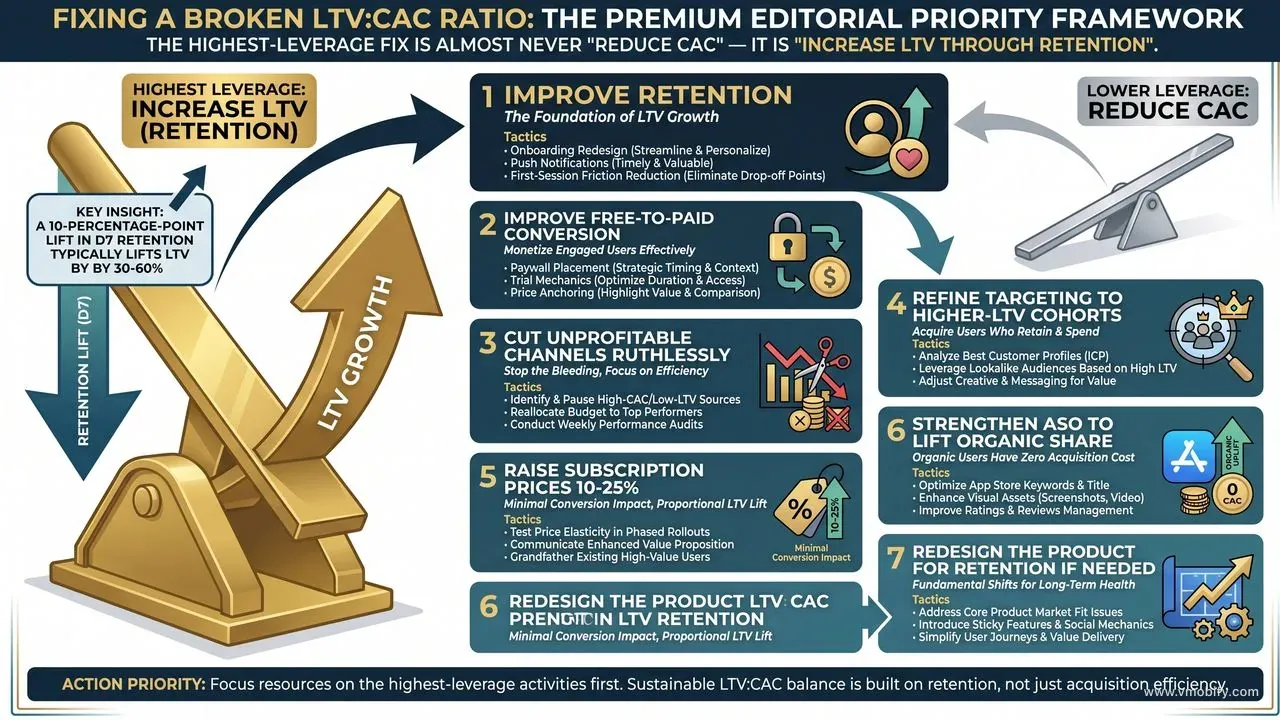
If LTV:CAC is consistently below 1.5x, the single highest-leverage fix is almost never "reduce CAC" — it is "increase LTV through retention." A 10-percentage-point lift in D7 retention typically lifts LTV by 30-60% because users stay through more monetisation cycles. Cutting CPI by 30% rarely delivers a comparable LTV multiplier.
In rough priority order, here is what to do:
- Improve retention first. Onboarding redesign, push notification strategy, first-session friction reduction. This is where to spend product time before spending more marketing money.
- Improve free-to-paid conversion. A 50% lift in free-to-paid conversion doubles LTV with zero change to acquisition cost. Paywall placement, trial mechanics, and price anchoring are usually undertested.
- Cut unprofitable channels ruthlessly. Some channels deliver users whose LTV is structurally lower than others — even if their CPI looks cheap. The cheap CPI is often what is causing the LTV problem.
- Refine targeting to higher-LTV cohorts. Geography, age band, device class, lookalike seeds based on paying users rather than installers. Our UA team rebuilds lookalike audiences from payer cohorts as a default optimisation.
- Raise prices on subscription apps. A 10-25% price increase typically has minimal effect on conversion but lifts LTV proportionally. This is the single most under-used lever in app monetisation.
- Strengthen ASO to lift organic share. Organic users have effectively zero acquisition cost and lift the blended ratio without any media spend change.
- Redesign the product for retention. If the product cannot retain at category benchmark, no marketing tactic will fix LTV:CAC sustainably. This is the hardest fix, and sometimes the only one.
Across our portfolio, the pattern is consistent: the apps that fix LTV:CAC sustainably do it through retention and conversion work; the apps that try to fix it only through CAC reduction stall within two quarters and end up cutting growth investment instead. See our app retention strategy guide for the specific tactics that move D1, D7, and D30 numbers.
Which calculation mistakes break the ratio most often?
Most "we hit our target LTV:CAC" claims fall apart under five minutes of audit because of one of the same five mistakes — every time.
- Using lifetime LTV instead of 90/180-day: Predicting too far into the future inflates LTV and creates false confidence. The further out you project, the wider the error bars, and most pLTV models lose accuracy fast beyond 180 days.
- Ignoring refunds, chargebacks, and store fees: Gross revenue is not net revenue. Apple and Google take 15-30% per App Store Connect's commission terms; refund rates of 5-15% are routine. Inflating LTV by 25%+ with this mistake is common.
- Including organic customers in paid CAC: Makes paid CAC look better than it is, which causes overspend on the channels that already had the best blended look. Always isolate paid-attributed customers in the paid CAC calculation.
- Excluding creative production cost: Modern UA is entirely creative-led. UGC shoots, motion design, copy testing, and platform-specific cutdowns all cost real money. Excluding them understates CAC and quietly subsidises the creative team.
- Not segmenting by cohort or channel: A blended LTV:CAC of 2.0x can hide one channel running at 4.5x and another at 0.8x. Without segmentation, you cannot scale the winners or cut the losers — and the blended number gives no actionable signal at all.
The fair objection at this point is that half these inputs are assumptions. If predicted LTV loses accuracy past 180 days, refund rates are estimated from a band, and creative cost is amortised on a judgement call, why trust the ratio at all? Because you are using it comparatively, not absolutely. The same model applied to every channel carries the same errors in the same direction, so the ranking between channels stays reliable even when the absolute level is off — and the ranking is what your budget decision needs. The absolute number matters in exactly two situations: a fundraise, and a decision to stop spending entirely.
You keep the model honest by back-testing it rather than by making it more elaborate. When a 90-day cohort matures, compare what the model predicted against what actually landed, and recalibrate. Two or three of those cycles and you will know your model's typical bias and its direction, which is worth more than a more sophisticated model you have never checked.
Across the 300+ apps we have audited, at least one of these five mistakes shows up in roughly 80% of incoming LTV:CAC numbers. Fixing the calculation often changes the strategic picture more than any new tactic. Get an LTV:CAC audit for your specific app, or browse our case studies to see how the corrected numbers reshaped scaling decisions for apps in your category.
Frequently Asked Questions
What is a good LTV-to-CAC ratio target?+
3x is the commonly-cited target. In reality 1.5-3x is sustainable for most app categories; below 1.5x means structural issues, above 3x means you can scale aggressively.
How long should I calculate LTV over?+
90 days for fast-cycle apps (commerce, content). 180 days for subscriptions. 12 months only for very mature businesses with stable retention curves and 18+ months of cohort history.
Should I include organic users in CAC calculations?+
Use both — blended CAC for board reporting and business health, paid CAC (paid spend divided only by paid-attributed customers) for paid channel scaling decisions specifically.
When should I cut a paid channel?+
When that channel's cohort LTV is below the channel's CAC consistently over 30+ days. Single bad weeks are noise; 30-day rolling cohorts give a reliable signal.
How does churn affect LTV?+
Massively. A 10% reduction in monthly churn rate typically lifts LTV 30-50% because users stay paying for many more cycles. Retention work almost always outperforms CAC work for fixing the ratio.
What is the difference between CAC and CPI?+
CPI is cost per install; CAC is cost per paying customer. If 5% of installs convert to paid, CAC is 20x CPI. Treating CPI as CAC is one of the most common — and most expensive — mistakes in app marketing.
Should marketing salaries be included in CAC?+
Yes for mature companies and any due-diligence-grade calculation. Often excluded in early-stage reporting to keep the number clean, but an honest fully-loaded CAC always includes them.
Sources
- AppsFlyer Performance Index — Quarterly LTV, retention and CPI benchmarks segmented by vertical and geography
- AppsFlyer — State of App Marketing in India — Aggregated LTV:CAC and unit-economic benchmarks across categories
- Adjust Mobile App Trends — pLTV model research and accuracy degradation past 180 days
- Sensor Tower State of Mobile — CPI movement and category benchmarks for cross-checking acquisition cost
- Apple App Store Connect — Official documentation on 15-30% store commission structure
- Google Ads — App Campaigns Help — UAC bidding, tCPA and tROAS setup that feeds CAC measurement
- SEBI — Regulatory environment shaping fintech / broking CAC in India
About the author
Amol Pomane — Founder, Vmobify
Amol leads Vmobify, a mobile app growth agency that has driven 30M+ downloads and ranked 54K+ keywords across 300+ apps since 2013. He writes about ASO, paid user acquisition, retention, and the operational reality of scaling mobile apps in India and global markets.