Mobile Ad Fraud in 2026: Types, Detection & Prevention
Mobile ad fraud quietly drains a large share of user-acquisition budgets every year. This is a practical 2026 guide to the fraud types, the data signals that expose them, and the layered defences — MMP fraud filters, the Play Install Referrer, allowlists and post-install validation — that actually protect your spend.
On this page
- How big is the mobile ad-fraud problem, and who pays for it?
- What are the main types of mobile ad fraud?
- How does each fraud type steal credit and budget?
- Which signals in your data expose ad fraud?
- How do MMPs and the Install Referrer detect fraud?
- How much budget does fraud really drain from a campaign?
- How do you prevent mobile ad fraud?
- Why is incentivised and emerging-market traffic higher risk?
- Can your organic installs be fraudulent?
- How do you audit a campaign you suspect is fraudulent?
- What pitfalls trip up fraud-fighting teams?
- Frequently Asked Questions
How big is the mobile ad-fraud problem, and who pays for it?
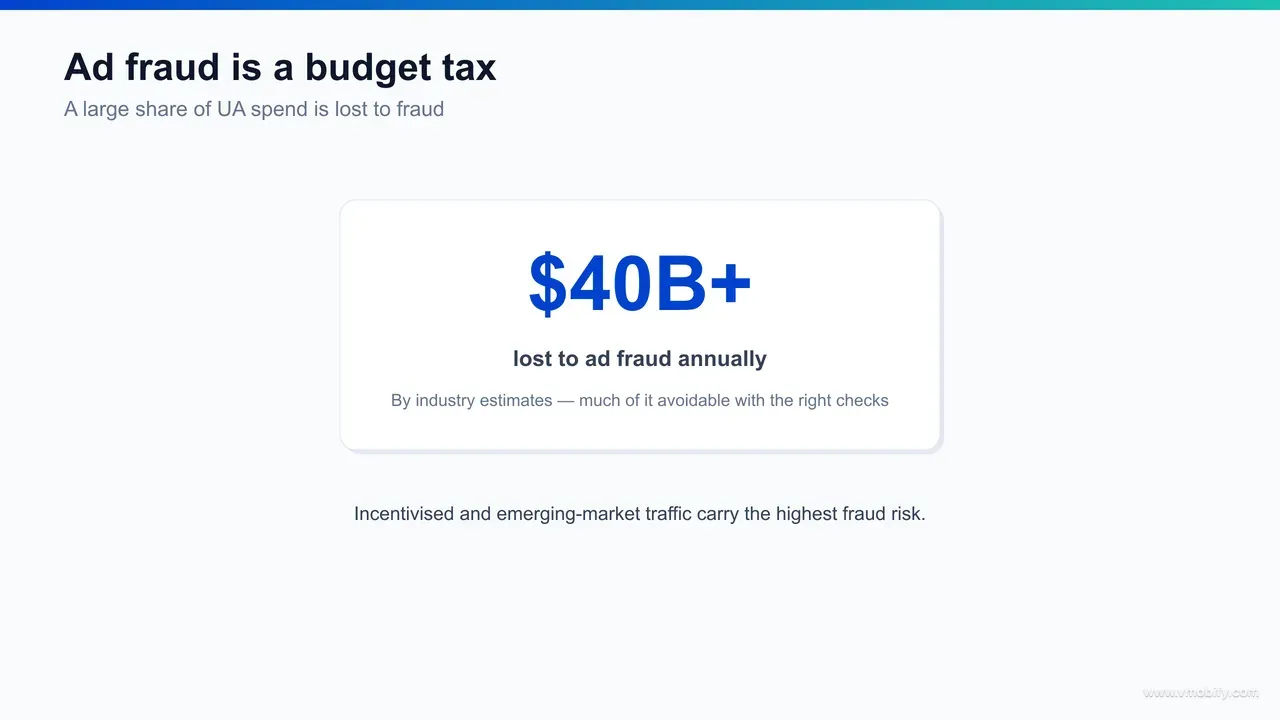
Mobile ad fraud drains tens of billions of dollars annually, by industry estimates, and the advertiser pays for almost all of it — fraud quietly siphons a large share of every user-acquisition budget that has no active defence in place. It is not a fringe risk you can defer until you scale; it is a structural cost of buying installs that you either control deliberately or fund unknowingly.
The mechanics of who pays are worth being blunt about. When fraud manufactures a fake install or hijacks credit for an organic one, your measurement platform records a conversion, your campaign reports a cost-per-install, and your finance team pays the invoice. The fraudster collects. The ad network often collects its margin too, because in most buying models the network is paid on reported installs whether those installs are real or not. The advertiser sits at the bottom of that chain, absorbing the loss — which is exactly why fraud defence is the advertiser's job, not something you can assume your partners have handled.
Both major measurement vendors treat this as a first-order problem rather than an afterthought. Adjust's fraud-prevention writing and AppsFlyer's fraud resources both document the same picture: fraud is concentrated, it is adversarial, and it adapts the moment a defence becomes common. The numbers vendors publish move year to year and vary by region and vertical, so the honest framing is directional — fraud routinely consumes a meaningful double-digit percentage of unprotected paid spend in high-risk channels, and almost nothing in well-defended ones.
Across our 300+ apps managed since 2013, the pattern that repeats is not that fraud is invisible — it is that teams never go looking. They judge a campaign on its reported cost-per-install and its install volume, both of which fraud inflates in the advertiser's favour on paper. The campaign looks cheap and high-volume precisely because a chunk of it is fake. The day a team starts measuring post-install behaviour instead of installs, the fraudulent sources collapse, and the "expensive" clean sources turn out to be the only ones that were ever working. The cost of ignoring fraud is therefore double: the wasted spend, and the bad decisions you make by trusting numbers fraud has rigged.
There is also a reason fraud is worse in mobile than on the open web, and it is structural. Mobile install attribution is a high-value, single-event payout — one install can be worth several dollars or hundreds of rupees — and the chain between a click and a paid install runs through multiple intermediaries, each with limited visibility into the others. That combination of high per-event value and low end-to-end transparency is precisely the environment fraud thrives in. The defences in this guide all work by collapsing that opacity: they give you, the advertiser, a direct line of sight from the click to the real human's behaviour, so that no intermediary can quietly bill you for something that did not happen.
What are the main types of mobile ad fraud?
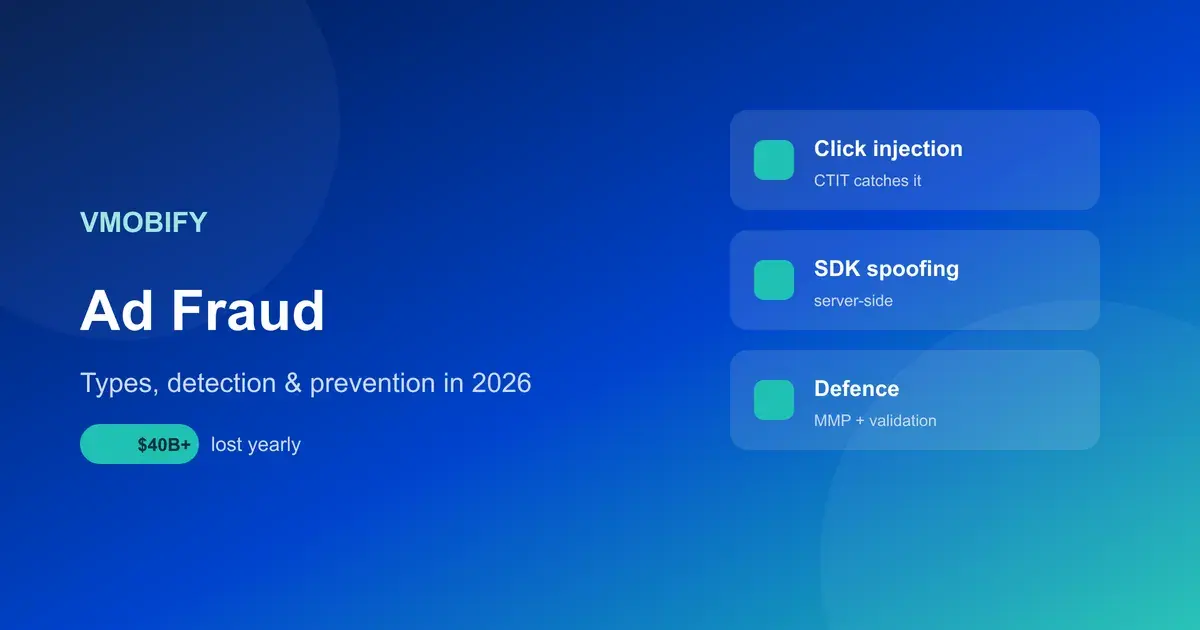
The six fraud families every user-acquisition team must recognise are click spamming (also called click flooding), click injection, SDK spoofing, install hijacking, device farms, and bots or emulators — each one either steals credit for installs you would have won anyway or fabricates installs that never really happened. Knowing which family you are looking at is what tells you which defence to deploy, because no single filter catches all of them.
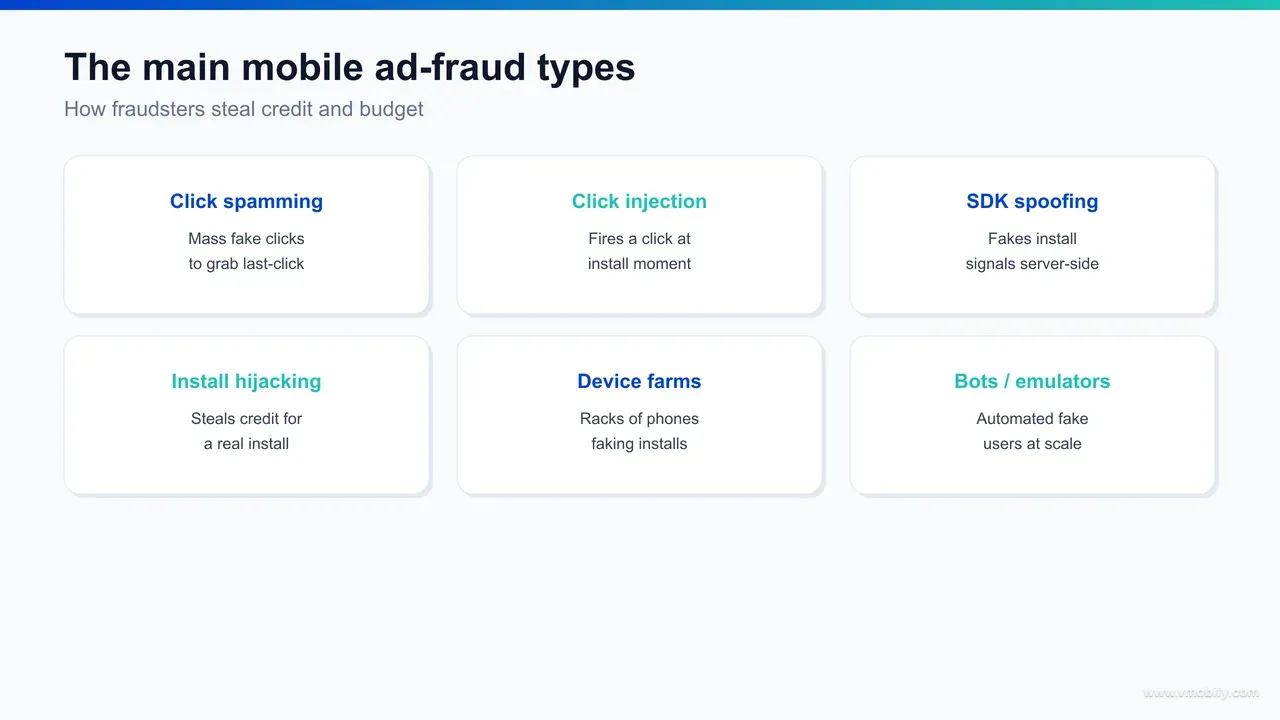
- Click spamming / click flooding: a fraudster fires huge volumes of fake clicks on behalf of devices that never actually clicked an ad. When any of those users later installs the app organically or via another channel, the fraudster's earlier fake click wins last-click attribution and steals the credit. It is a numbers game — flood enough clicks and you will "win" a share of genuine installs by sheer coverage.
- Click injection: an Android-specific attack where malware on the device detects that a new app is being installed and fires a click at the last possible moment, just before the install completes. Because that injected click is the most recent one, it hijacks attribution from whichever channel genuinely drove the install. It is click spamming with surgical timing.
- SDK spoofing: the most technical attack — fraudsters reverse-engineer the communication between a measurement SDK and its server and forge legitimate-looking install and event signals without any real device or install behind them. Done well, it generates installs out of thin air that look real to the attribution platform.
- Install hijacking: malware intercepts the install process itself and reassigns the new install to a fraudulent source, stealing it from the network that actually earned it.
- Device farms: physical racks of real phones (or factory-reset loops on a smaller set) generating clicks, installs and engagement at scale, often with constantly reset device identifiers to look like a stream of fresh new users.
- Bots and emulators: software-simulated devices and scripted users that mimic install and in-app behaviour entirely in software, with no human and no real handset involved.
These families are not mutually exclusive. A sophisticated fraud operation will run device farms and emulators to manufacture installs, then layer click flooding and injection on top to also steal organic credit — so a single bad source can show several signatures at once. The defences that follow are designed to be stacked for exactly that reason.
How does each fraud type steal credit and budget?
Fraud steals from you in two distinct ways: attribution theft, where a real install you earned is reassigned to a fraudulent click, and install fabrication, where a payout is triggered for an install that never happened — and the two demand completely different countermeasures. Mislabel which one you are facing and you will deploy the wrong defence.
Attribution theft
- The quieter and more insidious of the two, because the installs are real users — only the credit is stolen. Click spamming and click injection both live here.
- With click flooding, the fraudster blankets your potential users with fake clicks so that when one installs organically, a fake click sits in the attribution window and claims it. With click injection, the timing is precise: the injected click lands in the final moments before install completion, so it wins last-touch attribution over the channel that genuinely drove the user.
- In both cases you pay a fraudulent source for installs your organic, ASO, or other paid efforts actually produced. The damage compounds because it corrupts your measurement — you scale the fraudulent source thinking it is efficient and starve the real driver of budget.
Install fabrication
- The more brazen attack: there is no real user at all. SDK spoofing forges the install and event signals directly, device farms and emulators physically or virtually generate them, and install hijacking diverts the install record to a fraudulent owner.
- Here you are not just misattributing budget — you are paying for users who do not exist, will never open the app again, and will never convert.
- The signature is a cohort that installs and then flatlines: no day-1 retention, no purchases, no meaningful sessions.
The budget mechanics are unforgiving in both cases. In a cost-per-install model you pay per reported install, so fabricated installs are a direct cash transfer to the fraudster. In a cost-per-action or revenue-share model, sophisticated fraud will even simulate the post-install events that trigger payment — which is why measuring true downstream value, not just the event a payout is pegged to, is the only reliable defence. Our work on the buy side, including the CPI network we operate, is built around exactly this distinction: a clean install is one whose post-install behaviour matches a real human, and everything else is a cost to eliminate, not a volume to celebrate.
Which signals in your data expose ad fraud?
Fraud leaves four reliable fingerprints in your own data: an abnormal click-to-install time (CTIT) distribution, conversion-rate anomalies, sudden spikes in the new-device rate, and dead-flat post-install behaviour — and you can read all four without any specialist tooling beyond your measurement platform. Each signal maps to specific fraud types, so reading them together tells you not just that something is wrong but what is wrong.
- Click-to-install time (CTIT): the gap between the attributed click and the install. A healthy organic-ish distribution has most installs landing within minutes to a couple of hours of the click, with a smooth, recognisable curve. Click injection produces an unnaturally short CTIT — clicks landing seconds before install, because the click was injected at install time. Click flooding produces the opposite: a long, flat tail of installs hours or days after a click, because the fake click was fired speculatively long before the user happened to install. A CTIT distribution that is too short, too long, or simply the wrong shape is the single most diagnostic signal you have.
- Conversion-rate anomalies: click-to-install rates that are wildly higher or lower than the channel norm. A source converting clicks to installs far above any plausible human rate is usually flooding or fabricating; one converting far below can indicate impression or click stuffing.
- New-device-rate spikes: a sudden surge in installs from devices never seen before in your data. Some new devices are normal, but device farms that reset identifiers — and emulators that spin up fresh ones — produce an implausibly high share of brand-new devices, often with limited or templated device characteristics.
- Behavioural signals post-install: the ground truth. Real users open the app, browse, register, and sometimes pay. Fraudulent installs typically show near-zero day-1 retention, no meaningful session depth, and no downstream conversions. When a source's installs look fine but its cohort behaviour flatlines, the installs were never real.
The discipline that ties these together is measuring sources on post-install value rather than install count — the same principle that underpins all credible mobile attribution. In our portfolio, the fastest way we have ever exposed a fraudulent partner is to rank every source by day-7 retention and revenue per install: the fraudulent ones drop to the bottom instantly, regardless of how cheap and abundant their installs looked at the top of the funnel.
How do MMPs and the Install Referrer detect fraud?
Your mobile measurement partner's fraud layer and the Google Play Install Referrer together form the backbone of automated detection — the MMP applies real-time rules and machine models across billions of events, while the Install Referrer supplies a Google-signed timestamp that exposes click injection and flooding directly. Neither is sufficient alone, but stacked they catch the majority of automatable fraud before it ever reaches your reports.
The MMP fraud layer is the workhorse. Platforms such as those compared in our AppsFlyer vs Adjust vs Singular breakdown run rejection rules that reject installs failing CTIT, distribution, or device-validation tests, plus behavioural and network-level models trained across their entire client base — which gives them a cross-app view of known device farms, data-centre IP ranges, and emulator signatures that no single advertiser could assemble. Both Adjust and AppsFlyer publish how their respective fraud suites operate, and the practical upshot is the same: rejected installs are filtered out of attribution before you are billed for them, and the rejection reasons themselves become a diagnostic of which fraud type a source is running.
The Google Play Install Referrer Library is the second pillar, and it is the part many teams underuse. When a user installs from the Play Store, Google returns referrer data that includes trustworthy, Google-supplied timestamps — crucially, the moment the user actually began the install (install begin) and the moment they clicked through the store. Because those timestamps come from Google rather than from the click record a fraudster controls, they let your MMP reconstruct the true sequence of events. Click injection collapses the gap between the referrer click and the install begin to near zero; click flooding stretches it implausibly. The Install Referrer therefore turns CTIT from an inference into something you can verify against a source the fraudster cannot forge. Our deeper walkthrough of how those timestamps work lives in our Google Play Install Referrer guide.
The key mental model: the MMP is your scalable, always-on filter, and the Install Referrer is the trusted clock that makes timing-based detection reliable on Android. SDK spoofing and device farms are caught more by the MMP's device and network intelligence; click injection and flooding are caught most cleanly by referrer-validated timing. You want both switched on, configured, and monitored — not assumed.
How much budget does fraud really drain from a campaign?
In an unprotected high-risk channel, fraud can consume a meaningful double-digit percentage of paid spend, while a well-defended account on clean inventory loses very little — meaning the gap between a protected and an unprotected campaign of identical size can be enormous. The point is not a single universal number; it is that your exposure is a function of the channels you buy and the defences you run, both of which are under your control.
Think of it as a layered loss. First, the direct loss: every fabricated install you pay for is money gone, and every hijacked attribution is budget handed to a fraudulent source for an install you already earned. Second, the indirect loss, which is usually larger: fraud corrupts the optimisation signals you feed back into the ad networks. When you tell an automated bidding system that a fraudulent source is converting cheaply, it pours more budget into that source and into lookalikes of it — so a small fraudulent foothold metastasises into a large, misallocated spend pattern. Third, the decision loss: teams pause genuinely effective clean channels because, on a cost-per-install basis, they look expensive next to the artificially cheap fraudulent ones.
To size your own exposure, you do not need vendor benchmarks — you need your own cohort data. Pick a recent month, rank every paid source by post-install value (day-7 retention and revenue per install), and calculate what share of spend went to sources whose cohorts behave like real users versus sources whose cohorts flatline. That share is your fraud-and-waste exposure, measured on your own app, and it is far more actionable than any industry average. We run this exact exercise at the start of most user-acquisition engagements, and the recovered budget it frees up frequently funds the clean scaling that follows.
Two framing rules keep this honest. First, the fraud rate you see after your MMP filters is not your true exposure — it is the residual; the gross rate before filtering is higher, which is the whole argument for keeping the filter on. Second, fraud concentrates: it is rarely spread evenly, so a single bad sub-publisher or one incentivised placement often accounts for the bulk of the loss, which is good news, because it means a small number of well-targeted blocks recovers most of the budget.
How do you prevent mobile ad fraud?
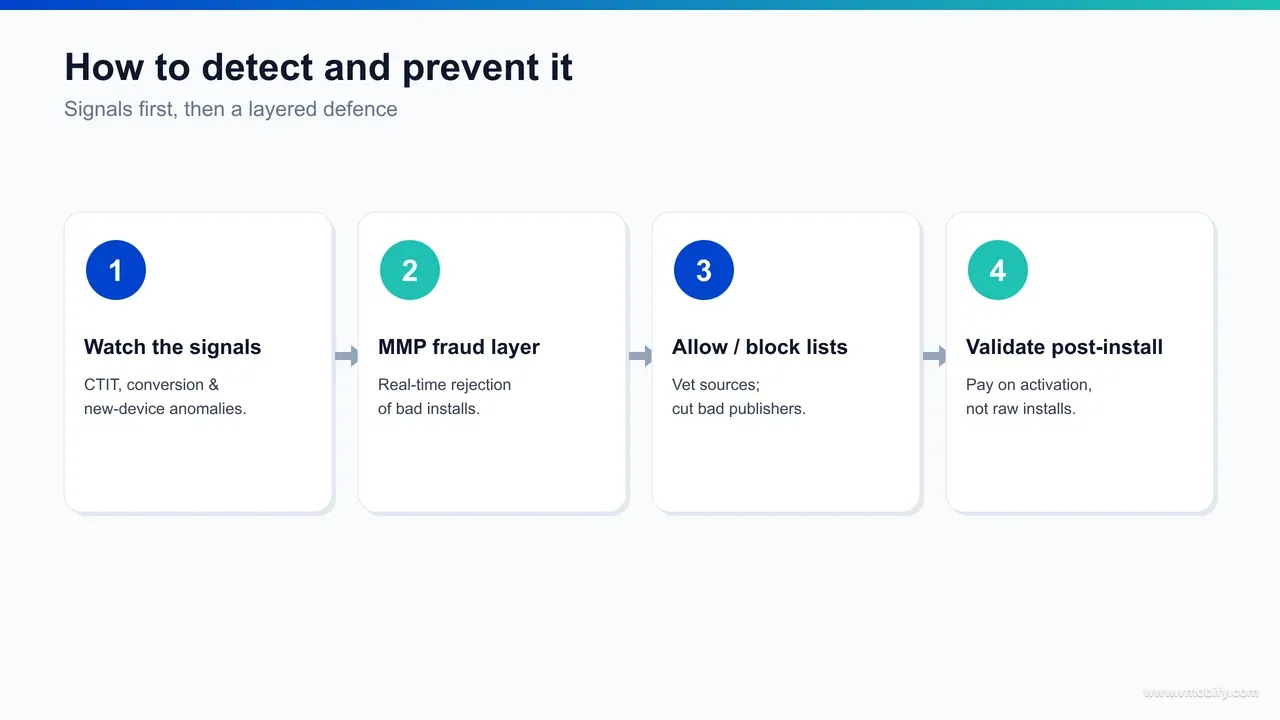
Prevention is not one tool but a stack: an always-on MMP fraud layer, Install Referrer validation, source allowlists and blocklists, post-install validation against real behaviour, and contractual clawback terms with every partner you buy from. Each layer catches what the others miss, and the contract layer is the one that turns detection into recovered money.
- Keep the MMP fraud layer on and configured: this is your baseline. Enable the full rejection-rule and validation suite, review the rejection reasons regularly, and treat a spike in rejections from a source as a signal to investigate, not just a filtered statistic.
- Validate with the Install Referrer: on Android, lean on Google-signed referrer timestamps to verify CTIT rather than trusting click logs a fraudster can fabricate. This is your single strongest defence against click injection and flooding.
- Run allowlists and blocklists at the sub-publisher level: do not block at the network level when the fraud lives in one placement. Identify the specific sub-publishers and placements whose cohorts behave like real users, allowlist them, and blocklist the ones that flatline. Fraud concentrates, so this is high-leverage.
- Validate post-install, not just at install: peg your judgement of a source to downstream behaviour — retention, sessions, and revenue — because sophisticated fraud can fake the install and even the payout event but cannot cheaply fake a real human's ongoing engagement at scale.
- Put clawback and fraud clauses in every contract: agree up front, in writing, that flagged fraudulent installs are non-billable and recoverable, define whose fraud verdict is authoritative (usually your MMP's), and set the reconciliation window. Without this clause, detection is academic — you can prove fraud and still pay for it.
The reason the contract layer matters as much as the technical one is that detection without a recovery mechanism just tells you how much you lost. We insist on MMP-arbitrated clawback terms before spending a rupee through any new source, and platform policy backs this up: both Google's and Apple's developer terms prohibit fraudulent and incentivised-install schemes that breach their rules, so a clean partner has no legitimate objection to a clause that simply holds them to it. The goal is a system where a fraudulent install is caught by the filter, verified by the referrer clock, excluded from your bill by the contract, and the source is blocklisted before it can scale — all without a human chasing each case.
Why is incentivised and emerging-market traffic higher risk?
Incentivised traffic and parts of the emerging-market install supply carry elevated fraud risk because incentives attract users (and bots) motivated by the reward rather than your app, and high-volume, low-CPI inventory in some regions is exactly where device farms and fabricated installs are cheapest to run. This is about probability and economics, not geography as such — and treating it as a blanket judgement on any country would be both wrong and useless.
Incentivised installs — where a user is rewarded with in-app currency, points, or cash for installing — are structurally fraud-prone for a simple reason: the user's motivation is the reward, not the app, so even the genuine humans in incentivised traffic retain and convert far worse than organic users, and the channel's economics make it a natural home for bots and device farms that automate reward-harvesting at scale. Both Google's and Apple's policies restrict how incentivised installs may be run, and many networks treat the manipulation of store rankings via incentives as a violation. If you use incentivised traffic at all, it should be ring-fenced: measured entirely separately, judged on post-install value rather than install volume, and never blended into the cohort you use to optimise your other channels.
The emerging-market dimension is about supply economics, not people. Markets including India and other high-growth regions are enormous, genuine, and central to mobile growth — but their scale and the abundance of low-cost inventory also mean that some of the cheapest, highest-volume sub-publisher supply is where fabricated installs and device farms are most cost-effective for fraudsters to operate. The risk attaches to specific low-quality placements and incentivised inventory, not to the audience. The correct response is sharper measurement, not avoidance: buy these markets through allowlisted, behaviourally validated sources, and you capture the real and substantial growth while filtering out the fraudulent supply riding alongside it.
Across our India-heavy portfolio we have seen both truths hold simultaneously — these are among the most valuable real audiences in mobile, and they are also where undisciplined buying gets fleeced fastest. The teams that win here do not pull back from the market; they tighten their source-level allowlists, lean harder on Install Referrer validation, and measure every sub-publisher on day-7 value. The growth is real; you just have to refuse to pay for the part that is not.
Can your organic installs be fraudulent?
Yes — and it is the hardest kind to see, because there is no vendor to blame, no invoice to stop, and the traffic arrives under the label you trust most. Most fraud thinking stops at paid channels, which is exactly why this one persists.
The mechanism is attribution theft rather than fabricated volume. In click flooding, a fraudster fires large numbers of click reports for devices that were never shown an ad. Most never install anything. But when one of those devices later installs your app for its own reasons — from a store search, a friend's recommendation, a press mention — there is a recent click on record, and the install is attributed to whoever sent it. The user is real. The install is real. The credit is stolen, and it is stolen from organic.
That produces a signature you can look for:
- Organic volume falls as a paid source scales, without total installs rising to match. You are paying for users you were getting anyway.
- Click-to-install times cluster oddly — a very long tail, or an implausibly tight distribution near the install.
- A source's users behave exactly like organic users in retention and revenue, because that is what they are.
On Android you can test this with evidence rather than inference. The Play Install Referrer API returns both client-side and server-side timestamps for the referrer click and the start of installation. The server-side pair comes from Google rather than the device, so it cannot be manipulated by a client. Comparing the interval between the recorded click and the install beginning is the closest thing to proof available in mobile attribution — our guide to the Play Install Referrer covers the implementation.
Every standard fraud signal assumes bad users: zero retention, no in-app events, impossible device profiles. Attribution theft passes all of them, because the users are genuine. The only reliable tell is the relationship between paid and organic volume over time, which means you have to be watching organic as a series rather than as a residual.
There is no iOS equivalent of the install referrer, so the same question is answered there by holdout and incrementality testing rather than by timestamps — measuring what happens to total installs when you switch a source off, rather than arguing about who deserves credit. That is the right instrument whenever attribution itself is the thing in dispute, and it is covered in our guide to incrementality testing and MMM.
We deliberately publish no figure here for what share of fraudulent installs is organic. Numbers exist in the market; the ones we traced came from press summaries we could not open at the source, and a fraud statistic you cannot verify is a poor basis for a budget decision. The mechanism above is what matters operationally, and it is testable in your own data.
How do you audit a campaign you suspect is fraudulent?
Audit a suspect campaign by drilling from the top down — network to sub-publisher — and checking the four fraud signals at each level: pull the CTIT distribution, the click-to-install conversion rate, the new-device rate, and the post-install behaviour, then isolate the specific sources whose numbers break the pattern. A structured drill-down is what separates a real diagnosis from a vague suspicion, and it usually takes a focused afternoon, not a project.
- Segment to the smallest source level you have: network-level numbers hide everything, because fraud concentrates in specific sub-publishers and placements. Break the campaign down to site IDs / sub-publishers before judging anything.
- Plot the CTIT distribution per source: look for the tell-tale shapes — a spike of near-instant installs (injection), a long flat tail (flooding), or a distribution that simply does not look human. This is usually where the fraudulent source declares itself.
- Compare conversion rates against the channel norm: flag any source converting clicks to installs at a rate no real audience could plausibly produce, high or low.
- Check the new-device rate and device characteristics: an implausible share of brand-new devices, or fleets of devices with templated, near-identical characteristics, point to farms or emulators.
- Rank every source by post-install value: day-1 and day-7 retention, sessions, and revenue per install. This is the verdict — sources that look fine at install but flatline afterwards are the fraud, full stop.
- Cross-check against MMP rejection reasons: your MMP has already flagged and categorised rejected installs; reconcile your findings with its rejection data and use the reasons to confirm which fraud type you are dealing with.
Once you have isolated the offending sources, act in the right order: blocklist them, file the fraudulent installs for clawback under your contract terms, and re-baseline the campaign's true cost-per-install on the clean remainder before you make any scaling decision. The most common mistake here is to pause the whole network when the fraud lived in two sub-publishers — that throws away the clean supply along with the dirty. If an audit is beyond your team's bandwidth, this top-down forensic pass is a standard part of how our UA team onboards an account, and we are happy to run it on a suspect campaign directly.
What pitfalls trip up fraud-fighting teams?
The biggest pitfalls are over-blocking legitimate users with aggressive rules, treating false positives as costless, optimising against fraud-corrupted signals, and assuming a partner's fraud verdict over your MMP's — and each of these can do as much damage as the fraud itself. Fighting fraud badly is its own failure mode, and the goal is precision, not maximum suspicion.
- Over-blocking and false positives: set rejection thresholds too aggressively and you will reject real users — short-CTIT installs from genuinely fast networks, legitimate cohorts in markets that happen to look unusual, real users on shared or recycled IPs. Every wrongly rejected install is a real user and real revenue thrown away, so tune thresholds against your own behavioural data and watch your rejection rate for over-correction, not just under-correction.
- Optimising on corrupted signals: if you feed an ad network's automated bidding the same events fraud is faking, you train the system to find more fraud. Make sure the conversion signal you optimise toward is a validated, fraud-resistant downstream event, not the shallow install or first-open that fraud trivially fakes.
- Trusting the seller's fraud verdict: the network or sub-publisher being paid on installs has an incentive to dispute your fraud flags. Decide contractually, in advance, that your MMP's verdict is authoritative — otherwise every clawback becomes a negotiation you lose.
- Treating fraud as a one-time clean-up: fraud is adversarial and adapts to whatever defence becomes common, so a campaign you cleared three months ago can be dirty again today. Monitoring has to be continuous, not a quarterly audit.
- Measuring only post-filter fraud: congratulating yourself on a low fraud rate after your MMP has already filtered the worst of it hides how much the filter is doing — and tempts teams to relax the very defences keeping the number low.
In our portfolio the costliest version of this is the team that, stung once, blocks so aggressively that it strangles its own clean growth — rejecting good users to feel safe. The discipline that avoids both ditches is the same one this whole guide rests on: judge sources by how real their users behave, keep your detection layers stacked and continuously on, and tune every threshold against first-party behavioural data rather than fear or generic defaults. Do that, and fraud becomes a managed, contained cost rather than a silent tax on everything you spend.
Frequently Asked Questions
What is mobile ad fraud?+
Mobile ad fraud is the use of fake clicks, fabricated installs, or hijacked attribution to claim payment for advertising activity that did not genuinely drive a real user. It either steals credit for installs you would have won anyway or manufactures installs that never happened, and in both cases the advertiser pays for it.
What is the difference between click injection and click spamming?+
Click spamming (or flooding) fires huge volumes of fake clicks speculatively so that some later organic install is wrongly attributed to the fraudster, producing a long click-to-install time. Click injection is an Android attack where malware fires a click at the moment of install to hijack attribution, producing an unnaturally short click-to-install time.
How do you detect mobile ad fraud?+
Detect it through four data signals: an abnormal click-to-install time (CTIT) distribution, conversion-rate anomalies, sudden new-device-rate spikes, and flat post-install behaviour such as zero retention. Your MMP fraud layer automates most of this, and the Google Play Install Referrer supplies trusted timestamps that verify CTIT.
How does the Google Play Install Referrer help fight fraud?+
It provides Google-supplied timestamps for when a user clicked through the store and began installing. Because those timestamps come from Google rather than from a click log a fraudster controls, they let your MMP verify the true click-to-install timing and expose click injection and flooding directly.
Is incentivised traffic always fraudulent?+
No, but it is high-risk. Incentivised users are motivated by the reward rather than your app, so they retain and convert poorly even when genuine, and the channel attracts bots and device farms. If you use it, ring-fence it, measure it separately, and judge it on post-install value rather than install volume.
How does Vmobify protect user-acquisition budgets from ad fraud?+
We run a stacked defence on every account: an always-on MMP fraud layer, Install Referrer validation, sub-publisher allowlists and blocklists, post-install behavioural validation, and contractual clawback clauses. Our user-acquisition and CPI-network work is built around buying installs whose downstream behaviour proves they are real.
What is the biggest mistake teams make fighting ad fraud?+
Over-blocking — setting rejection rules so aggressively that they reject legitimate users and throttle clean growth. False positives cost real installs and revenue, so thresholds must be tuned against your own first-party behavioural data rather than generic defaults or fear.
Sources
- Adjust — Fraud prevention resources — How an MMP fraud suite detects click injection, flooding and SDK spoofing
- AppsFlyer — Fraud protection resources — Fraud types, rejection rules and protection methodology
- Google — Play Install Referrer Library — Google-signed install and click timestamps used to verify CTIT
- AppsFlyer — Performance Index — CPI and quality benchmarks by category and geography
- Adjust — Mobile app trends resources — Channel-level benchmarks for spotting conversion anomalies
- Google Play — Developer content policy — Policy on incentivised installs and ranking manipulation
- Apple — App Store Review Guidelines — Rules on fraudulent and incentivised install schemes
About the author
Amol Pomane — Founder, Vmobify
Amol leads Vmobify, a mobile app growth agency that has driven 30M+ downloads and ranked 54K+ keywords across 300+ apps since 2013. He writes about ASO, paid user acquisition, retention, and the operational reality of scaling mobile apps in India and global markets.
Model an install budget
Turn CPI and activation assumptions into acquisition scenarios.
Open free tool