Best App Marketing Agency in India: What to Look For in 2026
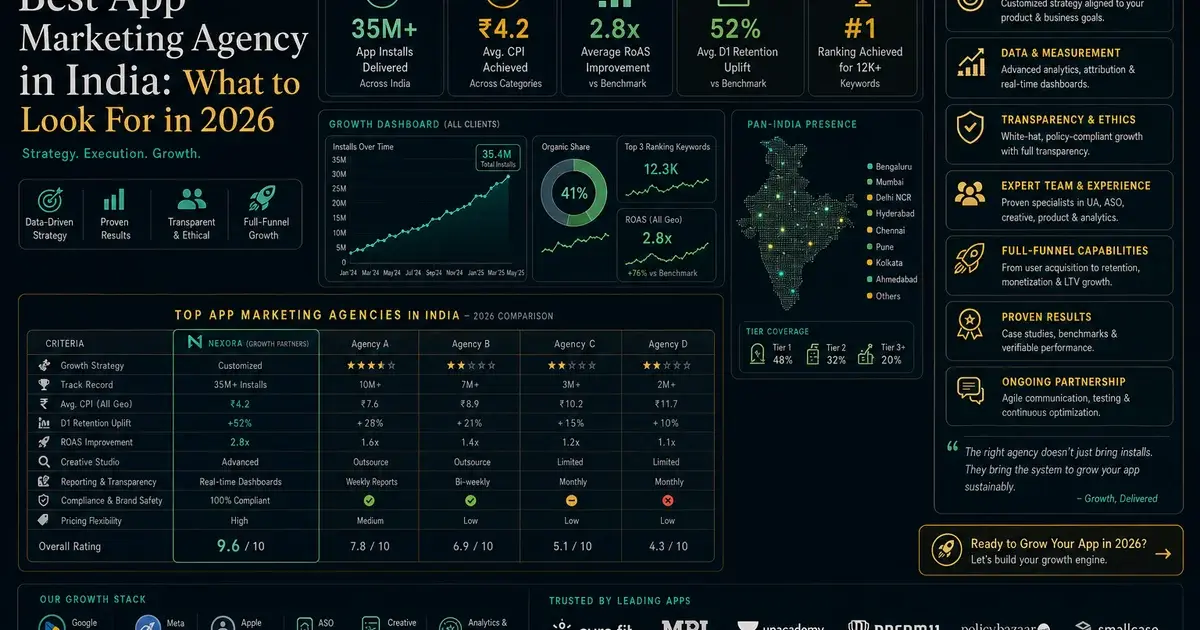
The Indian app marketing landscape has changed dramatically. Here's how to evaluate agencies that can actually move your installs, rankings, and revenue.
On this page
- Why should you hire an app marketing agency in India?
- What does an app marketing agency actually do?
- What does the Indian app market look like in 2026?
- How should Tier-2 and Tier-3 users change your India plan?
- How do you choose the right app marketing agency in India?
- What should the first 90 days with an agency look like?
- Which channels work best for Indian apps in 2026?
- What are the red flags in an agency pitch?
- What goes wrong in agency engagements, and how do you spot it early?
- How does Vmobify approach app marketing?
- What does an app marketing agency in India cost?
- Is an agency worth it, or should you hire in-house instead?
- Frequently Asked Questions
Why should you hire an app marketing agency in India?
Hire an agency when the thing blocking your growth is execution depth and speed — not money — because assembling an in-house ASO, paid UA, creative and attribution capability from zero takes longer than a full agency ramp and costs more before it produces a single install.
India is the world's second-largest smartphone market with over 800 million active users and one of the highest app download rates globally. But high downloads mean fierce competition — the Play Store and App Store are flooded with apps targeting the same users.
Most app founders and product teams are experts at building software, not at acquiring users at scale. Paid UA campaigns, keyword research for ASO, creative testing, MMP setup — these are specialised skills that take years to develop. A dedicated app marketing agency in India gives you immediate access to battle-tested playbooks without the hiring and learning curve.
The right agency doesn't just run ads. They operate as a growth partner — tracking what's working, eliminating waste, and compounding results month over month. That compounding effect is what separates apps with 10K installs from apps with 10M installs.
There is a second, less discussed reason: pattern recognition. An agency running dozens of apps at once sees which creative formats are fatiguing and which publishers have gone bad — across categories, not just yours. Across the 300+ apps we have managed since 2013, that cross-portfolio visibility has been worth more to clients than any single tactic.
What does an app marketing agency actually do?
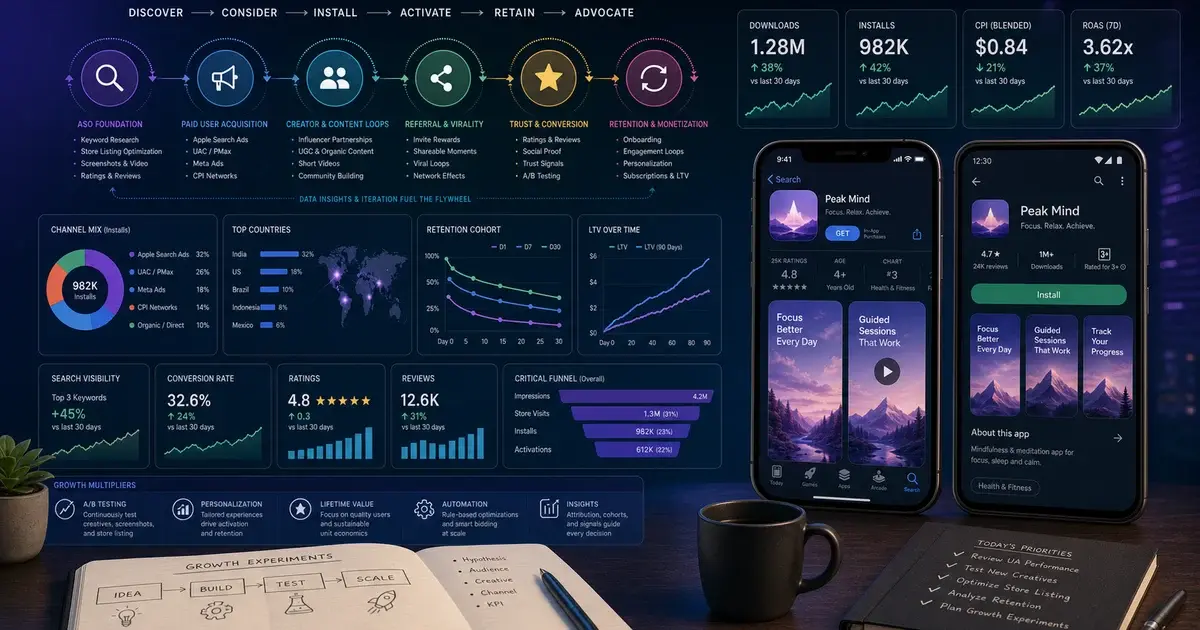
A full-service app marketing agency owns six connected disciplines — store optimisation, paid acquisition, incentivised and burst volume, attribution, creative production, and retention and monetisation — and the value comes from running them as one system rather than six separate vendors.
A full-service app marketing agency typically handles:
- App Store Optimisation (ASO): Keyword research, metadata optimisation, screenshot A/B testing, rating and review strategy. Good ASO can deliver 30–50% of an app's organic installs for zero incremental cost.
- Paid User Acquisition: Google UAC, Meta App Install campaigns, programmatic networks. The goal is a scalable CAC that stays below your LTV.
- CPI Networks: For apps that need volume fast — incentivised installs from quality publishers to boost chart ranking or prove product-market fit. See how a vetted CPI network engagement is structured.
- Analytics & Attribution: Setting up AppsFlyer, Adjust, or Branch correctly so every rupee of spend is attributed to the right source. This is what a mature analytics practice exists to protect.
- Creative Production: Video and static creatives built for performance, not awards. Motion-first, outcome-focused, tested systematically.
- Retention & Monetisation: Push notification strategy, in-app messaging, monetisation optimisation for ad-based and subscription apps.
The best agencies integrate these into a single system where each channel reinforces the others — paid UA drives volume, ASO converts that volume efficiently, and analytics tells you where to double down.
The integration is where fragmented setups quietly bleed money. If your ASO vendor rewrites the store listing without telling the paid team, your paid conversion rate moves and nobody knows why. If your media agency cannot see post-install events, it optimises to installs and hands you a cohort that never activates. We have seen more engagements underperform on that seam between disciplines than on any single bad campaign.
Ask who inside the agency owns the store listing, who owns the MMP configuration, and who owns creative. If the answer is three different companies, you are the integration layer — and you will be doing that job unpaid.
What does the Indian app market look like in 2026?
India in 2026 is a high-volume, low-ARPU, Android-dominated market where install costs are among the cheapest in the world and the difficulty has shifted almost entirely from acquisition to retention and monetisation.
India crossed 850 million smartphone users in 2025 and continues to add tens of millions more each year. Mobile data costs among the lowest in the world mean the average Indian user spends 4–5 hours per day on their phone, with apps accounting for the majority of that time. Statista's India mobile internet research tracks the same direction of travel: usage depth is still climbing while new-user growth shifts away from the metros.
Key dynamics shaping the Indian market in 2026:
- Tier 2 and Tier 3 city growth: The next wave of installs is coming from non-metro users. Apps need vernacular content, lighter APK sizes, and creatives that resonate beyond urban audiences.
- UPI and fintech saturation: Payments and banking apps are mature categories. Growth now requires differentiated retention and monetisation strategies, not just install volume.
- Short-video and content apps: Intense competition from domestic and global players. Brand safety and publisher quality matter enormously in this vertical.
- Gaming consolidation: India's gaming market is consolidating around a handful of genres. Hyper-casual is declining; mid-core RPG and real-money gaming are growing.
- Distribution beyond Play: OEM stores and India-specific storefronts now carry enough reach to matter for Android-first apps, which adds a listing surface most teams are not maintaining.
For any app targeting India, having an agency with deep local market knowledge — CPI benchmarks by category, carrier behaviour, device fragmentation — is a measurable competitive advantage. Our India app market statistics breakdown covers the underlying numbers in more depth than a single section can.
How should Tier-2 and Tier-3 users change your India plan?
Treat Tier-2 and Tier-3 as a separate growth motion with its own creatives, campaign structure and payback expectation — not as a geographic checkbox inside your metro campaigns. The cheaper installs in these markets are real, but they only convert into revenue when the rest of the funnel is built for that audience.
What changes in practice:
- Campaign separation: Metro and non-metro auctions clear at different prices. Mixed into one ad group, the algorithm spends your budget wherever conversions are cheapest and you lose the ability to price each segment. Split them and you can scale each on its own economics.
- Language, not translation: Hindi, Tamil, Telugu, Marathi and Bengali creatives written natively outperform translated metro creatives. The same applies to store listings — localised short descriptions and screenshot copy are the cheapest conversion lever available to an Android-first app.
- Build weight: Large APKs lose installs on mid-range devices and slower connections. Install completion rate, not click-through rate, is where this shows up first.
- Onboarding friction: KYC steps, OTP flows and permission requests that metro users tolerate cause visible drop-off in non-metro cohorts. Measure activation by geography or you will misread a funnel problem as a traffic-quality problem.
- Payback patience: Lower CPIs usually come with lower early ARPU. If your model assumes metro payback periods on non-metro CPIs, the segment will look unprofitable long before it actually is.
In our portfolio, the pattern we see repeatedly is a team that finds cheap Tier-2/3 installs, celebrates the CPI drop, and then quietly turns the segment off two months later because retention looked bad — when the actual problem was an onboarding flow built and tested only on metro users. The fix was product and creative, not media buying.
An agency worth hiring asks about your vernacular coverage and activation rate by region in the first conversation. If regional strategy only comes up after you raise it, local depth is a slide rather than a practice. Our guide to app install costs in India breaks down how the CPI spread across regions and categories behaves.
How do you choose the right app marketing agency in India?
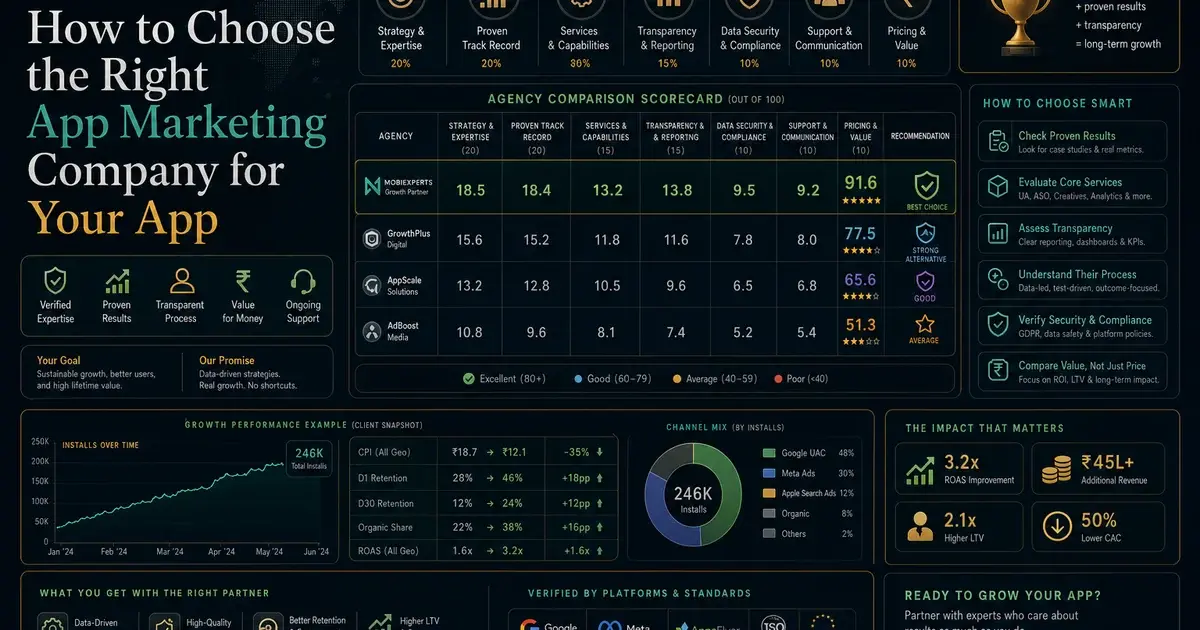
Choose on evidence: named results with real numbers, genuine depth across ASO and paid and analytics, a reporting cadence that produces decisions, and relevant category experience — in that order. Everything else on a pitch deck is decoration.
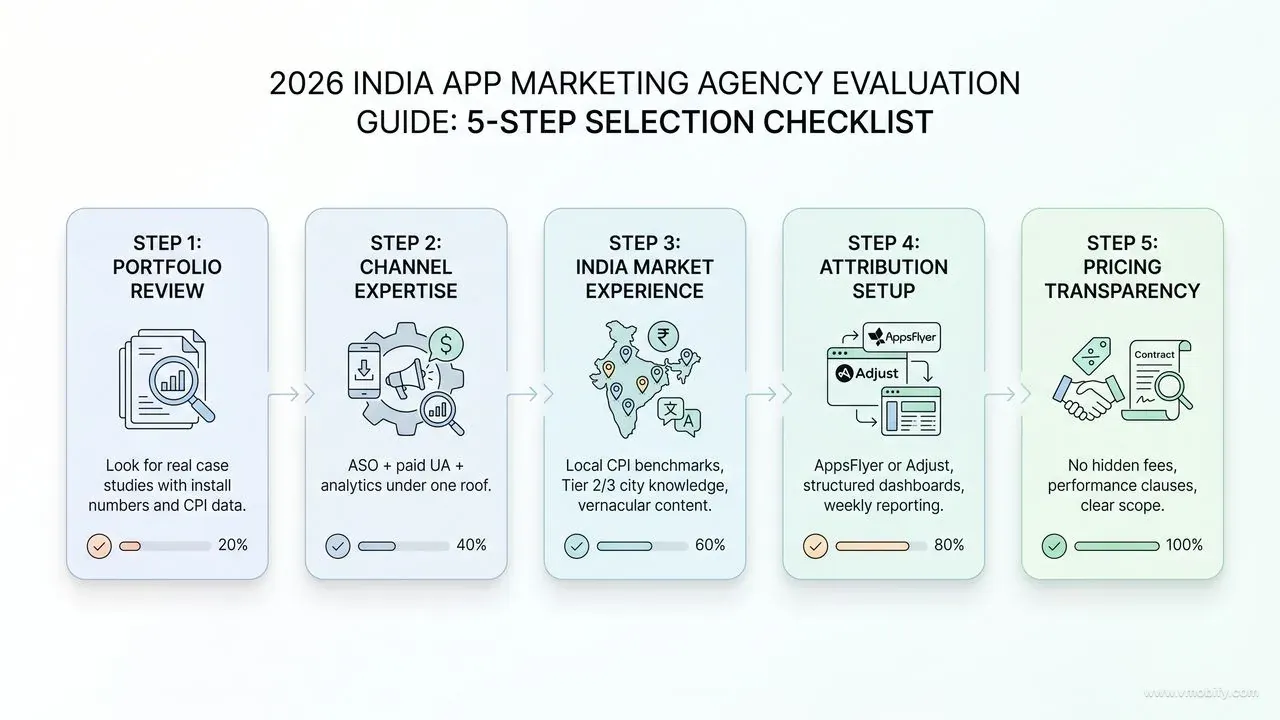
Choosing an agency is one of the highest-leverage decisions you'll make for your app. Here's the framework we recommend:
- Verify their track record: Ask for case studies with real numbers — installs delivered, CPI benchmarks, ranking improvements. Any agency worth hiring will have a results page with specifics.
- Sanity-check the claims: Compare quoted CPIs and retention against published category baselines such as AppsFlyer's Performance Index. Numbers far better than category norms are either a very specific edge case worth understanding, or a story.
- Check for channel depth: Do they handle ASO, paid UA, AND analytics? Or only one? Fragmented execution leads to fragmented results.
- Ask about their tech stack: Quality agencies use AppsFlyer or Adjust for attribution, use proper A/B testing tools for creatives, and build structured dashboards for reporting.
- Evaluate reporting cadence: Weekly check-ins with actionable insights are a green flag. Monthly PDF reports with no clear recommendations are a red flag.
- Look for category experience: An agency that's grown fintech apps thinks differently about trust signals than one that's grown gaming apps. Relevant category experience accelerates the learning curve.
- Confirm account and data ownership: Ad accounts, MMP configuration and creative source files should sit in entities you own. Agencies that hold these hostage make switching expensive by design.
One practical filter: ask what they would not do for your app. An agency that answers immediately — "we would not run a CPI burst before your onboarding is fixed" — is thinking about your situation. One that says yes to everything is selling capacity. Our roundup of mobile marketing companies in India covers how the market segments by scope and size.
What should the first 90 days with an agency look like?
A well-run engagement spends the first month measuring and fixing, the second month running deliberately small experiments, and only the third month scaling spend — any agency that wants to push large budgets in week one is skipping the part that makes the budget work.
- Days 1-10 — audit and instrumentation. Attribution setup verified end to end, post-install events defined beyond install, store listing and keyword position baselined, current cohort retention documented. Nothing is optimised yet because nothing is measurable yet.
- Days 10-30 — fix the conversion surface. Store listing, first screenshot, icon, short description and review responses. This work is free, it compounds, and it raises the return on every rupee of paid spend that follows. Running paid traffic into an unoptimised listing is the most common way to waste a first month.
- Days 30-60 — controlled experiments. Two or three channels, small budgets, deliberate creative variants. The goal is not volume; it is finding which audience-creative-channel combinations clear your CAC target and which do not. Expect most of them to fail — that is the experiment working.
- Days 60-90 — scale the winners. Spend concentrates behind what survived. Losing campaigns are cut rather than nursed. Reporting shifts from "what did we learn" to "what is the marginal cost of the next install".
Two things should be true by day 90 regardless of how the numbers land: you can state your blended CAC and retained-user cost from your own dashboard without asking the agency, and you know which single lever the next quarter depends on — creative volume, listing conversion, retention, or budget. If neither is true, the engagement has been activity rather than progress.
Install velocity matters through this whole sequence, which is why sequencing beats speed. Google Play's own launch best-practice documentation treats a concentrated, sustained ramp as a stronger signal than the same volume spread thin — but that only helps you if the listing converts the traffic when it arrives. For planning the spend behind this ramp, our year-one app marketing budget guide lays out the bands in detail.
Which channels work best for Indian apps in 2026?
For most Indian apps the answer is Google App Campaigns for scalable volume, Google Play ASO for organic baseline, and Meta for segmentation and creative discovery — with CPI networks and influencers as situational additions rather than core channels.
The channel mix that works best for Indian apps depends on your category, LTV, and growth stage. Here is what the data shows across our portfolio:
- Google App Campaigns (UAC): The highest-volume paid channel for Android-heavy markets like India. Works best for apps with strong engagement signals for Google's algorithm. Average CPI for utility apps: ₹15–40. For finance: ₹80–200. Google's App Campaigns documentation covers how a single campaign serves across Search, YouTube, Discover, Display and Play.
- Meta App Install Campaigns: More expensive than Google on average in India, but superior for audience segmentation and creative testing. Ideal for apps targeting specific demographics — women 25–34, working professionals, students. Meta's Advantage+ App Campaigns guidance is explicit that broad targeting with high creative volume outperforms narrow targeting.
- Google Play Organic (ASO): India is disproportionately an Android market (95%+). A strong Play Store presence — top 10 rankings for core keywords — can deliver thousands of installs per day at zero CAC.
- CPI Networks: Useful for burst campaigns to climb charts or for early-stage apps testing conversion before committing to expensive paid channels. Quality varies enormously — only work with agencies that have vetted publisher relationships.
- Influencer and Social: Growing in effectiveness for gaming, lifestyle, and consumer apps. Works best as a top-of-funnel amplifier for paid campaigns, not as a standalone performance channel.
The optimal strategy combines ASO for baseline organic installs with paid UA for scalable growth — each channel feeding the other. Sequencing matters as much as selection: ASO first because it raises the conversion rate on every other channel, then one paid channel scaled properly, then a second. Teams that open four channels at once rarely have the creative volume to feed any of them. Talk to our team about the right channel mix for your app specifically.
What are the red flags in an agency pitch?
The four reliable warning signs are guaranteed install volume with no quality metric, opaque traffic sources, lock-in contracts with no performance component, and a pitch that never asks about your economics. Any one of them is enough to keep looking.
The app marketing space has its share of agencies that over-promise and under-deliver. Here's what to watch for:
- Guaranteed installs with no mention of quality: Volume without retention is vanity. If an agency quotes raw install numbers without mentioning D1/D7 retention or engagement rates, walk away.
- No transparency on traffic sources: You should know exactly where every install comes from. Agencies that can't or won't share publisher lists or campaign breakdowns are hiding poor-quality sources.
- Lock-in contracts with no performance clause: The best agencies are confident enough to tie at least part of their fee to results. Long lock-ins with no out clause signal a lack of confidence.
- Cookie-cutter strategies: Every app is different. If an agency gives you the same pitch deck they've used for 50 other clients without asking about your LTV, churn rate, or category dynamics, they're not thinking about your app specifically.
- Vague sourcing on incentivised traffic: Incentivised installs presented as organic are a store-policy problem, not just a quality problem. Apple's App Store Review Guidelines prohibit install and ranking manipulation outright, and the account risk sits with you rather than with the vendor who sold the traffic.
There is also a quieter red flag: an agency that never says no. Growth work is a sequence of trade-offs — spend here means not spending there, and scaling now means not fixing retention first. A partner who agrees with every request is optimising for the renewal, not the outcome.
What goes wrong in agency engagements, and how do you spot it early?
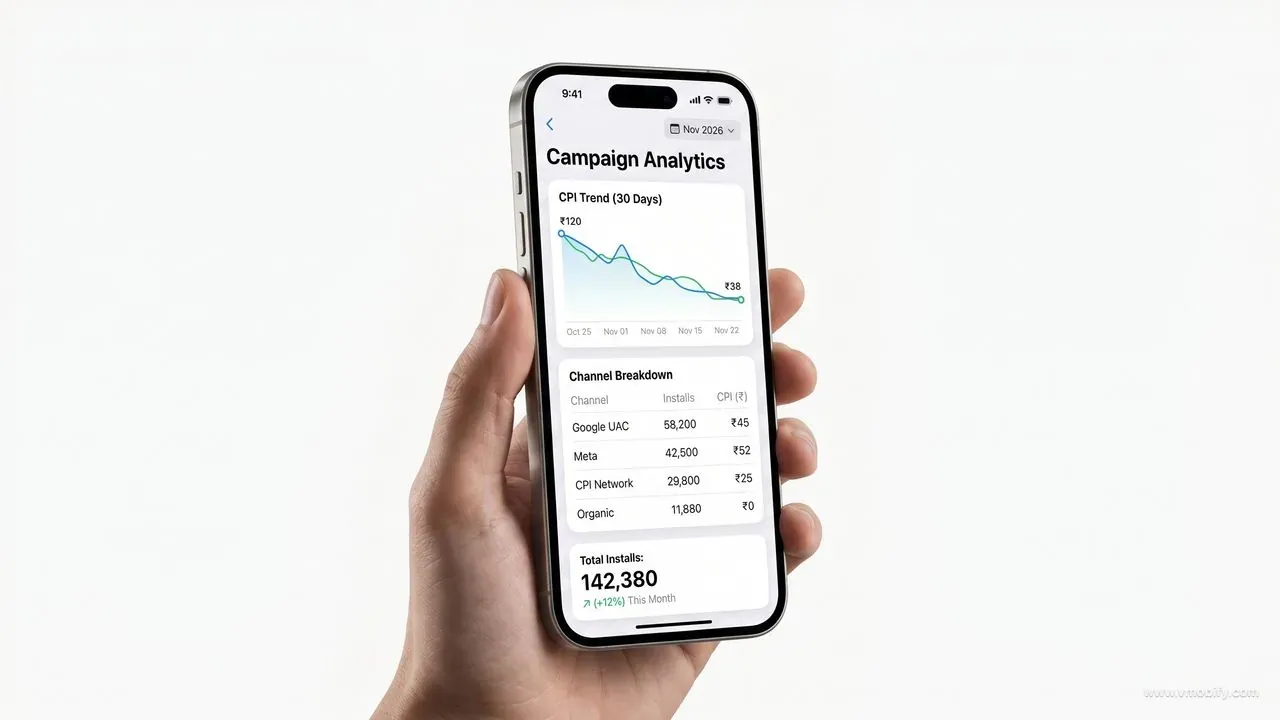
Engagements almost never fail because a campaign underperformed — they fail on broken attribution, a store listing that does not convert, retention that was never fixed, or reporting that hides source-level detail, and each of those is detectable within the first 30 days.
The four failure modes, and the early symptom of each:
- Attribution is wrong. Symptom: the numbers in your MMP, the ad platforms and your own backend disagree, and nobody can explain the gap. Ask for a reconciliation in week two, not month three. iOS makes this harder rather than impossible — Adjust's 2025 ATT research puts app-tracking opt-in around 35%, so a competent partner should already be planning for modelled and aggregated measurement rather than treating deterministic attribution as the default.
- The listing does not convert. Symptom: paid CPIs drift upward while click-through holds steady. That gap is store-page conversion, and no amount of bid tuning fixes it. Check store conversion rate before approving a budget increase.
- Retention was never the priority. Symptom: installs grow, DAU does not. This is the most expensive failure because it is invisible in every install-based report. Insist that weekly reporting carries a cohort retention line next to the install line from day one — our app retention benchmarks give you a reference point for what normal looks like in your category.
- Reporting is aggregated to hide problems. Symptom: you get channel totals but never publisher or placement detail. Blended numbers can look healthy while a third of spend goes somewhere you would refuse if you could see it. Ask for source-level breakdowns in the first report and treat reluctance as an answer.
We have seen all four, and the pattern is consistent: the technical problems get caught quickly because someone notices a number looks wrong, while the retention problem runs for months because every report says installs are up. The way to protect against that is to agree, before signing, on the two or three metrics that define success — and to make sure at least one of them is measured after the install rather than at it.
If month one produces a report with no bad news in it, ask for the bad news. Every real growth programme has failing experiments in its first month.
How does Vmobify approach app marketing?
We run app marketing the way an app owner would, because for over a decade that is exactly what we were — building and scaling our own apps before opening the practice to clients.
At Vmobify, we've spent 13+ years building and marketing our own apps before we opened our services to clients. We've reached 30M+ downloads and 54K ranked keywords across our own portfolio — so we operate with the mindset of founders, not just marketers.
Our integrated system covers ASO+, User Acquisition, CPI Networks, Monetisation, and Analytics — all under one roof. Every strategy is built around your specific LTV, retention curve, and category dynamics.
Engagements start with a free growth audit that maps your current position and identifies the 2–3 highest-impact levers for your app. Once we're aligned, expect a 90-day ramp: the first 30 days are setup and baseline measurement, days 31–60 are initial experiments, and days 61–90 are scaling what works. We've scaled apps in fintech, utility, entertainment, and e-commerce categories across India, Southeast Asia, the US, and the Middle East. Request your audit — no commitment required.
The audit is deliberately unglamorous: keyword position, store conversion, attribution integrity, cohort retention, channel economics. Often it concludes that the highest-impact next step is not more spend at all — it is fixing what the current spend lands on. That is a harder conversation in a sales call and a much cheaper one before the budget is committed.
What does an app marketing agency in India cost?
Expect ₹30,000–₹80,000 per month depending on scope, or a hybrid of base plus performance where both sides want incentives aligned — with agency fees sitting alongside, not inside, your media budget.
App marketing agency pricing in India varies widely based on scope and agency tier:
- Project-based: One-time ASO audit or campaign setup, scoped as a single piece of work rather than a monthly commitment.
- Monthly retainer: Ongoing management of one or more channels, typically ₹30,000–₹80,000/month depending on how many channels and markets are in scope.
- Performance-based: Fee tied to install volume or revenue milestones. Best for apps with proven LTV and enough data to set fair targets.
- Hybrid: Base retainer + performance bonus. This aligns incentives well — the agency is paid for showing up and for results.
Judge a quote by what it includes rather than by the number alone. Ask which channels are covered, who does the work, how often creative and metadata are tested, and what is reported monthly — two identical retainers can buy very different amounts of attention.
Two clarifications worth settling in writing before you sign. First, whether the fee includes media spend or sits on top of it — a percentage-of-spend model quietly rewards the agency for spending more, so pair it with a CAC ceiling. Second, what creative production is in scope: "creative included" can mean a full studio or merely resizing what you supply, and video production at volume is the largest hidden cost in most programmes.
Set the media budget separately from the fee, and set it against the data density you need rather than what you can afford. Paid UA needs enough conversion volume for the algorithm to exit its learning phase before optimisation means anything — that threshold is a function of your CPI and conversion event, not a fixed rupee figure, so work it out for your own funnel before committing to a monthly spend.
Is an agency worth it, or should you hire in-house instead?
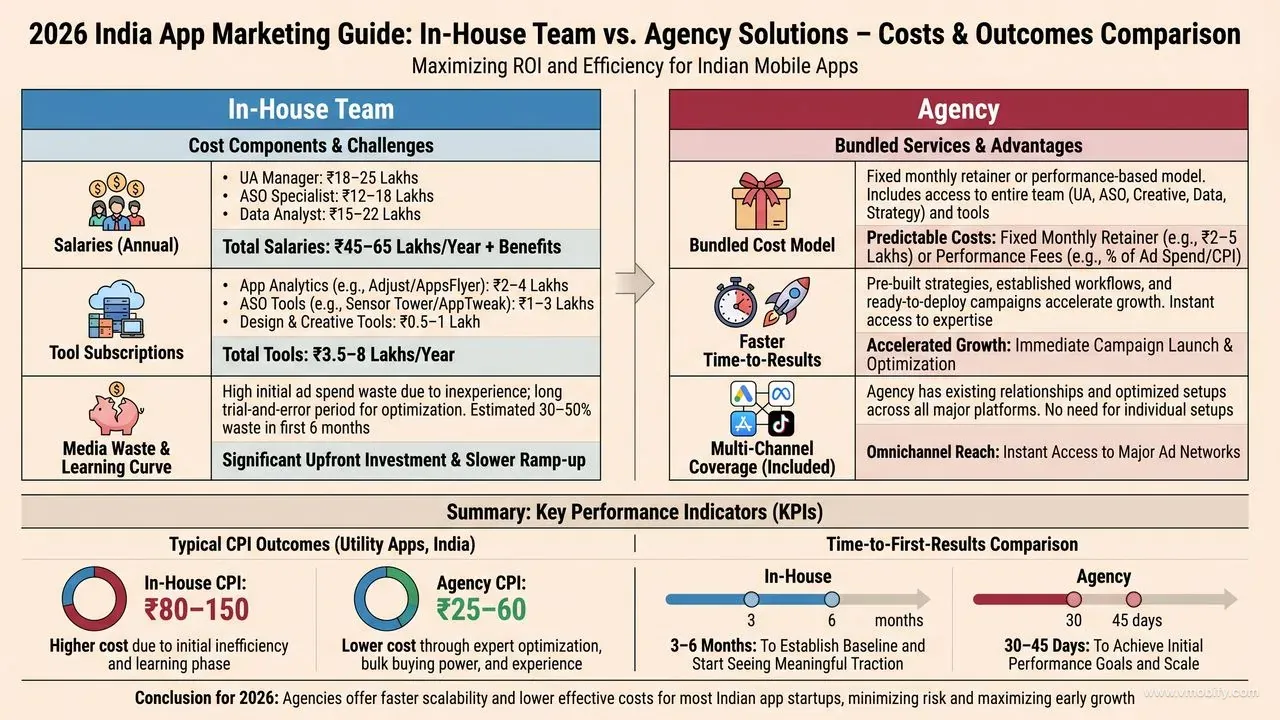
An agency is worth it when you need several specialisms at once and you need them working this quarter; in-house wins when your spend is large enough and stable enough that a dedicated team is cheaper than a fee — and the honest answer for most Indian apps under a few crore of annual media spend is a hybrid.
The sceptical version of the objection is fair: you are paying a margin on work you could hire directly. Here is how the two actually compare.
Agency makes sense when
- You need ASO, paid UA, creative and attribution simultaneously, and cannot hire four specialists
- Speed matters more than building institutional capability this year
- Your spend is variable — seasonal peaks, launch bursts, funding-dependent
- You want cross-portfolio pattern recognition your own team cannot have
- You need vendor and publisher relationships that take years to build
In-house makes sense when
- Media spend is consistently large enough that fees exceed salaries
- Growth is a core competitive advantage rather than a function
- Your product changes weekly and marketing must sit inside the build loop
- You are in a regulated category where compliance review must be internal
- You already have a senior growth lead who can hire and direct specialists
The hybrid is what most teams converge on and what we recommend openly: one strong in-house growth owner holding strategy, budget and the relationship, with an agency supplying execution depth across channels. That keeps decision-making and data ownership inside the company while avoiding the eighteen months it takes to build a full team.
The in-house failure case is worth naming precisely because it is common: a team hires one growth marketer, hands them ASO, paid UA, creative, attribution and reporting, then concludes a year later that growth marketing does not work. It was never a capability problem — it was five jobs given to one person. The agency failure case is the mirror image: the client outsources thinking along with execution and treats the monthly report as the relationship. Agencies do their best work for clients who argue with them. Tell us what you are working with and we will say which of the three structures fits.
Frequently Asked Questions
How long before I see results from an app marketing agency?+
ASO improvements typically show in 4–8 weeks. Paid UA results are visible in week 1. Full compounding effects from a combined ASO + UA strategy take 3–6 months.
Do I need a minimum ad budget to work with an agency?+
For meaningful paid UA results, we recommend a minimum of ₹2–3L/month in ad spend. Below that, the data is too thin to optimise effectively.
Can you work with early-stage apps?+
Yes, though the strategy differs. Early-stage apps benefit most from ASO and targeted paid experiments with small budgets to find product-market-fit signals before scaling.
Do you work with both Android and iOS apps?+
Yes. Our ASO practice covers both Google Play and the App Store. Our UA practice covers Google UAC, Meta, and programmatic for both platforms.
What is the difference between an app marketing agency and a mobile app marketing agency?+
There is no meaningful difference. Both terms refer to specialised agencies that grow mobile apps via ASO, paid UA, and analytics. "Mobile app marketing agency" is just a more specific phrasing of the same service.
Is an app marketing agency different from a general digital marketing agency?+
Substantially. A general digital agency optimises for web traffic, leads and e-commerce sessions; an app agency works inside store algorithms, mobile attribution and post-install cohorts. The tooling is different too — MMPs, store consoles and SDK-level event tracking rather than website analytics. Hiring a web-first agency for app growth usually costs a quarter of learning before it costs money.
Who should own the ad accounts and attribution data?+
You should. Ad accounts, the MMP configuration, store console access and creative source files belong in entities your company controls, with the agency granted access rather than ownership. This matters most on the day the engagement ends — teams that skipped this rebuild their measurement history from scratch. Settle it in the contract, not after the first invoice.
Sources
- AppsFlyer Performance Index — Category and geography benchmarks for validating agency-quoted CPI and retention claims
- Google Ads — App Campaigns Help — Official documentation on UAC structure, bidding, creative requirements and delivery surfaces
- Google Play — Launch Best Practices — Google guidance on launch sequencing and sustained install ramp as a ranking signal
- Apple App Store Review Guidelines — Rules on install and ranking manipulation, incentivised traffic and review schemes
- Meta — Advantage+ App Campaigns — Official Meta guidance on broad targeting and creative volume for app install campaigns
- Adjust — ATT Opt-In Rates 2025 — App-tracking opt-in data and methodology behind iOS measurement planning
- Statista — Mobile Internet Usage in India — Market-level data on Indian mobile internet adoption and usage depth
- AppsFlyer — State of App Marketing in India — Annual industry view of channel mix, budget allocation and regional growth patterns
About the author
Amol Pomane — Founder, Vmobify
Amol leads Vmobify, a mobile app growth agency that has driven 30M+ downloads and ranked 54K+ keywords across 300+ apps since 2013. He writes about ASO, paid user acquisition, retention, and the operational reality of scaling mobile apps in India and global markets.