OTT App Marketing: How We Grew a Streaming App to 1M+ Downloads
A regional language OTT app asked us to help them compete against Netflix and Hotstar. Here is how owning the regional keyword space and using content clips as ads drove 1M+ downloads, 51% activation, and a 65% lift in watch time.
On this page
- How competitive is the OTT market in India?
- What was the streaming app actually struggling with?
- What strategy did we choose for a regional OTT app?
- How did we execute ASO, onboarding, and paid UA?
- What results did the OTT app achieve in 11 months?
- What is the step-by-step playbook for a regional OTT app?
- What goes wrong in OTT marketing, and how do you spot it early?
- How much should an Indian OTT app budget for growth?
- Does this only work if you already have a strong content library?
- What are the transferable lessons from this engagement?
- How does Vmobify run OTT growth?
- Frequently Asked Questions
How competitive is the OTT market in India?
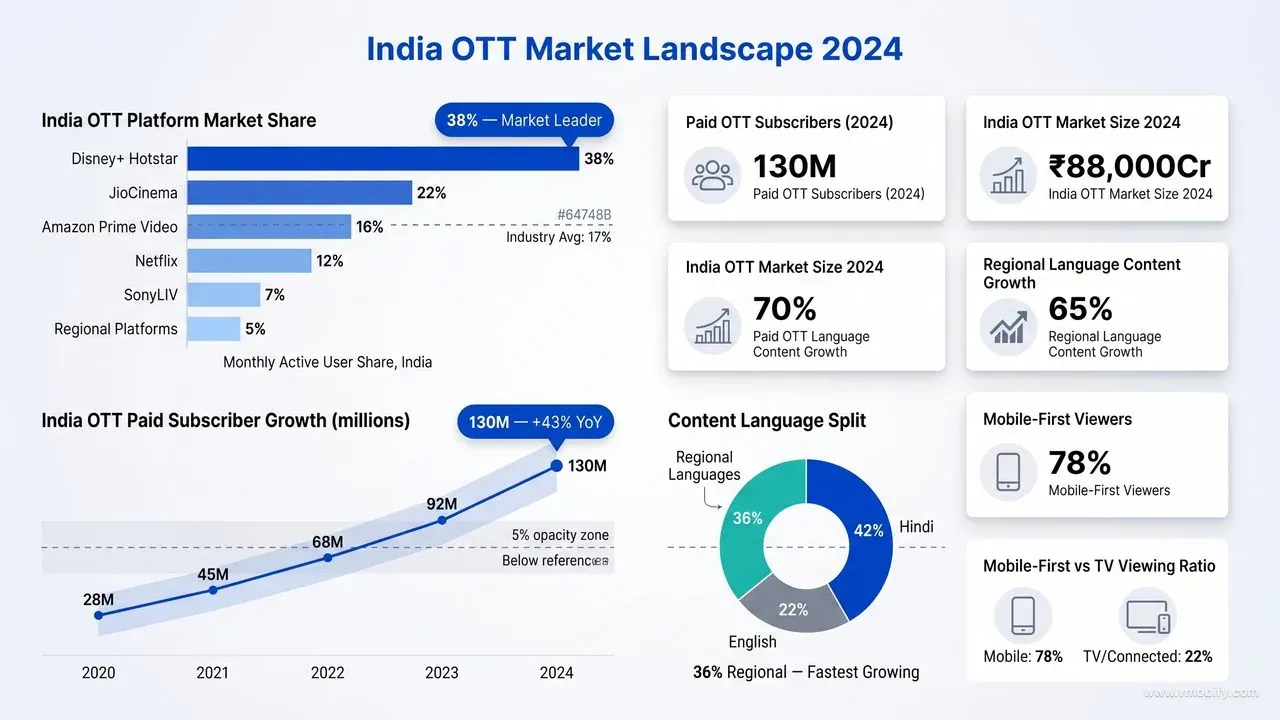
India's OTT market is one of the most crowded in the world at the national level, and one of the least served at the regional-language level — and that gap is the only place a small platform can win.
India's OTT landscape is one of the world's most competitive. Netflix, Amazon Prime Video, and Disney+Hotstar dominate mindshare and marketing budgets—Netflix alone spent an estimated ₹1,200 crore on content and marketing in India in 2024. JioCinema, with the IPL rights, redefined free-to-air streaming for a generation of mobile-first viewers. SonyLIV and ZEE5 compete aggressively in the premium tier. The conventional wisdom is that a small OTT platform cannot survive in this environment.
The conventional wisdom is wrong—if you pick the right battleground. Regional language content is the OTT market's fastest-growing and least-served segment. While the major platforms have regional content, they treat it as supplementary to their Hindi and English flagship content. A platform that is exclusively and authentically regional—Marathi, Kannada, Bhojpuri, Odia—can build fanatical loyalty among an audience that feels underserved by the giants.
The structural reason this works is that Indian streaming is overwhelmingly a mobile-first, Android-first behaviour. Statista's India mobile internet research tracks the scale of that shift, and it changes what marketing actually has to do: the store listing on a mid-range Android handset is the shop window, not a television campaign. Across the 300+ apps we have managed since 2013, the regional apps that grow fastest are the ones that treat Google Play search in the user's own script as their primary distribution channel rather than an afterthought.
What was the streaming app actually struggling with?
The app had a genuinely good content library and almost no distribution — 85,000 downloads, 22,000 monthly actives, and no repeatable way to acquire either.
Our client was an OTT platform exclusively focused on Marathi content—web series, films, comedy specials, and live events. Founded in 2022, they had built a library of 200+ hours of original Marathi content with genuine quality (multiple awards at regional film festivals). But they had 85,000 downloads and a monthly active user base of only 22,000—suggesting deep retention problems alongside insufficient acquisition.
The core challenges:
- Discovery gap: Marathi speakers searching for content in the Play Store were not finding the app. Searches for "मराठी वेब सीरीज" (Marathi web series), "Marathi movies app", and "नाटक app" (drama app) were returning results dominated by broader OTT platforms with a thin Marathi catalogue, not dedicated Marathi platforms.
- Activation funnel leakage: Only 26% of new installs were watching any content within 7 days. Users were installing, browsing, not immediately finding something compelling, and churning without ever experiencing the product's core value.
- No paid acquisition engine: The client had run a few boosted Facebook posts but had no structured paid UA campaigns. The majority of their installs came from social media posts about new content releases—spiky, unpredictable, and impossible to scale.
Read in sequence, those three problems have an order to them. The discovery gap capped how many people could ever find the app. The activation leak decided what fraction of those people became viewers. The absence of a paid engine meant nothing could be scaled deliberately. Fixing them out of order — buying installs first — would have spent the client's budget filling a bucket with a hole in it.
What strategy did we choose for a regional OTT app?
We stopped competing on breadth and competed on being the only serious Marathi platform — then removed the two things blocking that library from reaching people.
We built the strategy around the platform's genuine competitive advantage: the deepest, highest-quality library of Marathi content available on any app. No amount of marketing budget could make up for a weak content library—but with a strong library, distribution was the bottleneck. Our job was to remove that bottleneck.
Three strategic pillars:
- Own the Marathi content keyword space on Google Play and the App Store. No competitor was optimising specifically for Marathi OTT search terms. We could rank first for the category's entire search volume with focused ASO work.
- Use content clips as the primary paid creative. The most compelling advertisement for an OTT platform is the content itself. A 15-second clip from a beloved Marathi web series—showing the dramatic moment, the wit of the dialogue, the authentic Marathi setting—would outperform any brand creative. We would build all paid creatives around content clips.
- Fix the onboarding funnel before scaling acquisition. With only 26% of installs watching content within 7 days, pouring more users into the existing funnel would waste budget. First, fix the experience; then, scale.
How did we execute ASO, onboarding, and paid UA?
ASO: Dominating Marathi OTT search. We conducted keyword research specifically for Marathi content search behaviour. The opportunity was significant: terms like "मराठी वेब सीरीज app" (Marathi web series app), "Marathi natak app", "मराठी सिनेमा" (Marathi cinema), and "best Marathi OTT app" had meaningful monthly search volumes with almost no optimised competitors. We restructured the entire store listing around these terms.
The title was updated to explicitly state "Marathi Web Series, Movies & Shows"—making the app's positioning unmistakable in search results. Screenshots were redesigned to showcase recognisable Marathi actors and show titles rather than generic streaming UI. We created a dedicated Marathi-language store listing with Marathi-script descriptions and Marathi-language screenshot text. Within 60 days, the app ranked #1 for 11 Marathi content keywords. The mechanics of running a second-language listing properly are covered in our app store localisation guide.
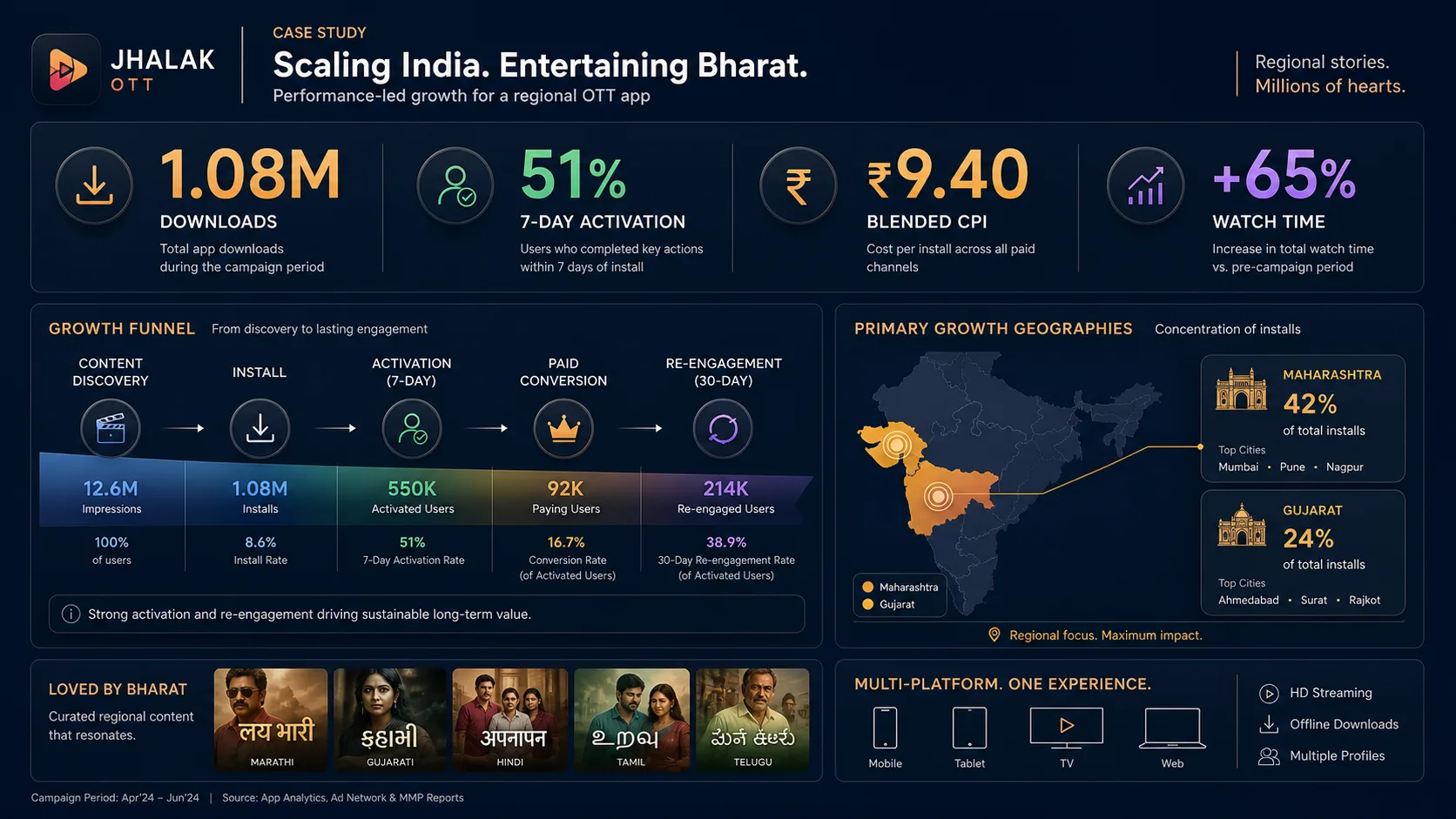
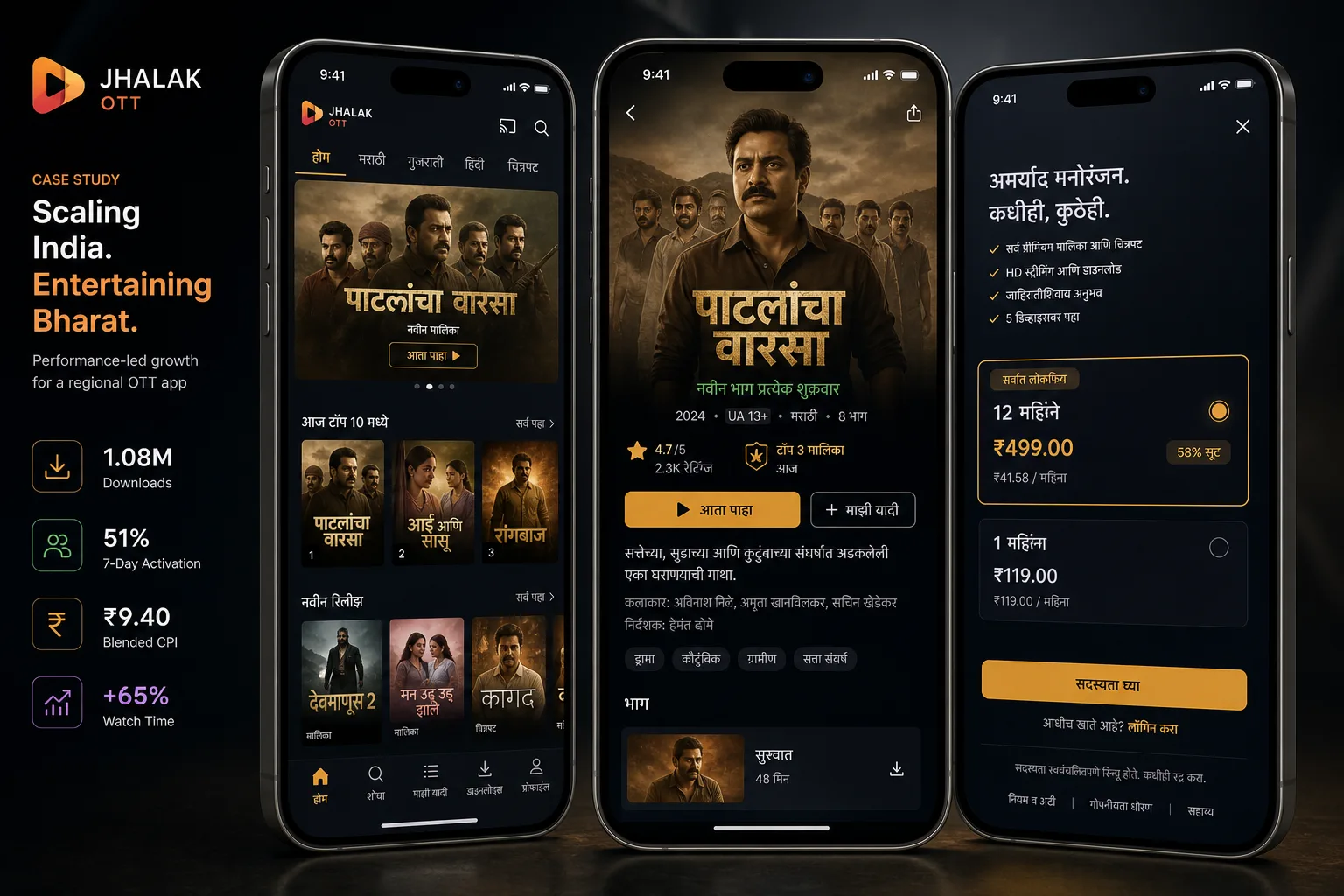
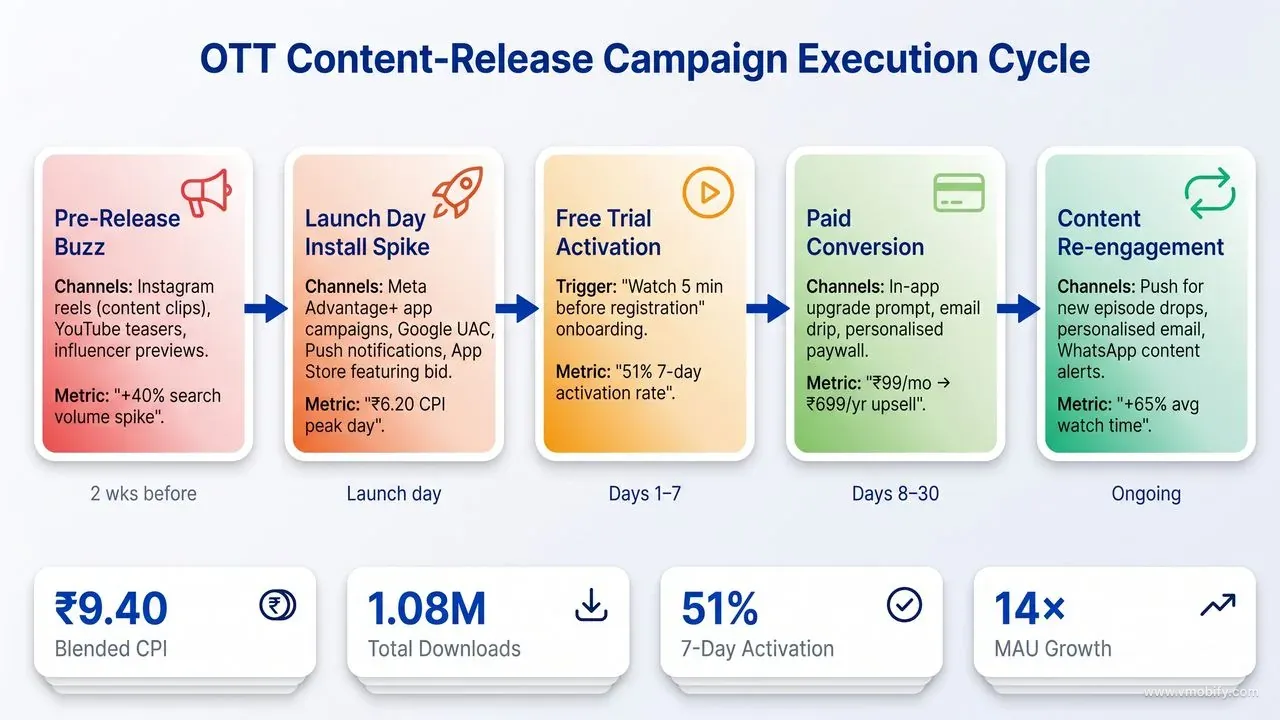
Onboarding funnel redesign (before scaling paid UA). We analysed the onboarding flow and identified two critical drop-off points: (1) users were hitting a mandatory account creation screen before watching any content, and (2) the home screen defaulted to the newest additions rather than the most popular content. We recommended (and the client implemented) a "watch 5 minutes before registering" experience that let users sample content immediately, and a redesigned home screen leading with "Top Picks in Marathi" curated by editorial staff. These two changes improved 7-day activation from 26% to 51% within 30 days of implementation—before any change in acquisition spend.
Content clip creative for Meta campaigns. We built a library of 30 content clip ads sourced from the platform's most-watched originals. Each clip was 15–30 seconds, ending with the show title, app name, and a "Watch Now—Free on [App]" call-to-action. We ran these in Meta Advantage+ App Campaigns targeting Maharashtra-based users aged 22–50, with Marathi as their device language. Broad targeting with heavy creative volume is what Meta's own Advantage+ App Campaigns documentation recommends, and it suited a catalogue business where the clip does the qualifying rather than the audience setting.
The content clips dramatically outperformed conventional OTT marketing creatives. A clip from their most popular web series achieved a CPI of ₹6.20—against a category average of ₹18–₹25 for streaming apps. The emotional connection to recognisable content and actors created an instant motivation to install that no generic creative could match.
Google UAC with content-specific creatives. We ran separate UAC campaigns for each of the platform's 5 most popular original series, treating each as its own mini-campaign. This allowed us to match YouTube and Display placements to users who had watched or searched for similar content—a precision targeting approach that delivered CPIs 35% below the non-content-specific campaign structure. Google's App Campaigns documentation is explicit that the system optimises against the creative assets you give it, which is exactly why one campaign per hit show beat one campaign for the whole catalogue.
What results did the OTT app achieve in 11 months?
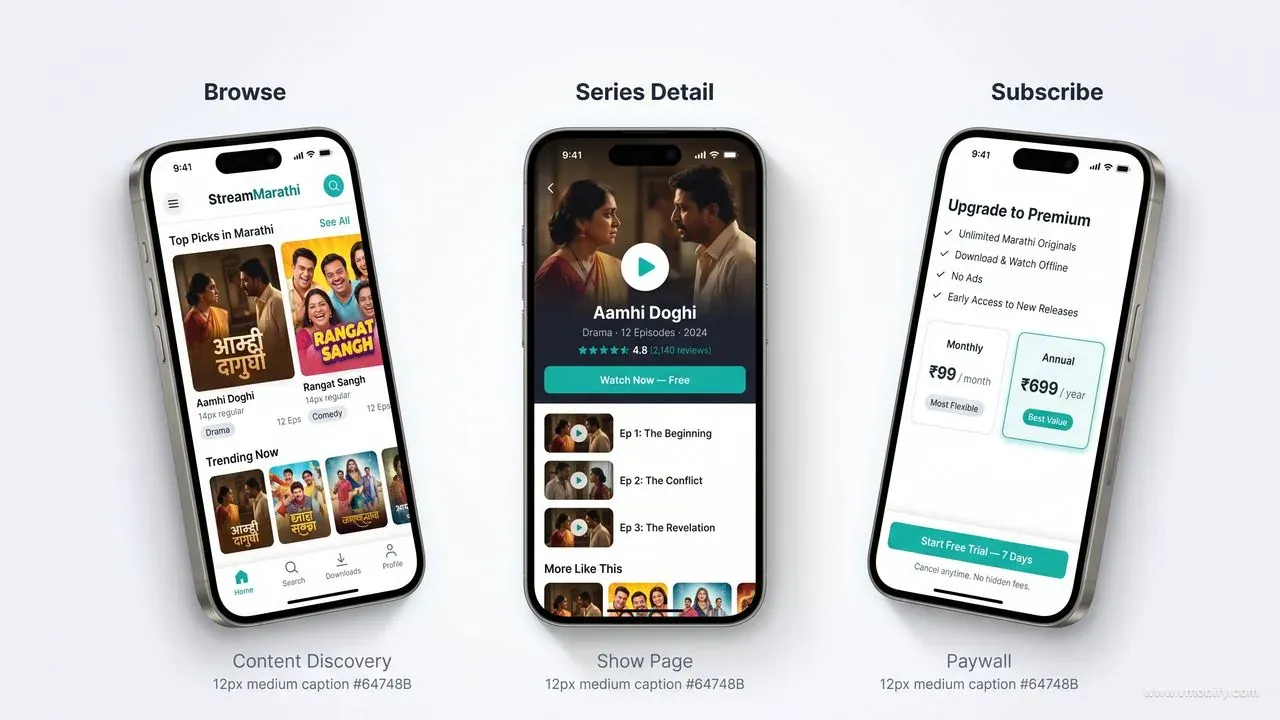
Downloads grew 12.7x and monthly actives grew 14x — the gap between those two numbers is the part worth studying, because it is what the onboarding work bought.
Over 11 months of the engagement:
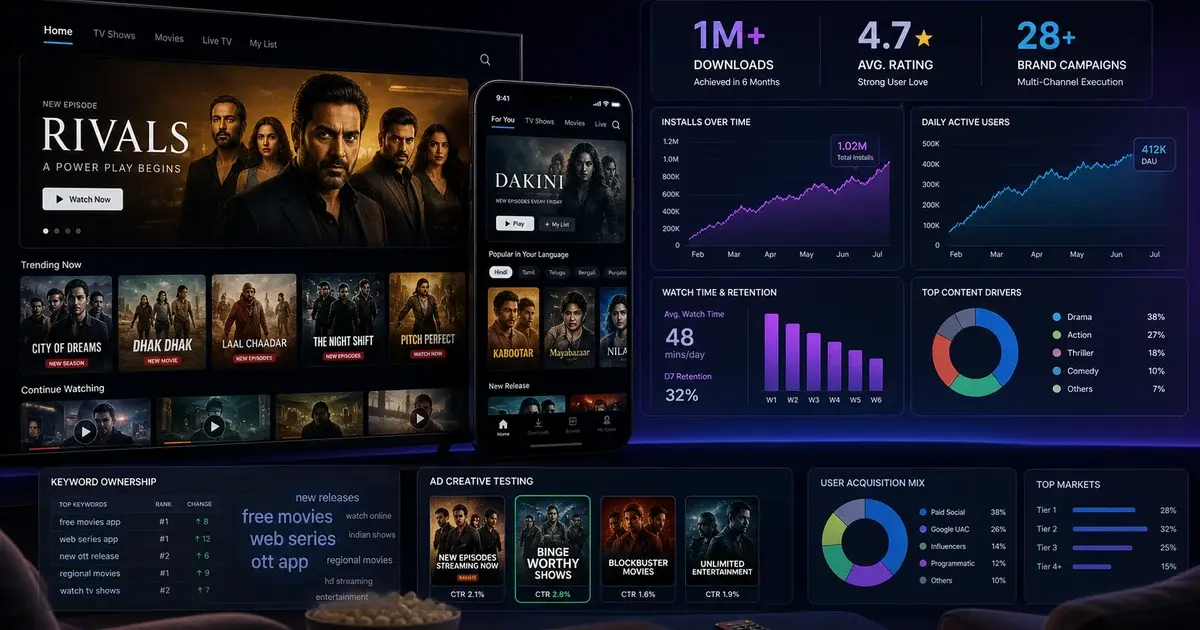
- 1.08 million downloads (up from 85,000 at engagement start—a 12.7x increase)
- 4.4★ average rating on Google Play (up from 3.6★)
- Average watch time per active user: +65% — driven by the onboarding funnel improvement and personalised home screen
- 51% 7-day activation rate (up from 26% before onboarding redesign)
- ₹9.40 blended CPI (significantly below the ₹18–₹25 streaming app category average)
- #1 ranking for 11 Marathi OTT search terms on Google Play
- Monthly active users: 310,000 at engagement end (up from 22,000—a 14x increase)
These are anonymised client results shared with permission. Individual results will vary based on content library quality, market, and competitive dynamics.
More case studies of this shape sit on our results page, including other vernacular content businesses where the same ordering — listing first, funnel second, spend third — produced the same pattern.
What is the step-by-step playbook for a regional OTT app?
Run it in four phases, in this order: vernacular keyword research, store listing rebuild, first-session repair, then paid scaling on content clips. Reordering these phases is the most common and most expensive mistake in this category.
- Weeks 1–2 — Research search behaviour in the actual script. Pull keyword data for your language in Devanagari, Kannada, Tamil or Bengali script as well as romanised transliteration, because a large share of users type one and a meaningful share type the other. Map each term to the specific show or genre that satisfies it. This is the single input everything downstream depends on.
- Weeks 2–4 — Rebuild the listing around those terms. Title and short description carry the primary keywords. Screenshots lead with recognisable faces and show titles, not player chrome. Publish a full second-language listing rather than translating a few strings. Where a platform supports it, build dedicated store pages per franchise — Apple's Custom Product Pages documentation describes exactly this pattern of matching the store page to the ad that sent the user.
- Weeks 4–8 — Repair the first session before spending. Remove any mandatory registration ahead of the first play. Default the home screen to proven popular titles, not newest uploads. Instrument the funnel so you can see install → first play → first completion → return visit as four distinct steps. Our app onboarding guide covers the instrumentation in detail.
- Weeks 8–16 — Scale paid on content clips. Cut 20–30 clips from your best-performing originals. Run one campaign per flagship show rather than one for the catalogue. Start on Meta and Google App Campaigns, and only add a CPI network once your activation rate is stable enough to judge incoming cohorts.
- Week 16 onward — Tie release calendar to media calendar. Every new show launch is an install spike opportunity. Brief creative two weeks ahead, warm the campaign three days ahead, and let the release day carry the velocity.
The thing that makes this sequence work is that each phase makes the next one cheaper. Better ASO raises the store conversion rate, so paid traffic converts harder. Better activation raises the value of every install, so a higher CPI is still affordable. We have seen teams attempt phase four alone and conclude that OTT user acquisition does not work in India — when in fact they were paying full price for installs that landed on a listing and a first session that were not ready for them.
What goes wrong in OTT marketing, and how do you spot it early?
Four failure modes account for almost every stalled OTT growth programme we have reviewed, and each one shows a warning sign in the data long before it shows up in revenue.
- Scaling spend into a broken first session. Early signal: install volume climbs but day-7 actives stay flat within two weeks of a budget increase. If your activation rate falls as spend rises, the funnel — not the traffic — is the problem. Check this weekly, not monthly, because a month of scaled spend into a leaking funnel is a month of budget gone.
- Treating the catalogue as one product. Early signal: your best creative and your worst creative are separated by a factor of three or more on CPI, and nobody can explain why. In a content business that difference is almost always the title, not the edit. The fix is campaign-per-title structure, which is what produced the 35% CPI improvement in this engagement.
- Buying installs from sources that do not watch anything. Early signal: cohort watch time collapses relative to your organic baseline while the CPI looks unusually good. Retention quality is weighted heavily in modern store ranking, and AppsFlyer's Performance Index is the standard reference for comparing your retention against category norms rather than against your own optimism.
- Paywalling too early or too hard. Early signal: a healthy activation rate paired with a collapsing trial-start rate. Users who have not yet found something they love will not pay to keep looking. Trial and paywall structures have well-documented conversion patterns — Adapty's trial conversion research is a useful benchmark set — and our free trial conversion guide walks through the trade-offs for content apps specifically.
The most dangerous of the four is the first, because it looks like success. Downloads are rising, the dashboard is green, and the problem only surfaces one or two months later when monthly actives fail to follow. Put activation rate on the same weekly review as spend, and the failure becomes visible in days rather than quarters.
None of these are exotic. In our portfolio the pattern is consistent: teams do not fail at OTT growth because the tactics are hard, they fail because they measure the wrong thing for six weeks and only then look at the number that mattered. Setting up the analytics layer before the first campaign goes live is what makes the difference.
How much should an Indian OTT app budget for growth?
Plan in three bands, and note that in India the cheapest lever is not media at all — it is vernacular ASO and a fixed first session, both of which cost engineering time rather than budget.
These are the bands we plan against for regional content apps in India, based on what we scope for clients rather than any published benchmark:
Foundation (₹1–3L per month)
- Vernacular ASO, second-language listing, screenshot rebuild
- Onboarding instrumentation and first-session fixes
- A single Meta campaign on 6–10 content clips to read demand
- Right when the library is strong but the listing has never been rebuilt
Scaling (₹4–10L per month)
- Meta plus Google App Campaigns running in parallel
- One campaign per flagship title, refreshed each release
- Continuous creative cutting — 20–30 clips in rotation
- Right once activation is stable and cohorts are readable
Category defence (₹12L+ per month)
- Sustained multi-channel presence across the release calendar
- Regional creator partnerships alongside paid
- Retention and win-back programmes on lapsed viewers
- Right when a larger platform starts commissioning in your language
Two India-specific realities shape those numbers. First, the audience is Android-dominant and heavily Tier-2 and Tier-3, which keeps install costs low but also keeps revenue per user low — RevenueCat's State of Subscription Apps report documents the persistent gap between iOS and Android revenue per user, and any Indian OTT model has to be built on the Android side of that gap. Second, Tier-2 and Tier-3 auctions are materially cheaper than metro auctions for the same vertical, so splitting geography into separate ad groups is not a refinement, it is the difference between an affordable CPI and an unaffordable one. Our India CPI benchmark guide breaks that split down by category.
The practical rule: do not enter the scaling band until your activation rate is one you would be happy to multiply. Scaling amplifies whatever your funnel currently does, including the bad parts. If you want help sizing this for a specific catalogue and city mix, talk to our team.
Does this only work if you already have a strong content library?
Partly, yes — and that is the honest answer. Marketing can make a good library findable; it cannot make a weak library worth watching. But the bar is lower and more specific than most teams assume.
The sceptical reading of this case study is fair: the client had 200+ hours of award-winning Marathi originals, so of course the clips converted. If your library is thin or licensed rather than original, the same playbook will not produce the same numbers. We would rather say that plainly than pretend distribution is a substitute for product.
What the objection gets wrong is the size of the library required. The paid engine here ran on the five most popular original series, not on 200 hours. Five titles that a specific audience genuinely cares about are enough to build a creative library, a campaign structure, and an activation path. A platform with fifteen good hours and one breakout show is in a workable position; a platform with 300 hours of undifferentiated licensed content is not, regardless of the raw number.
The second thing the objection misses is that the largest single improvement in this engagement — activation moving from 26% to 51% — came from removing a registration wall and reordering a home screen. That work had nothing to do with the content library. Any OTT app, with any catalogue, can find and fix its own version of those two blockers, and the return on doing so is immediate because it improves the economics of every install you have already paid for.
So the honest scope is this. If your content is weak, fix the content; no user acquisition programme will rescue it, and we will tell you so before taking the brief. If your content is good and your numbers are not, the problem is almost certainly discovery, first session, or campaign structure — and those are all fixable inside a quarter. Deciding which of the two situations you are in is the first thing worth doing, and it usually takes a funnel review rather than a strategy deck.
What are the transferable lessons from this engagement?
Four lessons carry across to any content app, regardless of language or catalogue size.
1. Fix retention before scaling acquisition. Improving 7-day activation from 26% to 51% effectively halved the cost per engaged user from every paid campaign we subsequently ran. For every ₹1 spent on onboarding improvement, we saved ₹2+ in wasted acquisition spend. This is the most universally applicable lesson from this engagement: never scale a leaking bucket.
2. For content apps, content IS the creative. The best advertisement for an OTT platform is always the content itself. A genuinely compelling 15-second clip from a quality original show will outperform the most sophisticated brand creative because the clip is inherently relevant to the user's interest. Brands with strong content libraries should use that content in every paid creative rather than producing separate marketing assets.
3. Regional language ASO is a blue ocean. Most app marketing happens in English. Most app store optimisation happens in English. Yet a significant and growing proportion of Indian users search for apps in their regional language. An OTT platform with Marathi content had almost no optimised competition in Marathi-language search results. This is an opportunity available to any regional app willing to invest in vernacular ASO.
4. Small OTT platforms can compete by going narrow and deep. The mistake many small OTT platforms make is trying to replicate the breadth of Netflix or Hotstar with a fraction of the budget. Our client's success came from the opposite approach: go narrower (Marathi only), go deeper (higher-quality Marathi content than any other platform), and win the audience that major platforms are only partially serving.
If you are scaling an OTT or content app in India, talk to our team. We have deep experience in user acquisition and ASO for content and entertainment apps. See our news app marketing case study for a similar story of owning a regional content vertical through keyword strategy, and our vernacular edtech case study for the same pattern outside entertainment.
How does Vmobify run OTT growth?
OTT growth is a content, trust, and activation problem, not just an install problem. We start by making sure the store listing and the first in-app session point to the same promise.
That means combining ASO, user acquisition, and analytics so the team can see which content themes drive installs, which cities convert, and where the first-week drop-off is happening. For content apps, the best creative is the content itself. The best growth system makes sure that content is discoverable and monetisable.
Where a subscription is involved, the monetisation work runs alongside rather than after, because the paywall decision and the activation decision are the same decision viewed from two ends. A viewer who has found a show they love will consider paying; a viewer who has not will churn regardless of how the pricing page is designed.
If you are building an OTT, streaming, or broader media app, start with a growth audit and a funnel review. That is usually where the biggest gains sit before any spend scales further.
Frequently Asked Questions
What is the biggest growth lever for OTT apps?+
Activation. If users do not reach a compelling piece of content quickly, install volume does not turn into retention. Fix the first-session experience before scaling media spend.
Why do regional OTT apps have an advantage?+
They can own vernacular keywords, localise the store listing, and use culturally relevant creative. That creates clearer positioning than a broad OTT platform with a thin regional library.
What should an OTT app measure instead of downloads?+
7-day activation, watch time per active user, content completion rate, and monthly active users by city. Downloads are useful only if they lead to sustained viewing.
How long does vernacular ASO take to show results?+
Both stores re-index metadata within a day or two of a listing update, and ranking movement usually follows over the next few weeks. In this engagement the app reached #1 for 11 Marathi content keywords within 60 days of the listing rebuild. The compounding organic lift takes longer and keeps building for months afterwards.
Should an OTT app run one campaign or one campaign per show?+
One per flagship show, once you have enough creative to feed each campaign. Splitting Google UAC into per-series campaigns delivered CPIs 35% below the generic catalogue-wide structure in this engagement, because the platform could match placements to people already interested in similar content.
Do you need original content, or can licensed content work?+
Original content is easier to market because you can cut clips freely and the show is exclusive to you. Licensed catalogues can still work if a few titles are genuinely differentiated for your audience, but check your licensing terms before building an ad library from footage you do not own.
What does it cost to market an OTT app in India?+
We typically scope foundation work — vernacular ASO, listing rebuild, onboarding fixes and a single test campaign — at ₹1–3L per month, and a scaling programme across Meta and Google App Campaigns at ₹4–10L per month. The right band depends on catalogue strength and how stable your activation rate already is.
Sources
- Google Ads — App Campaigns Help — Official UAC setup, bidding, and creative asset guidance behind the per-series campaign structure
- Meta — Advantage+ App Campaigns Documentation — Meta guidance on broad targeting and creative volume for app install campaigns
- Apple — Custom Product Pages — Matching a dedicated store page to the ad that sent the user — the per-title listing pattern
- Google Play — Launch Best Practices — Google's own documentation on install velocity and launch sequencing as ranking inputs
- AppsFlyer Performance Index — Category and geography benchmarks for judging retention quality of incoming cohorts
- RevenueCat — State of Subscription Apps — Documents the iOS vs Android revenue-per-user gap that shapes Android-first OTT economics
- Adapty — Trial Conversion Rates for In-App Subscriptions — Trial and paywall conversion patterns by model, used as a reference for OTT paywall timing
- Statista — Mobile Internet Usage in India — Scale of mobile-first, Android-first internet use that makes Play Store search the primary channel
About the author
Amol Pomane — Founder, Vmobify
Amol leads Vmobify, a mobile app growth agency that has driven 30M+ downloads and ranked 54K+ keywords across 300+ apps since 2013. He writes about ASO, paid user acquisition, retention, and the operational reality of scaling mobile apps in India and global markets.
Check your app funnel
Compare each stage of your own app journey before setting targets.
Open free tool