News App Marketing: Ranking #1 and Driving 300K Downloads
A Hindi news app wanted to rank for "hindi news" and "latest news"—the most competitive keywords in their category. Here is how we did it, and drove 300,000 downloads in the process. (Anonymised client results.)
On this page
- How competitive is the India news app market?
- What was holding this Hindi news app back?
- How do you win the news keywords with ASO?
- Which paid UA channels work for a news app?
- What results did the campaign deliver?
- What should you do first if you are marketing a news app?
- What goes wrong in news app marketing, and how do you spot it early?
- How does Tier-2 and Tier-3 India change the plan?
- Is ASO-led growth worth it when the incumbents are this big?
- What are the key learnings from this case study?
- Frequently Asked Questions
How competitive is the India news app market?
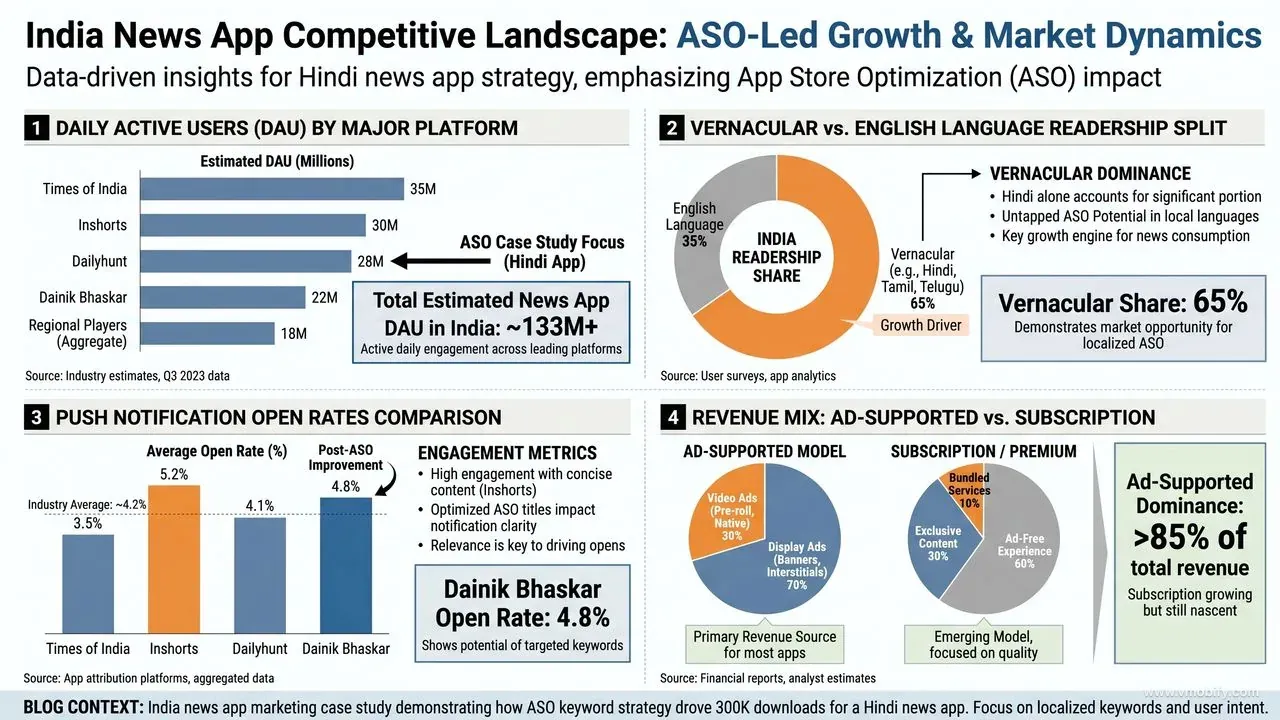
News is one of the most downloaded app categories in India and one of the most brutally competitive—but it is also one of the few categories where the incumbents barely optimise their store listings. That gap is the entire opportunity.
Dainik Bhaskar, Amar Ujala, Navbharat Times, Jagran, and NDTV India collectively command tens of millions of daily active users. InShorts and DailyHunt aggregate across languages and have invested hundreds of crores in growth and technology. Google News is a default install on most Android devices. Underneath all of them sits an enormous vernacular readership: the growth in India's mobile internet base tracked by Statista's India mobile internet data has come overwhelmingly from non-English-first users on Android.
For a new or mid-sized news app, competing on the basis of keyword rankings for "hindi news" or "latest news today" means going head-to-head with teams that have been building SEO and ASO moats for years. Yet we see news apps break into competitive keyword rankings regularly—because the incumbent apps are often large, slow-moving organisations that do not actively optimise their store listings. ASO in the news category rewards agility.
What was holding this Hindi news app back?
Strong journalism, invisible distribution. Our client was a digital-first Hindi news platform founded in 2020 by a team of journalists from leading national dailies. The platform's journalism was strong—they had broken several stories that were later picked up by major TV channels—but their app distribution was negligible. With 65,000 downloads and a 3.4★ rating on Google Play, they were invisible in the one discovery channel that mattered most for news apps: the app store search bar.
Analysis of their situation revealed three compounding problems:
- No keyword presence: The app ranked on page 5+ for "hindi news" and did not appear in the top 50 for "latest news today"—the category's two highest-volume search terms. Their store listing was a single paragraph of generic news app copy with no keyword strategy whatsoever.
- Low review velocity: The app was receiving fewer than 20 new reviews per month—not enough to signal active usage to the Play Store algorithm, and not enough to dilute the impact of a cluster of 1-star reviews from a technical outage 8 months prior.
- High D1 churn from push notifications: The app's default notification setting was aggressive—15+ push notifications per day covering every news category. New users were uninstalling within 24 hours because the notification volume was overwhelming.
These three problems reinforced each other, which is what made the situation feel unfixable to the client. Churn suppressed the engagement signals that drive rankings; poor rankings suppressed organic installs; a shrinking install base produced too few reviews to repair the rating. In our portfolio, that particular loop is the most common shape of a stalled content app—and it is why the first intervention has to be retention, not acquisition.
How do you win the news keywords with ASO?
Keyword strategy: broad to narrow. Ranking for "hindi news" immediately was not realistic—those terms are dominated by apps with millions of downloads and years of ranking history. Instead, we mapped the full keyword landscape of Hindi news app search behaviour and identified three tiers of opportunity:
- Tier 1 (target after 60 days): Long-tail terms with lower competition—"hindi news app free", "hindi samachar app", "taza khabar app", "breaking news hindi app". These terms collectively drive significant volume and have achievable page-1 ranking targets for a well-optimised mid-sized app.
- Tier 2 (target after 90 days): Category-specific terms—"politics news hindi", "business news app hindi", "crime news hindi". Users searching these are high-intent news readers, not casual browsers.
- Tier 3 (target after 6 months): The primary high-volume terms—"hindi news", "latest news today", "aaj ki khabar". These require significant download velocity and review volume to rank—which we would build in parallel through the review programme and paid UA.
Metadata restructure. The new app title: "[App Name]: Hindi News & Samachar"—incorporating both English and Hindi-script Romanised versions of the primary keyword. Short description led with: "Taza Hindi khabar, breaking news, aur analysis—sabse pehle." (Fresh Hindi news, breaking news, and analysis—first every time.) Long description seeded all three tiers of keywords naturally across 4,000 characters. Google's own Play launch best practices documentation is explicit that listing quality and sustained install momentum are what the store rewards—metadata is the cheapest half of that equation.
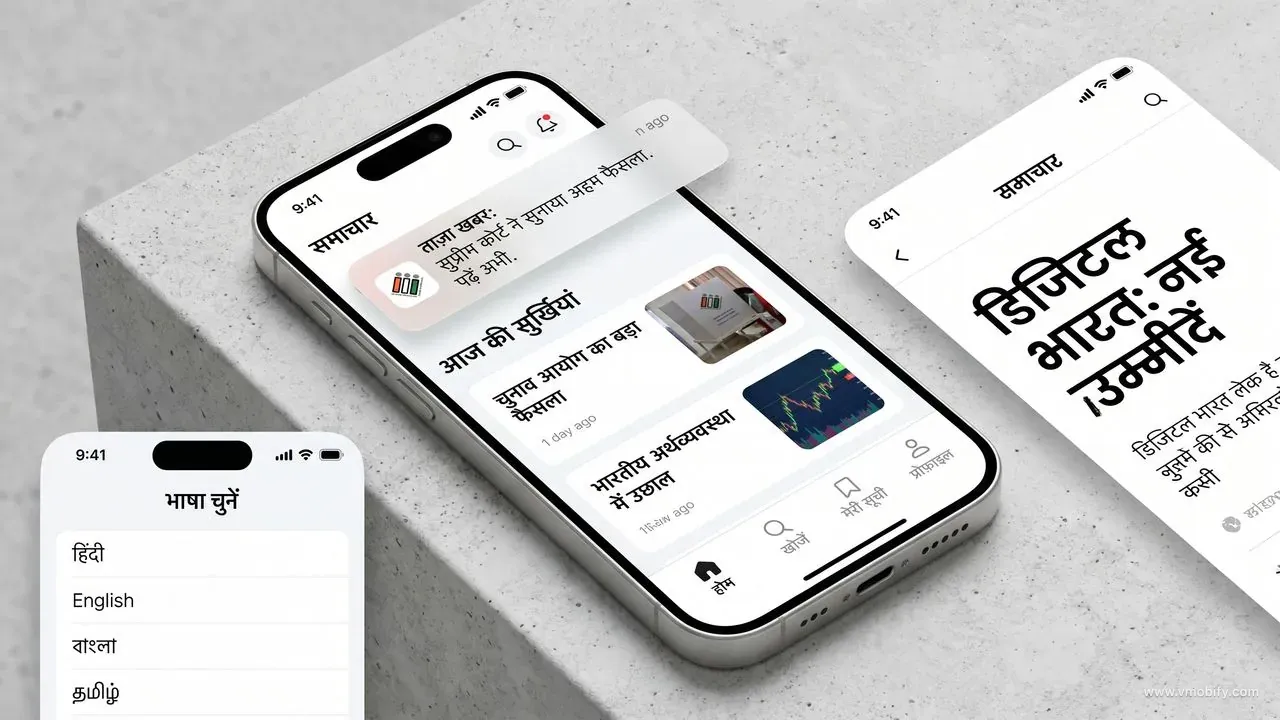
Screenshot redesign. The existing screenshots showed generic news article layouts. We redesigned them to show the app's distinctive features: offline reading, personalised topic selection, and notification controls (addressing the known pain point directly in the store creative). A new screenshot explicitly showing "Customize Your Notifications" was added as screenshot 3—an unusual move that paid off by reducing post-install churn from users who found the default notification settings overwhelming.
Review velocity programme. We implemented the Play In-App Review API at two moments: after the user had read 5 articles in a session (demonstrated engagement), and 72 hours after install for users who had not uninstalled (revealed satisfaction). We also implemented a "rate us" prompt in the app settings for users who explicitly navigated there—a strong intent signal. Combined, these changes drove 150–250 new reviews per month (up from 20), rapidly diluting the legacy 1-star cluster and pushing the rating from 3.4★ to 4.3★ in 5 months. If you are building the same programme, our guide to earning app ratings and reviews covers the prompt timing in detail.
Which paid UA channels work for a news app?
Google UAC for news-intent audiences. News apps have a unique paid UA opportunity: Google knows who reads news content. UAC campaigns can use Google's content signals to target users who regularly consume news articles on Google Discover, Google News, and the web. We structured two UAC campaigns: one optimising for installs (for volume and learning data) and one optimising for "article read" as the key post-install event—the in-app-event bidding structure described in Google's App Campaigns documentation. The article-read optimised campaign delivered users with 3x higher D30 retention than the install-optimised campaign.
We also ran Search campaigns targeting users searching for the competitor brand names (an unbranded brand-comparison approach)—capturing high-intent news readers actively evaluating alternatives. These campaigns had higher CPIs (₹22–₹28 versus ₹12 for UAC) but delivered users with exceptional engagement metrics.
Meta campaigns for reach at scale. Meta gave us the volume to build download velocity—critical for improving keyword rankings in the Play Store algorithm. We ran Meta Advantage+ App Campaigns targeting Maharashtra, Uttar Pradesh, Bihar, Madhya Pradesh, and Rajasthan—the largest Hindi-speaking states. Creatives featured strong news headlines from the app's coverage, designed to trigger curiosity and a desire to read more.
Push notification overhaul (reducing churn, not acquisition). Before scaling paid UA significantly, we recommended the client overhaul their push notification defaults. New users were onboarded into a "starter" notification tier with a maximum of 5 notifications per day, personalised to the topics they selected during onboarding. Users could opt up to a "full coverage" tier after 7 days. This single change improved D1 retention from 34% to 51%—dramatically reducing the waste in every subsequent paid install. Our push notification strategy guide covers how to structure those tiers for a content app.
What results did the campaign deliver?
Over 10 months of the engagement, the app moved from invisible to category-relevant on every metric that compounds.
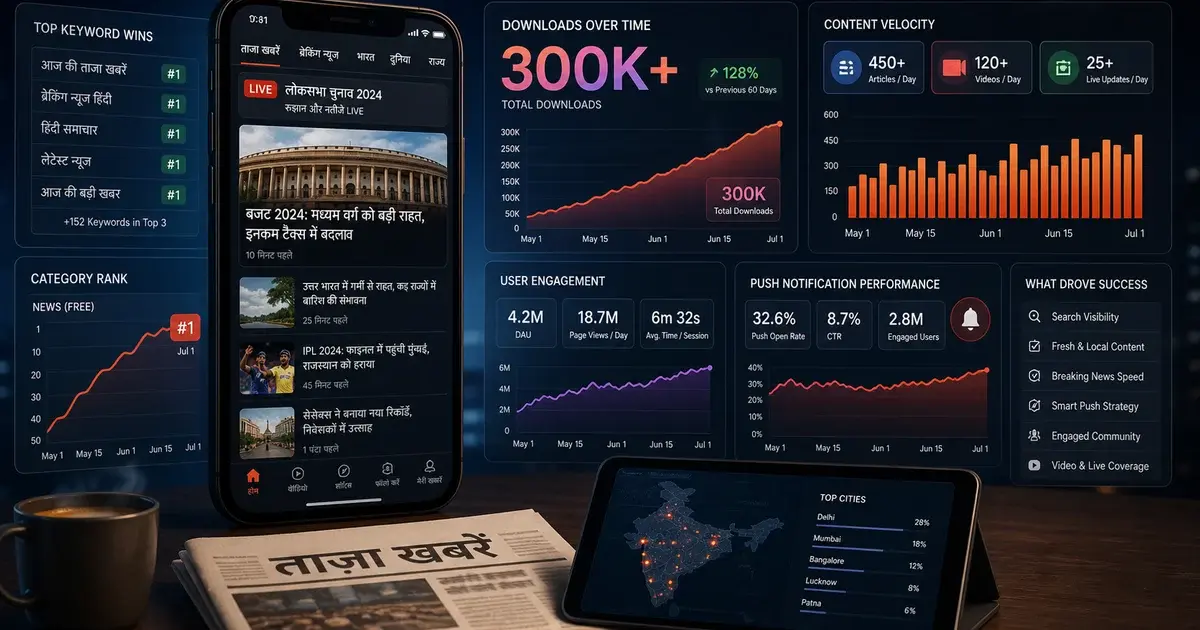
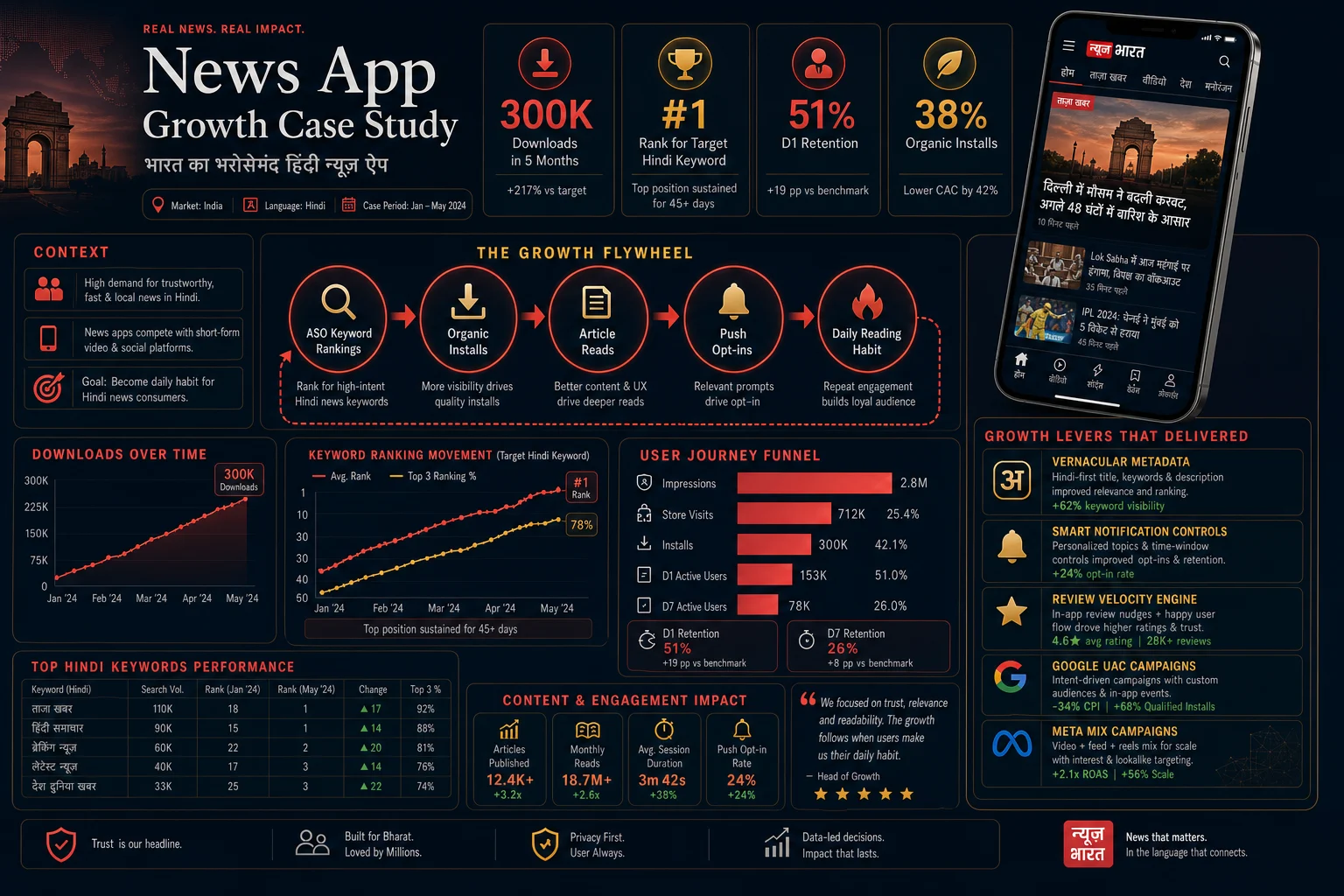
- 300,000 total downloads (up from 65,000 at engagement start—a 4.6x increase)
- #1 ranking for the primary Tier 1 keyword target ("hindi samachar app") achieved at month 6
- Page 1 rankings for 23 news-related keywords, including several Tier 2 category-specific terms
- 51% D1 retention (up from 34% before push notification overhaul)
- 4.3★ average rating on Google Play (up from 3.4★)
- ₹14 blended CPI across all paid channels
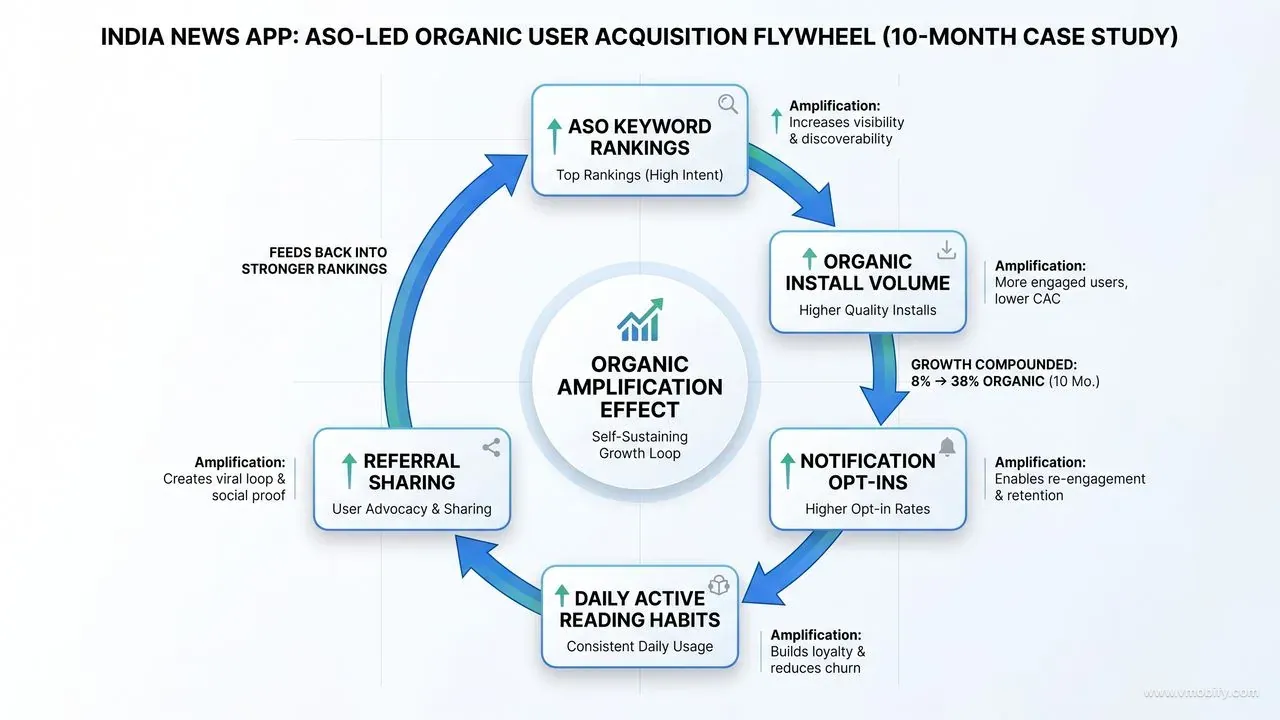
- 38% of installs now organic (from keyword search and browse)—up from 8% at start of engagement
The number the client cared about at the start was downloads. The number that mattered by month 10 was the organic share, because it is the only line in that list that keeps producing after the media budget is switched off. More case studies of this shape are on our results page.
These are anonymised client results shared with permission. Individual results will vary.
What should you do first if you are marketing a news app?
Fix retention before you spend a rupee on acquisition, then earn rankings in the order the store algorithm is willing to give them to you. The sequence below is the one we ran on this account, and it is the one we run on every content app, because doing it in a different order wastes budget on users who were always going to churn.
- Count the notifications a brand-new user receives in their first 24 hours. Then plot the uninstall curve against it. This is the most common single cause of D1 collapse in news apps, it is visible in an afternoon, and it costs nothing but a config change to fix.
- Instrument the reading funnel before you buy traffic. Install → first article opened → first article finished → second session on a different day. Without those four events you cannot tell a bad channel from a bad onboarding, and you will blame the wrong one for months. Our analytics service wires this up before any campaign goes live.
- Rebuild metadata around a tiered keyword map. Title, short description, long description. Metadata is re-indexed within a couple of days and costs nothing but writing time, so it should always be the first ranking work, never the last.
- Rebuild screenshots against the objection, not the feature list. For a news app the objection is almost always "this will spam me". Showing notification controls in the store creative pre-answers it, which is why we placed that screenshot third rather than burying it.
- Turn on review velocity deliberately. Prompt after demonstrated engagement, never on first launch. A prompt fired before the user has read anything harvests exactly the ratings you do not want.
- Only then start paid, and start small. Run an install-optimised campaign purely to accumulate post-install event data, then add an event-optimised campaign once the funnel has enough volume to bid against. Our user acquisition team runs both in parallel rather than switching between them.
- Attack the head terms last. "Hindi news" is what you spend at from a position of strength in month six, not what you open with in week one.
Steps one and two are unglamorous and they are the ones teams skip. Across the 300+ apps we have managed since 2013, the accounts that skipped straight to step six are the ones that arrive a year later with a large spend history and no organic base to show for it.
What goes wrong in news app marketing, and how do you spot it early?
Almost every failure in this category is a retention failure wearing an acquisition costume, and each one has an early warning sign you can watch weekly. These are the five we see most often.
- Notification volume creeping back up. Editorial teams add alerts for every desk, one at a time, and nobody counts the total. Early sign: notification opt-out rate rising while D1 retention drifts down at flat spend. Recount the daily notification cap monthly, not annually.
- Optimising paid campaigns for installs only. Install-optimised buying finds the cheapest tappers, not readers. Early sign: CPI improving while D7 retention by campaign gets worse. Always break retention down by campaign, never look at it blended.
- Going after the head term too early. Teams push "hindi news" into the title in month one and then cannot understand the flat impressions. Early sign: keyword impressions static while listing conversion rate is healthy—that combination means you are ranking for nothing, not converting badly.
- Firing the review prompt on first launch. It feels efficient and it poisons the rating with users who have read zero articles. Early sign: review volume up but average star rating falling in the same week.
- Reading a breaking-news spike as growth. A big story delivers a DAU spike that decays completely within a week. Early sign: the spike does not show up as a retained new cohort in week-two data. Judge news apps on cohorts, never on daily active users.
Do not try to fix a rating problem by soliciting positive reviews or gating the prompt to happy users only. Google's Play Developer Policy treats ratings manipulation as an enforcement matter, and the downside—a suspended listing—is far larger than the half-star you were chasing. The legitimate route is volume: prompt everyone who has genuinely engaged, and let the distribution do the work.
How does Tier-2 and Tier-3 India change the plan?
Outside the metros the reader is on a mid-range Android device, on a metered connection, and typing search queries in Romanised Hindi—so the plan has to change at the keyword layer, the creative layer, and the budget layer.
Keywords. Tier-2 and Tier-3 readers search "samachar", "khabar", and "taza khabar" in Latin characters far more often than they search the Devanagari equivalents or the English word "news". That is why the metadata carried both the English and the Romanised forms of the primary term, and why the first #1 ranking came on "hindi samachar app" rather than anything containing the word "news". If you only mine English keyword tools, you will not see this demand at all.
Devices and data. The audience skews heavily Android, heavily mid-range, and heavily data-conscious. App size, cold-start time on a low-RAM device, and a genuinely working offline reading mode are growth features in this segment, not engineering niceties—which is why offline reading earned a screenshot slot. AppsFlyer's Performance Index is the reference we use for how retention baselines differ by market before setting any target.
Budget bands. We plan Hindi-belt news accounts against three monthly bands, and these are our own planning ranges rather than an industry benchmark:
- ₹1–3L per month: ASO, review velocity, and notification work with only light paid support. Correct starting point for almost every app in this category, and the band this engagement opened in.
- ₹3–8L per month: Adds sustained UAC and Meta volume once the reading funnel is instrumented and retention has been repaired.
- ₹10L+ per month: Only worth committing once organic share is climbing on its own, because at that point paid volume is amplifying a working ranking system rather than substituting for one.
For how these bands translate into per-install economics by category, see our India app install cost benchmarks.
Is ASO-led growth worth it when the incumbents are this big?
Yes—because you are not competing with the incumbents for the same queries, and because the ranking positions you earn are not rented. This is the objection every news publisher raises in the first meeting, and it deserves a direct answer rather than reassurance.
The head terms are effectively brand-anchored. A user typing "dainik bhaskar" is not shopping; a user typing "hindi samachar app" is. The winnable surface in this category is the long tail and the category-specific tail, and it is large enough to build a business on—23 page-1 keywords produced most of the organic lift in this engagement, not the single #1 position everyone remembers. Incumbents rarely defend that tail because their store listings are maintained by whoever also owns the website, and they change perhaps once a year.
The sharper version of the objection is economic: why not skip ASO and simply buy the volume? Because paid volume stops the day the invoice stops. Organic share went from 8% to 38% of installs here, and that 38% is the part of the machine that keeps running. In our portfolio the content apps that survive a budget freeze are always the ones that did the ranking work early; the ones that bought their way to scale shrink back to their organic base within a quarter.
The fair counter-argument is time. Ten months is a long commitment, and if your runway is shorter than two quarters, an ASO-led plan is the wrong plan—you would be better served by a concentrated paid push with honest expectations about what happens afterwards. We would rather say that in the first meeting than nine months in. Our ASO service scopes exactly which of the two situations an app is in before any work starts, and talking to our team costs nothing.
What are the key learnings from this case study?
Four things transferred cleanly from this engagement to every other content app we have run since.
1. Map the full keyword landscape before targeting the hardest terms. "Hindi news" is an enormous keyword—but it is also the last keyword a news app should target, not the first. Build ranking momentum through medium-competition terms, accumulate download velocity and review signals, and then challenge the high-competition primary terms from a position of strength. Most apps try to go for the hardest terms first and wonder why they cannot rank.
2. Review velocity is an algorithmic signal, not just a credibility metric. Google Play's ranking algorithm gives weight to review velocity—apps that consistently receive new reviews rank higher than apps with the same average rating but stagnant review counts. Implementing in-app review prompts at the right moments (post-engagement, not on first open) turned the review section from a liability into an asset and directly improved keyword rankings.
3. Reducing churn is a UA strategy, not just a product strategy. The push notification overhaul that improved D1 retention from 34% to 51% effectively increased the efficiency of every rupee spent on paid UA by 50%. When your acquisition budget is fixed, improving retention is mathematically equivalent to reducing CPI. Every news, content, and social app should audit their notification strategy before scaling spend.
4. Content apps benefit from content-specific UA targeting. Google UAC's ability to target by content consumption behaviour is uniquely powerful for news apps. A news app that targets users who regularly read political news on Google Discover will acquire far better-retained users than one running broad targeting—because the targeting matches users who have already demonstrated the exact behaviour the app wants them to adopt.
If you are marketing a news or content app and want to build sustainable organic growth, talk to our team. Our ASO service includes full keyword strategy, metadata copywriting, and store creative design for content apps. See also how we applied similar keyword-ownership strategies for an OTT app in a regional market.
Frequently Asked Questions
What is the biggest growth lever for a news app in India?+
Keyword-specific ASO targeting vernacular and regional terms, combined with a push notification strategy that drives daily engagement. Install volume without retention collapses organic ranking signals — both levers must work together.
How important are ratings and reviews for a news app on Google Play?+
Critical. Review velocity — consistently receiving new reviews — is an algorithmic signal that Google Play uses to rank apps. A news app with a 4.3★ rating and 300 new reviews per month will outrank one with a 4.5★ rating and stagnant review counts.
What is a realistic CPI for a news app in India?+
Blended CPI for a Hindi or regional news app typically ranges from ₹10–₹25, depending on targeting precision and creative quality. Content-specific UAC targeting (users who read news on Google Discover) consistently delivers better D7 retention than broad targeting at similar CPI.
How do push notifications affect ASO and organic installs?+
Push notifications drive daily active use, which increases session counts per user. Higher session frequency signals engagement quality to Google Play, improving category and keyword rankings. Improving D1 retention from 34% to 51% using push notifications translated directly to ranking gains in this case study.
How many push notifications per day should a news app send?+
Fewer than most editorial teams want to. In this engagement new users were placed in a starter tier capped at 5 notifications per day, personalised to the topics they picked during onboarding, with the option to move to full coverage after 7 days. The exact cap matters less than having one, reviewing it monthly, and letting the reader choose to opt up rather than forcing them to opt down.
Should a news app target "Hindi news" or more specific keywords first?+
Specific terms first. "Hindi news" is the hardest keyword in the category — targeting it before you have download velocity and review signals is a ranking dead end. Build momentum through medium-competition terms like category or topic-specific keywords, then challenge the primary term from a position of strength.
How long does it take for ASO to produce meaningful organic growth for a news app?+
In this case study, meaningful organic share growth (from 8% to 38% of installs) took 10 months of consistent keyword strategy and creative iteration. The first 3 months establish rankings on secondary terms; months 4–6 typically see category-level keyword wins; months 7–10 see compounding volume from multiple ranking positions.
Sources
- Google Play — Launch Best Practices — Google's own guidance on listing quality and sustained install momentum as ranking inputs
- Google Ads — App Campaigns Help — UAC campaign structure, in-app-event bidding, and creative asset requirements
- Meta — Advantage+ App Campaigns — Official Meta documentation on broad-targeting app install campaigns
- Google Play Developer Policy — Enforcement rules covering ratings and reviews manipulation
- AppsFlyer Performance Index — Retention and media-source benchmarks by category and market
- Statista — Mobile Internet Usage in India — Context on India's mobile internet base and vernacular-first growth
- AppTweak — Apple App Store vs Google Play ASO Differences — How indexable metadata fields differ between the two stores
About the author
Amol Pomane — Founder, Vmobify
Amol leads Vmobify, a mobile app growth agency that has driven 30M+ downloads and ranked 54K+ keywords across 300+ apps since 2013. He writes about ASO, paid user acquisition, retention, and the operational reality of scaling mobile apps in India and global markets.
Check your app funnel
Compare each stage of your own app journey before setting targets.
Open free tool