Stock Broker App Marketing: 180K Installs for a Fintech App
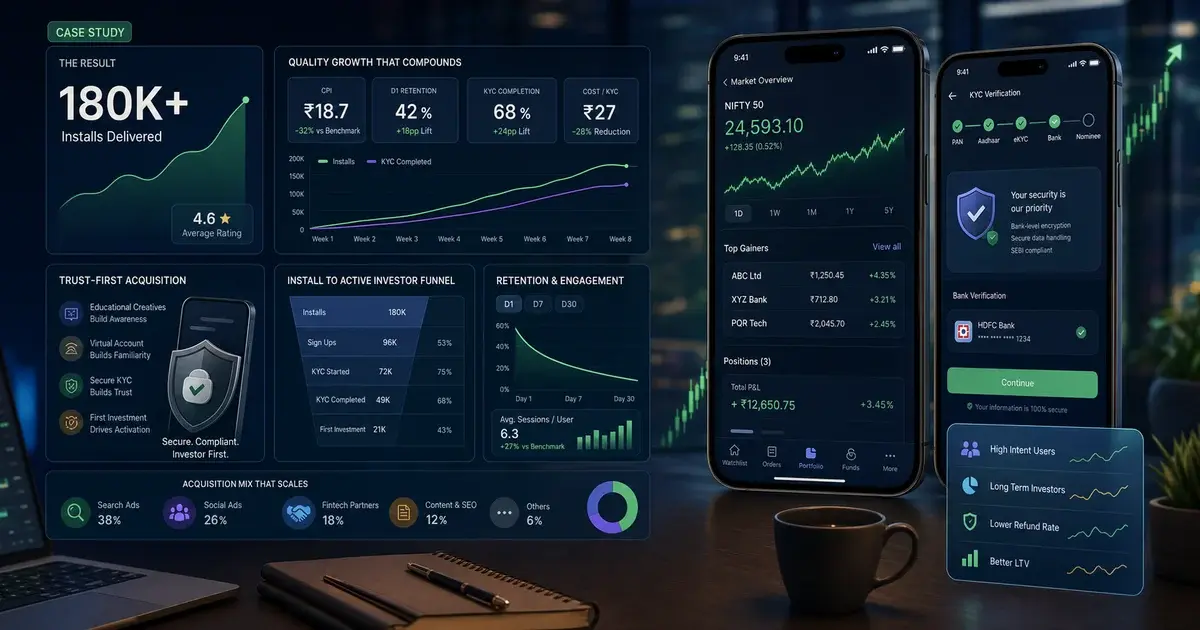
A leading Indian trading app needed quality installs, not just volume. Here is how we drove 180,000 installs at ₹8 CPI with strong retention using trust-first ASO and value-based UA.
On this page
- What growth problem was this stock broker app trying to solve?
- Why were the earlier campaigns producing installs but not traders?
- How do you do ASO for a SEBI-registered broker app?
- Which UA channels actually worked for this trading app?
- What does Tier-2 and Tier-3 India change about broker app growth?
- What did the nine-month engagement actually deliver?
- What goes wrong in broker app UA, and how do you spot it early?
- What should a broker app fix first, second, and third?
- Does a case study like this transfer to a different broker app?
- What are the transferable learnings for other fintech apps?
- How does Vmobify run growth for regulated apps?
- Frequently Asked Questions
What growth problem was this stock broker app trying to solve?
The client was buying installs successfully and acquiring traders unsuccessfully — the app had downloads, but almost nobody was finishing KYC or placing a first trade. That gap, not the install number, is what the engagement was built to close.
In mid-2025, we began working with a SEBI-registered discount brokerage that had recently launched a mobile trading app. The app offered zero-brokerage equity trading, mutual fund investments, and an IPO application feature—a competitive but growing segment dominated by well-funded players like Zerodha and Groww.
The client's existing install base was small—around 12,000 downloads, mostly from word-of-mouth among existing web platform customers. They had tried running Google UAC campaigns independently but saw CPIs of ₹25–₹35 and poor quality: users were installing but not completing KYC verification or making their first trade. The effective cost per active trader was north of ₹400—commercially unsustainable.
The brief was clear: get to 200,000 installs within 9 months, but focus on quality. We needed installs from users likely to complete KYC and trade—not just download and forget. The fintech regulatory environment added another constraint: certain ad creatives and targeting approaches that work for consumer apps are restricted for financial products under SEBI and Meta's financial advertising policies.
Regulated categories carry a second constraint that consumer apps do not: the claims you are allowed to make are narrow. Intermediaries operating under SEBI's regulatory framework cannot promise returns, imply guaranteed outcomes, or dress up a trading product as a savings product. Google Play applies its own layer through the financial services requirements in its developer content policy, which governs what a broker listing may claim and what disclosures it must carry. So the usual growth-marketing lever — sharpen the promise until the click-through rate moves — was largely unavailable. Everything had to come from trust, clarity, and targeting instead.
Why were the earlier campaigns producing installs but not traders?
Because every part of the funnel was tuned to produce the cheapest possible install, and an install is not the thing a brokerage sells. We identified three root causes of the client's poor earlier results:
- Wrong keyword positioning. The app was ranking for generic terms like "trading app" and "share market app"—high volume but low intent. Users searching these terms are often early explorers, not ready-to-trade investors.
- Incorrect optimisation event in UAC. The campaigns were optimising for installs, not post-install events. Google's algorithm was finding users most likely to tap "Install"—a very different population from users likely to complete a 12-step KYC process.
- No trust signal in store creative. The screenshots led with features (charts, portfolio view) rather than trust signals (SEBI registration, bank-grade security, 4.7★ rating). Fintech is a trust-first category—users need reassurance before they will hand over PAN card details and bank account credentials.
Our plan addressed all three: restructure ASO around trust and intent keywords, switch UAC to CPA optimisation targeting KYC completion, and redesign store creative to foreground trust signals.
The sequencing mattered as much as the diagnosis. Across the 300+ apps we have managed since 2013, the failure mode we see most often in regulated verticals is a team fixing the media before fixing the measurement — new creatives, new networks, new bids, all still pointed at an event that does not correlate with revenue. Until the event taxonomy names the moment a user becomes a customer, no amount of bidding sophistication can find that user. So the first two weeks of this engagement produced no new campaigns at all. They produced a clean event schema and a rebuilt store listing.
How do you do ASO for a SEBI-registered broker app?
You optimise for the objection, not the feature — in a regulated category the searcher's first question is "is this safe and legitimate", and the listing that answers it wins the install.
Trust keyword expansion. We conducted keyword research specifically around the intent signals that high-quality trading app users exhibit. Instead of just "trading app", we targeted: "SEBI registered broker app", "zero brokerage app India", "demat account open free", "best broker for beginners", and long-tail keywords like "how to buy IPO from mobile". These keywords have lower search volume but dramatically higher conversion rates because the searcher is further down the decision funnel.
Metadata restructure. We rewrote the app title to include "SEBI Registered" and the primary keyword. The subtitle led with the zero-brokerage proposition. In the long description (which Google Play indexes for search), we wove in 22 target keywords naturally, emphasised regulatory credentials in the first 150 words, and included a structured "Why Trust Us?" section addressing common security concerns.
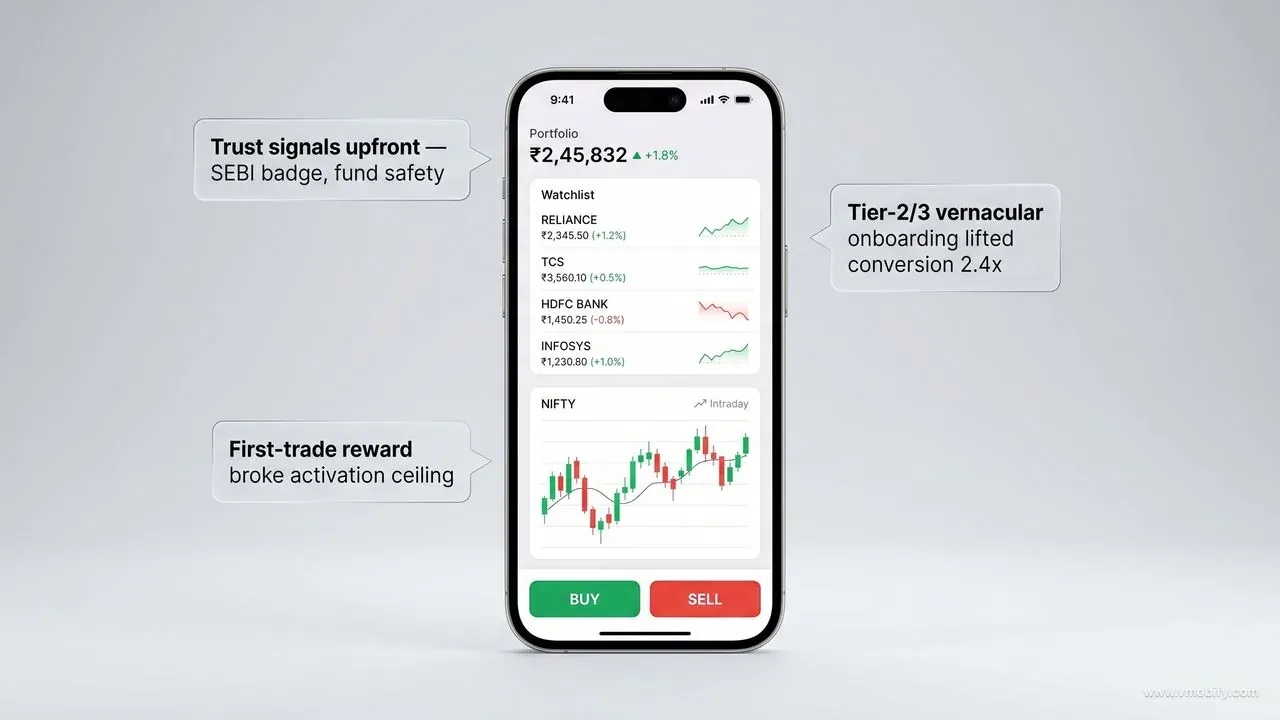
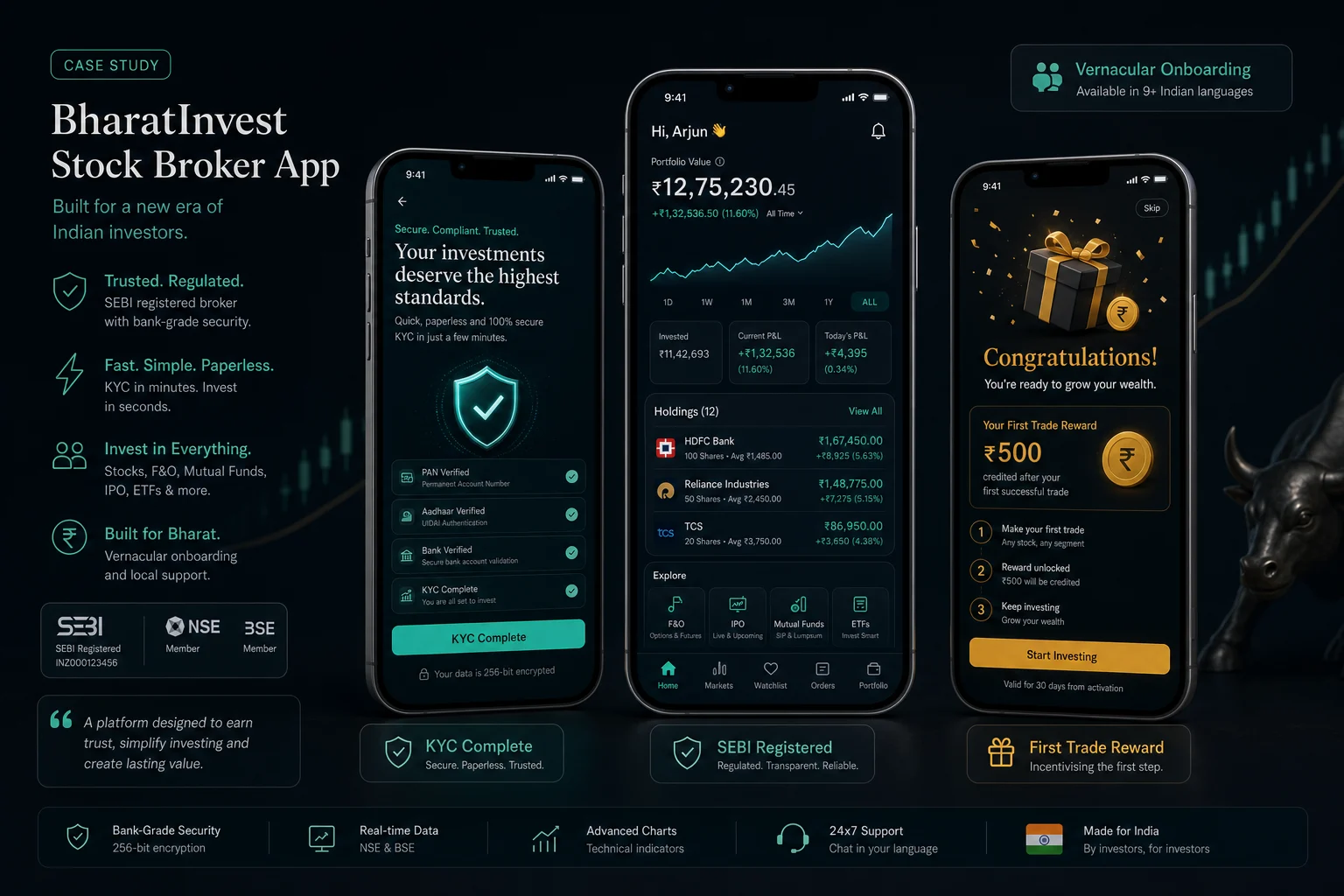
Store creative redesign. The new screenshot set led with a trust-first message: "SEBI Registered. Bank-Grade Security. ₹0 Brokerage." Screenshots 2–5 then demonstrated the core features. We tested two icon variants and two screenshot sets via Google Play Store Listing Experiments. The trust-first variant lifted install conversion rate by 34% over the feature-first original.
Running that as a controlled experiment rather than a redesign-and-hope was the point. The first frame of a listing carries a disproportionate share of the install decision, a pattern documented repeatedly in SplitMetrics' ASO research library, and in a trust-led category the first frame is the only place a regulatory credential can do work before the user scrolls away. We never ship a listing change on taste in this vertical — an experiment costs a fortnight and settles the argument permanently.
Rating improvement programme. The app had a 3.9★ rating—acceptable but not reassuring for a financial product. We implemented the Play In-App Review API at the moment after a user's first successful trade. Within 60 days, the rating improved to 4.5★, adding approximately 800 organic installs/month from the conversion rate improvement alone.
The trigger point is the whole trick. Prompting for a review after install, after signup, or on a fixed day-count all survey users who have not yet received value — in a broker app that means users still stuck in verification, who rate accordingly. Prompting immediately after a completed first trade surveys users at their single most positive moment. Same API, same volume of prompts, opposite rating outcome. Our broader approach to store fundamentals is set out in our ASO service and, for this specific vertical, in our demat app ASO case study.
Which UA channels actually worked for this trading app?
Three channels carried the account: Google UAC optimised on a post-install event, Meta targeting genuine investing intent, and a filtered CPI layer for tier-2 volume — each measured on activation rather than installs.
Google UAC restructured for quality. We rebuilt the UAC campaigns from scratch with two objectives: one campaign optimising for app installs (for volume and algorithm learning) and one campaign optimising for "KYC Started" as the in-app event. The KYC-optimised campaign ran at a higher CPA bid but delivered users 4x more likely to complete the activation flow. This is the structure Google's own App Campaigns documentation describes for in-app action bidding, and it only works when the event fires often enough for the system to learn from it.
Creative assets were completely refreshed: we produced 8 video assets (15s and 30s) featuring real trader testimonials (actors playing personas of the target demographic—salaried professionals and self-employed individuals between 24–38 years old), 12 image assets across all aspect ratios, and 5 text asset variants emphasising zero brokerage and ease of KYC.
Meta campaigns for intent audiences. On Meta, we targeted interest segments that indicated active investing intent: Zerodha and Groww page followers, NSE and BSE pages, "Stock Market India" groups, and financial literacy content consumers. We avoided broad interest categories like "Finance" which delivered poor-quality users at equivalent CPIs. That is a deliberate departure from the broad-targeting default that Meta's Advantage+ app campaign guidance recommends for most consumer apps: with a narrow, high-value, compliance-constrained audience, the signal from explicit investing intent outperformed the algorithm's broad exploration.
We also built a retargeting campaign targeting users who had visited the client's web platform but not downloaded the app—a high-intent audience that converted to KYC at 3x the rate of cold audiences.
CPI network for tier-2 volume. We supplemented Google and Meta with CPI network campaigns targeting tier-2 cities (Jaipur, Indore, Nagpur, Lucknow, Coimbatore) where both CPIs and competition from larger brokers were lower. These campaigns delivered installs at ₹5–₹7, with post-install filtering ensuring only quality installs were counted and paid for.
The post-install filter is what makes a CPI layer usable in fintech at all. Paying on raw install in this category funds a stream of users who will never verify; paying only on installs that clear a defined quality gate turns the same inventory into a volume source you can scale without polluting the algorithm's training data. We compare the three channel types in detail in our UAC vs Meta vs CPI network breakdown.
What does Tier-2 and Tier-3 India change about broker app growth?
It changes where the cheap quality volume is, which store you are really optimising for, and where in the funnel your users will drop out — all three, at once.
You are running an Android account. India's smartphone base is overwhelmingly Android, as Statista's India mobile internet data tracks, and outside the top metros that skew is stronger still. Practically, that means Google Play's long description is your keyword surface, Play Store Listing Experiments are your testing tool, and Play In-App Review is your ratings lever. iOS work on an Indian broker app is a brand exercise for a small, high-value cohort — it is not where the volume decision gets made.
The cost gap is real and it is not a trap. In this account, tier-2 cities filled at ₹5–₹7 through the filtered CPI layer against a ₹8 blended CPI overall, and those cohorts held D30 retention comparable to metro users. Cheaper users who behave the same as expensive users is the rarest thing in performance marketing, and it exists here because the large brokers concentrate their spend on metro auctions. Our India-wide install cost picture is set out in the India CPI benchmark guide.
The friction moves down the funnel, not away. A user in Nagpur is as willing to open a demat account as a user in Mumbai, but the verification journey is harder: patchier connectivity during a video-KYC step, more first-time PAN and bank-linking, more low-RAM devices where a heavy onboarding flow stalls. In our portfolio, the tier-2 cohorts that underperform almost never underperform on intent — they underperform between "KYC started" and "KYC completed". That is a product and onboarding problem wearing a media problem's clothes.
Two things follow from that. First, language: a listing and an onboarding flow that speak the user's language reduce the hesitation at exactly the step where a financial product asks for identity documents. Second, budget planning should be done backwards from the activation event rather than forwards from a CPI target. Decide how many verified accounts a month the business needs, work back through the completion rates you actually observe, and only then set a rupee budget. A budget that buys a large number of installs but too few KYC events per week starves the bidding algorithm of the signal it needs, and the account never leaves the learning phase.
What did the nine-month engagement actually deliver?
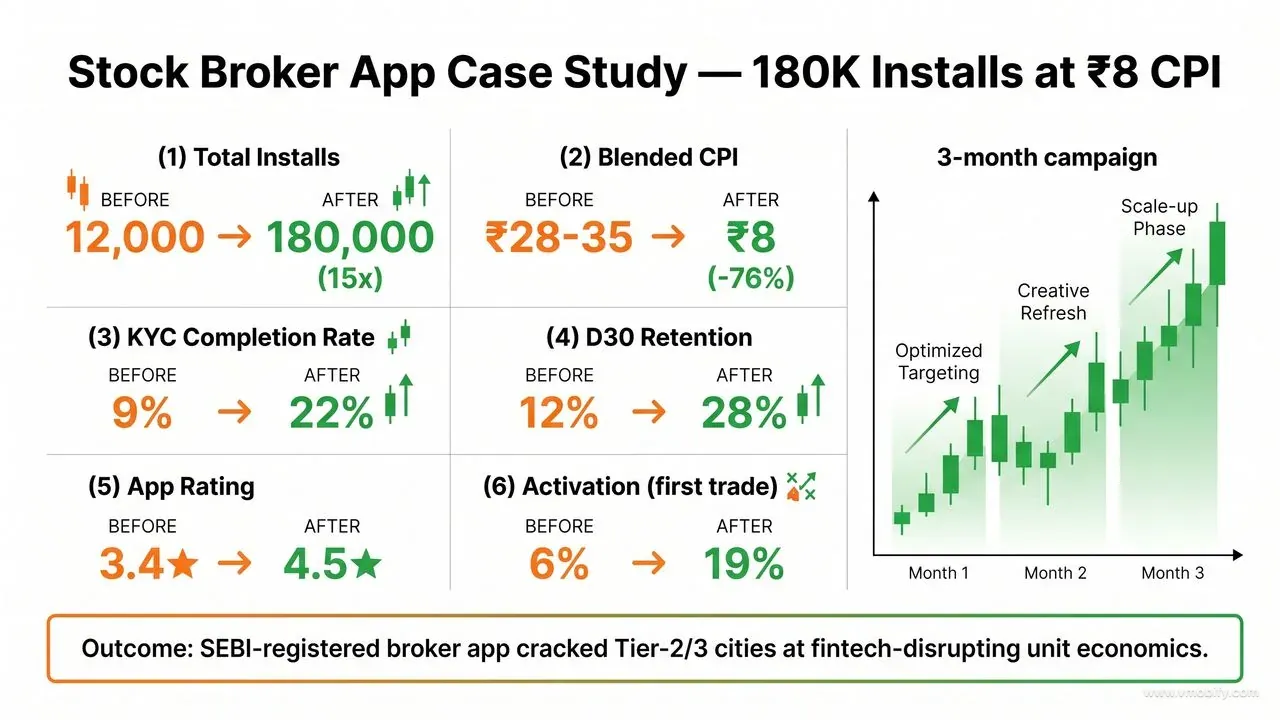
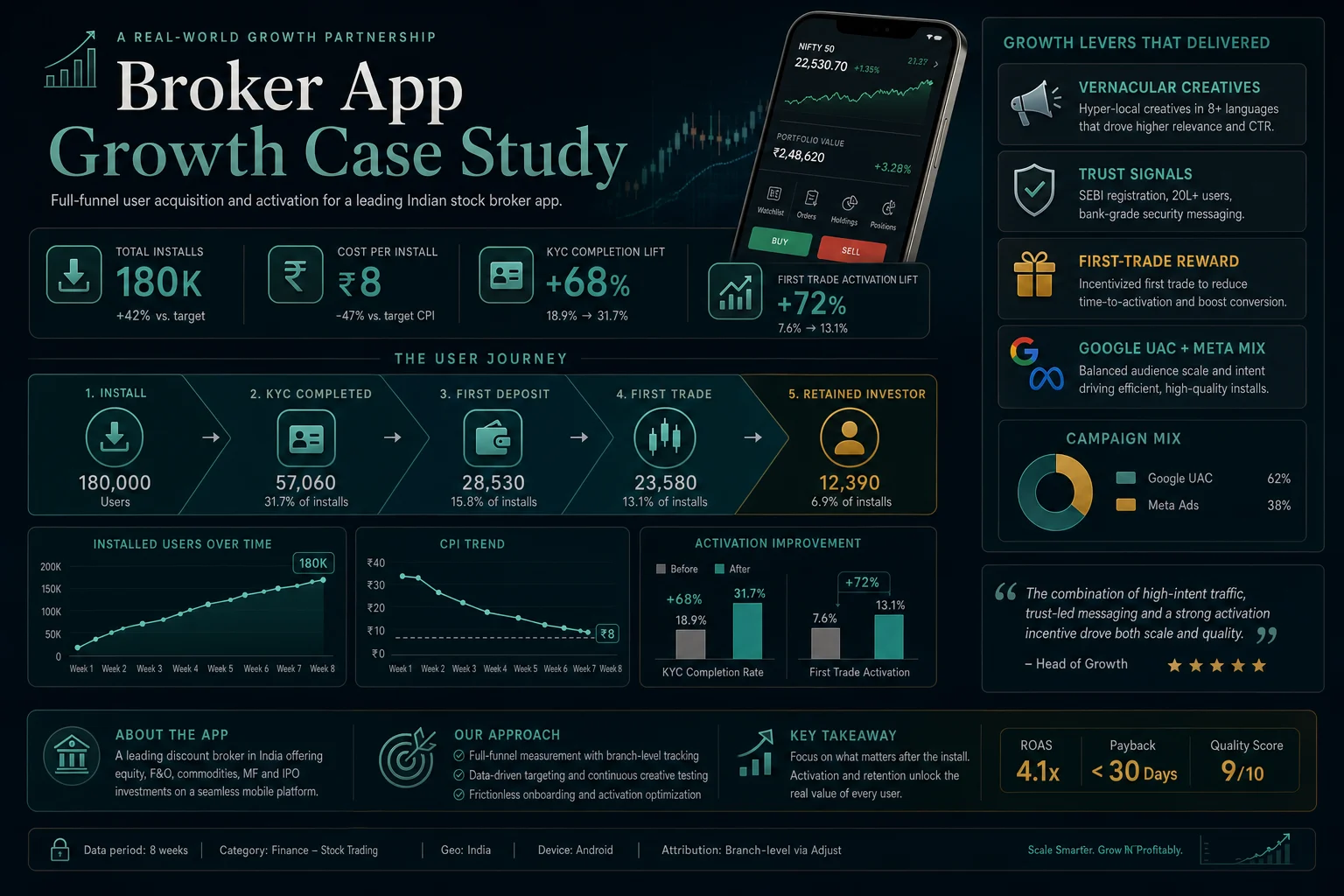
180,000 installs at a ₹8 blended CPI, with 28% D30 retention and 22% KYC completion — a cost per activated trader far below the ₹400+ the client was seeing before. Over 9 months of the engagement, the results exceeded the original brief:
- 180,000 total installs across all channels (target was 200K; ahead of pace by month 8)
- ₹8 blended CPI (down from ₹28–₹35 before engagement)
- 28% D30 retention — defined as users who logged in at least once in days 25–35 after install — versus an industry average of 18–22% for trading apps
- 22% KYC completion rate among all installs — meaning approximately 39,600 users completed full account activation and became active traders
- 4.5★ average rating on Google Play (up from 3.9★ at start of engagement)
- Page 1 rankings for 14 target keywords, including "zero brokerage app", "demat account app free", and "best trading app for beginners India"
The number worth dwelling on is not the CPI. It is that retention and install volume moved in the same direction at the same time, which is the opposite of what normally happens when an account scales. Retention benchmarks by category and market — the frame we hold client cohorts against — are published in AppsFlyer's Performance Index. Other engagements of ours are summarised on our results page.
Note: These are anonymised client results shared with permission. Individual results will vary based on app quality, category, and market conditions.
What goes wrong in broker app UA, and how do you spot it early?
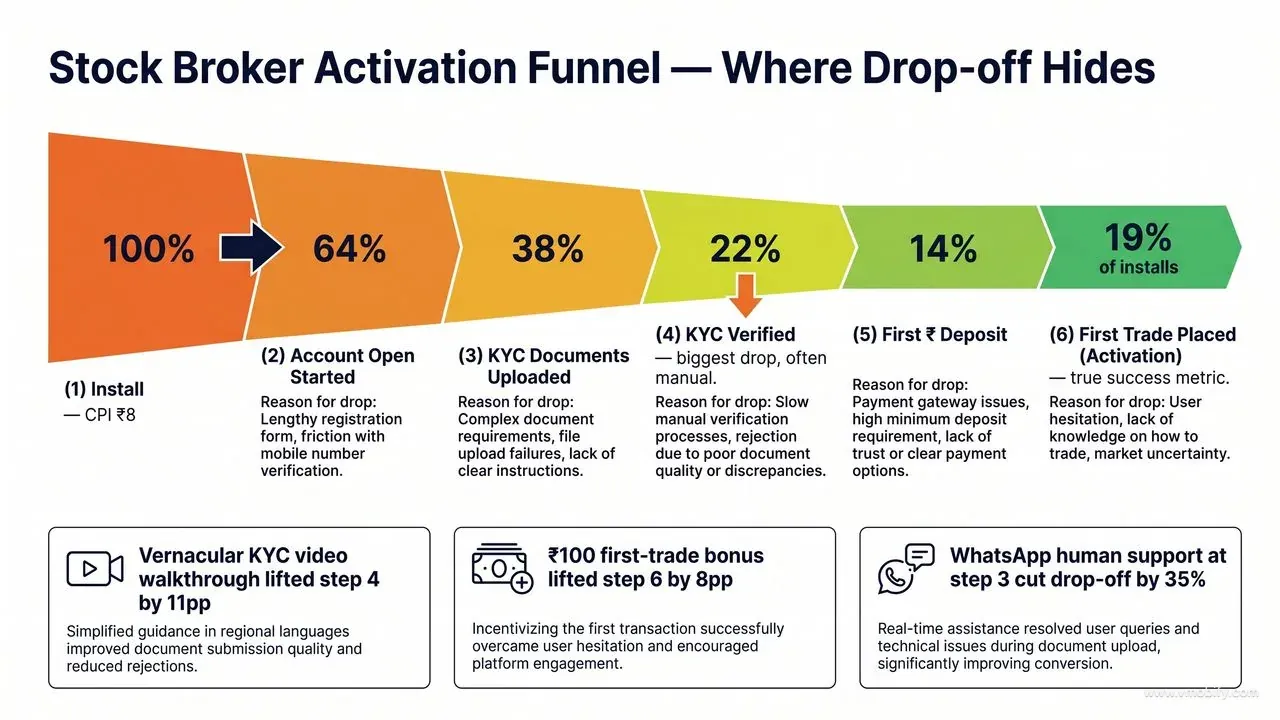
Almost every broker app failure we are called in to fix shows up first as a ratio moving quietly in the wrong direction while the headline CPI improves. That combination — cheaper installs, thinner funnel — is the single most reliable early warning in this category, and it is invisible to anyone reviewing only campaign-level cost.
The five failure patterns worth monitoring weekly:
- Install-to-KYC-started falls while CPI falls. The bidding system has found a cheaper population that is not your population. Recognise it by cohort, not by account average — one new placement can drag the ratio down for weeks before it dents the blended number.
- KYC started but not completed. This is not a media problem and no bid change will fix it. Instrument every step of verification separately; the drop is usually concentrated in one screen — document upload, video verification, or bank linking — and it is usually device- or connectivity-related.
- One publisher or placement takes an outsized share of installs. Concentration in a CPI or network layer is how fraud and low-quality inventory enter a clean account. Cap share per source and check retention per source, not just per campaign.
- Rating slips while volume climbs. Scaling into an onboarding flow that cannot absorb the traffic produces one-star reviews about verification delays, and the rating drop then taxes conversion on every channel at once.
- Creative fatigue disguised as a market shift. When CPI drifts up across every campaign simultaneously, it is nearly always creative, not competition. The tell is that the decay is uniform; genuine auction pressure hits some placements harder than others.
A falling cost per install alongside a falling activation rate is not an improving account. It is the same budget buying a worse customer, and by the time it appears in the revenue line the algorithm has spent weeks training on the wrong users.
The remedy is unglamorous: a weekly cohort review that reads install, KYC-started, KYC-completed, first trade, and D30 side by side, per source. That single view is what keeps a regulated account honest, and it is why we treat analytics instrumentation as the first deliverable rather than a reporting afterthought. The funnel structure we use is described in our mobile app funnel analytics guide.
What should a broker app fix first, second, and third?
Fix measurement, then the store listing, then bidding, then channel mix — in that order, because each step is what makes the next one legible. Teams that reverse the order buy expensive data they cannot interpret.
- Define the event taxonomy before you touch a campaign. Name and instrument every step: install, registration, KYC started, KYC completed, account funded, first trade. If you cannot see where users stop, every subsequent decision is a guess.
- Rebuild the store listing around the objection. Regulatory credential and security language in the first frame and the first 150 words of the long description. Test it as an experiment rather than shipping it on opinion.
- Run an install-optimised campaign only to seed data. A deep-event campaign with too few conversions cannot exit the learning phase. Treat the install phase as an investment in signal, and set a fixed exit condition rather than letting it run indefinitely.
- Switch bidding to the deepest event your volume supports. For most broker apps that is KYC started, moving to KYC completed once weekly event volume allows. Expect CPI to rise and cost per activated user to fall — judge the change on the second number.
- Add the tier-2 layer with a post-install quality gate. Never buy on raw install in this category. Define the gate first, then negotiate the price against it.
- Build the ratings programme into the product. Trigger the review prompt at the first genuinely positive moment — a completed first trade — not at a fixed day count.
- Review weekly on cost per activated user. CPI is a diagnostic input. Cost per verified, funded, trading customer is the only number that should drive budget decisions.
Steps one and two produce no installs and are the reason the rest works. In this engagement they consumed the first fortnight, and the client — reasonably — found that uncomfortable. The alternative is scaling spend into a funnel nobody has measured, which is precisely how the account arrived at a ₹400+ cost per active trader in the first place. Our wider approach to this vertical is set out in our fintech app marketing guide for India.
Does a case study like this transfer to a different broker app?
The method transfers; the numbers do not, and any agency telling you otherwise is selling you a benchmark it cannot honour. It is worth being precise about which half is which.
What transfers. The diagnostic order — measurement, listing, bidding, channel mix. The principle that a regulated app should optimise on the deepest event its volume supports. The finding that trust framing beats feature framing in the first store frame. The observation that non-metro India offers quality volume the large incumbents are not bidding hard for. These are structural properties of the category, and we have seen them hold repeatedly across the regulated apps in our portfolio.
What does not transfer. The ₹8 blended CPI was produced by one app, in one competitive window, with one particular geography mix and a specific zero-brokerage proposition. Change any of those and the number changes. A broker without a differentiated pricing story, or one launching into a period of heavier competitor spend, should expect different economics from an identical process. The same applies to the 22% KYC completion rate, which is as much a function of that client's onboarding build as of our media work.
Where this playbook underperforms. It is worth naming the conditions honestly. If the app's verification flow is broken, better traffic simply reaches the breakage faster. If the brand has no credibility signal to foreground — no established parent, no distinguishing regulatory or security story — trust-first ASO has less to work with. If the budget cannot sustain enough weekly activation events for a deep-event campaign to exit the learning phase, the bidding change will read as a failure when it is actually a sample-size problem. And if compliance review takes six weeks per creative, the creative testing cadence that drives most of the CPI improvement never gets going.
A sceptical buyer is right to discount a single case study. The useful question is not "will we get ₹8" — it is "is our failure the same failure". If your installs are cheap and your activation rate is falling, the diagnosis in this post probably applies to you. If your activation rate is healthy and you simply need more volume, it does not, and you need a different conversation. Tell us which one you are and we will say so plainly.
What are the transferable learnings for other fintech apps?
Four lessons from this account have since changed how we open every regulated-vertical engagement.
1. In high-trust categories, ASO is about credibility, not just keywords. For fintech, health, and legal apps, users do not just search for features—they search for reasons to trust. "SEBI registered trading app" converts better than "best trading app" because the former speaks directly to the user's primary concern. Build your keyword strategy around the objections you need to overcome, not just the features you want to showcase.
2. Optimise for the user you actually want, not just any user. Optimising UAC campaigns for installs is almost always the wrong choice for high-activation-cost apps. Every campaign should optimise for the deepest event your volume allows—registration, KYC, first transaction. The CPI will be higher, but the cost per activated user will be dramatically lower.
3. Tier-2 cities are an underexplored opportunity for fintech. While metros were already competitive, tier-2 cities showed strong appetite for zero-brokerage trading with significantly lower CPIs. The users from these markets also showed comparable D30 retention to metro users—a finding that has since informed our approach to several other fintech clients.
4. Store ratings compound. The 0.6-star improvement in the app's rating was not just a feel-good metric—it translated into a measurable lift in organic install conversion and an improvement in editorial consideration from Google Play's curation team.
If you are marketing a fintech app and facing similar challenges around install quality and cost, talk to our team. We specialise in user acquisition and ASO for regulated and high-trust categories. See also our crypto app marketing case study for a related challenge in a different regulated vertical.
How does Vmobify run growth for regulated apps?
Trust-first, measurement-first, and spend last. Regulated apps need a trust-first operating model. We start with the store listing, the event taxonomy, and the post-install quality targets before we scale spend.
For a stock broker or trading app, that means combining ASO, paid user acquisition, and analytics so the same trust signals that improve conversion also guide channel allocation. The point is not just to get installs — it is to get installs that complete KYC, fund accounts, and keep returning.
The operating cadence matters as much as the strategy. Weekly cohort reviews read on activation rather than installs, a standing creative pipeline sized around the compliance review cycle rather than the media plan, and a quarterly store experiment schedule so listing changes are settled by data instead of debate. None of it is exotic. It is simply the discipline that most regulated accounts skip because the install number looks fine.
If your category has compliance, KYC, or trust constraints, the first step is a growth audit and a store review. That is where we usually find the biggest gap between spend and quality.
Frequently Asked Questions
What is the biggest growth bottleneck for stock broker apps?+
Trust and activation. Users need to believe the app is legitimate before they will complete KYC, fund the account, and make the first trade. Store reviews, trust keywords, and onboarding friction matter as much as CPI.
Which channels worked best in this case study?+
Trust-first ASO, Google UAC optimised for KYC rather than installs, Meta intent audiences, and a limited CPI network layer for tier-2 volume. The mix worked because each channel was measured against post-install quality, not install count alone.
What should a fintech app measure instead of CPI?+
KYC completion, first deposit or trade, D30 retention, and cost per activated user. CPI is useful only if it is clearly connected to those downstream events.
Should a broker app optimise UAC for KYC started or KYC completed?+
Start with KYC started and move to KYC completed once weekly event volume is high enough for the campaign to leave the learning phase. Optimising on an event that fires too rarely produces unstable delivery and inflated costs. The deeper event is always better in principle, but only if the algorithm gets enough examples of it to learn from.
Are CPI networks safe for a SEBI-registered broker app?+
Yes, provided you buy on a post-install quality gate rather than on raw installs, and you cap the share of volume any single publisher can supply. In this engagement the CPI layer filled tier-2 cities at ₹5–₹7 with post-install filtering applied. Without that gate, a regulated app risks paying for users who will never clear verification and polluting the data its bidding algorithms train on.
How long before a trust-first ASO change shows results?+
Metadata is re-indexed within days, but a store listing experiment needs enough traffic to reach significance before you can trust the result. In this account the creative and metadata work was in place before paid spend scaled, which is the right order. Judge listing changes on install conversion rate, not on install count, since paid volume moving at the same time will obscure the signal.
What is the first thing to fix if installs are cheap but nobody completes KYC?+
Instrument every step of the verification flow separately before changing anything in the campaigns. In most cases the drop-off is concentrated in a single screen — document upload, video verification, or bank linking — and it is a product problem that no bid or creative change will solve. Only once the funnel is visible should you revisit the optimisation event.
Sources
- SEBI — Securities and Exchange Board of India — Regulatory framework governing broker registration and permitted claims in India
- Google Play Developer Policy — Financial services requirements and disclosure rules for broker app listings
- Google Ads — App Campaigns Help — Official guidance on in-app action bidding and campaign structure
- Google Play — Launch Best Practices — Store-side guidance on launch, listing quality, and install velocity
- Meta — Advantage+ App Campaigns — Meta targeting and optimisation guidance referenced for the intent-audience decision
- AppsFlyer Performance Index — Category and market benchmarks for retention alongside install volume
- SplitMetrics — ASO Research — A/B test research on store listing and first-frame conversion impact
- Statista — Mobile Internet Usage in India — Android-skewed device and connectivity context for the Indian market
About the author
Amol Pomane — Founder, Vmobify
Amol leads Vmobify, a mobile app growth agency that has driven 30M+ downloads and ranked 54K+ keywords across 300+ apps since 2013. He writes about ASO, paid user acquisition, retention, and the operational reality of scaling mobile apps in India and global markets.
Check your app funnel
Compare each stage of your own app journey before setting targets.
Open free tool