Crypto App Marketing: Growing a Crypto Exchange App to 250K Users
After the FTX collapse, trust became the core growth problem for crypto apps. This case study shows how a trust-first ASO, review, and referral system took an Indian exchange from 45K to 250K users.
On this page
- Who was the client and where did their growth stand?
- What made crypto app marketing so difficult after FTX?
- What strategy turns a trust deficit into an acquisition advantage?
- How did we execute the trust-first plan?
- What results did the crypto exchange app achieve in 14 months?
- What are the key learnings for crypto app marketers?
- How do you run this crypto app marketing playbook step by step?
- What goes wrong in crypto app marketing, and how do you spot it early?
- What does crypto app growth actually cost in India?
- Is trust-first marketing just slower growth with better branding?
- How does Vmobify run high-trust fintech growth?
- Frequently Asked Questions
Who was the client and where did their growth stand?
The client was a three-year-old Indian cryptocurrency exchange with a compliant, working product and an acquisition engine that had stopped paying for itself. In early 2024, we began working with them across both app store optimisation and paid user acquisition as a single coordinated programme rather than two separate briefs.
The platform offered spot trading for 80+ crypto assets, a simple buy-sell interface designed for first-time crypto buyers, and a rupee-to-crypto onramp integrated with UPI. They were a legitimate, compliant operator—holding the necessary registrations with India's Financial Intelligence Unit—but they were losing the narrative battle to fear and scepticism.
The exchange had approximately 45,000 registered users, a 3.7★ Google Play rating, and a Cost Per Registration (their primary success metric) of ₹380—commercially unviable given the competitive pressure on trading fees. Their marketing had relied almost entirely on one-off influencer partnerships with crypto YouTubers, with no sustainable organic or paid acquisition engine.
Two structural facts shaped everything that followed. First, this is an Android-first audience: the Indian mobile base that Statista tracks in its India mobile internet research skews heavily to Android, so Google Play was the battleground and iOS was a secondary surface. Second, the product itself was not the problem. Withdrawals worked, KYC worked, and support responded. What was broken was everything a prospective user could see before they installed.
What made crypto app marketing so difficult after FTX?
The category had a credibility problem that no individual app had caused and every individual app was paying for. The November 2022 collapse of FTX—one of the world's largest crypto exchanges—had permanently damaged consumer trust in crypto platforms. In India, this was compounded by a 30% flat tax on crypto gains introduced in the 2022 Union Budget, which dampened retail enthusiasm. When we started, searching for "crypto exchange India" in the Play Store returned apps with a mixture of poor ratings, negative reviews about fund withdrawals, and visible scam applications ranking ahead of legitimate operators.
The specific challenges we needed to solve:
- Trust deficit: Users arriving at the app's Play Store listing were converting at 2.8%—low even for a regulated financial app, reflecting deep scepticism about giving a crypto exchange access to their bank account.
- Review toxicity: Of 2,100 existing reviews, 340 were 1-star reviews—many from users who had experienced delays during the 2022 market volatility. These reviews were prominently displayed and destroying conversion.
- Ad platform restrictions: Meta and Google both have specific policies around cryptocurrency advertising that require pre-approval and limit certain messaging. Getting campaigns approved and staying within policy required careful creative development.
- Referral programme underperformance: The existing referral programme offered a flat ₹50 cash reward. Referral rate was below 5%—users were not motivated to stake their personal credibility on recommending a crypto exchange.
There is a compounding effect here that is easy to miss. A weak rating suppresses store conversion, which raises the effective cost of every paid install, which shrinks the budget available to acquire the users who would leave good reviews. The category penalty and the account-level penalty feed each other. Breaking that loop—not out-spending it—was the job.
What strategy turns a trust deficit into an acquisition advantage?
We built the strategy around a single insight: in the post-FTX environment, the acquisition battle for a crypto exchange is won by the brand that successfully communicates safety and legitimacy first, product features second.
This meant repositioning the entire marketing approach. Instead of leading with "trade 80 cryptos" or "lowest fees", every touchpoint would lead with regulatory compliance, security infrastructure, and user fund protection. The product features would follow once trust was established.
The reason this works is competitive rather than psychological. Any exchange can claim low fees. Only a registered, insured, audited operator can make a compliance claim and survive scrutiny of it. A claim your competitors cannot copy is the only kind of positioning worth building a programme on, and in this category the compliance claim was the one asset the client had that the scam listings ranking above them did not.
Practically, this translated into four strategic pillars:
- ASO overhaul focused on trust and safety keywords
- A structured review improvement programme to shift the public rating
- Carefully constructed Meta campaigns that passed ad policy review while communicating safety
- A redesigned referral programme with a crypto-native reward rather than cash
We sequenced these deliberately. Store listing and review work came first, because both are conversion multipliers that make every subsequent rupee of media spend go further. Scaling paid acquisition into an unconvincing store listing is the most common way a fintech growth budget disappears without trace, and we have seen it in the portfolio often enough to treat listing readiness as a gate rather than a parallel workstream.
How did we execute the trust-first plan?
Execution ran across four workstreams—store listing, reviews, compliant paid media, and referrals—with the first two treated as prerequisites for the second two.
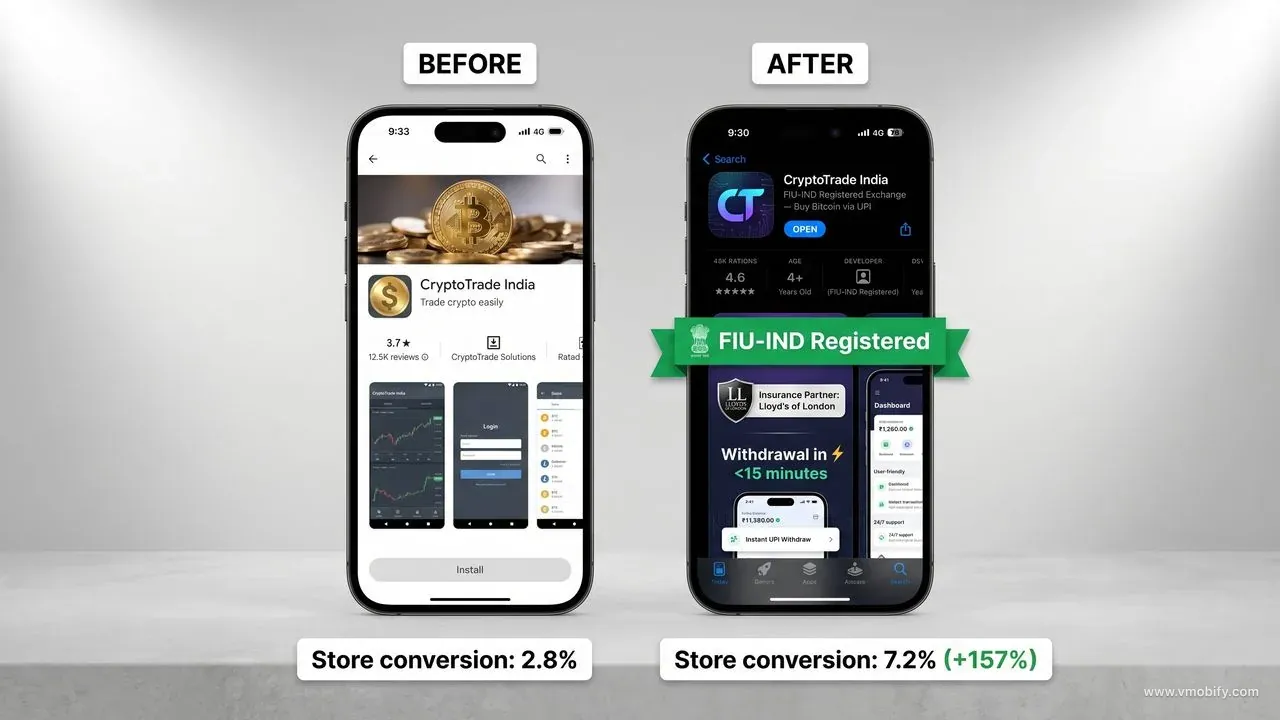
ASO: Safety keywords and trust signals. We redesigned the store listing from scratch. The new title included "FIU Registered" as the first qualifier. The short description led with "India's most trusted crypto platform—FIU registered, insured cold storage, 3.5M withdrawals processed." Screenshots were redesigned to show the security architecture (a dedicated "Your Funds Are Safe" screenshot explaining cold storage and insurance), followed by the trading interface.
Keyword targeting shifted to capture safety-intent searches: "safe crypto exchange india", "fiu registered crypto app", "trusted bitcoin app india", alongside transactional keywords like "buy bitcoin with UPI". We also targeted competitor brand terms to capture users actively researching alternatives—a legitimate strategy that delivered high-intent installs. Because the two stores index metadata differently, the Play long description carried the keyword weight while the iOS listing leaned on the title, subtitle, and keyword field.
Review improvement programme. We implemented a two-track review programme. Track one: in-app review prompt triggered at the moment of a successful withdrawal (the key trust moment—when a user successfully withdraws funds back to their bank, they have proof the platform is not a scam). This generated 150–200 new 4-5★ reviews per month. Track two: outreach to the 340 negative reviewers through the Google Play developer reply function, offering to resolve their issues. We resolved 80% of cases and 45% of those users updated their reviews upward. The full mechanics of prompt timing and reply templates are covered in our guide to getting app ratings and reviews.
Meta campaigns under crypto ad policy. Getting Meta campaign approval for crypto apps requires the exchange to be pre-certified by Meta's financial advertising review team. We managed this process and built creatives that communicated safety without making price predictions or returns claims (prohibited under Meta's crypto policy). The approved creative focus: "India ka apna crypto app—UPI se Bitcoin kharido" (India's own crypto app—buy Bitcoin with UPI). Simple, compliant, and highly effective for a Hindi-speaking target audience. Campaign structure followed standard broad-targeting practice for app installs, as described in Meta's Advantage+ App Campaigns documentation, with the compliance review handled as a separate, earlier track.
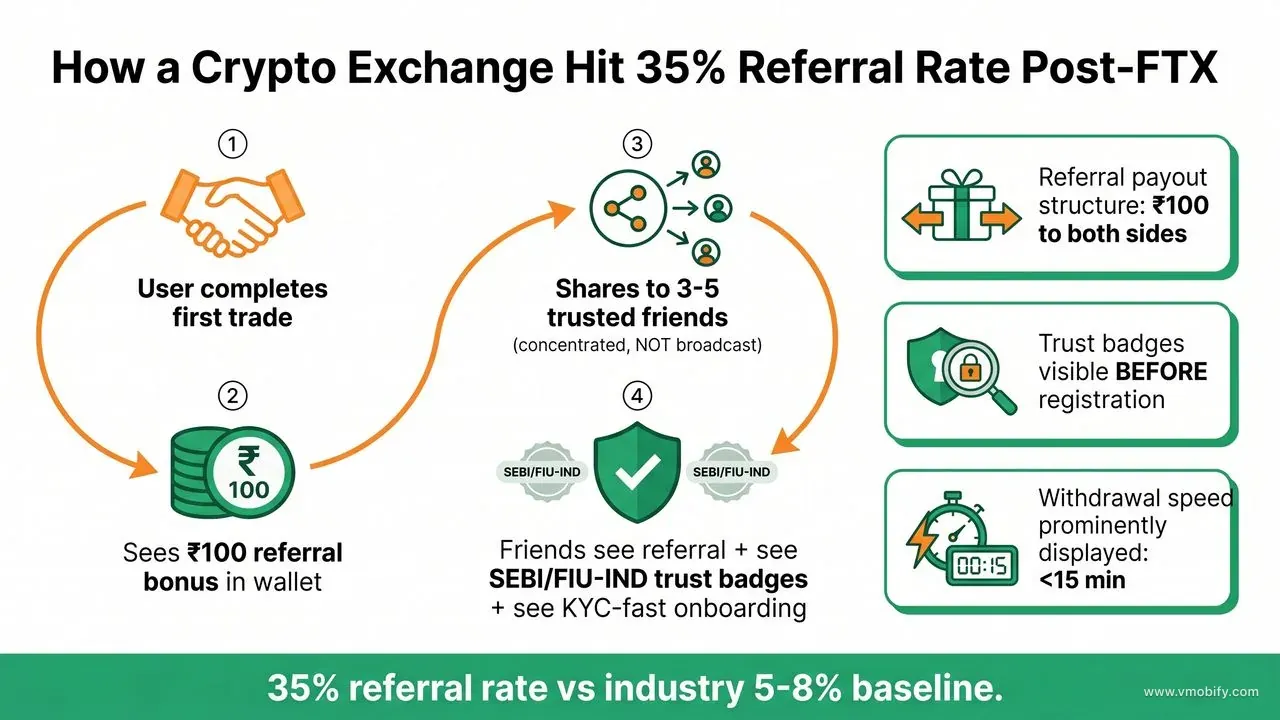
Referral programme redesign. We replaced the flat ₹50 cash reward with a tiered crypto reward: refer a friend, both receive ₹100 worth of Bitcoin credited to their exchange wallet. This was more compelling because it created a shared investment experience—the referrer and their friend both now owned a tiny amount of Bitcoin, creating a natural conversation hook. The reward also required the referred user to complete KYC to claim it, improving activation quality. That KYC condition mattered more than the reward size: it meant the programme paid out only for users who had cleared the hardest step in the funnel.
What results did the crypto exchange app achieve in 14 months?
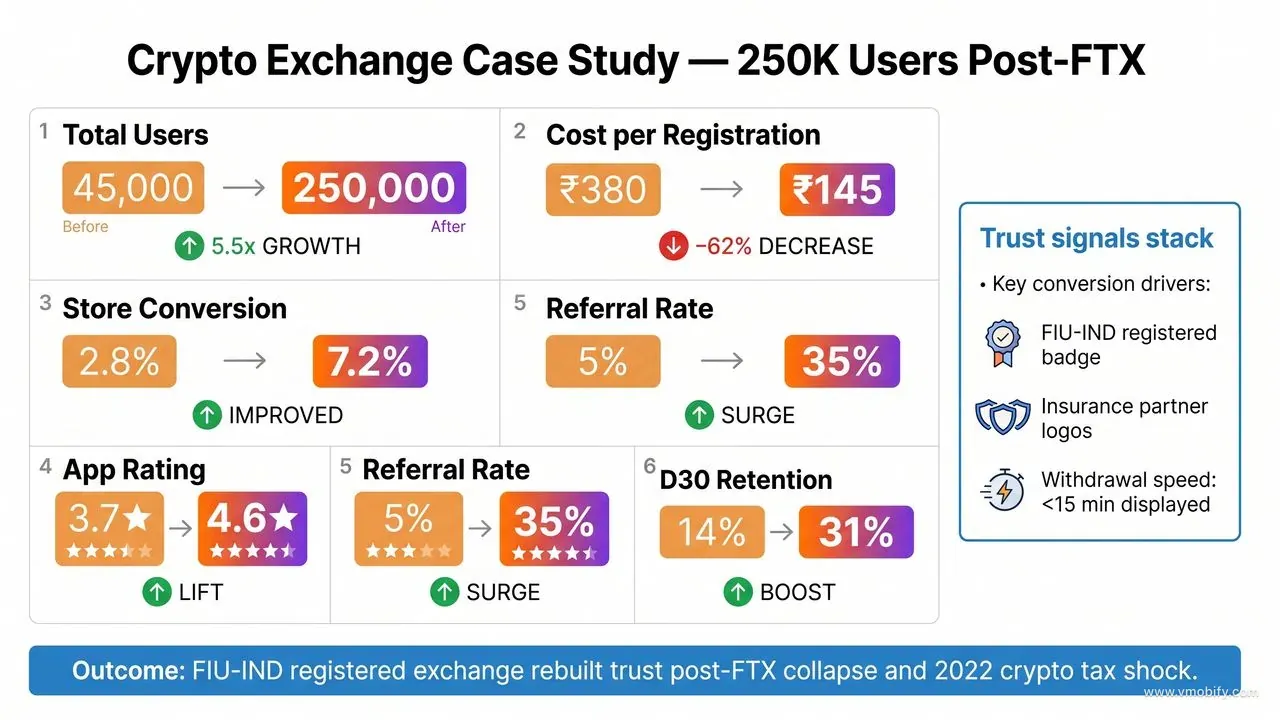
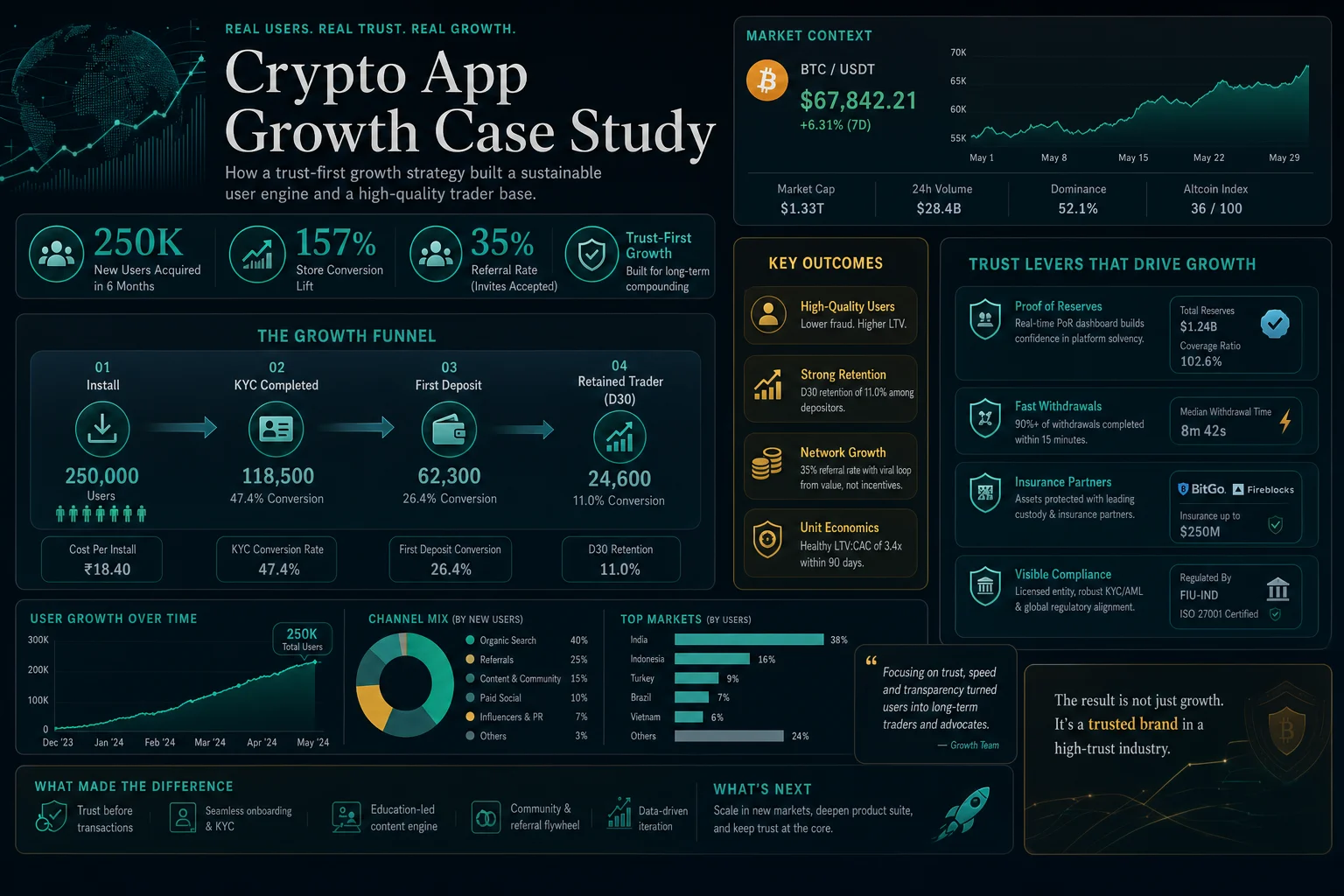
Over 14 months of the engagement, the app went from 45,000 to 250,000 registered users while its cost per registration fell by 62%. Growing volume and falling cost at the same time is the signature of a conversion fix rather than a spending increase.
- 250,000 registered users (up from 45,000 at engagement start—a 5.5x increase)
- 4.6★ average rating on Google Play (up from 3.7★—now the highest-rated FIU-registered exchange on the platform)
- 35% referral rate among activated users—meaning more than 1 in 3 new users came through the redesigned referral programme
- ₹145 Cost Per Registration (down from ₹380—a 62% reduction)
- Store listing conversion rate: 7.2% (up from 2.8% — a 157% improvement from ASO and creative changes alone)
- Page 1 rankings for 18 keywords including "safe crypto exchange india" and "buy bitcoin india app"
Read the numbers as a chain rather than a list. The rating moved, which lifted store conversion, which cut the cost of every paid install; the referral redesign then supplied a third of new users at near-zero media cost, pulling the blended figure down further. No single tactic produced the ₹145 Cost Per Registration—the compounding did.
These are anonymised client results shared with permission. Individual results will vary based on app quality, market conditions, and category dynamics.
What are the key learnings for crypto app marketers?
Four lessons transfer from this engagement to any crypto or high-trust fintech app.
1. In trust-damaged categories, leading with safety is not defensive—it is differentiating. While competitors were still leading with "lowest fees" and "most tokens", our client's trust-first positioning made them stand out. In a sea of similar crypto apps, "FIU Registered. Your funds insured." is a compelling differentiator precisely because most competitors cannot or do not say it clearly.
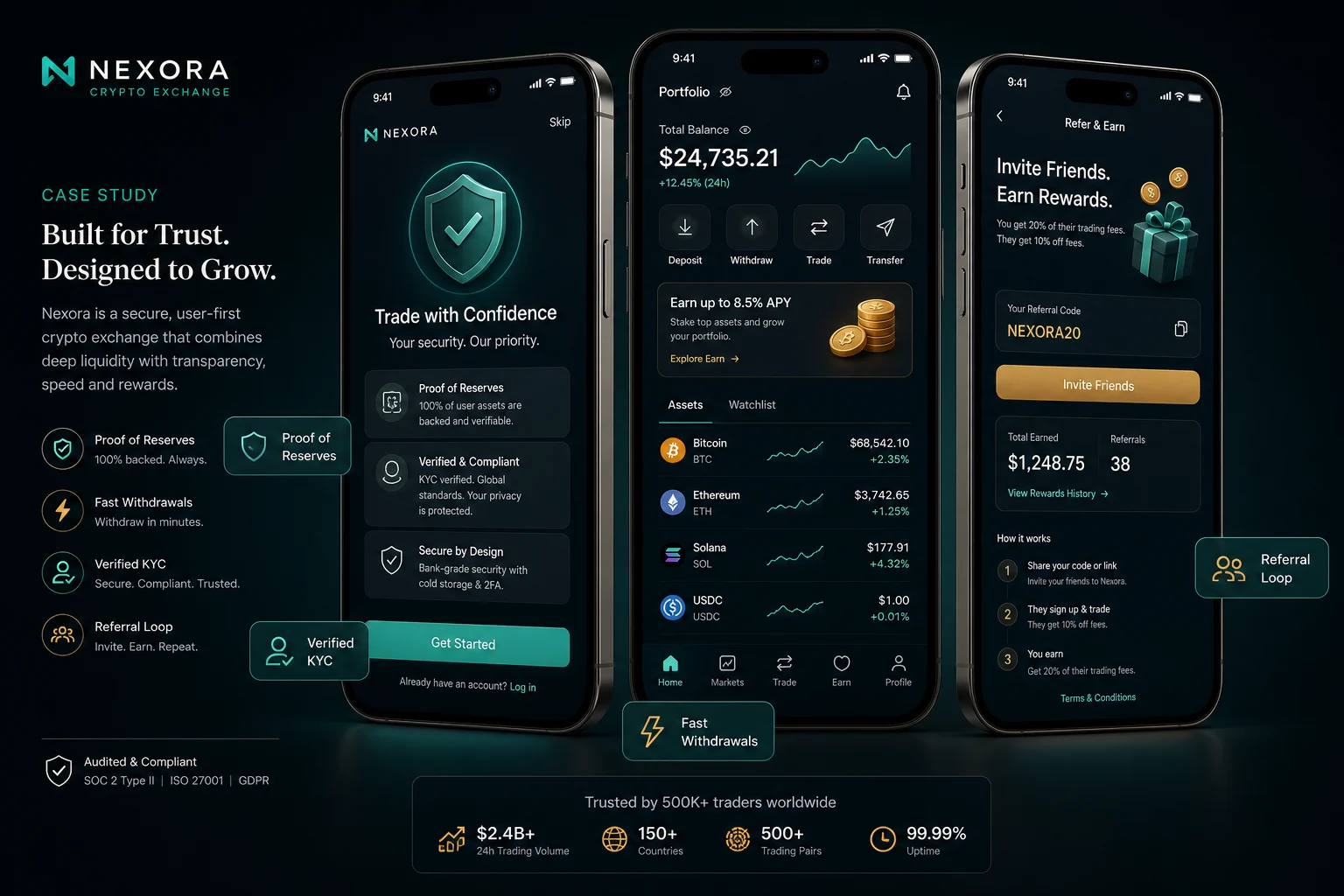
2. Referral programme rewards must align with app identity. A crypto exchange offering Bitcoin as the referral reward creates cognitive alignment—the reward reinforces the product. A ₹50 Paytm cashback feels like a discount promotion; ₹100 in Bitcoin feels like an invitation to join the ecosystem. Align your referral reward with the emotional and functional promise of your product, a principle we cover in more depth in our mobile app referral programme guide.
3. Developer review responses are an underutilised ASO tool. Responding thoughtfully to negative reviews—and successfully resolving the underlying issues—converted 45% of unhappy reviewers into updated positive reviews. This is one of the highest-ROI activities available to any app with existing negative review inventory.
4. Crypto ad policy navigation requires specialist knowledge. The approval process for crypto advertising on Meta and Google is genuinely complex. Getting it wrong means campaign rejection, account flags, or (in the worst case) advertiser account suspension. Both the store and the ad platform apply their own rules: Apple's App Store Review Guidelines restrict who may ship an exchange app at all, and Google Play's developer content policy sets country-specific requirements for financial products. Working with a team experienced in financial services advertising significantly reduces this risk.
Marketing a crypto or blockchain app in India requires navigating both regulatory complexity and deep consumer scepticism. Talk to our team if you are facing similar challenges. See also our related case study on stock broker app marketing for lessons from another high-trust fintech category.
How do you run this crypto app marketing playbook step by step?
Run it in strict order: fix what a prospective user can see, then fix what they say about you, then clear ad policy, then buy traffic, then build the loop that lowers your blended cost. Reordering these steps is the most common reason a crypto growth budget produces installs but no registrations.
- Audit the listing as a sceptic, not a marketer. Open your own Play listing on a mid-range Android phone and ask what a first-time buyer sees above the fold: the title, the first two screenshots, the rating, and the top three reviews. If none of those four answer "is my money safe here", nothing further down the funnel can rescue the visit.
- Put your regulatory and custody proof into the metadata. Registration status, insurance or cold-storage arrangements, and a verifiable withdrawal volume belong in the title qualifier, the short description, and the first screenshot—not on a website page nobody reaches before installing.
- Instrument the trust moment and prompt there. Identify the in-product event that proves you are legitimate—for an exchange it is almost always a completed withdrawal—and fire the review prompt on it. Prompting after a trade asks for a verdict the user cannot yet give.
- Work the negative review backlog by hand. Reply to every one-star review with a specific resolution path, resolve the underlying issue, and then ask for a re-rating. This is slow, unglamorous, and the highest-return week of work available to most fintech apps.
- Start the ad platform certification before you build creative. Meta's financial advertising review and Google's crypto advertiser verification both run on their own timelines. Treat approval as a dependency in the launch plan; Google's App Campaigns help documentation covers the campaign mechanics, but the certification sits upstream of all of it.
- Buy traffic only against post-install events. Optimise to KYC completion or first deposit from day one. Optimising to installs in a category where most installs never clear KYC produces a cheap number that means nothing.
- Make the referral reward out of your own product. Gate it on the hardest funnel step you want more of, and pay out only when that step completes.
Steps one to four typically take four to six weeks and cost almost nothing in media. Across the 300+ apps we have managed since 2013, that unglamorous front half is where the majority of the eventual cost-per-registration improvement is actually created.
What goes wrong in crypto app marketing, and how do you spot it early?
Most crypto growth programmes fail in one of four recognisable ways, and each has a warning sign visible well before the monthly report does.
Installs rising while KYC completions stay flat. This is the earliest and most reliable signal that you are buying traffic with no intent behind it, and it shows up within days rather than at month end.
Failure one: install-optimised campaigns in a KYC-gated funnel. The symptom is a falling CPI alongside a rising cost per verified user. If your dashboard only reports installs, you will read this as success for weeks. Fix it by making KYC completion the optimisation event and the number quoted in every status update, which is precisely the kind of instrumentation our analytics practice puts in place before media scales.
Failure two: scaling spend into an unconvincing listing. The symptom is a store conversion rate that does not move as impressions grow. Every additional rupee is buying visits to a page that has already been rejected by most visitors. Fix the listing first; the ceiling on paid performance is set by it. Our store conversion rate guide covers the diagnostic sequence.
Failure three: policy violations discovered at scale. The symptom is intermittent ad disapprovals that the team treats as noise and resubmits around. In crypto this escalates: repeated violations move from creative rejection to account-level flags to advertiser suspension, and a suspended account can take an entire quarter to recover. Treat the first disapproval as a policy question, not a creative one.
Failure four: fraudulent or incentivised install sources. The symptom is a supply source with an implausibly good CPI and implausibly bad post-install behaviour—high installs, near-zero KYC, clustered device profiles. High-payout financial verticals attract this traffic more than any other category. AppsFlyer's Performance Index is a useful reference for what normal retention looks like by category and geography, and anything far outside it deserves scrutiny before it deserves more budget. Our ad fraud prevention guide covers the detection checks worth running weekly.
The common thread is that every one of these is visible in post-install data and invisible in install data. In our portfolio, the fintech programmes that stay healthy are the ones reviewing a verified-user cost weekly, not an install cost monthly.
What does crypto app growth actually cost in India?
Less than most founders expect in media, and more than most expect in the compliance, creative, and review work that has to happen before media can perform. India is a cheap install market and an expensive trust market, and crypto sits at the extreme end of that.
Three market realities shape the plan:
- Android carries the volume. The audience is overwhelmingly on Android, so Play Store metadata, Play review management, and Google App Campaigns deserve the bulk of the effort. iOS matters for high-value users but will not supply the registrations.
- Tier-2 and Tier-3 cities are where the growth is, and where scepticism is highest. Media is materially cheaper outside the metros, but a first-time buyer in a Tier-3 city has usually heard about crypto through a scam story rather than a product. Vernacular creative in Hindi and regional languages is not a nice-to-have; the winning creative in this engagement was Hindi.
- The 30% flat tax on crypto gains is part of the funnel. Users know about it, and pretending otherwise in creative reads as evasion. Addressing it plainly in onboarding content performs better than avoiding it.
On budget: the bands below are the ranges we scope our own India retainers against, not an industry benchmark, and they exclude the client's own compliance and custody costs.
- Foundation phase (roughly ₹2-4L/month): listing rebuild, review programme, ad platform certification, analytics instrumentation, and a small paid test. Media is a minority of this.
- Scaling phase (roughly ₹8-15L/month): sustained Google and Meta spend against post-install events, continuous creative production, and referral programme operation.
- Defensive phase (₹20L/month and above): holding category position against better-funded competitors, usually with a broader channel mix and heavier creative volume.
For category-level install cost context in the Indian market, our India CPI benchmark guide sets out what different verticals pay, and our fintech app marketing guide for India covers the regulatory-adjacent categories in more detail. If you would rather see outcomes than benchmarks, our case study library collects the engagements behind them.
Is trust-first marketing just slower growth with better branding?
No—it was the faster route here, and the numbers in this engagement are the argument. The sceptical version of the objection is reasonable: safety messaging sounds like brand work, brand work is slow, and a growth budget needs registrations this quarter. It is worth answering directly.
The volume-first assumption
- Buy more installs, accept a weak listing, fix conversion later
- Cost per registration falls only if media gets cheaper
- Referral rate stays a rounding error, so every user is bought
- Negative reviews keep compounding against the paid spend
What actually happened
- Listing and reviews fixed first, media scaled after
- Store conversion went from 2.8% to 7.2%, so identical traffic produced more registrations
- 35% of new users arrived through referral rather than media
- Cost per registration fell from ₹380 to ₹145 across 14 months
Trust work is not brand work in this category. It is conversion rate optimisation applied to the two surfaces a buyer inspects before installing—the store listing and the review profile—and both of those are measurable within weeks, not quarters. The store conversion rate moved on metadata and screenshot changes; the rating moved on prompt timing and review replies. Neither required an awareness campaign.
The honest limitation is that this only works if the underlying claims are true. This client was registered, their withdrawals worked, and their support resolved cases—which is why the review outreach converted 45% of unhappy reviewers rather than annoying them. An app with real product problems will get the same programme and worse results, because a review prompt fired on a broken withdrawal simply gathers evidence against you. Fix the product, then market the proof.
The second limitation is time. The conversion gains landed early; the 250,000-user figure took 14 months of compounding. Trust-first is faster than the alternative, not instant.
How does Vmobify run high-trust fintech growth?
We treat the store listing, the review profile, and the attribution stack as prerequisites, and we do not scale paid media until all three are working. Crypto, brokerage, and other regulated fintech apps need a trust-first growth model for the simple reason that their buyers are evaluating risk, not features.
Our working model combines ASO, user acquisition, and analytics so trust signals, paid traffic quality, and retention are measured together. In a category like crypto, that prevents the common failure mode where cheap installs damage the very signals the store algorithm and user base care about most. Where volume genuinely needs a step change, we run it through vetted, non-incentivised supply via our CPI network rather than whatever source is quoting the lowest number that week.
If your app lives in a regulated category, start with a growth audit and a store review. That is usually where the highest-return improvements sit before any media spend increases—and it is the part of the programme that costs the least to get right.
Frequently Asked Questions
What is the biggest challenge in crypto app marketing?+
Trust. In a post-FTX market, users need proof of legitimacy before they will share financial details. Store reviews, regulatory credentials, and safety messaging matter more than feature lists.
Which channel works best for crypto app installs?+
High-intent channels like ASO and Apple Search Ads are usually the strongest starting point because they reach users already looking for a crypto solution. Paid social can work, but the creative has to clear policy and trust hurdles.
How should a crypto app measure success?+
Not on installs alone. The right metrics are KYC completion, first deposit or trade, review quality, and retained user quality. A campaign with lower CPI but weaker activation is not winning.
Can you advertise a crypto app on Meta and Google at all?+
Yes, but only after the advertiser clears each platform’s financial services certification, and the app itself has to satisfy the stores’ own rules for exchange apps. Creative that implies price movement or returns will be rejected regardless of certification. Build the approval timeline into the launch plan rather than discovering it during launch week.
How long does it take to move a crypto app rating from 3.7 to 4.6 stars?+
In this engagement it took sustained work across the full 14 months, because a public average only shifts as new reviews outweigh the existing inventory. The two levers are volume of new positive reviews and re-rating of existing negative ones. Prompt timing matters more than prompt frequency.
Why did a Bitcoin referral reward outperform a cash reward?+
Because the reward was made of the product. A cash or wallet reward positions the app as a promotion, while a small Bitcoin credit gives both users a shared stake and a reason to keep talking about it. Gating the payout on completed KYC also meant the programme only paid for users who cleared the hardest funnel step.
Does this playbook apply outside crypto?+
It applies to any category where the buyer is assessing risk before installing — broking, lending, insurance, and health apps all behave similarly. The specific proof points change, but the sequence does not: make the credential visible in the listing, fix the review profile, then scale media against post-install events.
Sources
- Apple App Store Review Guidelines — Official rules governing cryptocurrency exchange and wallet apps on the App Store
- Google Play Developer Content Policy — Country-specific requirements for financial products, including crypto exchange apps
- Meta — Advantage+ App Campaigns Documentation — Official Meta guidance on broad targeting and app campaign setup
- Google Ads — App Campaigns Help — UAC setup, bidding, and in-app event optimisation guidance
- AppsFlyer Performance Index — Category and geography benchmarks for retention and media quality
- Google Play — Launch Best Practices — Google's documentation on listing readiness and install velocity as ranking inputs
- Apple Search Ads — High-intent search channel referenced for iOS acquisition in regulated categories
- Statista — Mobile Internet Usage in India — Context on India's Android-skewed mobile internet base
About the author
Amol Pomane — Founder, Vmobify
Amol leads Vmobify, a mobile app growth agency that has driven 30M+ downloads and ranked 54K+ keywords across 300+ apps since 2013. He writes about ASO, paid user acquisition, retention, and the operational reality of scaling mobile apps in India and global markets.
Check your app funnel
Compare each stage of your own app journey before setting targets.
Open free tool