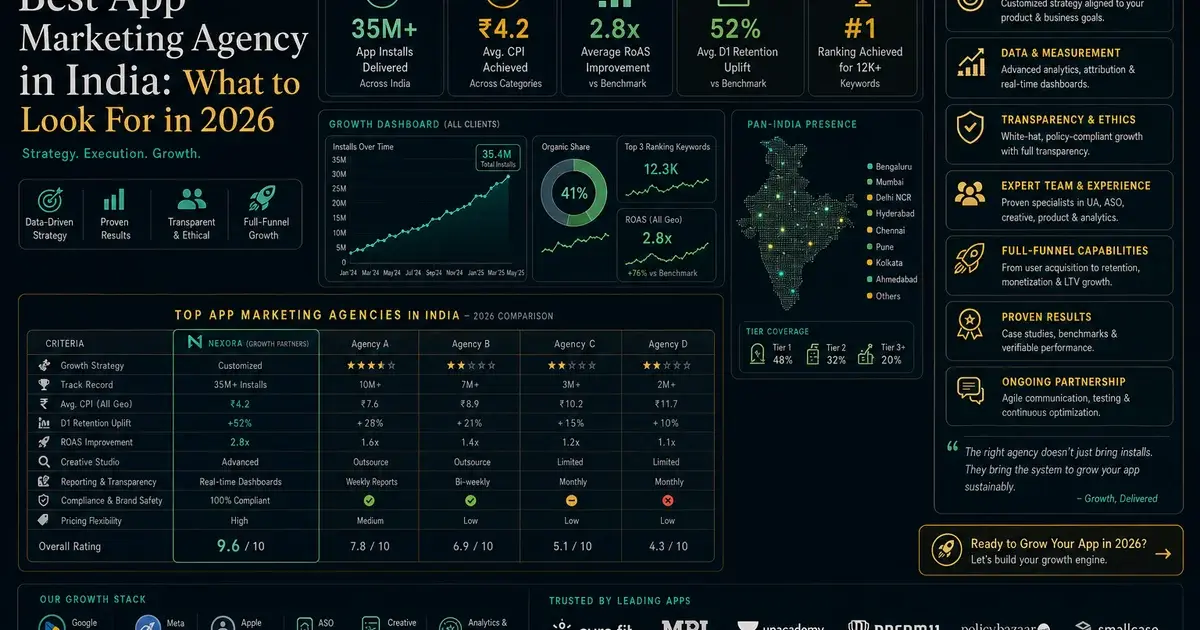
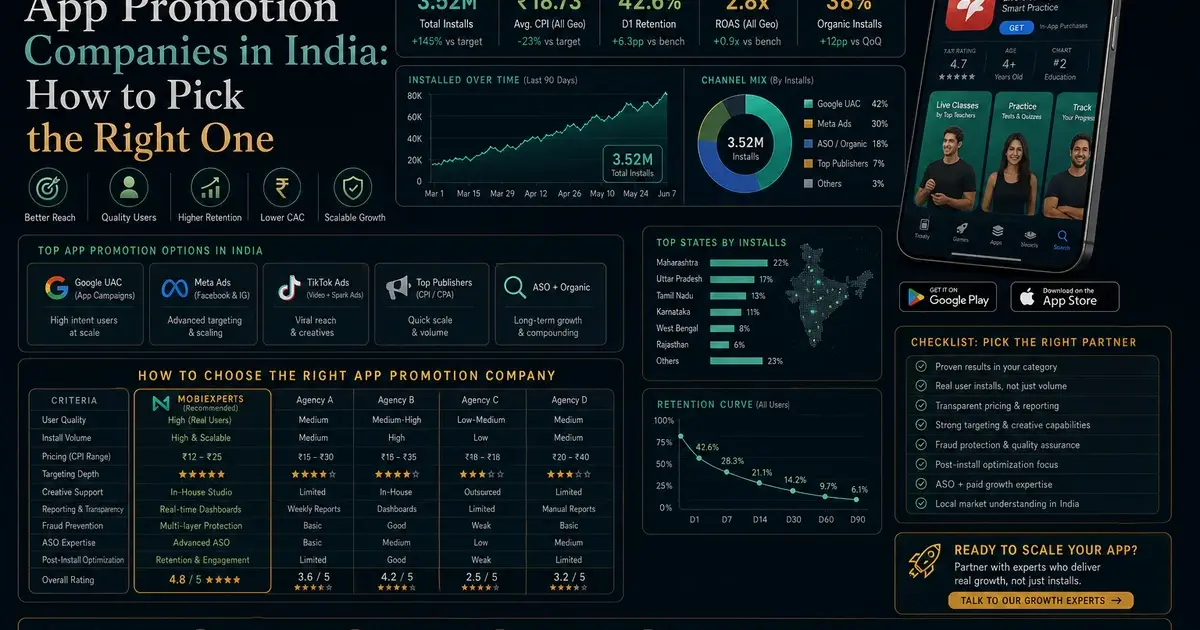
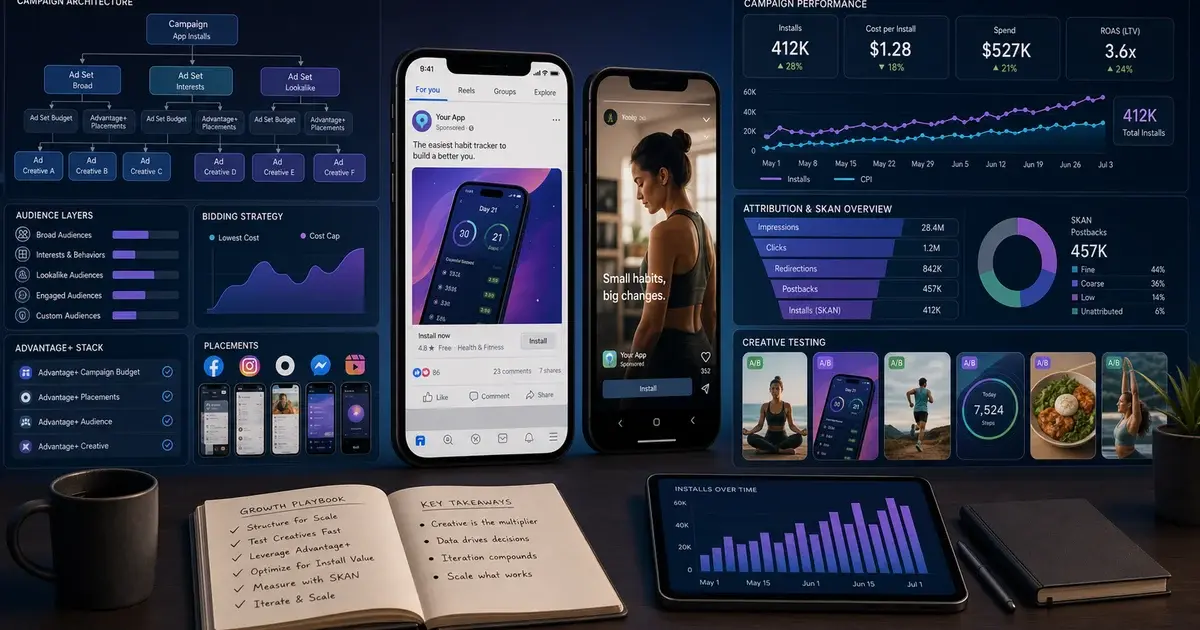
Top Mobile Marketing Companies in India for App Growth
Most mobile marketing companies in India sell channel execution. The best ones combine ASO, paid UA, analytics, and creative into one growth system. Here is how to choose the right partner.
On this page
- What does a mobile marketing company actually do?
- Who actually needs a mobile marketing company?
- Why is India a different mobile marketing market in 2026?
- How should targeting change for Tier-2 and Tier-3 India?
- How do you evaluate a mobile marketing company before signing?
- Which services actually drive mobile app growth?
- What should the first 90 days with an agency look like?
- What goes wrong in agency engagements, and how do you spot it early?
- How much do mobile marketing companies in India charge?
- Is an agency worth it when you could hire the team in-house?
- What else do founders ask before hiring an agency?
- Frequently Asked Questions
What does a mobile marketing company actually do?
Mobile marketing companies specialise in acquiring, engaging, and retaining users for mobile applications. The good ones do not just run ads. They connect the full growth stack so ASO, paid UA, analytics, creative, and lifecycle retention all improve each other instead of operating as separate workstreams.
A top-tier mobile marketing company handles the full growth stack:
- App Store Optimisation (ASO): Increasing organic visibility through keyword optimisation, metadata strategy, and conversion rate improvements on store listings.
- Paid User Acquisition: Running app install campaigns on Google UAC, Meta, and programmatic ad networks with proper bidding strategy and creative testing.
- Mobile Analytics: Setting up and interpreting data from MMPs like AppsFlyer or Adjust to attribute installs, measure retention, and calculate LTV by cohort.
- Creative Production: Producing performance-oriented video and static ad creatives that drive downloads at scale.
- Retention Marketing: Push notification strategy, in-app messaging, and re-engagement campaigns to improve D30 and D90 retention metrics.
The distinction between a mobile marketing company and a general digital agency matters enormously. Mobile apps live inside platforms with their own algorithms, conversion funnels, and policy constraints. Applying general web marketing thinking to an app growth problem produces poor results. If you need the full stack, start with our services overview, then review the specific workstreams for ASO, user acquisition, CPI networks, and analytics.
Who actually needs a mobile marketing company?
Not every app needs an agency on day one. The right time to hire is when the work has become too cross-functional for one founder or in-house generalist to execute well. In practice, that means one of three situations: you need to grow faster than your internal team can handle, you need specialist execution across multiple channels, or you need clearer measurement and accountability.
Use this as a fast fit check before you start vendor conversations:
| App stage | Best fit | What to expect |
|---|---|---|
| Pre-launch or first 10K installs | Small specialist or integrated partner | ASO setup, launch plan, a lean paid test, and store creative built for conversion. |
| 10K-100K installs | Full-stack mobile marketing company | Channel mix, attribution, creative testing, and retention loops working together. |
| 100K+ installs or category competition | Senior performance team with proof | Structured scale, cohort reporting, and clear decision-making across paid and organic. |
If your app sits in fintech, food delivery, edtech, health, or any category where paid acquisition and store ranking both matter, an integrated partner usually beats a single-channel vendor. That is the model we use at Vmobify because it is the only one that consistently compounds into lower blended CPI and higher LTV. See case studies for examples of how this works in production.
Why is India a different mobile marketing market in 2026?
India rewards teams that understand its distribution mechanics and punishes teams running a global playbook unchanged. Cheap installs do not automatically mean easy growth. The market rewards companies that localise, segment, and measure properly.
Here is the context that makes it uniquely challenging and uniquely valuable:
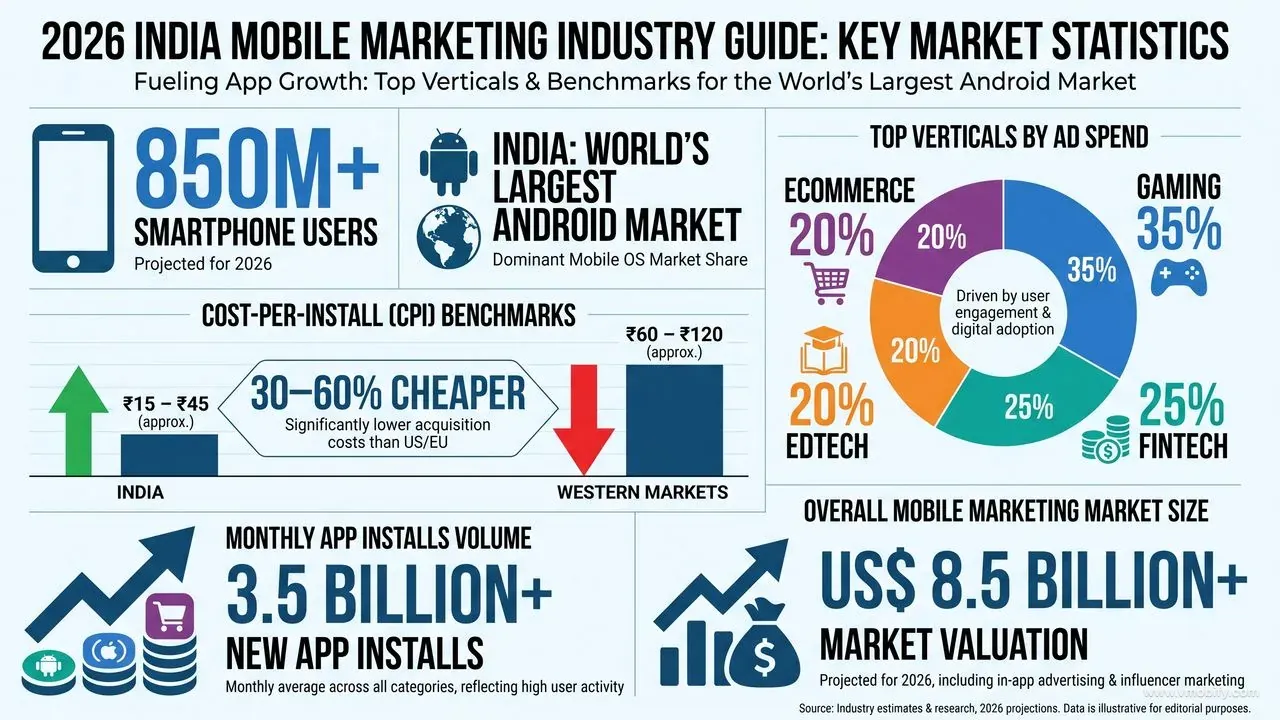
- Scale: 850M+ smartphone users make India the world's largest Android market. Any app that cracks India distribution has access to a massive, growing user base — Statista's India smartphone user forecast tracks the trajectory year by year.
- Low CPIs: India has some of the lowest cost-per-install benchmarks globally — typically 30–60% cheaper than Western markets. This means growth capital goes further here than almost anywhere else.
- High competition: Cheap CPIs attract global competition. Thousands of apps are fighting for the same users, making app store ranking and creative quality decisive factors in who wins.
- Vernacular opportunity: Only about 150M Indian users are English-comfortable. Apps with strong Hindi, Tamil, Telugu, Bengali, or Marathi language support have a significant competitive moat in Tier 2 and Tier 3 cities.
- Diverse monetisation: India's growing middle class is increasingly comfortable with subscriptions, in-app purchases, and ad-supported models — though ARPU remains lower than mature markets, LTV is rising. RevenueCat's State of Subscription Apps documents the persistent iOS-versus-Android revenue gap that shapes how Android-first markets are monetised.
The companies that succeed in India understand these dynamics at the campaign level — segmenting by language, optimising creative for device types, and managing CPIs by geography. Generic global playbooks do not work here. If you want the India-specific acquisition and ASO mechanics, start with our India CPI benchmark guide, our India app market statistics, and our ASO company guide.
How should targeting change for Tier-2 and Tier-3 India?
Tier-2 and Tier-3 India is a different funnel from metro India, not a cheaper version of it — and a partner that treats it as one budget line will hand you cheap installs that never retain. Across the 300+ apps we have managed since 2013, the split between a campaign that works in Mumbai and one that works in Nagpur is almost never the bid; it is the creative, the device assumption, and the onboarding.
What a competent India partner does differently:
- Separate ad groups by geography tier. Metro auctions and Tier-2/3 auctions clear at different prices for the same vertical. Blended into one campaign, the algorithm spends toward whichever tier converts first and the reporting hides which one is actually profitable.
- Vernacular creative, not translated creative. A Hindi voiceover dropped onto a creative written for an English-speaking metro audience reads as an import. The hook has to be written in the language it will run in.
- Test on entry-level Android hardware. Most of the incremental users in these markets arrive on budget devices with limited RAM and intermittent connectivity. If your app is slow to first screen there, paid spend simply buys uninstalls.
- Watch store listing localisation. Google Play serves localised listings; an English-only listing throws away conversion on traffic you already paid for. Our ASO service treats listing localisation as an acquisition lever, not a translation chore.
- Split retention reporting by tier. A blended D7 number averages two very different cohorts. Reported separately, it usually shows which tier deserves the next increment of budget.
On budget: the retainer bands later in this post do not change by geography, but the media split should. Treat Tier-2/3 as its own funded line item with its own creative allocation rather than as spillover from the metro campaign, and hold it to its own CPI and D7 targets. For where the money should sit across a first year of spend, see our year-one app marketing budget guide.
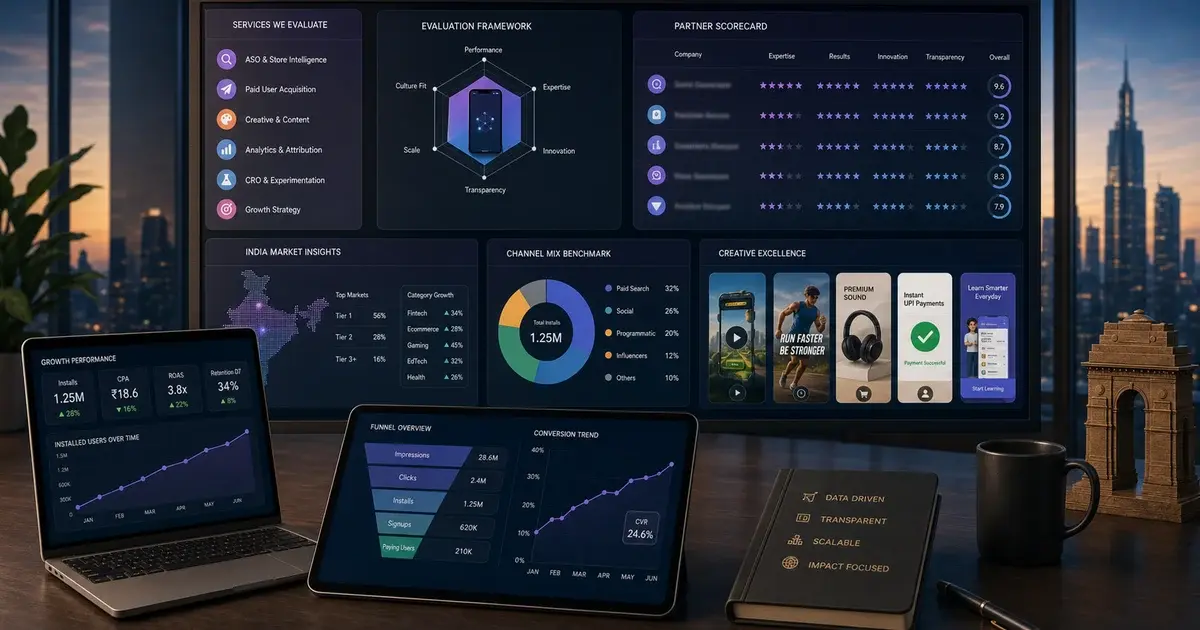
How do you evaluate a mobile marketing company before signing?
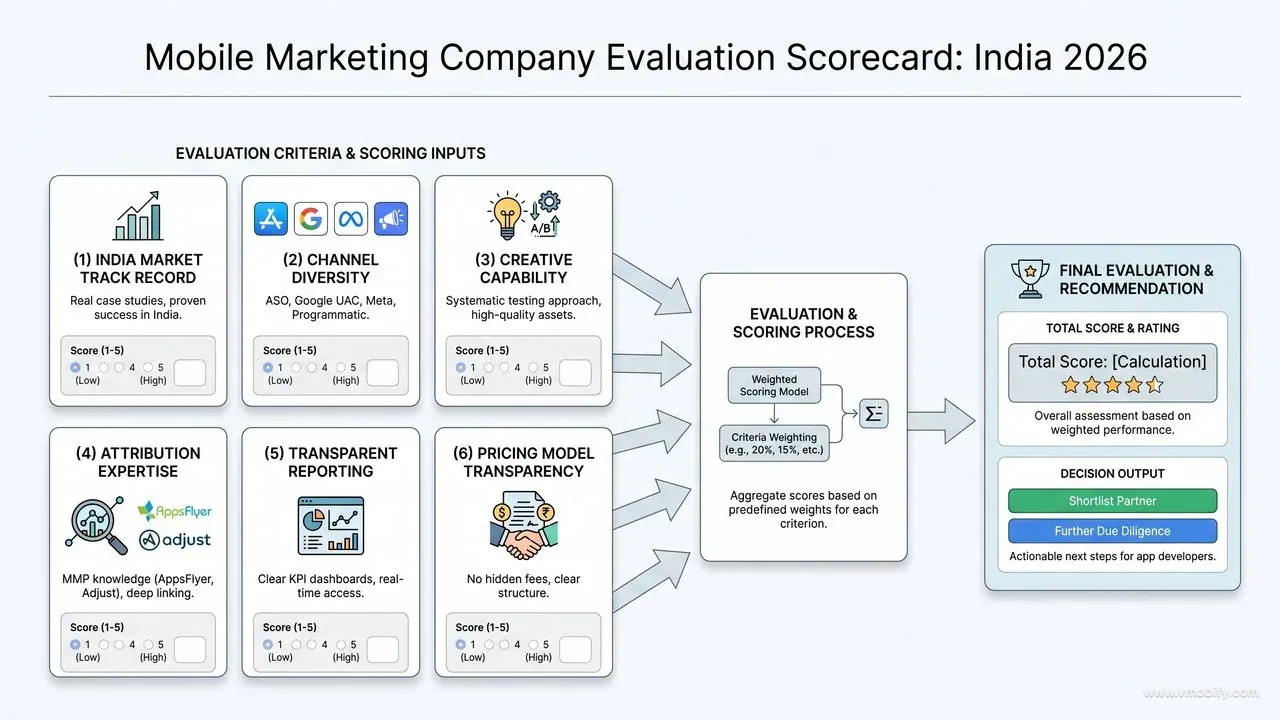
Evaluation is mostly a test of technical literacy — the companies that cannot explain measurement in detail are the ones selling execution they do not understand. With hundreds of companies claiming mobile marketing expertise in India, use this framework to separate genuine capability from sales theatre:
- Ask for India-specific case studies: Results from European or US markets do not translate directly to India. You want CPI benchmarks, ASO ranking data, and retention numbers from Indian campaigns specifically.
- Test their attribution knowledge: A company that cannot explain how SKAdNetwork affects iOS campaign measurement, or how to set up proper postback windows in AppsFlyer, is not operating at a professional level. Adjust's SKAdNetwork 4 documentation is the reference to hold their answers against, and our mobile attribution guide covers the same ground from the advertiser's side.
- Review their creative portfolio: Ask to see ad creatives they have produced and the performance data behind them. Do they have a systematic testing approach or do they just make "nice" creatives?
- Assess their team structure: Who owns ASO, who owns paid, who owns analytics — and do these people actually talk to each other? Siloed teams produce siloed results.
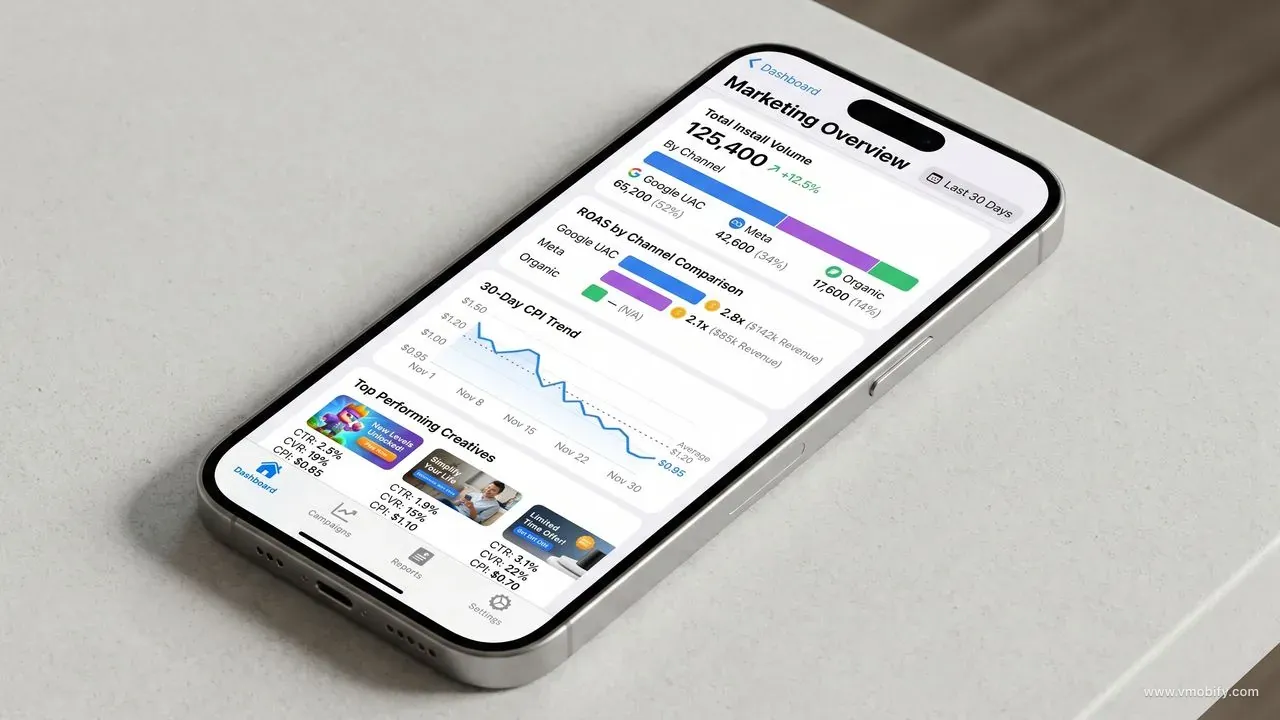
- Check their reporting hygiene: Request to see a live dashboard or a recent client report. Good reporting tracks KPIs against targets, highlights anomalies, and recommends clear next actions — not just describes what happened.
- Ask how they benchmark: A partner should be able to say where your retention sits relative to your category rather than only relative to last month. AppsFlyer's Performance Index is the common reference point; a team that has never used a category baseline will grade its own homework.
Also check their public case studies. Companies confident in their results make them visible. Companies that only share results under NDA may be protecting mediocre performance rather than client confidentiality.
At Vmobify, this evaluation usually starts with a free growth audit so we can map the current funnel before suggesting any spend. That keeps the conversation on evidence, not pitch decks. If you want the process and the output to be more transparent, our contact page is the fastest way in.
Which services actually drive mobile app growth?
Not all services offered by mobile marketing companies have equal impact. Here are the highest-leverage services and what to expect from each:
- ASO — highest ROI service: A well-executed ASO strategy can increase organic installs by 30–80% without any paid spend. This makes it the highest-ROI service in mobile marketing. Every app should have this as a foundation before scaling paid.
- Google App Campaigns — highest volume paid: For Android-heavy markets like India, paid UA through Google UAC is typically the most scalable channel. The algorithm is powerful but requires conversion data, creative volume, and patience during the learning phase — Google's own App Campaigns documentation is explicit that asset variety is what the system optimises against.
- Meta App Install Campaigns: Stronger for precise demographic targeting and for apps where the user persona is well-defined. Typically higher CPI than Google in India but often better D7 retention due to more intentional installs.
- CPI Network Management: Useful for burst campaigns to climb store rankings, but requires careful publisher vetting to avoid fraud. Quality CPI campaigns from managed networks can drive ranking boosts that sustain organic growth for weeks after the campaign ends. See our CPI network service and the channel comparison in our UAC vs Meta vs CPI breakdown.
- Creative Testing Infrastructure: The single biggest performance lever after channel selection. Companies with a systematic creative testing process — clear hypothesis, controlled variables, statistical significance thresholds — consistently outperform those running on creative intuition.
- Monetisation and pricing: Acquisition economics are decided partly by what a user is worth. A partner that never touches pricing, paywall placement, or ad density is optimising one half of the equation. Our monetisation service exists because CPI targets are meaningless without an LTV number to set them against.
If you need one team that can do all of the above together, that is the core Vmobify model: ASO, user acquisition, CPI networks, and analytics under one roof. That integration is what lets the channel learnings compound instead of fragmenting across vendors.
What should the first 90 days with an agency look like?
The first 90 days should run in a fixed order — measurement, then store, then paid, then scale — because every step depends on the one before it. Engagements that start with paid spend before attribution is trustworthy produce numbers nobody can act on, and in our portfolio that is the most common reason a first quarter gets written off.
- Weeks 1-2 — fix measurement first. MMP installed and validated, in-app events defined beyond install, iOS conversion values mapped, and a baseline recorded for CPI, store conversion rate, D1/D7 retention, and organic install share. Nothing after this is interpretable without it.
- Weeks 2-4 — rebuild the store listing. Keyword set, title and subtitle or short description, first screenshot, and localisation. This is free traffic quality: every rupee of paid spend afterwards converts against whatever the listing does. Google Play's launch best practices covers the store-side mechanics.
- Weeks 3-6 — run a deliberately small paid test. One channel, several creative variants, one geography tier. The goal is a readable CPI and a first retention read, not volume. Judge nothing during the learning phase.
- Weeks 6-10 — build the creative pipeline. A cadence that ships new variants weekly, with losers paused on a schedule rather than on a whim. Creative supply, not bidding, is what caps paid scale.
- Weeks 10-13 — scale what survived and report honestly. Increase spend only on the cohorts holding their retention. The quarter-end review should show movement in at least one core KPI and a clear statement of what is not working.
One measurement note for the iOS half of the plan: opt-in rates for tracking remain a minority of users — Adjust reported an average ATT opt-in rate of around 35% in 2025 — so an India-facing iOS plan has to be built on aggregated, delayed data rather than user-level attribution. A partner that promises iOS reporting as precise as Android reporting has not read the platform.
What goes wrong in agency engagements, and how do you spot it early?
Almost every failed engagement shows the same four symptoms inside the first eight weeks, and all four are visible in the reporting before they are visible in the bank balance. We have seen each of these enough times to name them.
- Reporting that describes instead of decides. If a monthly report lists what happened but never says what will change next month, the team is administering campaigns, not running them. Ask for a "what we are stopping" line in every report — it is the fastest test of whether anyone is making calls.
- Install volume rising while retention quietly falls. This is the classic sign that budget has drifted to low-quality inventory. It looks like success on a headline chart. Insist on D1 and D7 alongside install count in the same view, split by source, and read them together.
- Suspiciously clean traffic from one or two publishers. Concentration is a fraud signal. Click-injection, click-spamming, and device farms all show up as anomalous publisher patterns before they show up as revenue shortfalls — our ad fraud prevention guide covers the specific detection rules to ask about.
- Creative that has not changed in six weeks. Fatigue is not a possibility, it is a schedule. A flat creative pipeline eventually shows up as rising CPI that gets blamed on "the auction".
Watch for this
The most expensive failure mode is not a bad agency — it is a good agency working against an unclear objective. If nobody in the room can state the single KPI the engagement is being judged on, fix that before the next invoice, not after the quarter.
The recovery is usually procedural rather than dramatic: reset the objective to one number, cut spend back to the sources that survive a cohort review, and rebuild from a clean baseline. That is uncomfortable in month three and much cheaper than discovering it in month nine.
How much do mobile marketing companies in India charge?
Understanding market-rate pricing helps you evaluate whether a quote reflects genuine expertise or is suspiciously cheap (or expensive):
- ASO-only retainer: ₹30,000–₹80,000/month depending on the number of apps, markets, and depth of ongoing keyword management. One-time audits are scoped separately as project work.
- Paid UA management: Commonly charged as a percentage of ad spend under management, or as a retainer of ₹30,000–₹80,000/month. Ask which model is being quoted, because the two behave differently as spend scales.
- Full-stack retainer: A comprehensive engagement covering ASO, paid UA, creative and analytics sits at the upper end of the ₹30,000–₹80,000/month band, with media budget accounted for separately.
- Performance models: Some companies offer CPI-based pricing — you pay per install delivered. Useful for specific campaigns but be careful about what "install" means. Ensure the contract specifies quality thresholds (D1 retention, geographic source, etc.).
Compare quotes on scope rather than on headline price. Two retainers at the same number can differ enormously in how many channels they cover, how often creative and metadata are actually tested, and who is doing the work. Good partners should be able to explain exactly what is included, what is excluded, and what success looks like within 90 days.
Two contract details are worth more attention than the headline number. First, who owns the accounts: the ad accounts, the MMP, and the store console should stay in your name so that leaving costs you a transition, not a rebuild. Second, what happens to creative assets on exit. Both are cheap to agree at signing and expensive to negotiate at the end.
If you want an integrated quote instead of a channel-by-channel guess, talk to Vmobify. We scope ASO, paid acquisition, creative, analytics, and CPI networks as one operating system rather than as disconnected line items.
Is an agency worth it when you could hire the team in-house?
It is a fair objection, and the honest answer is that in-house wins on continuity while an agency wins on breadth and speed — the right choice depends on which of those you are currently short of. The comparison people usually run — one salary against one retainer — is the wrong one, because a single hire does not cover the same surface area.
In-house team
- Full-time context on your product and users
- Institutional memory that survives a campaign cycle
- Requires a growth lead who can hire and judge specialists
- Needs several roles — ASO, paid, creative, analytics — before the stack is covered
- Ramp time is months, and a single departure resets it
Integrated partner
- All four disciplines available from week one
- Pattern recognition from many apps in the same category
- Faster to start and faster to stop
- Needs a clear internal owner, or the work drifts
- Product context has to be transferred deliberately
The pragmatic answer for most Indian app teams between 10K and 500K installs is a hybrid: one internal growth owner who sets the objective and holds the numbers, plus an external team supplying the specialist execution. That structure gets the continuity of in-house without waiting two quarters to assemble four disciplines.
The point at which the maths flips toward in-house is when your monthly ad spend is large enough that a percentage-of-spend fee exceeds the fully loaded cost of the equivalent team, and when your category is stable enough that cross-portfolio pattern recognition stops being worth much. Before that point, an agency is buying you time; after it, you are mostly buying salaries at a markup. Say so out loud in the vendor conversation — a partner worth hiring will tell you when you have crossed it.
What else do founders ask before hiring an agency?
What is the difference between a mobile marketing company and a mobile ad network?
A mobile marketing company manages your growth strategy and campaigns. A mobile ad network is a platform (like ironSource, InMobi, or AppLovin) where ads are placed. Marketing companies often use ad networks as one of many channels they manage on your behalf.
Do I need a separate company for Android and iOS?
No. Quality mobile marketing companies work across both platforms. Strategy differs significantly between Android (Google Play, UAC) and iOS (App Store, Search Ads, SKAdNetwork) but a single integrated team handles both more effectively than two separate agencies.
How do I know if a company is delivering real installs or fraud?
Insist on an independent MMP (AppsFlyer, Adjust, or Branch) for attribution and install verification. Legitimate companies welcome third-party attribution. Those that resist it or suggest using only their own tracking should be treated with caution.
How long does it take to see results?
Paid UA results appear in week 1. ASO improvements show within 4–8 weeks. Meaningful compounding from an integrated strategy takes 3–6 months. Expect the first month to be primarily setup and baseline measurement.
What should a good mobile marketing company deliver in the first 90 days?
A clear audit, channel plan, baseline reporting, creative testing cadence, and measurable movement in at least one core KPI such as CPI, store conversion, or D7 retention.
Should I hire a full-stack company or separate specialists?
If your growth levers influence each other, full-stack usually wins. Separate specialists only make sense if you already have a strong internal growth lead coordinating them.
Frequently Asked Questions
What is the difference between a mobile marketing company and a mobile ad network?+
A mobile marketing company manages your growth strategy and campaigns. A mobile ad network is a platform (like ironSource, InMobi, or AppLovin) where ads are placed. Marketing companies use ad networks as one of many channels they manage on your behalf.
Do I need a separate company for Android and iOS marketing?+
No. Quality mobile marketing companies work across both platforms. Strategy differs significantly between Android (Google Play, UAC) and iOS (App Store, Search Ads, SKAdNetwork), but a single integrated team handles both more effectively than two separate agencies.
How do I know if a company is delivering real installs or fraud?+
Insist on an independent MMP (AppsFlyer, Adjust, or Branch) for attribution and install verification. Legitimate companies welcome third-party attribution. Those that resist it or suggest using only their own tracking should be treated with caution.
How long does it take to see results from mobile marketing in India?+
Paid UA results appear in week 1. ASO improvements show within 4–8 weeks. Meaningful compounding from an integrated strategy takes 3–6 months. Expect the first month to be primarily setup and baseline measurement.
What should a good mobile marketing company deliver in the first 90 days?+
A clear audit, channel plan, baseline reporting, creative testing cadence, and measurable movement in at least one core KPI such as CPI, store conversion rate, or D7 retention. If none of those are moving, the engagement is not adding leverage.
Should I hire a full-stack mobile marketing company or separate specialists?+
If your growth levers influence each other — which they almost always do — full-stack usually wins. ASO organic installs compound the efficiency of paid UA, and both feed retention metrics. Separate specialists only make sense if you already have a strong internal growth lead coordinating them.
Who should own the ad accounts and MMP — us or the agency?+
You should. Ad accounts, the MMP, and the store consoles belong in your name, with the agency granted access. That way ending an engagement costs you a handover rather than a rebuild, and your historical campaign and attribution data stays with the product it describes.
Sources
- Google Ads — App Campaigns Help — Official UAC setup, bidding, and creative asset guidance
- Google Play — Launch Best Practices — Store-side launch mechanics and listing readiness
- Adjust — How SKAdNetwork 4 Works — Postbacks and conversion values — the reference for testing an agency's iOS measurement literacy
- Adjust — ATT Opt-In Rates 2025 — Average ~35% opt-in rate and methodology behind it
- AppsFlyer Performance Index — Category baselines for retention and media source quality
- RevenueCat — State of Subscription Apps 2025 — ARPU and LTV by vertical, including the iOS-versus-Android gap
- Statista — Smartphone Users in India — Scale and growth trajectory of the Indian smartphone base
- Apple — App Store Review Guidelines — Policy limits any agency running acquisition on iOS must work inside
About the author
Amol Pomane — Founder, Vmobify
Amol leads Vmobify, a mobile app growth agency that has driven 30M+ downloads and ranked 54K+ keywords across 300+ apps since 2013. He writes about ASO, paid user acquisition, retention, and the operational reality of scaling mobile apps in India and global markets.