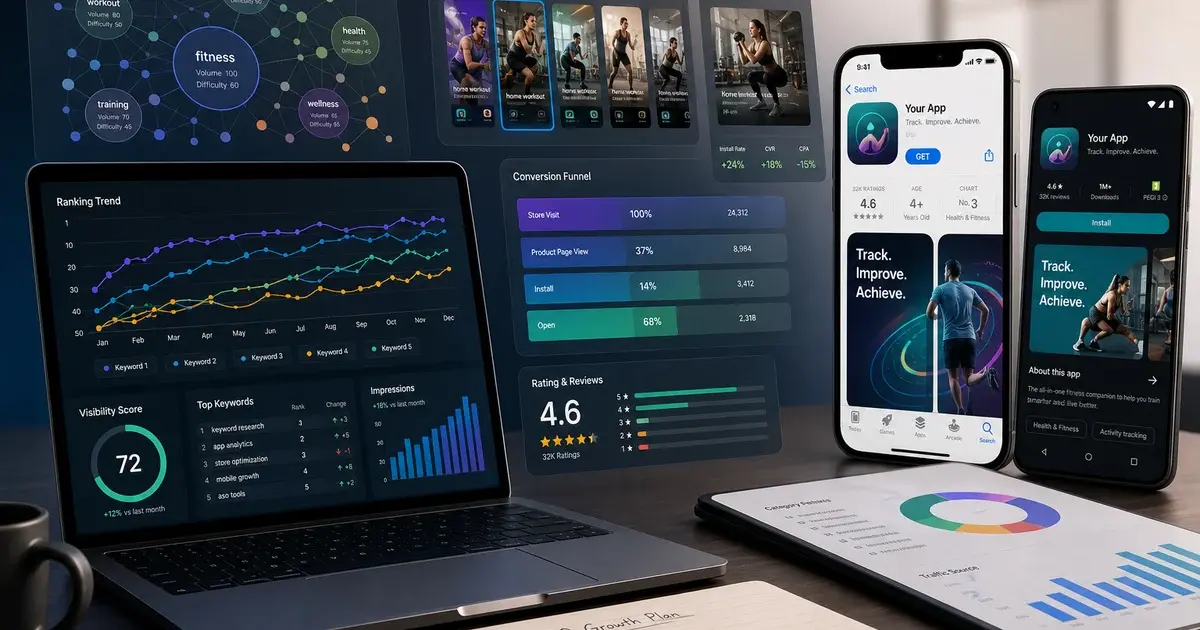
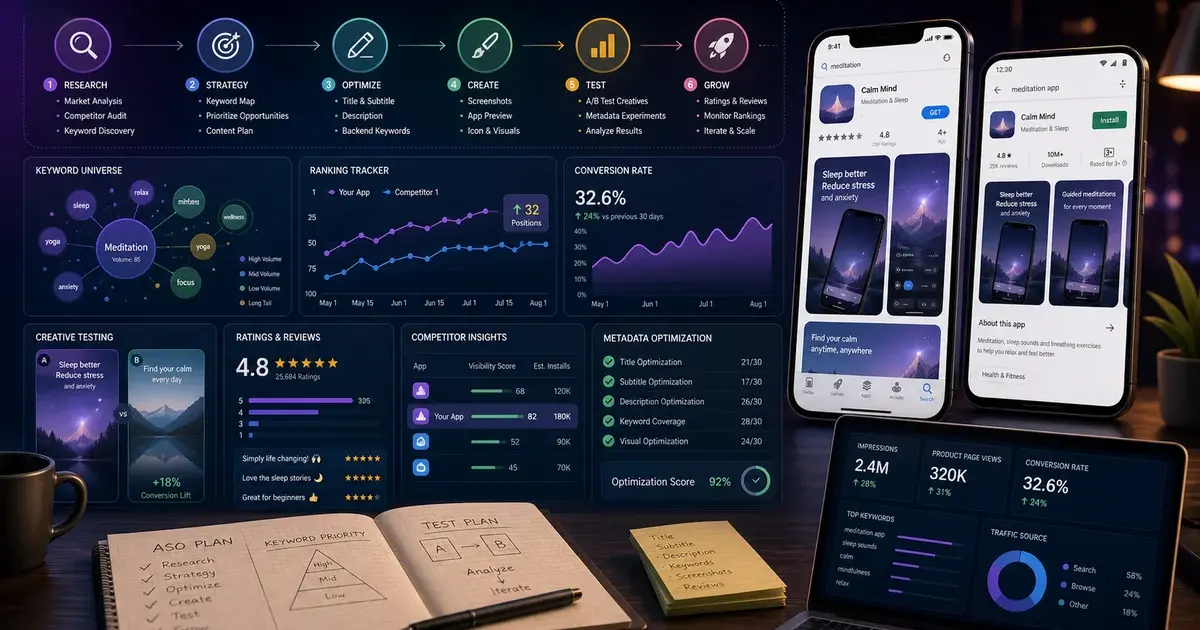
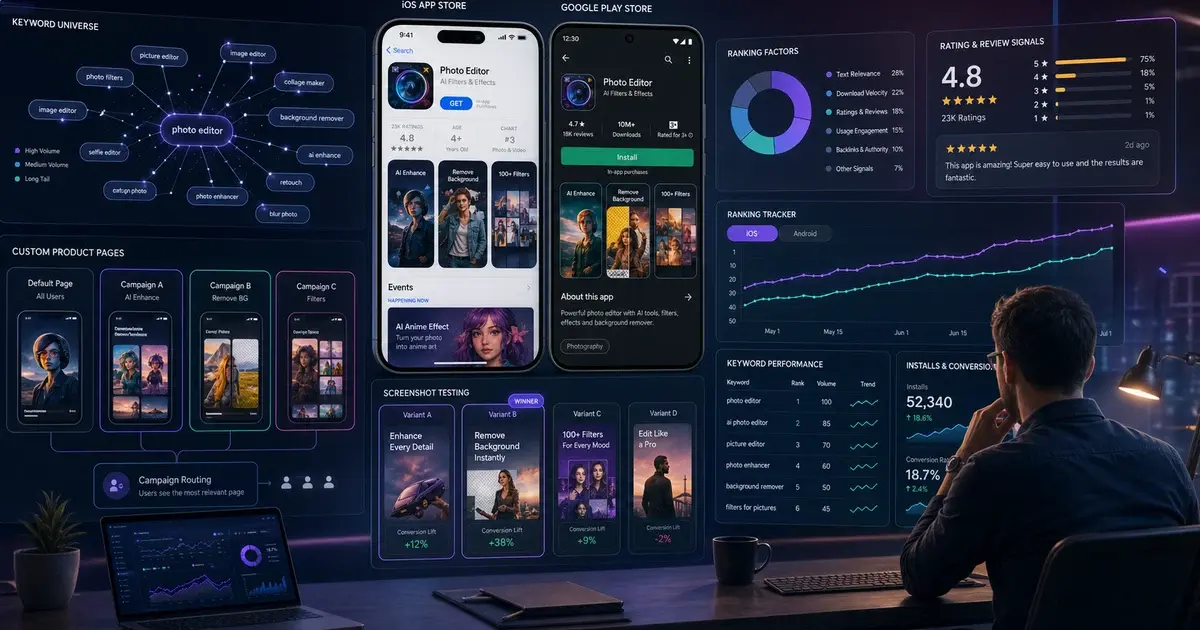
ASO Company in India: Finding the Best App Store Optimization Partner
A strong ASO company in India should improve ranking, conversion, and organic installs together. Here is how to separate real operators from generic agencies.

On this page
- What does an ASO company actually do?
- Why does ASO matter more for Indian apps than Western ones?
- What does ASO look like beyond the Indian metros?
- How do you evaluate whether ASO is actually working?
- Which services should an ASO company in India cover?
- What should the first 90 days with an ASO company look like?
- What goes wrong in ASO engagements, and how do you spot it early?
- Should you build ASO in-house or hire an agency?
- What determines what an ASO company in India charges?
- Is hiring an ASO company worth it, or is it repackaged copywriting?
- How do you choose the best ASO company in India?
- How does Vmobify ASO+ approach the work?
- Frequently Asked Questions
What does an ASO company actually do?
An ASO (App Store Optimisation) company specialises in improving an app's visibility and conversion rate on the Google Play Store and Apple App Store. The goal is to increase the volume of organic installs — users who find and download your app without any paid advertising.
ASO work falls into two main categories:
- On-metadata ASO: Everything you control directly in your store listing — app title, subtitle, short description, long description, keyword fields (App Store), tags, category selection. These elements tell the algorithm what your app is about and determine which search queries it can rank for.
- Off-metadata ASO: Signals you influence indirectly — install volume, install velocity, user ratings and reviews, engagement metrics (session length, retention), and external links. These signals tell the algorithm how valuable your app is to users.
A professional ASO company handles both sides systematically. They research keywords, write compelling metadata, test store creatives (screenshots, feature graphics, preview videos), manage review responses, and track ranking movements over time. The outcome is a store presence that converts searchers into installers more effectively than competitors.
The two stores do not reward the same inputs, which is why a single generic checklist rarely works across both. Google Play reads the full long description and treats it as indexable text; Apple ignores the description for search entirely and reads a 100-character keyword field instead. AppTweak's side-by-side breakdown of Apple and Google Play ASO fields is the clearest public summary of where the two diverge. Apple has also been indexing text inside screenshots since 2025 — Appfigures documented the change — which quietly turned creative work into keyword work on iOS.
The practical test of an ASO company is whether they can explain that divergence back to you in your own app's terms. In our portfolio, the engagements that stall are almost always the ones where a single metadata document was written once and applied to both stores unchanged.
Why does ASO matter more for Indian apps than Western ones?
India is a uniquely important market for ASO because discovery here is Android-first and search-first, which is exactly the combination ASO is built for. Several factors distinguish it from Western markets:
- Android dominance: Over 95% of Indian smartphone users are on Android. Google Play ASO directly reaches the vast majority of your target audience. A strong Play Store presence is more valuable in India than almost any other market.
- Search-driven discovery: Indian users heavily rely on search queries to find apps. Browse discovery (editor picks, top charts) is less influential than in Western markets. This makes keyword strategy particularly important.
- Price sensitivity and organic preference: High-quality organic installs — users who searched for and found your app intentionally — convert better, retain longer, and monetise more effectively than paid installs from broad audience campaigns. In a market where CPIs can be low but LTV is also lower than global averages, organic quality matters enormously.
- Vernacular keyword opportunity: Most ASO companies in India optimise only for English keywords. Apps that invest in Hindi, Tamil, Telugu, Bengali, and Marathi keyword research reach an audience that is massively underserved and much less competitive.
The scale underneath those points is what makes them worth acting on: India's smartphone base is one of the largest single-country audiences any app can address, and it is overwhelmingly Android. That skew changes the order of work. On an iOS-led global plan, the keyword field and the first two screenshots dominate. On an India plan, the long description, the short description, and the feature graphic move first, because those are the fields Google Play actually indexes and renders.
The return on investment from ASO in India is among the highest of any growth channel. Once keyword rankings are established, organic installs compound month over month at zero marginal cost. That compounding is also why ASO pairs well with paid: a stronger listing raises the conversion rate on traffic you are already buying through user acquisition campaigns, so the same media budget produces more installs without a single bid change.
What does ASO look like beyond the Indian metros?
Tier-2 and Tier-3 India is where the cheapest, least contested keyword demand sits, and it behaves differently enough that a metro-only listing under-performs there. The users are on lower-end Android devices, on patchier connections, and searching in a mix of English, transliterated Hindi, and regional languages.
Four things change when you optimise for that audience rather than for Mumbai and Bengaluru:
- Transliterated queries matter as much as translated ones. A user typing "paisa kamane wala app" in Latin script is not served by a Hindi-script Devanagari listing alone. Both spellings need to exist somewhere in your indexed metadata.
- App size becomes a conversion variable. On an entry-level device with constrained storage and metered data, download size is a real objection rather than a detail. Store listings that surface a small install footprint convert better in these cohorts, and shrinking the APK is an ASO action even though it lives in the engineering backlog.
- Screenshots have to carry meaning without dense English copy. Short benefit lines, large numerals, and recognisable UI beat paragraph-style captions. Google's own Play launch best practices push in the same direction: the listing has to be legible at a glance before it can be persuasive.
- Ratings volume is regionally uneven. An app can hold a healthy national rating while sitting well below it in a single state where a payment method or a language pack is broken. Reading reviews by locale, not just in aggregate, is how that gets found.
We have seen the vernacular gap widen rather than close over the last three years, because the agencies operating at volume in India still deliver English-only keyword sets. If you are localising properly, our app store localisation strategy guide covers the field-by-field mechanics for both stores.
How do you evaluate whether ASO is actually working?
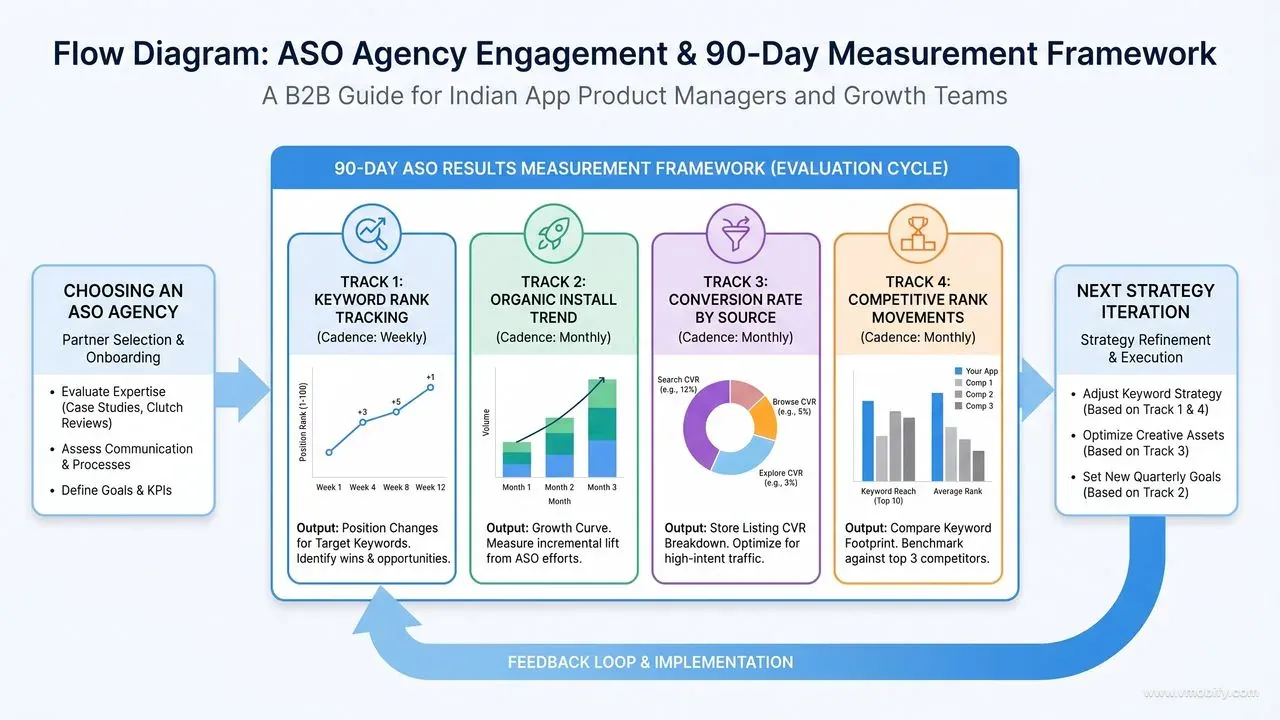
Judge an ASO company on organic installs and store-page conversion inside your own console, because those are the two numbers a vendor cannot present selectively. ASO is often misrepresented in the market because results are easy to fake or misattribute. Here is how to evaluate whether an ASO company is actually delivering value:
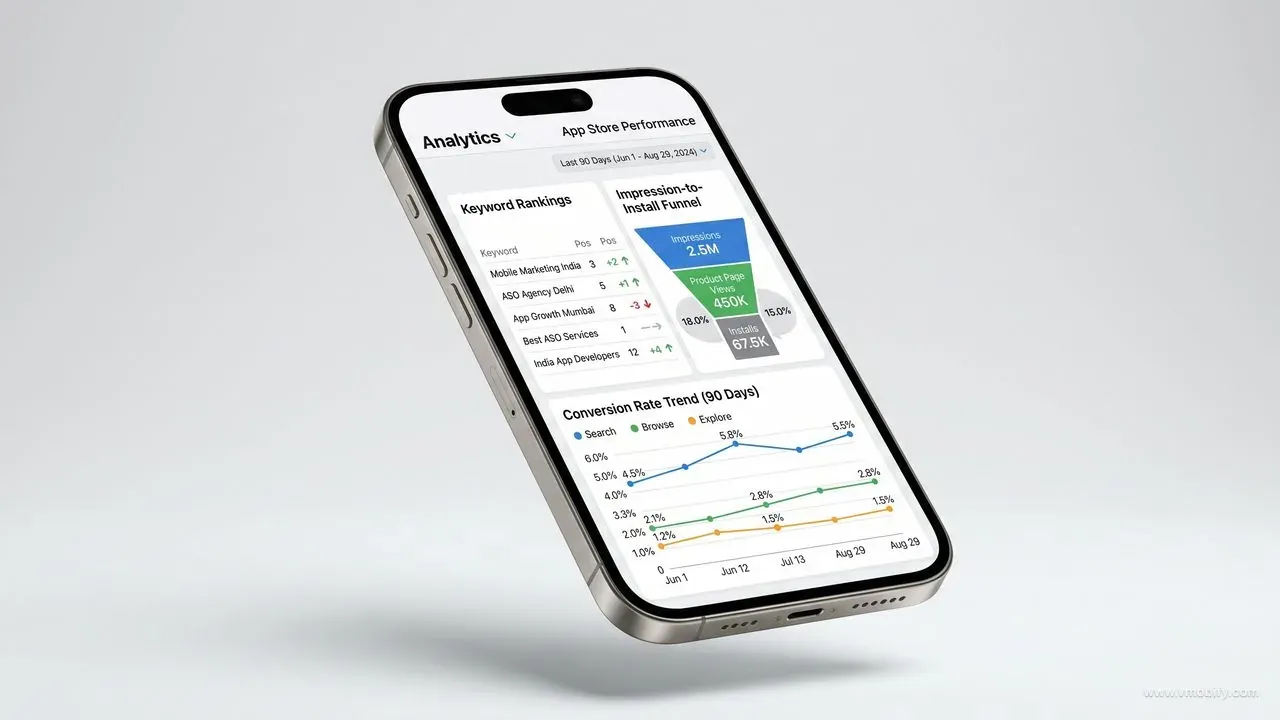
- Keyword ranking reports: Ask for keyword tracking data showing position changes over time for target keywords. Movement from position 50 to position 5 for a high-volume keyword is concrete, verifiable evidence of results.
- Organic install growth in the store console: Google Play and the App Store both report organic install volume. A successful ASO engagement should show a measurable increase in organic installs over 60–90 days.
- Store listing conversion rate: Impressions-to-install rate. If your store page gets 10,000 views but only 200 installs (2%), improving screenshots and description could push this to 4–6% — tripling installs without changing ranking.
- Category keyword share: Advanced ASO companies track how your keyword footprint compares to competitors in your category. Growing your share of ranked keywords in a category is a leading indicator of organic dominance.
Be cautious of ASO companies that report only on rankings without connecting them to actual install volume. Rankings matter only when they generate installs. A tool like AppFollow, Sensor Tower, or AppTweak can independently verify the claims an ASO company makes about your rankings.
Two measurement hygiene rules make the whole exercise trustworthy. First, agree the baseline before any change ships — a 30-day pre-engagement window for organic installs, store-listing conversion rate, and ranked keyword count, exported and saved by you rather than by the agency. Second, change one class of thing at a time. If new screenshots, a rewritten long description, and a paid burst all go live in the same week, nothing that follows is attributable to any of them, and you will spend the next quarter arguing about credit instead of compounding results. Where the split matters commercially, wire it into your analytics setup so organic and paid cohorts are separated at source.
Which services should an ASO company in India cover?
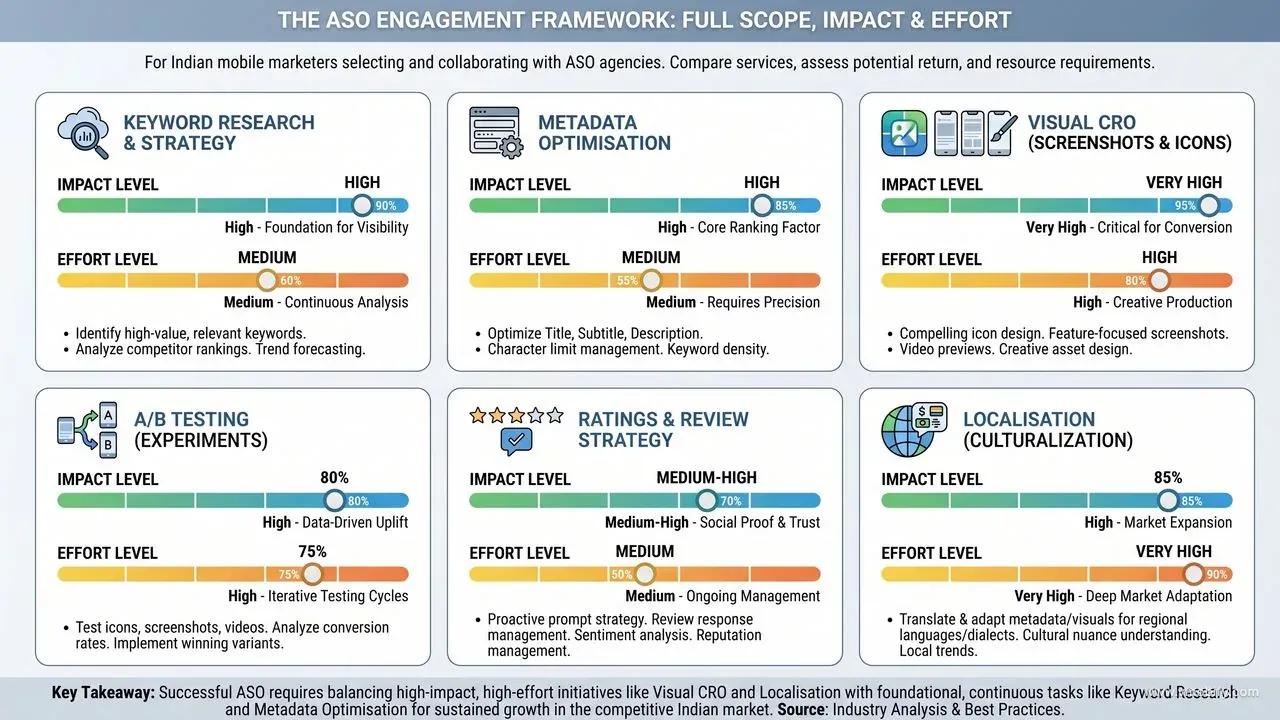
A complete ASO engagement covers seven service areas, and partial coverage produces partial results. When evaluating an ASO company in India, ensure they cover all of these:
- Keyword research and strategy: Data-driven keyword selection based on search volume, difficulty, and relevance. Should include both English and relevant vernacular keywords for Indian apps.
- Metadata writing and optimisation: Professionally written title, subtitle, description, and keyword fields optimised for algorithm and human reader simultaneously.
- Screenshot and creative optimisation: A/B testing of screenshots using Google Play Experiments or third-party tools. Screenshots are the single biggest driver of store conversion rate.
- Review and rating strategy: Process for generating legitimate reviews, flagging fraudulent reviews for removal, and responding to user feedback systematically to improve rating.
- Competitor monitoring: Tracking competitor keyword strategies and store changes to identify gaps and opportunities.
- Localisation: Translating and culturally adapting store listings for target markets beyond English.
- Monthly reporting: Keyword ranking movement, organic install trends, conversion rate changes, and recommended next actions.
Two capabilities are worth probing beyond the list, because they separate operators from vendors. The first is audience-specific listings: Apple's Custom Product Pages let you serve a different set of screenshots and copy to a specific campaign or segment, which turns ASO into a lever for paid performance rather than a separate workstream. If an agency has never shipped one, their iOS practice is shallower than it looks. The second is testing discipline — whether they can size an experiment, call it on statistical significance rather than on a hunch, and leave a losing variant running long enough to be sure. Our app store screenshots guide sets out the creative side of that in detail.
Explore our ASO+ service to see how Vmobify approaches each of these areas with a systematic, data-first methodology.
What should the first 90 days with an ASO company look like?
The first 90 days should run in a fixed order: audit, baseline, metadata, creative, then compounding — and you should be able to name the deliverable due at the end of each phase before you sign anything.
- Weeks 1–2 — audit and baseline. A full teardown of both listings, a competitor keyword map, and an export of your current organic installs, conversion rate, and ranked keyword count. Nothing ships yet. If an agency starts rewriting your title in week one, they are guessing.
- Weeks 2–4 — keyword architecture. A ranked target list split by intent: brand defence, category head terms, long-tail feature queries, and vernacular variants. Each keyword should carry a reason for being on the list and a realistic position target.
- Weeks 4–6 — metadata ships. Title, subtitle or short description, long description, and keyword field go live. Both stores re-index within a day or two, so this is the first change with a visible effect. Log the exact ship date; every later reading depends on it.
- Weeks 6–10 — creative testing. First screenshot and feature graphic experiments start running through Play Store listing experiments and, on iOS, product page optimisation. One variable per test. This is where conversion rate moves.
- Weeks 10–13 — read, iterate, and lock the cadence. Ranking movement from the metadata change is now readable, creative winners are promoted, and the monthly refresh rhythm begins.
What you should have in hand at day 90 is unglamorous but decisive: a documented baseline, one shipped metadata revision with a dated before-and-after, at least two completed creative experiments, and a keyword list that has been revised once with reasons. Across the 300+ apps we have managed since 2013, engagements that reach day 90 without those four artefacts almost never recover in month four — the problem is process, and process does not fix itself.
Ranking, meanwhile, lags conversion. Conversion changes the moment a new screenshot renders; ranking has to accumulate the install and engagement signals that follow. Expect the two curves to move on different clocks and do not panic in week seven when only one of them has.
What goes wrong in ASO engagements, and how do you spot it early?
Most failed ASO engagements fail for one of five reasons, and all five are visible inside the first six weeks if you know what to look for.
Ranking-only reporting. The deck shows keyword positions climbing and never shows organic installs. Ask for the install chart from your own console. If the two do not move together, the keywords being won have no real search volume behind them.
- Keyword stuffing dressed up as optimisation. A title crammed with comma-separated terms reads as spam to users and risks a policy strike under the Google Play developer content policy. The tell is a listing that no human at your company would have written.
- Vanity keywords. Winning position 1 for a term nobody searches is easy and worthless. Every keyword on the target list should carry a volume estimate and a reason.
- Creative work that never gets tested. New screenshots shipped straight to 100% of traffic with no experiment means you have swapped one guess for another and destroyed the ability to learn from it.
- No implementation owner on your side. The most common cause of a stalled engagement is not agency competence — it is a metadata change sitting in someone's inbox for five weeks. ASO recommendations that nobody internally can approve and ship are worth nothing.
- Review manipulation. Any offer involving purchased ratings or incentivised five-star reviews puts your developer account at risk. Walk away from the conversation rather than negotiating the volume down.
The recovery pattern is consistent. Freeze further changes, re-establish a clean baseline, ship one change, and read it properly before shipping the next. We have seen accounts recover a quarter's worth of lost ground simply by slowing down enough to make each change measurable.
Should you build ASO in-house or hire an agency?
The honest answer is that the choice is about continuity and cost structure, not about capability — both models work, and the failure mode in both is inconsistent execution.
In-house ASO makes sense when: your app has scale (1M+ installs), you are in a single category long-term, and you can afford a dedicated ASO manager (₹8–15L/year for an experienced hire). The advantage is institutional knowledge and faster iteration cycles when the team is responsive.
Agency ASO makes sense when: you need expertise immediately, you operate across multiple apps or markets, or you cannot justify a full-time hire for ASO alone. Agencies bring cross-category benchmarks, tool subscriptions (Sensor Tower, AppTweak), and institutional knowledge from dozens of similar apps.
In practice, most growing apps use a hybrid model — an agency handles strategy, keyword research, and reporting while an in-house product manager owns the implementation and A/B test calendar. This combines external expertise with internal responsiveness.
The hidden cost on the in-house side is rarely the salary. It is the tooling stack — a serious keyword and competitor intelligence subscription is a recurring line item on its own — plus the ramp time before a new hire knows your category well enough to make good calls, plus the single-point-of-failure risk when that person leaves and takes the reasoning with them. An agency absorbs all three, but only if the relationship outlasts the first quarter.
The most important factor is continuity. ASO is not a one-time project — it is an ongoing discipline that requires monthly keyword refreshes, creative testing cycles, and algorithm change responses. Whether in-house or agency, the team must be committed to consistent execution. If you are weighing a broader engagement rather than ASO alone, our comparison of app marketing agencies in India covers how the scopes differ.
What determines what an ASO company in India charges?
ASO pricing in India is driven by four variables — store count, language count, creative production load, and testing cadence — and a quote that ignores them is a quote for something other than ASO.
- One store or two. Android-only work is genuinely cheaper than a dual-store engagement, because the keyword field, Custom Product Pages, and Apple's review cycle are separate workstreams with their own research.
- How many languages. English-only is the baseline. Each additional Indian language adds keyword research, native copywriting, and a separate creative set — this is where a serious India engagement diverges most from a cheap one.
- Creative production. Whether screenshot and feature-graphic design is included or billed separately changes the number materially. Ask explicitly, because it is the most common line item hidden outside the retainer.
- Testing cadence. One experiment a quarter and one experiment a fortnight are different businesses. The faster cadence costs more and is worth more, but only if your team can ship the winners.
The useful way to sanity-check any quote is against the alternative you already know: the fully loaded annual cost of an experienced in-house ASO hire, before tooling. Our own retainers run ₹30,000–₹80,000 a month depending on scope, and an engagement at that level that delivers work across both stores, multiple languages and a live testing calendar is doing more than a single hire could. One that costs a rounding error is almost certainly a monthly keyword report with a new title suggestion attached.
Judge value on the second-order effect rather than the invoice. A better-converting listing raises install volume from traffic you are already paying for, which lowers your effective cost per install across every paid channel — including anything running through a CPI network. That interaction is the reason ASO is usually the cheapest line in a growth budget. For a scoped quote against your own app, talk to our team.
Is hiring an ASO company worth it, or is it repackaged copywriting?
It is a fair objection, and the honest answer is that a lot of what is sold as ASO in India really is repackaged copywriting — the difference is measurement, testing, and whether anything changes after month one.
Here is the sceptic's case, stated properly. Store metadata is a few hundred words. Screenshots are a design task. Both are things a competent in-house team could do in an afternoon. Why pay a monthly retainer for it?
The answer is that the writing is not the work. The work is knowing which of several hundred candidate queries are worth targeting for your specific app in your specific category, having a defensible read on which of two screenshot sets actually converts better rather than which one the founder prefers, and noticing within days when a store algorithm change moves your category. None of that is copywriting, and none of it is a one-afternoon job. SplitMetrics' published ASO research is a useful reality check here — the gap between intuitively good creative and tested creative is consistently large enough to matter.
Three situations where the sceptic is right and you should not hire an ASO company:
- You have almost no store traffic yet. Conversion optimisation on 200 monthly impressions produces noise, not learning. Fix demand first — see our guide to the complete ASO process for what to do yourself at that stage.
- Your retention is broken. Sending more people into an app they abandon on day one wastes the ranking gain, because both stores read the engagement signals that follow the install.
- Nobody internally can ship a metadata change. If store releases are blocked behind a quarterly cycle, an agency will produce recommendations that expire before they go live.
Outside those three cases, the arithmetic is straightforward: organic installs have no marginal media cost, and a listing that converts better improves every acquisition channel at once. That is the reason ASO survives budget cuts that kill everything else.
How do you choose the best ASO company in India?
The best ASO company in India should be able to explain three things clearly: what they will improve, how they will measure it, and what happens in the first 90 days. If the answer is vague, the engagement will be vague.
- Category proof: Ask for ranking and conversion results in your category or one with similar user intent.
- Reporting cadence: Weekly keyword tracking and monthly conversion summaries should be standard, not optional.
- Store creative expertise: Screenshots, feature graphics, and preview video strategy matter as much as keyword research.
- India localisation: If they are not discussing Hindi and regional keyword opportunities, they are leaving easy growth on the table.
Four questions are worth asking on the first call, because the answers are hard to fake. Which keywords would you drop from our current listing, and why? What would you ship in week four, and what would you deliberately not touch until month two? Which of our competitors is doing this best, and what specifically are they doing? And who on your side actually writes the metadata — the strategist on this call, or someone we will never meet?
Then check the commercial terms for the things that hurt later: who owns the keyword research and creative files if the relationship ends, whether tooling costs sit inside or outside the retainer, what the notice period is, and whether the agency will work inside your store console with your own accounts rather than an opaque intermediary layer. None of these are unreasonable to ask, and an operator will have crisp answers ready.
Vmobify's ASO team starts with a free audit so the first recommendation is based on your current store data, not generic advice. If you want that style of engagement, review our ASO+ service and compare it against the agency landscape.
How does Vmobify ASO+ approach the work?
Vmobify's ASO+ service is built on 13+ years of experience growing our own app portfolio to 30M+ downloads and 54K ranked keywords. We apply the same rigor to client apps that we use to grow our own.
Our ASO+ process covers:
- Deep keyword research: We use a combination of Sensor Tower, AppTweak, and proprietary data to identify keyword opportunities competitors have missed — especially in vernacular languages.
- Store listing optimisation: We write metadata that balances algorithm requirements with genuine persuasiveness for human readers. Keyword stuffing is not a strategy we use.
- Screenshot A/B testing: We run structured experiments on Play Store and App Store to systematically improve conversion rates. Our average client sees a 15–35% improvement in store listing CVR within the first 90 days.
- Ongoing management: Monthly keyword refreshes, competitive monitoring, algorithm change responses, and review strategy management.
What we do not do is treat ASO as a document. Every recommendation is tied to a field in a store console, a date it shipped, and a metric it was supposed to move — which is also why our reporting is short and specific rather than a deck of ranking screenshots.
We have grown organic install volume for apps in fintech, utility, entertainment, and e-commerce categories across India and 15+ other markets. Get a free ASO audit to see exactly where your app's organic growth opportunities are. For proof, review the matched outcomes on our results page.
Frequently Asked Questions
What should an ASO company in India deliver in the first 90 days?+
A store audit, keyword plan, screenshot recommendations, and clear tracking of ranking and organic install movement. If the company cannot show those outputs, the engagement is not mature enough.
Do I need separate ASO for Android and iOS?+
The strategy differs by store, but a good ASO partner should handle both. Google Play relies heavily on the long description and play experiments, while iOS relies more on metadata fields, creative, and the keyword field.
How do I know whether an ASO company is actually helping?+
Look for month-over-month keyword ranking gains, organic install growth, and higher store-page conversion. Rankings alone are not enough; they need to connect to installs and business outcomes.
How long does ASO take to show results in India?+
Store-page conversion moves first, because a new screenshot affects the very next visitor. Ranking follows more slowly, since it depends on the install and engagement signals that accumulate after the metadata change is re-indexed. Plan on reading conversion within weeks and ranking over a full quarter.
Is vernacular ASO worth the extra cost for an Indian app?+
For consumer apps targeting users beyond the metros, usually yes. Most competing listings are English-only, so regional-language queries are far less contested than their English equivalents. It is less compelling for B2B or developer tools, where the audience searches in English anyway.
Can an ASO company get my app suspended?+
A careless one can. Keyword-stuffed titles, misleading screenshots, and purchased or incentivised reviews all breach store policy and can trigger a listing takedown or a developer account strike. Ask directly how a prospective partner handles ratings, and treat any offer involving bought reviews as disqualifying.
Should I run ASO and paid user acquisition at the same time?+
Yes, but sequence the reading. A better-converting listing improves the return on every paid channel, so the two compound. Just avoid shipping a major listing change and a large paid burst in the same week, or neither result will be attributable.
Sources
- Google Play — Launch Best Practices — Google's own guidance on store listing quality and launch readiness
- Google Play Developer Content Policy — Rules covering metadata spam, misleading listings, and ratings manipulation
- Apple — App Store Review Guidelines — Official rules on metadata, screenshots, and review manipulation
- Apple — Custom Product Pages — Serving audience-specific screenshots and copy on the App Store
- AppTweak — Apple App Store vs Google Play ASO Differences — Field-by-field comparison of what each store indexes
- Appfigures — App Store Algorithm Update 2025 — Documentation of Apple indexing text inside screenshots
- SplitMetrics — ASO Research Library — Aggregated store-listing A/B testing research
- Statista — Smartphone Users in India — Scale of the Indian smartphone base underlying Play Store demand
About the author
Amol Pomane — Founder, Vmobify
Amol leads Vmobify, a mobile app growth agency that has driven 30M+ downloads and ranked 54K+ keywords across 300+ apps since 2013. He writes about ASO, paid user acquisition, retention, and the operational reality of scaling mobile apps in India and global markets.