App Store Optimisation: The Definitive Guide to Ranking Higher in 2026
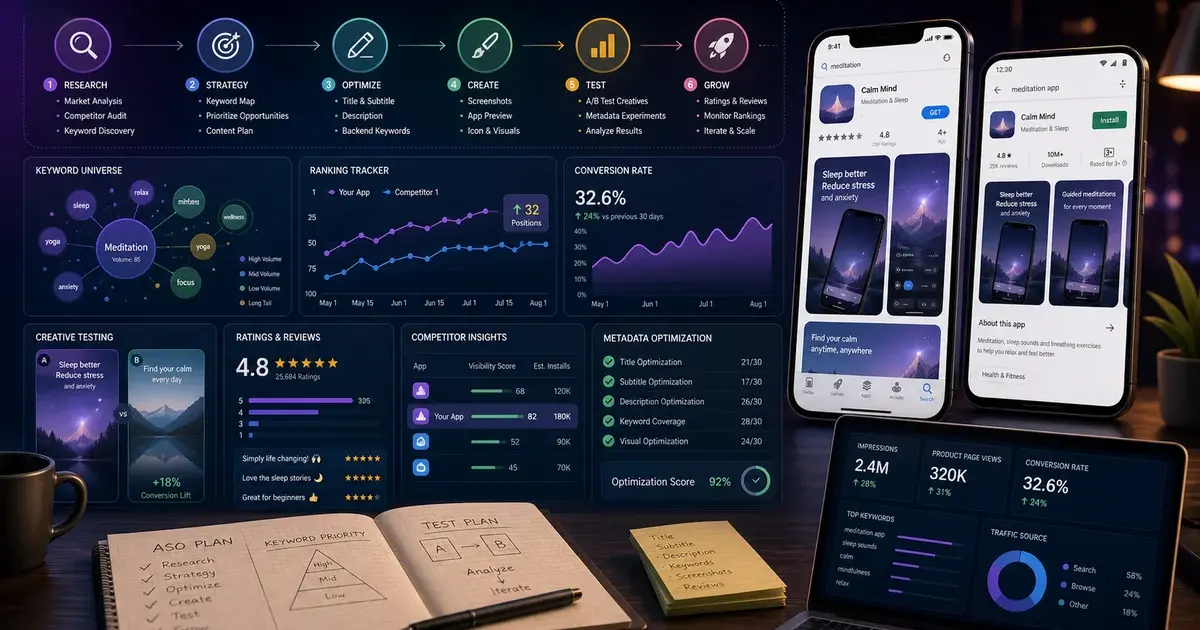
App Store Optimisation compounds because the work improves both ranking and conversion. This guide covers the ASO stack end to end and shows how to choose a partner that can actually move organic installs.
On this page
- What is app store optimisation, and why does it compound?
- What is the difference between on-metadata and off-metadata ASO?
- How do you do keyword research for ASO?
- Which screenshot and creative changes actually lift conversion?
- How do you build a review and rating profile that ranks?
- What should the first 90 days of ASO look like?
- How is ASO different for the India market?
- What goes wrong with ASO, and how do you spot it early?
- How do you measure whether ASO is actually working?
- Is ASO worth paying for if you already run paid UA?
- How do you choose the right ASO partner?
- Frequently Asked Questions
What is app store optimisation, and why does it compound?
App Store Optimisation (ASO) is the discipline of improving an app's visibility, ranking, and conversion rate in the Google Play Store and Apple App Store — and it compounds because every improvement raises both the traffic you get and the share of that traffic that installs. When users search for apps like yours, your app should appear — and when they land on your store listing, they should download.
ASO is often compared to SEO for websites, and the analogy holds in broad strokes. Both involve keyword research, content optimisation, and building external signals of authority. But ASO operates in a uniquely constrained environment — you have limited space in your title and description, your "content" is largely visual (screenshots and preview videos), and the algorithms prioritise engagement signals in ways that search engines do not. The two stores also index different fields, which is why a single listing copied across both underperforms; AppTweak's breakdown of Apple vs Google metadata fields is the clearest public summary of where they diverge.
The business case for ASO is compelling. Studies consistently show that 65–70% of app downloads begin with a search on the store. Apps that rank in the top 3 positions for high-volume keywords receive dramatically more installs than those on page 2 or below. And unlike paid advertising, the installs generated by strong ASO continue to compound month after month at zero incremental cost.
The compounding is mechanical, not mystical. Better metadata earns more impressions. More impressions at a better conversion rate produce more installs. More installs, if the product retains them, strengthen the ranking signals that earn the next round of impressions. Break any link in that chain and the loop stalls — which is why we treat retention and crash rate as ASO inputs, not as somebody else's problem.
For any app serious about growth, professional ASO is not optional — it is the foundation everything else is built on. If you are comparing service providers, keep reading this guide and then review real case studies before you choose a partner.
What is the difference between on-metadata and off-metadata ASO?
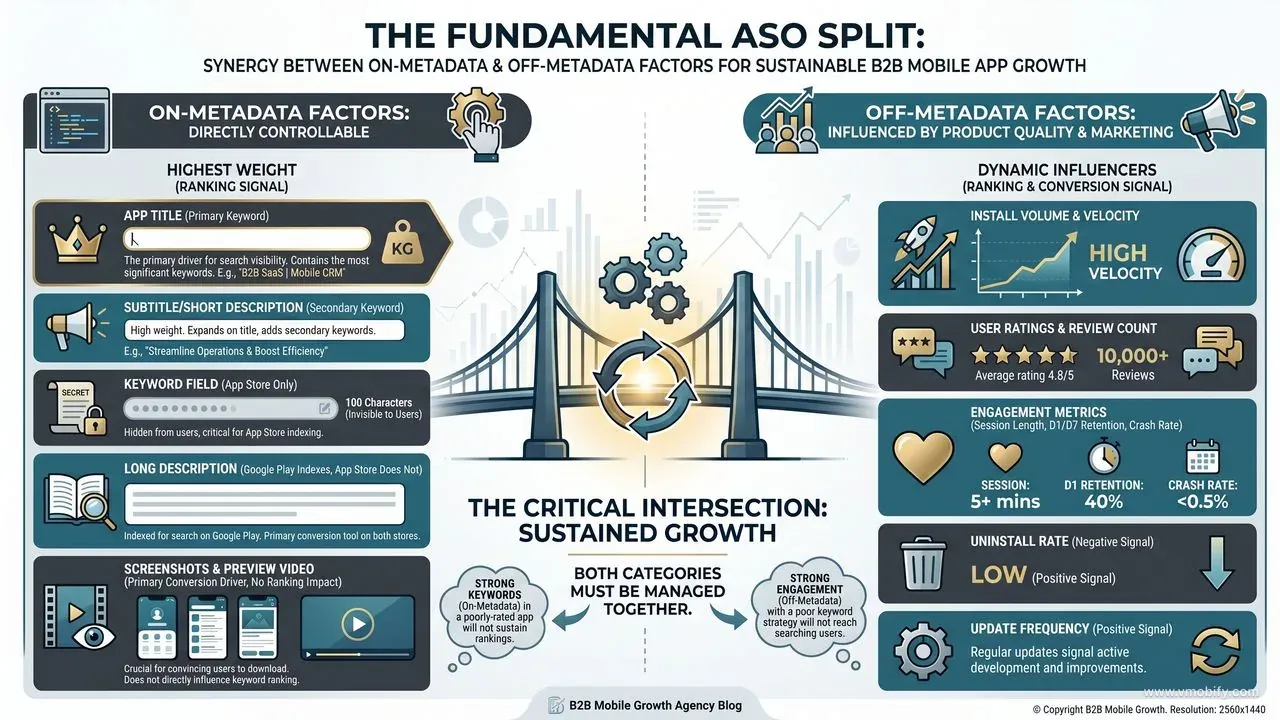
On-metadata factors are the fields you edit directly in your developer console; off-metadata factors are the behavioural signals your product and marketing generate — and rankings only hold when both move in the same direction. Understanding both is essential to a complete strategy.
On-metadata factors are elements you edit directly in your developer console:
- App title: The single most important keyword placement. The algorithm weights title keywords heavily. Include your primary keyword naturally.
- Subtitle (App Store) / Short description (Google Play): Secondary keyword placement with high algorithmic weight. Maximum 30 characters on App Store.
- Keyword field (App Store only): 100 characters of comma-separated keywords that influence ranking but are not visible to users. No duplicates with title or subtitle.
- Long description (Google Play): Google indexes this for ranking. App Store does not. Use your top keywords naturally throughout.
- Screenshots and preview video: Do not affect ranking but are the primary driver of store listing conversion rate. The visual first impression determines whether a visitor becomes an installer.
That last line now needs a caveat. Apple's search system has moved toward reading text inside screenshot captions as an indexable signal, which Appfigures documented in its App Store algorithm analysis. Treat screenshot captions as copy that has to convert first and index second, but stop writing them as throwaway decoration.
Off-metadata factors are signals you build through product quality and marketing activity:
- Install volume and velocity
- User ratings and review count
- Engagement metrics (session length, D1/D7 retention, crash rate)
- Uninstall rate
- Update frequency
Both categories must be managed together. Strong keywords in a poorly-rated app with low retention will not achieve sustained rankings. Strong engagement metrics on an app with poor keyword strategy will not reach the users who are searching for it. Google is explicit that launch momentum and ongoing quality signals shape distribution — its Play launch best-practices documentation is worth reading before any metadata work starts, because it tells you which off-metadata levers the platform actually watches.
How do you do keyword research for ASO?
Keyword research for ASO means finding terms with real search volume, beatable competition, and genuine relevance to your app — then sequencing them so you win the reachable ones first and use that authority to attack the hard ones. The goal is never a list; it is a ranked plan.
The keyword research process for ASO:
- Seed keyword generation: Start with the obvious terms your app should rank for — your category, core use case, and primary audience. Then expand using autocomplete suggestions, competitor keyword analysis, and user-generated terms from your reviews.
- Volume and difficulty assessment: Tools like AppTweak, Sensor Tower, and MobileAction score keywords by search volume and ranking difficulty. Prioritise high-volume, moderate-difficulty keywords where a newcomer can compete.
- Long-tail opportunities: Specific, multi-word queries often have lower competition and higher intent than broad single-word terms. A finance app might rank for "expense tracker for freelancers" far more easily than "expense tracker."
- Competitor gap analysis: Identify keywords your competitors rank for that you do not. These represent untapped opportunities where the demand already exists.
- Vernacular research (India-specific): For apps targeting Indian users, keyword research in Hindi, Tamil, Telugu, and other regional languages reveals opportunities with minimal competition. Most ASO companies ignore this entirely.
The step most teams skip is the one that decides everything: mapping each keyword to a field. A term can live in the title, the subtitle, the Apple keyword field, or the Play long description, and each placement carries different weight and different real estate cost. Write the map before you write the copy, or you will spend your 30-character subtitle on a term the algorithm was already giving you for free through the title.
Keyword strategy is not a one-time exercise. Google Play and the App Store algorithms evolve, user search behaviour shifts, and competitor keyword strategies change. Monthly keyword reviews — monitoring ranking changes and identifying new opportunities — are a core part of ongoing ASO management. Our ASO+ service includes this as standard practice, and our guide to the ASO tools worth paying for in 2026 covers which of the research platforms are worth a licence at your stage.
Which screenshot and creative changes actually lift conversion?
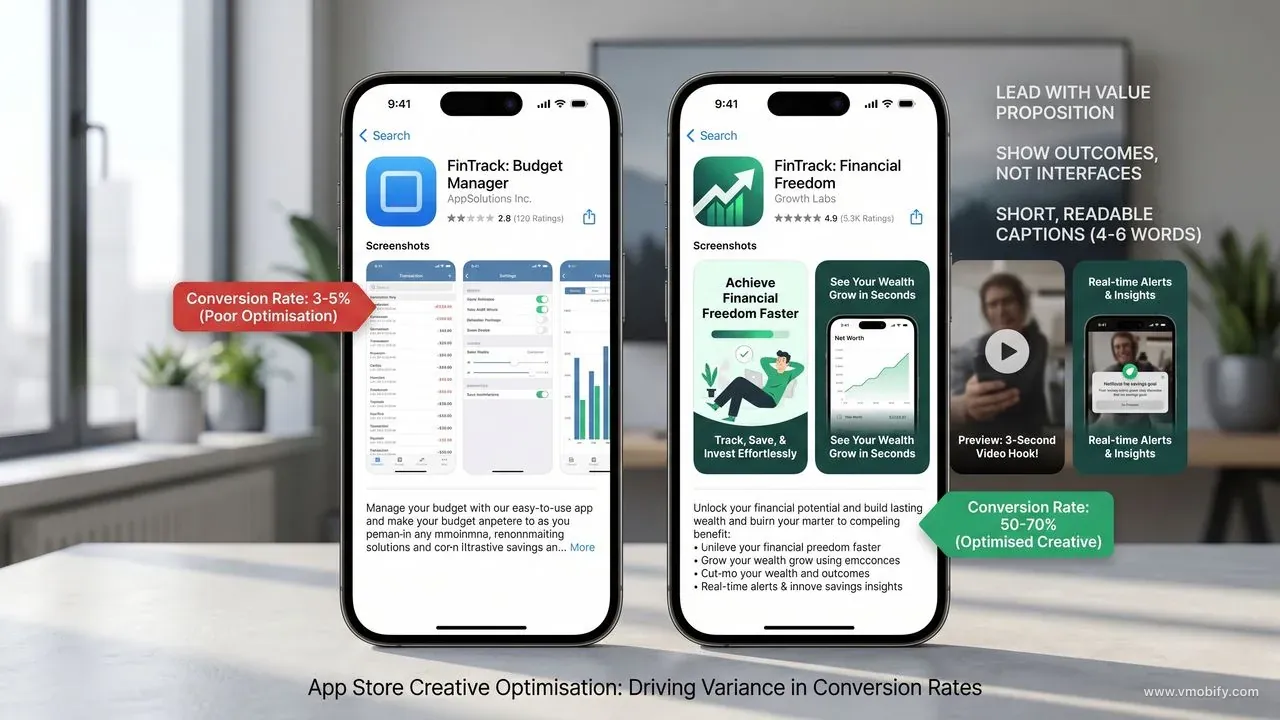
Once a user clicks on your store listing, screenshots are the most influential element in the conversion decision — and the changes that move the number are almost always about the first two frames, not the last six. Research consistently shows that screenshots drive 50–70% of the conversion rate variance between similar apps in the same category.
Principles of high-converting app store screenshots:
- Lead with the value proposition: The first 1–2 screenshots visible without scrolling must communicate what your app does and why it matters. Most users do not scroll past screenshot 3.
- Show outcomes, not interfaces: Users care about what they will be able to do, feel, or achieve — not what your app's interface looks like. Show the result of using the app, not the UI itself.
- Use short, readable captions: Caption text should be large enough to read on a small screen without zooming. 4–6 words per caption is optimal.
- Design for portrait on mobile: Even if your app is landscape, your screenshots are viewed in portrait on a phone. Design the screenshot composition accordingly.
- Preview video: Apps with a preview video consistently show 15–25% higher conversion rates than apps without one. The video must hook within the first 3 seconds.
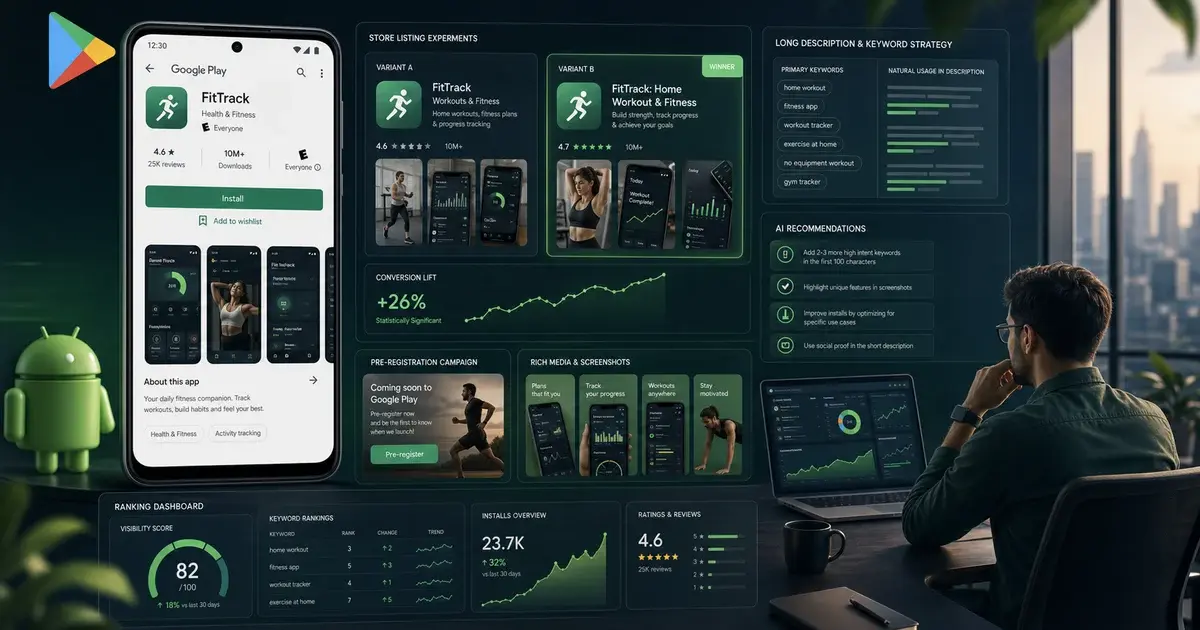
Do not rely on intuition for creative decisions — test them. Google Play Store Listing Experiments allows A/B testing of screenshots natively. Apple runs similar experiments through App Store Connect, and Apple's Custom Product Pages let you serve a different set of screenshots to a different traffic source entirely — the same paid campaign landing on a matched listing rather than a generic one. Running structured tests with statistical significance thresholds is the only way to know definitively what converts best for your specific audience. Our team has run hundreds of these experiments and consistently achieves 15–40% CVR improvements within 90 days.
Two practical rules keep those tests honest. Test one variable at a time — a new hero frame and a new caption system tested together tell you nothing about which one worked. And never call a test on a weekend-only sample; store traffic mix shifts by day of week, and short reads on skewed traffic are how teams end up shipping a losing variant with confidence. The mechanics of running these properly are covered in our Play Store Listing Experiments walkthrough and our screenshot design guide.
How do you build a review and rating profile that ranks?
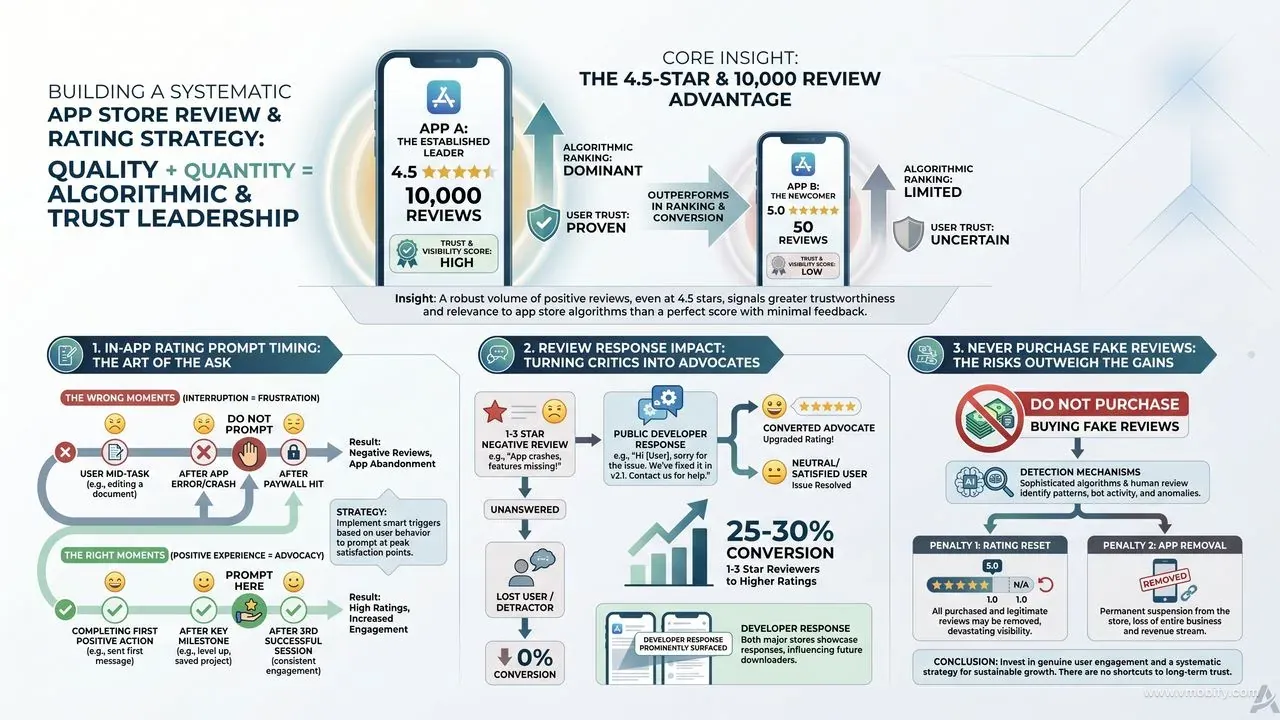
User ratings and reviews are a ranking signal and a conversion signal simultaneously, so the goal is volume and recency together, not a single high number. A 4.5-star app with 10,000 reviews outperforms a 5-star app with 50 reviews in both algorithm ranking and user trust.
Building a strong review and rating profile requires a systematic strategy:
- In-app rating prompts: Use the native rating prompt (SKStoreReviewRequest on iOS, ReviewManager on Android) at the right moment — after a user has completed a positive action, not mid-task. The timing of the prompt dramatically affects the rating distribution.
- Segment who you ask: Show rating prompts to users who have reached a defined engagement threshold (e.g., completed 3 sessions, achieved a milestone). Avoid prompting immediately after onboarding or when a user has encountered an error.
- Respond to reviews: Responding to negative reviews publicly shows responsiveness and converts some dissatisfied users into advocates. Both Apple and Google surface developer responses prominently. This is free reputation management that most apps ignore.
- Flag policy-violating reviews: Both stores have mechanisms to flag and remove reviews that violate their policies (spam, off-topic, competitor sabotage). Use them. A process for regular review auditing is worthwhile for apps with significant review volume.
Reviews are also your cheapest research asset. The words users choose when they describe what your app does for them are the words they type into store search, and mining a few hundred reviews regularly produces both keyword candidates and screenshot caption lines that already sound like your audience. We treat review mining as a monthly input to the keyword map, not as a support task.
Never purchase fake reviews. Both Google and Apple have sophisticated detection mechanisms, and Apple's App Store Review Guidelines treat rating and review manipulation as grounds for removal from the programme outright. Apps caught with fraudulent reviews face rating resets, featured position removals, and in serious cases, app removal. The short-term gain is never worth the long-term risk. Our guide to earning ratings and reviews legitimately covers the prompt-timing patterns that work without breaking policy.
What should the first 90 days of ASO look like?
Do the work in this order: baseline, metadata, creative, then ratings and iteration — because each stage produces the evidence the next stage needs, and skipping ahead means testing creative against a listing that was never indexed properly in the first place.
- Weeks 1–2 — baseline and audit. Export 90 days of store console data before you change anything: impressions, product page views, conversion rate, organic versus paid split, uninstall rate, crash-free sessions. Without a pre-change baseline you cannot attribute anything you do later, and this is the single most common gap we find when we take over an account.
- Weeks 2–4 — keyword map and metadata rewrite. Build the keyword-to-field map, rewrite title, subtitle or short description, the Apple keyword field, and the Play long description. Ship it as one release so re-indexing happens once and the before/after read is clean.
- Weeks 4–8 — creative testing. Start with the first screenshot frame, because it is seen by every visitor from every traffic source. Run one variable at a time and hold each test until it reaches significance rather than until someone is impatient.
- Weeks 6–10 — ratings system. Instrument the native prompt behind a success trigger, set up a response workflow for one- and two-star reviews, and start the monthly review-mining pass that feeds the next keyword round.
- Weeks 10–13 — second iteration and reporting. Re-rank the keyword map against actual movement, promote long-tail wins into the higher-weight fields, and produce the first honest before/after on organic installs and conversion rate.
The uncomfortable part of this schedule is that weeks 1 to 4 produce almost nothing visible. Store indexing takes days, ranking movement takes weeks, and any partner promising a chart that bends upward in month one is either buying installs or reporting on a metric that does not matter. Across the 300+ apps we have managed since 2013, the accounts that ended up with durable organic growth are consistently the ones whose first month was spent on measurement discipline rather than on shipping a redesign nobody could evaluate.
One sequencing rule matters more than the rest: fix retention and crash rate before you buy velocity. Pushing install volume into an app that churns feeds the algorithm exactly the signal you do not want, and you pay for the privilege.
How is ASO different for the India market?
India is an Android-first, multilingual, price-sensitive, multi-store market, and an ASO plan built for the US App Store fails on all four counts. The listing that works in San Francisco is usually the wrong listing for Lucknow, and the gap is not translation — it is the entire search and conversion context.
- Android carries the volume. Play is where the audience is, which means the long description is an indexed field you actually have to write, and Play's Store Listing Experiments are your primary testing surface rather than an afterthought.
- Vernacular search is under-contested. Hindi, Tamil, Telugu, Marathi, and Bengali queries face far less competition than their English equivalents, and Play's localised listing slots let you serve those users a page in their own language. Most competitors leave these fields empty.
- Tier-2 and Tier-3 users behave differently. Entry-level devices, tighter data budgets, and lower storage headroom mean app size and first-run performance are conversion factors, not engineering trivia. A large binary loses installs at the download step no matter how good the screenshots were.
- There is a second store. Indus Appstore is a real distribution surface in India with its own listing fields and its own competitive vacuum — we cover the mechanics in our Indus Appstore guide.
- Screenshot copy has to survive a small screen. Caption text sized for a flagship display is unreadable on the devices most of this audience uses. Test on a low-end handset, not on a designer's monitor.
On budget: the ranges we quote for Indian engagements run Rs 30,000–80,000 a month, with the position inside that band set by scope — a single-store listing with a focused keyword set and one creative test cycle sits at the lower end, and a dual-store programme with vernacular listings, continuous creative testing and review operations sits at the upper end. What matters more than the number is what the retainer buys: a monthly metadata rewrite is not the same product as a live testing calendar, and the two should never be quoted as though they were.
The scale of the opportunity is why this matters: Statista's forecast of smartphone users in India tracks a base large enough that a few positions of ranking movement on a vernacular keyword can outweigh a whole month of metro paid spend. For category-level cost context, see our India install cost benchmarks.
What goes wrong with ASO, and how do you spot it early?
Most failed ASO engagements fail in the same five ways, and every one of them shows an early warning sign in the store console weeks before it shows up in the install numbers. Knowing the signal is what lets you correct in month two instead of writing off the quarter.
Failure patterns
- Keyword stuffing the title. Reads badly, converts worse, and risks a policy rejection at review.
- Changing everything at once. Metadata, icon, and screenshots in one release makes attribution impossible.
- Chasing head terms only. Months of effort against terms an incumbent owns, with nothing to show.
- Ignoring the product. Optimising a listing for an app with a broken first session.
- Reporting rank, not installs. Positions climb on terms nobody searches for.
Early warning signs
- Impressions rise but product page views stay flat — your listing is surfacing for irrelevant queries.
- Page views rise but installs do not — the creative or the app size is losing people at the final step.
- Installs rise but D1 retention drops — you have bought the wrong audience.
- Rating average slides after a release — a regression shipped, and the ranking damage follows in weeks.
- The monthly report contains no decision — the engagement has become a status update.
The impressions-up-page-views-flat pattern is the one worth watching hardest. It almost always means the keyword map targeted volume without checking intent, and it is cheap to fix in the next release if you catch it — and expensive to fix after two quarters of building the wrong keyword footprint.
If a prospective partner offers a guaranteed ranking position, walk away. Neither store sells ranking, nobody can guarantee an auction they do not control, and in our portfolio every account that arrived carrying a guarantee had been buying install volume to manufacture it — with the retention collapse that follows.
The recoverable version of all of this is unglamorous: revert the change that broke the trend, re-baseline, and move one variable at a time. We have seen accounts recover a full quarter of lost ranking simply by rolling back an over-optimised title and letting the store re-index a listing humans could read.
How do you measure whether ASO is actually working?
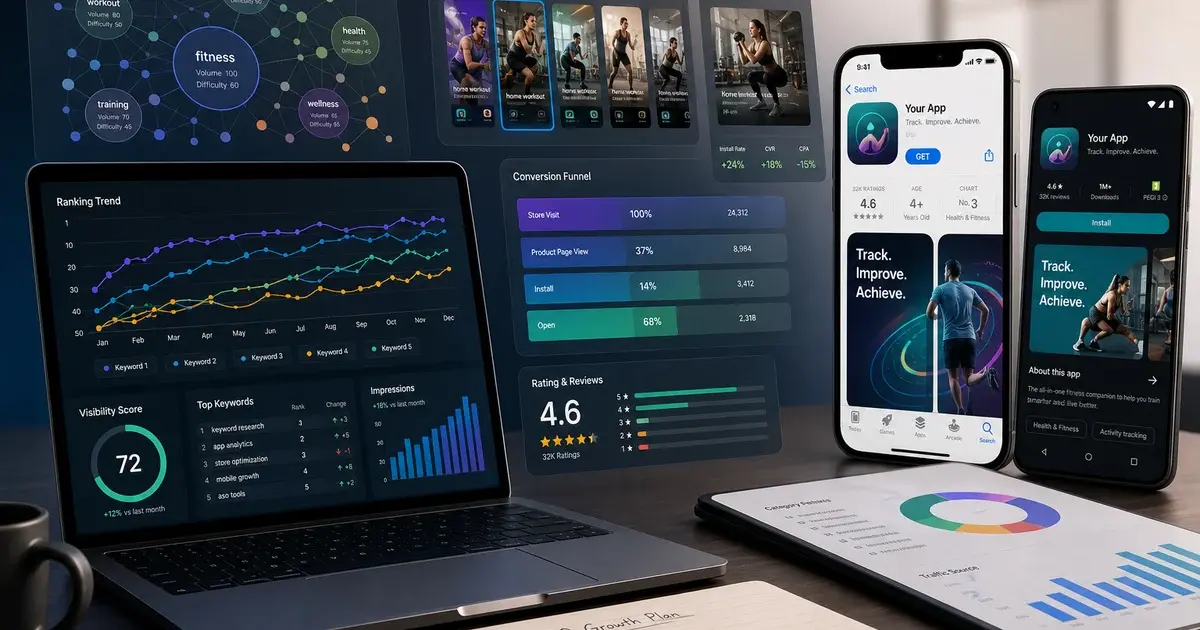
Effective ASO measurement means tracking one metric at each stage of the funnel — visibility, then conversion, then organic installs — so that when a number moves you know which stage caused it. Track the right metrics at each stage, from search visibility to organic install growth:
- Keyword ranking: Track position changes for your target keywords weekly using a tool like AppTweak, Sensor Tower, or AppFollow. Moving from position 20 to position 5 for a high-volume keyword is a concrete measure of progress.
- Keyword impressions (Apple Search Ads data): Apple Search Ads impression data provides a proxy for organic search volume by keyword. This data is available even if you are not running Search Ads campaigns.
- Store listing CVR (Conversion Rate): Both Google Play and the App Store report this natively. Track impressions-to-installs conversion rate monthly and after any store listing change.
- Organic install volume: The most important outcome metric. Available in your Google Play Console and App Store Connect analytics. Track month-over-month organic install growth as the primary KPI of your ASO engagement.
- Keyword footprint size: Total number of keywords your app ranks for in the top 10 or top 50. Growing this number systematically is the goal of an ongoing ASO strategy.
Two measurement traps are worth naming. The first is comparing organic installs across a period when paid spend also changed — paid campaigns lift organic discovery, so an organic rise during a media push is not proof your metadata worked. The second is reading conversion rate without segmenting by traffic source; a listing can improve for search visitors and decline for ad traffic at the same time, and the blended number hides both. Segment before you conclude, and connect the store console to the rest of your stack through proper analytics instrumentation.
Report on these metrics monthly and connect them to business outcomes — not just rankings. A successful ASO engagement ultimately shows up in organic install growth, reduced blended CAC, and improved LTV quality of the user base. Talk to our ASO team about setting up the right measurement framework for your app before any optimisation work begins.
Is ASO worth paying for if you already run paid UA?
Yes — because ASO does not compete with paid user acquisition, it changes what paid costs you. Every ad you run ends at a store listing. If that listing converts better, every campaign in your account gets cheaper on the same media spend, which is why we sequence store work ahead of scaling budget rather than running it as a side project.
The three objections we hear most, and the honest answers:
- "Organic will happen anyway once we scale paid." Partly true — paid spend does lift organic discovery. But that lift lands on whatever listing you have. Scaling media against a weak listing means paying full price for traffic you then fail to convert, and the organic halo you earn is smaller than it should have been.
- "We cannot attribute ASO, so we cannot justify it." You can attribute the conversion half precisely — store console conversion rate is measured, and listing experiments give you a controlled read. The ranking half is slower and noisier, which is an argument for a clean baseline and single-variable releases, not an argument for skipping the work.
- "Our developer already handles the store listing." They handle publishing, which is not the same discipline. Keyword mapping, competitive gap analysis, structured creative testing, and review operations are a weekly cadence, and they are the first thing dropped when a release is due.
There is a real case against paying for ASO, and it deserves stating plainly: if your app has not found product-market fit, if D1 retention is poor, or if you have no budget to run creative tests, ASO spend is premature. Fix the first session first. In our portfolio the engagements that disappoint are almost always the ones where the store listing was asked to compensate for a product problem.
Where ASO and paid genuinely compound is at the traffic-source level: matched creative in a Custom Product Page, a keyword footprint that catches the branded search your ads generate, and a conversion rate high enough that your paid UA programme can bid harder than competitors on the same inventory. Run them as one system, not as two line items.
How do you choose the right ASO partner?
The best ASO partner should be able to show ranking movement, store conversion improvements, and a clear operating cadence before they ask you to sign anything. If they cannot explain the plan in terms of keywords, creative testing, and measurement, they are probably selling ASO as a generic service rather than a growth discipline.
- Ask for category case studies: Finance, gaming, utility, and ecommerce behave differently in the store. The partner should have examples in your category or adjacent categories.
- Check how they measure CVR: ASO is not just ranking. A partner who cannot explain conversion rate changes and screenshot testing is missing half the job.
- Look for a 90-day plan: Month one should cover audit and fixes, month two should cover testing, month three should show compounding gains.
- Review the reporting format: You want keyword movement, organic installs, conversion rate, and next-step recommendations in one view, not a deck full of screenshots with no decisions attached.
- Ask who does the work: Find out whether the person in the pitch is the person on your account each week, and how many accounts they carry. This single question separates most agencies faster than any credentials slide.
Three questions are worth asking in the first call, because the answers are hard to fake: what would make you tell us ASO is the wrong investment right now; which of your last five engagements did not work and why; and what does month four look like once the obvious fixes are done. A partner with real operating history answers all three without hesitating.
At Vmobify, ASO starts with a free audit so the work plan is evidence-led from day one. If you want that style of operating cadence, start with our contact page, review the structure of our ASO service, or read how we scope engagements in our guide to choosing an ASO company in India.
Frequently Asked Questions
What is the difference between ASO and SEO?+
ASO improves visibility and conversion in app stores, while SEO improves visibility and conversion in web search. The mechanics overlap, but ASO is more constrained by store metadata limits and more dependent on screenshots, ratings, and install velocity.
How long does ASO take to work?+
Keyword ranking changes often show within 4–8 weeks, while meaningful organic install growth usually needs 60–90 days of consistent work. Conversion improvements from screenshots and ratings can show earlier if the listing is already getting traffic.
Should I hire an ASO specialist or a full-stack app marketing company?+
If ASO is your primary growth lever, a specialist can be enough. If ASO needs to work alongside paid UA, creative, and lifecycle, a full-stack partner usually wins because the signals compound instead of staying isolated.
Does ASO work the same way on the App Store and Google Play?+
No. Apple indexes the title, subtitle, and a hidden 100-character keyword field, while Google indexes the title, short description, and the full long description. That means Play rewards well-written long-form copy and Apple rewards ruthless keyword economy, so the same listing text should never be shipped to both stores unchanged.
How much should ASO cost per month in India?+
Our engagements run Rs 30,000-80,000 a month. Position inside that band is set by scope: a single-store listing with a focused keyword set and one creative test cycle sits lower, while a dual-store programme with vernacular listings, continuous creative testing and review operations sits higher. Compare quotes on what the retainer actually buys — a monthly metadata rewrite and a live testing calendar are different products.
Can ASO alone grow an app without any paid spend?+
It can, but slowly and only in categories where search demand already exists for what you do. ASO captures existing intent rather than creating it, so a genuinely new category usually needs paid or earned media to build the search demand that ASO then harvests. Most apps in our portfolio use ASO to lower the cost of paid acquisition rather than to replace it.
How often should app store metadata be updated?+
Plan a substantive keyword and metadata review monthly, and ship changes in deliberate batches rather than continuously. Constant small edits make attribution impossible and give the store no clean period to re-index, while going more than a quarter without a review means missing seasonal search shifts and new competitor terms.
Sources
- Apple App Store Review Guidelines — Official rules on rating and review manipulation, metadata, and grounds for removal
- Apple — Custom Product Pages — How to serve traffic-source-specific screenshot sets from a single app listing
- Google Play — Launch Best Practices — Google's own documentation on launch momentum and quality signals that shape distribution
- Google Play Developer Policy — Policy boundaries for metadata, ratings, reviews, and store listing claims
- Appfigures — App Store Algorithm Update 2025 — Analysis of Apple indexing text inside screenshot captions as a search signal
- AppTweak — Apple App Store vs Google Play ASO Differences — Field-by-field comparison of which metadata each store indexes
- SplitMetrics ASO Research — Aggregated store-listing A/B testing research on screenshots, icons, and preview video
- Statista — Smartphone Users in India Forecast — Scale context for the Android-first Indian app market
About the author
Amol Pomane — Founder, Vmobify
Amol leads Vmobify, a mobile app growth agency that has driven 30M+ downloads and ranked 54K+ keywords across 300+ apps since 2013. He writes about ASO, paid user acquisition, retention, and the operational reality of scaling mobile apps in India and global markets.