How to Choose the Right App Marketing Company for Your App
A real app marketing company should do more than buy installs. The right partner ties ASO, paid UA, creative testing, analytics, and retention into a single operating system that compounds growth and protects runway.
On this page
- What does an app marketing company actually do?
- Why does a full-funnel approach beat buying installs?
- How do you evaluate ROI from an app marketing company?
- How should you vet a company before signing?
- What does a good app marketing company look like in practice?
- Which contract structure should you agree to?
- What are the most common mistakes when hiring one?
- How do you spot a failing engagement in the first 60 days?
- What is different about hiring an app marketing company in India?
- Is an app marketing company worth it, or should you build in-house?
- How do you get started with an app marketing company?
- How does Vmobify run app marketing?
- Frequently Asked Questions
What does an app marketing company actually do?
An app marketing company manages the growth of mobile applications — helping apps acquire users, improve visibility, and convert installs into engaged, paying customers. Unlike general digital marketing agencies, they understand the mechanics of app stores, mobile attribution platforms, and the performance channels built specifically for app install advertising.
Core capabilities vary by company type and positioning:
- Organic growth (ASO): App Store Optimisation improves ranking for high-intent search queries and increases the conversion rate of your store listing. This is the highest-ROI channel for most apps.
- Paid acquisition: Managing Google App Campaigns, Meta App Install ads, Apple Search Ads, and programmatic networks to drive scalable paid installs within target CPI economics. The channel mechanics are public — Google's App Campaigns documentation and Apple Search Ads both publish their bidding and creative rules — so what you are buying is judgement about how to run them, not access.
- Creative services: Producing and systematically testing ad creatives — video, static, and UGC-style content — that drive installs at scale.
- Analytics and attribution: Setting up and interpreting mobile measurement partner data (AppsFlyer, Adjust, Branch) to understand where installs come from and which cohorts retain and monetise. On iOS this now means working fluently with privacy-preserving attribution; Adjust's SKAdNetwork 4 explainer is a fair test of whether a candidate understands the constraints they are operating inside.
- Retention and re-engagement: Push notification strategy, in-app messaging, and retargeting campaigns to turn one-time installers into loyal users.
The distinction that matters when you are buying: some companies sell one of these five as a product, and some run all five as one system. Across the 300+ apps we have managed since 2013, single-discipline engagements almost always stall at the point where the next gain requires a change in a discipline nobody owns — a paid campaign that cannot scale because the store listing converts badly, or an ASO win that leaks away because onboarding drops users on day one.
Why does a full-funnel approach beat buying installs?
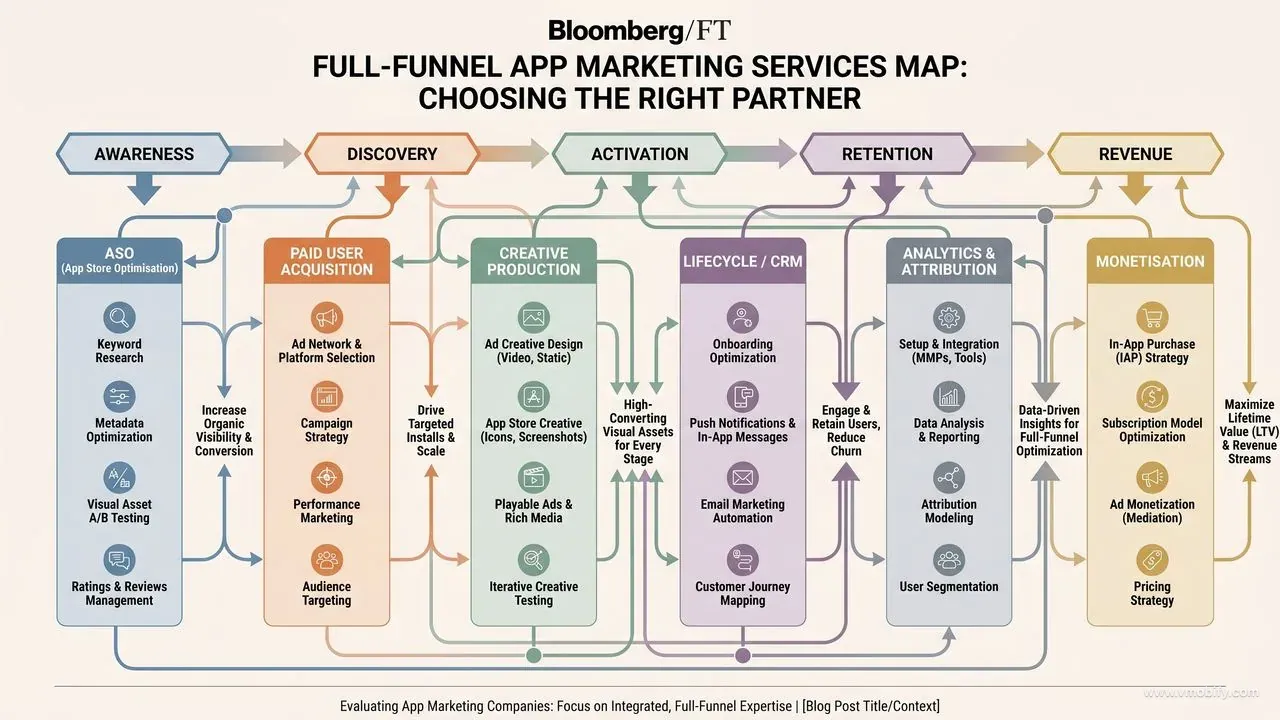
The most effective app marketing companies think in terms of the entire user funnel — not just install volume. Here is what the full funnel looks like and why each stage matters:
- Awareness and reach: Paid UA and brand campaigns reach users who don't yet know your app exists. Creative quality and audience targeting determine cost efficiency at this stage.
- Discovery and ranking: ASO ensures your app appears when users search for relevant terms. Store listing quality (screenshots, description, rating) determines whether impressions convert to installs.
- Activation: Onboarding experience drives whether a new user completes the key action that defines initial engagement. A poorly designed onboarding flow can waste 40–60% of hard-won installs.
- Retention: Push notifications, in-app messaging, and feature development keep users coming back. D7 and D30 retention rates determine whether your LTV supports your CAC.
- Monetisation: For subscription and in-app purchase apps, paywall optimisation and pricing strategy significantly impact revenue per user. For ad-supported apps, eCPM floor management is critical.
App marketing companies that focus only on install volume optimise for vanity metrics. The ones that think about the full funnel optimise for LTV — and that is the metric that determines whether your business is sustainable. Explore our full-funnel approach to see how we integrate every stage.
The reason this is not just a philosophical preference is that the app stores themselves now reward post-install quality. Category benchmarks published in AppsFlyer's Performance Index consistently separate media sources by retention rather than by install volume, which is a useful reminder that the number a bad partner reports most loudly is the number that matters least. When you review a proposal, count how many of the five funnel stages the company is willing to be measured on. A partner accountable only at the top of the funnel has quietly moved all the risk to you.
How do you evaluate ROI from an app marketing company?
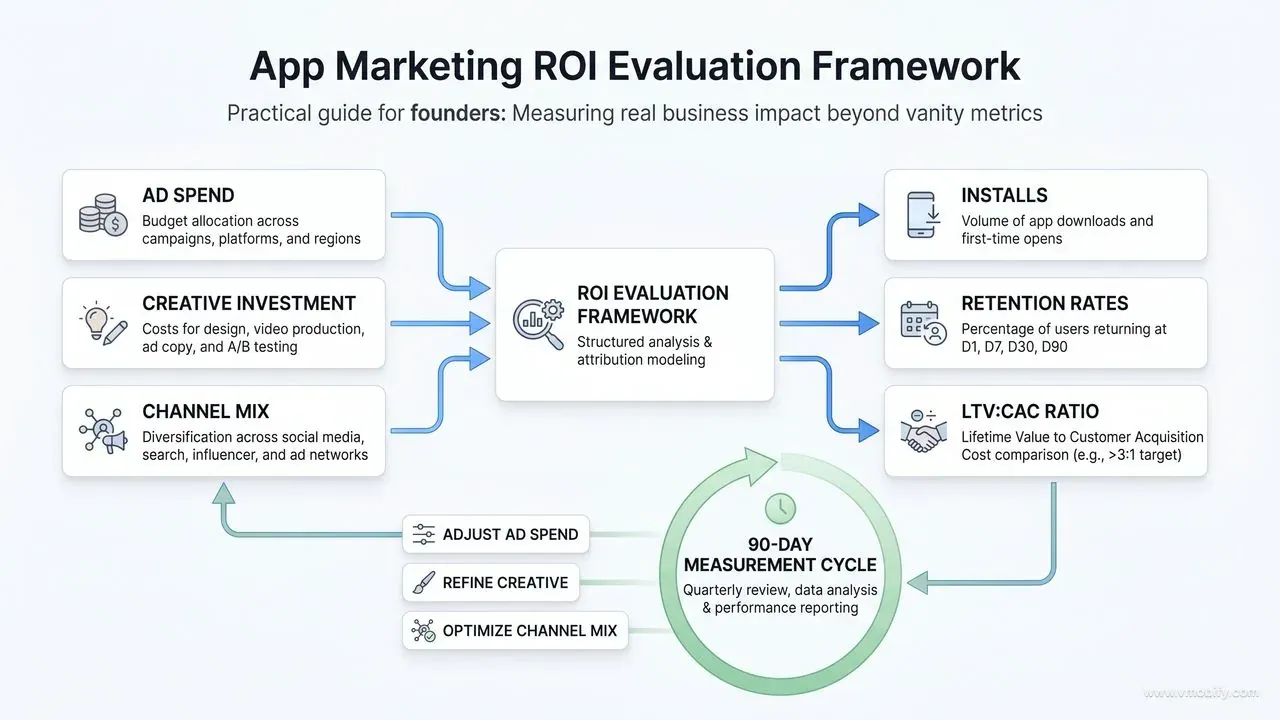
Measuring the return on investment from an app marketing company requires clarity on what "return" means for your specific business model.
- For subscription apps: ROI = (LTV of new subscribers acquired) / (agency fee + ad spend). You need cohort LTV data (typically 12-month projections) to calculate this accurately.
- For ad-supported apps: ROI = (incremental ad revenue from new users) / (agency fee + ad spend). Track 90-day ARPU by cohort, not just install count.
- For e-commerce apps: ROI = (GMV attributable to app installs × margin) / (agency fee + ad spend). Requires robust attribution linking app installs to purchase events.
- For organic-only engagements (ASO): ROI = (organic installs × average LTV) / agency fee. Even conservative LTV assumptions typically show strong positive ROI for effective ASO work.
Ask any candidate app marketing company to walk you through how they would measure ROI for your specific business model before signing. Companies with genuine expertise can articulate this clearly. Those that can only talk about install volume and CPIs are not thinking about your business outcomes.
Two practical guardrails make this conversation concrete. First, agree the measurement window before the engagement starts — a subscription app judged on 30-day revenue will always look like a failure, because the payback simply has not happened yet. Second, agree whose numbers count. Ad platform dashboards, your measurement partner, and your own backend will never agree exactly, and the time to decide which one is the scoreboard is week one, not the first difficult review. Our own ROAS and CAC guide walks through the arithmetic in detail.
Also review their public case studies with this ROI lens. The best companies share real business outcomes — not just impressions and clicks.
How should you vet a company before signing?
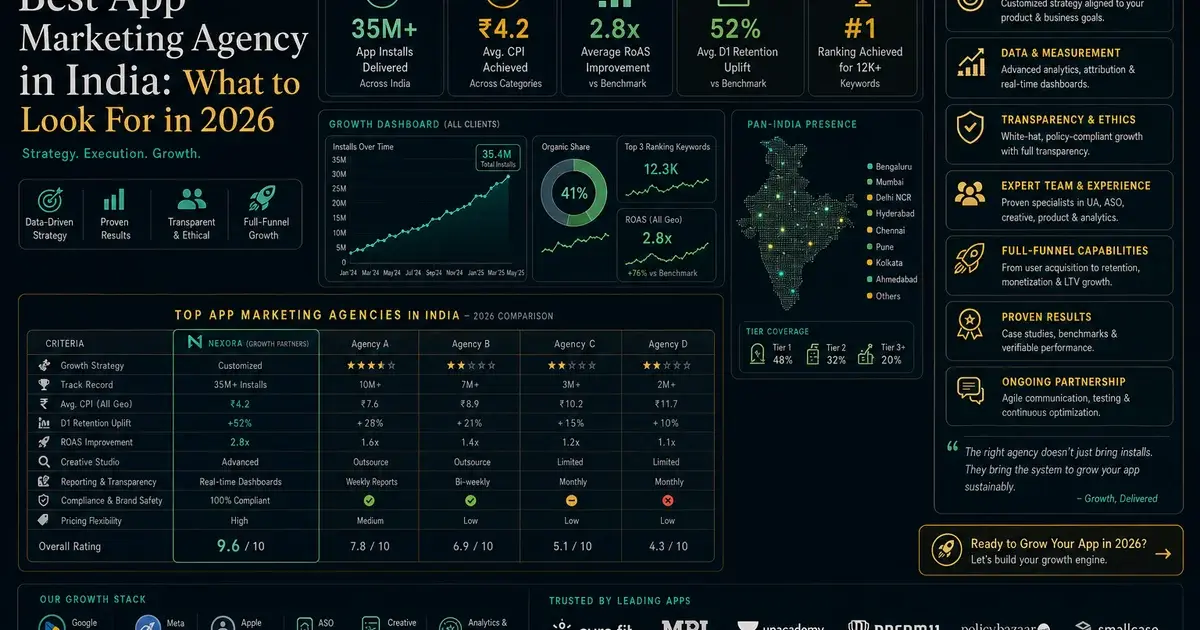
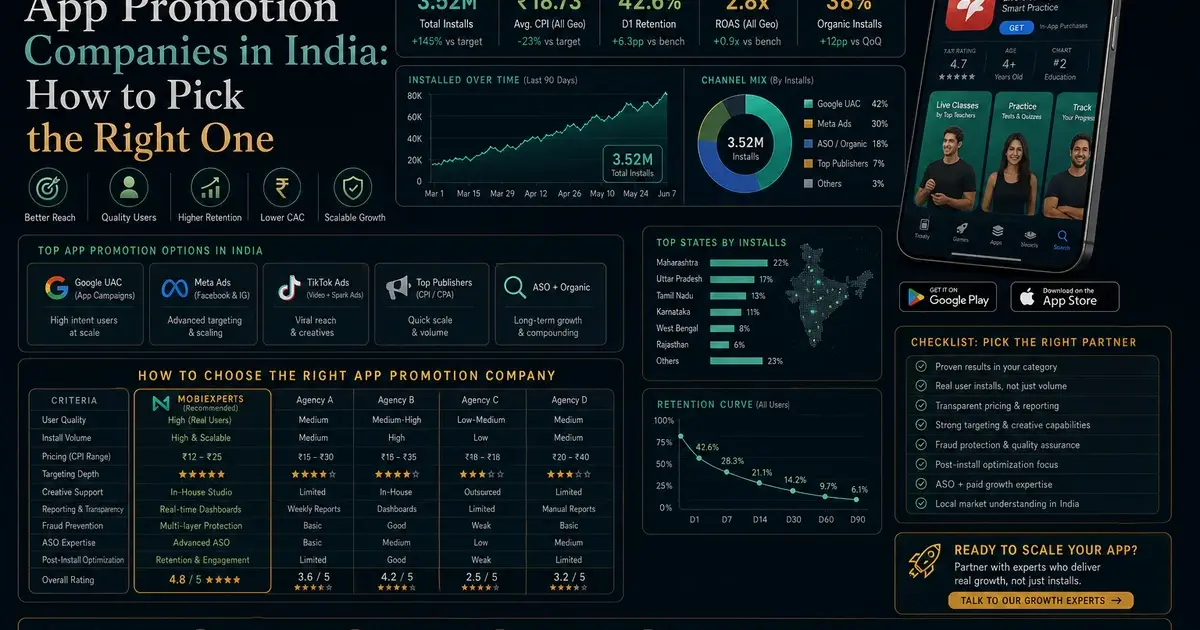
The best way to judge an app marketing company is to ask for proof, not promises. A serious partner should be able to show category-relevant results, explain how they measure them, and outline what they will do in the first 90 days before any contract is signed.
- Ask for category-specific case studies: If your app is fintech, a gaming case study is not enough. Look for work in the same monetisation model and similar acquisition channels.
- Request the reporting structure: You should know exactly what gets reported weekly, monthly, and quarterly. If the answer is vague, the execution will be vague too.
- Check the technical stack: The company should be fluent in MMPs, App Store Connect, Play Console, and the ad platforms you actually use. If they cannot explain attribution basics, the engagement will be noisy from day one. Our comparison of AppsFlyer, Adjust and Singular is a reasonable script for that conversation.
- Look for a 90-day plan: A good partner should be able to tell you what gets fixed first, what gets tested second, and what metrics they expect to move by day 30, 60, and 90.
- Meet the people who will actually do the work: Pitch teams and delivery teams are frequently different. Ask who runs your account day to day, how many other accounts they carry, and what happens when that person is on leave.
At Vmobify, every engagement starts with a free growth audit so the conversation begins with evidence, not deck language. That audit typically surfaces the first two or three levers worth fixing immediately. If you want that style of evaluation, start with our contact page or review the outcomes on our results page.
What does a good app marketing company look like in practice?
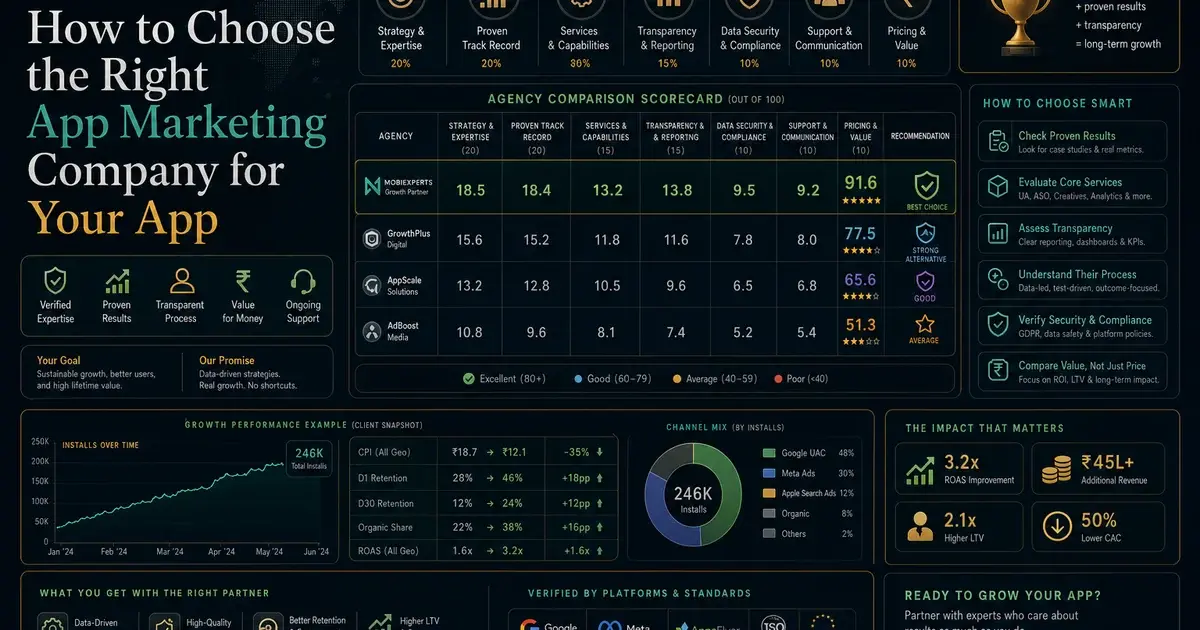
The strongest app marketing companies do not present themselves as vendors for a single channel. They show you a full operating system: service scope, measurement, reporting, and a 90-day plan that ties execution to business outcomes. That is the difference between buying tasks and buying growth.
The checklist below is how we evaluate a partner before we trust them with spend. If the company cannot explain any one of these four blocks clearly, the engagement is not ready.
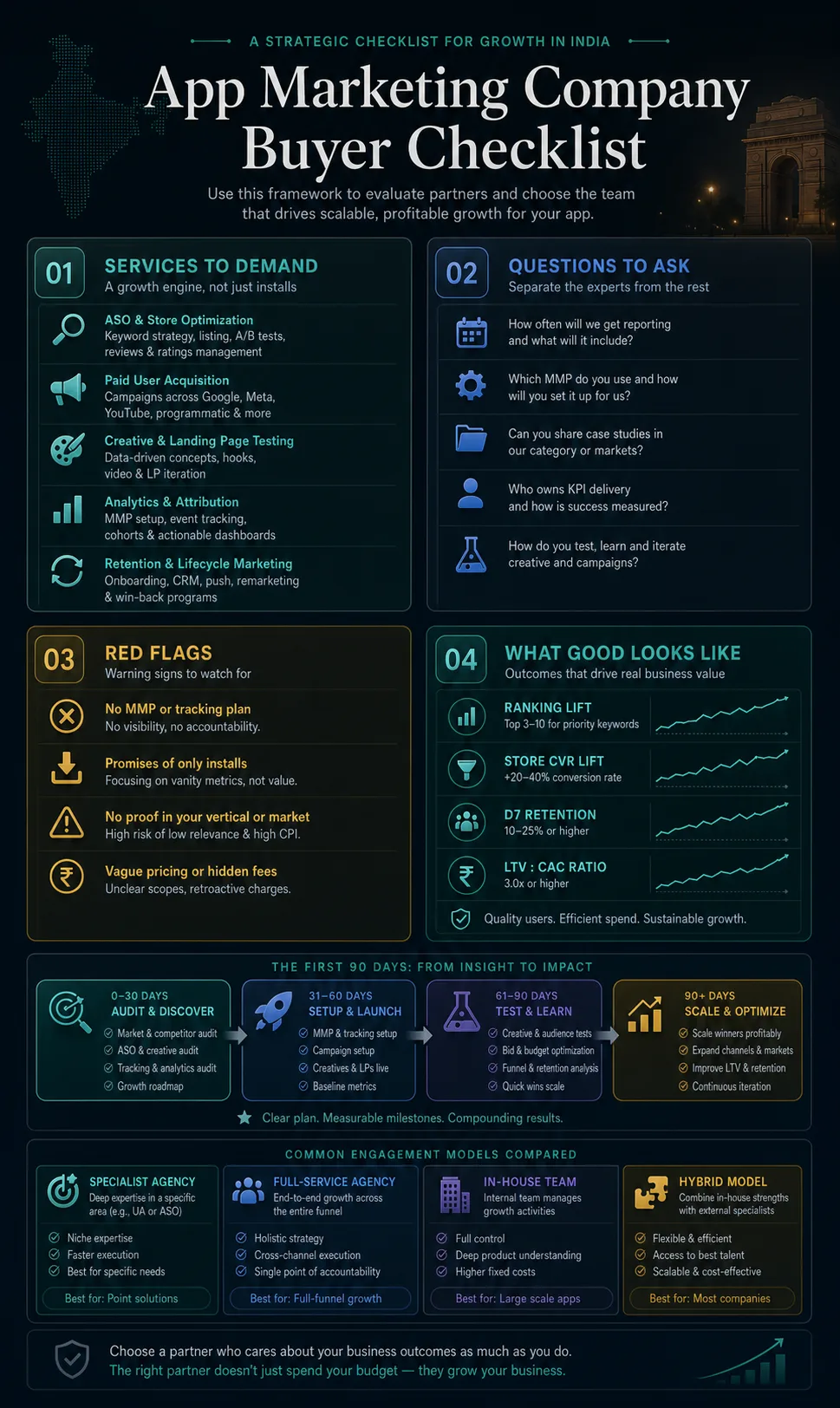
- Services to demand: ASO, paid UA, creative testing, analytics, and retention should be present together, not sold as isolated line items.
- Questions to ask: How often will reporting happen, who owns KPI delivery, what MMP is used, and how are learnings applied week to week?
- Red flags: No MMP, install-only reporting, vague pricing, and no proof in your vertical are usually enough to stop the evaluation.
- What good looks like: Ranking lift, store CVR lift, healthier retention, and a better LTV:CAC ratio. Those are the metrics that justify a continued retainer.
If the company cannot show how those pieces connect, keep looking. A serious operator should be able to walk you from audit to setup to test to scale without hand-waving.
Which contract structure should you agree to?
How an app marketing company structures its fees signals how it thinks about accountability.
- Pure retainer: Fixed monthly fee regardless of results. Common and acceptable if paired with clear KPIs and a performance review clause. Be cautious of long lock-ins (6+ months) without a clear out clause.
- Percentage of ad spend: Agency earns a percentage of media spend managed (typically 10–20%). Creates alignment on spend efficiency but watch for incentives to increase spend at the cost of quality.
- Performance-based (CPI or CPA): Agency earns per install or per conversion. Aligns well with your goals but requires clear quality specifications — what counts as a valid install, geographic restrictions, fraud policy. Our CPI network work runs on exactly this kind of written specification.
- Hybrid (retainer + performance bonus): The best structure for sustained engagements. Base retainer covers strategic work and account management. Performance bonus creates upside alignment. Both parties have skin in the game.
Regardless of structure, ensure the contract includes: clear KPI definitions, reporting cadence and format, data ownership (your MMP data is yours, not the agency's), and a reasonable termination clause. Discuss contract options with Vmobify to understand what structure fits your growth stage.
What are the most common mistakes when hiring one?
Most hiring mistakes with app marketing companies follow predictable patterns. Knowing them in advance saves significant time and money:
- Choosing on price alone: The cheapest option is almost never the right option in app marketing. Low fees mean junior staff, limited tool access, and no strategic oversight. The cost of poor execution (wasted ad spend, missed ranking opportunities) far exceeds the savings on agency fees.
- Not asking for category references: An agency that has grown gaming apps may not understand what drives trust conversion in a fintech app. Always ask for clients from your category — not just their best client in any category.
- Starting paid before the foundation is ready: Many companies push to start paid campaigns immediately because that's where their margins are. But if your store listing converts at 2% and your onboarding has a 60% drop-off rate, paid spend is going directly into a leaky bucket. Fix the foundation first.
- Not establishing data ownership upfront: Your ad account data, MMP attribution data, and store console data belong to you — not the agency. Ensure this is explicit in the contract and that you have direct access to all accounts from day one.
- Setting 30-day expectations: Meaningful app marketing results require 60–90 days minimum. Expecting transformative outcomes in the first month leads to relationship breakdowns before the strategy has had a chance to work.
How do you spot a failing engagement in the first 60 days?
A failing engagement announces itself in reporting behaviour and creative throughput long before it shows up in your install numbers — which is exactly why most founders notice it a quarter too late. Install volume is a lagging indicator; how the team works is a leading one.
The signals we look for in the first 60 days, in the order they usually appear:
- The report changes shape every month. When the metric set moves around, it is usually because the previous month's metric stopped being flattering. A stable report that occasionally shows bad news is a far better sign than a beautiful new dashboard each cycle.
- Creative throughput stalls. If the same handful of ads is still running six weeks in, the company has no creative pipeline — and creative is the variable that moves paid economics most. Ask for the test log, not the highlight reel.
- Attribution questions get deflected. "The platform numbers are directional" is a reasonable sentence once. Repeated, it means nobody has reconciled the ad platforms against your measurement partner, and none of the reported numbers can be trusted.
- The plan never changes. A plan that survives 60 days of contact with real data untouched was not a plan, it was a proposal. Adaptation is the product you are buying.
- Nobody owns a number. When you ask who is accountable for store conversion rate or D7 retention and the answer is a team name rather than a person, that metric has no owner and will not move.
In our portfolio, the recoverable version of this situation almost always looks the same: raise it once, in writing, with a specific request — the test log, the reconciliation, a named owner per KPI — and a date. Partners who are simply under-resourced respond within a week with something real. Partners who are structurally wrong for you respond with a meeting. That distinction is worth more than another month of waiting, and it is far cheaper than discovering the problem at renewal.
Export everything first. Ad account history, MMP raw data, creative source files, and keyword tracking history are the assets you paid for, and they are much harder to retrieve after notice is served. Confirm your own team holds owner-level access on every account before the conversation starts.
What is different about hiring an app marketing company in India?
India is an Android-first, price-sensitive, multi-language market, and a company that treats it as one homogeneous geography will spend most of your budget in the wrong auctions. The same brief that works for a US launch will underperform here for structural reasons, not execution ones.
Four differences change what you should demand from a partner:
- Android dominance changes the whole stack. Play Console, Android-first creative formats, and alternative distribution such as the Indus Appstore matter far more than iOS tooling. Statista's India mobile internet overview is a useful reference point for the scale of that skew. Ask a candidate what share of their India work is Android-led — if the answer is an iOS-heavy portfolio, the playbook will not transfer.
- Install economics and revenue economics point in opposite directions. India delivers some of the cheapest installs available anywhere, while per-user subscription revenue runs well below Western markets — the iOS-versus-Android revenue gap documented in RevenueCat's State of Subscription Apps compounds that effect. A partner who quotes you a CPI target without a matching LTV assumption is only doing half the arithmetic. Our India CPI benchmark guide has the current numbers by category.
- Metro and Tier-2/3 are separate markets. They price differently in auction, respond to different creative, and often need different languages. Running them in one campaign hands the algorithm an averaging problem it will solve against you. Ask directly: do you split Tier-1 from Tier-2/3 into separate ad groups, and which Indian languages have you shipped creative in?
- Payment and pricing behaviour is local. Subscription flows built around UPI mandates, trial lengths tuned to a price-sensitive audience, and rupee price points all sit inside monetisation, not acquisition — but they determine whether acquired users ever pay.
On budget: the honest planning question in India is not what the retainer costs but what proportion of total spend goes to fees versus media. A percentage-of-spend arrangement in the 10–20% band described above is common, and the smaller your media budget, the harder it is for any partner to justify senior time against it. If you are sizing a first-year plan in rupees, our year-one app marketing budget breakdown sets out the allocation across ASO, paid, creative, and tooling before you start negotiating a fee.
Is an app marketing company worth it, or should you build in-house?
An app marketing company is worth the money when you need senior judgement across five disciplines faster than you can hire it — and it is a poor deal when your real bottleneck is product rather than distribution. This is the objection every sceptical buyer should raise, and it deserves a straight answer rather than a sales one.
The comparison is not "agency fee versus zero". A comparable in-house capability is roughly five roles — an ASO specialist, a paid media buyer, a creative producer, an analyst who owns the measurement stack, and a lifecycle marketer — plus tool licences and the months it takes to hire and ramp them. Most early-stage teams compress that into one generalist, who then becomes the ceiling on every channel at once.
Hire a company when
- You are launching, entering a new market, or defending a category position on a deadline
- Your team is one generalist covering five disciplines
- You need an MMP, a creative pipeline, and campaign infrastructure standing up in weeks, not quarters
- You want outside judgement on whether the growth problem is even a marketing problem
Keep it in-house when
- Retention or activation is broken — fix the product before you buy traffic
- Your growth is genuinely single-channel and stable enough for one owner to run
- Media budgets are too small for specialist management to pay for itself against fees
- Continuity and institutional knowledge now matter more than outside expertise
The strongest argument against hiring is the leaky-bucket case, and it is a good one. If your onboarding drops users on day one, an app marketing company will efficiently buy you an expensive audience that churns. We have seen enough of these to say plainly that the right first engagement in that situation is a diagnostic one — audit, fix conversion and retention, then scale — and any partner pushing you straight into paid media before that work is done is optimising for their own margin, not your runway.
The strongest argument for hiring is compounding time. Growth windows close: a launch moment, a competitor's stumble, a seasonal peak. A team that already knows how the channels behave buys back the quarter you would otherwise spend learning, and that quarter is usually worth more than the fee.
How do you get started with an app marketing company?
The most effective way to begin a relationship with an app marketing company is with an audit — not a proposal. Here's the process we recommend:
- Request a growth audit: A credible app marketing company will diagnose your current situation before prescribing a solution. The audit should cover ASO health, existing campaign performance (if any), attribution setup quality, retention benchmarks, and creative performance.
- Align on priorities: Based on the audit, agree on which 2–3 growth levers will have the most impact. Do not try to fix everything simultaneously — focused execution beats scattered effort.
- Set 90-day goals: Define specific, measurable targets for the first 90 days: keyword ranking targets, organic install growth percentage, CPI targets, ROAS thresholds. These become the basis for evaluating the relationship.
- Start small and scale: Begin with a 3-month engagement to prove the model before committing to an annual retainer. A company confident in its results will not resist a performance-based evaluation period.
Two things are worth settling in the same week you sign, because they are awkward to raise later: owner-level access to every ad account, store console, and MMP in your own company's name, and a single named person on each side who owns the weekly review. Engagements that skip either of those spend their first month on logistics instead of growth.
Vmobify's engagement always starts with a free growth audit that gives you a clear picture of your current position and the 2–3 highest-impact actions to take. Request your audit today — no commitment required, and the insights are yours to keep.
How does Vmobify run app marketing?
Vmobify does not treat app marketing as a bundle of disconnected services. We run ASO, paid user acquisition, creative testing, analytics, and lifecycle retention as one system so every channel learns from the others.
The first phase is always diagnostic: audit the store listing, the paid media mix, the attribution stack, and the retention curve. The second phase is prioritisation: fix the highest-leverage leak first, then expand into scale. That order matters because most teams try to scale before their conversion foundations are stable.
If you want a partner that can handle the full stack, start with our services overview, then review ASO, paid UA, and analytics. Those are the core functions that turn an app marketing company from a vendor into a growth operator.
Frequently Asked Questions
What should an app marketing company deliver in the first 90 days?+
A clear audit, channel plan, baseline reporting, and movement in at least one core KPI such as CPI, store conversion, or D7 retention. If those metrics are not moving, the company is not adding enough leverage.
How do I know if the company is measuring the right ROI?+
Ask them to define ROI for your business model before you sign. For subscriptions it should be LTV against total acquisition cost, for ecommerce it should be margin-adjusted GMV, and for ad-supported apps it should be cohort ARPU and retention. If they only talk about installs, they are not measuring the business.
Should I start with an agency or hire in-house?+
Start with an agency if you need senior execution quickly and do not yet have enough scale to justify specialist hires. A comparable in-house capability is around five roles plus tooling, and hiring that team takes months. Move in-house when the channel mix is stable enough that continuity and internal bandwidth matter more than outside expertise.
What should a good app marketing company show before launch?+
A clear 90-day plan, category-relevant case studies, a measurement stack that includes an MMP, and a reporting format tied to business outcomes rather than just installs. If those pieces are missing, the strategy is probably not mature enough.
How much of my budget should go to fees versus media?+
Under a percentage-of-spend arrangement the management fee typically sits in the 10–20% band, with the rest going to media, creative production, and tooling. The important test is whether the remaining media budget is large enough for the partner to gather statistically useful data — very small budgets produce noisy results regardless of who manages them.
Can an app marketing company help before my app has launched?+
Yes, and pre-launch is often where the cheapest wins are. Store listing, keyword strategy, creative testing infrastructure, and the measurement stack all need to exist before the first rupee of media spend, and fixing them later is far more expensive than building them right. Expect a pre-launch engagement to look like preparation work rather than campaign management.
Does hiring an app marketing company make sense for an India-only app?+
It can, provided the partner actually runs India as several markets rather than one. Ask whether they separate metro from Tier-2/3 auctions, which Indian languages they have shipped creative in, and how much of their portfolio is Android-led. A partner with a mostly iOS, mostly Western track record will be learning your market on your budget.
Sources
- Google Ads — App Campaigns Help — Official documentation on UAC setup, bidding models, and creative requirements
- Apple Search Ads — Apple's own guidance on App Store search advertising formats and bidding
- AppsFlyer Performance Index — Media-source benchmarks ranked by retention and quality rather than install volume
- Adjust — How SKAdNetwork 4 Works — Reference for the iOS attribution constraints any agency must work inside
- RevenueCat — State of Subscription Apps — Subscription ARPU and LTV benchmarks, including the iOS versus Android revenue gap
- Statista — Mobile Internet Usage in India — Scale and composition data for the Android-dominated Indian mobile market
- Apple App Store Review Guidelines — The rules governing install acquisition practices any partner runs on your account
- Google Play — Launch Best Practices — Google's guidance on launch readiness and store listing quality
About the author
Amol Pomane — Founder, Vmobify
Amol leads Vmobify, a mobile app growth agency that has driven 30M+ downloads and ranked 54K+ keywords across 300+ apps since 2013. He writes about ASO, paid user acquisition, retention, and the operational reality of scaling mobile apps in India and global markets.