How to Scale Ad Budget Without Resetting the Algorithm
Every performance team has been told that raising the budget resets the algorithm. Google does not document it that way — the triggers it publishes for the Learning status are bid strategy events, and the budget cautions live in a different place with different conditions attached. This is the operational method for stepping spend up without paying for the same calibration twice.

On this page
- What actually resets when you raise a budget?
- How long does the learning period last?
- Why does the first 100 conversions gate everything?
- How big a single step is safe?
- Does your budget support the bid you set?
- What does the daily budget figure actually mean?
- Should you scale the campaign or launch a new one?
- Do other networks work the same way?
- What does a scaling cadence look like?
- Frequently Asked Questions
What actually resets when you raise a budget?
Not what folklore says. Google's documented triggers for the Learning status are bid strategy events, and a budget edit is not among them. That single correction changes how you scale, because most teams are protecting against the wrong thing.
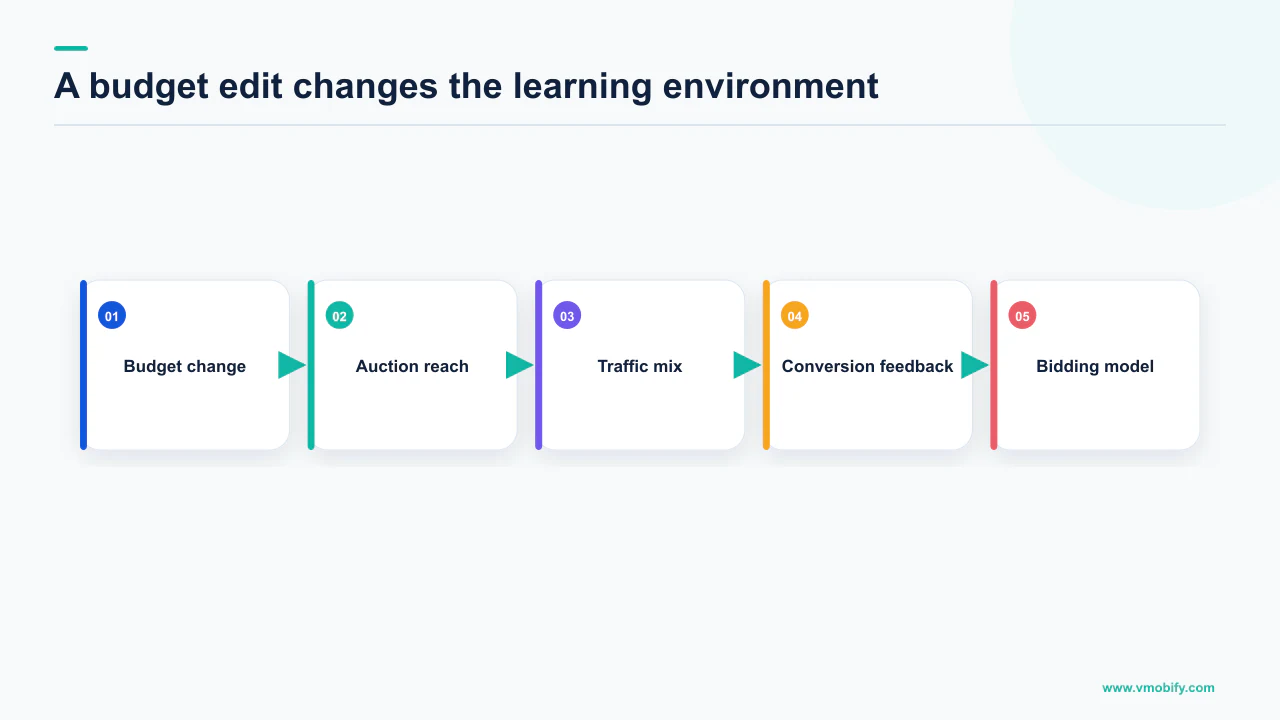
Google's page on the duration of the learning period lists four categories that put a bid strategy into Learning. A new strategy, where the bid strategy was recently created or reactivated. A setting change, where a setting for the bid strategy was changed. A composition change, where campaigns, ad groups or keywords have been added or removed. And an ad group target change, which Google says may in some cases trigger a Learning status on Shopping campaigns.
Notice what is missing. There is no line saying that raising a daily budget flips the strategy into Learning. The cautions about budget are real and we quote them in full below — but they live on different pages, they are worded as risk rather than as a switch, and they carry conditions the folklore version has dropped.
A documented trigger is a rule. A documented caution is a warning about likely disruption. Treating a caution as a rule makes teams freeze budgets that could safely move; treating a rule as a caution makes them recreate campaigns that did not need recreating. Scaling well means knowing which of the two you are looking at.
The honest mechanical picture is this. Raising a budget does not tell the system to forget anything. It changes the volume of auctions the strategy has to fill at a given target — the system has to find more of the same kind of user, and the marginal user is usually more expensive to win. Google does not publish a model for how far a given budget increase perturbs delivery, and we are not going to invent one; there is no publishable number for "a X% budget rise costs you Y days". The damage from scaling badly shows up as cost, not as a status label. Our companion piece on why CPI rises as you scale covers that economics in depth. This article is the operational side: how to move the number without paying for calibration twice.
Across the 300+ apps we have managed since 2013, the most common scaling failure is not a reset at all. It is a team making four changes in one afternoon, seeing performance move, and having no way to attribute the move to any one of them.
How long does the learning period last?
Google states it can take up to 3 weeks or 1-2 conversion cycles for the bid strategy to calibrate to the new objective, although it can be faster depending on the amount of conversion data present. That is the only duration figure Google publishes, and the qualifiers are part of it.
The same page names three factors that determine where inside that range you land: the number of conversions that your campaigns, ad groups, keywords or products obtain; the duration of your conversion cycles; and the bid strategy itself, with Maximize Conversions and Maximize Conversion Value given as the examples.
The second unit is the one worth internalising. Google offers conversion cycles as an alternative to weeks, which means the clock is not really a clock — it is a data counter wearing a calendar's clothes. A campaign generating a high volume of installs a day calibrates on a completely different timeline from one generating a handful, and no amount of waiting substitutes for volume.
Google's tips for maximising your App campaign add the front end of that timeline, noting that App campaigns can take a few days to start gathering information. Between the two pages you get a shape rather than a schedule: a few days before there is anything to look at, and potentially up to three weeks before a strategy has settled against a new objective.
What neither page provides is a mandatory waiting interval between changes. Teams routinely quote one to each other — a fixed number of days you must leave a campaign alone — and we cannot source it. That figure is not publishable, so we do not print it. What is sourced is the conversion-count condition in the next section, and it is a better gate than any calendar rule because it scales with your campaign instead of ignoring it.
Why does the first 100 conversions gate everything?
Because Google states that making changes to your in-flight campaign before the first 100 conversions have registered may disrupt learning and result in poorer performance. That sentence, from Google's best practices for App campaigns, is the closest thing to a hard gate in the documentation.
Every word of the condition travels with the number. It is the first 100 conversions, not a rolling window. It applies to an in-flight campaign, meaning one already running rather than one being set up. And Google says such changes may disrupt learning — it is a stated risk, not a guarantee of damage. Quoting it as "you cannot touch a campaign until 100 conversions" overstates it; quoting it as a vague suggestion understates it. It is a threshold below which you should expect changes to cost you.
The gate is more useful than a calendar rule because 100 conversions is a count, and counts scale with spend. Two campaigns on identical daily budgets can sit on opposite sides of it at the same moment: at a target of ₹40 per install a given budget clears 100 installs quickly, while at ₹400 the same budget takes an order of magnitude longer. Those are arithmetic examples on figures we chose, not benchmarks — we do not publish a CPI benchmark we cannot source.
Put the conversion count since the last material change on the same dashboard row as spend. Most teams track conversions since campaign start, which is the wrong denominator once you have edited anything. The number that governs your next edit is conversions accumulated since your last one.
It is also why launching several small campaigns instead of one larger one so often underperforms. Splitting a fixed budget across four campaigns divides the conversion signal four ways, and each fragment needs its own hundred conversions before edits are safe. You have not diversified; you have quadrupled the calibration bill. Our guide to building a mass acquisition programme covers when the consolidation argument stops applying.
How big a single step is safe?
Google's stated guideline is to avoid drastic changes, giving as its examples changing the budget by more than 20% or changing your CPI by more than 20%. That is a guideline about magnitude, and the only percentage Google puts a number on.
The exact wording on the App campaign tips page is to try not to make drastic changes to your campaign, for example changing the budget by more than 20%, or changing your CPI by more than 20%. Two things follow from how that is phrased. Budget and bid are each named separately, which means a 20% budget rise combined with a 20% bid cut is not one change within the guideline — it is two changes that happen to be individually within it. And the guideline is expressed as a percentage, so it compounds: a campaign that takes a 20% step every time it clears the gate doubles its budget in four steps.
- Change one variable at a time. Budget or bid, not both. If both move together and performance shifts, you have learned nothing about which lever did it.
- Keep the step inside the stated guideline. Google's example is 20%; a step larger than that is explicitly the kind of change the page describes as drastic.
- Wait for conversions, not for days. The documented gate is the first 100 conversions on an in-flight campaign, which is a count you can watch accumulate.
- Do not reverse the last change. Google's best practices page advises avoiding cycling your bids up and down, and aiming for one-time changes if possible.
- Write down what you changed and when. Without a change log, the delivery chart is uninterpretable — you cannot separate your edits from the auction's own movement.
The fourth step is the one teams break under pressure. Performance dips after a rise, someone reverses it, someone raises it again, and the campaign has absorbed three changes in a week. A reversal is itself a change rather than an undo — there is no undo button on a bid strategy.
Does your budget support the bid you set?
Google publishes minimum budget-to-bid ratios for App campaigns, and they differ by campaign type — so a bid that is fine at one budget is starved at another. This is the check most teams skip, and it explains a large share of campaigns that quietly fail to spend.
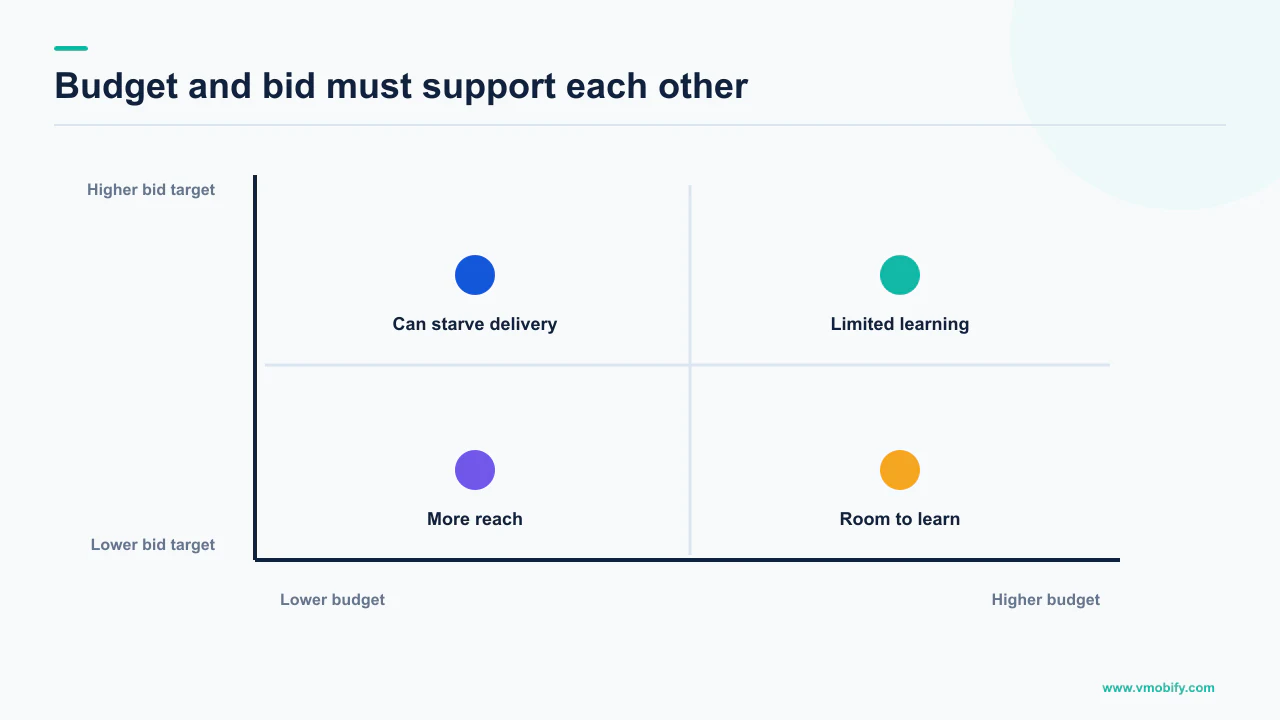
The best practices page states them directly: for ACi tCPI and ACpre, the budget should be at least 50 times the bid; for ACi tCPA, the budget should be at least 10 times the bid; for ACe tCPA, the budget should be at least 15 times the bid. Google uses its own campaign-type shorthand on that page and does not expand the abbreviations there, so we quote them as written rather than guess at expansions.
ACi tCPI and ACpre
- Budget at least 50x the bid
- The most demanding of the three ratios
- A bid of ₹100 implies a budget of at least ₹5,000
ACi tCPA
- Budget at least 10x the bid
- The least demanding of the three
- A bid of ₹500 implies a budget of at least ₹5,000
ACe tCPA
- Budget at least 15x the bid
- Sits between the other two
- A bid of ₹400 implies a budget of at least ₹6,000
The arithmetic in those cards is the ratio applied to a bid we picked for illustration, not a recommended bid. The point is the relationship: the ratio is a floor on budget given a bid, which means raising a bid without raising the budget can push a campaign under its own floor.
This also reframes what a budget increase is for. If a campaign sits at exactly its ratio floor, the first tranche of any budget rise is not buying scale at all — it is buying the headroom the bid already needed. If your campaign is not spending its budget in the first place, the ratio is one of the first things to check, and our diagnostic on an App campaign that will not spend works through the rest of the fault tree.
Google's own description of App campaigns is that you provide some text, a starting bid and budget, and the languages and locations for your ads, and the system tests different asset combinations using your text ideas, images, videos and assets from your store listing. Read that as assets rather than finished ads. The system tests different ad combinations and serves the best-performing ads. Bid and budget are two of the very few inputs you control. Setting them out of proportion to each other wastes one of them.
What does the daily budget figure actually mean?
It is an average, not a cap — Google states your campaign spend will never exceed 2 times your average daily budget on a given day, and that in a given billing period you are never charged more than 30.4 multiplied by your average daily budget amount. Both halves of that matter when you are scaling.
Google's page on choosing your bid and budget sets out the mechanism. The daily figure is the average you are comfortable spending per day; individual days can run above it because traffic fluctuates, bounded at twice the average; and the billing period is bounded by the 30.4 multiplier, Google's figure for the average number of days in a month.
Two operational consequences follow directly.
- A single overspending day is not a signal. It is the documented behaviour of an average daily budget, bounded at 2x. Reacting to it by cutting the budget introduces a change the campaign did not need, and that change is subject to every caution in this article.
- Judge spend over the billing period, not the day. The 30.4 multiplier is the number that governs what you can actually be charged, so a period-level view is the one that matches how the product bills.
Never more than 2 times the average daily budget on a given day. Never charged more than 30.4 times the average daily budget in a billing period. Everything between those two bounds is normal delivery, not a problem to solve.
A finance team working from the daily number will be surprised by a 2x day; a team working from the 30.4 multiplier will not. That alignment prevents the worst kind of intervention — a mid-flight cut driven by an accounts query rather than by performance. We work through the cash side in our guide to UA budget and cash payback, and the return side in the ROAS and CAC guide.
Should you scale the campaign or launch a new one?
Scale the existing campaign wherever it is viable, because creating a new one starts a new bid strategy — and a bid strategy that was recently created or reactivated is the first documented trigger for the Learning status. Duplication is the one move that reliably does the thing everyone is trying to avoid.
The instinct runs the other way. When a campaign performs well, teams want to clone it and run the clone at a higher budget, on the theory that the original stays safe. But the clone has no calibration at all: it is a new bid strategy, it starts in Learning, and it has to accumulate its own conversions before edits to it are outside the caution zone. You have not protected the original; you have bought a second calibration.
Be careful how far you take this one. Google's list of Learning triggers names a bid strategy that was recently created or reactivated. A campaign paused to control month-end spend and switched back on afterwards is a reactivation. If your spend control involves pausing and resuming campaigns on a cycle, you are paying that cost every cycle.
The same page lists composition changes — campaigns, ad groups or keywords added or removed — as a trigger in their own right, so restructuring is not a neutral tidy-up. Settle on a structure before you scale rather than during.
There are legitimate reasons to open a new campaign: a genuinely different objective, a different market, a different campaign type where the bid semantics differ. Those are cases where the existing strategy is calibrated to the wrong thing and the recalibration is the point. What does not justify a new campaign is a desire to spend more money on something that already works. That is what the budget field is for.
When the existing campaign genuinely cannot absorb more spend at an acceptable cost, the answer is usually upstream of bidding altogether. New creative expands the set of auctions you can win without asking the same strategy to reach further into the same audience, and our creative strategy guide covers how to feed that pipeline. In our experience that lever is under-used precisely because it is slower to pull than a budget slider.
Do other networks work the same way?
The shape is similar and the published numbers are not — TikTok, for instance, states that volatility typically starts to decline after about 25 campaign results or 7 days from when the campaign enters the learning phase. A single scaling rule applied across networks will be wrong on at least one of them.
Note what that TikTok sentence actually claims. It describes volatility starting to decline after about 25 results or 7 days — not a hard exit from the phase, and not a threshold below which changes are forbidden. It is a different kind of statement from Google's 100-conversion caution, and the two should not be merged into a shared house rule. TikTok's page also names the behaviours that interrupt progress: pausing campaigns or ad groups, making edits that retrigger the learning phase, and setting unreasonable budget allocations or creative volumes.
Meta's learning phase documentation is the obvious third comparison, and we are deliberately not quoting a figure for it. The Business Help page did not return readable content when we checked it, and our rule is that we do not print a number from a page we could not open and read. If you have seen a specific Meta optimisation-event threshold quoted in a deck, treat it as unverified until you have the page in front of you. Our overview of Meta app install campaigns and the comparison in TikTok app install campaigns cover the platform mechanics we can source.
Write the scaling gate for each network in that network's own published unit — conversions for Google App campaigns, campaign results for TikTok — and keep them separate in your runbook. A single blended rule inherits the strictest number from one platform and applies it to another where it has no basis.
What does a scaling cadence look like?
One variable per change, steps within Google's 20% example, spaced by the documented conversion gate rather than by the calendar, with a written log of every edit. That is the whole method, and its value is that every component is traceable to a published sentence.
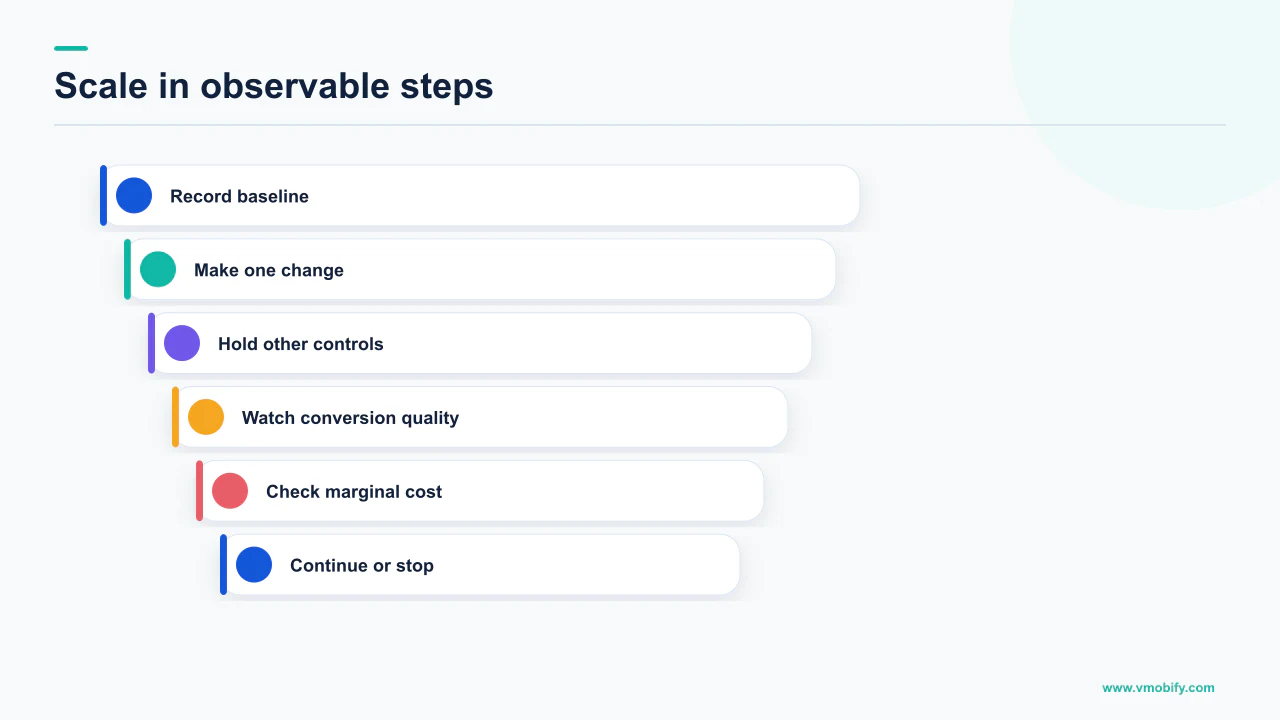
- Confirm the campaign is past the first 100 conversions since your last material change. Below that, Google states changes may disrupt learning and result in poorer performance.
- Check the budget-to-bid ratio for your campaign type before touching either field, so a rise in one does not push the pair under the stated floor.
- Move one field by no more than the 20% example from Google's App campaign tips, and leave the other alone.
- Read performance over the billing period, using the 30.4 multiplier as the frame rather than reacting to a single day that ran up to 2x the average.
- Do not reverse. If the step underperforms, the next decision is the next step in the sequence, not an undo — Google advises against cycling bids up and down.
- Log the date, the field, the old value and the new one. This is the only way the chart stays interpretable three steps later.
Two limits are worth restating so nobody over-reads this article. Google does not publish a required interval between changes, so any waiting period in your runbook is a convention you chose, not a rule you inherited — label it as such. And Google does not publish how a budget change propagates through delivery, so the honest framing of a step is that it increases the volume the strategy must fill at your target, with a cost you observe rather than predict.
Scaling is not the same problem as efficiency. This article is about not damaging what you have while you spend more; the reason the cost per install rises anyway as you spend more is a separate mechanism, covered in our piece on diminishing returns. If you are planning a step change in spend and want the cadence pressure-tested against your actual conversion volumes, send us the campaign structure, or see how we run this in our user acquisition work.
Frequently Asked Questions
Does raising the budget reset the learning period?+
Google does not list a budget change among its documented triggers for the Learning status. Those four triggers are a bid strategy recently created or reactivated, a bid strategy setting change, a composition change adding or removing campaigns or ad groups or keywords, and in some cases ad group target changes on Shopping campaigns. The budget guidance exists separately and is worded as a caution about disruption rather than as a switch.
How much can I raise the budget in one step?+
Google advises against drastic changes and gives changing the budget by more than 20% as its example of one, alongside changing your CPI by more than 20%. Because that is a percentage, repeated steps compound: four consecutive 20% rises roughly double the budget. Google does not publish a required waiting time between steps, so use the conversion gate instead of inventing an interval.
What is the 100-conversion rule exactly?+
Google states that making changes to your in-flight campaign before the first 100 conversions have registered may disrupt learning and result in poorer performance. Every condition matters: it is the first 100 conversions, it applies to a campaign already running, and Google says such changes may disrupt learning rather than that they will.
Is it safer to duplicate a winning campaign than to raise its budget?+
No. A duplicate is a new bid strategy, and Google lists a bid strategy that was recently created or reactivated as the first trigger for the Learning status. The clone starts with no calibration and needs to accumulate its own conversions. Raising the budget on the existing campaign does not appear on that trigger list.
Why did my campaign spend more than its daily budget yesterday?+
Because the figure is an average daily budget rather than a cap. Google states your campaign spend will never exceed 2 times your average daily budget on a given day, and that in a given billing period you are never charged more than 30.4 multiplied by your average daily budget amount. A day between those bounds is normal delivery.
Does my bid need to be in proportion to my budget?+
Google publishes minimum ratios by App campaign type: for ACi tCPI and ACpre the budget should be at least 50 times the bid, for ACi tCPA at least 10 times, and for ACe tCPA at least 15 times. Raising a bid without raising the budget can push a campaign under its own floor, which is one reason campaigns quietly stop spending their full budget.
Do the same numbers apply on TikTok and Meta?+
No, and they should not be blended. TikTok states that volatility typically starts to decline after about 25 campaign results or 7 days from when the campaign enters the learning phase, which is a statement about volatility rather than a change threshold. We are not quoting a Meta figure here because the Business Help page did not return readable content when we checked it, and we do not print numbers from pages we could not open.
Sources
- Duration of the learning period for campaigns and what affects it — The four Learning triggers, the up to 3 weeks or 1-2 conversion cycles duration, and the factors that affect it.
- Best practices for App campaigns — The first 100 conversions caution, the budget-to-bid ratios by campaign type, and the advice against cycling bids.
- Tips for maximizing your App campaign — The guidance against drastic changes, with more than 20% budget or CPI change given as the example.
- Choose your bid and budget — Average daily budget, the 2 times daily bound, and the 30.4 multiplier for a billing period.
- About App campaigns — What the advertiser supplies — text, starting bid and budget, languages and locations — and that Google tests ad combinations.
- Learning Phase — Volatility typically declines after about 25 campaign results or 7 days, and the actions that interrupt progress.
About the author
Amol Pomane — Founder, Vmobify
Amol leads Vmobify, a mobile app growth agency that has driven 30M+ downloads and ranked 54K+ keywords across 300+ apps since 2013. He writes about ASO, paid user acquisition, retention, and the operational reality of scaling mobile apps in India and global markets.
Model an install budget
Turn CPI and activation assumptions into acquisition scenarios.
Open free tool