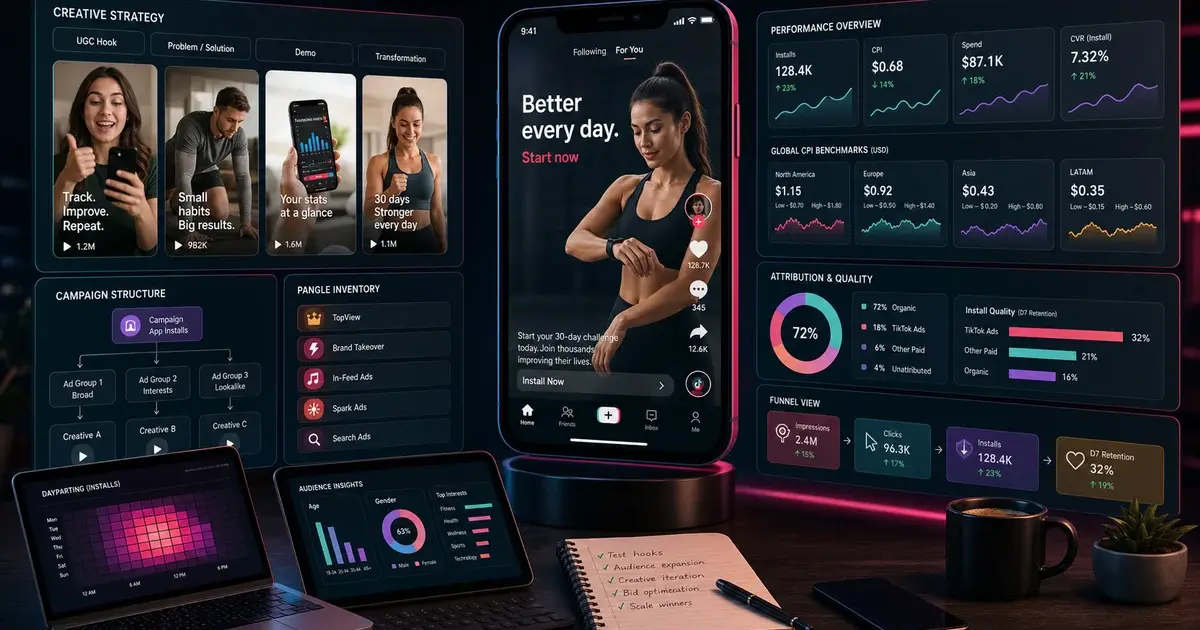
TikTok Is Not Available in India: What to Run Instead
Every Indian app team eventually asks the same question: TikTok is gone, so where does the short-video budget go? Most answers you will find name a list of domestic platforms without showing you a single line of their advertising documentation. This one is built the other way round, from the ad managers whose rules we could actually read.
On this page
- Why can’t you buy TikTok inventory in India?
- What can actually be verified about Moj, Josh, ShareChat and Glance?
- Which channels can you document before you spend?
- What does a Google App campaign actually put your ad on?
- Which App campaign type are you eligible for?
- What does Meta require before the first rupee?
- Is Apple Ads available in India?
- Where does the short-video creative go now?
- How do you measure any of it?
- What should the first quarter look like?
- Frequently Asked Questions
Why can’t you buy TikTok inventory in India?
Because the app is not distributed in India, there is no Indian audience on it to buy — which makes this a distribution problem rather than an ad-platform problem, and that distinction decides where the budget goes next. The commercial consequence is simple even when the legal history is not: an Indian install cannot be bought from a platform Indian users cannot install.
We are going to be unusually careful about the history itself. The government notification that removed the app is not something we could open from a primary government source — the pages we tried returned an access error rather than a document — so this article does not print its date, its file number, or the count of apps it covered. Every version of those details circulating in marketing posts is second-hand. What matters operationally is the present state, and that is not in dispute by anyone planning Indian media.
That leaves the real question, which is not what replaced TikTok but which of the replacements you can verify before committing budget. Those are very different lists, and the gap between them is the subject of this article.
If we could not open a platform’s own advertising documentation and read its rules, that platform does not get a recommendation, a format list, or a price in this article. Not because it is bad — because we would be guessing, and a guess costs you real money at scale.
Across the 300+ apps we have managed since 2013, the teams hurt by the TikTok exit were not the ones who lost a channel. They were the ones who lost a creative format and assumed it had died with the channel. It had not. Vertical, sound-on, fast-cut video has documented homes on the platforms below, and the transferable asset was always the creative, never the buying seat. Our breakdown of how TikTok app install campaigns are structured is still worth reading for markets where the platform does operate.
Which channels can you document before you spend?
Google App campaigns, Meta app ads and Apple Ads — three ad managers whose eligibility rules, asset requirements and country availability are published and checkable before you fund an account. That is the entire selection criterion, and it is a better one than reach estimates you cannot audit.
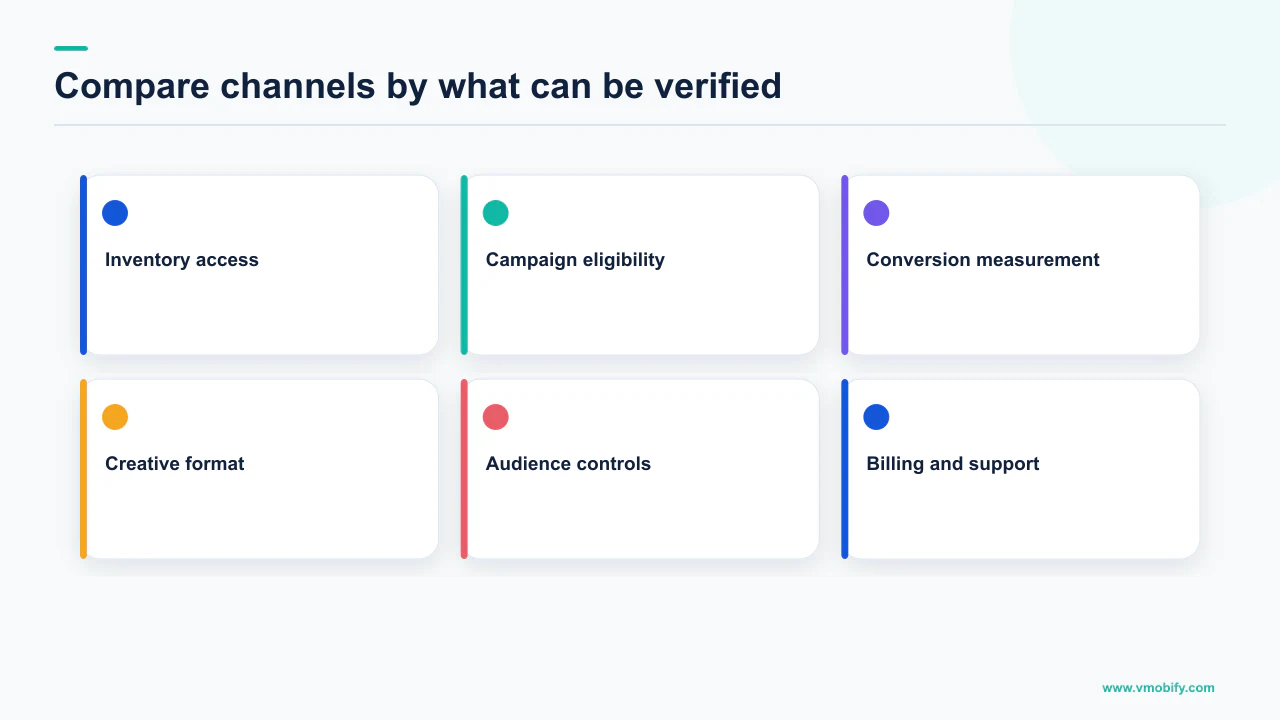
Documented and checkable
- Google App campaigns — campaign types, eligibility gates and asset counts published in Google Ads Help
- Meta app ads — app registration, SDK conditions and deep-link requirements published in Meta’s developer documentation
- Apple Ads — India appears on Apple’s published list of App Store countries and regions where Apple Ads is available
Requires a direct conversation first
- Indian short-video and lock-screen platforms — we could not verify self-serve availability from primary documentation
- Any channel whose "documentation" is a sales deck
- Any network that will not name the attribution partners it supports
None of this says the second column is worthless. It says the second column is a procurement exercise with an unknown answer, and you should not schedule a launch against one. Build on column one, run column two as a parallel enquiry, and move budget across when someone sends you the rules in writing.
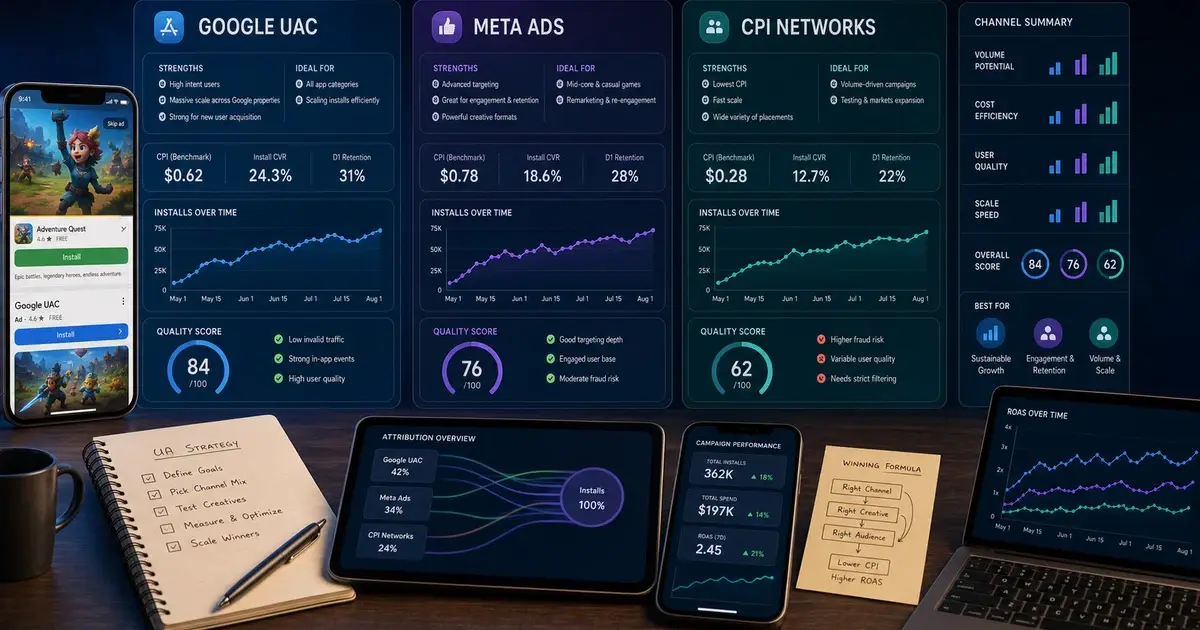
There is a second reason to start here. These three platforms are where your Indian competitors already bid, so this is the auction that sets your cost per install. Our notes on what an app install costs in India and on how Google, Meta and CPI networks compare cover the trade-offs.
What does a Google App campaign actually put your ad on?
One campaign places your ad across Search, Google Play, YouTube, Discover and the Google Display Network — which is why it is the single most efficient replacement for a lost short-video channel rather than merely one of several options. You are not buying a placement; you are buying a distribution system.
Google’s documentation on App campaigns states that ads appear across Google’s largest properties including Search, Google Play, YouTube, Discover on Google Search, and the Google Display Network. It also sets out what you supply: some text, a starting bid and budget, plus ad text ideas, images, videos, and assets from your app’s store listing. The system then tests asset combinations and serves the best performers.
Read that supply list carefully, because it is where the TikTok creative library becomes an asset rather than a sunk cost. The machine decides the combinations; the vertical video you already shot goes in as an input.
The prerequisites Google names are worth checking before you start: an app published on the Google Play Store or Apple App Store, a valid payment method linked to your account, basic app information such as name, category and audience, and your ad assets uploaded. You also specify the languages and locations for your ads, which for a market as linguistically segmented as India is a decision with consequences rather than a form field.
This is where an India plan either respects that the market is many audiences or quietly treats it as one. Our note on creative strategy covers variants that survive the split.
If your campaign is live and not spending, that is a separate diagnosis with its own causes — we work through it in why a Google App campaign will not spend.
Which App campaign type are you eligible for?
Google publishes three App campaign subtypes with genuinely different entry requirements, and two of the three have hard gates that will stop a plan before it starts. Check these first, because discovering them during setup wastes a week.
Google’s page on the different types of App campaigns lists them:
- App campaigns for installs. The default entry point — campaigns that encourage people to install your app. This is what a new app in India runs.
- App campaigns for engagement. Designed to re-engage customers who have installed or used your app. This one is gated, and the gate is specific.
- App campaigns for pre-registration. Android only, serving ads that build excitement and awareness for apps and games before they release on Google Play.
The gates matter more than the descriptions. Google states that to create an App campaign for engagement, your app needs to have a minimum of 50,000 installs. That requirement sits alongside several others for the same campaign type: a Universal Link on iOS, an App Link on Android or a custom scheme on both; an audience list of app users; mobile app conversion tracking configured through Firebase or a supported App Attribution Partner; and a privacy policy that discloses sufficient information about your use of re-engagement campaigns.
Pre-registration carries its own conditions, and they travel together: the campaign type is Android only, the app’s APK must be uploaded to Play Console, the app must launch within 90 days of pre-registration availability, and the app must not be available for install in the targeted country. Quote any one of those without the other three and you have given someone a false plan.
For a post-TikTok Indian launch this resolves cleanly. You are on installs, and the 50,000-install threshold stops being a barrier and becomes a milestone worth planning towards.
What does Meta require before the first rupee?
App registration and account linkage for install campaigns, and an SDK, Conversions API or partner integration the moment you optimise for anything beyond installs — a condition that catches teams after launch rather than before. Meta’s app ads work, but the setup order is not optional.
Meta’s app ads documentation states that to get the most out of your app ads, you will want to register your app with Meta, and connect your app to your business manager and your ad account. It then draws a line that is easy to miss: if you want to use ad objectives other than App Installs, you will need to implement one of the Meta Business SDK, the Conversions API, or a Partner Integration with Meta.
That conditional is the planning point. Teams launch on installs, see the install quality an install-optimised campaign was always going to produce, then discover that moving to a value objective requires engineering work nobody scheduled. Do that work in the launch sprint, not after the first disappointing week.
Deep links are the other piece, and Meta is specific about them. Its guide to adding deep links to your app ad defines a deep link as a link that goes directly to a specific piece of content within your app, and requires that you enable install tracking. Deferred deep linking is described as optional and requires the Facebook SDK for the relevant platform; on iOS, Meta states that you must enable advertiser ID collection for it. Meta also notes that on iOS, deep linking works only with ads.
Register the app and link the accounts, implement the SDK or Conversions API path you will need for value objectives, wire deep links and enable install tracking, and only then fund the account. Every one of those steps is documented; none of them is fast to retrofit under campaign pressure.
Meta’s reach across Facebook, Instagram and Reels makes it the closest substitute for the vertical-video audience an Indian team lost. Our walkthrough of Meta app install campaigns covers structure and creative volume once the setup above is done.
Is Apple Ads available in India?
Yes, on both counts that matter — India appears on Apple’s published list of App Store countries and regions where Apple Ads is available, and separately on its list of countries whose residents may use Apple Ads to advertise on the App Store. Those are two different lists, and a plan needs India on both.
Apple’s countries and regions page groups India under "Africa, Middle East, and India" in the list of App Store countries and regions where Apple Ads is available. Further down, under advertisers who may use Apple Ads to advertise on the App Store, India appears again. Apple also notes that additional requirements apply and may vary depending on the ad placement.
Distinguishing the two lists is not pedantry. One answers whether you can reach Indian users; the other answers whether your Indian entity can buy. Check both, for every market you plan.
On what you are actually buying, Apple describes four placements across the App Store: the Today tab, the Search tab, search results, and product pages. Today tab ads feature your app name, icon and subtitle, and use a custom product page you set up in App Store Connect as the tap destination. Search results ads offer a choice of two bidding strategies — a manual option or a conversion-maximising one — with your own keywords or Apple’s suggestions. Product page ads appear to users who have scrolled to the bottom of product pages, and can run across all app categories or be refined to selected categories. Pricing is cost-per-tap: you set the maximum amount you are willing to pay for a tap and can change it at any time.
For an Indian app with a meaningful iOS share, this is intent-led inventory no short-video platform substitutes for. It is not a like-for-like TikTok replacement and should not be budgeted as one — it captures demand rather than creating it. Our guide to structuring Apple Ads campaigns goes into keyword and match-type strategy.
Where does the short-video creative go now?
Into Google App campaigns as video assets and into Meta’s vertical placements — because the format outlived the channel, and the library you built for TikTok is the most valuable thing you carried out of it. Teams that rebuilt from scratch wasted months rebuilding something they already owned.
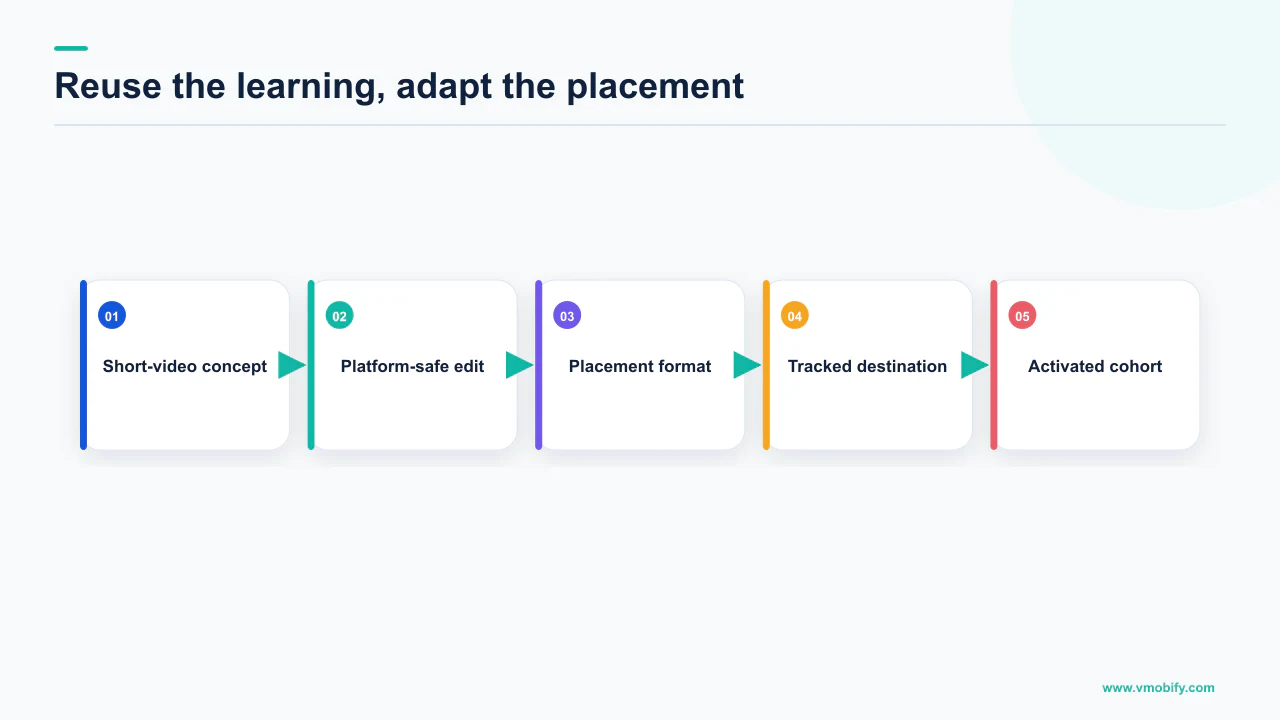
Google states you can add up to 20 of each of images, videos and HTML5 assets when setting up an App campaign for installs. Twenty video slots is not a token allowance. It is a request for a portfolio, and it rewards the production habit short-video advertising taught: many variants, fast, tested against each other rather than agonised over individually.
Two things do need to change in the work itself:
- The context changes even when the aspect ratio does not. A viewer scrolling a feed, a viewer on a Play Store listing and a viewer mid-YouTube are three different states of attention. The same cut will not do all three jobs equally.
- The machine chooses the combinations, so give it real range. Google states it tests different asset combinations and serves the best-performing ads. Twenty near-identical videos gives that system nothing to choose between; five genuinely different angles with variants gives it something to work with.
For India specifically, language is the axis that most often gets under-produced. A campaign where you set the languages and locations, as Google’s setup requires, will underperform if the creative behind it is one Hindi cut and one English cut for a market that is neither. In our portfolio, the biggest creative unlock on Indian install campaigns has consistently been genuine language variants rather than higher production values on a single one — cheaper to make, and it addresses the actual constraint. The discipline of shipping many variants and killing the losers quickly is the part of TikTok-era practice worth keeping.
How do you measure any of it?
With the measurement stack the platforms themselves name as a requirement — Firebase or a supported App Attribution Partner on Google’s side, install tracking and the SDK or Conversions API path on Meta’s — set up before launch rather than reconstructed afterwards. This is not a nice-to-have layer; the platforms gate features on it.
Google makes this explicit in its eligibility rules. Mobile app conversion tracking configured through Firebase or a supported App Attribution Partner is one of the stated requirements for creating an App campaign for engagement, alongside the 50,000-install minimum and the deep-link and audience-list requirements. The measurement work is not optional at the point you want to graduate from installs to re-engagement — it is the entry ticket.
Meta’s requirement is phrased differently but points the same way. Enabling install tracking is a stated requirement for deep links, and the SDK, Conversions API or partner integration is required for any objective other than App Installs. A team that skips this is limited to install-optimised buying regardless of how sophisticated its plan is.
Without a common measurement layer, comparing Google, Meta and Apple Ads is a comparison of three self-reported install counts that will not agree. You will spend the quarter arguing about attribution rather than about performance, and the argument is unwinnable after the fact.
This is also the qualifying question to put to any domestic platform you are evaluating: which attribution partners do you support, and how does an install signal reach our stack? A platform that answers clearly is one you can test. Our mobile attribution guide covers how the pieces fit together across both stores.
One caveat on numbers. We are not printing benchmark costs per install by channel for India, because we have no primary source that publishes them and platform-reported averages are not comparable across these three ad managers. Plan with your own data and treat any published India CPI benchmark as directional at best.
What should the first quarter look like?
Setup and measurement first, Google App campaigns for installs and Meta as the working pair, Apple Ads sized to your actual iOS share, and the domestic platforms treated as an open procurement question running in parallel. That sequence follows from the documentation rather than from a preference.
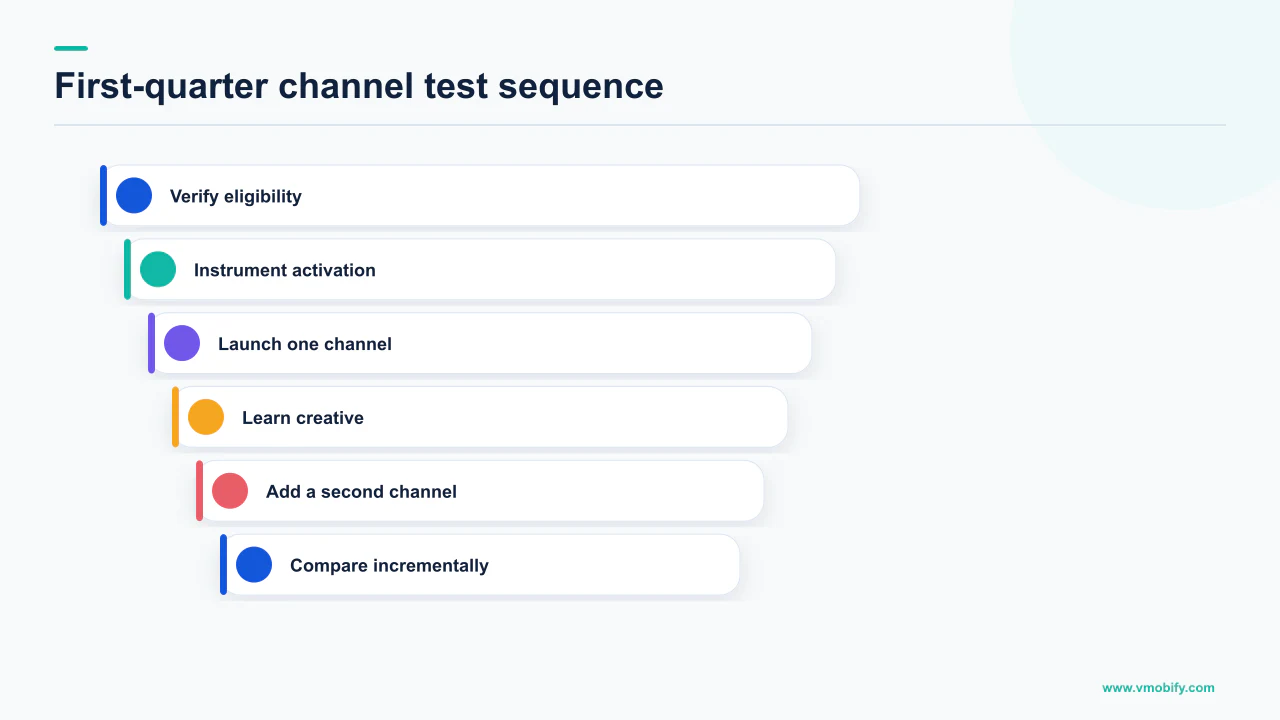
- Do the prerequisite work before funding anything. On Google: app published, payment method linked, app information and assets ready. On Meta: app registered and connected to business manager and ad account, deep links and install tracking wired, SDK or Conversions API path chosen.
- Launch on App campaigns for installs. It is the subtype with no install threshold, and it distributes across Search, Play, YouTube, Discover and the Display Network from one campaign.
- Set languages and locations deliberately. This is a campaign setting on Google, and in India it is the difference between one audience and several.
- Load real creative range. Up to 20 each of images, videos and HTML5 assets are accepted in setup for installs; use the range on genuinely different angles and languages, not near-duplicates.
- Add Apple Ads sized to your iOS share. India is on both of Apple’s published lists; the four placements and cost-per-tap pricing are documented; treat it as demand capture rather than as a TikTok substitute.
- Run the domestic-platform enquiry in parallel. Ask directly about self-serve availability and supported attribution partners, and only budget against a written answer.
- Plan towards 50,000 installs as a milestone. That is the stated minimum to create an App campaign for engagement, so re-engagement becomes a real option rather than a hypothetical one.
What this sequence avoids is the failure mode we see most often in post-TikTok Indian plans: a budget split across five channels, three of which nobody has confirmed can be bought, measured through a stack assembled after the first invoice. That plan does not fail loudly. It fails as three months of ambiguous numbers.
If you are rebuilding an Indian acquisition plan and want the channel selection argued from documentation rather than from folklore, tell us what your current split looks like, or see how we structure this work in our user acquisition practice.
Frequently Asked Questions
What is the closest direct replacement for TikTok ads in India?+
There is no single like-for-like replacement, but Meta is the closest for vertical short-video audiences and Google App campaigns are the most efficient single buy because one campaign distributes across Search, Google Play, YouTube, Discover on Google Search and the Google Display Network. Apple Ads covers intent on the App Store rather than substituting for feed video.
Can I advertise on Moj, Josh, ShareChat or Glance?+
We could not verify self-serve ad manager availability for those platforms from primary documentation, so we do not publish an answer either way. The right move is to contact each platform directly and ask two questions: is self-serve open to your category, and which attribution partners do they support. Budget only against a written answer.
Is Apple Ads available to Indian advertisers?+
Yes. India appears on Apple's published list of App Store countries and regions where Apple Ads is available, and separately on its list of countries whose residents may use Apple Ads to advertise on the App Store. Apple also notes that additional requirements apply and may vary depending on the ad placement.
Why can I not run a re-engagement campaign on Google?+
Most likely the install threshold. Google states that to create an App campaign for engagement your app needs a minimum of 50,000 installs. The same campaign type also requires a Universal Link on iOS, an App Link on Android or a custom scheme, an audience list of app users, mobile app conversion tracking through Firebase or a supported App Attribution Partner, and a privacy policy disclosing your use of re-engagement campaigns.
Can my old TikTok video creative be reused?+
Yes, and it is the most valuable thing to carry across. Google accepts up to 20 each of images, videos and HTML5 assets when setting up an App campaign for installs, and states it tests different asset combinations. Give the system genuinely different angles and language variants rather than twenty near-identical cuts.
What does Meta require before I can optimise for purchases rather than installs?+
Meta states that if you want to use ad objectives other than App Installs you need to implement one of the Meta Business SDK, the Conversions API, or a Partner Integration with Meta. Registering your app and connecting it to your business manager and ad account comes first. Schedule that engineering work alongside the launch, not after it.
What should an India cost per install be on these channels?+
We do not publish a figure here. There is no primary source publishing comparable India cost-per-install benchmarks across Google App campaigns, Meta app ads and Apple Ads, and platform-reported averages are not comparable to each other. Plan from your own measured data and treat published benchmarks as directional only.
Sources
- About App campaigns - Google Ads Help — Lists the properties App campaigns serve on, the assets you supply, and the prerequisites to start.
- About the different types of App campaigns - Google Ads Help — The three subtypes: installs, engagement, and pre-registration, with the conditions attached to each.
- Create an App campaign for engagement - Google Ads Help — States the minimum of 50,000 installs plus the deep link, audience list, conversion tracking and privacy policy requirements.
- Set up an App campaign for installs - Google Ads Help — Setup sequence, bid strategy options, and the limit of up to 20 each of images, videos and HTML5 assets.
- Countries and Regions - Apple Ads — India appears on both the App Store availability list and the list of countries whose residents may advertise.
- Ads on the App Store - Apple Ads — The four ad placements, the two search results bidding strategies, and cost-per-tap pricing.
- Meta for Developers - App Ads: Overview — App registration and account linkage, and the SDK or Conversions API condition for objectives other than App Installs.
- Add Deep Links to Your App Ad - Meta for Developers — Deep link definition, the install tracking requirement, and the iOS advertiser ID condition for deferred deep linking.
About the author
Amol Pomane — Founder, Vmobify
Amol leads Vmobify, a mobile app growth agency that has driven 30M+ downloads and ranked 54K+ keywords across 300+ apps since 2013. He writes about ASO, paid user acquisition, retention, and the operational reality of scaling mobile apps in India and global markets.
Model an install budget
Turn CPI and activation assumptions into acquisition scenarios.
Open free tool