Travel and Hotel App Marketing in 2026
Indian travel rebounded hard post-pandemic. MakeMyTrip and Goibibo dominate but niche players (homestays, religious travel, train-only) are winning meaningful slices.
On this page
- What does the Indian travel app market look like in 2026?
- Where can niche travel apps actually win?
- How do you plan around extreme travel seasonality?
- What does a healthy travel booking funnel look like?
- What is the right channel mix for a travel app?
- How do you retain travel app users between trips?
- Frequently Asked Questions
What does the Indian travel app market look like in 2026?
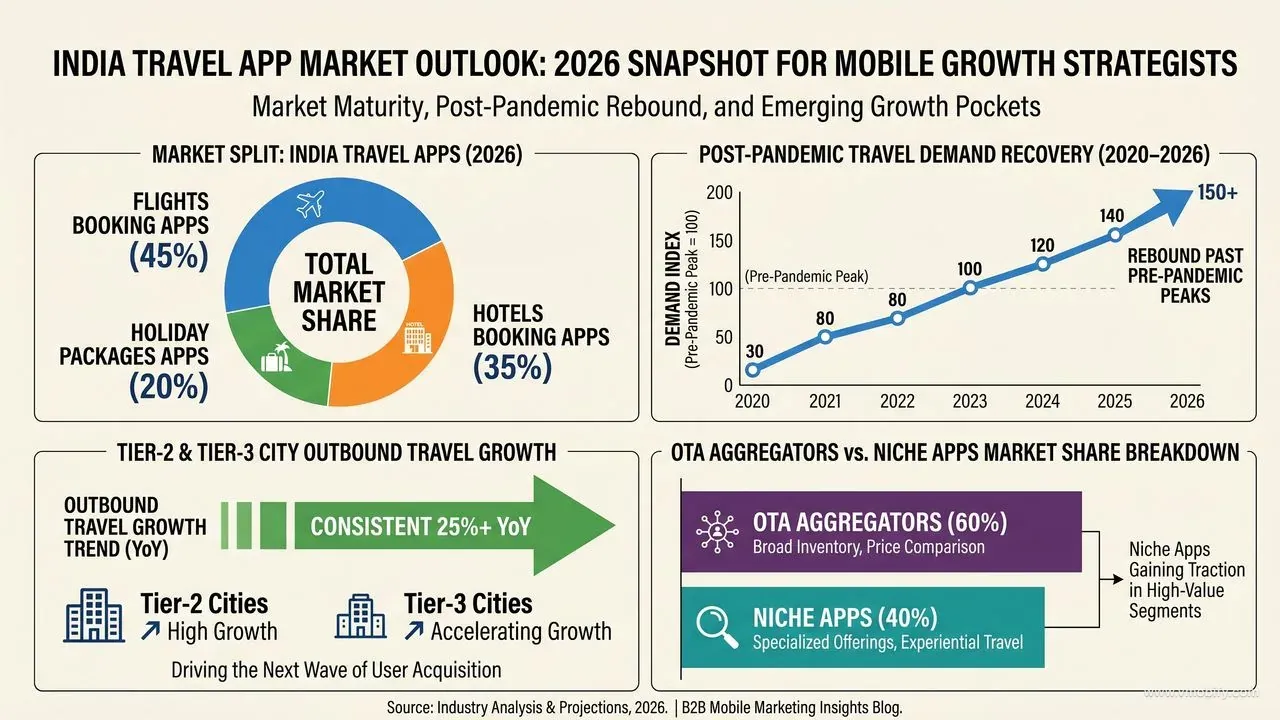
Indian travel demand rebounded past pre-pandemic peaks in 2023 and has been compounding at 15-20% annually since — but the install economics of the category have bifurcated sharply between dominant aggregators and defensible niches.
The aggregator layer is locked. MakeMyTrip, Goibibo (same parent), ixigo, Yatra and EaseMyTrip own the head queries for "flight booking app" and "hotel booking app." International OTAs like Agoda, Booking.com and Airbnb hold smaller but premium-priced share at the top of the funnel. Train ticketing operates almost as a separate market — IRCTC's official app handles base inventory, while ConfirmTkt and RailYatri compete on confirmation prediction, alternate routes and PNR utilities.
What has changed in 2026 is the speed at which Tier-2 and Tier-3 demand is growing. Statista's India mobile internet data shows non-metro internet penetration crossing 60% and the bulk of new travel app installs now originate outside the top 8 cities. That structural shift opens room for vertical-specific apps that the aggregators cannot serve well — because their unit economics are tuned for high-AOV metro bookings.
The 2026 dynamics worth pricing in:
- Religious and pilgrimage travel apps are taking meaningful share around Tirupati, Vaishno Devi, Char Dham, Shirdi and Ujjain. Bundled darshan + transport + accommodation is a workflow generic OTAs do not handle.
- Homestay and experiential platforms are growing faster than hotel inventory, particularly in Himachal, Uttarakhand, Goa hinterland and the North-East.
- Senior-citizen travel and curated group tours are a distinct buyer segment with very different UX and trust requirements.
- Tier-2/3 first-time travellers are growing 25%+ YoY and convert through completely different creative and channel mix than metro buyers.
Across the 300+ apps we have managed since 2013, the travel apps that scaled past ₹50K MAU all picked a vertical they could defend rather than fighting aggregators on generic queries. That choice was made before any UA spend.
The harder truth that founders often resist: aggregator unit economics are not just better — they are structurally subsidised. The big four spend ₹400-1,200 on paid acquisition per first-time booker and recover it over 3-5 future bookings, often cross-selling a flight buyer into hotels, holidays, insurance and forex. A single-vertical entrant cannot match that LTV-to-CAC ratio on generic search auctions and should not try. The right move is to compete where the aggregators cannot bid efficiently — long-tail queries, regional-language creative, niche workflows and community-driven distribution that does not run through the open ad auction at all.
Where can niche travel apps actually win?
Every defensible 2026 travel-app niche has the same shape: a workflow generic OTAs cannot replicate cheaply, plus a buyer the aggregators do not optimise their UX for. Six niches we have seen win meaningful share:
- Religious and pilgrimage travel: Destination-specific bundles (darshan slot + transport + dharamshala), prasad logistics, group coordination, and religious-context UX (Hindi/regional language first, dietary defaults, festival calendars). MakeMyTrip cannot build dedicated Tirupati or Vaishno Devi UX without diluting its core product.
- Train-only apps: ConfirmTkt-style confirmation prediction, alternate route search, waitlist analytics, seat tracking and IRCTC-adjacent utilities. The TAM is enormous — Indian Railways serves more passengers per year than the entire domestic aviation market — and the utility framing drives much higher daily-active-use than booking apps.
- Homestay and experiential platforms: Hyperlocal supply, host-community building, regional curation. Airbnb under-indexes outside metros because it cannot economically run host-acquisition in Tier-2/3.
- Senior-citizen travel: Curated group tours, doctor-on-tour positioning, larger fonts, simplified payment flows, family-member booking permissions. Distribution often runs through community newsletters and WhatsApp rather than paid social.
- Adventure and outdoor: Trekking, scuba, paragliding, camping. Vertical platforms with safety records, certified guides and gear bundling. CPI is higher but LTV is 3-5x category average.
- International-experience apps: Visa support, forex, eSIM, travel insurance and local-experience bundling for outbound Indians. Premium ARPU; aggressive cross-sell economics.
In our portfolio the niche apps that grew sustainably picked exactly one of these and went deep, rather than building a "lite OTA" that tried to do everything. The defensibility comes from the workflow, not the inventory.
Two niches we deliberately did not list because they are harder than they look: bus ticketing (RedBus dominance + low per-ticket margin) and luxury holidays (long sales cycle, offline-trust dominant, app-first acquisition rarely pays back). Test these only with strong existing distribution.
For founders evaluating which niche to enter, the diagnostic question is simple: what does my user google before they open any travel app? If that query is generic ("cheap flight Delhi to Goa"), you are competing with aggregators. If it is workflow-specific ("Tirupati darshan booking online" or "PNR confirmation chances"), you have a niche worth building for. Long-tail intent is where defensibility starts.
How do you plan around extreme travel seasonality?
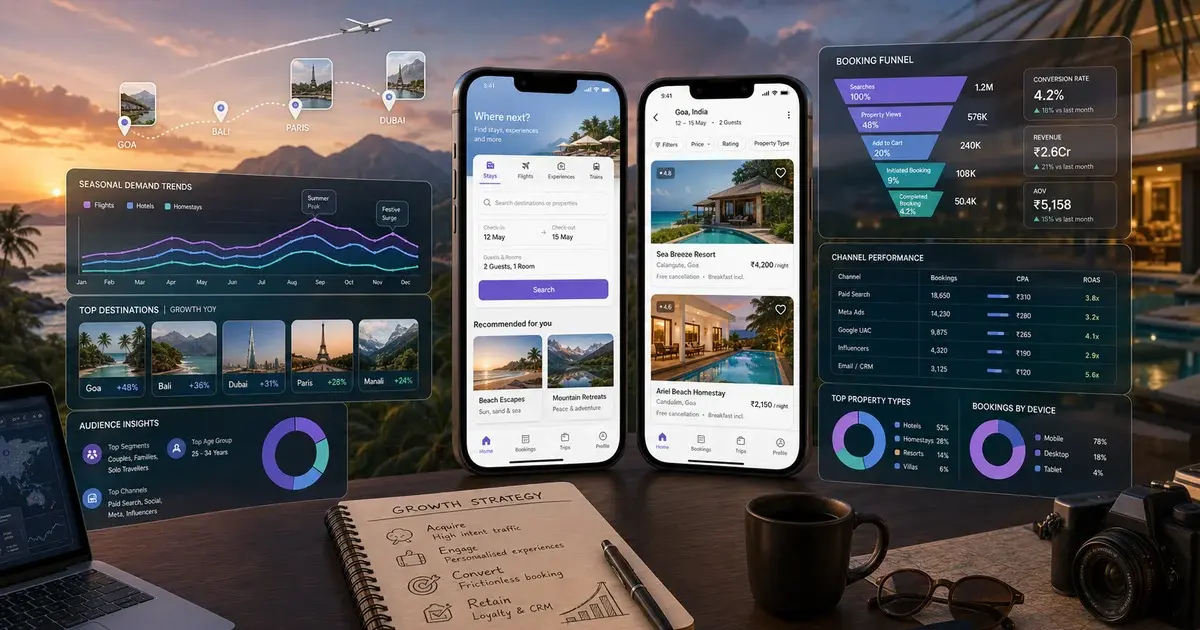
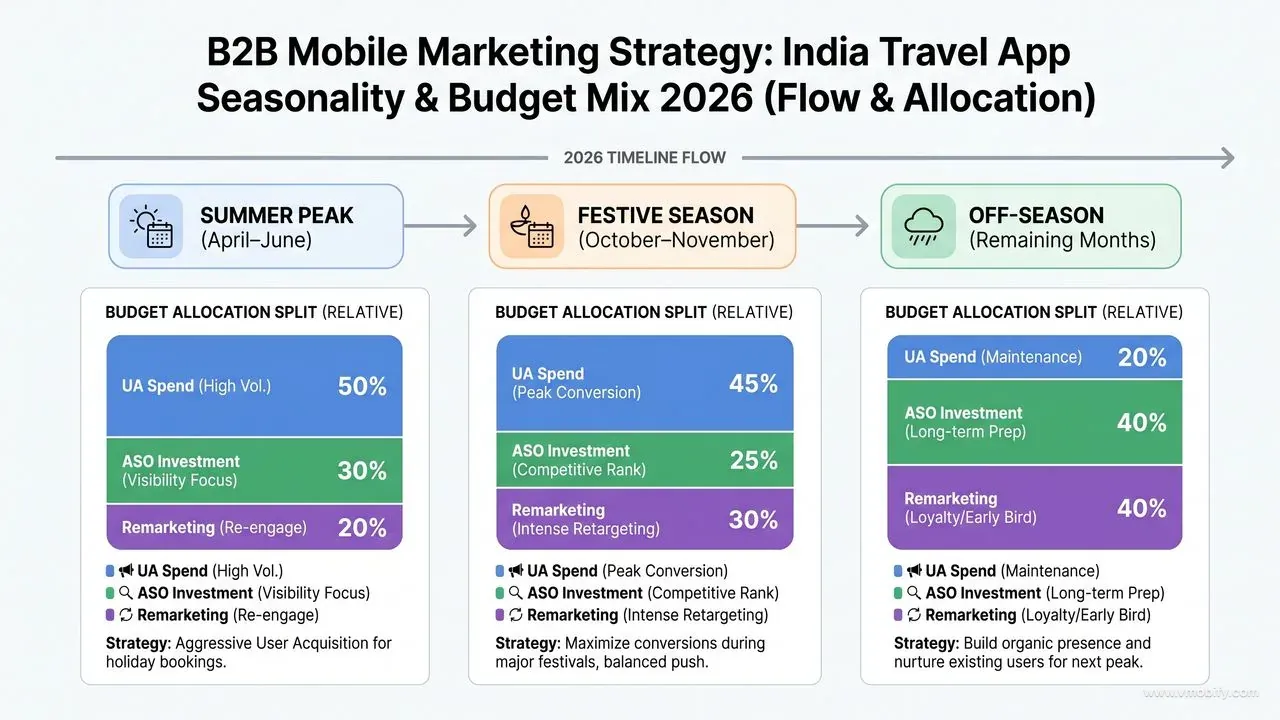
Indian travel is one of the most seasonal app categories in the world — 60-70% of annual bookings concentrate in four peak windows. Plan your budget, creative pipeline and inventory pre-buying around the calendar, not the other way around.
- April-June (Summer holidays): Family travel peak. Hill stations (Shimla, Manali, Munnar, Ooty), beaches (Goa shoulder, Andamans), international family destinations (Bali, Dubai, Thailand). Search demand spikes 4-6 weeks before peak departure dates — start UA aggressively from late February.
- July-August (Monsoon): Religious travel surges (Shravan, Kanwar Yatra, Janmashtami). Monsoon-specific getaways (Lonavala, Wayanad, Coorg). International outbound dips; domestic spiritual + romantic micro-trips dominate.
- October-November (Diwali / school holidays): Largest single peak of the year. Family domestic + international, gifted trips, corporate offsites. Booking lead times shrink — last-minute searches spike in the 10 days before Diwali.
- December-January (Year-end + winter): Goa, Kerala, North-East, Rann of Kutch, Rajasthan circuits. International long-haul (Europe winter, Southeast Asia, Dubai NYE). Premium ARPU peak.
- February-March (Shoulder): Honeymoons, corporate travel, last-of-financial-year offsites. The cheapest UA window of the year — CPIs 40-60% lower than peak weeks.
The economics inversion that catches most teams out: CPIs are 2-3x higher in peak weeks but conversion rates are 3-5x higher and average order value lifts another 20-40%. ROAS is almost always better in peak even at elevated CPIs. The off-season is for brand-building, creative testing, retention experiments and quiet ASO work — not for trying to drive bookings against weak demand.
Adjust's mobile trends data consistently shows travel as the highest seasonality variance category alongside ecommerce — but with sharper, more concentrated peaks. Plan creative refresh cycles around the four windows: a Diwali creative will not work for summer family travel and vice versa.
In our portfolio we typically front-load 60-65% of annual paid budget into the four peak windows, with the remaining 35-40% spread across brand and retargeting through the year. Apps that try to spend evenly month-on-month consistently underperform peak-loaded competitors by 25-40% on annual ROAS.
One operational detail that catches teams out: creative production lead times. A Diwali campaign that goes live in mid-October needs creative briefs locked by mid-August, shoots completed by mid-September and approvals through ad platforms by early October. Treating peak creative as a six-week sprint instead of a three-month pipeline guarantees underwhelming launches. Plan creative as inventory, not as a deliverable.
The other under-appreciated seasonality lever is ASO refresh timing. Both stores re-index metadata within 24-48 hours, so swapping screenshots, subtitle and feature graphics 2-3 weeks before each peak captures the organic search surge that paid is already heating up. We have measured 15-25% lifts in organic install share from properly timed seasonal ASO swaps in our portfolio. See our ASO service for the seasonal-refresh playbook.
What does a healthy travel booking funnel look like?
The travel booking funnel has five clear stages, each with category benchmarks tight enough to immediately diagnose where leakage is happening. Measure every stage as a same-session conversion in your first cohort, then track multi-session conversion for properly-attributed funnel performance.
- Install → first search (target ≥80% within session 1): Below this, the onboarding is friction-heavy. Most common cause: forcing signup before users can search. Defer auth to checkout — the search experience is your value demonstration.
- First search → property view (65-80% healthy): Below 60% usually means weak search-result presentation: bad photography, missing reviews, poor price visibility. Fix the listing card before fixing UA.
- Property view → cart / pre-payment (8-18%, varies by category): Hotels: 10-15%. Flights: 12-18%. Experiences: 6-10%. Below benchmark means trust signals are missing — reviews, photo gallery quality, cancellation clarity.
- Cart → completed booking (35-55% healthy): This is the single most diagnostic metric in the funnel. Below 30% means payment friction, surprise charges at checkout, hidden taxes, or trust gaps. The fix is rarely UA; it is product.
- Push notification cart-abandonment recovery within 1 hour (15-25% recovery rate): The single highest-ROI marketing automation in travel. Apps that do not run this loop are leaving 8-12% of total revenue on the table — we have measured this across multiple portfolio clients.
The non-obvious lever: cart abandonment in travel is overwhelmingly about price comparison shopping, not lack of intent. Recovery notifications work because the user is genuinely buying — they just opened a competitor's app to verify the price. A timely push with a small incentive (free cancellation upgrade, ₹200 wallet credit) converts a meaningful share. See our app retention strategy guide for push-notification cadence frameworks that work without burning user trust.
For paid acquisition, optimise UAC and Meta campaigns on completed booking events — not installs, not signups, not even cart-add. Algorithms optimise toward whichever event you feed them; feeding them shallow events produces cheap installs that do not book. AppsFlyer's State of App Marketing reports the same pattern across every transactional vertical including travel.
What is the right channel mix for a travel app?
Travel is one of the few app categories where intent-based search dramatically outperforms social discovery — because users typically know they want to go to Goa before they open a travel app. A working 2026 channel mix for an Indian travel app:
- Google UAC + Search Network (45-55% of paid budget): Travel queries are overwhelmingly intent-driven. UAC handles app installs + in-app conversions across Search, YouTube, Discover, Display and Play. Per Google's UAC documentation, optimising on a deep in-app event (completed booking) produces dramatically better quality than install-only optimisation. See our paid UA service for managed UAC scale-up frameworks.
- Meta Advantage+ + Reels (25-35%): Destination-inspired Reels, lookalikes off completed-booking events, retargeting cart abandoners. Meta wins on inspiration and retargeting; it loses to UAC on direct intent-to-booking. Mix accordingly.
- YouTube (10-15%): Destination walkthroughs, hotel tour videos, vlogger-style content. Highest-converting format is creator-produced rather than brand-produced — even when the brand pays for the production.
- Influencer / travel creators (5-10%): Destination-specific creator partnerships (a Manali creator for Manali campaign), property-specific takeovers, regional language creators for Tier-2/3. Statista's India influencer market data shows the segment growing 25%+ YoY with creator inventory expanding faster than brand demand — keeping CPMs friendly through 2026.
- Programmatic retargeting (5-10%): Display + native retargeting users who searched specific destinations or viewed specific properties without booking. High ROAS but limited scale ceiling — runs as efficiency layer, not growth driver.
The single most common mis-allocation we see when auditing travel app accounts is too much Meta and not enough Google. Teams default to Meta because the dashboards are flashier, but the intent layer on travel queries lives in Google. Across our portfolio, accounts that shift 10-15% of Meta budget into UAC + Search consistently see 20-30% blended CPA improvements within 6 weeks. For India-specific install cost benchmarks see our India CPI guide and the broader ASO playbook for organic capture.
Two channel-mix nuances worth pricing in for 2026:
- Incremental CPI top-up via vetted networks for peak-week ranking velocity. A controlled burst before Diwali or summer peaks can push a vertical-specific app into top-10 category positions where organic compounds for weeks. See our CPI network service for managed burst frameworks that stay inside store guidelines.
- WhatsApp and SMS retention loops for booking confirmations, check-in reminders and post-trip nudges. Not a UA channel, but the highest engagement medium for transactional travel messaging in India. Open rates above 90% versus push notification rates below 40%.
The creative pipeline matters more in travel than in almost any other vertical because destination creative ages out fast. A Goa creative loses 30-40% of CTR within 3 weeks of launch as audiences saturate. Plan a refresh cadence of 5-8 new creatives per active campaign per week during peak, dropping to 2-3 per week in off-season.
How do you retain travel app users between trips?
Travel apps face the lowest natural booking frequency of any transactional vertical — typical Indian users book 2-4 trips per year — which means the entire retention strategy has to focus on staying useful and present in the long gap between bookings. Five levers that actually move repeat-booking rate in our portfolio:
- Wishlist + price alerts: Users wishlist 3-8 destinations and properties they are considering. Price-drop notifications convert at 4-7% — far above generic re-engagement push. The wishlist is also the single best signal for inspirational content personalisation: send Goa creative to the Goa-wishlisters.
- Saved travellers, saved payment, one-tap booking: Reduces re-booking friction from 6-8 form fields to a single tap. We have measured 12-18% lifts in second-booking conversion when this is properly implemented. Trivial product work; outsized retention impact.
- Loyalty programs: MakeMyTrip Black, Booking Genius, Marriott Bonvoy — switching cost is the entire game for high-LTV travellers. For multi-category platforms, loyalty tiers drive 30-50% repeat-booking lift. For single-vertical apps (train-only, bus-only) loyalty has less impact — the switching cost is too low.
- Inspirational content: Destination guides, "where Indians are travelling this month," seasonal recommendations, monsoon picks, weekend-getaway lists. Content keeps the app open in the long no-booking gap. Best executed as in-app feed + push notification combination, not standalone email.
- Trip companion features: Itinerary management, ticket storage, in-trip notifications, offline maps, local-experience suggestions. Users who use the app during the trip are 3-4x more likely to book the next trip in the same app. Across our portfolio this is the single highest-ROI retention investment.
The hardest segment to retain is the once-a-year traveller. The honest answer is that for these users, you compete on price and brand recall — not on product loyalty. Allocate retention budget to the 2-4x-per-year segment where switching cost actually compounds. For broader retention frameworks see our retention playbook and case studies in our results section.
Two more retention mechanics worth testing in 2026:
- Referral with two-sided incentives: Travel is one of the most socially-shared purchases (group trips, family coordination, honeymoon recommendations). A referral program that rewards both inviter and invitee with wallet credit redeemable on a future booking drives 8-15% of new installs in our portfolio for vertical-specific travel apps — at a fully-loaded CAC roughly half of paid UA.
- Post-trip review + photo upload loops: Users who leave a review or upload a trip photo within 7 days of returning are 2-3x more likely to book the next trip within 6 months. The mechanism is identity reinforcement — users who publicly affiliate with a brand convert future demand to that brand by default. A small completion nudge (₹100 credit, badge, leaderboard placement) is enough to drive 20-30% of users into the loop.
The unifying principle across every retention lever above: travel apps are not booking apps with retention bolted on — they are utilities that occasionally process a booking. The apps that win the second, third and fourth trip from a user are the ones that stay useful in the 90 days when no booking is happening. Build for usefulness in the gap, and the bookings follow.
Talk to our team for a managed travel app launch, scale-up or seasonal-peak war-room engagement.
Frequently Asked Questions
Can a new travel app realistically compete with MakeMyTrip and Goibibo?+
Not head-on in aggregator search. In defensible niches (religious, train-only, senior, adventure, group travel, international-experience) absolutely yes — meaningful share is regularly captured by vertical-specific apps that solve a workflow generic OTAs cannot.
How seasonal is travel app marketing in India?+
Extremely. 60-70% of annual bookings concentrate in four peak windows (April-June, October-November, December-January, plus religious peaks). Marketing budgets that spend evenly month-on-month consistently underperform peak-loaded competitors by 25-40% on annual ROAS.
What is the highest-LTV travel app category?+
International outbound + premium hotel users typically deliver ₹8K-50K annual transaction value. Adventure travel is mid-tier. Domestic train-only sits at the lower end (₹500-3K annual) but compensates with daily-active-use frequency and utility framing.
Should travel apps invest in loyalty programs?+
For multi-category platforms yes — drives cross-sell and switching cost, especially for the 2-4x-per-year traveller segment. For single-vertical apps (bus-only, train-only) loyalty has less impact because switching costs stay low.
How important is creator and influencer marketing for travel apps?+
High for inspirational top-funnel discovery, regional language audiences and destination-specific campaigns. Less effective for booking-completion conversions, which remain dominated by Google search intent in 2026.
What is the single highest-ROI retention investment for a travel app?+
Trip companion features — itinerary management, ticket storage, offline maps, in-trip notifications. Users who use the app during the trip are 3-4x more likely to book the next trip in the same app in our portfolio.
What is the right paid channel split for an Indian travel app?+
Google UAC + Search at 45-55%, Meta at 25-35%, YouTube at 10-15%, influencer at 5-10%, programmatic retargeting at 5-10%. The most common mistake is over-indexing on Meta because travel intent overwhelmingly lives in Google query data.
Sources
- Statista — India Mobile Internet Usage — Non-metro mobile internet penetration and travel demand expansion data
- Statista — Smartphone Users in India — Smartphone user base forecast underpinning Tier-2/3 travel app TAM
- AppsFlyer — State of App Marketing in India — Funnel benchmarks and deep-event optimisation impact across travel vertical
- AppsFlyer Performance Index — Quarterly retention and channel quality benchmarks by category
- Adjust — Mobile App Trends — Seasonality variance benchmarks across travel and ecommerce categories
- Google Ads — App Campaigns Help — UAC setup, bidding and deep in-app conversion optimisation for transactional verticals
- Meta — Advantage+ App Campaigns — Broad targeting + creative volume guidance for retargeting and inspiration campaigns
- Statista — India Influencer Marketing Market — 25%+ YoY growth data for Indian creator economy and regional creator inventory
About the author
Amol Pomane — Founder, Vmobify
Amol leads Vmobify, a mobile app growth agency that has driven 30M+ downloads and ranked 54K+ keywords across 300+ apps since 2013. He writes about ASO, paid user acquisition, retention, and the operational reality of scaling mobile apps in India and global markets.
Model an install budget
Turn CPI and activation assumptions into acquisition scenarios.
Open free tool