tCPI, tCPA or tROAS: Choosing the Right Bid Strategy
Most App campaign bid strategy arguments are really eligibility arguments. Google publishes a conversion-volume requirement for tROAS, a warning that small budgets on Maximize conversions may get no conversions at all, and an explicit caution against bidding on more than one in-app action. Read in order, those three rules decide the strategy for you.
On this page
- Which bid strategy is your data eligible for?
- What does each App campaign bid strategy actually do?
- Why does Maximize conversions starve a small budget?
- When is target CPI the right answer?
- When should you bid on an in-app action instead?
- Why does picking two events break your target?
- What does tROAS require before it works?
- How should you set and then change the target?
- How do you choose in practice?
- Frequently Asked Questions
Which bid strategy is your data eligible for?
Start with eligibility, not preference — Google publishes a conversion-volume requirement for target ROAS on App campaigns, and it disqualifies most of the accounts that ask for it. The bid strategy debate that consumes a planning meeting is usually settled in one line of documentation.
Google's Target ROAS bidding documentation lists eligibility by campaign type. For App campaigns the requirement is stated as at least 10 conversions every day, or 300 conversions in 30 days. That is conversions of the biddable event you intend to optimise toward, not installs in aggregate, and for a purchase event on a young app it is a demanding bar.
The same logic applies one rung down. Google's Target CPA documentation advises measuring performance over periods that have at least 30 conversions, which tells you something about the volume at which a target becomes readable at all. Below that, you are not evaluating a bid strategy — you are reading noise and calling it a result.
Google states the App campaign requirement for target ROAS as at least 10 conversions every day, or 300 conversions in 30 days. If the event you want to bid on does not clear that, the discussion about value-based bidding is premature regardless of how good the case for it is.
So the order of operations is fixed. Ask what your biddable event produces per day, then pick the most specific strategy that volume supports. Across the 300+ apps we have managed since 2013, the single most common cause of a stalled App campaign is a target defined for an event that fires a handful of times a week. The campaign is not underperforming; it has nothing to learn from. If yours is not spending at all, the causes are slightly different and we cover them in why your App campaign is not spending.
What does each App campaign bid strategy actually do?
Each strategy is a different statement about what you are willing to pay for, and the wording in Google's own documentation is more precise than the shorthand teams use. Getting the definitions straight removes half the confusion before you compare them.
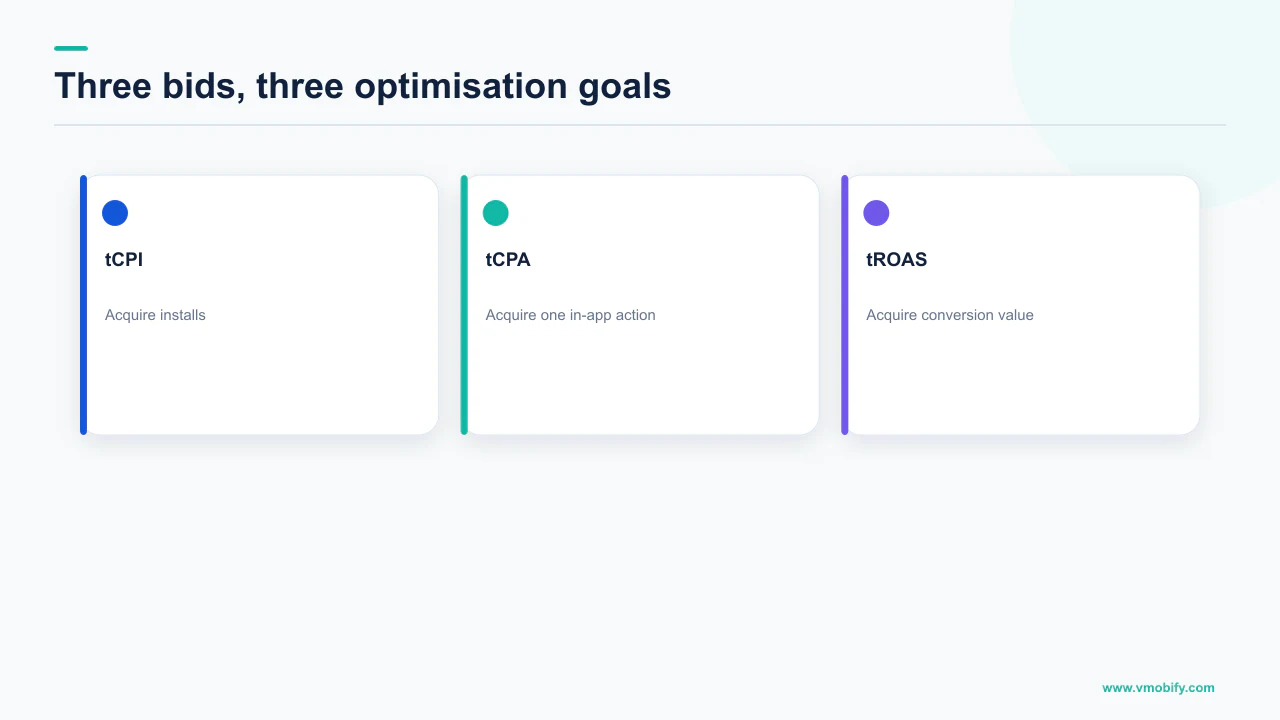
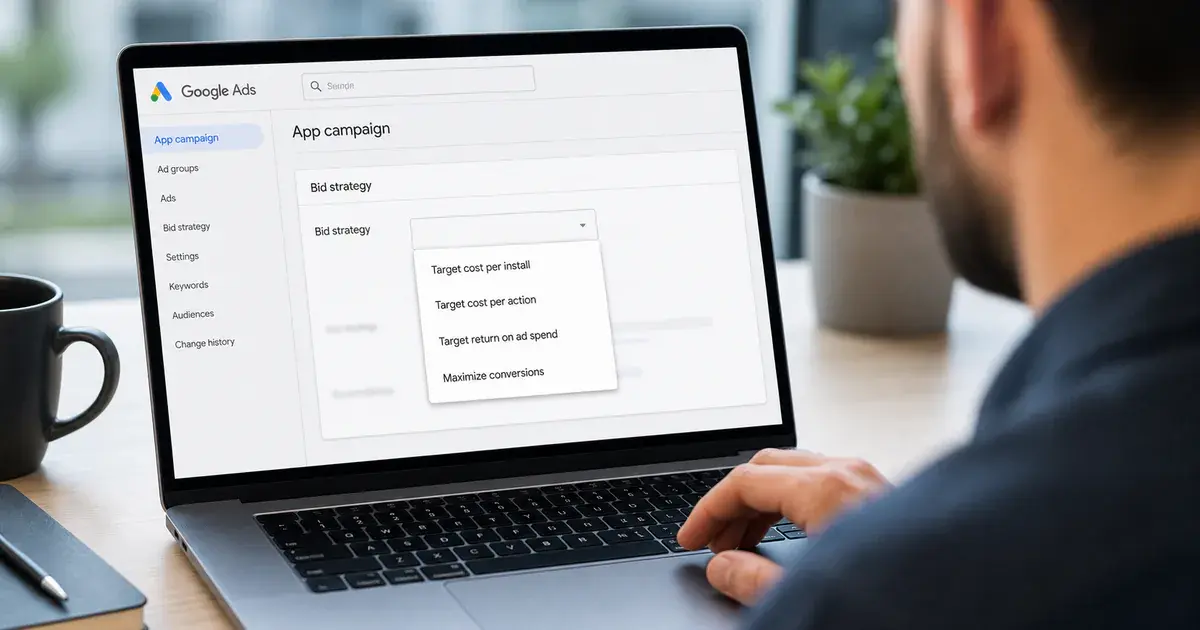
Google's App campaign bidding documentation defines them plainly. Target cost per install lets you choose how much you are willing to pay to acquire a new user for your app. Target cost per action lets you choose how much you are willing to pay for a new user for your app who is more likely to complete the in-app event you selected. Target ROAS lets you set how much dollar value you want back for every dollar you spend. Maximize conversions comes in three variants — for installs, for in-app actions, and for conversion value — and automatically sets bids to get the most conversions, or the most conversion value, while spending your daily budget.
Read the target CPA definition again, because it is routinely misread. You are not paying per in-app action. You are paying per install, and telling the system to prefer installs that look likely to complete the action. The target is expressed against that action, but the auction you are entering is still an install auction.
tCPI — target cost per install
- Optimises toward volume of installs
- Needs only install measurement
- Fastest to accumulate signal
- Says nothing about user quality
tCPA — target cost per in-app action
- Still buys installs, but biased toward likely converters
- Needs the in-app event measured and firing
- Slower, more selective delivery
- Treats every converter as equal
tROAS — target return on ad spend
- Optimises toward value, not count
- Requires values attached to events
- Highest data bar of the three
- Only strategy that sees a big spender
Google's overview of App campaigns also names the campaign subtypes that constrain the menu: App campaigns for installs, App campaigns for engagement, and App campaigns for pre-registration. Pre-registration carries its own strategy, target cost per pre-registration, and engagement campaigns target existing users rather than new ones — so the tCPI-versus-tCPA-versus-tROAS question really only applies within the installs subtype.
Why does Maximize conversions starve a small budget?
Because the optimal bid can exceed your entire daily budget, and Google says so outright: campaigns in that position may not be able to get any conversions. This is the failure mode that produces a campaign spending nothing and a team blaming the creative.
The bidding documentation states it directly. For Maximize conversions campaigns with small budgets, the optimal bid per conversion may be higher than your budget, and Maximize conversions campaigns with small budgets may not be able to get any conversions. There is no target to relax, so there is no lever to pull other than the budget itself.
Google's Maximize conversions documentation adds the other half of the risk. The strategy will try to fully spend your average daily budget, and if you are currently spending much less than your budget, Maximize conversions could increase spend significantly. Both failure modes come from the same design: the budget is the only constraint the strategy respects.
Set the budget below the natural cost of one conversion and you may get nothing at all. Set it well above your historical spend and the strategy will find a way to use it. Neither outcome is a bug, and neither is visible in advance from the campaign settings screen.
What is not publishable is the threshold. Google does not state a currency amount at which a budget becomes "small", and it varies by market, event and competition — so we will not print one. The workable test is arithmetic you can do yourself: if your daily budget does not comfortably cover several conversions of the type you are optimising toward, at the cost you have historically paid for them, the budget is small in the sense the documentation means. In our portfolio that is the check that catches it, not a benchmark table.
The practical consequence is that Maximize conversions belongs where budget is genuinely uncapped in spirit and you want the system to find the ceiling. Where cash is the binding constraint, a target-based strategy at least keeps the cost per outcome inside a number you chose. We work through the cash side of that in budgeting user acquisition against payback.
When is target CPI the right answer?
When you do not yet have enough post-install signal for anything else to learn from, or when the install itself is genuinely the outcome you are buying. tCPI is the default not because it is crude but because it is the only strategy whose feeding event fires on every single conversion.
Three situations make it correct rather than merely convenient:
- A new app or a new market. There is no post-install history for the system to generalise from, and a target defined on a rare event gives it nothing to optimise. Our guide to soft launch sequencing covers what to establish before you tighten the objective.
- A biddable in-app event that does not clear a usable daily volume. If registration fires a few times a day, a target on registration is a target on noise.
- Genuine install-value businesses. Where monetisation is ad-based and largely uniform per user, the install really is close to the unit of value, and the extra specificity of tCPA buys little.
The known weakness is worth stating plainly, because it is the reason nobody wants to stay on tCPI. The strategy is indifferent to what happens after the install. It will happily find you the cheapest installs available, and cheap installs are frequently cheap for a reason. That is not a defect in the bid strategy; it is the objective you gave it.
Which is why tCPI should be treated as a stage rather than a destination. The job while you are on it is to accumulate enough of the post-install event you actually care about to become eligible for something more specific. Instrument the event, verify it is firing and attributing correctly, and watch its daily count. When that count is consistently supporting a target, move. Until then, tightening the objective just starves delivery.
Google's overview describes the system testing asset combinations and serving the best-performing ads across several formats and networks, so an underfed creative set can look like a bidding problem — we separate those in creative strategy for app campaigns.
When should you bid on an in-app action instead?
When one event reliably predicts the value of a user, fires often enough to be learnable, and is measured properly — all three, not two of three. Moving from tCPI to tCPA is the highest-return change most App campaign accounts can make, and also the one most often made too early.
Pick the event on predictive power, not on how important it sounds. The right event usually sits earlier in the funnel than the commercial event: not the subscription, but the step that most reliably precedes it. That trade is deliberate — you give up some correlation with revenue in exchange for a volume of signal the system can learn from.
- Confirm the event is measured and attributed. Google's target CPA documentation states you must set up conversion tracking, and Maximize conversions carries the same requirement. An event that exists in your analytics but is not a tracked conversion in the account is invisible to bidding.
- Count its daily volume honestly. Not its monthly total divided by 30 — its typical day, on the campaigns that will actually run.
- Set the first target from observed cost, not from ambition. Google's bid strategy setup guidance for App campaigns tells you to set the target from the cost per event the campaign has already observed, once it has collected data — not from your install bid and not before the campaign has run. Google's worked guidance is to set the target around 20% above the actual cost per action you are seeing for that event.
- Allow the delivery to narrow. A tCPA campaign should serve to fewer people than the tCPI campaign it replaced. If volume does not fall at all, check that the event is genuinely being received.
- Judge it on the in-app action, not on install volume. Installs will look worse. That is the trade you chose.
The measurement precondition deserves the emphasis it gets in step one. In our experience, a clear majority of failed tCPA migrations are attribution problems wearing a bidding costume: the event fires in the app, never reaches the ads account, and the campaign optimises toward an outcome it never observes. Our attribution guide covers the plumbing, and why Firebase numbers look wrong covers the discrepancies that follow.
Why does picking two events break your target?
Because a target applied to two events becomes an average of two things you value differently — and Google explicitly advises against it. This is the most common self-inflicted wound in App campaign bidding, and it is invisible in the interface.
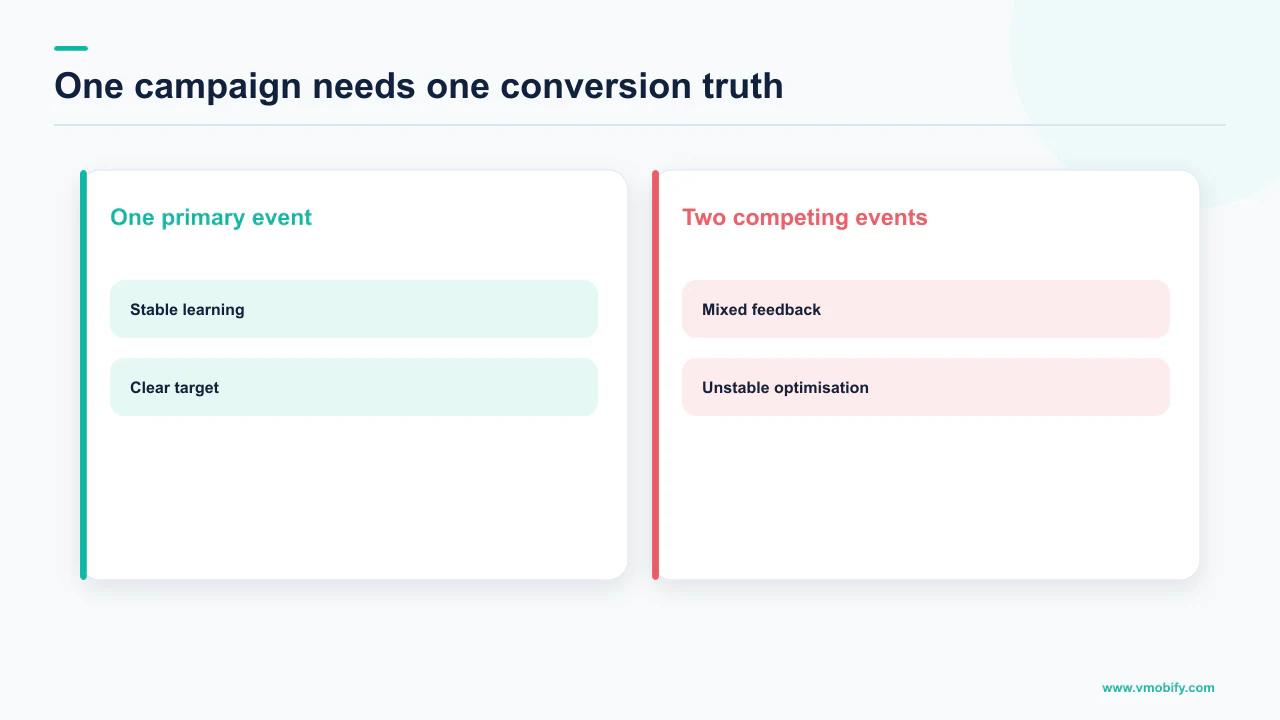
The setup guidance is unambiguous: it is not recommended to select more than one action, as doing so effectively makes your set tCPA a blended target for two or more actions with potentially different values. The interface will let you tick both boxes. Nothing warns you at the point of the mistake.
Consider what that blend does. Suppose you select registration and purchase together. A registration is worth a fraction of a purchase to you, but the target treats a conversion as a conversion. The strategy can hit your blended number by finding registrations cheaply, and it will, because they are more plentiful and cheaper to find. You will hit target and miss the point.
The blend does not average your intentions. It hands the system a rate it can satisfy with the cheaper of the two events, which is the one you cared about less. Select one biddable action per campaign, and if you need to buy both outcomes, run separate campaigns with separate targets.
The setup guidance also flags a related trap: optimising for frequent actions such as session start results in a higher number of conversions than usual. A high-frequency event will dominate any target it is part of, and will make the campaign look extremely efficient against a metric with no commercial meaning.
The fix is structural. One campaign, one biddable action, one target. If you want registrations at one price and purchases at another, that is two campaigns, and the reporting is cleaner besides.
What does tROAS require before it works?
A specific SDK, values attached to your events, and a stated conversion volume — and the SDK requirement alone rules out a lot of stacks that assume otherwise. tROAS is the only App campaign strategy that can tell a high-value user from a low-value one, which is exactly why its preconditions are the strictest.
Google's bidding documentation states that target ROAS requires the Google Analytics for Firebase SDK. That is a hard integration requirement, not a preference, and teams running a third-party measurement partner without Firebase in the app frequently discover it at the point of trying to switch. Google Analytics for Firebase is described as an app measurement solution, available at no charge, that provides insight on app usage and user engagement, with unlimited reporting on up to 500 distinct events.
Then the values. A return target is meaningless unless your events carry monetary value, which in practice means logging purchase events with a value and a currency parameter, as Firebase's ecommerce measurement documentation sets out. An event that fires without a value contributes a conversion count to a strategy that is trying to optimise a sum.
Then the volume, from the Target ROAS documentation: for App campaigns, at least 10 conversions every day, or 300 conversions in 30 days.
One more property to plan around. Google notes that a higher ROAS target will narrow the pool of potential installs, whereas a lower ROAS target will typically enable the campaign to have more potential to scale. tROAS is therefore a volume dial as much as an efficiency dial, and an aggressive first target will simply shut delivery down. The related documentation for the strategy makes the same point in general terms: setting a target that is too high may limit the amount of traffic your ads may get.
If you are working out what your target should be in the first place, that is a unit economics question rather than an ads question — our ROAS and CAC guide sets out the arithmetic.
How should you set and then change the target?
Set it from what you have actually observed, then change it slowly, because the documented behaviour is that the bidder reacts immediately but needs one to two conversion cycles to reach a new target. Most target-based campaigns are not badly configured; they are edited too often to ever settle.
For tROAS, the setup guidance gives the calculation directly: conversion value divided by ad spend, multiplied by 100%, equals your target ROAS percentage. It also directs you to identify your biddable event's conversion window first, which is the step people skip. If value arrives over a fortnight and you compute a target over a week, you will set an impossible number and conclude the strategy does not work.
Two documented behaviours should shape your editing rhythm:
- Targets are averages, not caps. Google describes your average target ROAS as the traffic-weighted average ROAS that your bid strategy optimised for, and states for target CPA that Google Ads will try to keep your cost per conversion equal to the target you set. Individual conversions above the target are expected behaviour, not a malfunction.
- Reaction is instant; convergence is not. After a change, the bidder reacts immediately but needs some time to hit the new target — Google suggests giving it one to two conversion cycles. Editing again inside that window means you never observe the result of the previous edit.
Google's target CPA documentation recommends measuring performance over periods that have at least 30 conversions. That is a useful discipline for any target-based App campaign: before you conclude a target is wrong, check whether the window you are judging it on contains enough conversions to be readable at all.
On direction of error, the documentation cuts both ways and it is worth holding both. Setting a target that is too low may cause you to forgo clicks that could result in conversions, resulting in fewer total conversions. Setting one too high may limit the amount of traffic your ads may get. Neither over-tight nor over-loose is the safe default, which is why the observed-cost starting point matters more than the philosophy.
Google Ads also offers a comparative route rather than a destructive one: rather than editing a working campaign directly, the target CPA documentation describes saving a change as an experiment, which runs your new settings against the original campaign. When the stakes are a live spending campaign, that is the version to use.
How do you choose in practice?
Work down from the most specific strategy your measurement and volume can support, and stop at the first one that holds. That single rule replaces almost every framework you will be offered for this decision.
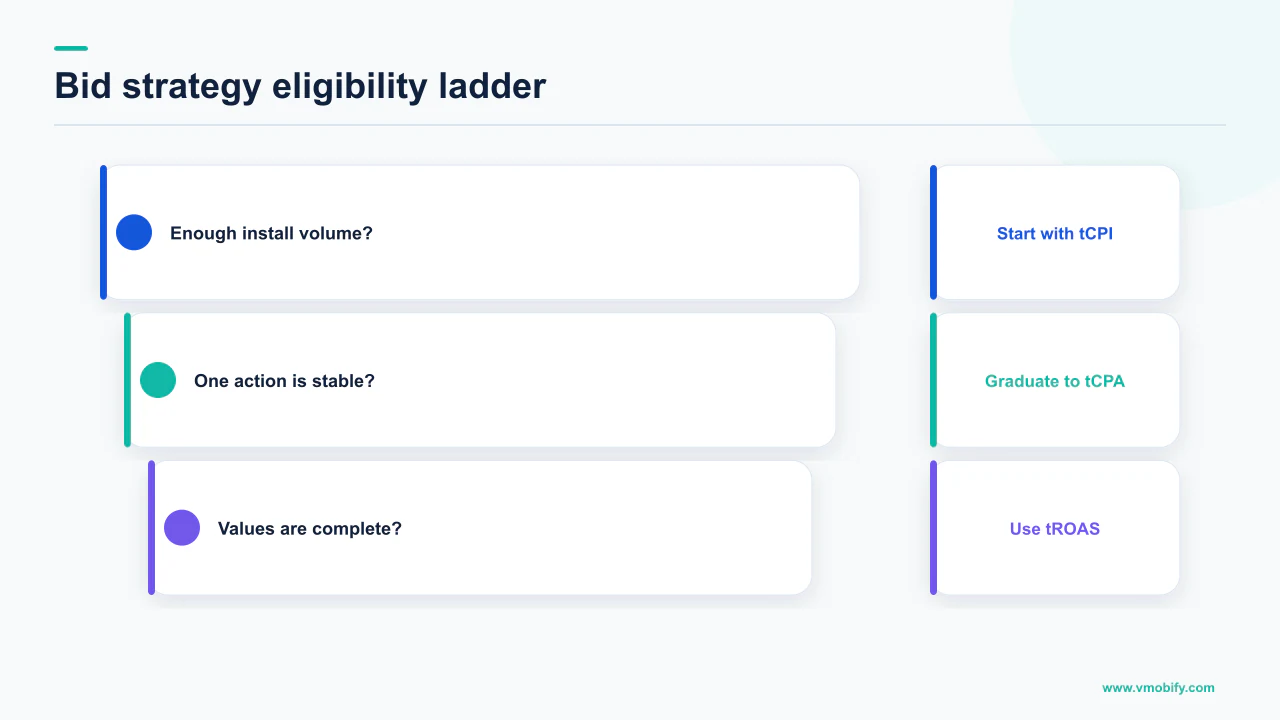
- Do you have the Firebase SDK, values on your events, and the conversion volume Google states for App campaigns — at least 10 conversions every day, or 300 in 30 days? If yes, tROAS is available to you, and it is the only strategy that distinguishes a valuable user from a merely converting one.
- If not, is there a single in-app action that predicts value and fires at a volume you can read? Then target CPA on that one action. One action, never two.
- If not, target CPI, and treat the period on it as the work of building the post-install signal that gets you to step two.
- Consider Maximize conversions only where budget is not the binding constraint, given the documented risk that small budgets may get no conversions and that spend can increase significantly against an underspent budget.
This decision is not a permanent commitment — the correct strategy for an app changes as its measurement matures, and reviewing it once a quarter is reasonable. Where the campaign competes against other channels entirely, that is a different comparison and we set it out in Google App campaigns versus Meta versus CPI networks.
One deliberate omission in this article: we have not printed benchmark target CPIs or ROAS figures by vertical or market. Google does not publish them, they vary enormously by country, event definition and season, and a benchmark quoted from an unverifiable source is worse than no benchmark, because it becomes the number your team optimises toward. Your own observed cost per event over a readable window is the only starting target we will endorse.
If you want a second opinion on which strategy your account is actually eligible for, and what the measurement work is to reach the next one, tell us what your biddable event does per day — or see how we structure paid acquisition in our user acquisition work.
Frequently Asked Questions
What is the difference between target CPI and target CPA on App campaigns?+
Target CPI is how much you are willing to pay to acquire a new user for your app. Target CPA, in Google’s wording, is how much you are willing to pay for a new user who is more likely to complete the in-app event you selected. Both buy installs — target CPA biases delivery toward installs that look likely to convert, which is why volume falls and cost per install usually rises.
How many conversions do I need before I can use tROAS?+
Google’s Target ROAS documentation lists the App campaign requirement as at least 10 conversions every day, or 300 conversions in 30 days. That is conversions of the biddable event you are optimising toward. Below that volume the strategy has too little to learn from, and the sensible move is target CPA on a more frequent event.
Do I need Firebase to run target ROAS?+
Yes. Google states that target ROAS requires the Google Analytics for Firebase SDK. Google Analytics for Firebase is a free app measurement solution with unlimited reporting on up to 500 distinct events. Your events also need monetary values attached — a purchase event logged with a value and a currency parameter — because a return target computed over valueless conversions has nothing to sum.
Can I optimise for two in-app actions at once?+
Google advises against it. Selecting more than one action effectively makes your target a blended target for two or more actions with potentially different values. In practice the campaign hits the blended number by finding the cheaper, more plentiful event. Run separate campaigns with separate targets instead.
Why is my Maximize conversions campaign getting no conversions?+
Google states that for Maximize conversions campaigns with small budgets, the optimal bid per conversion may be higher than your budget, and that such campaigns may not be able to get any conversions. There is no target to loosen, so the only lever is the budget. Google also warns the strategy will try to fully spend your average daily budget, so an underspent budget can see spend rise significantly.
How often should I change my target?+
Rarely, and never inside a conversion cycle. Google states the bidder reacts immediately to a change but needs some time to hit the new target, suggesting one to two conversion cycles. It also recommends measuring performance over periods that have at least 30 conversions. For a live campaign, Google Ads offers saving the change as an experiment rather than editing the original directly.
What target CPI should I start with for my category?+
We do not publish benchmark figures by vertical or market, because Google does not publish them and any number quoted from an unverifiable source becomes the figure your team optimises toward. Start from your own observed cost per event over a window long enough to be readable. Google’s guidance is to derive the target from the cost per action the campaign has already observed for that event, rather than from your install bid — which means you need the campaign running before you can set the target properly.
Sources
- Google Ads Help — About bidding for App campaigns — Definitions of target CPI, target CPA, target ROAS and Maximize conversions; the small-budget warning; the Firebase SDK requirement; the higher-target-narrows-scale trade-off.
- Google Ads Help — Choose a bid strategy for your App campaign — Setup steps for tCPI, tCPA and tCPpre; the blended-target caution; the target ROAS formula; the note on optimising for frequent actions such as session start.
- Google Ads Help — About Target ROAS bidding — Eligibility by campaign type, including the App campaign requirement of at least 10 conversions every day or 300 in 30 days, and the one-to-two conversion cycle guidance after a change.
- Google Ads Help — About Target CPA bidding — Conversion tracking requirement, the target as an average, the recommendation to measure over periods with at least 30 conversions, and saving a change as an experiment.
- Google Ads Help — About Maximize conversions bidding — The strategy tries to fully spend the average daily budget, requires conversion tracking, and can increase spend significantly on a previously underspent budget.
- Google Ads Help — About App campaigns — Campaign subtypes for installs, engagement and pre-registration, and how assets are combined and served across Google properties.
- Firebase — Google Analytics — Google Analytics for Firebase as a free app measurement solution with unlimited reporting on up to 500 distinct events.
- Firebase — Measure ecommerce — Logging a purchase event with value and currency parameters, which is what gives a return-based bid strategy something to sum.
About the author
Amol Pomane — Founder, Vmobify
Amol leads Vmobify, a mobile app growth agency that has driven 30M+ downloads and ranked 54K+ keywords across 300+ apps since 2013. He writes about ASO, paid user acquisition, retention, and the operational reality of scaling mobile apps in India and global markets.
Model an install budget
Turn CPI and activation assumptions into acquisition scenarios.
Open free tool