SEO for Mobile Apps: A Web-to-Install Growth System
App SEO is not a trick for indexing screens inside a binary. It is a web demand, content, technical-routing, store-conversion and measurement system that turns qualified searches into installs or app opens.

On this page
- What does SEO for a mobile app actually include?
- Where should you look for app search demand?
- Which pages should an app website create?
- What technical SEO foundation does an app need?
- How should SEO hand visitors to the app stores?
- How do deep links change the search journey?
- How do you measure organic web-to-app growth?
- How does an app website earn search authority?
- How should app SEO work across countries and languages?
- Which app SEO mistakes waste the most time?
- What should a 90-day app SEO plan look like?
- Frequently Asked Questions
What does SEO for a mobile app actually include?
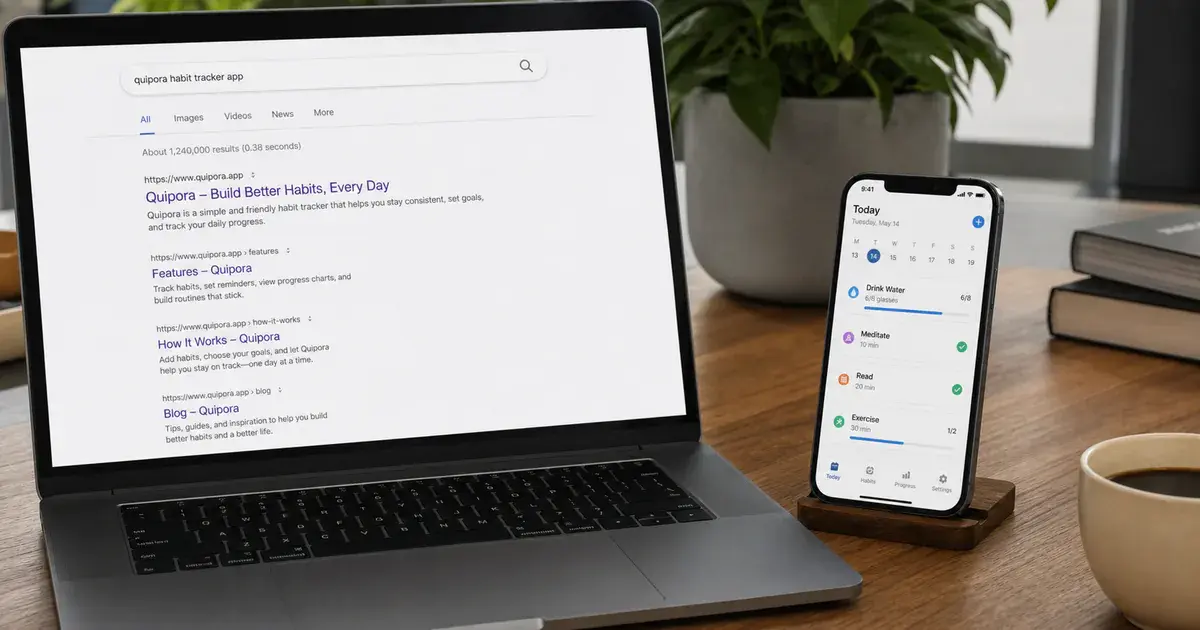
SEO for a mobile app is the system that captures search demand on the web, answers it on crawlable pages, routes qualified visitors to the right store or installed-app destination, and measures whether they activate. It is not a way to make Google crawl a binary as though every app screen were an HTML page.
Four disciplines sit inside the phrase and should remain distinct. Web SEO earns visibility for pages on your domain. ASO improves discovery and conversion inside Apple’s and Google’s stores. Deep linking routes an eligible URL into installed app content. Web-to-app measurement connects the anonymous search visit to store click, install, first open and downstream value as far as platform privacy allows.
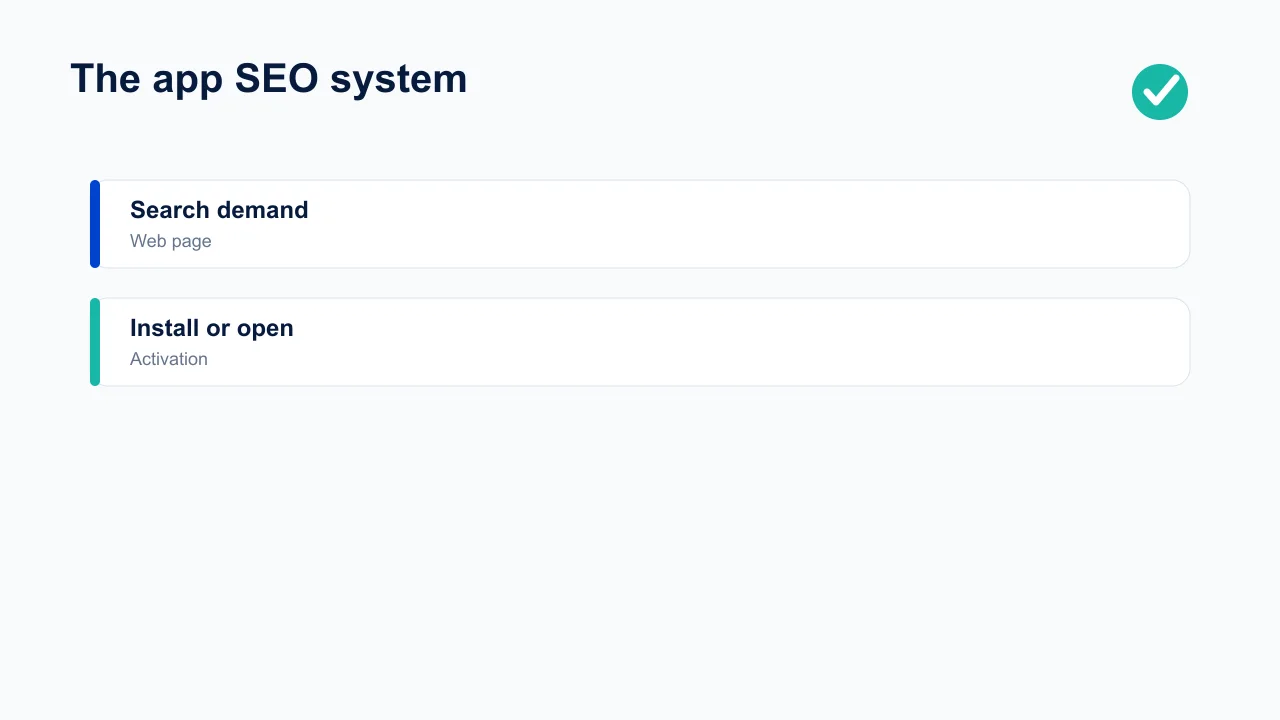
This definition stops two common mistakes. The first is doing ASO and calling it SEO, leaving non-store search demand to publishers, directories and competitors. The second is publishing broad blog content that earns traffic but has no credible path into the product. Traffic is not an app-growth outcome.
Choose the system when people search the web for the problem, comparison or workflow your app serves. A tax calculator, language tutor, photo editor or business tool has obvious web demand. A new social mechanic with no established vocabulary may grow faster through product loops and creator distribution until demand emerges.
Our narrower guide on whether Google Search can drive app installs documents the current indexing and structured-data mechanics. This pillar focuses on how a team operates the entire channel.
Give one person ownership of the complete search-to-value journey, even when specialists execute individual parts. Their weekly review should connect Search Console impressions and landing-page engagement with store clicks, installs, activation and retained value. Without that join, the SEO owner celebrates traffic, the ASO owner celebrates conversion, and the product owner receives users whose original intent nobody preserved.
Build an evidence sheet for every priority intent. Record the query cluster, result-page format, proposed URL, unique evidence, product capability, conversion route, owner and review date. Add the strongest reason the page might not deserve to rank. This forces the team to distinguish a useful page from a keyword-shaped article and gives an editor a concrete standard for consolidation later.
Use a small measurement ladder:
- Discovery: impressions and qualified rankings by intent cluster, with brand and non-brand separated.
- Answer quality: whether visitors reach the relevant demonstration, tool, comparison or decision section—not an arbitrary time-on-page target.
- Hand-off: store click or verified deep-link open, segmented by platform and landing intent.
- Product value: first meaningful action, repeat use and revenue where privacy-safe attribution permits.
- Maintenance: decaying queries, broken links, outdated screenshots, unsupported claims and cannibalising pages.
When direct install attribution is incomplete, do not fill the gap with certainty. Use tagged store links where supported, privacy-safe measurement, matched landing cohorts, geo or time-based tests, and directional relationships. Label inference explicitly. An honest range that survives scrutiny is more valuable than a precise dashboard number built from incompatible attribution windows.
Finally, set stop rules. Consolidate a page when it duplicates an established intent, update it when product or platform facts change, and retire it when the app no longer fulfils the promise. Search content is part of the product surface: abandoned pages can acquire users under an outdated expectation long after the team has forgotten them.
For AI-mediated discovery, make the answer extractable without flattening the article. Put a direct answer first, define entities consistently, keep tables and steps in semantic HTML, cite the original platform or research source near the claim, and state dates and limitations. Do not create a second layer of robotic “AI text” or stuff question variants. A passage useful to an answer engine should also help a founder make a safer decision in context.
Publish the primary evidence behind original claims: a redacted experiment design, calculation method, cohort definition, screenshot or template. If confidentiality prevents that, describe the method and avoid precise portfolio statistics that readers cannot verify. This is the difference between experience and borrowed authority. It also gives other pages a durable internal-link destination instead of repeating the same unsupported number across the site. Keep a changelog when definitions, screenshots or conclusions move, and state which version of the app the evidence represents. Readers and search systems should be able to distinguish a current operating recommendation from a historical result. Name the responsible editor and the next evidence review date.
Where should you look for app search demand?
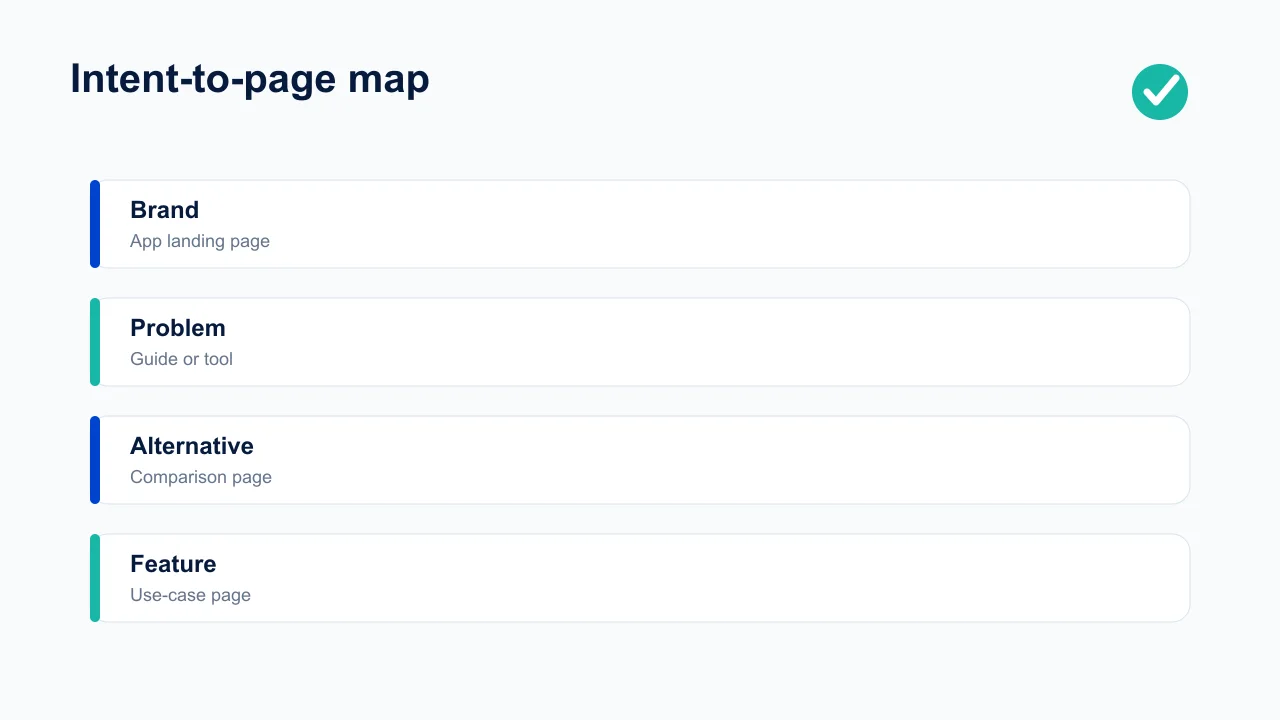
Look beyond the app’s category term and map demand across brand, problem, task, feature, alternative, integration, audience and geography. “Best budgeting app” is useful, but “how to split rent with roommates” may reveal the actual job that leads to activation.
Start with first-party evidence: Search Console queries, paid-search terms, store-search terms where available, support conversations, sales calls, app reviews, onboarding answers and in-product search. Then use search results to understand the page type Google already rewards. A transactional app page rarely displaces a detailed calculator or guide when the result set signals informational intent.
Score opportunities on qualified demand, product fit, achievable authority, conversion path and maintenance cost. A high-volume query that attracts students to a B2B field-service app is less valuable than a low-volume integration query used by buyers. Record the activation event you expect from each theme before approving content.
Cluster queries by shared intent rather than word variation. One authoritative page can answer “receipt scanner app”, “scan receipts to spreadsheet” and “digitise expense receipts” if the underlying job and result format are the same. Ten near-duplicate pages split links, confuse canonical signals and become a maintenance burden.
Finally, protect ownership. Brand queries should land on an official, fast page with accurate store links. Comparison and alternative demand needs honest decision criteria, not invented competitor weaknesses. Problem content should solve enough of the task on the web to earn trust, then show where the app makes the recurring workflow easier.
Which pages should an app website create?
Create one strong app landing page, then add use-case, feature, comparison, integration, tool and editorial pages only where each serves distinct intent. A large sitemap is not a strategy; every page needs a reason to exist and a next step.
- App landing page: the canonical brand destination, with platform-aware store links, proof, requirements, privacy and support.
- Use-case pages: outcomes for a specific audience or job, backed by real product capability.
- Feature pages: durable functionality with examples, constraints and screenshots—not release-note fragments.
- Comparison pages: transparent criteria for users actively choosing between approaches or products.
- Tools and templates: a useful web experience that demonstrates the app’s value before the install.
- Guides: expert answers that naturally lead to a recurring workflow the app can own.
Show product evidence. Original screenshots, short demonstrations, outputs, limitations and named workflows are harder to imitate than generic advice. Add a visible author or responsible team, update date, support route, privacy information and clear distinction between observed evidence and portfolio judgement. Those details strengthen trust and improve conversion even when no ranking system reads them as a direct factor.
Internal linking should mirror the journey. A problem guide links to the relevant use case, the use case links to the core app page, and the app page links to help and privacy resources. Our app website guide covers the minimum site footprint; comparison and alternative pages covers that high-intent format.
What technical SEO foundation does an app need?
Serve complete, crawlable mobile HTML on stable canonical URLs; keep pages fast and equivalent across devices; expose clean internal links and sitemaps; and add structured data only when it matches visible content. App teams often over-invest in schema while basic rendering and duplication remain broken.
Google’s mobile-first indexing guidance recommends equivalent primary content and structured data on mobile and desktop versions. Responsive delivery is usually the simplest route. If important copy, links or images appear only after a fragile client-side interaction, inspect the rendered result with Search Console rather than assuming a crawler sees the browser experience.
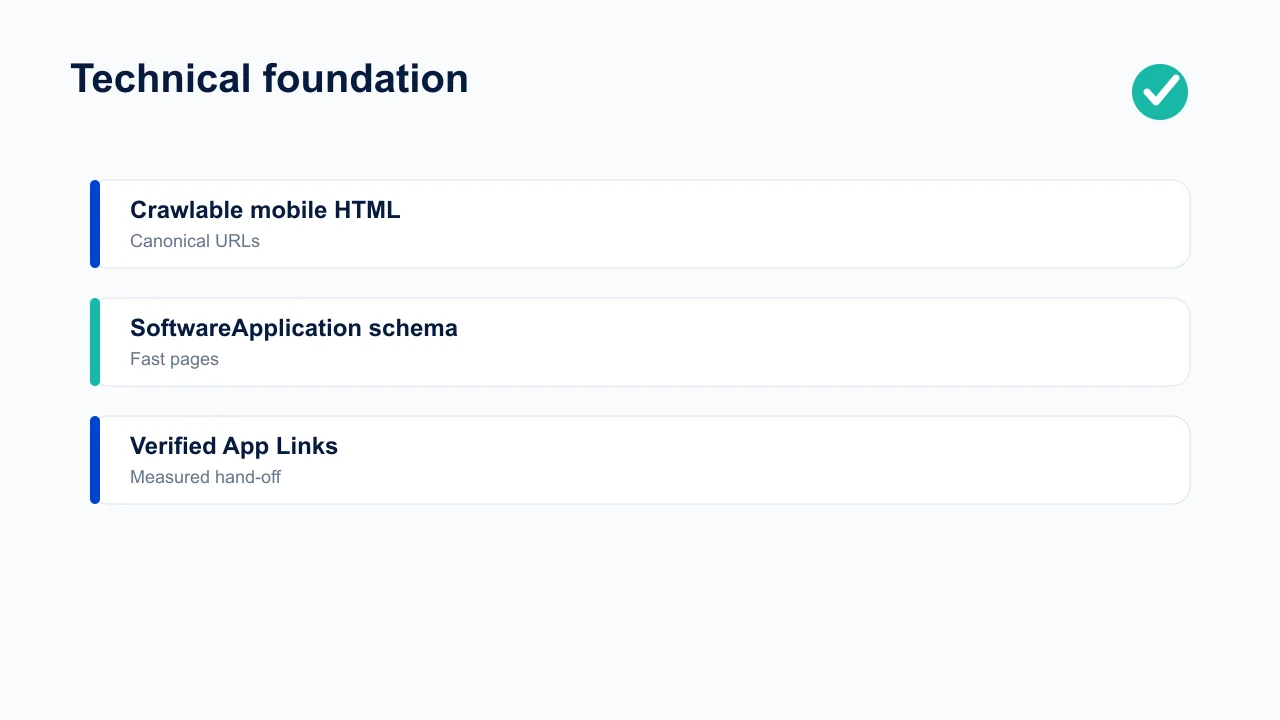
For an app page, Google supports SoftwareApplication structured data. Its documented requirements include the app name, an offer price and either aggregate rating or review information. The marked information must be visible and comply with structured-data policies. Valid markup provides eligibility, not guaranteed display or ranking.
Keep store URLs centralised so country and platform routing can be changed without editing every page. Use descriptive link text, correct canonicals, accessible image alternatives, share previews and a sitemap with only indexable canonical pages. Monitor coverage, rich-result errors, server responses and performance after deployments.
How should SEO hand visitors to the app stores?
Preserve the visitor’s intent from search snippet to landing page to store first frame, while giving installed users a direct path into the relevant app content. Every generic hand-off spends trust you already earned.
A page ranking for invoice scanning should not lead to a homepage promising “AI productivity”, then to a store screenshot about team chat. Repeat the specific outcome, show the workflow, identify platform and price expectations, and make the store button obvious without hiding the useful web answer.
Use platform-aware links carefully. A visible pair of App Store and Google Play badges is predictable and accessible; automatic redirects can frustrate users researching across devices or block crawlers. Preserve campaign parameters through an approved measurement path and provide a web fallback.
Coordinate with ASO owners. Search content reveals vocabulary, objections and use cases that can improve store copy and creative, while store conversion data shows which promise actually survives the hand-off. Our store screenshot CRO guide explains how to turn that promise into a first-frame narrative.
Do not optimise only store clicks. A forceful CTA can raise outbound rate while lowering install or activation quality. Compare page cohorts through first value and retained revenue. The right page sometimes persuades an unqualified visitor not to install, saving support and acquisition cost.
How do deep links change the search journey?
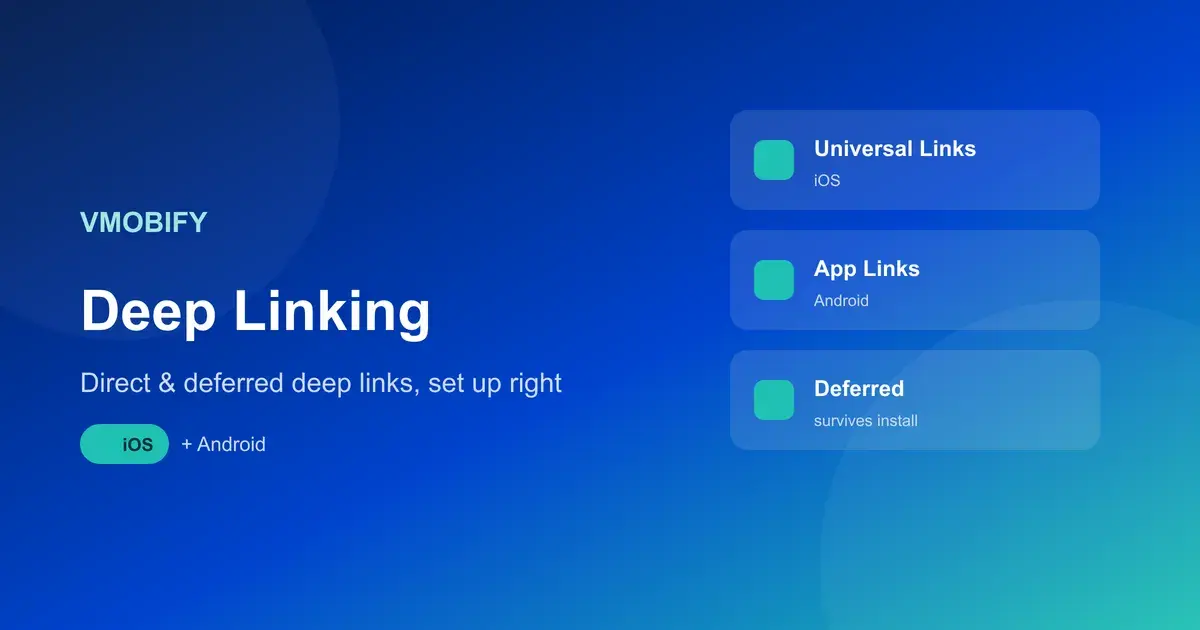
Verified Universal Links and Android App Links let a normal HTTPS result open matching content for users who already have the app, while everyone else retains a functioning web destination. They improve routing; they do not create search rankings.
Apple uses associated domains and an apple-app-site-association file to establish the website-app relationship. Android uses intent filters and a Digital Asset Links file for verified App Links. Test exact hosts, paths, redirects, installed and uninstalled states, app versions, browsers, signed production builds and web fallback. A link that works from Messages on one developer device is not a complete test.
Firebase Dynamic Links shut down on 25 August 2025, according to the official shutdown FAQ. Do not build a current SEO workflow on old setup tutorials. Choose first-party links plus a maintained provider where deferred routing, attribution or campaign operations justify it.
Google’s 2025 guidance on app deep links from Search emphasises correct App Link implementation and landing-page parity. Our deep linking guide includes the architecture and test matrix.
How do you measure organic web-to-app growth?
Measure a chain of evidence—query and landing page, qualified session, store click or app open, install or first open, activation, purchase and retained value—while accepting that privacy rules prevent perfect person-level stitching. Report uncertainty instead of filling gaps with last-click certainty.
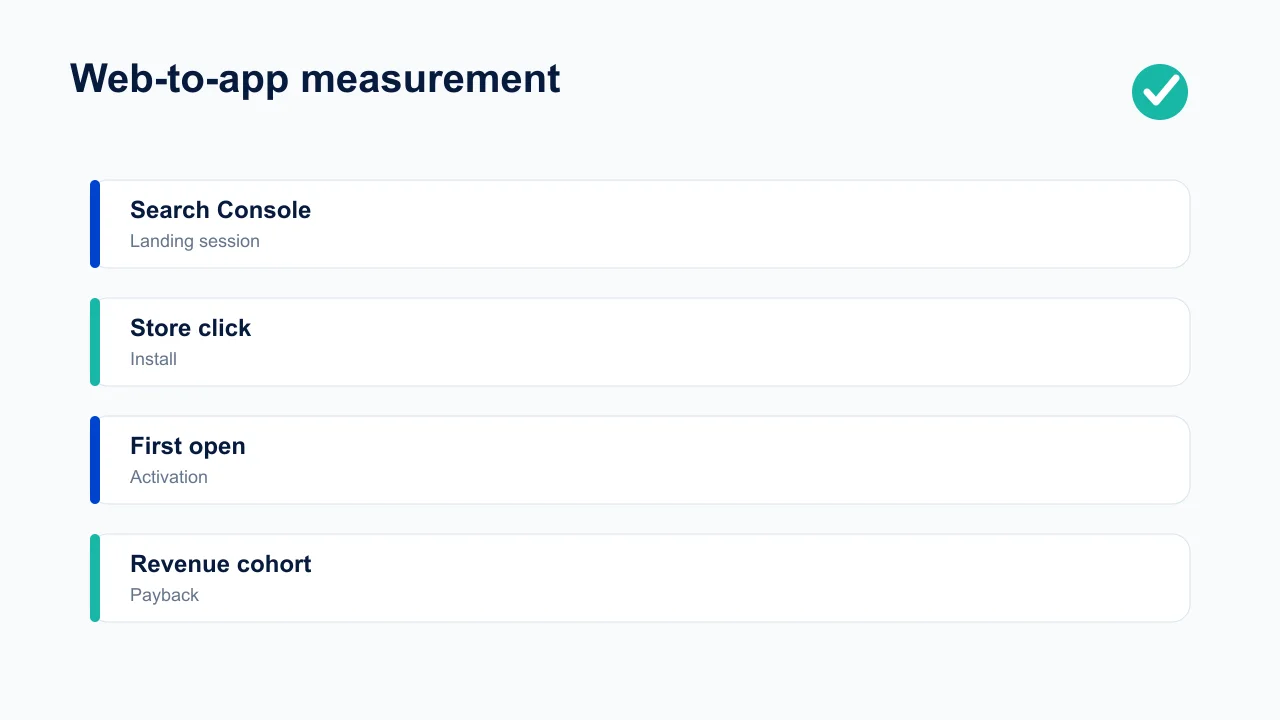
Search Console is the source for query, page, country and device search performance. Web analytics measures landing behaviour and outbound store clicks. Store consoles report product-page and acquisition outcomes using their own definitions. An MMP or first-party deferred-link system may add campaign continuity; product analytics and backend records establish activation and revenue.
Document definitions and windows. “Organic install” in a store console, MMP and internal model may not mean the same thing. Keep platform-reported fields separate, reconcile directionally, and use controlled tests where stakes justify them: publish by market, hold out a page group, or compare brand and non-brand lift rather than claiming every install.
The operating table needs page cluster, publication date, impressions, qualified clicks, store outbound rate, activated installs where observable, activation rate, paid conversion and retained revenue. Use four- to twelve-week trends depending on demand and crawl frequency. Do not declare a page failed after five days or successful because it ranked for an irrelevant query.
What should a 90-day app SEO plan look like?
Spend the first 15 days fixing measurement and technical blockers, the next 30 publishing the highest-intent page cluster, the following 30 improving hand-off conversion, and the final 15 consolidating evidence into the next roadmap. This sequence earns learning before scale.
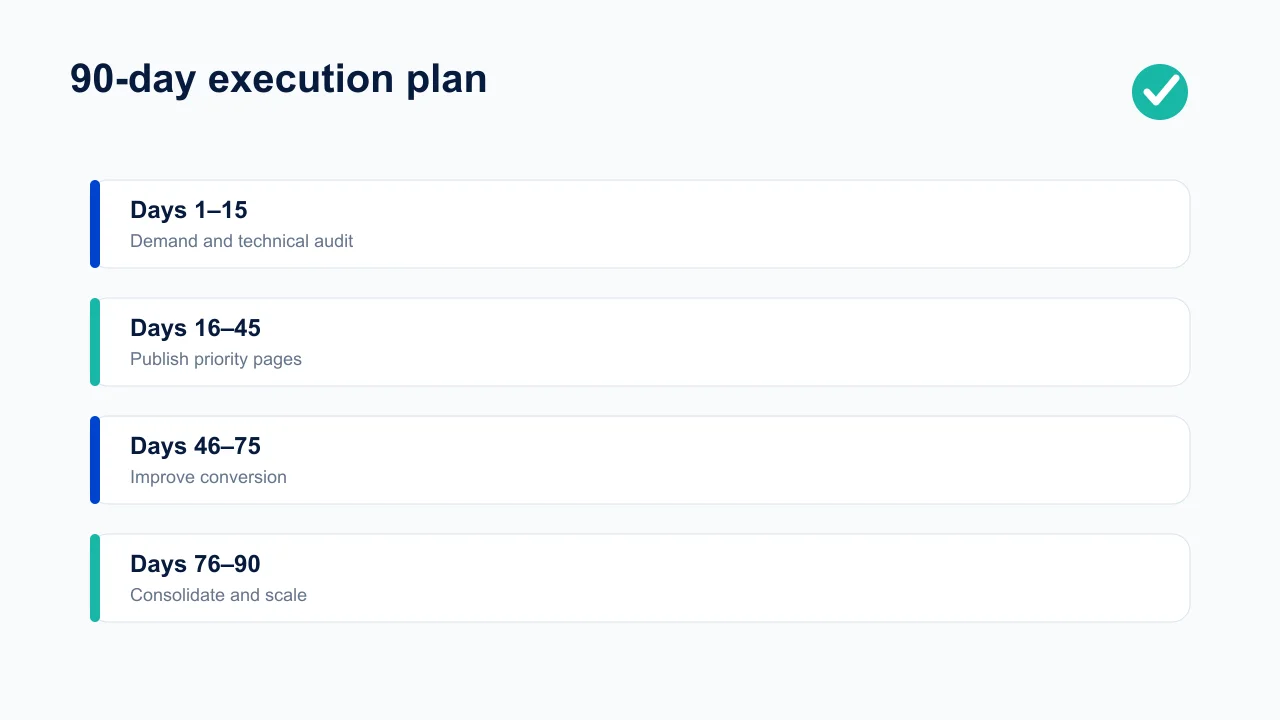
- Days 1–15: inventory indexed pages, queries, store links, canonicals, mobile rendering, schema, app-link verification and analytics events. Agree activation and guardrail metrics.
- Days 16–45: publish or rebuild the app page and three to six pages around one qualified intent cluster. Add original evidence and internal links. Submit clean sitemaps and monitor rendering.
- Days 46–75: align snippets, landing promises and store creative. Test CTA placement or first-frame narrative without changing every variable. Fix deep-link and platform-routing failures.
- Days 76–90: compare cohorts through activation, refresh weak pages, merge overlap, redirect retired URLs and choose the next cluster based on business value.
Assign one owner across the hand-offs even when specialists execute each layer. SEO that ends at ranking, ASO that begins only at the store, and product analytics that begins only after onboarding leave three unowned gaps. The growth system works when one roadmap joins them.
How should app SEO work across countries and languages?
Localise only when search intent, product availability and store conversion can all support the market; translate meaning and evidence, not merely strings. A language directory full of machine-translated pages with the wrong currency, screenshots and support details creates an indexation problem and a broken promise.
Research demand independently in each market. Users describe the same job differently, and a popular English category term may have no direct equivalent. Review local result formats, regulations, competitors, device mix and store availability. Choose a stable URL convention, use valid language and regional annotations, self-reference canonicals and provide visible navigation between real equivalents.
Localise the complete journey: title and snippet, page examples, pricing and currency, testimonials, platform badges, privacy disclosures, store listing, screenshots, onboarding and support. If the app remains English-only, say so before the store click. It is better to serve one honest English page than imply a localised product that does not exist.
Measure each locale separately because blended conversion hides mismatch. A local page may rank well and still fail when it hands visitors to an untranslated store listing. Use custom Play listings or Apple custom product pages where they legitimately preserve the market-specific promise, and connect local page cohorts to activation rather than comparing traffic alone.
Which app SEO mistakes waste the most time?
The costliest mistakes are publishing without a qualified conversion path, confusing store optimisation with web search, creating overlapping pages, relying on obsolete App Indexing advice and reporting traffic without product outcomes. They produce activity while leaving the system’s hand-offs unowned.
- Thin programmatic pages: thousands of city, feature or alternative URLs with nearly identical copy create maintenance and canonical problems. Launch only templates that can provide genuinely distinct evidence.
- Store badges as the whole landing page: a visitor still needs the answer that earned the click, proof the app can help, pricing expectations and privacy confidence.
- Forced mobile redirects: device assumptions can trap researchers, desktop users and crawlers. Keep a functional web destination and let users choose.
- Schema before substance: valid JSON-LD cannot rescue a page without visible supporting content, demand or authority.
- Rank tracking as the scorecard: positions fluctuate and do not reveal whether a visitor installs or activates. Use them diagnostically.
- Unmaintained volatile claims: store and measurement documentation changes. Date the research and schedule revalidation.
Set a kill or merge rule before publishing. If a page attracts the wrong demand, cannot earn links, overlaps a stronger resource or sends no qualified visitors after a fair test, improve its intent fit, consolidate it or remove it. More indexed URLs are not inherently an asset.
The best safeguard is a one-page brief for every proposed URL: target user and query cluster, unique evidence, primary answer, page format, internal parent, store/app destination, activation hypothesis, owner and review date. If those fields cannot be completed, the page is not ready to commission.
Review the brief with product and support before writing. They can usually identify a false promise, missing constraint or recurring objection faster than a keyword tool can. That review also creates the named expert and original evidence the finished page needs.
Frequently Asked Questions
Is app SEO the same as ASO?+
No. SEO targets web search and pages on the web; ASO targets discovery and conversion inside app stores. A strong system coordinates both.
Can Google index screens inside a mobile app?+
Google Search ranks web documents. Current app-link technology routes eligible web URLs into installed apps; it does not turn app screens into independently crawled pages.
Does SoftwareApplication schema improve rankings?+
Structured data can make a compliant page eligible for app rich-result treatment. It is not a guaranteed display or a substitute for useful content and authority.
Do deep links help SEO?+
Verified links improve the destination experience for installed users and preserve a web fallback. They do not create rankings by themselves.
How long does app SEO take?+
Technical fixes may be observed quickly, but meaningful non-brand growth commonly requires months of crawling, content evaluation, linking and iteration. Use 90 days as a first learning cycle.
Which app SEO metric matters most?+
Retained value from qualified organic cohorts is the business metric. Rankings, clicks and store outbound rate are diagnostic steps in that chain.
Sources
- Google Search Central — Software app structured data — Supported properties and eligibility.
- Google Search Central — Mobile-first indexing — Mobile content and markup parity.
- Google Search Central — App deep links — Search-to-app routing guidance.
- Firebase — Dynamic Links shutdown FAQ — Shutdown date and migration context.
- Android Developers — About App Links — Verified Android web links.
- Apple Developer — Supporting associated domains — Universal Link domain association.
About the author
Amol Pomane — Founder, Vmobify
Amol leads Vmobify, a mobile app growth agency that has driven 30M+ downloads and ranked 54K+ keywords across 300+ apps since 2013. He writes about ASO, paid user acquisition, retention, and the operational reality of scaling mobile apps in India and global markets.
Check your store metadata
Run your current App Store or Play metadata through the free checker.
Open free tool