What Google Play Actually Takes, and Alternative Billing in India
You budgeted for 15% and your Play Console statement says 30%. The lower tier is not automatic — it requires an enrolment most teams never completed, enrolment most teams never completed, and within an account group the threshold is pooled across every developer account you own. Alternative billing in India reduces the fee by four percentage points, but only for developers who build and certify a second payment stack.
On this page
- Why does your statement say 30%?
- How does the first $1M tier actually count?
- Are subscriptions really 15% regardless?
- Is there a rate below 15%?
- What does alternative billing in India change?
- What do you have to build to earn the 4 points?
- Does the 4-point reduction leave you ahead?
- What is changing in the EEA, UK and US?
- Which transactions sit outside the fee entirely?
- How should you model this before you build?
- Frequently Asked Questions
Why does your statement say 30%?
Almost always because nobody enrolled — the 15% tier is an opt-in that requires creating an Account Group and accepting a separate set of terms in Play Console, not a rate Google applies to you automatically. This is the single most expensive piece of misinformation in Indian app monetisation, and it costs teams fifteen points of revenue on every transaction until someone notices.
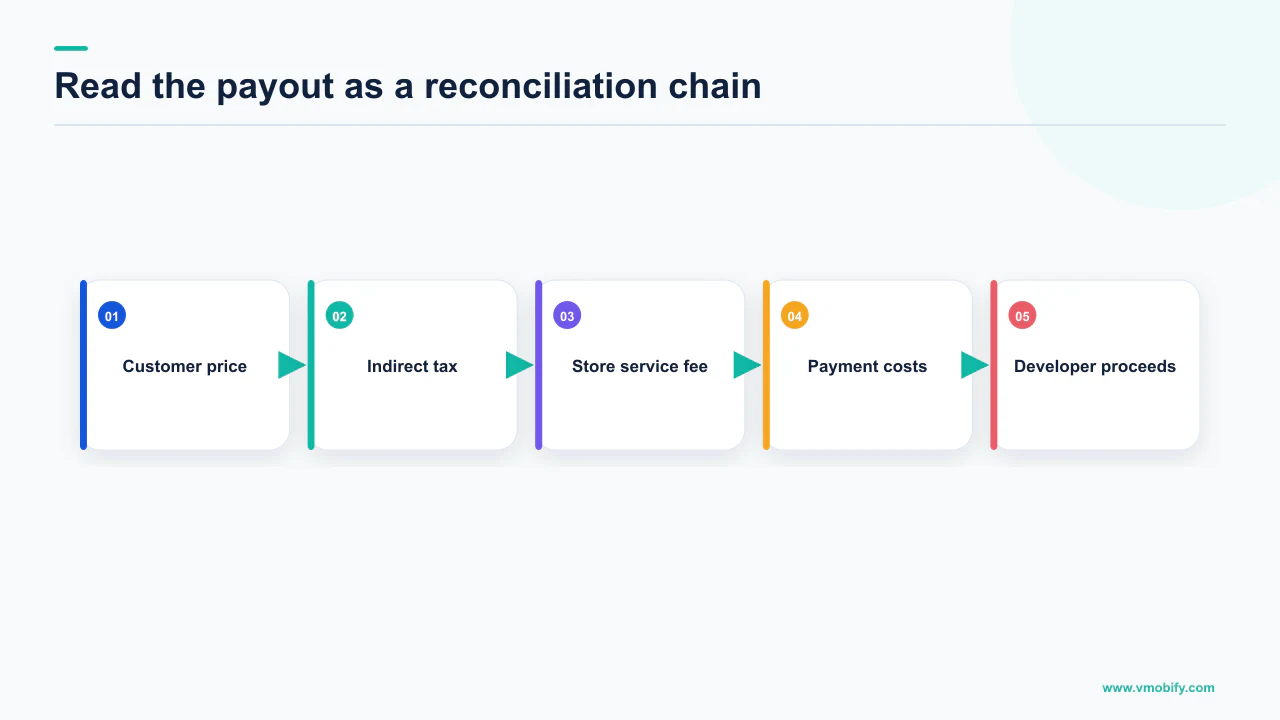
Google's service fees documentation sets out the global schedule plainly. Outside the restructured EEA, UK and US markets it is 15% for the first $1M (USD) revenue earned by the developer each year and 30% for earnings in excess of $1M (USD), with 15% for automatically renewing subscription products purchased by subscribers.
What that page does not do is describe the tier as something that switches itself on. Google's separate note on the 2021 service fee change is where the mechanism lives: developers officially enrol for the 15% service fee tier by creating an Account Group and accepting the terms of service in Play Console. No Account Group, no reduced rate.
Open Play Console, look for an Account Group, and check whether the 15% service fee tier terms were ever accepted. If your app launched before someone in the team went looking for this, the answer is frequently no — and the difference between 15% and 30% on the same revenue is not a rounding error you can absorb.
Across the 300+ apps we have managed since 2013, this is the most common single reason a monetisation model and a payout statement disagree. The model was built from a blog post quoting the headline rate; the statement reflects an account that never enrolled. Nothing about the product is wrong. The paperwork is.
How does the first $1M tier actually count?
On a calendar year, pooled across every associated developer account in your Account Group, and once the pool crosses $1M the 30% rate applies to every account in the group for the rest of that year. Each of those three properties surprises somebody, and the pooling one surprises almost everybody.
Google's documentation on the change describes earnings as determined on a calendar year basis, running 1 January to 31 December. That is not your financial year, which for an Indian company almost certainly ends in March. If your monetisation planning runs on an April-to-March cycle, your fee tier does not, and the two calendars will cross in the middle of a quarter.
The pooling rule is the one that changes structural decisions. Where a developer maintains multiple associated developer accounts inside a group, the 15% tier applies as long as the total earnings of all accounts in the group is under $1M, and every account receives the benefit. Once total earnings exceed $1M, the service fee is 30% for all accounts for the rest of the year.
Splitting a portfolio across several developer accounts inside one group does not buy you several $1M allowances. The allowance is shared, and it is exhausted collectively.
If you are building the unit economics that sit on top of this, our guide to ROAS and CAC for apps and the LTV to CAC calculator both assume you have a defensible net-revenue figure to feed in. This is where that figure comes from, and getting the tier wrong distorts every payback number downstream.
Are subscriptions really 15% regardless?
Yes — Google's schedule lists 15% for automatically renewing subscription products purchased by subscribers, stated without a revenue threshold attached to it. That makes subscriptions the only major transaction type on Play where crossing $1M does not change what you pay.
One-off in-app purchases
- 15% on the first $1M of group earnings each calendar year
- 30% on earnings above that
- Requires enrolment in the 15% tier
- Your effective rate rises as you grow
Auto-renewing subscriptions
- 15% for automatically renewing subscription products purchased by subscribers
- No second tier stated in the published schedule
- Applies to the renewing subscription product
- Your effective rate does not move with scale
Note the precision of the wording. It covers automatically renewing subscription products purchased by subscribers. A one-time unlock, a consumable, or a non-renewing pass is not that, whatever your marketing calls it. If you are re-architecting a catalogue around this line, the product configuration has to genuinely be an auto-renewing subscription, and the migration work involved is covered in our note on the Play Billing Library 8 migration.
The strategic reading is not that everything should become a subscription. It is that on Play the fee schedule stops penalising subscription revenue for growing, which is a real input into a catalogue decision alongside retention and willingness to pay. We work through the rest of that decision in the app subscription monetisation strategy guide.
Is there a rate below 15%?
Yes, for a narrow set of media apps accepted into a named programme — Google lists 15% or lower for eligible developers who qualify under programmes such as the Play Media Experience Program. It is not a rate you negotiate; it is a programme you apply to and are admitted to, and most apps are not eligible.
The Play Media Experience Program page describes a service fee of 15% for all applicable earnings or lower based on industry, across three media verticals: video, audio and books. Entry is by expressing interest through a submission form rather than by ticking a setting, which is the tell that acceptance is discretionary.
We are deliberately not printing a below-15% figure here. Google's own wording is or lower based on industry, and it publishes no table of what lower resolves to for which vertical. Any specific number you see quoted for this programme has been inferred rather than sourced, and it is not a figure we will put in a model on a client's behalf.
If a rate is not published, model the published rate and treat any improvement as upside. A monetisation plan that only works at an unpublished rate is a plan that depends on a negotiation you have not had.
What does alternative billing in India change?
It reduces the service fee by four percentage points on transactions the user chooses to make through your billing system — and it does not remove Google Play's billing system from your app, because you must still offer it alongside. The four points are real. The word alongside is the part that dictates the engineering.
Google's page on billing requirements for developers serving users in India is explicit on both halves. It describes offering all developers the ability to offer an alternative billing system alongside Google Play's, and states that if a user pays through an alternative billing system, the Google Play service fee will be reduced by 4%. Eligibility is framed as an app or game offering alternative billing to mobile and tablet users in India.
Carry those conditions with the number every time you quote it, because each one narrows it:
- The reduction is 4 percentage points off the fee that would otherwise apply, not a flat rate. An enrolled developer under the threshold moves from 15% to 11%; the same developer above $1M moves from 30% to 26%; an auto-renewing subscription moves from 15% to 11%.
- It applies only to transactions the user actually routes through your system. Anything paid through Play's billing system is charged at the ordinary rate. You are not converting your whole revenue line, you are converting the share of users who pick the other option.
- It applies to mobile and tablet users in India under this programme. It is not a global fee reduction, and a separate programme with its own terms exists for South Korea, where Google uses the same language: the service fee will be reduced by 4%.
- Google Play's billing system stays. Google's position on the India page is that users should have the choice to use Play's billing system when they make a digital goods purchase from apps installed from Google Play. Removing it is not one of the options.
What do you have to build to earn the 4 points?
An enrolment, a certification, a payment integration, a fraud-reporting path and a transaction-reporting obligation measured in hours — the four points are payment for compliance work, not a discount for asking. Reading the requirement list is the fastest way to work out whether the programme is worth it for your volume.
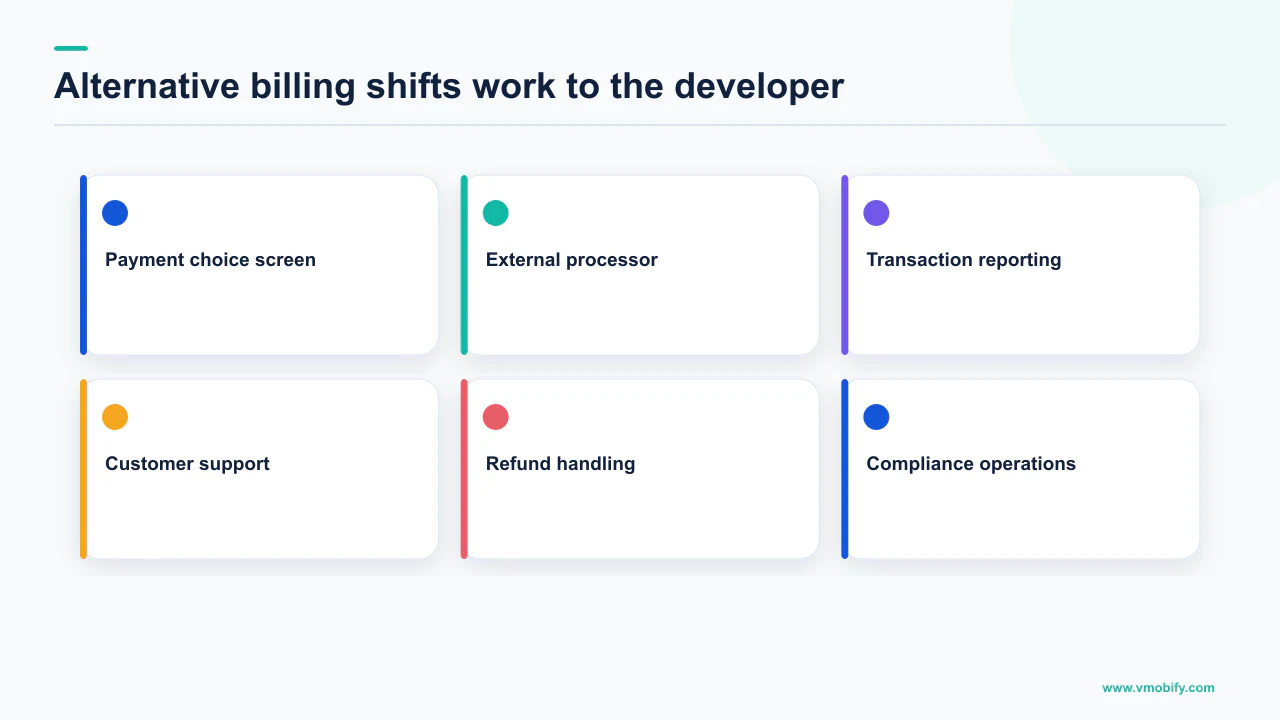
Google's India page describes the onboarding sequence, and it is longer than teams expect:
- Review the eligibility criteria — the offering is scoped to apps and games serving mobile and tablet users in India.
- Complete onboarding in Play Console's alternative billing settings, which includes accepting the terms of service and setting up a payment profile.
- Certify PCI DSS compliance and the ability to report fraudulent transactions. This is a compliance assertion about your payment stack, not a checkbox, and it is where most small teams stop.
- Integrate the alternative billing APIs and configure the settings, including the payment method logos users will see.
- Make the choice legible to users, either by following Google's UX guidelines or by using the alternative billing APIs, so that a user understands which billing option they are selecting.
- Report every authorised transaction from users in India to Google Play within 24 hours using the alternative billing APIs. Google documents a manual monthly self-reporting route by the fifth business day for non-API implementations, but the 24-hour API path is the default expectation.
There is also a cost you now carry that Google was previously carrying. Running your own billing means you pay a payment gateway, absorb failed-payment and refund handling, take on chargeback exposure, and support users through a checkout Google no longer operates. We are not going to print a percentage for Indian gateway pricing here — the rates vary by instrument, by negotiated contract and by whether the payment is a card, a UPI collect or an autopay mandate, and there is no primary source that would make a single published figure honest. Get quotes for your own mix.
That is not a hedge; it is the whole decision. If your own processing and operational cost lands close to four points, the programme is administrative overhead with no margin attached. If it lands well under four points and your volume is meaningful, it pays. Our work on UPI AutoPay for app subscriptions covers the recurring-payment mechanics you would be taking ownership of in India.
Does the 4-point reduction leave you ahead?
Only if your fully loaded cost of running payments yourself is comfortably below four percentage points of gross transaction value, on the share of transactions users actually route away from Play. Both halves of that sentence have to be true, and teams usually test only the first.
Work the arithmetic on the published rates. An enrolled developer under the $1M threshold pays 15% through Play's billing system and 11% through an alternative system, so the gross improvement is four points. Against that, set every cost Play's fee previously covered on your behalf, and the share of users who will actually choose the alternative.
The adoption share is the variable nobody can hand you. Google requires that Play's billing system remains available and that the choice is presented legibly, so you cannot design a flow that steers users. Whatever proportion of users selects your option is an empirical result of your specific checkout, and we will not publish a benchmark for it, because any number we have seen is a single client's mix rather than a market rate. Measure it yourself, on your own users, before you extrapolate a saving.
There is a second-order effect worth pricing in as risk rather than as a number. Any additional payment step is a place where conversion can fall, and a four-point fee saving is wiped out by a checkout that converts materially worse than Play's. Run it as a controlled experiment, with your testing tooling instrumented on completion rate and not just on the fee line.
Alternative billing is a scale decision. Below a certain transaction volume the compliance, integration and support cost exceeds four points of a small number. Above it, four points of a large number funds a payments team. The threshold sits in your own numbers, not in a published table, which is why we build the model before we build the integration. If you want that model run against your data, talk to us.
What is changing in the EEA, UK and US?
Those three markets have moved to a separate schedule that splits the charge into a service fee plus a distinct 5% billing fee, and treats transactions differently depending on whether the install predates 30 June 2026. India is not part of it, and a model built on the new structure will misprice Indian revenue.
The structural features Google documents on the service fees page are worth understanding even if you do not sell in those markets, because they signal where the pricing architecture is heading:
- The charge is unbundled. Instead of one blended percentage, the schedule presents a service fee alongside a separate 5% billing fee for transactions processed through Play's billing system.
- Installs are classified by date. The schedule distinguishes New Installs, where the first install or update happened on or after 30 June 2026, from Existing Installs that predate it, and charges them differently.
- Routing to an external web link carries a lower rate than the equivalent in-app transaction on the same install class.
- Programme enrolment still moves the rate, with distinct rows for developers in Google's games and apps experience programmes.
For an Indian developer the practical guidance is narrower and clearer. If your revenue comes from Indian users, the 15%/30% schedule and the 4% alternative billing reduction are your numbers. If you also sell into the EEA, UK or US, you now maintain two fee models rather than one, and your blended take rate depends on your geographic mix. Teams running purchasing-power-based price localisation across regions should recheck their margin assumptions market by market rather than applying one global figure.
Which transactions sit outside the fee entirely?
Purchases of physical goods and physical services, utility and telecommunications bill payments, peer-to-peer transfers, online auctions and tax-exempt donations are not required to use Google Play's billing system — and what does not go through it is not charged a service fee on it. For a large share of Indian apps this is the most consequential paragraph in the whole payments policy.
Google's payments policy requires Play's billing system for paid app downloads and for in-app purchases of digital goods: virtual items such as currencies and extra lives, subscription services covering categories like fitness, gaming, dating, education, music and video, app functionality such as ad-free versions and new features, and cloud services such as data storage and productivity software.
It then sets out categories where Play's billing system is not required, including physical goods such as groceries, clothing and electronics; physical services such as transportation, cleaning, airfare, gym memberships, food delivery and event tickets; payment of utility bills including cable and telecommunications; peer-to-peer transactions and online auctions; and tax-exempt donations.
The exemptions are defined by what is actually being sold, not by how the checkout is dressed. The policy also states that apps may not lead users to a payment method other than Google Play's billing system, other than in eligible countries under the specific alternative billing programmes. Relabelling a digital good as a service is a suspension risk, not a fee strategy — see what actually triggers a Play suspension.
The genuinely useful application of this section is a categorisation exercise. Take every SKU you sell and place it on the correct side of the line, using the policy's own categories rather than your product taxonomy. In our portfolio, commerce, travel and services apps frequently find that most of their transaction volume was never subject to a Play service fee at all, and that the fee anxiety driving the conversation applies only to a small digital-goods tail. That changes what the monetisation work should be, and our monetisation playbook starts from that split.
How should you model this before you build?
Establish your enrolment status, classify your SKUs, forecast the calendar-year threshold at group level, and only then evaluate alternative billing as an incremental decision on the transactions that remain. Run in that order and most teams discover the biggest win is administrative rather than architectural.
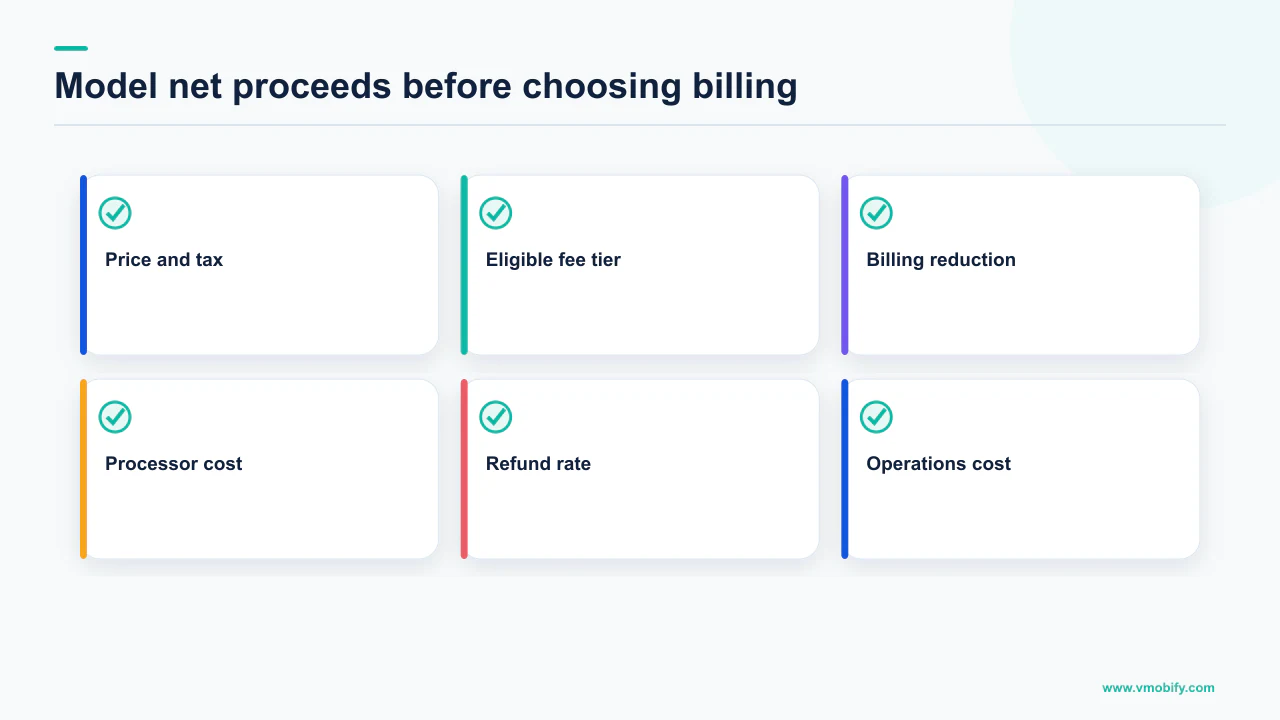
- Confirm the 15% tier enrolment. Account Group created, terms accepted. This is free, immediate, and worth more than any integration project on the list. It is also the step most frequently missing.
- Split your catalogue against the payments policy categories. Digital goods and services requiring Play billing on one side; physical goods, physical services, utility payments, peer-to-peer and donations on the other. Only the first side carries a service fee.
- Forecast group earnings on a January-to-December basis and identify the month you expect to cross $1M, if you expect to. Your blended rate for the year is a weighted average, and this affects every account in the group, not just the app that crossed.
- Separate subscription revenue from one-off purchases in that forecast, since the published schedule keeps auto-renewing subscriptions at 15% while one-off purchases move to 30% above the threshold.
- Price the alternative billing decision last. Four points of the transactions users actually route through your system, minus your fully loaded processing, compliance, support and reporting cost, minus any conversion loss at checkout. If that number is not clearly positive, do not build it.
- Instrument before you migrate anything. You need per-SKU net revenue after fees, not gross bookings, or you cannot tell whether a change helped. Our analytics work usually starts here.
The pattern we see repeatedly is a team spending a quarter scoping an alternative billing integration while sitting on an unenrolled account paying 30% on revenue that should have been charged at 15%. The integration might eventually be right for them. The enrolment was right for them on day one and cost nothing.
Everything above comes from Google's own published pages, and those pages change — the EEA, UK and US restructure is proof that they change materially. Re-read the service fees page before any planning cycle in which the fee is a load-bearing assumption, and treat any percentage you find in a secondary source, including this one, as something to verify rather than to model on. If you want help building the net-revenue model that sits underneath all of this, our monetisation practice does exactly that work.
Frequently Asked Questions
Does Google Play automatically charge me 15% if I earn under $1M?+
No. Google documents that developers officially enrol for the 15% service fee tier by creating an Account Group and accepting the terms of service in Play Console. Without that enrolment the reduced tier does not apply, which is the most common reason a Play Console statement shows a higher rate than a founder expected.
How much does alternative billing save me in India?+
Google states that if a user pays through an alternative billing system, the Google Play service fee will be reduced by 4%. That is four percentage points off whatever rate would otherwise apply to that transaction: 15% becomes 11%, 30% becomes 26%. It applies only to transactions the user routes through your system, and only to mobile and tablet users in India under this programme.
Can I remove Google Play billing from my app in India?+
No. Google describes the India programme as the ability to offer an alternative billing system alongside Google Play’s, and states its position that users should have the choice to use Play’s billing system when making a digital goods purchase from an app installed from Google Play. You add a second option; you do not replace the first.
Does the $1M threshold reset every year?+
Yes. Earnings are determined on a calendar year basis running 1 January to 31 December. That is not the Indian financial year, so a company planning on an April-to-March cycle will see its fee tier reset in the middle of a quarter.
Do subscriptions ever get charged 30% on Google Play?+
Google’s published global schedule lists 15% for automatically renewing subscription products purchased by subscribers and does not attach the $1M second tier to that line. The condition matters: the product has to genuinely be an auto-renewing subscription, not a one-off unlock or a non-renewing pass.
Do the new EEA, UK and US rates apply to my Indian users?+
No. Google publishes that restructured schedule for the EEA, UK and US, with a separate 5% billing fee and a distinction between installs before and after 30 June 2026. Indian revenue continues under the 15%/30% schedule with the 4% alternative billing reduction where applicable.
Which of my sales are exempt from the Play service fee?+
Google’s payments policy lists categories that are not required to use Play’s billing system, including physical goods, physical services such as transport, airfare, gym memberships, food delivery and event tickets, utility and telecommunications bill payments, peer-to-peer transactions, online auctions and tax-exempt donations. Digital goods and services sold in-app must use Play’s billing system, and the policy also states apps may not lead users to another payment method outside the eligible alternative billing programmes.
Sources
- Service fees - Play Console Help — Publishes the global schedule of 15% for the first $1M (USD) of annual developer revenue, 30% above it, and 15% for automatically renewing subscription products purchased by subscribers; also states that alternative billing transactions in South Korea and India are charged the applicable Play fee reduced by 4%, and sets out the separate EEA, UK and US structure.
- Changes to Google Play’s service fee in 2021 — States that developers must officially enrol for the 15% service fee tier by creating an Account Group and accepting terms in Play Console, that earnings are counted on a calendar year basis, that the threshold is pooled across associated developer accounts in a group, and that exceeding $1M moves all accounts in the group to 30% for the rest of the year.
- Changes to Google Play’s billing requirements for developers serving users in India — Describes the ability to offer an alternative billing system alongside Google Play’s for mobile and tablet users in India, states the Play service fee is reduced by 4% when a user pays through it, and lists the onboarding steps including PCI DSS certification, fraud reporting, API integration and reporting authorised transactions within 24 hours.
- Changes to Google Play’s billing requirements for developers serving users in South Korea — The parallel South Korea programme, using the same wording that the Google Play service fee will be reduced by 4% for alternative billing transactions, with an equivalent enrolment, certification and transaction-reporting sequence.
- Offering an alternative billing system for users in the European Economic Area (EEA) — Sets out the EEA alternative billing programme without user choice, its covered countries, enrolment requirements and fee treatment, which differs from the India and South Korea programmes.
- Payments policy - Play Console Help — Defines which transactions must use Google Play’s billing system, lists the categories that are not required to, including physical goods and services, utility payments, peer-to-peer transactions and tax-exempt donations, and states that apps may not lead users to another payment method outside the eligible alternative billing programmes.
- Understanding Google Play’s Service Fee — States that 97% of developers distribute apps at no charge and that 99% of developers who are subject to a service fee qualify for a fee of 15% or less.
- Google Play Media Experience Program | Google Play Console — Describes a service fee of 15% for all applicable earnings or lower based on industry for accepted video, audio and books apps, with entry by expressing interest through a submission rather than by self-enrolment.
About the author
Amol Pomane — Founder, Vmobify
Amol leads Vmobify, a mobile app growth agency that has driven 30M+ downloads and ranked 54K+ keywords across 300+ apps since 2013. He writes about ASO, paid user acquisition, retention, and the operational reality of scaling mobile apps in India and global markets.