Account Deletion With Active Subscriptions: A Safe App Flow
Deleting an app account does not automatically cancel an Apple or Google subscription. This implementation guide separates identity, personal data, billing and entitlement state so users receive a clear, compliant and testable deletion flow.

On this page
- Why does account deletion not cancel a subscription?
- What do Apple and Google require for account deletion?
- What should the user see before confirming deletion?
- How should you handle an active iOS subscription?
- How should you handle an active Google Play subscription?
- What data can you retain after account deletion?
- How do you design the backend deletion workflow?
- What happens if a store event arrives after deletion?
- How do you test account deletion end to end?
- What account deletion operating checklist should founders use?
- Frequently Asked Questions
Why does account deletion not cancel a subscription?
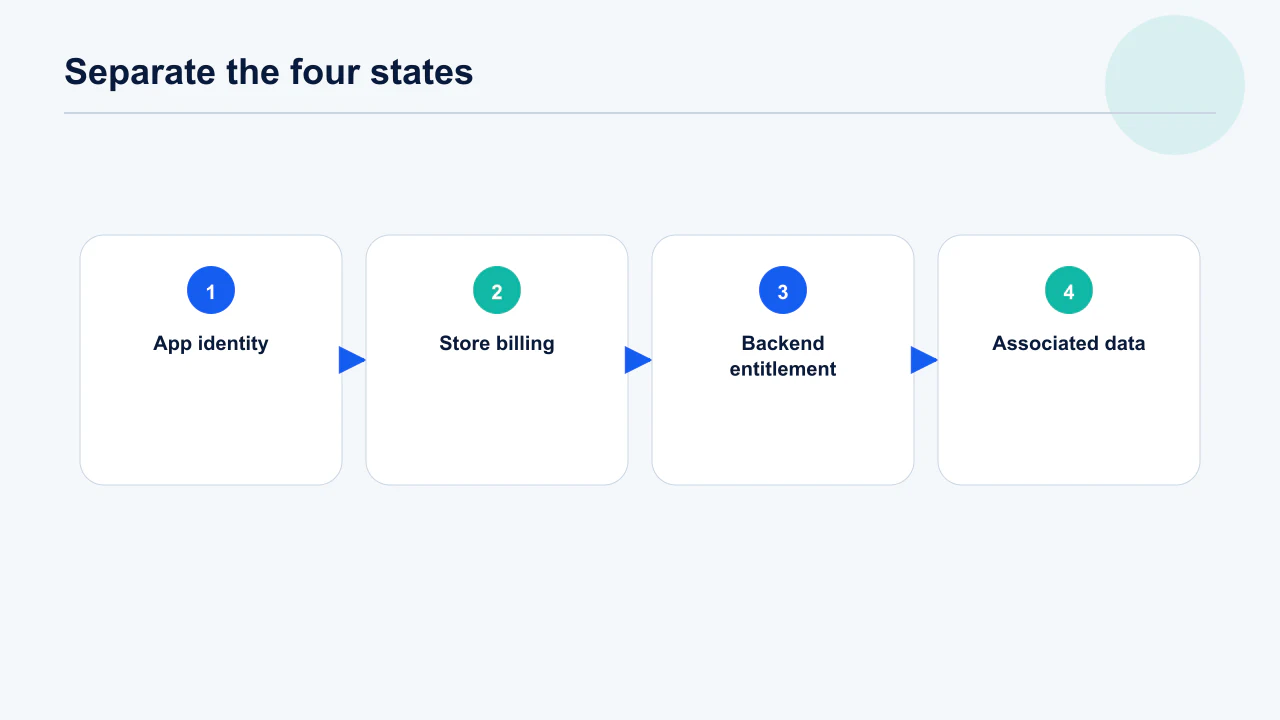
Account deletion removes the product identity and associated data, while subscription cancellation changes a separate billing contract held by Apple or Google. Conflating them creates the dangerous state in which a person loses access to the app but continues to be charged.
Your backend may receive transaction events and grant entitlements, but it usually cannot unilaterally cancel every store subscription in the way it deletes a database row. The flow must therefore expose both states: what will happen to the account now and what action is required in store subscription management.
- Identity: The app owns the login, profile and internal user identifier. Deletion begins here.
- Billing: The store owns payment authorisation and renewal controls for store purchases. Send the user to the correct management surface.
- Entitlement: Your server maps a validated transaction to access. Define what deletion does to that mapping.
- Data: Operational and personal records have different deletion or retention rules. Classify them before implementation.
Decision rule: Never label a control “delete and cancel” unless the system can prove both operations completed.
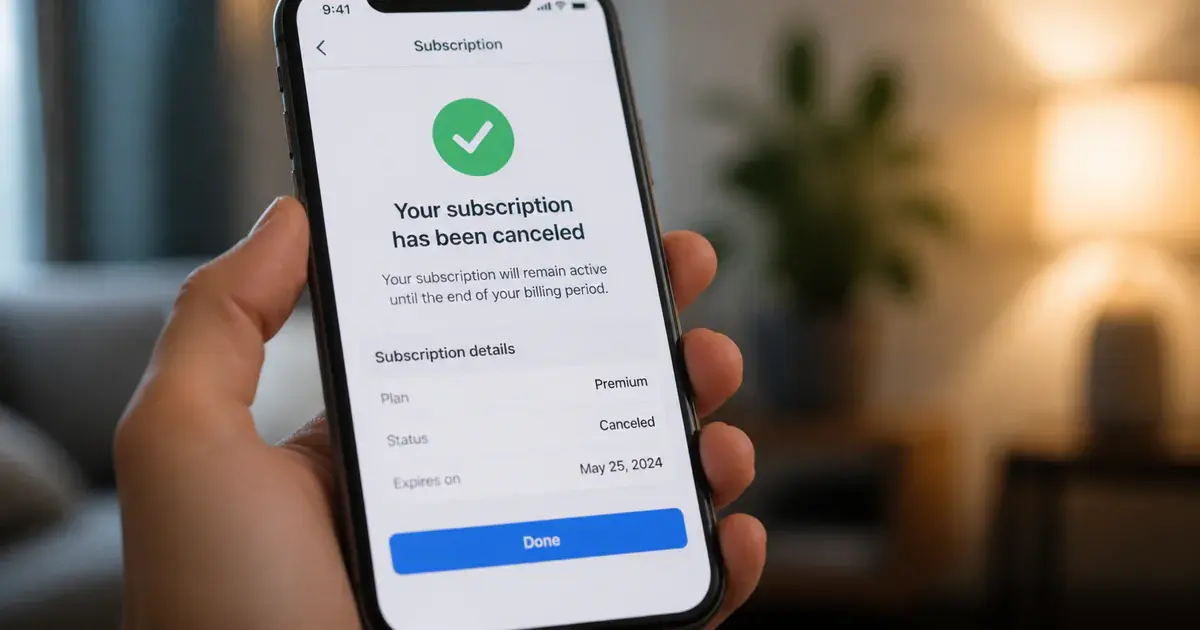
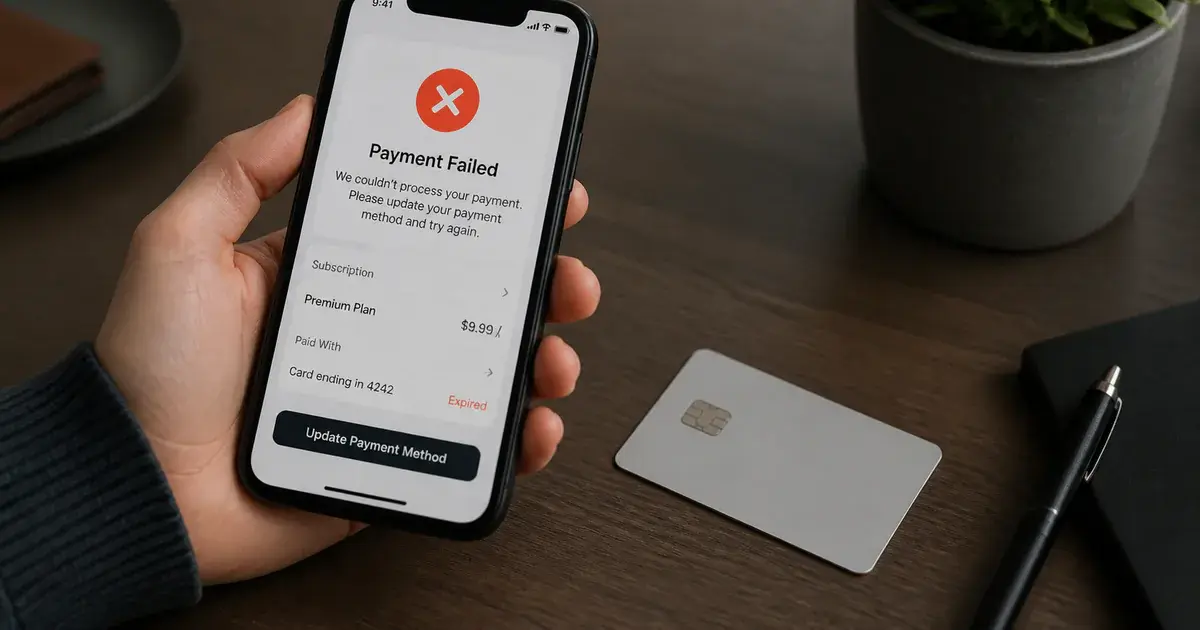
The worst flow confirms “everything deleted” while renewal continues. A safer confirmation states that the account is gone, names the subscription state, and gives a direct route to manage billing.
The practical consequence is a support queue full of people who believe they cancelled and are still being charged. Their account is gone, so your own dashboard shows nothing to investigate, and the only record lives with the store. Instrument for this before launch: log a deletion event with the subscription state at that moment, retained under the financial-records exemption rather than the user record, so support can answer the question without restoring anything. Apple's account deletion guidance is explicit that deletion of the app account does not terminate the store subscription.
Separate identity, billing, entitlement and data early — they have different owners and different deletion rules. Deletion path defects are a recurring rejection cause.
What do Apple and Google require for account deletion?
Both stores expect an accessible deletion mechanism for apps that support account creation, with Google additionally requiring a declared web deletion resource. Apple’s account-deletion guidance requires initiation in the app; Google Play policy requires an in-app path and a functioning web resource.
The path should delete the full account record rather than merely deactivate access. Additional support steps may be legitimate for regulated products or verified identity, but they should be proportionate and explained. Reviewers need valid credentials and must be able to find and complete the flow.
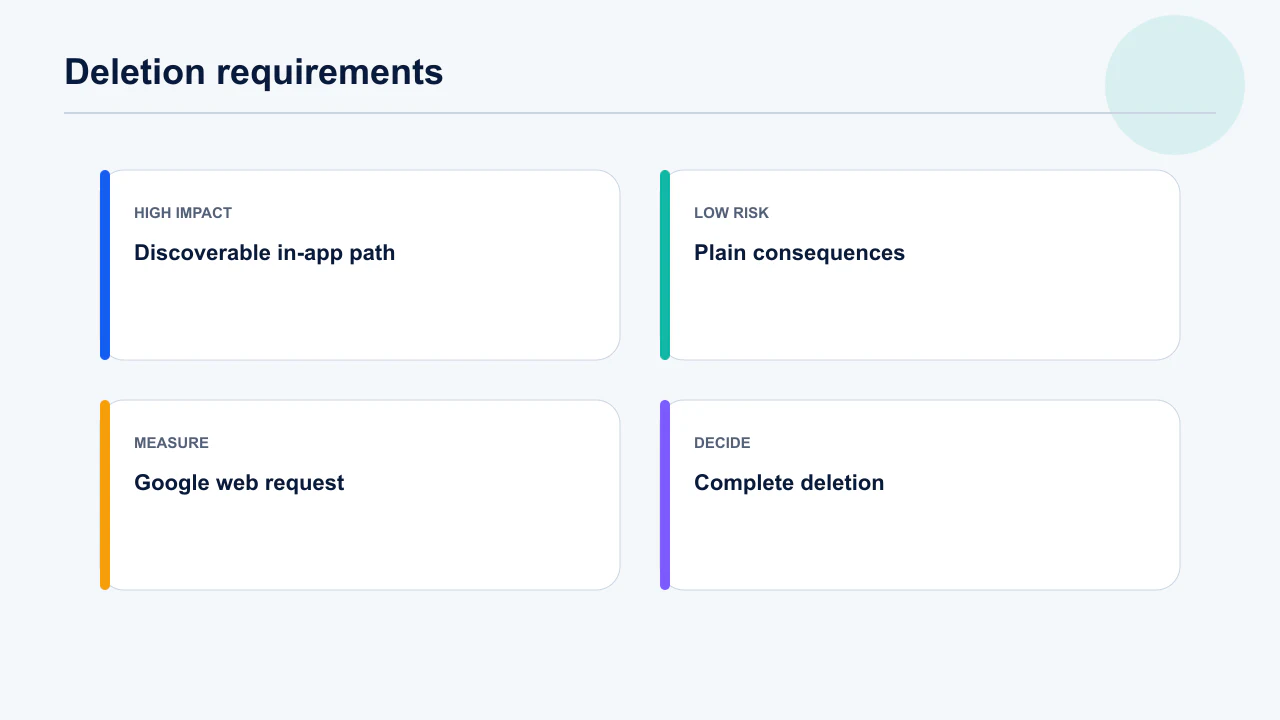
- Discoverability: Place deletion in account settings near other identity controls. Do not hide it in a privacy-policy paragraph.
- Completeness: Delete associated user data unless a documented exception applies. A disabled login is not deletion.
- Web route: Provide Google Play with a stable deletion-request URL that identifies the app. Test it without an authenticated app session.
- Review evidence: Supply test account, steps and any necessary explanation. Re-run them on the submitted build.
Decision rule: A reviewer and a real user should reach the deletion choice from account settings without contacting support unless the product category genuinely requires assisted verification.
In our submission reviews, broken web URLs and support-only loops are more common than missing buttons. The policy declaration and the shipped journey must describe the same system.
Reviewers test discoverability by trying to find the control without instructions, so bury it and the build is rejected regardless of whether the backend is correct. Keep the path to at most two taps from account settings, label it in plain language rather than as 'manage data', and avoid a support-ticket-only route. Apple's Review Guidelines require an in-app initiation point for any app that supports account creation, and a web route that exists in addition to — not instead of — the in-app control.
Keep reviewer evidence with the release: the navigation path, a test account and the expected end state. If review stalls, that evidence answers the question fastest.
What should the user see before confirming deletion?
Before confirmation, state exactly what disappears, what may be retained, whether deletion is immediate and how an active subscription must be managed. The screen is a consequence summary, not a dark-pattern retention offer.
Use progressive disclosure: a short plain-language summary, expandable detail and one deliberate confirmation. Reauthentication can protect against accidental or malicious deletion, but it should not become an obstacle course. Offer data export beforehand if the product supports portable user-created data.
- Scope: Name profile, history, uploads, social content and device sync consequences. Avoid the vague phrase “your data”.
- Timing: State whether access ends now and when background deletion completes. Give a support reference for delayed work.
- Retention: Name categories kept for legal or security reasons and the applicable period or policy. Do not imply zero retention when exceptions exist.
- Subscription: Show store, current entitlement end and a direct management action. Do not promise cancellation you cannot perform.
Decision rule: The user should be able to predict both tomorrow’s bill and tomorrow’s access before pressing the destructive confirmation.
We favour one factual warning over repeated “are you sure?” screens. Friction does not create informed consent; specific consequences do.
Write the confirmation screen as four separate answers rather than one paragraph of legal text, because users skim it and support pays for what they miss. State what disappears, when it disappears, what is kept and why, and — critically — what happens to money. A screen that says the account will be deleted, without saying the subscription continues to bill, is technically accurate and operationally useless. Play's data deletion requirements expect the same clarity in the web-facing route.
Test the copy with someone who has not seen the feature. Ambiguity here converts directly into refund requests and one-star reviews.
How should you handle an active iOS subscription?
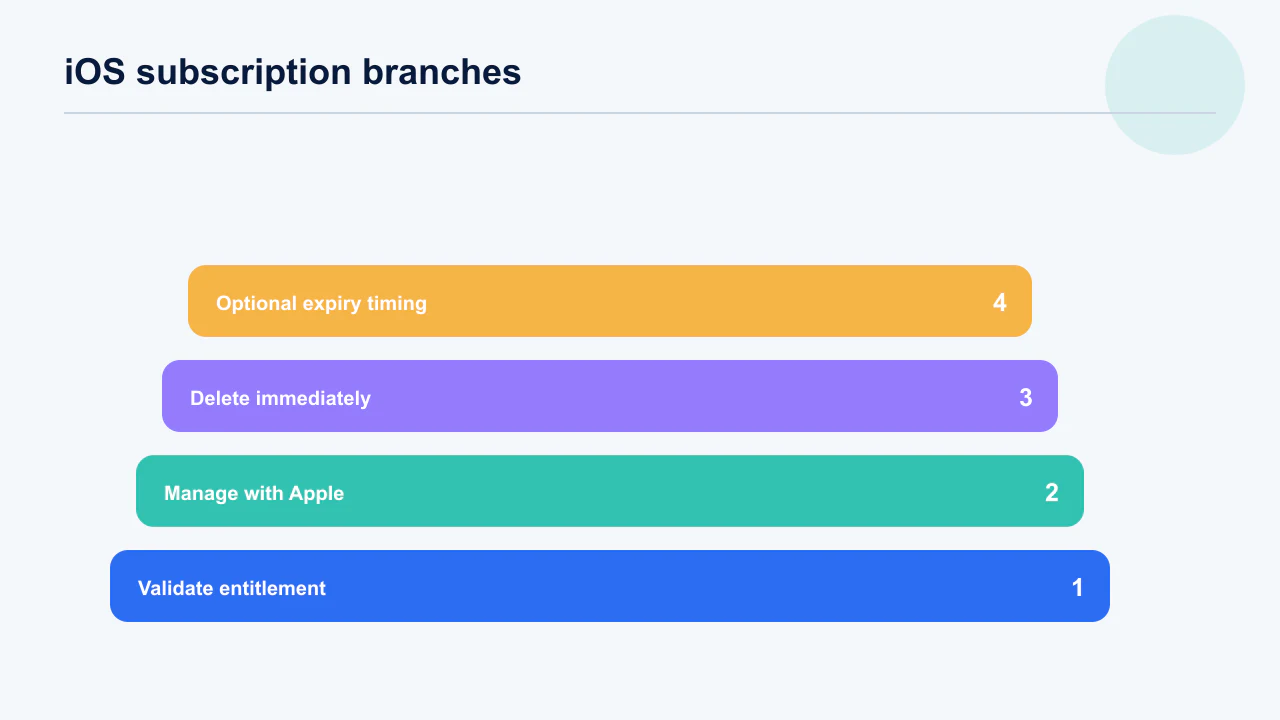
Show the validated iOS entitlement, offer Apple subscription management and let the user choose immediate deletion without pretending the app cancelled Apple billing. Apple’s guidance says an app may offer deletion scheduled for subscription expiry, but only if immediate deletion remains available.
Read server-validated transaction state rather than relying on a stale local flag. Explain that deleting the account may end access while billing remains controlled through Apple. If business rules allow anonymous entitlement restoration, define it explicitly; otherwise explain that deletion removes the app-side association.
- Validate: Use current transaction and server-notification state to show the entitlement end. Do not trust a screenshot or device clock.
- Manage: Link or instruct the user to Apple’s subscription management surface. Keep the deletion choice separate.
- Delete now: Complete account deletion even when time remains, subject to lawful retention. State what happens to remaining access.
- Delete at expiry: Offer only as an optional convenience with recorded consent. Immediate deletion must still be possible.
Decision rule: Never block immediate deletion solely because an Apple subscription is active.
An expiry-timed option can be user-friendly when it is genuinely optional. It becomes a dark pattern when the immediate route disappears or is visually buried.
Offer the choice explicitly rather than picking for the user. Deleting immediately while a paid period remains destroys value they have already paid for; deferring deletion until expiry keeps their data alive longer than they expected. Present both, record which they chose, and honour it. On iOS you cannot cancel on the user's behalf, so the flow has to deep-link to the system subscription management screen and then verify the resulting state rather than assuming the user completed it. Store subscription management behaves differently across platforms, so branch the flow rather than sharing one path.
Verify the resulting state on next launch rather than trusting the hand-off. Grace periods and billing retry complicate what 'active' means.
How should you handle an active Google Play subscription?
Use the current SubscriptionPurchaseV2 lifecycle state, provide Play subscription management and process deletion independently of whether renewal is still enabled. Google’s subscription lifecycle guidance distinguishes active, grace, hold, paused, cancelled and expired conditions.
A cancelled subscription may still grant access until its expiry; grace and hold indicate payment recovery states rather than simple cancellation. Store a transaction-linked entitlement record separately from the deleted personal profile so later notifications can be handled without restoring identity.
- Active renewal: Explain that renewal remains on until the user changes it in Play. Offer the direct management route.
- Cancelled active: Show the entitlement end date and that no further renewal is expected. Deletion can still end account access now.
- Grace or hold: Use the exact current lifecycle state and avoid promising a fixed recovery outcome. Store rules can change.
- Expired or revoked: Remove entitlement according to validated server state. Finish unlinking transaction references safely.
Decision rule: Model subscription state as an enum with explicit transitions; never reduce it to one isPremium boolean.
A boolean cannot distinguish paid access ending normally from a refunded or payment-recovery state. That ambiguity later creates support disputes and accidental re-entitlement.
Enumerate the states before writing the branch, because Play's subscription lifecycle has more of them than most implementations handle. Active renewing, cancelled but still entitled, in grace period, on account hold, paused, expired and revoked each imply a different correct action at deletion time, and treating the middle four as simply 'active' produces either premature entitlement loss or unpaid access. Play Billing's purchase management documentation defines the transitions; map each one to an explicit deletion behaviour and cover them in tests.
Revoked and refunded states deserve particular care — they can arrive after deletion. Billing library changes alter these transitions between versions.
What data can you retain after account deletion?
Retain only records supported by a documented legal, tax, security or fraud purpose, for a defined period, with product access removed. This is a data-governance decision that varies by jurisdiction and product; it is not permission to keep a hidden copy of the account.
Build a retention matrix with data category, system, purpose, legal basis, owner, period and deletion method. Pseudonymise identifiers where the purpose does not require identity. Backups need their own expiry and restore controls so deleted records do not quietly return to production.
- Financial: Receipts or ledger evidence may require retention. Separate them from marketing and profile use.
- Security: Abuse-prevention records may need a narrow identifier or event trail. Minimise fields and access.
- Support: Close open cases and remove unnecessary attachments or transcripts. Do not retain by default.
- Backups: Let records age out under a documented backup schedule. Block rehydration into live profiles.
Decision rule: If the team cannot name the purpose, owner and deletion date for a retained field, delete it with the account.
A hashed identifier is still personal data when it remains linkable. We treat pseudonymisation as risk reduction, not as a magic exemption.
Retention after deletion is a small allowlist, not a general exemption. Transaction records and tax documents have statutory retention periods; fraud and abuse signals justify a bounded hold; support correspondence usually belongs to a shorter clock. Everything else should go. Write the allowlist as a table with a field, a lawful basis, a retention period and an owner, and have privacy sign it before launch rather than after the first regulator question. Subscription lifecycle events continue to reference the purchase long after the account is gone, so keep a pseudonymous key rather than the full profile.
Backups are the commonly missed case: define how deletion propagates to snapshots and how long that takes. The wider compliance checklist covers the declarations this feeds.
How do you design the backend deletion workflow?
Use an authenticated, idempotent workflow that freezes ordinary use, records the request, deletes dependent data in a controlled order and issues a non-sensitive completion receipt. A single synchronous cascade is fragile when data spans storage, analytics, messaging, support and billing systems.
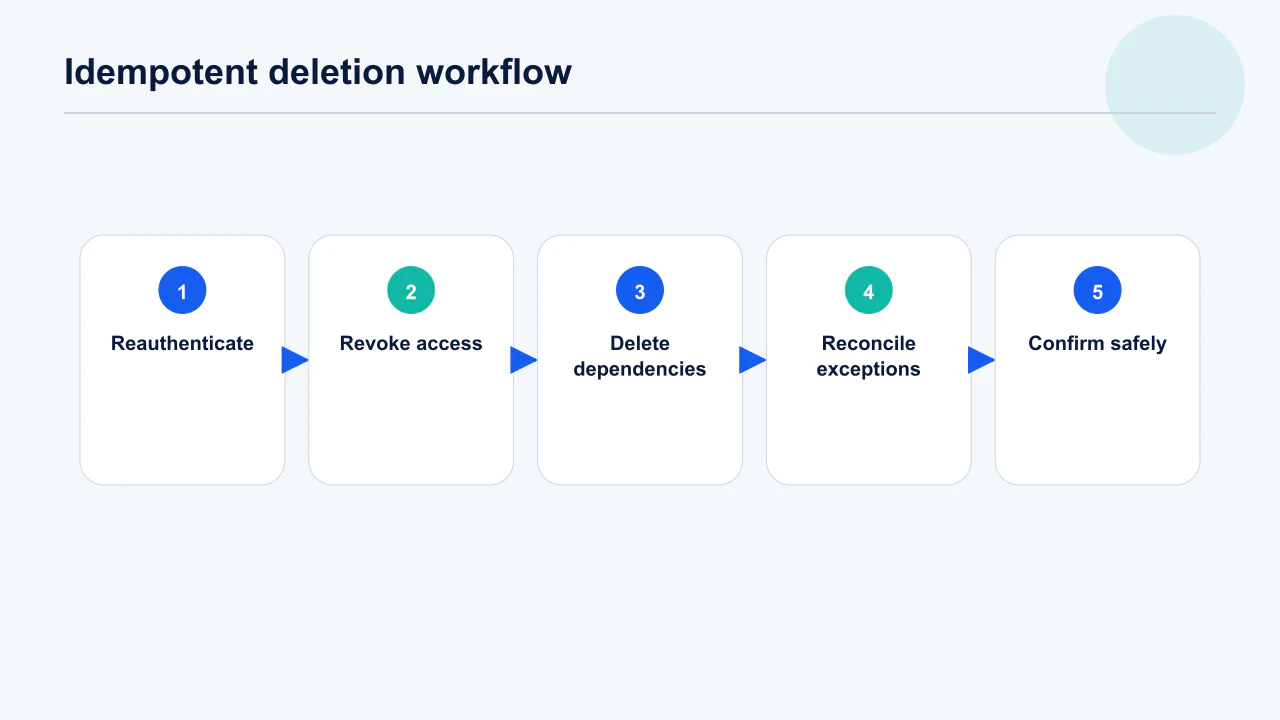
Create a deletion job with a random reference, not an email address. Revoke sessions and new writes first, then process system-specific tasks with retries. Each task should report complete, retained-with-basis or failed. Completion occurs only when every mandatory task reaches a terminal state.
- Authorise: Reauthenticate and protect the endpoint from cross-site or replay abuse. Log the security decision.
- Quiesce: Revoke tokens, disable messaging and prevent new user data. Stop the target from moving.
- Execute: Run owned deletion tasks with retries and bounded access. Make every step idempotent.
- Confirm: Send a receipt that reveals no deleted sensitive data. Give support a lookup reference.
Decision rule: Retried deletion must never create a new account, duplicate cancellation or turn a completed job back into an active profile.
We design the workflow like a payment pipeline: explicit states, idempotency keys and reconciliation. Destructive operations deserve at least the same engineering discipline as revenue.
Make the workflow asynchronous and idempotent, because deletion touches systems that fail independently. Authorise with a fresh authentication check, quiesce by revoking sessions and tokens so nothing writes mid-deletion, execute per-system with retries, then confirm. Each step should be safe to run twice: a retried deletion that throws because the row is already gone will strand the job halfway through and leave an account that is neither present nor removed. StoreKit's subscription model is the authority on entitlement, so reconcile against it rather than against your own cached flag.
Emit a completion event the support team can query by pseudonymous reference. Whether you need accounts at all is worth revisiting if this workflow feels disproportionate.
What happens if a store event arrives after deletion?
Handle the store event against a minimal transaction record without recreating the deleted user profile or resuming marketing. Renewal, refund, revocation and restore messages can arrive after the account deletion job completes.
Keep transaction identifiers in a restricted billing domain only where necessary, and detach them from ordinary profile data. The event consumer verifies authenticity, applies the financial or entitlement transition and records the result. A new sign-up is a new identity unless the user deliberately restores a supported purchase.
- Renewal: Record validated billing state and apply the documented post-deletion entitlement policy. Do not silently rebuild identity.
- Refund: Revoke any surviving entitlement and retain only required financial evidence. Prevent negative-balance abuse separately.
- Restore: Require deliberate user action and explain what can and cannot return. Deleted personal content stays deleted.
- Notification retry: Deduplicate by event or transaction identity. Assume delivery can repeat and reorder.
Decision rule: No asynchronous billing event is authorised to recreate personal data that the deletion workflow removed.
Separating billing from identity makes this tractable. When both live in one user row, teams keep the entire row “just in case” and fail the spirit of deletion.
Design for the late event, because it is guaranteed rather than exceptional. Renewals, refunds, restores and retried notifications all arrive after the account has gone, and a handler that assumes a user row exists will either crash or silently drop the message. Persist a pseudonymous mapping from the store transaction identifier to the deletion record so late events can be reconciled without resurrecting the profile. App Store Server Notifications retry on failure, so an endpoint returning errors for deleted accounts will accumulate a backlog you eventually have to replay.
Handle restore-purchase attempts explicitly: a returning user with a valid receipt and no account needs a defined outcome. Build-or-buy for the billing layer changes who owns this reconciliation.
How do you test account deletion end to end?
Test a state matrix across stores, subscription lifecycles, data systems and failure points, then verify from the user interface down to vendor deletion evidence. A successful button tap proves almost nothing about completion.
Create dedicated test identities and never use production customer accounts. For each case, capture preconditions, visible copy, store state, backend job states, retained exceptions, final access and any notification. Include deletion requested from the web resource as well as in-app.
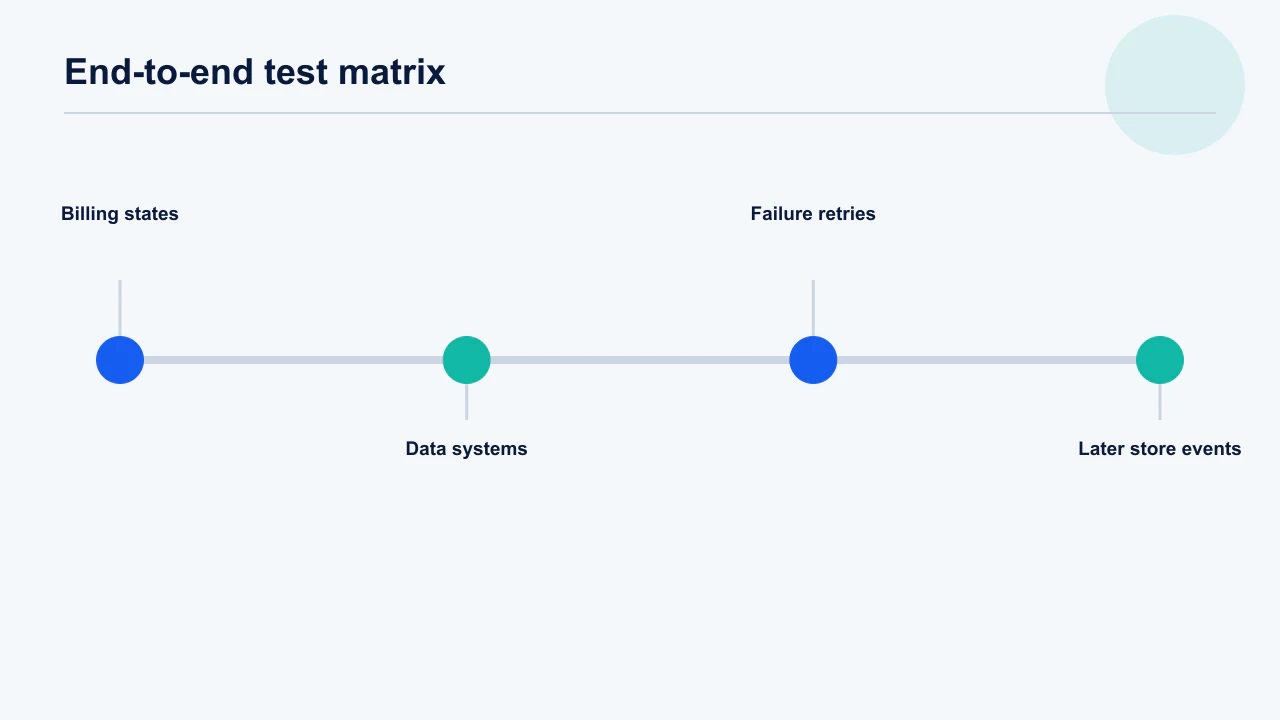
- Billing matrix: Active, cancelled-active, grace, hold where available, refunded, revoked and expired. Cover iOS and Android separately.
- Data matrix: Profile, content, analytics identifiers, push tokens, support records and backups. Verify downstream vendors.
- Failure matrix: Timeout, duplicate request, worker retry and store event during deletion. Prove idempotency.
- Experience matrix: Fresh install after deletion, login attempt, restore purchase and support lookup. No ghost account should appear.
Decision rule: A case passes only when the user-visible promise, backend state and store state agree.
Our pre-submission checks search for the deleted identifier in every expected system and also try to use the old session. The absence of a profile is not proof if the token still works.
Build the test matrix as a product of billing state and data state, because bugs live in the combinations rather than the individual paths. Every subscription state crossed with immediate and deferred deletion, plus the failure cases — network loss mid-deletion, a partial system failure, a duplicate request, and a late store notification. Automate the billing matrix against sandbox accounts; the store states are too numerous to exercise reliably by hand before each release. Apple's guidance is the acceptance criterion for the reviewer-facing half.
Re-run the matrix whenever the billing library or entitlement model changes. Compliance regressions are usually introduced by unrelated refactors.
What account deletion operating checklist should founders use?
Assign one accountable owner and review policy, implementation, support and deletion evidence together at every material account or billing change. Deletion fails when it is treated as a one-time settings screen rather than a living cross-system capability.
Quarterly, run a real test request on each platform and the published web form. At every SDK, identity, analytics, support or billing migration, update the data map and regression suite. Train support to distinguish deletion, cancellation, refund and restore without making promises outside the app’s control.
- Product: Copy, discoverability and consequences remain accurate. New features enter the data map.
- Engineering: Jobs, vendors, notifications and restores pass tests. Monitor age of incomplete jobs.
- Privacy and legal: Retention bases and periods remain current. Review jurisdiction and product changes.
- Support: Macros give correct store-specific steps and escalation. Audit a sample of cases.
Decision rule: No account, subscription or data-vendor change is complete until deletion behaviour and documentation are updated.
The cheapest time to find a broken deletion integration is during the change that broke it. A quarterly test is the backstop, not the primary quality system.
Assign each line of the checklist to a named owner rather than to a team, because deletion spans product, engineering, privacy and support and unowned items are the ones that fail in production. Give support a runbook entry for the charged-after-deletion case with the exact refund guidance for each store, since that single scenario generates most of the contact volume. Review the checklist at each release that touches billing, authentication or the data model. The Review Guidelines change, and a flow that passed a year ago is not evidence that it passes now.
Keep the completed checklist with the release record. Play Console declarations ask you to describe this behaviour accurately at submission.
Frequently Asked Questions
Does deleting an app account cancel an active subscription?+
Not automatically. Account deletion is controlled by the app, while App Store or Google Play billing is a separate relationship. The flow must clearly show the subscription state and provide store management instructions.
Can an app refuse deletion until a subscription expires?+
Do not make expiry the only path. Apple explicitly allows scheduled deletion at subscription expiry only when immediate deletion is also available. Explain the access consequence and let the user choose immediate deletion.
Should deleting an account remove remaining paid access?+
That is a product and legal policy decision that must be disclosed before confirmation. Whatever the policy, it must not imply that store billing was cancelled, and it must safely handle later renewals, refunds and restores.
Can financial records be kept after account deletion?+
Some records may need retention for tax, accounting, disputes, security or law. Keep only necessary fields, document purpose and period, restrict access and remove the data from normal product and marketing use.
Does Google require a website for account deletion?+
Yes. Apps in scope must provide an in-app path and a functional outside-the-app web resource where users can request account and associated-data deletion.
What should happen when a subscription renews after deletion?+
Verify and process the billing event against a restricted transaction record under a documented entitlement policy. Do not recreate the deleted personal profile or resume messaging automatically.
How can a team prove deletion works?+
Run state-matrix tests, inspect every owned and vendor system, verify old sessions fail, test duplicate requests and later store events, and retain a non-sensitive job record showing completed, retained-with-basis or failed tasks.
Sources
- Apple Developer — Offering account deletion in your app — In-app initiation, regulated flows, subscription guidance and optional expiry-timed deletion.
- Apple — App Review Guidelines — Current account, privacy, purchase and review requirements.
- Google Play — Account deletion requirements — In-app deletion path, web resource and disclosure requirements.
- Google Play — Subscription lifecycle — Current purchase lifecycle and SubscriptionPurchaseV2 states.
- Google Play Billing — Manage subscriptions and purchases — Backend acknowledgement and purchase management.
- Google Play Billing — Lifecycle — Subscription state transitions and real-time notifications.
- Apple StoreKit — Supporting subscription offer codes — StoreKit subscription implementation reference.
- Apple — App Store Server Notifications — Asynchronous transaction lifecycle notifications.
About the author
Amol Pomane — Founder, Vmobify
Amol leads Vmobify, a mobile app growth agency that has driven 30M+ downloads and ranked 54K+ keywords across 300+ apps since 2013. He writes about ASO, paid user acquisition, retention, and the operational reality of scaling mobile apps in India and global markets.