Subscription Grace Periods, Billing Retry and Account Hold
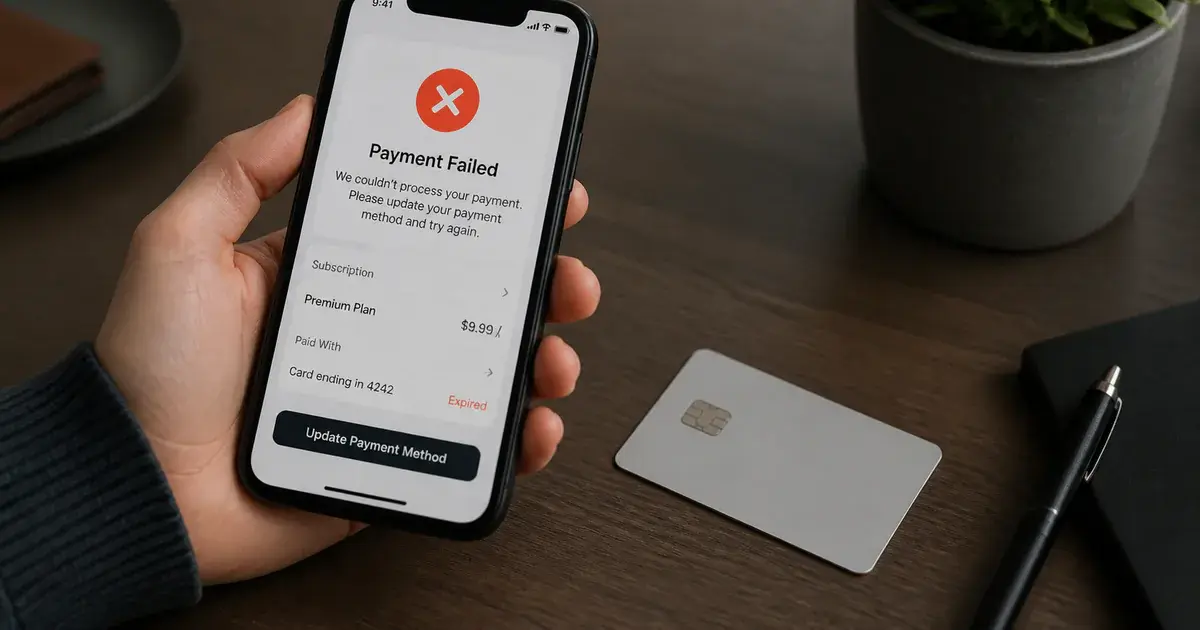
Your active subscriber count fell but almost nobody pressed cancel. That gap is involuntary churn — cards that expired, banks that declined, wallets that ran dry — and both stores run a long, documented recovery machine to win those payments back. Most of the revenue is lost not by the store giving up but by the app revoking access at the wrong moment.
On this page
- Why did subscribers disappear without cancelling?
- What states does Google Play put a failed renewal through?
- How long does Play actually keep trying?
- What does Apple do when a renewal fails?
- Which notifications tell you where a subscriber is?
- When should your backend cut off access?
- How do you get the user to fix the card?
- What does shortening the recovery window cost?
- How do you measure recovered revenue honestly?
- Frequently Asked Questions
Why did subscribers disappear without cancelling?
Because a renewal charge failed, not because anyone decided anything — and both stores treat that as a temporary condition they will spend weeks reversing. Apple names the category: involuntary churn "occurs when users do not intend to leave your service but their subscription fails to renew, usually due to billing issues", and it is "not related to customer satisfaction".
The distinction matters because the two kinds of churn need opposite responses. A voluntary cancellation is a product problem, and no payment plumbing will change the subscriber's mind. An involuntary lapse is a plumbing problem, and the subscriber usually still wants the product. Treating the second as the first is how teams run win-back campaigns at people whose card simply expired.
Before any retention work, split your churn into "auto-renew turned off by the user" and "renewal attempted and declined". Different notifications, different fixes. If you cannot split them today, that is the first piece of work — and it is a backend change, not a marketing one.
Both stores build a recovery period into the lifecycle so you do not have to re-sell every declined card yourself. Google's subscription lifecycle documentation describes it plainly: "If there are payment issues with a subscription renewal, Google notifies the user and periodically attempts to renew the subscription for some time before the subscription expires. This recovery period can consist of a grace period followed by an account hold period."
Apple runs the same idea with different machinery. The designs diverge in one expensive way — what your app should do about entitlement while retries are happening — and that is where most recoverable revenue is thrown away. Across the 300+ apps we have managed since 2013, backends that get this wrong get it wrong in the same direction: they revoke access on the first failed renewal, on both platforms, because that is the simplest rule to write.
What follows is the fault tree: the states, their lengths, the notification announcing each, and what your server should do. If the offer itself is still unsettled, start with our subscription monetisation strategy guide.
What states does Google Play put a failed renewal through?
Grace period first, where the user keeps access, then account hold, where Google's documentation says you should block it. The entitlement rule flips between the two states, and that flip is the most important thing to encode in your backend.
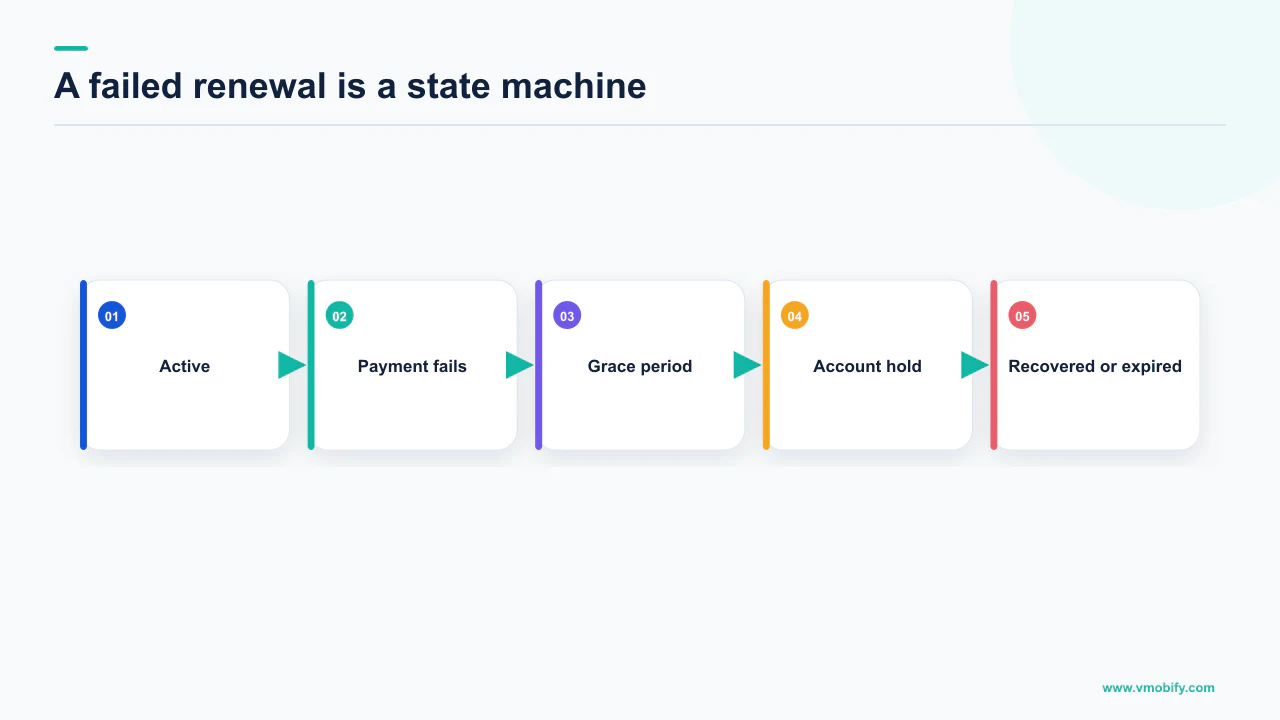
During the grace period, Google's guidance is explicit: "During a grace period, the user should still have access to their subscription entitlement." The subscription resource carries autoRenewEnabled = true, Google "dynamically extends the expiryTime value until the grace period has expired", and the state field reads SUBSCRIPTION_STATE_IN_GRACE_PERIOD.
Account hold reverses it: "after any grace period has ended, an account hold period begins. When a subscription enters account hold, you should block access to the subscription entitlement." The subscription is not gone — Google is still charging the card — but the user should not be receiving the product.
Grace period (Play)
- Enabled by default on all auto-renewing base plans
- User keeps entitlement
- expiryTime is dynamically extended by Google
- Announced by
SUBSCRIPTION_IN_GRACE_PERIOD
Account hold (Play)
- Enabled by default on all auto-renewing base plans and installment plans
- User should lose entitlement
- Length auto-calculated as 60 days minus any grace period
- Announced by
SUBSCRIPTION_ON_HOLD
A third, quieter state exists. Google documents a silent grace period: "You can set a grace period of 0 days, but Play will wait a minimum of 1 day to ensure sufficient time for payment retries." During that 24-hour window the subscription remains ACTIVE. Even a team that deliberately disables grace gets no instant cut-off, and a backend assuming one will disagree with the store about who is entitled.
Two further mechanics change the funnel. A subscription "enters into account hold directly when the subscription resumes from a paused state with a failed form of payment", so a paused subscriber whose card has expired never passes through grace at all. And "when a subscription recovers from account hold, the renewal date resets", which shifts every downstream cohort date you were counting on. If you are on an older integration, check this state handling as part of the upgrade rather than after it — see the Play Billing Library 8 migration guide.
How long does Play actually keep trying?
Google Play's default is a total recovery window derived from 60 days: account hold length is automatically calculated as 60 days minus whatever grace period you configured. That is the documented arithmetic, and it is the number to plan your dunning around.
The Play Console help page on understanding subscriptions states it plainly: "By default, all auto-renewing base plans have account hold enabled and the lengths are automatically calculated. The calculation will be 60 days minus any grace period duration." It adds a floor you cannot design around — "The total of account hold and grace period durations must total 30 days or more."
That 48-hour figure carries a condition, so keep them together. Google states: "Before a subscription enters into account hold, Google Play makes additional attempts to charge the payment method for up to 48 hours. The user retains subscription benefits during this period. After this retry period has elapsed, the subscription then enters into account hold, and the user should lose access to subscription benefits." It sits between grace and hold, not at the start of the sequence.
Google does not publish the retry cadence inside these windows — how many attempts, on which days, against which instruments — and we will not estimate it. The envelope and the entitlement rule at each stage are documented, which is enough to build correctly against.
What does Apple do when a renewal fails?
Apple runs a billing retry period of up to 60 days with no account hold equivalent, and an optional Billing Grace Period that you must switch on in App Store Connect. If you never enabled it, your subscribers get no protected access at all when a card fails.
Apple's guidance on reducing involuntary subscriber churn sets the window: "If the customer's billing is invalid, the renewal fails and the user's subscription enters a billing retry state, where the App Store attempts to collect payment for up to 60 days." Recovery inside that window still costs you something — "If the user is recovered within the 60 days, the new billing date is established on the date of recovery and subsequent renewal dates are based on this new billing date."
Billing Grace Period protects your days of paid service, and its durations depend on the subscription period. Apple lists them as options, not a single default: "3 or 6 days for a weekly subscription" and "3, 16, or 28 days for monthly and longer subscriptions". Apple's auto-renewable subscriptions overview adds the scope choice — you can apply it "to all renewals (existing paid renewals and free offers transitioning to paid renewals) or only to existing paid renewals".
Recovered inside the grace period: "neither the subscriber's days of paid service, nor your revenue for auto-renewable subscriptions will be interrupted." Recovered after grace but inside the retry period: the subscription will "renew on the recovery date, starting a new billing cycle", and "payment for the provided full service during the grace period would not be collected."
There is a trap in the timing. Apple states that "Billing Grace Period is applied at the time of a billing error when it's enabled for subscriptions in the app, and cannot be altered once assigned to a user." Turning it on after a subscriber has already hit a decline does nothing for them. Get it right before you need it; it is not a lever to pull during an incident.
The structural contrast with Play drives different backend logic on each platform. Play makes you revoke access during account hold and tells you when. Apple has no hold state — after grace expires the subscription expires while retries continue silently, and your only signal that the customer is still winnable is the retry flag. Whether you run that logic yourself or delegate it is the question behind StoreKit versus RevenueCat.
Which notifications tell you where a subscriber is?
Real-time developer notifications on Play, App Store Server Notifications V2 on Apple — and on both platforms the recovery states have dedicated types you can key entitlement off directly. Polling on a schedule is not a substitute; the states change on the store's clock, not yours.
Google's real-time developer notifications reference assigns each state a numeric type. The ones that matter for involuntary churn are these:
SUBSCRIPTION_IN_GRACE_PERIOD(6) — "A subscription has entered grace period (if enabled)." Keep entitlement on.SUBSCRIPTION_ON_HOLD(5) — "A subscription has entered account hold (if enabled)." Turn entitlement off.SUBSCRIPTION_RECOVERED(1) — "A subscription was recovered from account hold or resumed from pause." Note the two causes: this type does not tell you on its own which one happened.SUBSCRIPTION_CANCELED(3) — "A subscription was either voluntarily or involuntarily cancelled." Ambiguous by itself, and Google states you receive this type if the user does not fix their payment method before the end of the account hold period.SUBSCRIPTION_EXPIRED(13) — "A subscription has expired."SUBSCRIPTION_REVOKED(12) — "A subscription has been revoked from the user before the expiration time." Google's instruction here is unambiguous: revoke the user's entitlement immediately.
Apple's notificationType reference encodes the same journey as a type plus subtype pair, and the subtype is where the meaning lives. Apple maps them event by event: the subscription failing to renew and entering the billing retry period is DID_FAIL_TO_RENEW with no subtype; the same failure "with Billing Grace Period enabled" is DID_FAIL_TO_RENEW with subtype GRACE_PERIOD. Exiting the grace period while continuing in billing retry is GRACE_PERIOD_EXPIRED. A successful rescue is DID_RENEW with subtype BILLING_RECOVERY. Giving up is EXPIRED with subtype BILLING_RETRY — "the subscription expires because the billing retry period ends without recovering the subscription".
That last pair is the one to instrument first. EXPIRED with subtype VOLUNTARY means the customer chose to leave; EXPIRED with subtype BILLING_RETRY means the machinery ran for up to 60 days and lost. Two subtypes, two different post-mortems, and a churn dashboard that collapses them into one number cannot tell you which problem you have. If your funnel analytics stops at "expired", this is the split to add.
When should your backend cut off access?
Follow the store's own instruction for each state rather than a rule of your own invention: on Play, access during grace and none during hold; on Apple, access for as long as the grace period you configured lasts. Every deviation costs you revenue or creates a support problem.
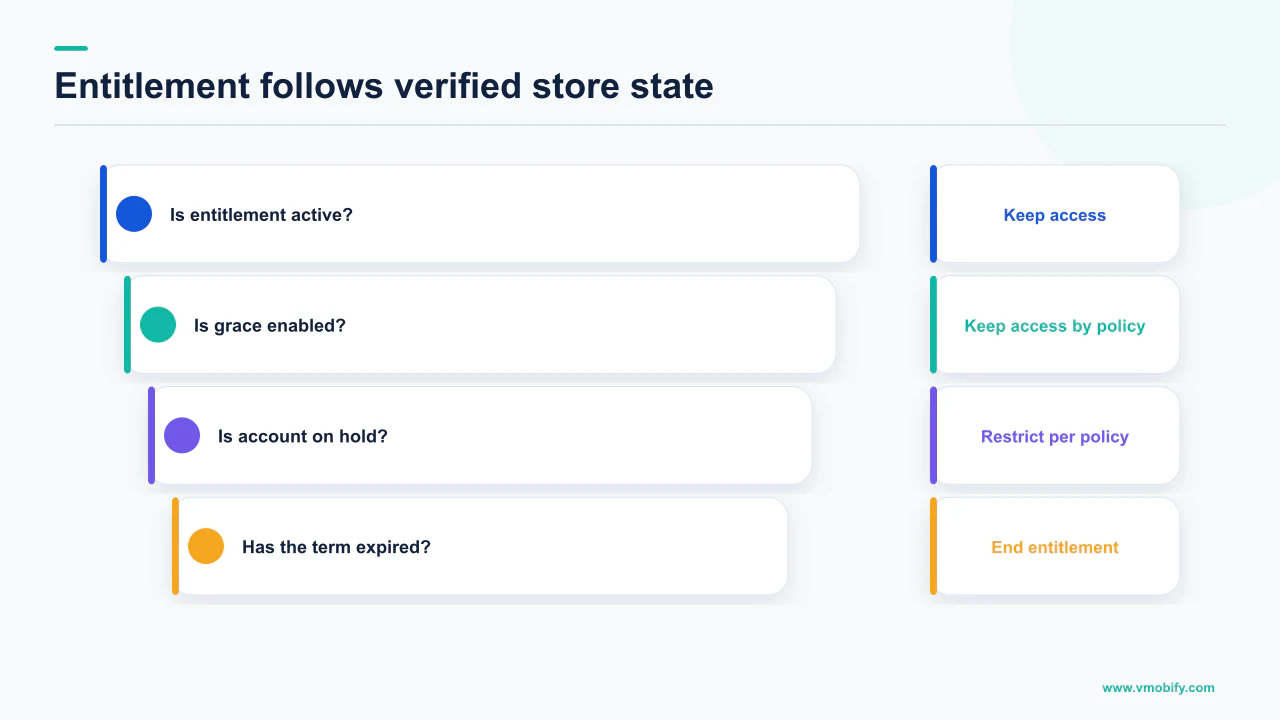
- Treat the notification as the trigger, then verify. The RTDN or App Store notification tells you a state changed; the purchase token or transaction lookup tells you what it changed to. Build entitlement off verified server-side status, never a client-side flag.
- Grant entitlement in grace, on both platforms. Google states the user should still have access during a grace period; Apple states that if you enable Billing Grace Period you should "provide full service for the subscription throughout the grace period". Not optional generosity — documented behaviour.
- Revoke on account hold, on Play. Google's instruction is to block access when a subscription enters account hold. Leaving it on through a hold that can run for the better part of two months is service you will not be paid for.
- Revoke immediately on revocation. For
SUBSCRIPTION_REVOKED— which Google notes can follow a chargeback or your own call to the revoke API — revoke the entitlement immediately, not at period end. - Restore on recovery, and reset your dates. On Play, recovery arrives as
SUBSCRIPTION_RECOVEREDwith the same purchase token as before the hold, "because the same purchase is recovering". On Apple it isDID_RENEWwith subtypeBILLING_RECOVERY.
Purchase token behaviour on Play decides whether your database sees one subscriber or two. Recovery from account hold keeps the same token, and so does a restore — a user undoing a cancellation before expiry, announced as SUBSCRIPTION_RESTARTED. A resubscribe after expiry does not: "Google Play issues a brand new purchase token, and your backend receives an RTDN with type SUBSCRIPTION_PURCHASED." Keying a subscriber record on the token alone splits one person into two lifetime-value rows the moment they lapse and come back.
How do you get the user to fix the card?
Use the store's own messaging surfaces first, because they prompt inside the payment account the user actually needs to edit. A generic "there was a problem with your payment" banner that links nowhere is the weakest version of this.
On Android, Play Billing exposes in-app messaging for exactly this case. Google's subscriptions documentation describes it as showing a message "when there is a payment issue or an outstanding opt-in price increase", appearing as a snackbar prompting the user to fix their payment "during grace period and account hold once per day". You call showInAppMessages() with the TRANSACTIONAL category, and Google recommends calling it whenever the user opens the app.
Handle the callback rather than ignoring it. NO_ACTION_NEEDED means the flow finished with nothing for you to do. SUBSCRIPTION_STATUS_UPDATED means the status changed — Google gives "a subscription is recovered from a suspended state" as an example — and the purchase token is returned with that response code for use with the Google Play Developer API. The user may have fixed their card two seconds ago, and your server can find out immediately instead of waiting for the next sync.
On iOS, Apple provides a system prompt and a deep link. Apple states that "Starting in iOS 16.4 and iPadOS 16.4, if a subscription doesn't successfully renew, a system-provided sheet appears in your app upon launch with a prompt that lets customers update the payment method for their Apple Account." Separately, your app "can deep link customers to the Manage Payments page on their account settings" — with a condition that must travel with it: "This URL is only supported for iOS and macOS."
An in-app dunning message is only correct if it knows which state the subscriber is in. Telling a user in grace they have lost access is a false statement they can verify; telling a user in account hold that everything is fine is a support ticket. Wire notification handling first, messaging second.
Timing beats copy here. Both stores already email the user; your advantage is catching them as they open the app to use the thing they are about to lose — see in-app messaging versus push for when each channel is right.
What does shortening the recovery window cost?
Google states directly that specifying lengths less than the default values may reduce the number of subscriptions recovered from payment declines — so the trade is fewer recovered subscribers in exchange for less unpaid service. That is the whole decision, and the sentence appears in both the developer documentation and the Play Console help.
The temptation to shorten comes from a real cost. During a Play grace period you are serving a customer who has not paid, and on Apple, service delivered during a grace period that ends without recovery is unpaid — Apple says so: "Payment for the provided full service during the grace period would not be collected." For a content app with negligible marginal cost per user that is close to free. For an app where every active subscriber burns compute, bandwidth or a third-party API call, it is not.
Longer recovery window
- More subscriptions recovered, per Google's own caveat
- Apple: recovery inside grace preserves days of paid service
- Cost: unpaid service during grace
- Suits low marginal cost per subscriber
Shorter recovery window
- Less unpaid service delivered
- Google: may reduce subscriptions recovered
- Play floor still applies: grace plus hold ≥ 30 days
- Suits high marginal cost per subscriber
Note what the floor does to the choice on Play: you can move the split between grace and hold freely, but the combined window cannot fall below 30 days, so "turn recovery off" is not an available setting on an auto-renewing base plan with account hold enabled. The decision is how much of the window the user spends with access, not whether the window exists.
We are not publishing a recovery rate for either configuration. No primary source publishes one, and our own portfolio numbers are not a benchmark anyone else should plan against. What is publishable is the direction, stated by the platform that owns the retries: shorter windows recover less.
Payment instrument changes this problem more than window length does. Where recurring card mandates are weak, the failure mode is a mandate that never authorised rather than a declined renewal — a different fault tree, covered in UPI AutoPay for app subscriptions. If declines cluster in one market, look at the payment rail before the grace period; sequencing both is what our monetisation practice exists to unpick.
How do you measure recovered revenue honestly?
Count the subscribers who entered a recovery state and came out the other side, using the store notifications as entry and exit events — not a figure modelled from your churn curve. Both platforms hand you the exact events, which makes this one of the few growth metrics that can be measured rather than estimated.
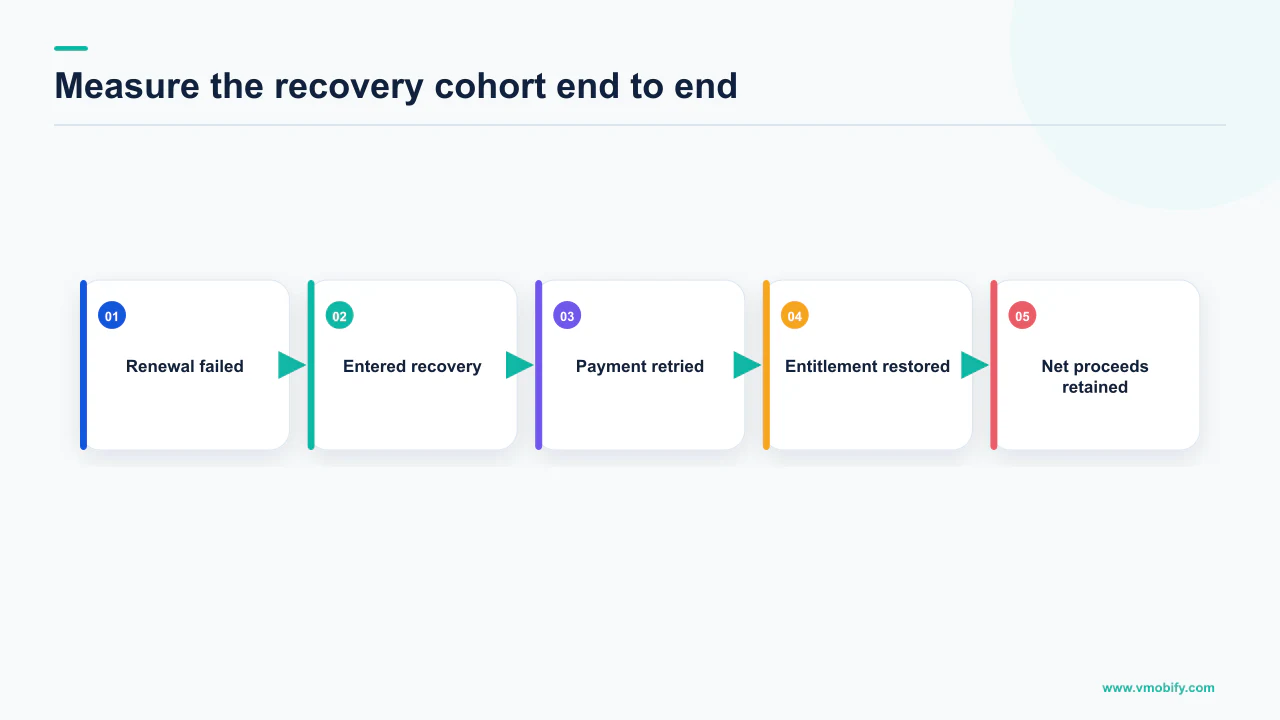
The pipeline on Play is: entries via SUBSCRIPTION_IN_GRACE_PERIOD and SUBSCRIPTION_ON_HOLD, successful exits via SUBSCRIPTION_RECOVERED, failed exits via SUBSCRIPTION_CANCELED at the end of account hold. On Apple: entries via DID_FAIL_TO_RENEW, with the GRACE_PERIOD subtype separating those who kept access from those who did not; successful exits via DID_RENEW with subtype BILLING_RECOVERY; failed exits via EXPIRED with subtype BILLING_RETRY.
Two adjustments stop the number from lying to you. First, the ambiguous types: SUBSCRIPTION_RECOVERED covers recovery from account hold and resumption from pause, and SUBSCRIPTION_CANCELED covers both voluntary and involuntary cancellation, so neither counts as a recovery metric without checking the prior state. Second, the date reset: the renewal date resets when a subscription recovers from account hold on Play, and Apple establishes a new billing date on the recovery date, so a recovered subscriber's future renewals no longer line up with their original cohort.
Three directly observable numbers: how many subscriptions entered a recovery state this month, how many exited successfully, and what those recovered subscriptions were worth at their renewal price. No modelling, no assumed lifetime multiplier. If someone wants a projected annual figure, derive it from those three and label the assumption.
Then read it against everything else. Recovered subscribers are the cheapest you will ever add — no acquisition cost, no onboarding, no paywall to clear — so this changes the payback maths rather than sitting in its own report. Our guidance on cash payback on UA budgets and on ROAS and CAC assumes you know the difference between a subscriber you kept and one you re-bought.
Finally, review the configuration rather than setting it once. Grace and hold lengths, whether Billing Grace Period is enabled at all on iOS, whether in-app messaging is wired up, whether entitlement logic still matches the documented states after a billing library upgrade — in our portfolio these are the settings most likely to be inherited and never revisited.
Frequently Asked Questions
How long does Google Play keep trying to charge a failed subscription renewal?+
By default the recovery window is built around 60 days: Google states that all auto-renewing base plans have account hold enabled and that the length is automatically calculated as 60 days minus any grace period duration. You can adjust or disable it in Play Console, but the total of account hold and grace period must be 30 days or more.
Should the user keep access during a grace period or an account hold?+
During a grace period, yes. Google states the user should still have access to their subscription entitlement. During account hold, no. Google states that when a subscription enters account hold you should block access to the subscription entitlement. There is one narrow exception before hold begins: Play makes additional charge attempts for up to 48 hours, and the user retains benefits during that period.
What are the Apple billing grace period durations?+
Apple lists them as options that depend on the subscription period length: 3 or 6 days for a weekly subscription, and 3, 16 or 28 days for monthly and longer subscriptions. Billing Grace Period must be enabled in App Store Connect, and Apple states it is applied at the time of a billing error and cannot be altered once assigned to a user.
Which notifications tell me a subscription is in trouble?+
On Google Play, SUBSCRIPTION_IN_GRACE_PERIOD (type 6) and SUBSCRIPTION_ON_HOLD (type 5), with SUBSCRIPTION_RECOVERED (type 1) for recovery. On Apple, DID_FAIL_TO_RENEW for entry into billing retry, with the GRACE_PERIOD subtype when Billing Grace Period is enabled, GRACE_PERIOD_EXPIRED when grace ends and retry continues, and DID_RENEW with subtype BILLING_RECOVERY when the retry succeeds.
How do I tell involuntary churn apart from voluntary cancellation?+
On Apple, use the subtype: EXPIRED with subtype VOLUNTARY means the customer chose to cancel, while EXPIRED with subtype BILLING_RETRY means the billing retry period ended without recovering the subscription. On Play, be careful with SUBSCRIPTION_CANCELED, which Google documents as covering both voluntary and involuntary cancellation, so you need the prior state to classify it.
Does the purchase token stay the same after a recovery on Google Play?+
After recovery from account hold, yes. Google states the purchase token is the same as before the account hold started because the same purchase is recovering. A restore before expiry also keeps the same token. A resubscribe after expiry does not: Google Play issues a brand new purchase token and sends an RTDN of type SUBSCRIPTION_PURCHASED, which is a new purchase.
What percentage of failed renewals can I expect to recover?+
We do not publish a figure, because neither store publishes one and an internal average from one portfolio is not a benchmark anyone else should plan against. What is documented is the direction: Google states that specifying grace and hold lengths shorter than the default values may reduce the number of subscriptions recovered from payment declines. Measure your own rate from the notification events rather than from a borrowed percentage.
Sources
- Subscription lifecycle | Play Billing | Android Developers — Grace period and account hold entitlement rules, the 60-days-minus-grace calculation, the silent grace period, the 48-hour pre-hold retry, pause behaviour, restore and resubscribe token behaviour.
- Real-time developer notifications reference guide | Play Billing | Android Developers — SubscriptionNotification type numbers and descriptions, including types 1, 3, 5, 6, 7, 12 and 13.
- About subscriptions | Play Billing | Android Developers — In-app messaging for payment issues, the TRANSACTIONAL category, once-per-day snackbar during grace and hold, and the two response codes.
- Understanding subscriptions - Play Console Help — The 60-days-minus-grace default calculation for account hold and the 30-day combined minimum for grace period plus account hold.
- Reducing Involuntary Subscriber Churn | Apple Developer Documentation — Definition of involuntary churn, the 60-day billing retry period, grace period duration options by subscription length, and revenue continuity inside versus outside grace.
- notificationType | Apple Developer Documentation — Event-to-notification mapping for DID_FAIL_TO_RENEW, the GRACE_PERIOD subtype, GRACE_PERIOD_EXPIRED, DID_RENEW with BILLING_RECOVERY, and EXPIRED with VOLUNTARY or BILLING_RETRY.
- Auto-renewable Subscriptions - App Store - Apple Developer — Billing Grace Period scope options, the 60-day recovery statement, and the iOS 16.4 system-provided payment update sheet.
About the author
Amol Pomane — Founder, Vmobify
Amol leads Vmobify, a mobile app growth agency that has driven 30M+ downloads and ranked 54K+ keywords across 300+ apps since 2013. He writes about ASO, paid user acquisition, retention, and the operational reality of scaling mobile apps in India and global markets.