UGC Moderation Operations for Mobile Apps: A Practical System
User-generated content turns moderation into a continuous product operation, not a policy page. This guide maps preventive controls, reporting, queues, severity tiers, enforcement, appeals, evidence retention, staffing and App Store or Play review readiness.

On this page
- What do app stores require from UGC apps?
- How do you write an enforceable content policy?
- Which preventive controls should a UGC app build?
- How should reporting and blocking work?
- How do you triage a moderation queue?
- What should a moderator decision record contain?
- How should enforcement and appeals work?
- Which moderation metrics should you track?
- How do you staff and protect a moderation operation?
- What should a UGC store review proof pack include?
- Frequently Asked Questions
What do app stores require from UGC apps?
Both major stores require UGC apps to prevent and respond to abuse with controls proportionate to the content and interaction model. Apple’s Review Guidelines name filtering, reporting, timely response, blocking and contact information; Google Play policy requires robust ongoing moderation, terms, reporting and blocking for direct interaction.
These are operating obligations. A report button that feeds an unread inbox is not meaningful moderation, and a terms page cannot replace product controls. Map every creation and interaction surface—including profile text, usernames, images, comments, live chat and private messages.
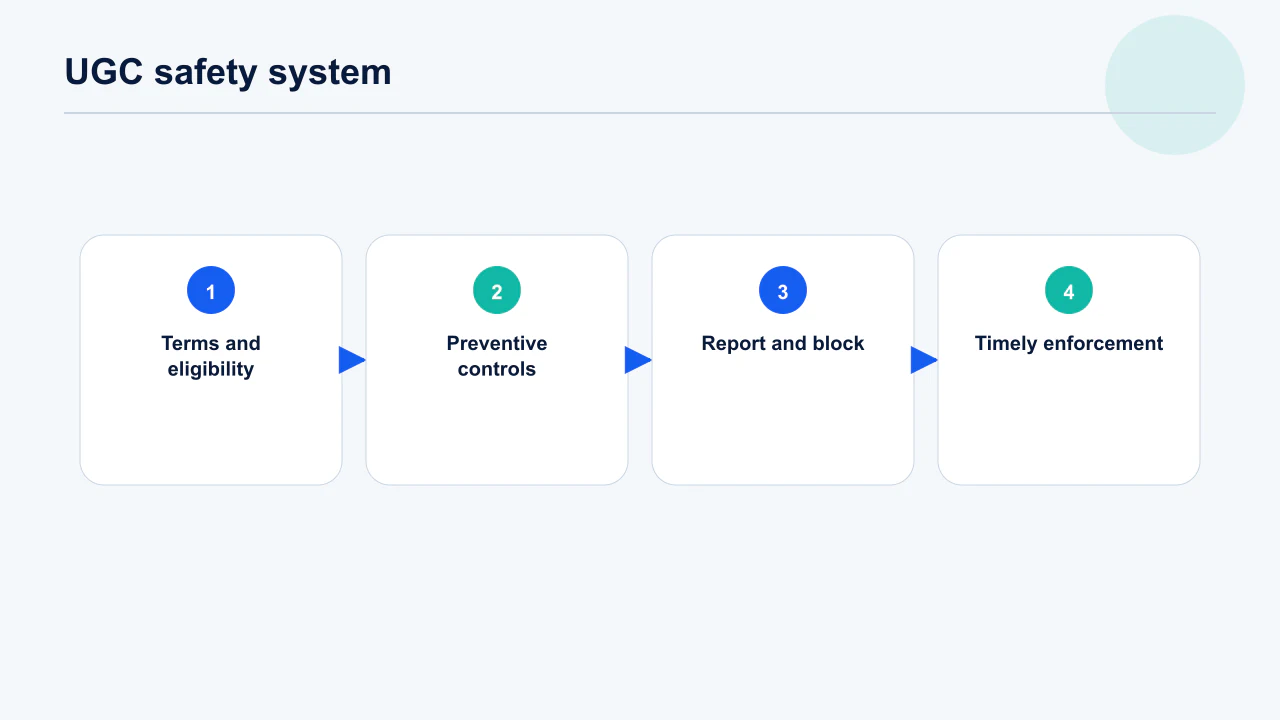
- Terms: Require acceptance before users create or upload content. Name prohibited behaviour clearly.
- Prevention: Apply age, feature and content controls appropriate to risk. Do not rely on reactive review alone.
- Response: Make reporting available at the content or user context. Route it to an owned queue.
- Protection: Let users block abusive accounts where direct interaction exists. Apply the block consistently.
Decision rule: Do not launch a UGC surface until the team can prevent obvious abuse, receive a report, act on it and prove the complete loop.
In our release reviews, the gap is usually not a missing policy sentence. It is a control that exists on comments but not profiles, direct messages or media captions.
Build the surface inventory as a living table rather than a launch-day exercise. For each surface, record whether content is public or private, whether it persists, whether media is involved, and which of the four obligations it currently satisfies. The gaps become a backlog instead of an argument. Store reviewers work the same way: they open the app, find the fastest route to publishing something, and look for a report control within reach of that content. A surface that ships without one is the most common route to an unexpected rejection, so treat the inventory as release-blocking rather than documentation.
Inventory surfaces whenever the product adds a new way for users to publish or contact others. The guidelines that actually block launch show how reviewers exercise these paths.
How do you write an enforceable content policy?
Write rules as observable content or behaviour with examples, exceptions and a defined enforcement range. Abstract values such as “be respectful” cannot produce consistent reviewer decisions.
Create a policy taxonomy covering safety, sexual content, child exploitation, threats, hate, harassment, fraud, impersonation, privacy, illegal goods, spam and intellectual property as relevant. Localise meaning, not only words, and obtain qualified legal and safety review for high-risk categories.
- Definition: Describe what a reviewer can see or verify. Avoid guessing intent when evidence is behavioural.
- Examples: Include allowed, disallowed and borderline cases. Update from real appeals.
- Context: State exceptions for documentary, educational, medical, artistic or newsworthy use. Require appropriate warnings.
- Consequence: Map category, severity and history to content and account actions. Keep discretion bounded.
Decision rule: If two trained reviewers can reasonably interpret a rule in opposite ways, refine it before using it for irreversible enforcement.
A good policy turns “harassment” into observable repeated unwanted contact, targeted degradation or credible intimidation, then separates severe threats from lower-level hostility.
Version the policy like code. Give each rule an identifier, a change date and an owner, then require enforcement records to cite the identifier and version applied rather than a free-text reason. Without that, an appeal reviewed three months later is judged against rules the original reviewer never saw. Test new rules before they carry consequences: take fifty recent decisions, have two trained reviewers apply the draft independently, and measure where they diverge. Disagreement concentrates in borderline cases, which is exactly where the examples need work. Rules that survive the exercise can support irreversible actions; rules that do not should stay advisory until the wording improves. Google's Developer Program Policies are the outer boundary your taxonomy has to sit inside.
Publish user-facing rules and maintain a more detailed internal playbook without secret prohibited categories. Play Console declarations ask you to describe these controls before release.
Which preventive controls should a UGC app build?
Use layered friction, eligibility, rate limits and detection to stop predictable abuse before it reaches another person. The correct layer depends on whether content is public, private, live, persistent and accessible to minors.
Prevention should minimise harm without turning every user into a suspect. Apply stronger controls to new or risky accounts and sensitive actions, then relax them with earned trust. Never expose precise detection logic that lets attackers tune around it.
- Eligibility: Gate livestreaming, messaging or high-reach posting by account age or verified standing. Avoid pay-to-bypass safety.
- Rate control: Limit rapid messages, mentions, invites, uploads and account creation. Use risk-based thresholds.
- Input safeguards: Scan known high-risk media, links and text with human escalation. Models are signals, not universal judges.
- Recipient control: Default risky contact surfaces conservatively and expose mute, block and privacy settings. Protect targets directly.
Decision rule: Prioritise controls by expected harm reduced, false-positive cost and attacker adaptability, then stage them with telemetry.
A one-minute delay on a new account sending its fiftieth message can be harmless to legitimate users and expensive for spam operations. Broad identity demands may impose the opposite trade.
Stage every control behind a flag and measure both sides before enforcing it. Run it in observation mode first so it scores traffic without blocking, then compare what it would have caught against what reviewers actually actioned. That comparison gives you a false-positive cost in real numbers rather than an estimate, and it exposes controls that fire mostly on legitimate new accounts. Watch the effect on genuine first-session behaviour too: a rate limit tuned against spam operations can quietly suppress a new user's first few posts, which is the moment activation is most fragile. A control that costs activation without measurably reducing harm is worth removing. Where minors can be reached, Play's child safety standards set requirements that risk appetite cannot trade away.
Threat-model how a determined user could move harm to a less protected field, then re-run the same measurement on that surface.
How should reporting and blocking work?
Place reporting beside the content or interaction, preserve the target evidence and make blocking take effect immediately from the reporter’s perspective. Do not require users to search help pages, copy identifiers or continue receiving contact while moderation investigates.
The report flow should capture category, optional context and immediate safety choices without forcing a long narrative. A block should stop direct contact and conceal content according to the product model. Tell users what the control does without revealing enforcement details that could enable retaliation.
- Context: Attach content, actor, surface, version and timestamp server-side. Do not depend on screenshots alone.
- Category: Offer a short taxonomy with an urgent-safety route. Avoid dozens of confusing choices.
- Immediate control: Block, mute, leave conversation or hide content at once. Moderation can follow asynchronously.
- Status: Acknowledge receipt and communicate when policy permits. Never promise a specific outcome.
Decision rule: A user in danger should be able to stop contact in seconds, whether or not the report eventually produces account enforcement.
Reporting and blocking are related but not identical: reporting protects the community; blocking protects the individual now. Combining them into one mandatory action weakens both.
Build the test matrix explicitly, because report flows break on state rather than on the happy path. Cover content deleted after the report was filed, edited after the snapshot, ephemeral and already expired, sent from an account since suspended, and reported from a device that went offline before the request completed. Each produces a queue item with missing context unless the client captures the reference server-side at report time. The failure is quiet: the reviewer sees an empty record, closes it as unactionable, and resolution metrics still look healthy. Sample closed-as-unactionable reports monthly and count how many were evidence-capture failures. Services operating in the EU should also check the notice-and-action expectations in the Digital Services Act.
Test the flow against deleted, edited, ephemeral and cross-device content before every release that touches a publishing surface.
How do you triage a moderation queue?
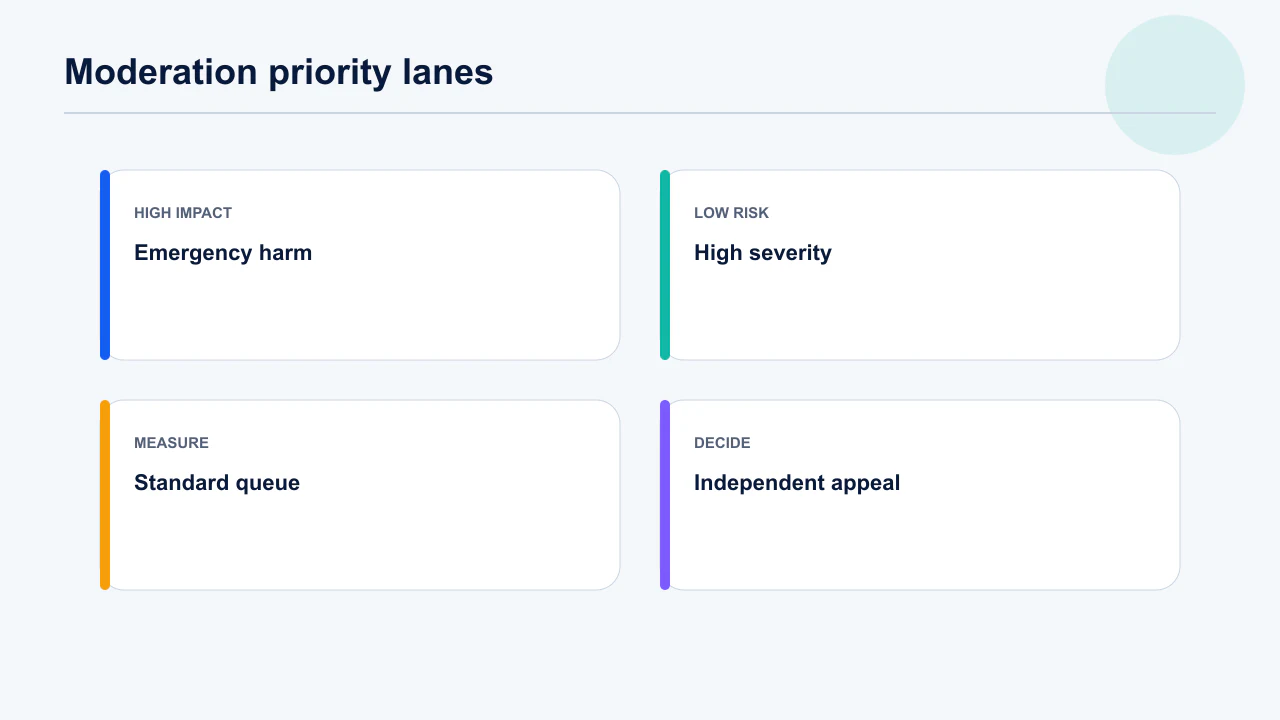
Prioritise by potential harm, immediacy, exposure, vulnerability and evidence confidence—not first-in, first-out. High-severity queues need explicit timers and escalation routes that ordinary spam reports do not.
Build severity tiers with examples and owners. Automated systems may detect or score reports, but they must not bury low-confidence severe risk. Deduplicate coordinated reports carefully: report volume can indicate broad harm or a brigading attack against legitimate content.
- Emergency: Imminent physical harm, credible threats and child-safety signals go to specialist escalation immediately. Preserve evidence and follow local obligations.
- High: Targeted harassment, non-consensual intimate material or dangerous fraud needs rapid containment. Limit distribution while reviewing.
- Standard: Spam, impersonation and ordinary policy disputes enter measured queues. Batch similar work safely.
- Appeal: Route to a reviewer with sufficient independence and original context. Do not auto-confirm the first decision.
Decision rule: Set a maximum exposure time for each severity tier and alert before the service level is breached.
We track time from first detectable exposure and first report separately. A fast review can still follow days of unmeasured harm if discovery is weak.
Queue design is capacity arithmetic before it is prioritisation. Multiply expected arrivals per hour by average handling time per severity, compare that against staffed reviewer-hours in the same window, and the resulting utilisation tells you whether your service levels are achievable at all. Past roughly eighty per cent sustained utilisation, queues stop behaving linearly: backlog age grows faster than arrival rate, which is why a modest spike on an already-busy queue produces a disproportionate breach. Model the peak hour rather than the daily average, because arrivals cluster around the product's own usage curve and around whatever event triggered the abuse. UK-facing services should size those windows against Ofcom's online safety guidance rather than internal preference alone.
Rebalance staffing from arrival patterns and severity, not total ticket count alone.
What should a moderator decision record contain?
Record the content snapshot, policy version and clause, decision, scope, reviewer, time, evidence confidence and appeal eligibility. A reason code without preserved context cannot support quality review or a fair appeal.
Limit access because moderation evidence can itself be highly sensitive. Use immutable event history for actions while allowing protected content to follow lawful retention and deletion rules. Separate reviewer notes from user-visible explanations and never include speculation as fact.
- Evidence: Preserve the minimum content and interaction context needed to review. Hash or reference larger media securely.
- Policy: Store the exact policy version and rule applied. Rules change over time.
- Action: Name content removal, reach limit, feature restriction, suspension or ban duration. Avoid ambiguous “actioned”.
- Accountability: Record human or model actor, confidence and escalation. Irreversible actions need stronger review.
Decision rule: Another qualified reviewer should be able to reconstruct the decision without contacting the original reviewer.
Good records reveal whether a bad outcome came from unclear policy, weak evidence, reviewer error or tooling. Those require different corrections.
Retention is where moderation evidence collides with deletion obligations. A user who deletes their account may still be the subject of an open investigation, an appeal or a legal hold, and the record may contain another person's report. Decide in advance which fields survive deletion, for how long, and under what access control — typically the action, policy version, timestamp and a pseudonymous actor reference rather than the content itself. Agree that with privacy and legal owners before the first deletion request arrives, because reconstructing it under time pressure produces either over-retention or destroyed evidence.
Define retention and access with privacy, safety and legal owners. The account deletion flow has to account for these holds explicitly.
How should enforcement and appeals work?
Match enforcement to harm, confidence, reach and account history, then provide a clear appeal for consequential decisions. Permanent bans should not be the default response to every violation, and repeated severe harm should not reset with every new report.
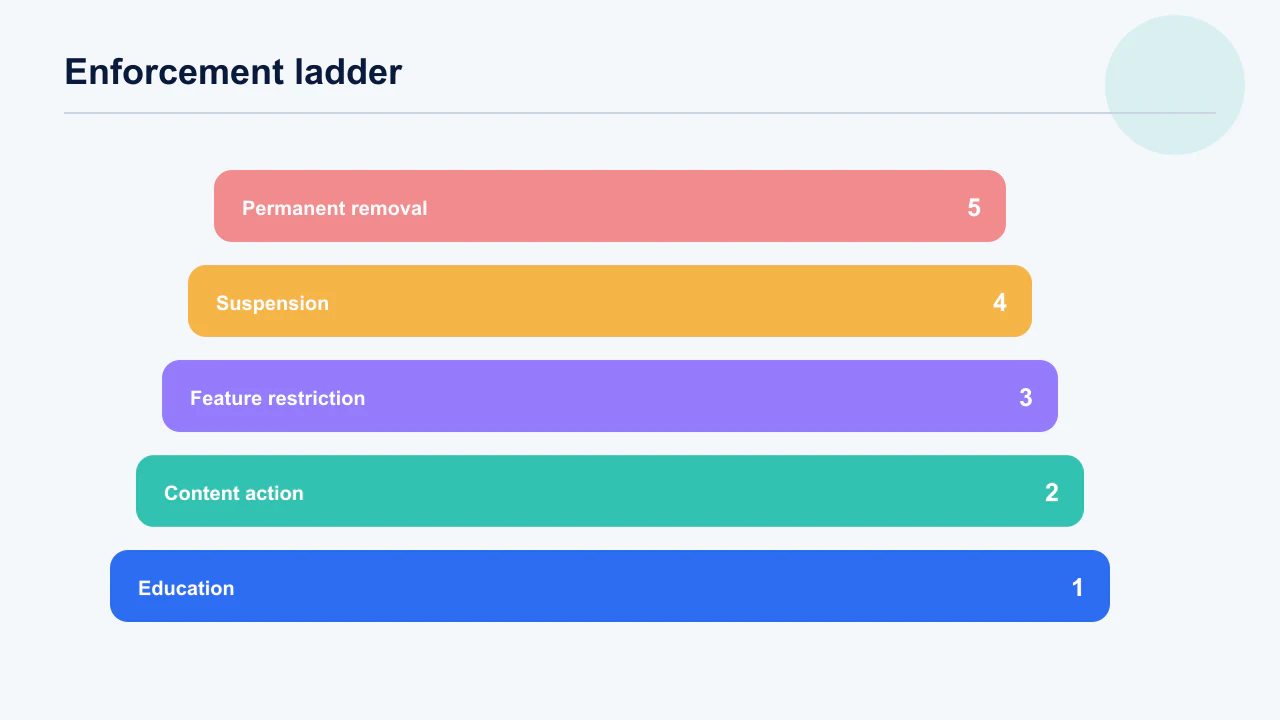
Use an action ladder: warning or education, content removal, reach restriction, feature cooldown, temporary suspension and permanent removal. Some severe categories justify immediate permanent action. Tell the user which rule was applied and what changed, subject to victim safety and investigative constraints.
- Proportionality: Consider severity, intent evidence, recurrence and likely future harm. Do not turn popularity into immunity.
- Scope: Act on content, feature or account at the narrowest safe level. Broad action needs broader evidence.
- Notice: Give a usable reason and duration. Avoid revealing reporter identity.
- Appeal: Use a fresh review path and track reversals by policy and team. Restore wrongly removed content where safe.
Decision rule: Higher-impact and lower-confidence actions require more review, except when immediate containment is necessary to prevent severe harm.
Appeal reversals are not merely failures. They identify ambiguous rules, poor evidence capture or reviewer training gaps and should feed the quality programme.
Treat reversal rate as a diagnostic split by cause, not a single number. Segment reversals into unclear rule, missing evidence, reviewer error and tooling failure; each points at a different fix — rewrite the clause, change what the client captures, retrain, or repair the console. A team tracking only the aggregate will keep retraining reviewers for a problem the evidence pipeline is causing. Notice copy deserves equal attention. A message naming the rule, the duration and the appeal route reduces repeat violations and support volume; one saying the account was actioned for violating the terms generates a ticket and teaches nothing.
Publish expected appeal handling without promising outcomes. Clear enforcement notices also protect your store rating — see ratings and reviews without breaking policy.
Which moderation metrics should you track?
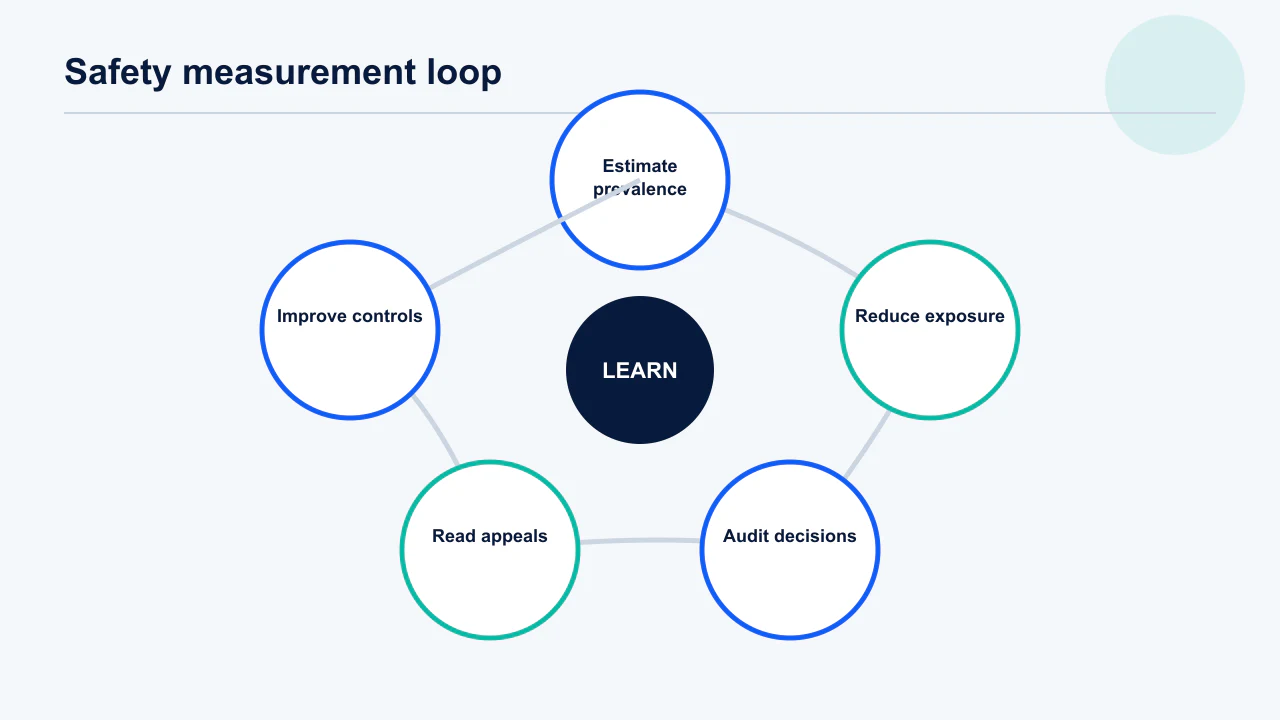
Track harmful-content prevalence, time exposed, report coverage, decision quality and appeal outcomes alongside queue speed. A falling report count can indicate safety, broken discovery or exhausted users.
Define denominators by views, conversations or active creators as appropriate. Sample unreported content to estimate prevalence; reports alone see only what users recognise and choose to flag. Break results down by surface, language, market and severity while protecting privacy.
- Prevalence: Estimate violating views or interactions from representative review. Report confidence and sampling method.
- Exposure: Measure time and impressions before containment. Speed begins before queue arrival.
- Operations: Watch backlog age, handling time and severity service levels. Do not optimise handling time alone.
- Quality: Measure audit agreement, error type, appeal rate and reversal. Segment by rule and model version.
Decision rule: No operational efficiency metric may improve by increasing user exposure or discouraging legitimate reports.
A reviewer who closes twice as many tickets may be excellent or may be skipping context. Quality sampling distinguishes productivity from rushed enforcement.
Prevalence needs a written sampling protocol, or the number drifts with whoever produced it. Draw a random sample weighted by views rather than by post count, since harm scales with exposure and an unviewed violating post is a different problem from a widely seen one. Have trained reviewers rate the sample against the current policy version, record inter-rater agreement alongside the estimate, and publish a confidence interval rather than a bare percentage. Re-sample on a fixed cadence with the same method so the series stays comparable across policy changes. Where automated classifiers contribute to decisions, NIST's AI Risk Management Framework is a workable structure for documenting measurement, drift and human oversight.
Review leading safety indicators weekly and policy outcomes monthly. Review mining surfaces categories that reports alone miss.
How do you staff and protect a moderation operation?
Staff from severity-weighted arrival forecasts, language and time-zone coverage, and protect moderators with tooling, rotation and psychological support. One generic support inbox is not a credible response system for live or high-risk UGC.
Estimate reports and proactive detections by hour and category, then model handling time and escalation. Restrict graphic media by default with click-to-reveal, blur and metadata summaries. Give moderators safe break schedules, training, calibrated quality review and access to professional support appropriate to exposure.
- Coverage: Map peak arrival, languages and mandatory response windows. Plan handoffs across shifts.
- Specialisation: Train dedicated escalation for child safety, credible threats and legal requests. General queues should not improvise.
- Tool safety: Blur media, suppress autoplay and expose only necessary context. Protect reviewer privacy.
- Resilience: Use rotation, wellness resources and non-punitive incident support. Do not reward harmful overexposure.
Decision rule: Do not launch a high-risk synchronous feature until urgent coverage exists for every hour it operates.
Moderation capacity is a product constraint. If a team can safely review 500 live reports, growth that generates 2,000 is not success until capacity or prevention changes.
Cost the operation per unit of content rather than per ticket, so the number scales with the product instead of the symptom. Divide fully loaded reviewer cost — including training, quality sampling and wellness provision — by content items published in the same period, and the result tells you what each new surface adds to operating cost before it launches. Vendor arrangements need the same quality sampling, escalation paths and wellness standards as internal staff, set contractually rather than by expectation, because the store holds the publisher accountable regardless of who performed the review. Build specialist escalation ramp time into the launch plan; it is measured in weeks. Products reaching children carry obligations beyond general moderation — Apple's guidance on protecting kids online sets the baseline.
Include vendor workers in the same safety and quality expectations as employees. Run the wider mobile compliance checklist alongside this moderation system.
What should a UGC store review proof pack include?
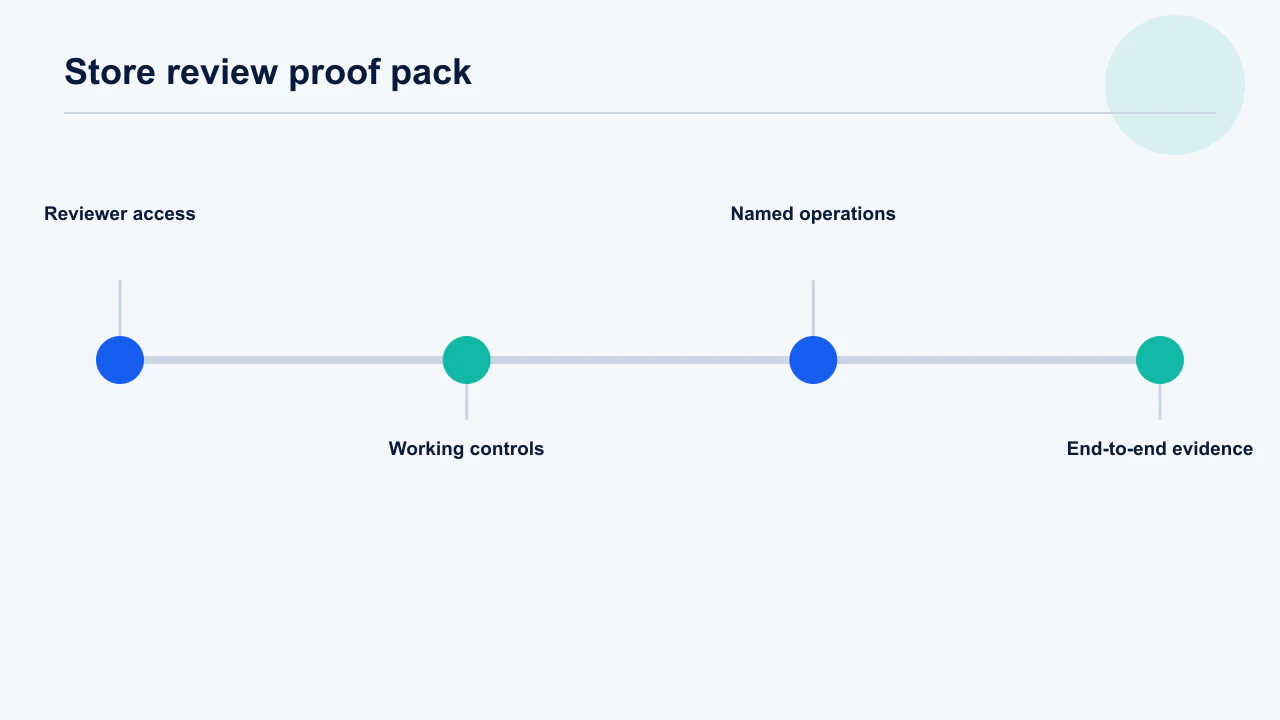
Provide reviewer access, published terms and contact details, working report and block paths, moderation ownership and evidence that every UGC surface was tested. Store reviewers need to observe the controls, not infer them from a policy URL.
Create seeded test accounts that demonstrate posting, reporting, blocking, moderator action and the resulting user experience. Explain any automated review delay, regional restriction or special hardware. Keep screenshots and test IDs current with the submitted build.
- Access: Supply credentials, roles and exact navigation for reviewer-visible UGC. Keep accounts active.
- Controls: Demonstrate filters, reporting, blocking and contact route. Cover private and public surfaces.
- Operations: Name response owner, escalation coverage and user-facing terms. Show it is ongoing.
- Evidence: Include test cases, outcomes and any necessary policy explanation. Match declarations to behaviour.
Decision rule: If the reviewer cannot create, report, block and observe an outcome with supplied instructions, the proof pack is incomplete.
The most persuasive note is concise: surface, control, navigation, test account and expected result. A long policy essay cannot rescue a broken path.
Record the pack as a reproducible script rather than a one-off note, because it has to be re-run for every submission that touches a publishing surface. List each test account with its role and current password, the exact navigation path to reach the surface, the action to perform, and the expected observable result. Store it beside the release checklist so the person submitting is not reconstructing it from memory at the point of upload. Where a control behaves differently by region, age band or account standing, say so explicitly and supply an account for each variant — a reviewer who cannot reproduce the documented behaviour will assume the control is absent rather than conditional.
Re-run the proof pack against the final signed candidate before submission, and keep the previous run attached to the release record. If review stalls, the pack is usually the fastest way to answer a reviewer question.
Frequently Asked Questions
Does every app with user-generated content need moderation?+
Yes, but the controls should be proportionate to the content and interaction risk. A profile-name field and live public video do not need identical operations, yet both need enforceable rules and response capability.
What UGC controls does Apple require?+
Apple’s Review Guidelines name filtering of objectionable material, a reporting mechanism with timely responses, blocking abusive users and published contact information.
What UGC controls does Google Play require?+
Google requires robust ongoing moderation appropriate to the UGC, acceptance of terms or user policy, in-app reporting, and blocking where users interact directly.
Can AI fully automate content moderation?+
AI can detect, prioritise, limit reach and assist reviewers, but error rates and context vary by category and language. Consequential low-confidence decisions need accountable human review and appeal.
How quickly should a moderation report be reviewed?+
Set times by potential harm and exposure. Imminent danger and child-safety signals require immediate specialist escalation; spam can use a standard queue. One universal SLA is unsafe.
Should users be told the result of a report?+
Acknowledge receipt and communicate meaningful status where policy, privacy and victim safety allow. Do not reveal reporter identity, private enforcement details or promise a particular outcome.
Which moderation metric matters most?+
Violating-content prevalence and time exposed are closer to user safety than report count alone. Pair them with queue service levels, decision quality and appeal reversals.
Sources
- Apple — App Review Guidelines — UGC filtering, reporting, timely response, blocking and contact requirements.
- Google Play — User Generated Content policy — Ongoing moderation, terms, reporting and blocking requirements.
- Google Play — Child safety standards — Published child-safety standards and compliance contact requirements for social and dating apps.
- Apple — Helping protect kids online — Platform resources for age-appropriate experiences and safety.
- NIST — AI Risk Management Framework — Primary public framework for governing automated decision systems.
- Digital Services Act — European Commission overview — Official overview of platform obligations in the EU; obtain legal advice for applicability.
- UK Ofcom — Online safety — Official UK regulator guidance; requirements depend on service and jurisdiction.
- Google Play — Developer Program Policies — Current policy source for Play-distributed apps.
About the author
Amol Pomane — Founder, Vmobify
Amol leads Vmobify, a mobile app growth agency that has driven 30M+ downloads and ranked 54K+ keywords across 300+ apps since 2013. He writes about ASO, paid user acquisition, retention, and the operational reality of scaling mobile apps in India and global markets.