Fastest Way to Get App Installs: 7 Tactics That Work in 72 Hours
Most "fast install" hacks blow up your ranking, drain your budget, or get your app suspended. These seven tactics deliver real installs in 72 hours — and they actually retain users.
On this page
- Why does install speed matter for app stores?
- What should you avoid when trying to get installs fast?
- 1. How do CPI burst campaigns drive ranking velocity?
- 2. How fast can Google App Campaigns deliver installs?
- 3. Does Meta Advantage+ work for rapid scaling?
- 4. Which ASO changes move installs in 24 hours?
- 5. How effective is a coordinated micro-influencer push?
- 6. What does a Product Hunt + Reddit launch look like?
- 7. Why is creative-led cold traffic the fastest scaling lever?
- What does a real 72-hour install push deliver?
- How much does a 72-hour install push cost?
- Frequently Asked Questions
Why does install speed matter for app stores?
Install velocity — the rate at which your app accumulates installs over time — is one of the single heaviest weighted signals in both the Apple App Store and Google Play ranking algorithms. Stores reward apps gaining momentum because that signal correlates strongly with "this app is interesting to users right now."
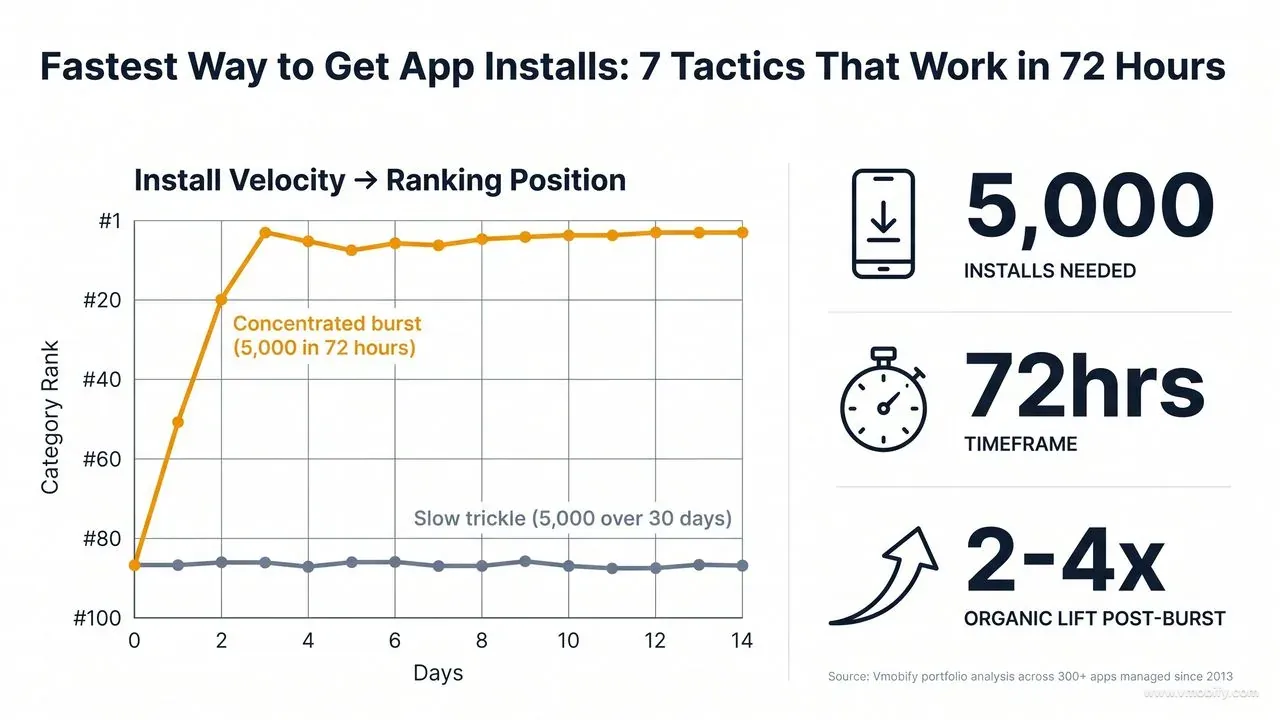
The math behind this is simple: a surge of 5,000 installs concentrated in 24 hours moves the algorithm in a way that a slow trickle of 5,000 over a full month never will. Google's Play Console explicitly references install velocity in its launch best practices documentation, and Apple's editorial and search ranking systems behave similarly.
But — and this is the trap most teams fall into — speed alone is worthless if those installs do not retain. Modern ranking algorithms now weight D1 and D7 retention almost as heavily as install count. AppsFlyer's Performance Index consistently shows that apps with above-category-baseline retention get materially more discovery-surface impressions than apps with higher install volume but worse retention. A burst that brings 10,000 fake or incentivised installs with 5% D1 retention will move you up the ranks for 48 hours and then crash you below your starting point.
In our portfolio across 300+ apps managed since 2013, the apps that successfully translate a 72-hour install push into sustained ranking lift have three things in common: high-quality demand sources (no fraud), a properly optimised store listing (so the velocity actually converts), and a creative system capable of feeding paid spend without fatigue. The seven tactics below cover all three.
What should you avoid when trying to get installs fast?
Avoid anything that generates installs without genuine user intent — these are the patterns Apple and Google's fraud-detection systems are specifically designed to catch. The five fastest ways to destroy your account or ranking:
- Incentivised non-disclosed installs at scale: Both stores have aggressive detection for incentivised traffic disguised as organic. Caught once means delisting. Apple's App Store Review Guidelines section 3.2.2 explicitly prohibits this.
- Bot or emulator install farms: Cheap to buy, easy to detect. Modern fraud-detection at AppsFlyer, Adjust, and Singular catches device-farm patterns within minutes of traffic starting. The MMP fraud-flag rate alone often exceeds the supposed savings.
- SEO-style keyword stuffing in your app title: Triggers manual review and rejection on both stores. We have seen accounts permanently suspended after a third strike.
- Paid review schemes: Apple removes review purchases automatically and may suspend developer accounts on repeat offences. Apple — App Store Review Guidelines shows Apple removes hundreds of millions of fraudulent reviews per year.
- "Guaranteed installs" packages priced below market: If a vendor is offering installs below ₹3 per install in India or $0.20 in Western markets for non-incentivised traffic, the economics literally do not allow real installs. Almost certainly fraud.
Everything in the seven tactics below works inside both stores' published guidelines. None of it will get your account flagged. None of it relies on tricks that will be patched in the next platform update.
1. How do CPI burst campaigns drive ranking velocity?
A managed burst campaign through a reputable CPI network is the fastest way to add 5,000-50,000 real installs over 72 hours. The key word is reputable. Top-tier CPI networks like Tapjoy, Aarki, ironSource non-incent inventory, and our own vetted publisher set deliver real users on real devices through real publisher apps — there is nothing about "buying installs" that is inherently against store policy when the installs come from genuine humans clicking genuine ads.
Where to use burst campaigns specifically:
- Ranking velocity for a featured launch: If you have editorial featuring scheduled, layering a burst on the same day amplifies the organic spike that featuring drives.
- Chart-position push in your category: Top 10 in your category is a discovery surface that compounds organically. A burst can push you into a position where organic momentum takes over.
- Competitive defence: When a rival is climbing fast in your category, a defensive burst can hold your position until your sustained UA system catches up.
Indian Tier-2/3 fills can run as low as ₹3-8 per install through quality non-incent networks — about 40-60% cheaper than urban metros.
The crucial detail: do not measure CPI bursts on raw install count. Measure them on the ranking lift they trigger in the 7-14 days after the burst. In our portfolio, well-executed bursts typically lift the organic install rate to 2-4x baseline for 3-4 weeks after the burst ends. That delayed lift is where the real ROI lives.
2. How fast can Google App Campaigns deliver installs?
Google App Campaigns (UAC) is the highest-volume paid install channel in the world. Properly set up, it can spend $10K in 24 hours and deliver thousands of high-intent installs. Google's own documentation claims UAC delivers ads across Search, YouTube, Discover, Display, and Google Play — the widest reach of any single paid channel.
The settings that make UAC work fast:
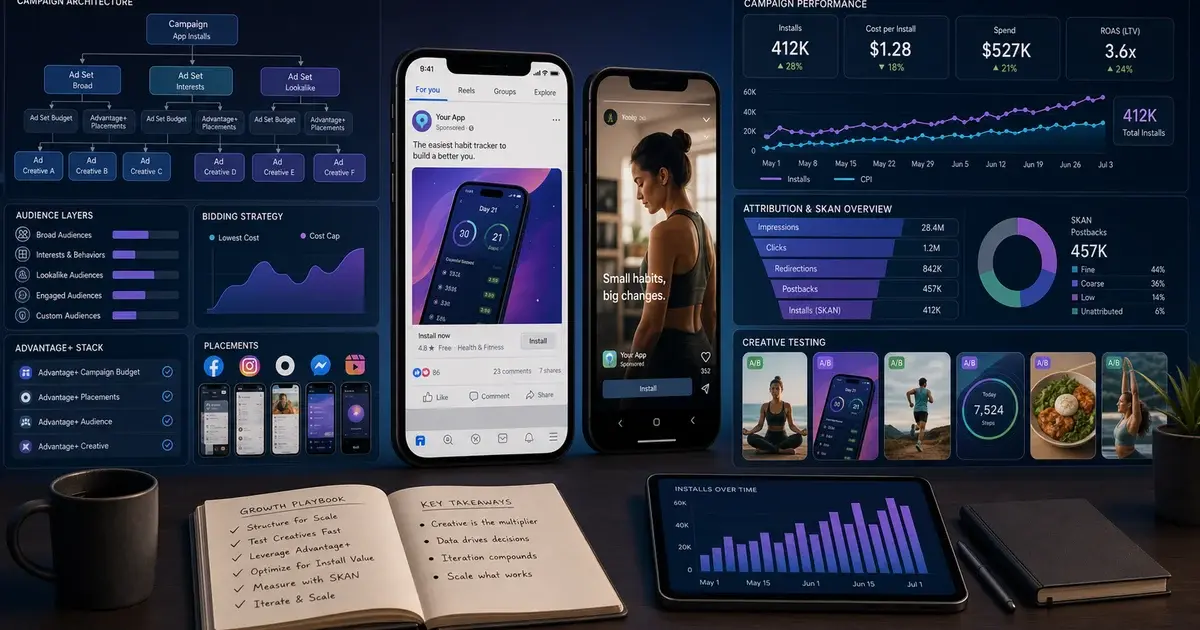
- Bidding: Start with target-CPI (tCPI) for the first 100 conversions, then switch to target-ROAS (tROAS) once the algorithm has enough data. Letting the algorithm find your buyers is the entire UAC philosophy — fighting it slows results.
- Creative volume: Upload 10+ creative variations per ad group, mixing HTML5, video, and static formats. UAC's algorithm needs creative volume to optimise effectively. Apps with only 2-3 creatives in their UAC campaigns consistently underperform peers with 8-12.
- Conversion events: Define in-app conversion events beyond install — registration, first purchase, subscription, level 5 reached. This is what separates "installs" from quality installs. Apps optimising on shallow events get cheap installs that do not retain.
- Geographic targeting: Split India Tier-1 from Tier-2/3 into separate ad groups. Auctions in metro India are 2-3x more expensive than Tier-2/3 for the same vertical — separating campaigns lets you scale each correctly.
Realistic timeline: within 48 hours of campaign launch, the algorithm has enough data to start delivering. Within 7 days, your CPI typically drops 30-50% from your initial bid as the system learns. We have seen UAC campaigns scale from ₹2L to ₹15L of weekly spend within 3 weeks while maintaining CPA targets — provided creative and tracking are set up correctly.
3. Does Meta Advantage+ work for rapid scaling?
Yes — Meta's Advantage+ App Campaigns (the successor to AAA) are the fastest "set-and-forget" paid channel for app installs in 2026, especially for apps with broad demographic appeal. Three setting decisions determine whether they work:
- Targeting: Country + age band only. No interest stacking, no detailed demographics. Meta's official Advantage+ guidance is explicit on this — broad targeting outperforms narrow targeting consistently because the algorithm has more signal to work with.
- Optimisation: App install + value optimisation. Start with install optimisation in week 1, layer in value optimisation once you have 30+ post-install conversions tracked. Skipping the install-only phase produces under-trained models.
- Creative volume: Upload 6-12 creatives at launch — mix of UGC-style video, motion graphics, and static. Pause anything below your top quartile after 3 days. Meta creative fatigues faster than Google UAC creative; refresh cadence is the bottleneck for sustained scale.
For apps with broad consumer appeal (utility, social, ecommerce, finance), Meta Advantage+ can reliably deliver 1,000-5,000 installs per day inside 72 hours at competitive CPIs — typically ₹40-90 in India for D2C, ₹80-200 for fintech, ₹25-60 for utility. See our full Meta App Install Campaigns playbook for campaign structure and creative testing protocols.
The single most common mistake: launching Advantage+ with a single creative. Meta's algorithm is designed to test variants against each other; without inventory to test, the algorithm has nothing to optimise toward. Apps that launch with 1-2 creatives produce 60-80% higher CPIs than apps that launch with 8-12 creatives in our portfolio.
4. Which ASO changes move installs in 24 hours?
Most of the impact of ASO compounds over months — but four specific changes deliver visible install lift within 24 hours of going live. All four are free, all four are reversible, all four are inside both stores' guidelines:
- Update your subtitle (iOS) or short description (Android) with the highest-volume relevant keyword you do not currently rank for. Both stores re-index metadata within hours of submission. We typically see ranking movement within 24-48 hours for the inserted keyword.
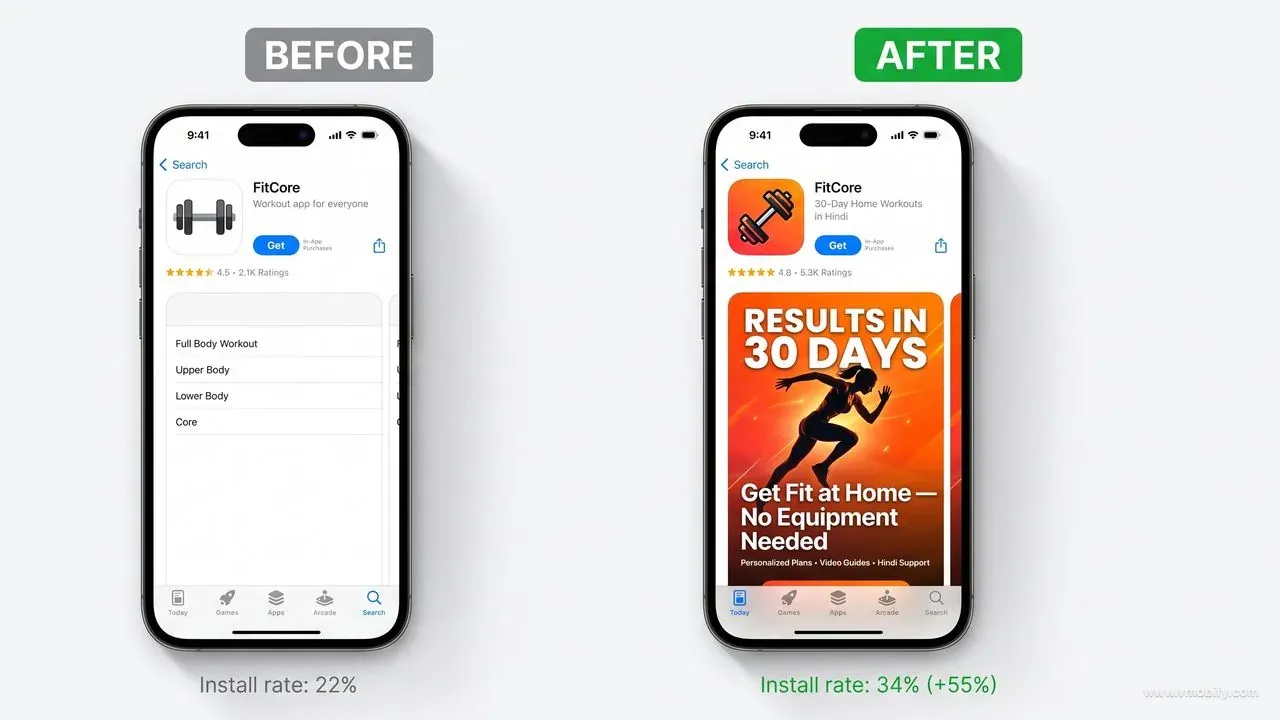
- Swap your first screenshot for a new variant with a clearer benefit hook. The first screenshot drives approximately 60% of the install decision per Apple — App Store Product Page. A 10% lift in first-screenshot conversion means 10% more installs from the same paid and organic traffic — immediately.
- Refresh your icon if it has not changed in 6+ months. A modern icon can lift store-page conversion by 5-15%. The lift shows up the moment the new icon goes live; the algorithm rewards updated apps and users respond to visual freshness.
- Respond to recent 1- and 2-star reviews within 48 hours. Visible developer responses cause approximately 15% of reviewers to revise their rating upward — typically within a week. Rating lift is one of the strongest non-metadata signals in both stores' algorithms.
None of this costs anything. The lift is real, measurable, and shows up within a day. For deeper ASO playbook see our complete ASO guide and our Android-specific ASO hacks.
5. How effective is a coordinated micro-influencer push?
A coordinated push from 5-15 micro-influencers (20K-200K followers in your niche) can drive 10,000-50,000 installs over a long weekend at a fraction of paid CPM cost — provided the push is concentrated. The mistake teams make is spreading 10 influencer posts across 30 days; the spike never registers in store algorithms. The fix is firing all posts within a 48-hour window.
How to structure it:
- Identify creators who already cover your category — fitness creators for a workout app, finance creators for fintech, gamers for games. Audience match matters more than absolute follower count.
- Negotiate flat fees plus a small CPI top-up for verified installs. Pure performance deals attract spammy creators; flat-fee-only attracts disengaged ones. The hybrid keeps both sides invested.
- Track via custom UTM-tagged deep links so you can attribute installs back to each creator post-hoc and identify which audiences converted.
- Time the burst with your other channels: influencer posts going live on day 1 of a Meta + UAC campaign launch creates a velocity stack that exceeds the sum of its parts.
Indian creators on Instagram Reels and YouTube Shorts deliver some of the best install economics in the world right now. We routinely see effective CPIs under ₹15 from regional creator partnerships for the right category match. Statista's India influencer market data shows the segment growing 25%+ year-over-year, with creator inventory expanding faster than brand demand — keeping CPMs low in 2026.
One important sequencing note: do not launch influencer posts before your store listing is optimised. Influencer-driven traffic with a weak store listing produces low install rates and wastes the spike. Lock down the ASO quick wins above before activating the influencer push.
6. What does a Product Hunt + Reddit launch look like?
For consumer apps and developer tools, a coordinated Product Hunt + Reddit launch can drive 1,000-10,000 installs in 24 hours plus durable backlinks that compound for months. This is one of the few install-acceleration tactics with permanent SEO upside — Product Hunt and Reddit links remain crawlable indefinitely.
Product Hunt protocol:
- Launch Tuesday or Wednesday — these are the highest-traffic days on the platform per Product Hunt's own engagement reports.
- Line up 30+ supporters in advance to upvote in the first hour. The first hour determines whether you crack the top 5; everything after depends on it.
- Prep a clear "what it does + why now" pitch. Generic launches get ignored. Sharp positioning gets featured.
Reddit protocol:
- Identify 3-4 subreddits where your app's audience actually lives. Cross-posting to 20 subreddits triggers shadow-bans; concentration to 3-4 relevant subreddits builds genuine engagement.
- Post a self-text "I built X because of Y" story, not a link drop. Reddit instinctively distrusts marketing links but rewards founder narratives.
- Respond to every comment for the first 6 hours. Engagement velocity in the first hours determines whether your post gets surfaced beyond the subreddit.
This approach works exceptionally well for utilities, productivity tools, fitness apps, developer tools, and any app with a clear creator story. It does not work for opaque crypto apps, dating apps (privacy concerns), or pure consumption apps (no story to tell). Match the tactic to the app type.
7. Why is creative-led cold traffic the fastest scaling lever?
The single biggest variable in fast install economics is creative quality. A breakthrough creative can drop your CPI by 40% in 48 hours and uncap your paid spend. In our portfolio, the difference between an average creative and a top-quartile creative is consistently a 2-3x difference in CPI for the same audience and channel.
How to engineer a breakthrough creative fast:
- Brief a UGC creator network like Billo, Insense, or local Indian equivalents. Turnaround is typically 48-72 hours for a batch of 5-10 raw videos.
- Test 4-6 hooks against the same product demo. The hook — the first 2 seconds of the video — determines 70-80% of total performance. Same product, four different opening lines: one will win by 2-3x over the others.
- Pause underperformers daily. The opportunity cost of running a creative below your CPI threshold for a week is enormous; daily pause-and-replace keeps your blended CPI moving in the right direction.
- Scale spend on winners by 2x each day they hold their CPI. Winning creatives can absorb 10x scaling before fatiguing if you ramp them progressively rather than overnight.
A working creative compounds. One winning ad can carry a campaign for weeks of profitable scaling. The goal of the first 72 hours is not just installs — it is to identify which creatives are your winners so the next 30 days of paid scaling have a foundation to build on.
What does a real 72-hour install push deliver?
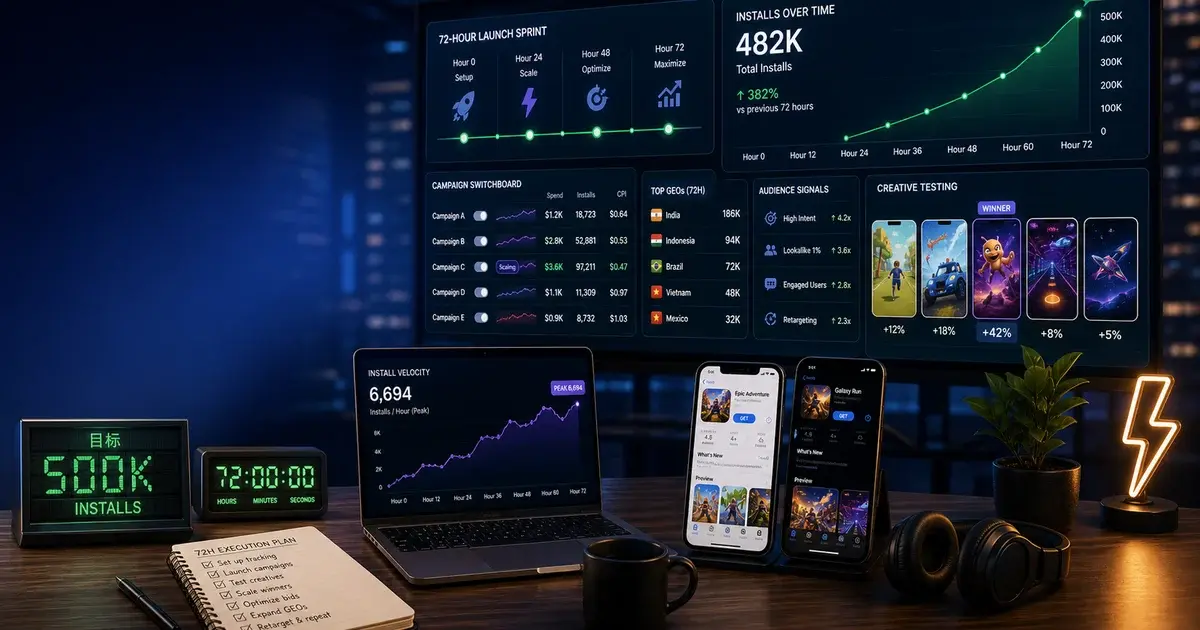
Combining 3-4 of these tactics with a ₹10L budget, here is a realistic 72-hour outcome for a mid-stage app in India:
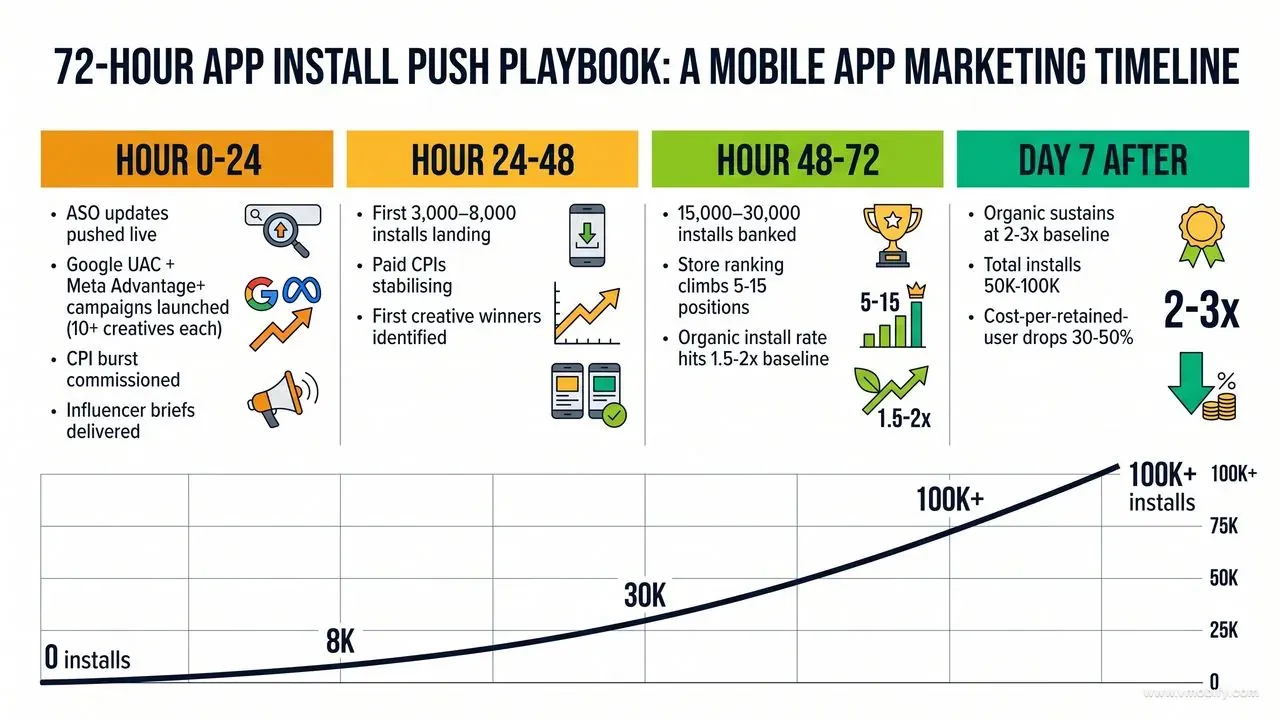
- Hour 0-24: ASO updates pushed live (subtitle keyword + first screenshot swap). Google UAC + Meta Advantage+ campaigns launched with 10+ creatives each. CPI burst commissioned through a vetted publisher network. Influencer briefs sent to 8 regional creators.
- Hour 24-48: First 3,000-8,000 installs landing. Paid CPIs stabilising as algorithms learn. First creative winners identified — pause losers, scale winners 2x. Burst traffic flowing. Influencer posts going live in concentrated 6-hour window.
- Hour 48-72: 15,000-30,000 installs banked. Store ranking climbing 5-15 positions in primary category. Organic install rate already 1.5-2x baseline as the velocity signal registers with the algorithm.
- Day 7 after the push: Organic install rate sustains at 2-3x baseline. Total installs in the 7-day window: typically 50,000-100,000. Cost-per-retained-user is 30-50% lower than baseline because the velocity boost amplifies organic acquisition.
This is what a real fast-installs operation looks like — no fraud, no penalties, no account risk, retention indistinguishable from organic baseline. The combination of legitimate paid + smart organic timing + creative discipline outperforms any single tactic by a wide margin.
How much does a 72-hour install push cost?
Realistic 72-hour install push budgets by goal, India market:
- Minimum viable test (₹1-3L): ASO updates + Meta + light influencer. Expect 3,000-8,000 installs. Useful for proof-of-concept before bigger investment.
- Meaningful push (₹3-8L): Add Google UAC + small CPI burst. Expect 10,000-25,000 installs + visible category ranking movement.
- Market-moving push (₹10-15L): Full stack with large CPI burst + 10+ influencers + sustained creative testing. Expect 30,000-80,000 installs + top-20 category ranking.
- Defensive scale push (₹20-40L+): Used to defend category position against well-funded competitors. Expect 80,000-200,000 installs + sustained top-10 category presence.
Western market budgets run 3-5x these numbers for equivalent install volume, though India's audience size and lower CPMs make it the most cost-efficient install market on the planet for most verticals. For category-specific CPI benchmarks see our India CPI benchmark guide.
The hardest part of a 72-hour push is not the spend — it is the operational coordination. The teams that win run a war-room schedule: hourly check-ins for the first 24 hours, daily creative refresh decisions, real-time bid adjustments based on early-cohort retention signals. Talk to our team if you want a managed 72-hour push for an upcoming launch or competitive moment.
Frequently Asked Questions
How many installs can I realistically get in 24 hours?+
With a coordinated paid + CPI burst, 3,000-10,000 installs in 24 hours is realistic for an Indian audience at ₹3-5L spend. Higher volumes require larger budgets and existing creative inventory ready at launch.
Will fast install tactics hurt my retention?+
Only if you use incentivised or fraudulent sources. The seven tactics in this guide all use high-intent paid traffic and organic discovery channels — retention from these sources is typically within 10-20% of your organic baseline.
How fast does ASO actually move rankings?+
Metadata changes are re-indexed by both stores within 24-48 hours. Ranking movement typically follows within 3-7 days for inserted keywords. Screenshot and icon changes affect conversion immediately on the next user visit.
Are CPI networks safe to use?+
Reputable CPI networks running non-incentivised real-user traffic are completely safe and widely used by major apps. Avoid any vendor selling installs below ₹3 in India or $0.20 in Western markets — those are almost always fraud.
What is the minimum budget for a 72-hour install push?+
For a meaningful spike: ₹3L in India or $5K in Western markets covers a basic paid + CPI combination. Larger spikes scale roughly linearly with budget up to the ceiling of your creative quality.
Should I run a 72-hour push for a new app launch?+
Yes, but only after your store listing is optimised and your retention/onboarding is tested. Spending heavily into a leaky bucket produces installs that churn and signal poor quality to the stores — net negative outcome.
What is the single most important variable in a fast install push?+
Creative quality. A breakthrough creative cuts CPI 30-50% within 48 hours and uncaps your scalable paid spend. The single biggest difference between teams that succeed and teams that struggle is the creative pipeline behind their campaigns.
Sources
- AppsFlyer Performance Index — Quarterly benchmarks for install velocity vs retention by category and geography
- Apple App Store Review Guidelines (section 3.2.2) — Official rules on incentivised installs and install manipulation
- Google Play — Launch Best Practices — Google's own documentation on install velocity as a ranking signal
- Apple — App Store Product Page — Aggregated A/B test data on first-screenshot conversion impact
- Meta — Advantage+ App Campaigns Documentation — Official Meta guidance on broad targeting and Advantage+ setup
- Statista — India Influencer Marketing Market Size — 25%+ YoY growth data for Indian creator economy
- Google Ads — App Campaigns Help — UAC setup, bidding, and creative best practices
About the author
Amol Pomane — Founder, Vmobify
Amol leads Vmobify, a mobile app growth agency that has driven 30M+ downloads and ranked 54K+ keywords across 300+ apps since 2013. He writes about ASO, paid user acquisition, retention, and the operational reality of scaling mobile apps in India and global markets.
Model an install budget
Turn CPI and activation assumptions into acquisition scenarios.
Open free tool