Which Market Next? Sequencing Expansion by Unit Economics
Most expansion decisions are made on market size, which is the one input that tells you nothing about whether the market will pay you back. The store mechanics make it worse: Google Play targets releases by the country a user registered their account in, not where they are standing, while your ad platform targets something else entirely. This is the sequencing framework we apply to a client's own numbers, with no invented benchmarks in it.

On this page
- What does “available in a market” actually mean?
- Why does your ad targeting not match your store availability?
- Which numbers should decide the sequence?
- Where do the inputs come from before you have spent anything?
- What does the market actually pay you after fees and tax?
- What has to be localised before the test is fair?
- How do you open a market as a test rather than a launch?
- How do you know when a market has failed?
- What order should you actually go in?
- Frequently Asked Questions
What does “available in a market” actually mean?
On Google Play it means the user's Play country — where their account is registered — is on your list, not that they are physically standing in that country. That single sentence decides more failed expansions than any spreadsheet does, because it breaks the assumption everyone starts from: that a market is a place.
Google's guidance on distributing app releases to specific countries is explicit on both halves. When you roll out a release to production, open testing or a closed testing track, you can target that release in each track to users in specific countries — and targeting is determined by the user's Play country, that is, where their account is registered, rather than their current location.
Availability and targeting are two different controls that people conflate. Google defines app availability as your app's availability in the production track, and states that when you select a country as available, any current and future production releases include that country.
There is also a condition on testing that catches teams trying to pilot a market quietly. Country targeting cannot be customised for testing releases unless either your app has no app bundle uploaded to production, or your app has an app bundle in production and at least one country is available in the production track.
Apple's model is a list with a standing default for future territories. Its help on managing availability for your app on the App Store offers three options: all countries or regions, which Apple describes as all 175 countries or regions of the App Store; a specific selection; or publishing as a pre-order. In both the all-territories and the pre-order option, Apple states the app will also be available in any new countries or regions added to the App Store in future, and on the specific-selection path there is a box at the bottom of the list that does the same thing.
If someone on your team chose “all countries or regions” at launch to avoid a decision, you are not expanding into markets — you are already in them, unmeasured, with an untranslated listing and no local pricing. That is not a clean baseline, and it is the most common state we find an app in when the expansion conversation starts.
Apple also documents the timing to plan around: the changes take effect immediately but may require up to 24 hours to be visible to all users. Treat that as the earliest honest moment to start reading data.
Why does your ad targeting not match your store availability?
Because the ad platform targets a location inferred from signals while Google Play targets the country your user's account is registered in, and those two definitions disagree for exactly the people you are most likely to buy first. The mismatch produces a specific, diagnosable failure: spend that converts to a click and stops.
Google's help on targeting ads to geographic locations states that location targeting is based on a variety of signals and that 100% accuracy is not guaranteed in every situation. It also distinguishes presence targeting, which narrows to people in your targeted locations, from a broader option that includes people who have shown an interest in your targeted locations. Google's recommendation to use the broader setting is stated for Search campaigns; do not carry that recommendation across to a first market test where you are trying to measure one country cleanly.
Now line the two definitions up. An ad platform can reasonably show your ad to a person who is physically in Indonesia. If that person's Play account is registered in Singapore, your Indonesia-targeted production release does not include them. You paid for the impression and the intent, and the store declined the install.
Google Play
- Targets the user's Play country
- Defined as where the account is registered
- Binary: available or not
- Decides whether the install can happen
Ad platform geo
- Targets an inferred location
- Based on a variety of signals
- 100% accuracy not guaranteed
- Decides only who sees the ad
The consequence for sequencing is that markets with large diaspora or expatriate populations, and markets where account registration commonly sits in a neighbouring country, will under-convert relative to any model built on population. No amount of iteration on the ad fixes that. Across the 300+ apps we have managed since 2013, this is the first thing we check when a new market shows healthy click-through and a collapsed install rate. The wider discipline of separating platform-reported numbers from what happened is in our guide to mobile attribution.
Which numbers should decide the sequence?
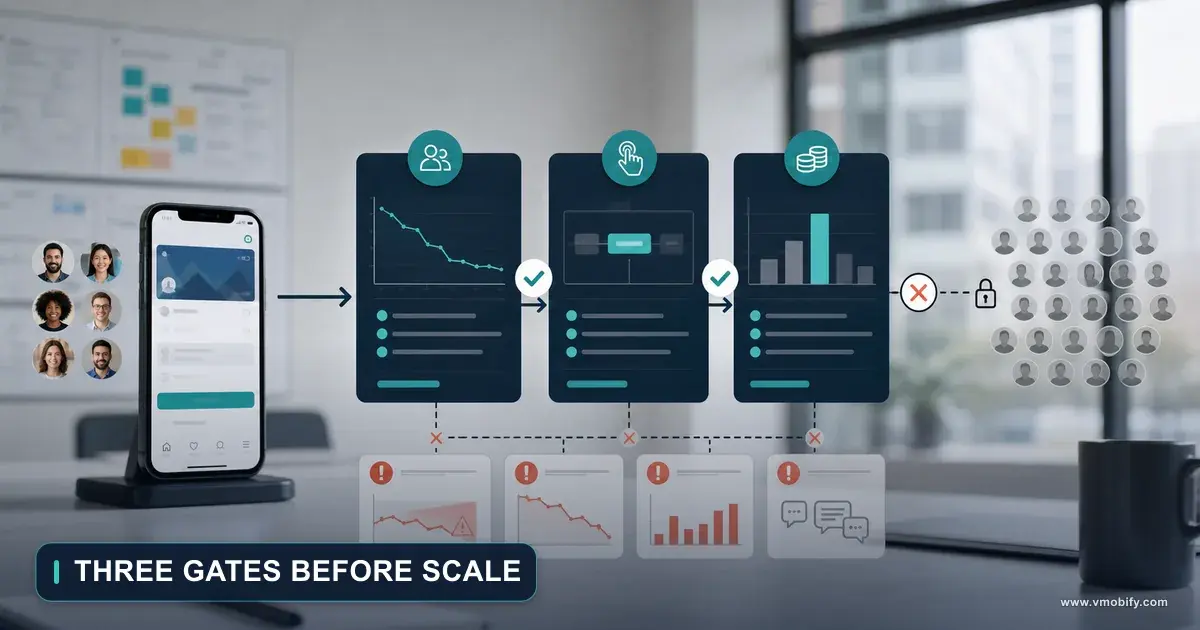
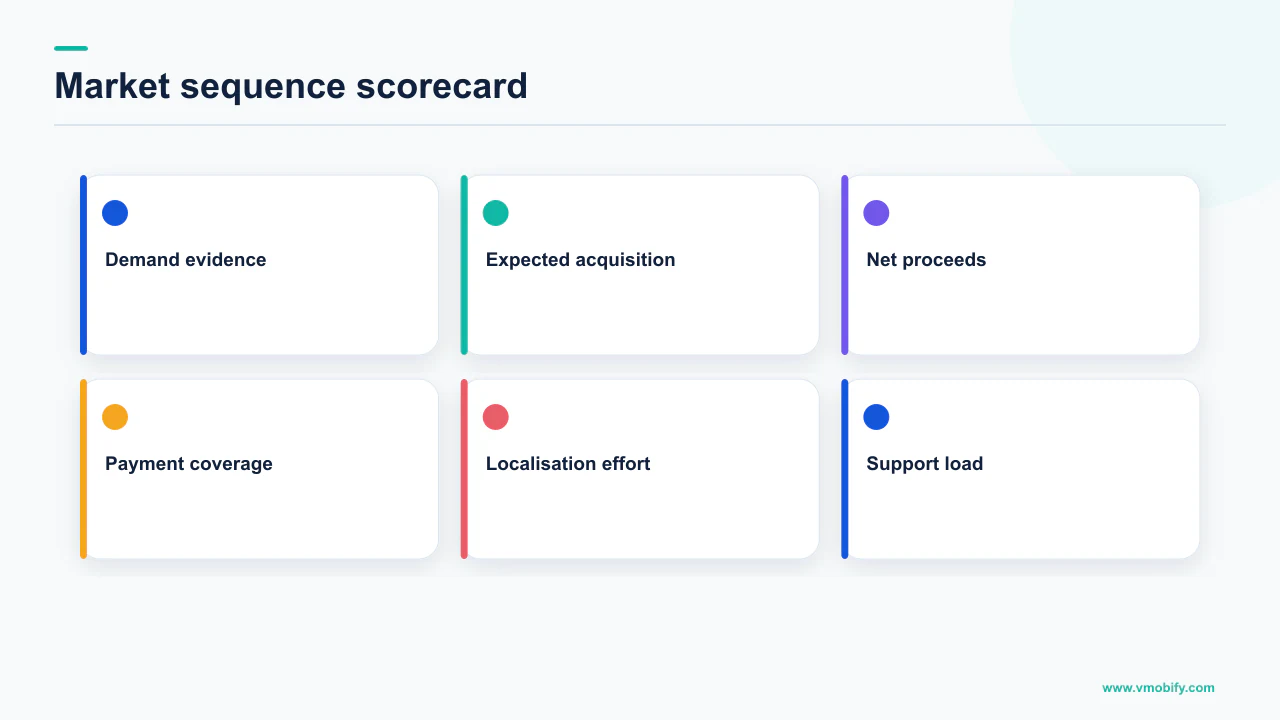
Payback period first, contribution per install second, market size last — and market size only as a ceiling on how much of the first two you can eventually buy. Sequencing on size is the default because size is the only number that is easy to find, and it is the number that predicts the least.
We are not going to print market-size or cost-per-install benchmarks here. Any such figure is specific to a category, a season, a creative set and an auction, and a number pulled from someone else's app is worse than no number because it feels like evidence. The inputs below are ones you compute from your own data.
- Rank candidates by expected payback period, not by expected volume. A market that returns your acquisition cost quickly funds the next market. A market that returns it slowly consumes the cash you needed to open the next one. Our note on budgeting against cash payback works through why this ordering compounds.
- Compute contribution per install after store fees, tax and local price, not revenue per install. The gap between those two is not a rounding error and it varies by market. The next two sections deal with it.
- Discount for anything you would have to build. A local payment method, a language you do not support, a compliance obligation — each is a fixed cost that has to be earned back before the market is profitable, and it belongs in the ranking rather than in a footnote.
- Only then apply size as a ceiling. A market with excellent unit economics and a small addressable base is a good second market and a poor tenth one. Size tells you how long the market stays worth working, not whether to open it.
The uncomfortable implication is worth stating plainly: the largest market on your list is frequently not the right next one. It is usually the most competitive, which means the most expensive traffic and the longest payback, at the exact point when payback speed matters most. The calculations sit in our LTV and CAC calculator guide and the broader ROAS and CAC guide.
Where do the inputs come from before you have spent anything?
From the organic installs you are already receiving from markets you never targeted, broken out by country in the reports both stores already give you. Nearly every app has this data and nearly nobody reads it before deciding where to expand.
Google's documentation on downloading and exporting monthly reports sets out what is available. The aggregated statistics reports cover installs, crashes, ratings and subscriptions; the user acquisition reports cover retained installers, buyers and subscribers. The dimensions include country, language, device, carrier, app version and Android OS version. Google states data is captured daily and posted within 3 to 7 days in monthly CSV files, so this is a monthly-cadence input, not a live dashboard.
What you are looking for is a country where you never spent anything and the behaviour is nonetheless good. Unpaid installs from an untargeted market, with an untranslated listing, that go on to retain and convert, are the strongest free signal you have — every friction you have not yet removed is already priced into the result.
Not “which country sends us the most installs?” but “which country retains and converts best at a listing we have not optimised for it?” The first question ranks by size and reproduces the mistake in the previous section. The second ranks by evidence of product fit, which is what you actually need before committing budget.
Two cautions. An untargeted market's organic cohort is self-selected, so treat it as directional rather than as a forecast. And the country dimension in store reporting is not the same field as the geo dimension in your ad platform, for the reason set out above — if they disagree, the store is the one that decided whether an install happened.
The corresponding App Store data lives in App Store Connect's own reporting by territory. In our portfolio, this export is where roughly every good expansion decision starts, and the process is the same one we apply to funnel analytics generally: segment first, then decide.
What does the market actually pay you after fees and tax?
Less than your price, by an amount that changes per market — because local price, tax treatment and the store's service fee all vary, and only the first of those is under your control. Contribution per install is the number that decides the sequence, so this is where the ranking is usually won or lost.
Start with what the store does to your price. Google's help on setting up your app's prices states that it converts your price to the local currency, adds tax in select countries, and applies locally relevant pricing patterns and valid exchange rates for the date on which you set the price. Two conditions in that sentence matter for a long-lived catalogue: the rate is the one from the date you set the price, and you can refresh prices manually to reflect current rates. A price set two years ago in a currency that has moved is not the price you think you are charging. If a country has no local currency support, your default price in USD or EUR applies instead. Google states pricing changes take a few hours to display on Google Play.
Then the service fee. Google's service fees documentation describes a rate schedule that varies by transaction type, by market, by whether the transaction relates to a new or existing install, and by whether the developer participates in specific Play programmes, with separate arrangements where alternative billing applies. We are deliberately not printing a single percentage here, because there is no single percentage — quoting one rate as though it were universal is precisely the error that makes an expansion model wrong. Read the schedule against your own app's situation and use the rate that actually applies to you.
Contribution per install = local price after conversion and any added tax, minus the service fee that applies to your transaction type and market, minus local payment or support costs. Rank on that. Revenue per install flatters every market equally and therefore ranks nothing.
Price level itself is a market decision, not a conversion of your home price, and it interacts with everything above. We cover the reasoning in price localisation and purchasing power.
What has to be localised before the test is fair?
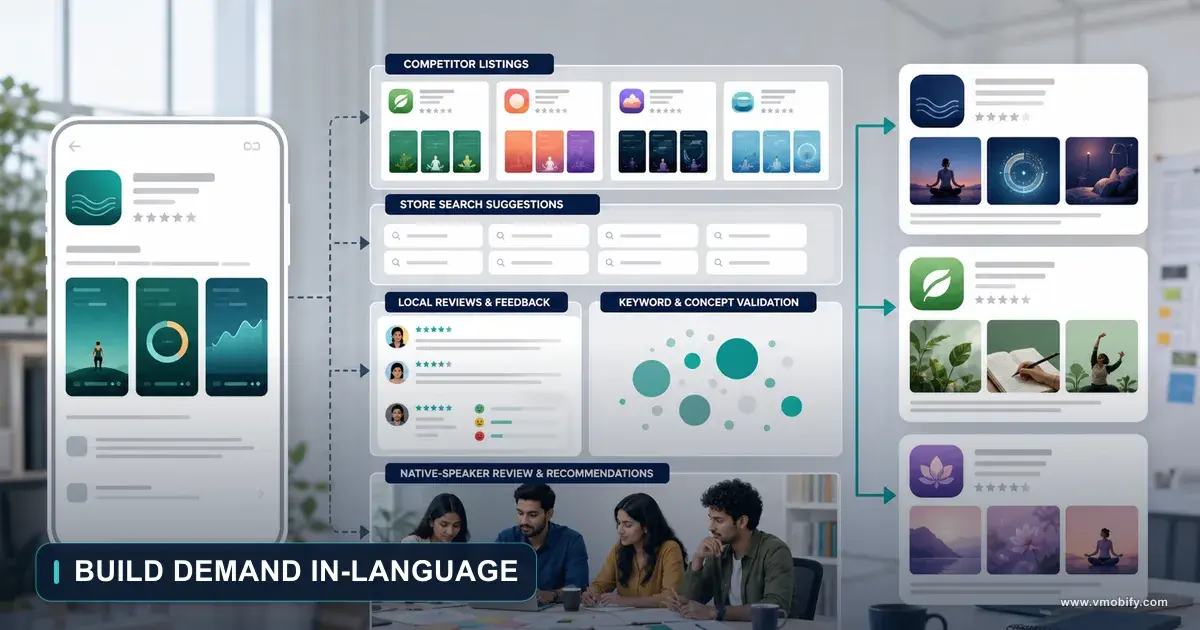
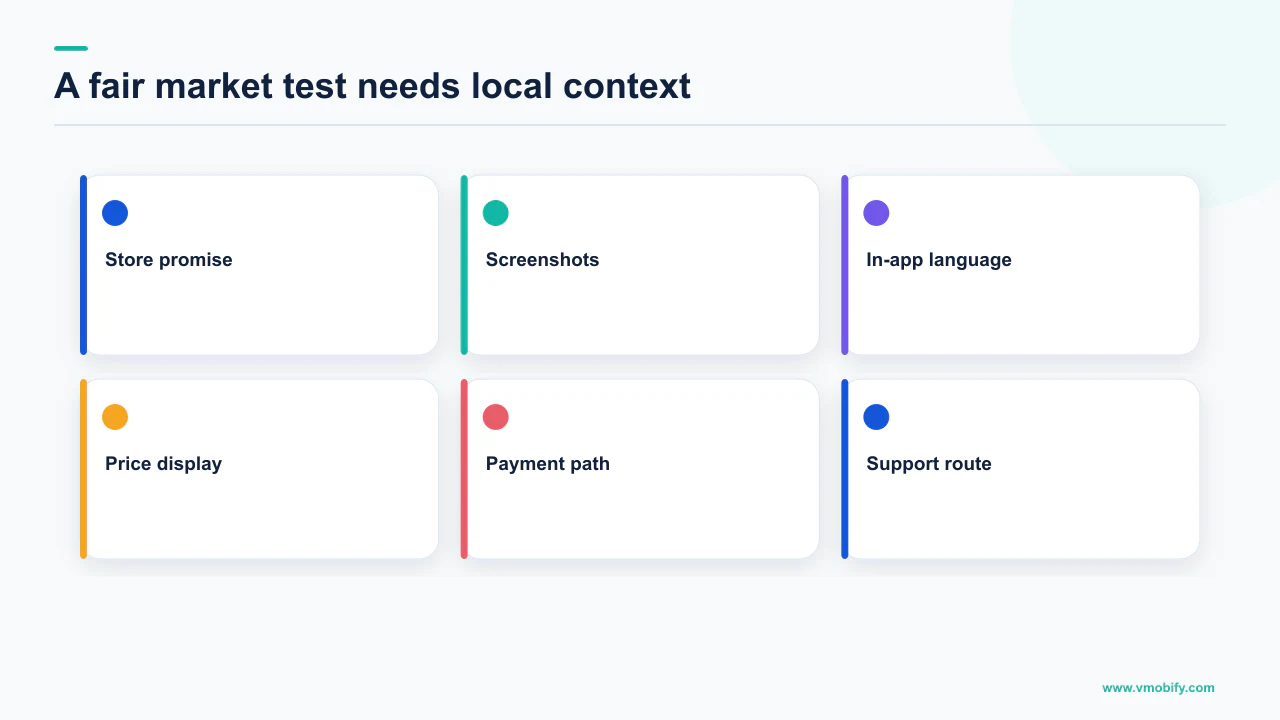
At minimum the store listing in the languages your candidate market actually reads, because otherwise you are testing your translation gap rather than the market. An untranslated market that underperforms has told you nothing you can act on.
Google's help on translating and localising your app describes the fallback precisely: if a user's language preference matches the translation languages you have added, they see the translated version of your listing. If you have not provided a translation for their language preference, they can choose to view an automated translation of the page — and Google notes automated translations are not available in Armenian, Raeto-romance, Tagalog and Zulu.
Read that fallback carefully, because it is weaker than it sounds. The user can choose an automated translation; it is not the listing they land on. Your first impression in an untranslated market is still your source-language listing, and a market judged on that is judged on a handicap you imposed.
Apple's side of this is a fixed list. App Store metadata localisations are available in a defined set of languages and locales, and Apple states that when you add more than one language or locale for your metadata, the language shown to each customer could be affected by the App Store language for their location, their device's language settings, the languages you have added, and your primary language in App Store Connect. In other words, you do not fully control which of your localisations a given customer sees, so the sensible approach is to cover the languages a market reads rather than to reason about individual users.
The order we use is cheaper than it looks:
- Store listing text and screenshots first. This is the surface that converts, and it is the cheapest thing to change.
- In-app strings second, and only for the flows a new user actually traverses before the moment you count as activation.
- Everything else when the market has earned it. Full product localisation is a commitment made after the unit economics clear, not before.
Our full treatment of the listing side is in app store localisation strategy. The reason it comes before spend is simply that it changes the denominator of every number you are about to collect.
How do you open a market as a test rather than a launch?
By separating the two Play controls — make the country available, then target releases and spend deliberately inside it — and by fixing your read-out date before you switch anything on. Most market tests fail as tests, not as markets, because nobody wrote down what would count as a result.
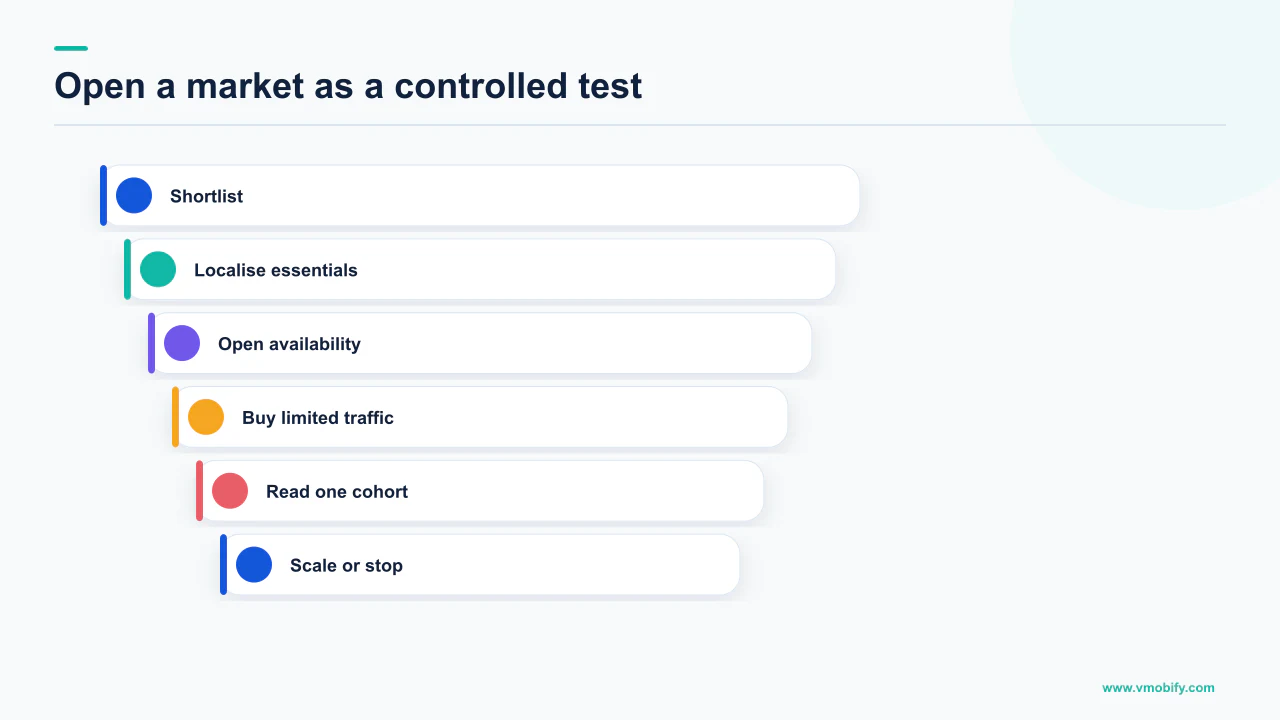
The mechanics give you more room than teams realise. Because Google distinguishes availability from per-track release targeting, you can stage an entry rather than flipping a switch. The condition quoted earlier still applies: testing-track country targeting is only customisable when your app either has no bundle in production, or has one with at least one country available in production.
- Localise the listing before anything is spent. Otherwise the test measures your translation gap.
- Set local pricing explicitly rather than accepting a conversion of your home price, and note the date, because Google applies the exchange rate from the date you set the price.
- Make the country available and let it settle. Apple states availability changes take effect immediately but may require up to 24 hours to be visible to all users, so do not read anything on day zero.
- Buy a deliberately small, single-source cohort. One channel, one geo setting, one creative family. Mixed sources in a new market produce a blended number that cannot be attributed to anything.
- Fix the read-out date and the decision rule in advance. Write down the payback threshold that means continue and the one that means stop, before the first impression is served.
- Hold the product constant during the window. A release mid-test makes the cohort unreadable, and you will not get the window back.
The one variable you cannot compress is time. Payback is measured over a period, so a two-week test cannot answer a question about a sixty-day payback. This is the same discipline as our soft launch strategy. Where a test is urgent, shorten the list of markets rather than the window.
How do you know when a market has failed?
When the payback threshold you wrote down before the test was not met and no single fixable cause explains it — and closing a market is a documented, reversible operation on both stores. The decision is easy if the rule existed in advance and almost impossible if it did not.
Before you close anything, work the fault tree, because three of the four common causes are fixable and only the fourth is the market itself:
- Availability or targeting mismatch. Ad geo and Play country disagree. Symptom: clicks convert to installs far below your other markets.
- Listing handicap. The market reads a language you did not add, so store-listing conversion carries a penalty you created.
- Price or fee error. A price converted rather than set, or a stale exchange rate from the date the price was originally set, or a model built on a service-fee rate that does not apply to your transaction type.
- Genuine economics. Everything above is clean and payback is still outside your threshold. This is the only one that means stop.
If it is the fourth, closing is straightforward. Apple documents what happens: when you deselect a country or region where your app was available, the app is removed from the App Store there, users who previously downloaded it continue to receive app updates, and the app can be redownloaded from a customer's purchase history as long as the necessary contract remains active. Apple states a removal takes effect within 24 hours. Existing users are not stranded, which makes the decision less irreversible than it feels.
In most cases the right action is to stop buying and leave the market available, rather than to remove availability. Organic installs keep accruing, existing users keep their app, and you retain the country-level data that will tell you whether the economics move. Removal is for markets carrying an obligation — support, compliance, payment or tax — that you do not intend to meet.
Note the pre-order asymmetry if you are still planning a first entry: Apple states that once your app becomes available for download or purchase in a country or region, pre-orders are no longer possible in that same location. A pre-order is a decision you can only make before the fact.
What order should you actually go in?
Start where the fixed cost of entry is lowest and your existing evidence is strongest, then spend the returns on the harder markets — which usually means adjacent language and payment infrastructure before adjacent geography. The map is a poor guide because the costs that matter are not spatial.
Applying everything above produces a sequence rather than a shortlist:
The first tier costs almost nothing and you have evidence. The second costs a listing variant. The third costs translation and creative. The fourth costs a roadmap slot, and that is why it comes last regardless of size — a fixed engineering cost has to be repaid out of contribution, and contribution is exactly what you have not yet proven.
Two habits keep the sequence honest. Re-rank after every market, because opening one changes what you know about the others. And keep the payback rule fixed while the ranking moves — a threshold that drifts to accommodate a market you have already invested in stops being a decision rule.
The failure mode we see most often is not choosing the wrong market. It is opening six at once, on an untranslated listing with converted prices and mismatched geo targeting, and then having no way to tell which of the six was actually viable. In our portfolio, the teams that expand fastest are the ones that open markets one at a time and finish each one.
If you are staring at a list of candidate markets and cannot tell which of your own numbers should decide it, that is usually a short conversation — send us the country breakdown you already have, or see how we run market entry as part of our user acquisition work.
Frequently Asked Questions
Does Google Play target users by where they are or by their account country?+
By their account country. Google states that country targeting is determined by the user's Play country — that is, where their account is registered — not their current location. This is why a market can show healthy ad click-through and a collapsed install rate: the ad platform reached someone physically in the country whose Play account is registered elsewhere.
What is the difference between app availability and release targeting on Play?+
Availability is your app's standing availability in the production track, and Google states that when you select a country as available, any current and future production releases include that country. Release targeting is narrower: when you roll out to production, open testing or a closed testing track, you can target that release in each track to users in specific countries.
Can I country-target a testing track to pilot a market?+
Only under a stated condition. Google says country targeting cannot be customised for testing releases unless either your app has no app bundle uploaded to production, or your app has an app bundle in production and at least one country is available in the production track.
How long do App Store availability changes take?+
Apple states that changes take effect immediately but may require up to 24 hours to be visible to all users, and that a removal from the App Store in all countries or regions happens within 24 hours.
Should I rank markets by size?+
Size should be the last input, used as a ceiling on how long a market stays worth working rather than as a reason to open it. Rank on payback period first and contribution per install second, both computed from your own data. Benchmarks borrowed from another app's category, season and auction are not evidence about yours.
What happens to existing users if I remove a country?+
Apple documents that when you deselect a country or region where your app was available, the app is removed from the App Store there, users who previously downloaded it continue to receive app updates, and it can be redownloaded from a customer's purchase history as long as the necessary contract remains active. In most cases stopping spend while leaving the market available is the better move.
Do I have to translate the listing before testing a market?+
You should. Google states that users whose language preference matches a translation you have added see the translated listing, and that users in a language you have not translated can choose to view an automated translation — a choice, not the page they land on. Testing an untranslated market measures your translation gap rather than the market.
Sources
- Distribute app releases to specific countries — Per-track country targeting, the definition of app availability, the Play-country rule and the testing-track condition.
- Manage availability for your app on the App Store — The three availability options including all 175 countries or regions, the pre-order restriction, removal behaviour and the 24-hour visibility window.
- Download and export monthly reports — Statistics and user acquisition reports, the country and language dimensions, and the 3 to 7 day monthly CSV posting window.
- Set up your app’s prices — Local currency conversion, tax added in select countries, exchange rate fixed to the date the price was set, and the USD or EUR fallback.
- Service fees — The fee schedule varies by transaction type, market, new versus existing install and programme participation; no single universal rate.
- Translate and localize your app — Translated listings shown on language-preference match, the optional automated translation fallback and the languages it excludes.
- App Store localizations — The available metadata languages and the factors that decide which localisation a customer is shown.
- Target ads to geographic locations — Location targeting uses a variety of signals with accuracy not guaranteed, and the presence versus presence-or-interest distinction.
About the author
Amol Pomane — Founder, Vmobify
Amol leads Vmobify, a mobile app growth agency that has driven 30M+ downloads and ranked 54K+ keywords across 300+ apps since 2013. He writes about ASO, paid user acquisition, retention, and the operational reality of scaling mobile apps in India and global markets.
Model an install budget
Turn CPI and activation assumptions into acquisition scenarios.
Open free tool