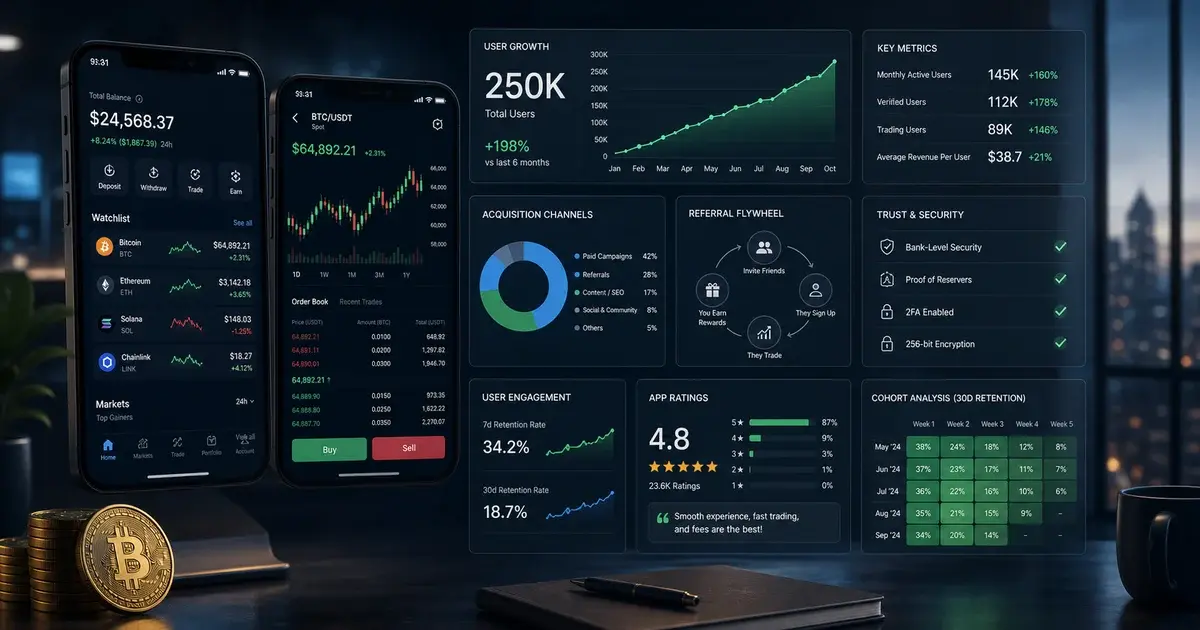
Crypto App User Acquisition in India: The Compliance-First Guide
Crypto app user acquisition in India starts with rules, not traffic: ASCI disclaimer discipline, platform permission and certification, and store policies decide what can be said and where. This guide covers what each gate requires, where growth comes from when paid is closed, and how to measure to the funded account.

On this page
- What makes crypto app user acquisition different in India?
- What does ASCI require in a crypto ad?
- What do Meta, Google and the app stores actually allow?
- If paid is gated, where does growth come from?
- How do you measure a crypto acquisition funnel?
- What creative passes review and still converts?
- How do market cycles change the plan?
- When is it not a marketing problem?
- Frequently Asked Questions
What makes crypto app user acquisition different in India?
Crypto app user acquisition in India is a restriction-first discipline: the advertising is regulated before any traffic is bought, the major platforms gate the category, and the funnel only pays off at a verified, funded account — not at the install.
In most app categories you choose channels by cost and scale. Here three constraints decide the plan before cost enters the conversation.
- The advertising is regulated. Since 1 April 2022, every ad for a virtual digital asset (VDA) product or exchange in India has had to follow the Advertising Standards Council of India’s VDA guidelines: a fixed risk disclaimer, banned vocabulary and an absolute bar on promising future profits.
- The platforms gate the category. Meta needs prior written permission, Google limits exchange and wallet ads to approved countries with certification, and both app stores apply their own crypto rules. Some channels that work for every other fintech app are simply closed.
- The user is deliberate. Gains on VDAs are taxed under their own regime, with tax deducted at source on transfers, and the people still active in the category research registration, security and fees before they hand over identity documents and money.
Put those together and the job changes. You are not buying installs; you are building a path from first discovery to a completed KYC and a funded account, inside rules that decide what you may say at every step. An install that never verifies is a cost with nothing behind it.
This guide is the how-to companion to our crypto app marketing service page. For the wider regulated-finance picture — lending, payments, broking — start with fintech app marketing; for a worked example of the approach in practice, read our crypto exchange case study.
This guide summarises published rules as they read on 28 November 2026. Platform policies change often. Final compliance for any ad sits with the advertiser and its own legal review.
What does ASCI require in a crypto ad?
ASCI requires every ad for VDA products, VDA exchanges or ads featuring VDAs to carry one fixed disclaimer, prominently and in a set position for each medium — and it bans words, claims and depictions that would make the category look safer or simpler than it is.
The disclaimer is word-for-word, and it cannot be paraphrased:
“Crypto products and NFTs are unregulated and can be highly risky. There may be no regulatory recourse for any loss from such transactions.”
Where it goes is just as fixed. Per the ASCI code book:
- Print and static: at least one fifth of the ad space, at the bottom, in an easy-to-read font on a plain background.
- Video: at the end, on a plain background, with a voiceover at a normal pace, on screen for at least five seconds. Long-format video over ten minutes repeats it at the start and the end.
- Audio: spoken at the end; over 90 seconds, repeated at the start and the end.
- Social posts: in both the caption — upfront, before the fold — and any picture or video attachment.
- Character-limited formats: the short version, “Crypto products and NFTs are unregulated and risky”, followed by a link to the full text.
- Language: the dominant language of the ad, so a Hindi ad carries a Hindi disclaimer.
Beyond the disclaimer, the guidelines set the content limits that most rejected drafts break:
- The words “currency”, “securities”, “custodian” and “depositories” may not be used in VDA advertising, because consumers associate them with regulated products.
- No statement may promise or guarantee future increases in profit, and past performance may not be shown partially — returns for periods under 12 months are excluded.
- Cost claims must be complete: “zero cost” has to include every cost a consumer would reasonably associate with the transaction.
- No ad may show a minor, or someone who appears to be one, dealing with or talking about the product.
- No ad may present VDA trading as a solution to money or personal problems, suggest it is so easy that nobody needs to think twice, or compare VDAs with any regulated asset class.
- Every ad must name the advertiser and give an easy way to contact them, and celebrities who appear must do their own due diligence on the claims.
Treat all of this as a design input. A disclaimer that takes a fifth of a static ad changes the layout; a five-second end card changes the edit; a caption that must lead with the warning changes the hook. Drafted in from the start, it costs very little. Bolted on at review, it breaks the creative.
What do Meta, Google and the app stores actually allow?
Meta allows crypto exchange, wallet and trading ads only with its prior written permission; Google allows crypto exchange and software-wallet ads only in approved countries with certification, and India is not one of them; and both app stores apply licensing rules of their own.
Meta. Under its advertising standard for crypto products and services, ads for exchanges and trading platforms, borrowing and lending, wallets that offer buying, selling, swapping or staking, and mining software need Meta’s written permission. The advertiser applies through Meta Business Suite and has to show a recognised regulatory licence or registration. At the time of writing, the jurisdictions on Meta’s published licence list do not include India, so an Indian advertiser should treat Meta permission as uncertain and slow, and plan as if it may not come.
Google Ads. Google’s crypto and related products policy allows exchange and software-wallet ads only in a defined list of locations, by certified advertisers that meet local licensing. India is not on that list, and the policy states that Google Ads does not support advertising in non-approved markets. Some products are closed everywhere regardless of country: ICO sales, crypto loans, initial DEX offerings, token liquidity pools, unhosted software wallets and unregulated dApps. For an Indian exchange or wallet, Google Ads is not an open channel today — any plan that assumes it is will fail at review.
Google Play. Play’s blockchain-based content policy expects crypto purchase, holding and exchange to run through certified services in regulated jurisdictions, and it lists countries with specific licensing requirements. India is not among them; the policy says apps may stay available in unlisted countries, and Play can still ask for compliance documents.
App Store. Apple’s App Review Guidelines, section 3.1.5, allow exchange apps only in countries or regions where the app has the appropriate licensing and permissions, require wallets to come from developers enrolled as organisations, and bar apps from offering crypto for tasks such as downloading other apps or posting to social media.
Two practical rules follow. First, treat every permission and certification as a timeline, not a decision you control: start the applications early and build the plan so it works if they never land. Second, the exchange’s own regulatory posture is the client’s, not the marketer’s. VDA service providers serving Indian users must register with FIU-IND as reporting entities under the anti-money-laundering law. That registration is a legal obligation — not an endorsement, an investor protection or a guarantee of safety — and no agency can provide or certify it.
If paid is gated, where does growth come from?
When paid social and search are gated, growth comes from the channels the user already trusts — the store listing, education content and transparent referral — with compliant paid layered on only where permission and certification actually allow it.
In order of reliability, the channels that carry crypto acquisition in India are these.
- App store optimisation. The store is where the deliberate user does their checking, so the listing has to answer the questions they bring: who operates the app, how accounts are verified, what the fees are, how the app protects accounts. Keep every claim to what the client actually publishes, and stay inside the store crypto policies above. Our ASO service starts with the keyword and listing audit, and both stores let you test listing changes before committing to them.
- Education-led content. How the app works, what the fees and taxes look like, how to keep an account secure, what a KYC step needs and why. This is the content people search before they sign up, and it is the discovery engine where ads are closed. It also has to follow the same care lines as an ad: factual, with no hint of returns or advice.
- Community and in-app referral, run transparently. Referral works in this category because trust passes between people. Keep it clean: disclose what the referrer receives, never tie incentives to deposits or trades, and never pressure anyone to transact.
- Compliant paid, where it is genuinely open. Where the client holds the permission or certification a platform requires, paid can extend reach — with ASCI disclaimers in every format and creative that would survive a regulator reading it.
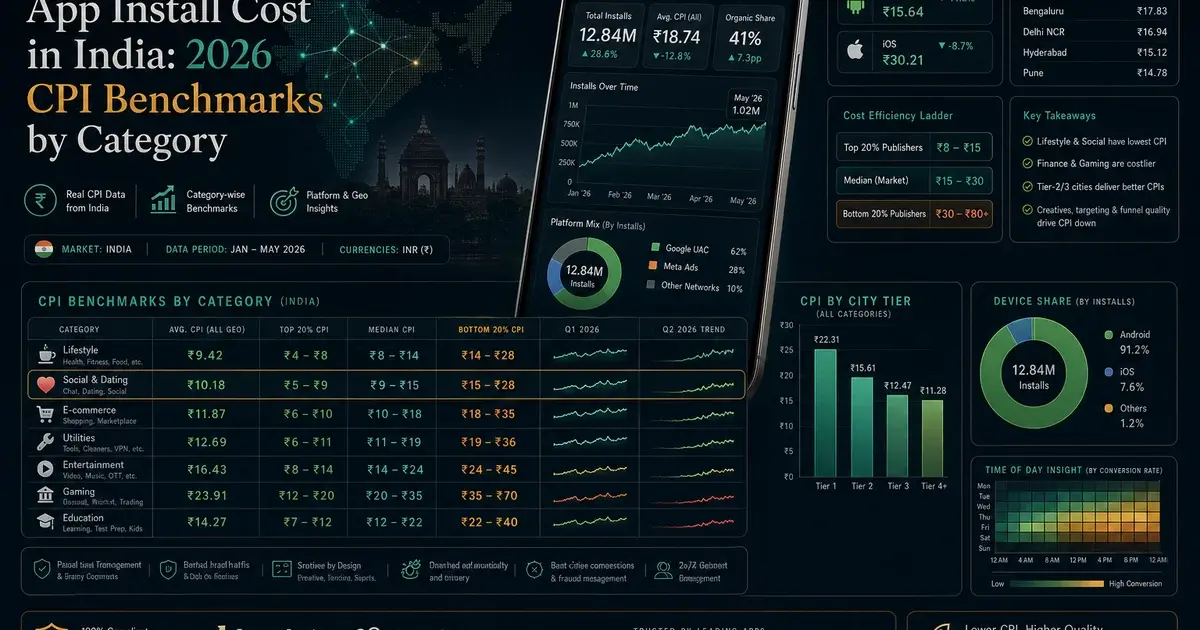
Install campaigns have a narrower role here than in most categories. A controlled install test is useful as an acquisition baseline: it shows what the listing converts and what each later funnel stage looks like at a known volume. It is never the growth objective. Our CPI packages start from ₹5 per install, with fixed packages at ₹7,000, ₹30,000 and ₹50,000, all excluding GST, so a first test can stay small enough to verify in your own console. For how install costs vary by vertical, see app install cost in India.
How do you measure a crypto acquisition funnel?
Measure a crypto funnel stage by stage, all the way to the funded account, and read each channel on its cost per completed KYC and per funded account — a single blended install number hides everything that matters.

Name the stages as events before any spend goes live, so every channel reports against the same definitions:
Three habits keep the reading honest.
- Read stage to stage, not top to bottom. A channel can look expensive per install and cheap per funded account when its users complete KYC at a higher rate. The reverse is also common: cheap installs that never verify.
- Use cohort windows. Compare day-30 and day-90 cohorts by channel and creative, not one blended month. Funding often lags the install by days.
- Treat funding and trading as user decisions. You measure them to find friction — a KYC step that loses people, a deposit flow that confuses — never as targets to push users towards.
Data discipline matters as much as definitions. Analytics and ad platforms should only ever receive event data; identity documents, wallet credentials and keys never enter them. Install delivery is verified in your own Play Console or App Store Connect, and quality and attribution in your own analytics or attribution tool. Our analytics service sets up this event plan before scaling, because a funnel you cannot see stage by stage cannot be improved.
What creative passes review and still converts?
Creative that passes review in this category is drafted disclaimer-first, describes the product factually and teaches something — and that same restraint is what converts a deliberate user who has learned to distrust hype.
Angles that survive review and still earn the tap:
- How it works: a plain walk-through of signing up, verifying and making a first deposit.
- Fees, stated in full: what each action costs, with nothing left out — ASCI’s cost rule makes this a strength, not a risk.
- Account security: the protections the app actually provides, described exactly as the app implements them, never stronger.
- Tax and reporting help: what the app shows the user to make their own filing easier, without advising on it.
The negative list is short and absolute:
Never in the creative
- Returns, profit or wealth — stated or implied
- Price predictions or market direction
- Anything that reads as advice to buy, sell or hold
- Urgency or fear-of-missing-out mechanics
- The four ASCI-banned words describing the product
- Security or regulatory claims stronger than the client publishes
Always in the creative
- The ASCI disclaimer, in the right place for the format
- The advertiser’s name and a contact route
- Costs stated completely
- Adults only, in every frame
- Plain product facts the user can check
- A legal sign-off from the advertiser before launch
Across our 300+ apps, the pattern in regulated categories is consistent: the creative that converts best is the creative that answers the user’s doubt rather than talking over it. In crypto that doubt is sharper than anywhere else, which is why factual creative tends to outperform the hype it replaces.
How do market cycles change the plan?
Market cycles change how much interest arrives, not what you are allowed to say — so the plan keeps an always-on education base and prepares compliant creative for high-interest periods, without ever predicting the market or selling on price movement.
Interest in the category rises and falls with the wider market. A sound plan treats that as demand to be ready for, not something to forecast.
- Keep the education base on all year. Explainers, safety content and the store listing keep working when interest is low, and they are what new users find first when it rises.
- Prepare, do not predict. Have approved creative, landing content and KYC capacity ready so a rise in interest can be served. Never time campaigns to a forecast, and never say anything about where prices are going.
- Reactivate on product news, not price. Dormant users come back for a new feature, a fee change or a better verification flow. Reactivation that leans on price excitement breaks the care lines and attracts the users least likely to stay.
In our portfolio, the regulated apps that grew steadily were the ones whose acquisition did not depend on a single surge. The education base is what makes a high-interest period useful rather than chaotic.
When is it not a marketing problem?
Some crypto growth problems are not marketing problems at all: registration and licensing posture, product trust after a security incident, a KYC operation that cannot absorb volume, or fees the market has rejected — marketing can surface these in the funnel data, but it cannot fix them.
Being clear about this boundary is part of doing the job well. The funnel data will usually show where the real problem sits:
- Verification stalls after a volume spike: the KYC operation needs capacity before more acquisition.
- Good listing conversion, weak funding: the deposit flow, the fees or the trust signals inside the app need work.
- Permission or certification refused: a regulatory question for the client and its counsel, not a creative one.
- Reviews dominated by one complaint: a product or support issue that more spend will only amplify.
When one of these shows up, the right move is to pause scaling, fix the root cause and then resume — not to buy past it. If you want a second opinion on where your funnel is losing people, talk to us; we will tell you plainly whether the next fix is marketing or not.
Wherever this guide discusses VDA advertising, the same disclaimer applies: “Crypto products and NFTs are unregulated and can be highly risky. There may be no regulatory recourse for any loss from such transactions.”
Frequently Asked Questions
Can you run Google Ads for a crypto exchange in India?+
Not today. Google allows crypto exchange and software-wallet ads only in an approved list of locations, by certified advertisers that meet local licensing, and India is not on that list. Google states that it does not support crypto advertising in non-approved markets, so an Indian exchange or wallet should plan its acquisition around ASO, education content and referral.
What is the ASCI disclaimer, and where does it have to appear?+
The disclaimer reads: “Crypto products and NFTs are unregulated and can be highly risky. There may be no regulatory recourse for any loss from such transactions.” It goes at the bottom of print and static ads (at least a fifth of the space), at the end of video and audio with a voiceover, upfront in social captions and on any attachment, and in the ad’s dominant language. Character-limited formats use the short version with a link to the full text.
Why was my crypto ad rejected?+
The usual causes are a missing or misplaced ASCI disclaimer, one of the banned words (“currency”, “securities”, “custodian”, “depositories”) used to describe the product, language that implies returns or profit, urgency mechanics, or running the ad without the platform permission or certification it needs. Check those first; the platform’s rejection reason usually points to one of them.
What events should a crypto app track first?+
Track the verified funnel as named events before spending: install, registration started, KYC submitted, account verified, first deposit and account funded, then returning users and repeat deposits for day-30 and day-90 cohorts. Send only event data to analytics and ad platforms — never identity documents, credentials or keys.
Can a crypto app start marketing before launch?+
Yes, and pre-launch is when compliance groundwork pays most: the event plan, a listing drafted to ASCI and store rules, platform permission and certification applications started early, and the education content built in advance. Install testing waits until the app is live and its funnel is measurable.
Will you guarantee users or trading volume?+
No. We commit to the process — compliant creative, verified delivery and stage-by-stage reporting. Whether a user completes KYC, funds an account or trades depends on the product, its fees, the market and the user’s own decisions, none of which a marketer controls.
How much does a first crypto install test cost?+
Our CPI packages start from ₹5 per install, with fixed packages at ₹7,000, ₹30,000 and ₹50,000, all excluding GST. In this category an install test is a baseline to measure KYC and funding rates against, not the goal; ASO, content and measurement work are quoted per engagement.
Sources
- ASCI — Guidelines for advertising of Virtual Digital Assets (press release, Feb 2022) — Mandatory disclaimer, placement rules, banned vocabulary and content limits; applies from 1 April 2022
- ASCI — The Code and Guidelines book — Current text of the VDA guidelines, including the ten-minute long-video repeat rule
- Meta Advertising Standards — Cryptocurrency products and services — Prior written permission and recognised licence requirement
- Google Ads policy — Cryptocurrencies and related products — Approved locations, certification and products prohibited everywhere
- Google Play — Blockchain-based content policy — Requirements for crypto exchange and software wallet apps
- Apple — App Review Guidelines, section 3.1.5 — Rules for wallets, exchanges and crypto rewards on the App Store
- Financial Intelligence Unit – India (FIU-IND) — Registration of VDA service providers as reporting entities
About the author
Amol Pomane — Founder, Vmobify
Amol leads Vmobify, a mobile app growth agency that has driven 30M+ downloads and ranked 54K+ keywords across 300+ apps since 2013. He writes about ASO, paid user acquisition, retention, and the operational reality of scaling mobile apps in India and global markets.
Model an install budget
Turn CPI and activation assumptions into acquisition scenarios.
Open free tool