Dating app marketing strategy: launching into a shrinking market
Dating CPI data that carries its sourcing, the platform gates before you can spend, the liquidity problem, and an India campaign structure.

On this page
- How big is the dating app market, and what is the one fact that changes your strategy?
- Who are you actually acquiring, and what activation event predicts revenue?
- What is the density gate, and how do you know a city is ready?
- What is the smallest geography you can actually target, channel by channel?
- Which platform gates have to clear before you can spend a rupee?
- What do you need to get right before you spend anything?
- What does store hygiene look like for dating, and what gets you rejected?
- What is the right Apple Ads structure for a dating app?
- How do you set up Google App Campaigns and reach first velocity?
- Can you actually run a gender-split strategy, and on which channels?
- What does Meta creative for dating have to do differently?
- What is the event ladder for dating, and what volume does each rung need?
- What creative actually works for dating apps?
- What are the real CPI numbers, and what budget do you need?
- What breaks in a dating launch, and what does it cost?
How big is the dating app market, and what is the one fact that changes your strategy?
Global dating app revenue was $6.07bn (about ₹53,400 crore) in 2025 — the category's first-ever annual revenue decline, per Business of Apps. India's online dating market reaches only ₹2,000–2,500 crore ($227–284M) by 2030 on Redseer's September 2026 sizing. The structural fact that changes your strategy: women are about 26% of users on Indian dating platforms.


Revenue is shrinking. Business of Apps counts roughly 350M users and 23M payers globally — 6.6% paid penetration — with Match Group taking $3.3bn of the $6.07bn. A first-ever revenue decline means the user you buy in 2026 is worth less than the same user in 2023.
Downloads tell the more useful story. AppTweak's report on the top 500 dating apps across both stores, January to December 2025, shows the category up 4.1% year on year while its shape shifts underneath.
| Rank | App | 2025 downloads | YoY |
|---|---|---|---|
| 1 | Tinder | 63.7M | +6.8% |
| 2 | Bumble | 29.2M | −19.0% |
| 3 | Hinge | 21.3M | +25.4% |
| 4 | Badoo | 19.5M | −9.2% |
| 5 | Boo | 17.7M | +7.1% |
| 6 | Omi | 16.0M | +6.0% |
| 7 | iHappy | 15.9M | −17.5% |
| 8 | happn | 12.8M | +12.3% |
| 9 | Grindr | 12.3M | +7.9% |
| 10 | Kismia | 12.0M | +8.0% |
The top ten take 31.6% of category downloads, and Hinge — the intent-led product — is the only major gainer. Redseer cites the same signal from the revenue side: a major swipe app's monthly payers fell 7% year on year in Q3 2025 while "serious dating" apps grew payers 17%. The swipe model is in structural decline and the intent-led model is growing. "Swipe, but nicer" puts you in the losing half of a shrinking market.
India is small, and India's install pool is not growing either. Redseer sizes dating plus matrimony at about ₹13,000 crore ($1.48bn) by 2030, with offline matrimony alone at ₹4,500–5,000 crore in 2025 — still the biggest pool. Sensor Tower's India numbers for Q2 2026, reported via TechCrunch, put quarterly downloads at roughly 6.3 billion and flat since 2023; the +35% year on year belongs to consumer spend ($345M in the quarter), not to download volume. You are competing for share of a fixed install pool with money that is moving into post-install monetisation.
The India field: Tinder, Bumble and Hinge internationally; Aisle, QuackQuack, TrulyMadly and Verona domestically; Shaadi, BharatMatrimony and Jeevansathi as incumbents. No verified India ranking by app exists publicly — Sensor Tower and AppMagic India cuts are paywalled — and while Bumble's −19% global download decline is verified, no verification exists for any "Bumble exited India" claim.
Who are you actually acquiring, and what activation event predicts revenue?
You are acquiring two products with different costs and different value. The event that predicts revenue is the first reciprocated conversation — a match that receives a reply — not the install, not the profile completion, not the match. A match with no reply is a churn event dressed as a success metric. This post treats reply_received_first as a real bid target and does the volume arithmetic for it further down, because naming an activation event and never configuring it is the failure mode this series exists to correct.
The ladder, from practitioner consensus documented by Admiral Media.
install → profile complete → first swipe session → first match →
first message sent → FIRST REPLY RECEIVED → paywall view →
trial start → subscription start → renewal
A match is produced by your algorithm; a reply is produced by another human deciding your app is worth their time. The first is a supply metric you can inflate, the second is not.
Now apply the 26%. Male-side installs are cheap and mostly worthless; female-side installs are expensive and load-bearing. Blend them and the algorithm finds you the cheapest conversions, which are men, and your ratio degrades the more you spend. The fix is a per-side campaign structure — but that is a real engineering constraint, not a slide, and it is only buildable on some channels and only above a certain budget. There is a whole section on that below.
| Side | Optimisation event | Why |
|---|---|---|
| Women | profile_complete, then reply_received_first |
You need them present and answering; monetisation is secondary and often zero |
| Men | reply_received_first, then subscription_start |
Abundant supply, low intent per install; only the payer matters |
This is the liquidity problem, and it is why most dating launches fail. A dating app is a marketplace with a minimum viable density per geography. Below it, a user opens the app, sees eleven profiles and never returns — and you paid for that install. You cannot launch a dating app in a geography without solving the gender ratio first, and no ad budget fixes it. That sentence is only worth writing if the plan that follows honours it, which is why the budget section starts with a phase that has no media in it at all. Admiral's data also shows iOS at roughly twice Android's retention, which is why practitioners treat the platforms as separate businesses.
Monetisation reality in India. Tinder's live India IAP list runs Plus at ₹99 and ₹369, Gold at ₹159 to ₹1,099 — around a tenth of US pricing. Redseer finds only 5–15% of MAU upgrade to premium in India and names it as the direct cause of high acquisition costs and low lifetime value. Business of Apps' benchmarks, updated 21 May 2026, add the durability problem: under 5% of monthly subscribers are still active at 12 months. You recover in months one to three or not at all.
What is the density gate, and how do you know a city is ready?
The density gate is a number, not a feeling. Define it as: the count of other users' profiles that match a new user's own stated filters — gender, age band and distance — and that were active in the last seven days, measured at the 25th percentile of new users in that city during their first session. Measure at the 25th percentile, not the median, because the median user is not the one who churns.

Here it is, worked for a male-side new user in one Indian metro.
| Step | Figure |
|---|---|
| Active female profiles in the city, last 7 days | 4,000 |
| Inside 25 km of this user's location | 1,400 |
| Also inside his stated 24–32 age filter | 900 |
| What the median new user sees | ~180 |
| What the 25th-percentile new user sees (worse location, narrower filters) | 60 |
Set the gate at 60 and the pause trigger at 40. The reasoning is arithmetic, not a published benchmark: a first swipe session burns 20–30 cards, and you want at least two more sessions of unseen supply available before day 2, which is where Adjust's 24% D1 retention for dating is decided. Sixty is two-and-a-bit sessions of headroom. Calibrate it against your own D1 by decile of first-session supply within your first 60 days and then hold yourself to the number you find.
The pause trigger, written so it can be automated: if the 25th-percentile matching-profile count in a city falls below 40 for three consecutive days, pause all male-side paid spend in that city. Resume only when it holds at or above 60 for seven consecutive days. Female-side spend and supply seeding continue throughout — the point of the trigger is to stop you buying the side that is already abundant.
This is the gate on the pre-launch checklist, the gate on scaling into a new city, the top of the KPI ladder, and the remedy for ratio degradation in the what-breaks table. It is the same number in all four places.
What is the smallest geography you can actually target, channel by channel?
A city-by-city strategy is only a strategy if the channels can express it. They cannot, equally.
| Channel | Smallest unit you can target in India | What that means for a city launch |
|---|---|---|
| Meta | City, and radius around a dropped pin | Fully expressible. One campaign per city, per side. |
| Google App campaigns | Standard Google Ads locations — country, state, city, radius | Expressible, but delivery concentrates wherever conversions are cheapest, so run one campaign per city rather than one campaign listing several |
| Apple Ads | Country or region. Apple documents sub-country targeting for only a small set of storefronts and India is not among them | Not expressible. Check the campaign screen before you plan a city test |
| TikTok | City | Expressible |
| Programmatic DSP (Moloco-class) | Geofence or postcode | Expressible, and the tightest of the set |
Where you cannot go below country, stop pretending you can. For Apple Ads that means three things. Buy city intent through keywords instead of geography — "dating app mumbai", "dating app bangalore" carry the city in the query, and India's Apple Ads auction is thin enough that these are cheap. Use Custom Product Pages to land those queries on city-specific screenshots. And read Apple Ads at the country level while your city test is judged on Meta and Google — do not let a national channel's blended CPI decide whether a city cleared its gate.
Which platform gates have to clear before you can spend a rupee?
Four gates, two of which have lead times measured in weeks and neither of which is on most launch plans. Start the clock on all four before you start the build. Discovering these in launch week costs you a fortnight of committed budget with nowhere to spend it — the same failure the broking post documents for financial-services verification.

Meta requires prior written permission to run dating ads at all. Dating is a restricted category under Meta's Advertising Standards: you apply for permission, and until it is granted your dating ads are not eligible to run, whatever the state of your ad account or your billing. The permission is granted to an advertiser, and Meta's dating-specific rules ride along with it — an 18+ minimum audience, no sexual content or implication of it, and no targeting or copy that asserts knowledge of personal attributes. You cannot spend on Meta until this clears. Treat it as a hard dependency with no float, apply the day your app has a reviewable landing experience, and assume weeks rather than days.
Google requires dating-advertiser certification. Google Ads treats dating and companionship as a certified vertical: you apply, Google certifies the advertiser and the destination, and only then are dating ads eligible. Certification is granted per country, so confirm that India is in the permitted list for the formats you plan to buy before you build a media plan on it. You cannot spend on Google until this clears either. Both of these also apply to an agency running on your behalf, so if you are outsourcing, the certification has to sit somewhere in the chain and you need to know where.
Play production access needs 12 testers for 14 continuous days. For personal Play Console accounts created after 13 November 2023, you cannot ship to production until twelve testers have been opted in continuously for a fortnight. Organisation accounts are exempt. Testers who opt in for under 14 days then leave do not count, and if a tester opts out and returns, the clock restarts. Review is typically within seven days after that. Older guides say 20 testers; that is outdated. For a dating app this gate is worse than it looks, because your twelve testers are also your first twelve profiles and they will be in each other's card stack.
Apple 4.3(b) is the fourth gate, and it is covered in full below. Plan for a rejection as your base case.
Sequenced, that is a minimum of four to eight weeks of gate-clearing before your first impression. Run them in parallel and start them before code freeze.
What do you need to get right before you spend anything?
Four things live before your first rupee of media: a density gate per city with a numeric pause trigger, an event taxonomy that names and configures the reply event, deterministic Android attribution with an aggregate plan for iOS, and a moderation stack satisfying Apple 1.2 and Google Play's UGC policy. Miss one and either your spend is unmeasurable or your app is unshippable. Name these events once and never rename them.
| Event | Fires when | Used for |
|---|---|---|
profile_complete |
photos and prompts minimum met | female-side bid target, and the cheapest rung that clears every threshold |
match_first |
first mutual like | diagnostic only, never a bid target |
reply_received_first |
user receives a reply to a message they sent | the activation event, and a bid target on Meta from first velocity |
paywall_view |
paywall shown | creative-to-paywall QA |
message_sent_first |
user sends a first message | diagnostic, and the denominator for reply rate |
trial_start / subscription_start |
as named | bid target once volume allows |
renewal_1 |
first successful renewal | LTV validation |
Mark bid targets as key events in Firebase: maximum 30 key events per standard GA4 property, marking is not retroactive. If Google is your only paid channel, Firebase is enough and free — Google supports importing Firebase conversions "without needing to add new code to your app". The moment a second paid network exists an MMP pays for itself, because Firebase does not feed Meta and two SDKs give you two incompatible definitions of the same event.
Treat iOS and Android as different channels, not one channel with a multiplier. Android Privacy Sandbox was cancelled on 17 October 2025; GAID persists and deterministic Android attribution continues, so any playbook preparing you for an Android ATT-style event is out of date. On iOS you are on AdAttributionKit, with three conversion windows from first launch (days 0–2, 3–7, 8–35) and fine conversion values only in the first postback, and only at Tier 2 or 3 crowd anonymity. A launch-volume dating app sits in the low tiers, where the first postback is coarse-only or, at Tier 0, absent. A subscription event landing on day 5 is structurally invisible on iOS at launch volume. Encode your most important signal into days 0–2 and accept that even that only becomes legible once your own volume lifts you out of Tier 0 or 1.
What does store hygiene look like for dating, and what gets you rejected?
Both stores put dating in Lifestyle, not Social, and every leader burns the exact phrase "dating app" into the title. The category-specific rejection risk is Apple guideline 4.3(b), which names dating explicitly and is the single biggest reason a new dating app never ships. Plan for that rejection as your base case, not your worst case.
Tinder's India listing reads: title Tinder Dating App: Meet & Date, subtitle Match & Meet New Single People, Lifestyle, #17, 18+. AppTweak's global conventions show the same construction — Bumble Dating App: Meet & Date, Hinge Dating App: Match & Date, Badoo: Dating, Chat & Meet. The formula is [Brand] Dating App: [Verb] & [Verb], two verbs from meet / date / match / chat, subtitle carrying the audience noun.
India head terms, inferred from leaders' metadata rather than volume-ranked, since no keyword-volume tool was accessible: dating app, dating app india, free dating app, chat with girls, meet new people, online dating, friendship app, plus vernacular transliterations and city modifiers. Matrimony intent volume dwarfs dating intent in India, and the conversion-efficient long tail is serious-relationship phrasing — but do not chase matrimony head terms with a swipe product.
Apple 4.3(b), verbatim, because people paraphrase it wrong:
"Certain app categories — dating, flashlight, sound effects, wallpaper, simple timers, and fortune telling — are well established on the App Store and will not be accepted unless they offer a meaningfully different or improved experience."
Repeated submissions can lead to removal from the Apple Developer Program, and this is not a clause reserved for template junk. Apple Developer Forums thread 777838 documents a working dating app from a small independent developer — 57,000+ monthly active users, live across multiple countries — rejected under 4.3(b) on saturation grounds alone. The rejection turned on the category being full, not on whether the app was useful to the people using it. Apple's remedy is procedural: request an App Review call, or book an App Review Appointment through "Meet with Apple", Tuesdays and Thursdays. Pre-write the differentiation argument before you submit. "Better UX" is not one; "verified-only matching for a named community, with a moderation model no incumbent operates" is.
Apple 1.2 requires four UGC mechanisms: filter objectionable material before posting, a report mechanism with timely response, the ability to block abusive users, and published contact information. Apps that become primarily used for pornography, anonymous chat or bullying "may be removed without notice".
The September 2026 social media declaration — and a sourcing caveat you should carry. Everything in this paragraph is secondary analysis, not an Apple document. The dates and consequences come from an ecorpit readthrough that is consistent with Apple's published timeline, and I could not source them to an Apple page; treat them as a prompt to check App Store Connect yourself rather than as quoted policy. On that basis: Apple's rating system now has five tiers — 4+, 9+, 13+, 16+, 18+ — with a questionnaire deadline of 31 January 2026. The social media declaration questions activated in App Store Connect on 9 July 2026 and responses became mandatory from September 2026 for new submissions, updates and notarization; apps without answers cannot ship updates. The definition in circulation is broad — "the ability to redistribute, amplify, or interact with user-generated content through a social feed or similar discovery method" — and DMs and referrals are described as in scope, which puts every dating app in scope. The reported consequences are a Social Media content descriptor on your product page and categorisation into Time Allowances parental controls regardless of the category you chose, exempted only where capabilities are disabled through server-authoritative gates. Dating in practice lands at 18+ anyway, as Tinder India does.
Apple enforces consent revocation by blocking launch; Google Play does not — you must read the Play Age Signals API and implement restrictions yourself, which moves the liability to you.
Google Play's UGC policy requires terms of use with consent, the ability to report and block both content and users, and timely enforcement, with incidental sexual content hidden behind at least two user actions and age screening. Its July 2026 update put anonymous and random-chat features under stricter child-safety review.
India intermediary duties. Under the IT Rules 2021 you must publish a Grievance Officer and remove unlawful content within 36 hours of actual knowledge; at 5 million registered users you become a Significant Social Media Intermediary with a Chief Compliance Officer, Nodal Officer and monthly transparency reports. Under the DPDP Act 2023 anyone under 18 is a child requiring verifiable parental consent, and the maximum penalty for breaching the children's-data obligations is ₹200 crore ($22.7M). The ₹250 crore ($28.4M) figure that circulates is a different ceiling — it attaches to failure to take reasonable security safeguards, not to the children's provision.
Category review risk: one-star reviews here cluster on fake profiles, paywall surprise and harassment. Watch the share containing "fake" — it is the leading indicator that supply-side seeding has gone wrong.
What is the right Apple Ads structure for a dating app?
Run Apple's own documented four-campaign structure — Brand, Category, Competitor, Discovery — with exact match and Search Match off on the first three. This is the cheapest install you will buy anywhere in India: AppTweak's 2025 data across roughly 3,500 apps, 50,000 campaigns and $1bn of ad spend puts median India CPI at $0.89 (about ₹78).
| Campaign | Apple's definition | Configuration |
|---|---|---|
| Brand | keywords relating to your app or company name | exact match, Search Match off |
| Category | non-branded keywords describing your category and what the app does | exact match, Search Match off |
| Competitor | keywords for similar apps in the same or related category | exact match, Search Match off |
| Discovery | finds new terms to graduate into the other three | broad match with Search Match off, plus a no-keyword group with Search Match on |
Add every keyword from the first three campaigns into Discovery as exact-match negatives, so Discovery only spends on genuinely new terms. Budget splits like 30/35/30/5 are convention, not Apple guidance.
Carry the panel spread with the number. AppTweak is the best Apple Ads dataset published, but it is one panel. On US cost per tap AppTweak reads $1.91 and Adapty's panel of over a million ad groups reads $1.58 — a fifth apart on the same metric, same year. Whenever an AppTweak CPT or CPI is your planning anchor, plan the range, not the point. India's $0.89 has no second panel to check it against at all, which is itself a reason to treat it as a floor rather than a forecast.
On the Apple Ads share of your budget: iOS is roughly 4–6% of Indian devices. Any Apple Ads line above that share is a deliberate bet that your iOS users monetise well above your Android users — which Admiral's roughly 2× iOS retention advantage in dating supports, but does not prove for your app. Set it above device share if you like; do not set it there by accident because Apple Ads is the only channel with published India costs.
The keyword sets that matter here. Category: dating app, dating app india, free dating app, online dating, meet new people, friendship app, plus the serious-intent long tail — serious relationship app, marriage minded dating — and the city modifiers that stand in for the geo targeting Apple will not give you. Competitor: tinder, bumble, hinge, badoo, boo, happn, aisle, quackquack, trulymadly, plus the matrimony brands jeevansathi and shaadi. That last group is where India competitor bidding gets interesting, because the intent arriving is not yours yet.
Bidding, and the 2026 tension nobody has resolved. Maximize Conversions launched 25 February 2026 and works to a target CPA plus daily budget. Apple's documented guidance: budget for at least five conversions a day, run at least two weeks before judging, not available for pre-order campaigns, and Search Match is mandatory on the automatic ad group. But Search Match at campaign level conflicts directly with the exact-match discipline the four-campaign structure depends on, and Apple has published no guidance reconciling them. Run the manual structure, or run Maximize Conversions alongside it and keep them separate.
Lifetime budget campaigns were paused in June 2026; daily budget is the only model and monthly maximum is daily × 30.4. Run separate Custom Product Pages for the female-side and male-side keyword sets — up to 70 per app, search-results ad groups only — because those are different products, and because on Apple Ads the CPP is one of only two levers you have for addressing a side. AppTweak shows search results at 7.4% TTR versus product pages 2.0% and the search tab 0.29%, with India at 5.2% TTR and 48% install-per-tap. Put your money in search results.
How do you set up Google App Campaigns and reach first velocity?
Start with App campaigns for Installs on tCPI and fund it properly: Google's documented minimum daily budget for ACi with tCPI is at least 50 × your bid. Then do not touch it until 100 conversions have registered — Google's wording is "making changes to your in-flight campaign before the first 100 conversions have registered may disrupt learning," a conversion count, not a time window. ("UAC" is a deprecated name; it is App Campaigns.) The documented floors:
| Subtype / strategy | Gate | Minimum daily budget |
|---|---|---|
| ACi with tCPI | none | ≥ 50 × bid |
| ACi with tCPA on an in-app action | none | ≥ 10 × bid |
| App campaigns for Engagement | 50,000 installs, deep links, audience lists, Firebase or AAP tracking | ≥ 15 × bid |
| App campaigns for Pre-registration | Android only, launch within 90 days, tCPpre only | ≥ 50 × bid |
Worked examples, run across the planning CPI band derived in the budget section (₹78–₹128). At a ₹78 tCPI the minimum is 50 × ₹78 = ₹3,900 a day, or ₹1.19 lakh a month. At ₹128 it is ₹6,400 a day, ₹1.95 lakh a month. Optimise instead to profile_complete — assume 40% of installs reach it, so a cost per completion of ₹195–₹320 — and the 10× floor is ₹1,950–₹3,200 a day, ₹59,000–₹97,000 a month. The deeper event has a lower documented floor because the multiplier drops from 50× to 10×. That does not make it safe at launch; it makes it cheap to attempt and expensive to get wrong.
Other documented guidance: "It isn't recommended to select more than one action" for tCPA; iOS bids at roughly 1.5× Android; bid about 20% higher than baseline tCPI when targeting in-app-action users. Video must be 10–60 seconds and hosted on YouTube first — supply none and Google auto-generates from your store listing, which for a dating app will be the worst asset in the account.
Can you actually run a gender-split strategy, and on which channels?
Partly, and this is where most dating plans quietly stop being buildable. Google App campaigns for Installs has no gender targeting. There is no female-side ACi to run. Splitting your Meta structure doubles the number of ad sets that each have to clear roughly 50 events a week, in a plan that elsewhere tells you the structural fix for learning problems is fewer, larger ad sets. Both of those are real and both have to be priced.
| Channel | Can you split by gender? | The levers you actually have |
|---|---|---|
| Meta | Yes — gender is an ad set targeting field | Two ad sets or two campaigns per side, each carrying its own ~50-events-a-week burden |
| Apple Ads | Yes — demographic refinement on search results campaigns | Plus separate Custom Product Pages per side, which work even where demographics do not |
| TikTok | Yes | Standard demographic targeting |
| Google ACi | No | Creative and store-listing variants only — differentiated asset groups, iOS Custom Product Pages and Play custom store listings. You steer who responds; you cannot choose who sees |
Now price the Meta split. With the planning band below, an ad set optimising to subscription_start at a 2% subscription rate needs roughly 2,500 installs a week to clear ~50 events, which is ₹8.45–₹13.86 lakh a month per ad set. Two of those — one per side — is ₹16.9–₹27.7 lakh a month, which consumes the entire ₹25 lakh Scale budget and leaves nothing for the male-side install volume that feeds the trials in the first place. A gender split at the subscription rung is affordable only above roughly ₹40 lakh a month.
Split where it is cheap instead. The threshold cost of an ad set scales inversely with the rate of the event you bid on, so split at the shallow rungs and consolidate at the deep one.
| Rung | Assumed rate of installs | Installs/week for ~50 Meta events | Monthly cost of one ad set (₹78–₹128 CPI) | Split affordable from |
|---|---|---|---|---|
profile_complete |
40% | 125 | ₹42,000–₹69,000 | First velocity (₹6–10 lakh) |
reply_received_first |
10% | 500 | ₹1.69–₹2.77 lakh | First velocity, at the top of the band |
subscription_start |
2% | 2,500 | ₹8.45–₹13.86 lakh | ₹40 lakh+ only |
So the buildable version at Scale is: two profile_complete ad sets and two reply_received_first ad sets, one per side, plus a single consolidated subscription_start ad set that both sides feed. On Google you run one ACi and express the split through creative and store-listing variants. On Apple Ads you run demographic refinement plus one CPP per side. That is a gender-split strategy that survives contact with the platforms, which the version in most decks is not.
What does Meta creative for dating have to do differently?
Meta is where dating creative earns or loses the account, because its policy for this category rejects most of the obvious territory. Ads implying sexual content, using before-and-after physical appearance comparisons, or targeting on sensitive personal attributes are flagged or rejected — and remember that none of your ads run at all until Meta's written dating permission is granted. Your creative has to sell identity and outcome, not attraction.
A sourcing note: Meta's Business Help Center is robots.txt-blocked, so every threshold here is trade-press consensus, not Meta documentation. Roughly 50 optimisation events per ad set per rolling 7 days is universally cited and consistent across sources, but it is not primary-verifiable, and I am not going to pretend it is. Documented on developers.facebook.com: App Installs is the recommended default, Value Optimization requires purchase data and is "available on a limited basis to partners and advertisers", and Meta discourages Link Click Optimization if you have the SDK installed. Budget, creative, audience and event changes all reset learning — and raising budget purely to escape the "learning limited" label typically yields only 5–10% improvement, where the structural fix is fewer, larger ad sets.
iOS and the 8-event model, all eight slots filled. Up to eight conversion events per verified domain, ranked by priority, with only the highest-priority event in a session reported, and reordering pauses affected ad sets for 72 hours. The change most playbooks miss: the standalone AEM tab and manual ranking step were removed for many web accounts, but the 8-event model still governs iOS app campaigns. Rank by revenue proximity, not by volume:
| Priority | Event | Why it sits here |
|---|---|---|
| 1 | renewal_1 |
The only event that proves LTV rather than predicting it |
| 2 | subscription_start |
The money event |
| 3 | trial_start |
The money event's leading indicator |
| 4 | reply_received_first |
The activation event, and the highest-priority event most installs will ever fire |
| 5 | message_sent_first |
Reply-rate denominator; separates intent from supply failure |
| 6 | paywall_view |
Creative-to-paywall QA |
| 7 | match_first |
Diagnostic. Ranked below paywall view because it is inflatable |
| 8 | profile_complete |
Volume floor, and the female-side bid target |
Install sits outside the eight and is reported separately. Because only the highest-priority event in a session is reported, a user who completes a profile and receives a reply in one session reports as a reply — which is what you want, and which is also why match_first must never sit above the events it precedes.
The creative difference. The strongest documented case here is Inshallah's "Halal Love" campaign, where a community-identity angle massively outperformed generic safety and family positioning: +1,253% revenue and 9× paying subscribers, per Admiral Media. Identity beats category — "a dating app" is not a proposition. Two more from the same source: FET at −66% CPA and +162% subscriptions, PURE at −74% CPI, both from short-form UGC replacing polished brand assets.
What is the event ladder for dating, and what volume does each rung need?
Pick the deepest event that still clears its platform threshold at your intended budget, and never skip a rung. For dating that means launching on installs, moving to profile_complete, then to reply_received_first, then to subscription_start.

| Platform | Documented gate |
|---|---|
| Apple Ads, Maximize Conversions | budget supporting ≥ 5 conversions/day |
| Google ACi, tCPI | daily budget ≥ 50 × bid |
| Google ACi, tCPA | daily budget ≥ 10 × bid |
| Google ACe, tCPA | ≥ 15 × bid, and 50,000 installs |
| Google, all campaigns | do not edit before 100 conversions |
| Meta | ~50 events/ad set/7 days (trade press only) |
Configuring the activation event, in full. No MMP publishes an install-to-first-reply-received rate for dating; nobody publishes one for any category. So derive a planning band and label it as such. A first received reply requires the user to come back, match, message and be answered, so it must sit below D1 return, and D1 return for dating is 24% on Adjust's dating dataset and 25% on Business of Apps' activation figure. Plan at 10% of installs, with a band of 8–15%. That is arithmetic, not a published benchmark. Replace it with your measured rate in week two — it is the single number in this post most worth measuring early, because every threshold below moves with it.
| Question | At 10% install-to-reply |
|---|---|
Cost per reply_received_first |
₹780–₹1,280 (CPI ₹78–₹128 ÷ 0.10) |
| Installs a week for one Meta ad set to clear ~50 events | 500 |
| Weekly media for that ad set | ₹39,000–₹64,000 |
| Monthly media for that ad set | ₹1.69–₹2.77 lakh |
| Google ACi tCPA floor on the reply event (10 × bid) | ₹7,800–₹12,800 a day, ₹2.37–₹3.89 lakh a month |
| Verdict | Meta can carry reply optimisation from first velocity. Google can carry it from Scale. |
For contrast, the same arithmetic on subscription_start at 2%: cost per subscription ₹3,900–₹6,400, Google's 10× floor ₹39,000–₹64,000 a day — ₹11.9–₹19.5 lakh a month for that one campaign. Google subscription optimisation is a ₹40 lakh-a-month move, not a scale-up.
Why going too deep too early fails. Statistical starvation: the campaign never exits learning, delivery throttles, CPA inflates. Sparse-signal overfitting: the model fits noise, which is why Google says not to select more than one action. Reset cascades: every fix resets learning, and Meta's AEM reordering adds 72 hours. And the one most playbooks omit — iOS signal decay: deep events land in AdAttributionKit windows two and three, which return only coarse values, and at Tier 0 produce no postback at all. Launch on tCPI, clear 100 Google conversions or ~50 Meta events a week, move down one rung, re-clear, repeat. Validate on Android first.
What creative actually works for dating apps?
Identity-led short-form video with the proposition in the first three seconds. Not swipe animations, not UI tours, not attraction imagery — Meta rejects much of that anyway. Run 50 to 80 or more variants a month; only a small share become scale performers. Formats with documented results: talking-head testimonial, screen-record walkthrough, split-screen reaction, problem-to-solution, day-in-the-life. Hook rate is the primary lever.
The India split is two tracks, not one campaign in two skins — and on Google, where you cannot target a side, creative is the only track. Female-facing creative leads on safety, verification and control: who verified this person, how do I remove someone, what happens to my photos. None of those objections are answered by a swipe demo. Male-facing creative leads on reply rate, not match volume — "get more matches" is the promise that created this category's retention problem, while "people actually answer here" maps to the activation event. No published India-specific dating creative study exists; this split is extrapolated from Redseer's gender-ratio finding plus Admiral's UGC results, and I would rather name the provenance than dress it up as a benchmark.
Channel mix runs four to six concurrent, with Meta leading on ROAS rather than CPI. Google and TikTok both require pre-approved compliant creative libraries for dating on top of the certification gates above, so budget the approval time rather than discovering it in launch week.
What are the real CPI numbers, and what budget do you need?
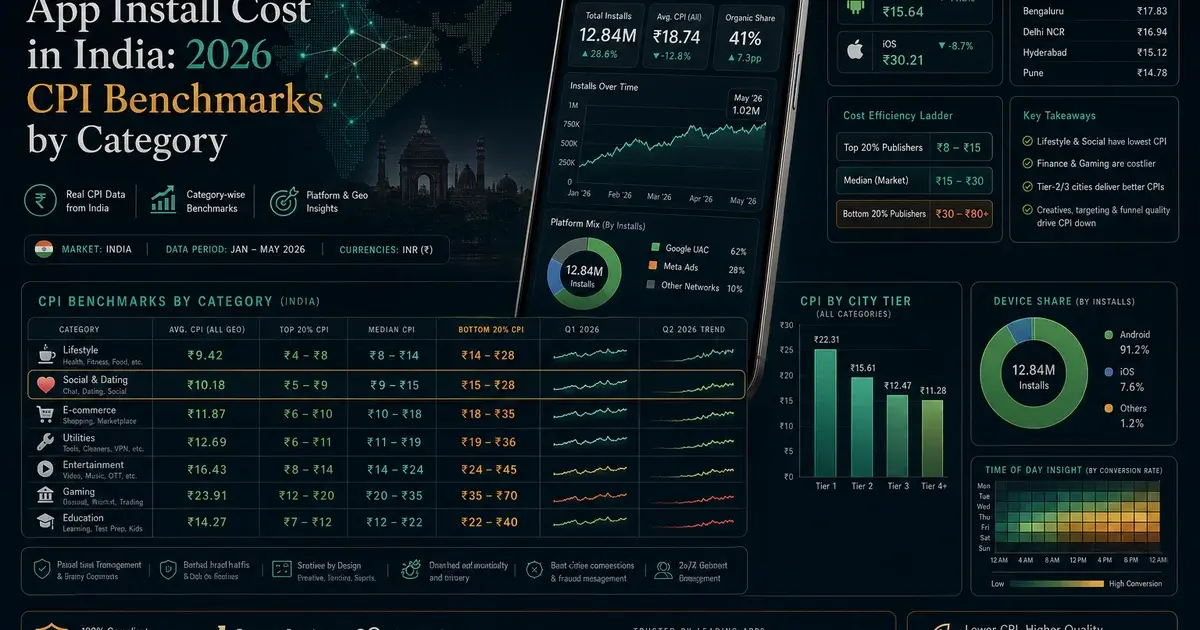
The only genuine MMP dataset for this category is Adjust's dating data covering January 2023 to December 2024: CPI $1.46 (about ₹128), CPM $4.37, CTR 2.2%, D1 retention 24%, D7 11%, D30 5%, with installs and sessions down 13% year on year. Global blended, no India or US split. That is the honest number. One sourcing distinction worth carrying: this dating cut does state its period, unlike Adjust's general cross-category retention page, which carries no stated period at all and should be labelled undated wherever it appears.
| Metric | Jan 2023 | Dec 2024 |
|---|---|---|
| CPI | $1.37 | $1.46 |
| CPM | $3.36 | $4.37 |
| CTR | 1.7% | 2.2% |
| CPC | $0.23 | $0.18 |
| IPM | 3.73 | 6.24 |
| D1 / D7 / D30 | — | 24% / 11% / 5% |
Two D30 figures conflict, and you should see both. Adjust's dating dataset says 5% for January 2023 to December 2024. Business of Apps' dating benchmarks, updated 21 May 2026, say 3.0% for 2025, down from 3.3% in 2024. They are different panels with different definitions and neither is wrong. Plan against 3.0%, because it is the more recent reading and the direction of travel in every other number in this post is down; hold 5% as the ceiling you would be pleased to hit. If you model LTV on 5% and land on 3%, you have overstated month-3 revenue by roughly 40%.
The calibration you will not get elsewhere. A large genre of content-farm pages circulates a "$6.30 dating CPI". Adjust's measured platform data says $1.46 — more than four times lower. One number comes from a named MMP with a stated 24-month window; the other has no named report, no stated period and no disclosed sample size. Any CPI number without those three things is marketing.
Deriving the planning CPI, out loud. There is no India dating CPI. There are two anchors and they bracket the answer. The floor is AppTweak's Apple Ads India CPI of $0.89 (₹78) — the only India CPI published anywhere for any category, and cheap partly because India's Apple Ads auction is thin, not only because India is cheap. The ceiling is Adjust's global blended dating CPI of $1.46 (₹128), which is category-correct but geo-blended across markets far more expensive than India. So: plan the band ₹78–₹128 and every threshold in this post twice, once at each end. That is arithmetic, not a published benchmark. A single blended midpoint would read more confidently and tell you less. Business of Apps' North American dating CPI of $2.50–5.00 sits far above both and is included only as contrast, so you can see how much of that number is geography.
Budget, in two phases, because a ratio problem is not a media problem. The first phase has no media in it. If you skip it you will spend phase two discovering that your CPI is fine and your app is empty.
| Phase | Duration | Monthly cost | What it buys | Gate to the next phase |
|---|---|---|---|---|
| 0. Supply seeding | 10–14 weeks, one city | ₹5–8 lakh, zero paid media | 2 full-time community leads plus 1 part-time creator and campus partnerships lead (₹3–4.5 lakh fully loaded); creator and campus stipends ₹1.5–2.5 lakh; events, verification ops and moderation cover ₹50,000–₹1 lakh; 15–25 organic content pieces ₹40,000–₹60,000 | The density gate at 60, held 14 consecutive days. Nothing else |
| 1. Validation | 6–8 weeks | ₹1.5–2.5 lakh media + ₹60,000–₹1 lakh creative production (30–40 variants) + supply seeding continues at ₹3–4 lakh | Apple Ads four campaigns, national, city intent bought through keywords; one Google ACi on tCPA to profile_complete at the ₹1,950–₹3,200/day floor |
100 Google conversions. Keyword and creative learning. Do not judge CPA |
| 2. First velocity | 8–12 weeks | ₹6–10 lakh media + ₹1.5–2.5 lakh creative (50–80 variants) + ₹3–4 lakh supply | Google ACi tCPI at the ₹3,900–₹6,400/day floor; Meta with two profile_complete ad sets, one per side, and one reply_received_first ad set |
~50 Meta events a week per ad set. Your first measured install-to-reply rate |
| 3. Scale | Ongoing | ₹25 lakh+ media + ₹3–4 lakh creative (80–120 variants) + ₹4–6 lakh supply per active city | Split profile_complete and reply_received_first per side on Meta; one consolidated subscription_start ad set; Google ACi tCPA on the reply event; CPPs per side on Apple Ads |
Density gate cleared in city two before city two gets a rupee |
The gender split at the subscription rung needs ₹40 lakh+ a month, per the arithmetic above. Below that, the split lives on the shallow rungs and the deep rung stays consolidated. Do not publish a plan that quietly needs 76% of its budget in two ad sets.
The KPI ladder, in order: the density gate at the 25th percentile per city, reply_received_first rate as a share of installs, D1 and D7 against Adjust's 24% and 11%, cost per activation by side and platform, month-1 to month-3 revenue against a 3.0% D30, blended CPI last. Total installs is not on the list — in a 74/26 marketplace it is the metric that lets you feel productive while your ratio degrades.
What breaks in a dating launch, and what does it cost?
Five things break, in this order of frequency: a platform gate is discovered late; 4.3(b) stops you shipping; the gender ratio degrades as you scale spend; you optimise too deep too early and never exit learning; and you buy a burst that gets filtered or gets your account terminated.
| What breaks | What it costs | The fix |
|---|---|---|
| Meta dating permission or Google certification not started early | Committed budget with nowhere to spend it, 2–6 weeks | Apply before code freeze; treat both as hard dependencies with no float |
| 4.3(b) rejection | 3–8 weeks of runway | Pre-written differentiation argument, review appointment booked early |
| Ratio degradation | Your entire paid budget, silently | Per-side campaigns where the channel allows it, and the density gate pause trigger at 40 |
| Over-deep optimisation | 1–2 months of throttled delivery, inflated CPA | The rate-and-threshold arithmetic above, before you pick the event |
| Quality-threshold exclusion | Removal from prominent discovery surfaces | Hold crash and ANR under Google's bar before scaling installs |
That last one is the only ranking penalty either store has ever quantified: Google publishes a user-perceived crash rate threshold of 1.09% and ANR of 0.47%, below which apps are excluded from prominent discovery surfaces. A surge of low-intent installs onto a shaky build pushes you across it.
Before you buy a burst
Two facts you cannot design around. Apple added a named clause, 5.6.3 "Discovery Fraud", in the February 2026 Guidelines revision, under the Developer Code of Conduct, where the stated remedy is termination of the Developer Program account, not app rejection: "Manipulating any element of the App Store customer experience, such as charts, search, reviews or referrals to your app, erodes customer trust and is not permitted." The Section 3 preamble catches your agency too — "or engage with third-party services to do so on your behalf."
Separately, Google says it filters incentivised installs out of its ranking systems, escalating to removal from top charts and then from the store — so the burst can be silently zeroed while you still pay for it. And the enforcement does not stop at the app or the account that ran it: "any related Google Play developer accounts will also be permanently suspended." One app's burst is a company-level risk.
If you buy CPI inventory anyway, price in the fraud: AppsFlyer's State of Ad Fraud 2026, across 106.4 billion installs, puts affiliates at ~40% versus self-reporting networks at ~1%, and "affiliate" is exactly how CPI networks are structured. Warrant "no incentivised or rewarded inventory" in the IO. The legitimate version produces the same curve anyway: a pre-registration cohort, a waitlist, a PR embargo, creator posts and paid campaigns all landing the same day.
Frequently Asked Questions
What's a good CPI for a dating app?+
Adjust's platform data for January 2023 to December 2024 gives $1.46 (about ₹128) global blended, with CPM $4.37 and CTR 2.2%. For India the only published datapoint for any category is AppTweak's Apple Ads India CPI of $0.89 (₹78), and it is a floor rather than a forecast. Plan the ₹78–₹128 band and run every threshold at both ends. No MMP publishes an India dating CPI, so the band is arithmetic, not a benchmark.
How much budget do I need to start Apple Ads for a dating app?+
Apple documents no minimum daily budget for Advanced. The practical floor comes from Maximize Conversions, which needs a budget supporting at least five conversions a day and two weeks before you judge it. At an India CPI near ₹78 that is roughly ₹400 a day to clear the gate, and ₹2,000–3,000 a day to learn anything across four campaigns. Remember that Apple Ads cannot target below country in India, so this is a national line item, not a city test.
Do I need permission to advertise a dating app?+
Yes, on both large channels. Meta requires prior written permission before dating ads are eligible to run at all, and Google requires dating-advertiser certification, granted per country. Neither is instant and neither can be worked around by opening a new ad account. Apply before code freeze; you cannot spend until they clear.
Why is my dating app getting installs but no matches?+
Liquidity, not acquisition. Check the density gate before CPI: at the 25th percentile of your new users in that city, how many profiles match their own filters within their own distance setting and were active in the last seven days? Under 40 and you should not be buying male-side installs there at all. Check your gender ratio against the roughly 26% female share Redseer reports for India. No ad budget fixes a ratio problem.
Will Apple reject my dating app?+
Assume yes on first submission. Guideline 4.3(b) names dating explicitly and rejects apps that do not offer "a meaningfully different or improved experience". Apple Developer Forums thread 777838 documents a live app with 57,000+ MAU rejected on saturation grounds alone. Pre-write your differentiation argument and book an App Review Appointment through "Meet with Apple".
Should I optimise to installs or subscriptions?+
Installs first, then descend one rung at a time: profilecomplete, then replyreceivedfirst, then subscriptionstart. At a 10% install-to-reply rate, Meta can carry reply optimisation on about 500 installs a week per ad set — ₹1.69–₹2.77 lakh a month. At a 2% subscription rate the same threshold needs 2,500 installs a week, and Google's 10× floor on the subscription event is ₹11.9–₹19.5 lakh a month for one campaign. That is the whole argument for descending slowly.
Sources
- Business of Apps — Dating App Market data
- Business of Apps — Dating app market records first annual revenue decline
- Business of Apps — Dating App Benchmarks, updated 21 May 2026
- AppTweak — Most downloaded dating apps 2025
- AppTweak — Apple Ads benchmarks 2025
- Adapty — Apple Ads benchmarks 2026: CPI & CR by niche
- Redseer — Who's winning in India's dating and matrimony market
- Apple — App Review Guidelines (4.3 Spam, 1.2 UGC, 5.6.3 Discovery Fraud)
- Apple Developer Forums — thread 777838, 4.3(b) dating rejection
- Tinder — App Store India listing
- Meta — Advertising Standards, restricted content
- Google Ads — Dating and Companionship certification policy
- Google Play Console Help — User-generated content policy
- Google Play Console Help — Testing requirements for production access
- Admiral Media — Dating app marketing
- Mondaq — Legally launching a dating app in India
- ecorpit — App Store social media declaration and age assurance readiness 2026
About the author
Amol Pomane — Founder, Vmobify
Amol leads Vmobify, a mobile app growth agency that has driven 30M+ downloads and ranked 54K+ keywords across 300+ apps since 2013. He writes about ASO, paid user acquisition, retention, and the operational reality of scaling mobile apps in India and global markets.
Model an install budget
Turn CPI and activation assumptions into acquisition scenarios.
Open free tool