Photo editing app marketing strategy: the 2026 India launch playbook
Launch a photo editing or AI photo app in India: a channel split built from the budget floors up, the export activation event and credits economics.

On this page
- What does the photo editing app market actually look like in 2026?
- Who are you actually acquiring, and what is the one event that predicts revenue?
- What do you need to get right before you spend a rupee?
- What does store hygiene look like here, and what will get you reviewed?
- Phase 1, Android: how do you run App Campaigns as your volume engine?
- Phase 2, iOS: how should you structure Apple Ads for a photo app?
- Phase 3: when should you open Meta, and what does the creative have to do differently?
- Phase 4: what is the event ladder, and how much volume does each rung need?
- What creative actually works for photo editing apps?
- What budget do you need, and what should each rung cost?
- What breaks, and what does it cost you?
What does the photo editing app market actually look like in 2026?
It is a huge install category and a mid-sized revenue category, and the gap between those facts is the strategic problem. Picsart has over 1 billion Play installs and Remini over 500 million, yet Appfigures' February 2026 ranking shows no photo editing app in the global top ten by downloads or revenue. The money went to general AI assistants.

On the Indian Play Store, "Picsart AI Photo Editor, Video" carries 100 crore plus installs at a 12+ rating; Remini, from Bending Spoons, carries 50 crore plus installs and 4.3 across 58.5 lakh reviews at 3+. Remini's short description now leads with "Create AI Photos" — a restoration app repositioned as a generator, which tells you where the category thinks its revenue is. Sensor Tower puts India at roughly $345 million (₹3,040 crore) in Q2 2026 consumer spend, up 35 percent year on year, against about 6.3 billion quarterly downloads, flat since 2023. India's story is monetization, not volume.
The structural fact everyone misreads: on AppTweak's Apple Ads panel — roughly 3,500 apps, 50,000 campaigns and $1 billion in ad spend across 38 countries in 2025 — Photo and Video converts taps to installs at 63 percent, the highest of the categories AppTweak publishes. Graphics and Design is 62 percent. Shopping is 41 percent. So an Apple Ads tap in your category converts to an install roughly 1.5 times more often than a tap for a shopping app.
That is a tap-to-install ratio and nothing more. It is not a statement about what a tap is worth. A shopping install converts to revenue at a multiple of a photo app's 1.5 percent day-35 paid conversion, so the better-converting tap is very often the less valuable one. Conflating the two is how this number gets misused.
And it is not a reason to build an India budget on Apple Ads. A 63 percent conversion rate makes Apple Ads the best-converting slice of your plan; it does not make it the biggest. India iOS reach is roughly 4 to 6 percent of devices. Weighting 60 percent of an India budget into Apple Ads spends most of your money bidding into a twentieth of your market, and the campaigns will simply run out of auction long before they run out of budget. That 60 percent weighting is defensible for a US-primary launch, where iOS is roughly half the installed base and carries most of the consumer spend. This post is not a US-primary launch. So: Google App Campaigns is the volume engine, Apple Ads is a thin permanently funded high-intent slice, and Meta opens only when it can clear its own thresholds.
On cost, AppTweak puts Apple Ads CPI in India at $0.89 (₹78) against a global median of $1.80 (₹158) and $4.06 (₹357) in the US. Read the India figure carefully. It is an all-category Apple Ads median, not a Photo and Video number, and it is cheap because the India iOS auction is thin — few advertisers bidding for few devices — not because the channel is efficient at volume. It is a reasonable planning anchor for a small campaign and a bad basis for a scale plan.
Where a cost figure is a planning anchor, use the cross-panel range rather than a single number. Adapty, on over a million ad groups, puts US cost-per-tap at $1.58 where AppTweak says $1.91 — the same metric, two panels, a 20 percent spread. On conversion rate, treat AppTweak's 63 percent for Photo and Video as the anchor and the rest as measurement noise rather than a category range: Adapty's 62.71 percent is a US all-category figure, and SplitMetrics' 67.2 percent, on 4.44 billion impressions, is an average across top categories. Neither is Photo and Video. "62 to 67 percent" is three panels disagreeing about how to count an install, not a band your app should sit inside.
Who are you actually acquiring, and what is the one event that predicts revenue?
Your activation event is first export or save — not install, and not first edit. Everything before the save is exploration. The save is the moment a user has made something they value enough to keep, and the earliest event that correlates with paying. Optimize to it, time your paywall around it, report on it weekly.

The second rung, once you have volume, is first paid generation. For credits models the highest-intent event in the whole funnel is credits_exhausted — a user who has burned their free allowance has self-identified as someone with a job to do.
Four buyers hide inside "photo editing app user" and behave nothing alike:
| Segment | The job | Where they come from | Monetization shape |
|---|---|---|---|
| Utility seeker | Passport photo, background removal, document crop | Search — Apple Ads, Play organic | High intent, converts once |
| Social poster | Make this good enough to post | Meta, Instagram, TikTok | High volume, low conversion |
| Seller | Product photos for a marketplace listing | Search, B2B content | Best retention, subscription-native |
| AI novelty | Try the thing from a video | Meta, creator content | Huge volume, near-zero retention |
In India the utility seeker is far larger than most Western-built roadmaps assume. "Passport size photo" is a distinctly Indian, high-intent search niche that almost no international editor serves properly, under-competed because it is unglamorous.
The trap is that acquisition creative recruits the wrong segment beautifully. RocketShip HQ's analysis of before-and-after ads for AI photo apps — vendor-adjacent, so directional rather than measured — names the mechanism: transformation creative drives enormous volume from low-intent users, which reads as a CPI win and a return-on-ad-spend loss. Their working bands are a 25 to 35 percent trial start rate on healthy campaigns and trial-to-paid of 15 to 25 percent, below 5 percent when creative overpromises.
What do you need to get right before you spend a rupee?
Three things: photo permission handled without a prompt, an event taxonomy that names the export, and a financial model treating your free tier as media spend. Get the third wrong and your unit economics are broken in a way no bid adjustment fixes, because every free generation costs real GPU money.
Permissions. On iOS, do not ask for full library access. Use PHPickerViewController, the out-of-process picker, which requires no permission prompt at all; Apple's guideline 5.1.1(iii) pushes you toward it. Library-permission denial is one of the biggest silent leaks here, and the picker removes it entirely.
Event taxonomy. Name these once, before the first campaign:
| Event | Fires when | Used for |
|---|---|---|
photo_imported, edit_applied |
Image picked, core action taken | Funnel diagnosis |
first_export |
First save or share | Primary optimization event |
share_whatsapp |
Export routed to WhatsApp | India viral loop |
credits_exhausted |
Free allowance spent | Upsell trigger, highest intent |
paywall_view, trial_start |
Paywall shown, trial begun | Secondary optimization event |
first_paid_generation |
First generation after payment | Value rung |
subscription_started, renewal_1 |
Purchase, first renewal | Value optimization, tROAS |
Attribution. Firebase is enough and free if Google is your only paid channel. The moment a second network exists an attribution partner pays for itself, because Firebase does not feed Meta and two SDKs give you two incompatible definitions of the same event. Seven partners are Google-certified: Adjust, Airbridge, AppsFlyer, Branch, Kochava, Singular, Tenjin.
On iOS, encode your most important signal into the first two days. AdAttributionKit sends fine conversion values only in the first postback and only at crowd anonymity tiers 2 and 3; windows two and three are always coarse, and at tier 0 nothing is sent. If your paywall fires on day five, iOS will not tell you about it.
The compute cost problem. In a conventional freemium app a free user costs a rounding error. In an AI photo app every free generation is a GPU invoice. If a generation costs ₹1.30 ($0.015) and a free user takes eight before deciding, that user cost ₹10.40 ($0.12) whether or not they pay. At Photo and Video's median download-to-paid of 1.5 percent at day 35 — RevenueCat's figure across 115,000-plus apps, and a disclosure that belongs here rather than in a footnote: RevenueCat sells subscription infrastructure, so every framing they publish points toward subscriptions being the answer — you fund roughly 66 free users per payer: ₹686 ($7.80) of compute per acquired subscriber, on top of CPI.
Model it as a media line, in the same spreadsheet as your CPI. Three levers control it: the size of the free allowance, the cost per generation (a smaller distilled model on the free path is the standard answer), and how fast you move a user to the paywall. A free tier generous enough to be shareable and cheap enough to survive is a design constraint the P&L owner signs off, not a growth setting.
What does store hygiene look like here, and what will get you reviewed?
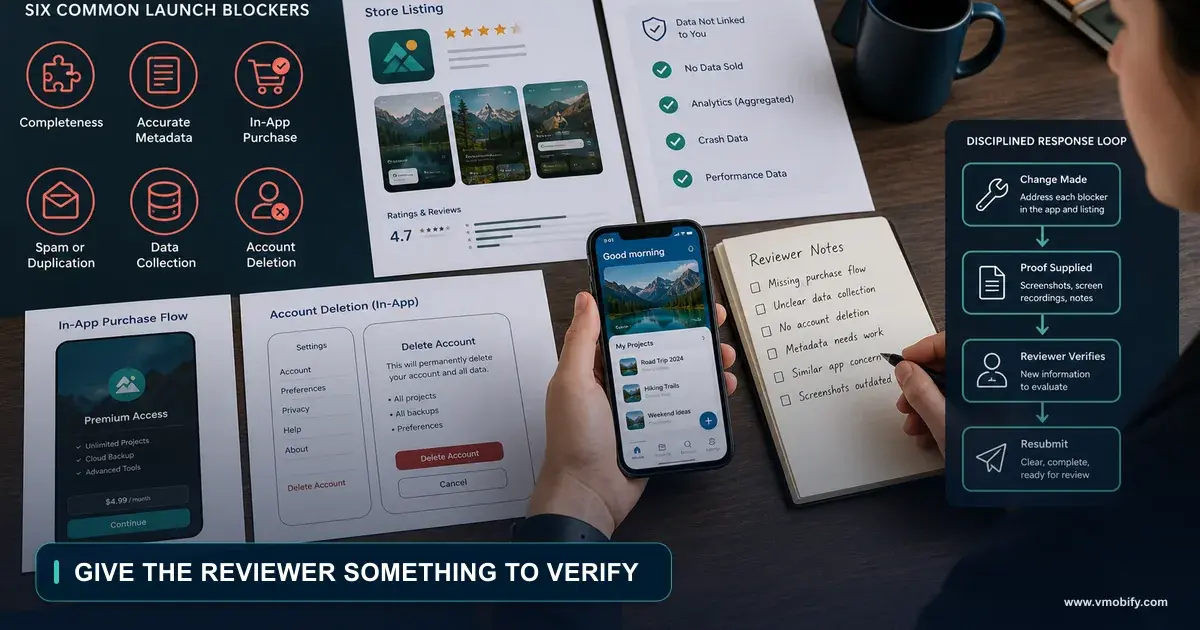
Every category leader now has "AI" in the title, your Play short description is a keyword field disguised as a sentence, and your largest policy obligation is a build requirement: Play requires apps generating content with AI to ship in-app reporting or flagging before you submit. That is engineering work, not documentation.
Look at what the leaders do. "Picsart AI Photo Editor, Video" is brand plus AI qualifier plus two head keywords plus an adjacent category, and its short description — "Remove and swap backgrounds in your photos and remove unwanted objects" — carries three head terms in one readable sentence.
Field mechanics are in the launch playbook. The field this category wastes is Play's 80-character short description: indexed, heavily weighted, and usually filled with adjectives.
Head terms worth building around — I have no volume data, so commission a keyword pull before committing title copy:
- US: photo editor, ai photo editor, photo enhancer, background remover, remove background, face swap, ai headshot, photo restoration, unblur, collage maker
- India: photo editor, background remover, background eraser, photo enhancer, ai photo, passport size photo, photo frame, plus the transliterated Hindi cluster — photo banane wala app, photo banana — which is high volume and under-competed because international teams do not think to target it
Custom Store Listings by acquisition channel and Store Listing Experiments are free. Run them from day one.
Policy, which here is not optional. Google Play's AI-Generated Content policy states verbatim that apps generating content using AI "must contain in-app user reporting or flagging features that allow users to report or flag offensive content to developers without needing to exit the app." Play's Inappropriate Content policy separately prohibits "non-consensual sexual content created via deepfake or similar technology."
Apple enforces the same territory through existing rules rather than a dedicated AI guideline. Guideline 1.2 requires a filtering method for objectionable material, a reporting mechanism with timely responses, the ability to block abusive users, and published contact information, with removal from the App Store and the Developer Program named as the remedy for repeated behaviour. Guideline 5.1.2(i) requires you to disclose where personal data goes to third parties "including with third-party AI" and get explicit permission first — posting user photos to Replicate, Fal, OpenAI or Stability needs a consent screen, not a privacy policy line.
Enforcement is live. In July 2026, San Francisco City Attorney David Chiu issued cease-and-desist letters to Apple and Google demanding removal of nudify and undress apps — eight on Apple's platform, five on Google's. Apple removed three and initiated developer account terminations. Separately, Apple removed the Kromix AI app after explicit images surfaced in its Meta ads: the ad creative triggered the takedown, not the app.
One review risk here is measurable and one is a hypothesis, and they should not be stated in the same voice. The measurable one: AI output-quality complaints spike exactly when creative overpromises, and they arrive as one-star reviews within days of a variant scaling. The hypothesis: weekly billing plausibly generates more refund-adjacent one-star reviews than monthly or annual pricing, because the charge lands before the user has forgotten signing up — but nobody publishes review sentiment by price point, so watch it in your own reviews rather than planning around it. Either way your rating is an acquisition input, because it feeds the store conversion rate you are paying Apple and Google to reach.
Phase 1, Android: how do you run App Campaigns as your volume engine?
Launch App Campaigns for Installs on target CPI, respect the budget floors, and change nothing until 100 conversions have registered. Android is where your India volume lives and where attribution is still deterministic, so it takes the majority of an India budget and it is where you validate every measurement decision before porting it to iOS. The floors practitioners most often get wrong are published by Google:

| Campaign and strategy | Minimum daily budget |
|---|---|
| Installs with target CPI | 50 times your bid |
| Installs with target CPA on an in-app action | 10 times your bid |
| Engagement with target CPA | 15 times your bid, plus 50,000 installs |
| Pre-registration | 50 times your bid |
Compute the floor before you set the budget, not after. At the ₹78 ($0.89) planning CPI used throughout this post, one App Campaigns for Installs campaign on target CPI needs 50 × ₹78 = ₹3,900 a day, which is ₹1,18,560 a month at 30.4 days. That single figure constrains the whole plan: any monthly budget whose Google share lands below roughly ₹1.2 lakh cannot run one compliant tCPI campaign, and the scenarios later in this post are built upward from it rather than downward from a round total. If you plan to bid lower, say so explicitly and recompute — a ₹50 bid puts the floor at ₹2,500 a day, and it also instructs Google to find you cheaper, worse installs. Quietly lowering the stated bid to make a budget table fit is the most common way these plans lie.
Google's exact wording on learning: "Making changes to your in-flight campaign before the first 100 conversions have registered may disrupt learning." A conversion count, not a time window. Google also documents that it "isn't recommended to select more than one action" for target CPA, that iOS bids run around 1.5 times Android, and that targeting in-app-action users should bid roughly 20 percent above baseline target CPI.
Asset specs are in the launch playbook. The one that matters here is video: supply none and Google generates one from your store listing, worse than anything you would make. Upload 9:16 and 1:1 cuts of your best transformation, 10 to 60 seconds, to YouTube first.
Two deep-link failures that fail silently and cost weeks: your robots.txt must allow AdsBot-Google and AdsBot-Google-Mobile to reach apple-app-site-association and assetlinks.json, and Android installs need deferred deep links enabled in your measurement SDK or post-install routing breaks.
The pre-launch gate that catches teams the week before launch. Play production access requires 12 testers opted in for 14 continuous days for personal Console accounts created after 13 November 2023; organization accounts are exempt. Testers who opt in and leave inside the window do not count, and if a tester opts out and returns, the clock restarts. Review then typically takes up to seven days. Older guides say 20 testers — outdated. Start the closed test six weeks before the date you want to spend money, not two.
On burst installs, before you take a vendor's call. Apple added a named clause, 5.6.3 "Discovery Fraud," in the February 2026 Guidelines revision, under the Developer Code of Conduct where the stated remedy is termination of your Developer Program account, not app rejection: "Manipulating any element of the App Store customer experience, such as charts, search, reviews or referrals to your app, erodes customer trust and is not permitted." The Section 3 preamble catches your agency too — "or engage with third-party services to do so on your behalf." Google separately states it filters incentivised installs out of ranking, escalating to top-chart removal then store removal, so a burst can be silently zeroed while you still pay for it — and the suspension cascades beyond the one app: "any related Google Play developer accounts will also be permanently suspended." The IO clauses you can negotiate protect your money, not your account.
The legitimate version produces the same curve: pre-registration cohort, email waitlist, PR embargo, creator posts and paid campaigns landing on one day. Play pre-registration runs 90 days maximum per country and auto-installs on launch day — but only at or under 200MB on Wi-Fi and cellular, 200MB to 2GB on Wi-Fi only, and not at all above 2GB. AI photo apps with bundled on-device models routinely cross those cliffs.
Phase 2, iOS: how should you structure Apple Ads for a photo app?
Run Apple's own four-campaign structure — Brand, Category, Competitor, Discovery — and fund it as a permanent thin slice at roughly 15 to 20 percent of media, not as your opening channel. It earns that slice on conversion rate rather than reach: best-converting category on Apple's panel, smallest addressable base in your market. Fund it accordingly and keep it funded.
The structure is Apple's documented recommendation, not agency folklore:
| Campaign | What goes in it | Configuration |
|---|---|---|
| Brand | Your app and company name terms | Exact match, Search Match off |
| Category | Non-branded terms describing what the app does | Exact match, Search Match off |
| Competitor | Terms for similar apps in the same or related category | Exact match, Search Match off |
| Discovery | Finds new terms to graduate into the other three | Broad-match ad group with Search Match off, plus a no-keyword ad group with Search Match on |
Add every keyword from the first three campaigns into Discovery as exact-match negatives, so Discovery only spends on new terms. Splits like 30/35/30/5 are convention, not Apple guidance.
The conversion floor everyone quotes applies to a different campaign than the one above, and confusing the two is why readers conclude Apple Ads is broken at their size. The four-campaign structure runs on Manage Bids — manual maximum cost-per-tap. Apple documents no minimum daily budget for it and no conversion floor at all. Maximize Conversions, launched 25 February 2026, is a separate, fifth campaign with its own budget: automated bidding to a target CPA, where Apple's guidance is to budget for at least five conversions a day. That is roughly 5 × your CPI per day — about ₹390 a day, ₹11,900 a month, at a ₹78 CPI — and it is money that campaign needs on top of the four, not carved out of them. Apple also asks for two weeks before you judge it, makes Search Match mandatory on its automatic ad group, and does not offer it on pre-order campaigns. Target CPA there is a weekly average goal, not a per-query ceiling.
The two are alternatives, and Apple has published nothing reconciling them — mandatory Search Match contradicts the exact-match discipline of the four-campaign structure. So run the manual four, or run the manual four plus one separately funded Maximize Conversions campaign and compare them. What you must not do is split ₹70,000 a month four ways, read "five conversions a day" and conclude the channel does not work: that number does not govern the structure you are running. Lifetime budgets were paused in June 2026, so your monthly ceiling is daily budget times 30.4.
Custom product pages are your best lever here: up to 70 per app, Marketing role required in App Store Connect, search-results ad groups only, one active custom ad per ad group, no new app version needed. Build one per transformation type — background removal, restoration, headshot, unblur — matched to the keyword cluster that drove the tap.
The 2026 Apple Ads change that matters most to this category, and neither this post nor most others covered it until now: custom creative assets, added in June 2026. You can upload your own creative for Today tab and search results instead of letting Apple assemble the ad from your product page screenshots. For a category whose entire pitch is a visible before-and-after, that is the difference between an ad that shows your strongest transformation and an ad that shows whatever your first screenshot happens to be. It is also the one Apple Ads surface where your existing Meta and TikTok transformation library transfers with light rework, so put it in the creative brief.
Tap-through on AppTweak's panel is 7.4 percent in search results against 2.0 percent on product pages and 0.29 percent on the search tab. Only search results supports target CPA and keywords, so put your money there.
At 20 percent of a validation budget, Apple Ads is ₹40,000 to ₹70,000 a month ($450 to $800) across the four campaigns — enough signal at a ₹78 CPI to learn which keyword clusters convert, not enough to be a volume channel. That is the same figure as the Apple Ads line in the Validation column below, and the two agree deliberately: if the phase text and the budget table disagree, one of them is wrong.
Nobody publishes Apple Ads conversion rate by match type. If a vendor shows you that table, they made it up.
Phase 3: when should you open Meta, and what does the creative have to do differently?
Open Meta only when the Meta line itself can carry roughly ₹1.5 lakh a month. Below that, do not open it at all. Then optimize to App Events rather than installs, and accept that your best-performing creative is also your biggest liability.
Why ₹1.5 lakh is the gate, and why it is per ad set. Meta's learning threshold is roughly 50 optimization events per ad set per rolling seven days — trade-press consensus rather than anything Meta publishes, and the "per ad set" clause is the part budget tables drop. Take trial_start at the 30 percent middle of RocketShip's 25 to 35 percent band: 50 ÷ 0.30 is about 170 installs a week, per ad set. At ₹78 that is ₹13,300 a week, roughly ₹58,000 a month per ad set, and any real structure runs two or three ad sets. That puts the honest floor for a Meta line optimising to trial start at ₹1.2 to ₹1.7 lakh a month — and Meta's CPI in broad-audience feed traffic realistically runs above a ₹78 search figure, so treat ₹1.5 lakh as a floor rather than a target.
A 10 percent slice of a ₹1.5 to 3 lakh validation budget is ₹15,000 to ₹30,000 a month. That buys one permanently learning-limited ad set on any event you could choose, which produces no information you can act on — it is not a cheap small test, it is a line item that teaches you nothing while confirming your prior that Meta is expensive.
Mechanically, once you are above the gate: use App Event Optimization when you have event volume, and note that Meta's own documentation calls Value Optimization "available on a limited basis to partners and advertisers", so do not plan around it. Budget, creative, audience and optimization-event changes all reset learning.
On iOS, the eight-event Aggregated Event Measurement model still governs app campaigns even though the standalone AEM tab and manual ranking step were removed for many web accounts. Only the highest-priority event in a session is reported, and reordering reportedly pauses affected ad sets for 72 hours. Rank first_export above trial_start early, then swap once — deliberately — when you have paying volume.
If you run the Conversions API for App Events, note that install events get automatic 90-day deduplication and post-install events do not — so your export and trial events need real event_id values. The full parameter list is in the launch playbook.
What the creative must do differently. In most categories Meta creative sells a promise. Here it demonstrates an output, so the gap between ad and app is visible within sixty seconds of install. When creative overpromises, RocketShip's read is that day-one retention collapses and trial-to-paid falls below 5 percent. Their claim that down-funnel optimization produces 40 to 60 percent better return on ad spend is vendor-adjacent rather than measured, but the mechanism is sound.
Three rules follow. Show a transformation your app produces on the free tier, not a cherry-picked output. Show an input image at the quality your users actually have — Indian users upload compressed WhatsApp forwards, not DSLR files. And put a human review gate on every variant, because Apple removed Kromix AI on the basis of what was in its Meta ads.
Phase 4: what is the event ladder, and how much volume does each rung need?
Pick the deepest event that still clears its platform threshold at your intended budget, and never skip a rung. The ladder runs install → first export → trial start → first paid generation → subscription. Each step is more valuable and lower volume, and every platform has a published or well-established minimum.
| Platform | Gate | Sourcing |
|---|---|---|
| Apple Ads, Maximize Conversions campaign only | Budget supporting 5+ conversions per day | Apple documented |
| Apple Ads, manual four-campaign structure | No documented conversion floor | Apple documented |
| Google App Campaigns | The budget floors in the table above, and no edits before 100 conversions | Google documented |
| Meta | ~50 events per ad set per 7 days | Trade press only, not primary-verifiable |
Work it backwards, and keep "per ad set" in the sentence — dropping it is how playbooks arrive at thresholds that look reachable and are not. At Photo and Video's median download-to-paid of 1.5 percent at day 35, one Meta ad set optimising to subscription needs about 3,300 installs a week, per ad set. At RevenueCat's 0.7 percent for India and Southeast Asia it needs about 7,100 a week, per ad set. Now multiply by a realistic ad-set count: three India ad sets is 21,300 installs a week, ₹16.6 lakh a week, roughly ₹72 lakh a month on Meta alone — above the entire Serious budget in this post. Subscription optimisation on Meta is out of reach in this category at every budget here, including ₹60 lakh a month. Do not plan a phase around reaching it.
The deepest rung Meta can actually reach is trial_start: about 170 installs a week per ad set at a 30 percent trial start rate, roughly ₹58,000 a month per ad set. first_export is shallower still and clears at almost any budget, which is exactly why it is the right opening target. Subscription-level optimisation, if you want it, belongs on Google's target CPA and Apple's Maximize Conversions, where the floors are budget multiples rather than per-ad-set event counts.
And there is a ramp caveat that makes weeks one to five worse than the arithmetic suggests. RevenueCat's 1.5 percent is a day-35 conversion rate, not a weekly event rate. Three thousand three hundred installs in a week produce roughly 50 purchase events in that week only in steady state — once five successive weekly cohorts are each contributing their day-35 conversions. Until then you are structurally below the threshold no matter what you spend, because the events have not had time to happen yet. So hold the shallow event through the first six weeks and do not read a "learning limited" label in week two as a budget problem.
Four compounding mechanisms make optimizing too deep too early fail. The model never exits learning, so delivery throttles and CPA inflates. Sparse signal means it fits noise, which is why Google says not to select more than one action. Each fix resets learning, so volume never accumulates. And on iOS, deep events land in conversion windows two and three, which return only coarse values and, at tier 0, no postback at all — a deep monetization event may be structurally unmeasurable at low volume regardless of configuration. That last one is the mechanism most playbooks omit.
Sequence: launch on installs, clear 100 conversions on Google or roughly 50 a week per ad set on Meta, move one rung down, re-clear, repeat. Validate on Android first — iOS is aggregate measurement and Android deterministic, not the same channel with a bid multiplier.
What creative actually works for photo editing apps?
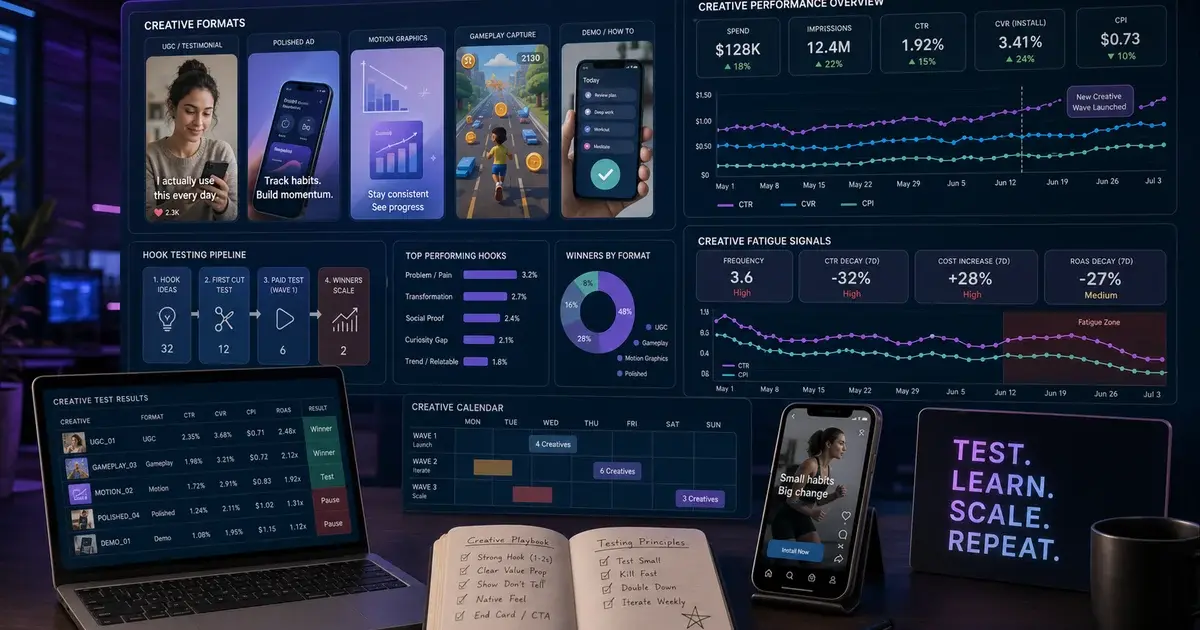
Before-and-after transformation is the dominant hook and nothing else is close. It is the category's native language, because the value proposition is a visible delta between two images. Your job is not to find a better hook — it is to test the right variable and keep the promise honest.
Formats that perform, per RocketShip HQ:
- TikTok: swipe-reveal, 9:16, 15 to 20 seconds
- Meta: side-by-side static, 1:1 or 4:5
- Carousel: four to six cards, each a different transformation type
Their testing order, ranked by variance, is the most useful thing in the work:
- Transformation type — highest variance, test first
- The "before" face or demographic — second
- Layout and format — third
- Text copy — lowest variance
Teams burn test budget on copy, which barely moves the number. If your background remover is not working, test restoration rather than rewriting the headline.
Production velocity beats polish. Above roughly $50,000 (₹44 lakh) monthly spend, RocketShip's figure is five to ten new variants weekly on a 70/20/10 split of proven winners, variations and wildcards. Below that threshold nobody publishes a cadence. Three to five a week is my judgement call, not a sourced number — it is the smallest cadence that gives the auction something new before your winners fatigue, and you should treat it as a starting hypothesis you measure against creative fatigue in your own account.
For India, use Indian faces in the "before" slot. The before-image demographic is the second-largest variance driver, and creative built on US and European faces underperforms on Indian audiences — unverified as a published finding, but strongly indicated by the variance ranking itself. Test WhatsApp-native ratios and Hinglish overlays.
Liftoff's report — 4.7 trillion impressions — puts the impression-to-install lift from introducing user-generated content at 152 percent. A creator editing a real photo out-performs a studio side-by-side.
What budget do you need, and what should each rung cost?
Three scenarios, India-only, built upward from the platform floors rather than downward from a round number. These are planning frames, not benchmarks — there is no credible published CPI for photo editing apps in any geography, and any table claiming otherwise is content marketing.

Two constraints set every figure below. App Campaigns for Installs on target CPI needs 50 × bid a day, which at ₹78 is ₹3,900 a day, ₹1.19 lakh a month — so the Google line, not the total, is what a scenario has to clear first. And a Meta line below roughly ₹1.5 lakh a month cannot exit learning on any event worth optimising to, so Meta does not appear until it can.
| Validation | Scale | Serious | |
|---|---|---|---|
| Monthly media spend | ₹2–3.5 lakh ($2,300–4,000) | ₹8–15 lakh ($9,000–17,000) | ₹35–60 lakh ($40,000–68,000) |
| Google App Campaigns | 80% — ₹1.6–2.8 lakh | 58% — ₹4.6–8.7 lakh | 55% — ₹19.3–33 lakh |
| Google daily, against the ₹3,900 floor | ₹5,260–9,210 ✓ | ₹15,260–28,600 ✓ | ₹63,400–1,08,550 ✓ |
| Apple Ads | 20% — ₹40,000–70,000 | 17% — ₹1.4–2.6 lakh | 15% — ₹5.3–9 lakh |
| Meta | Not opened — below the ₹1.5 lakh floor | 25% — ₹2–3.75 lakh | 30% — ₹10.5–18 lakh |
| Optimization event | Install, then first export | First export | Trial start on Meta; subscription only on Google and Apple |
| Creative variants per week | 3–5 (judgement call) | 5–8 | 8–15 |
| Creative production, on top of media | ₹40,000–80,000 — one freelance editor, stock-face licensing | ₹1.5–3 lakh — one editor plus 4–6 creator briefs a month | ₹6–12 lakh — a two-person creative pod plus 15–25 creator briefs a month |
Three things about that table are deliberate and worth saying out loud. Validation starts at ₹2 lakh, not ₹1.5 lakh, because ₹1.5 lakh at an 80 percent Google share is ₹1.2 lakh — right on the floor with no headroom, and the first week of underdelivery puts you under it. Meta is absent from Validation entirely rather than sitting at 10 percent: a ₹15,000 to ₹30,000 Meta line is a rounding error that buys a learning-limited ad set, and removing it funds the Google line properly instead. And creative production is a real budget line, not a resourcing footnote — a plan that mandates five to eight variants a week and budgets nothing to make them is a plan that will run three-month-old creative by month two.
Judge the KPI ladder in this order: tap-to-install on Apple Ads, against AppTweak's 63 percent for Photo and Video rather than a fabricated band — materially below it points at your product page, not your bid; install to first export, your honesty check against your creative; first export to paywall view; trial start rate, working band 25 to 35 percent; trial to paid, 15 to 25 percent healthy and below 5 percent meaning overpromising creative; and compute cost per acquired subscriber, the line nobody tracks and everybody should.
Payback, and why AI changes it. RevenueCat's 2026 data across 115,000-plus apps puts Year-1 lifetime value for AI apps at $30.16 (₹2,654) against $21.37 (₹1,881) for non-AI — 41 percent higher — while finding AI apps retain 36 percent worse on monthly plans over 12 months. You are buying higher lifetime value and faster churn at once.
So your payback window must be shorter, not longer, than a conventional subscription app's, even though your LTV is higher. Front-load revenue: annual plans priced to be obviously better value, a credits top-up path for users who will never subscribe, and an upgrade prompt fired at credits_exhausted rather than on a calendar. On the paywall question the gap RevenueCat reports is large enough to test on its own merits — 10.7 percent day-35 trial-to-paid on a hard paywall against 2.1 percent freemium, and $3.09 (₹272) revenue per install at day 60 against $0.38 (₹33) — while remembering the disclosure made earlier in this post about who publishes it.
One tension to resolve deliberately. Photo apps conventionally run 3-day trials with weekly billing. RevenueCat says 17 to 32 day trials convert at 42.5 percent against 25.5 percent under four days, and that 55.4 percent of 3-day trial cancellations happen on day zero. The counter-argument is real — photo work is episodic and a long trial gives away the whole job in one sitting. Test 7-day against the 3-day incumbent early.
On Android in India, involuntary churn is a first-order lever: Play billing failures account for 31 percent of cancellations against 14 percent on the App Store. UPI Autopay setup and failure recovery is worth more than most bid optimizations you will run.
What breaks, and what does it cost you?
The failures here are predictable, and most cost you a month rather than a campaign. In rough order of damage:

You built an India budget on Apple Ads. Sixty percent of your money bidding into 4 to 6 percent of India's devices, campaigns that exhaust their auction long before their budget, and a quarter of underdelivery you will misread as a creative problem. Cost: the quarter, plus the rebuild.
You optimized on installs. Transformation creative delivered volume at a CPI that looked excellent and none of it converted. Cost: a month of spend plus a model that now finds people who watch transformation videos.
Your free tier ate your margin. Nobody modelled compute per free user, and at 1.5 percent conversion you fund 66 free users per payer. Cost: a business that scales into losses.
You opened Meta at 10 percent of a small budget. One ad set, permanently learning limited, no usable read either way. Cost: the money, and a wrong conclusion about the channel that costs you again later.
You shipped without in-app reporting. Google Play's AI content policy requires it before submission. Cost: a rejection cycle in the week your launch campaign is booked.
An ad variant went out unreviewed. Kromix AI was removed on the basis of its Meta ads. At five to ten variants weekly, review needs a named owner. Cost: potentially your account.
You edited the Google campaign at 40 conversions, or bought a burst. Cost: two weeks of inflated CPA in the first case, potentially everything in the second.
You planned iOS around fine conversion values that never arrive. Paywall on day five, traffic at tier 1, coarse values only. Cost: an iOS channel you can neither optimize nor explain.
Frequently Asked Questions
How much does it cost to get a photo app install in India?+
There is no credible published CPI benchmark for photo editing apps anywhere. The one real India datapoint is AppTweak's Apple Ads figure of $0.89 (₹78) — and it is an all-category median for search traffic on a thin iOS auction, not a Photo and Video number, so use it as a planning anchor and not as a forecast. A ₹2 lakh (about $2,300) test over three weeks gives you a better number than any report you can buy.
Why is my app getting installs but no revenue?+
Almost certainly the gap between your creative promise and your free tier. Check install-to-first-export first. If that is healthy and trial-to-paid is under 5 percent, the creative is overpromising. If it is the leak, look at onboarding and permissions.
Should I use a hard paywall or freemium?+
RevenueCat's data across 115,000-plus apps favours hard paywalls heavily — 10.7 percent against 2.1 percent day-35 trial-to-paid, eight times the revenue per install at day 60. Read that alongside the disclosure earlier in this post about what RevenueCat sells. In an AI photo app there is a second, independent argument for gating: every free generation costs money. The hybrid the category has converged on is a small free allowance, then a paywall, with credit top-ups for non-subscribers.
How much of my budget should go to Apple Ads in India?+
Roughly 15 to 20 percent. Apple Ads converts taps to installs better in this category than in any other AppTweak publishes, which is why it stays permanently funded — but India iOS reach is roughly 4 to 6 percent of devices, so it cannot be your volume channel. The 60 percent weighting you see in playbooks is a US-primary number that got copied into India posts without recomputing.
Is India a real revenue market for photo apps?+
For subscriptions, weakly — RevenueCat puts India and Southeast Asia at 0.7 percent download-to-paid against North America's 2.8 percent, at roughly 40 to 50 percent of US pricing. Per payer the gap is far smaller: $19.32 (₹1,700) Year-1 realized value against $26.07 (₹2,294). India's problem is conversion and payment friction, not willingness to pay. Plan India as volume and advertising or credits revenue, and expect the subscription line to be written elsewhere.
Does my app need face-processing compliance work?+
If you extract face geometry for anything — beautification, face swap, avatar generation, age or gender detection — yes, and the exposure is significant. The beauty and camera app playbook covers it in full: Illinois BIPA, Texas CUBI and India's DPDP Act. A general editor doing only background removal and enhancement avoids most of it.
Sources
- Apple App Store Review Guidelines
- Apple Ads campaign structure, Maximize Conversions and custom creative assets documentation
- Google Play — AI-Generated Content policy
- Google Play — Inappropriate Content policy
- Google Play — production access testing requirements
- Google Ads — App campaigns documentation
- AppTweak — Apple Ads benchmarks 2025
- Adapty — Apple Ads benchmarks 2026: CPI & CR by niche
- SplitMetrics — Apple Search Ads benchmarks
- RevenueCat — State of Subscription Apps 2026
- RevenueCat — 2026 subscription benchmarks summary
- Sensor Tower — India mobile app market Q2 2026, via TechCrunch
- Appfigures — most downloaded and highest earning apps, February 2026
- RocketShip HQ — before/after ads for AI photo apps
- RocketShip HQ — Liftoff Mobile Ad Creative Report summary
- 9to5Mac — Apple ordered to remove AI undressing apps, July 2026
- Storyboard18 — Apple removes Kromix AI over explicit image generation
- Google Play listing — Picsart AI Photo Editor, Video
- Google Play listing — Remini AI Photo Enhancer
About the author
Amol Pomane — Founder, Vmobify
Amol leads Vmobify, a mobile app growth agency that has driven 30M+ downloads and ranked 54K+ keywords across 300+ apps since 2013. He writes about ASO, paid user acquisition, retention, and the operational reality of scaling mobile apps in India and global markets.
Model an install budget
Turn CPI and activation assumptions into acquisition scenarios.
Open free tool