Habit tracker app marketing strategy: retention first, then media
Habit tracker UA for India: streak_3 rates against platform gates, paywall choice, RBI e-mandate rules, Play billing recovery, and real budgets.

On this page
- What does the habit tracking market actually look like?
- Who are you acquiring, and what event predicts revenue?
- What has to be right before you spend anything?
- What does store hygiene look like for a habit app?
- Phase 1, iOS: how do you structure Apple Ads for a habit app?
- Phase 2, Android: how do you get an App Campaign to first velocity?
- Phase 3: how should Meta be set up for a subscription habit app?
- Phase 4: how much volume do you need before optimising to each rung?
- What creative actually works for a habit app?
- What budget do you need, and what should each rung cost?
- What breaks, and what does it cost you?
What does the habit tracking market actually look like?
There is no habit-tracker category, so there is no category ranking, and the leader is not really a habit tracker. Finch, a self-care app built around a pet you keep alive by checking in, carries 10 million-plus installs and a 4.9 rating on Play India, and its short description leads with mood rather than habits.

Apps sit in iOS Health & Fitness or Productivity, and in Play Health & Fitness, Productivity or Lifestyle — a strategic choice. Health & Fitness converts better and attracts Apple's medical-claims scrutiny; Productivity converts worse and reviews cleaner.
A disclosure before the first number, because almost every subscription figure in this post comes from one source. RevenueCat's State of Subscription Apps 2026 covers more than 115,000 apps and $16B in tracked revenue, and it is the largest subscription dataset that exists. RevenueCat also sells subscription infrastructure, so "hard paywalls win" is a commercially convenient finding for them. The method is disclosed and the numbers are real; the framing is not neutral, and you should read every RevenueCat figure below with that in mind. Where their data settles a decision, I say which way it points and why the interest does not change the answer.
With that stated: RevenueCat puts Health & Fitness median D35 install-to-paid at 2.9% against Photo & Video's 1.5%.
A Sparrow Apps teardown from April 2026 — an outside estimate, directional only — puts Finch at $30–40M ARR bootstrapped, 4.95 stars across 550,000-plus App Store reviews, and an audience 75% women aged 25 to 35. The geography matters most: the US is 61.8% of users, Canada 10.3%, Australia 5.7%, the UK 5.5%. India does not register in the top five.
The structural fact that should change your strategy: this is the weakest India-primary category in the series, and the fix is positioning rather than media. RevenueCat puts India and Southeast Asia at 0.7% D35 download-to-paid against North America's 2.8%, roughly a quarter the rate. But Year-1 realised LTV per payer is $19.32 (₹1,700) for India and Southeast Asia against $26.07 (₹2,294) in North America — a gap of only about 26%. India's problem here is conversion, not willingness to pay, and a funnel problem is one you can work on.
Two India reads follow from live listings rather than a dataset. HabitNow Daily Routine Planner carries 5 million-plus installs and a 4.8 rating on Play India selling a one-time premium purchase, not a subscription. And the strongest India demand signal here is study and exam productivity — JEE, NEET, UPSC routines — not wellness, so an India-only launch should probably position as a study routine planner. That is a hypothesis from listings, not keyword volumes; validate it before committing title copy.
For scale: Sensor Tower, reported via TechCrunch, puts India at roughly 6.3 billion quarterly downloads, flat since 2023, against $345M (₹3,036 crore) in consumer spend in Q2 2026, up 35% year on year. The 35% belongs to spend, not downloads. Non-gaming was 68% of first-half revenue against 58% three years earlier. Growing, moving toward apps like yours, still small.
Who are you acquiring, and what event predicts revenue?
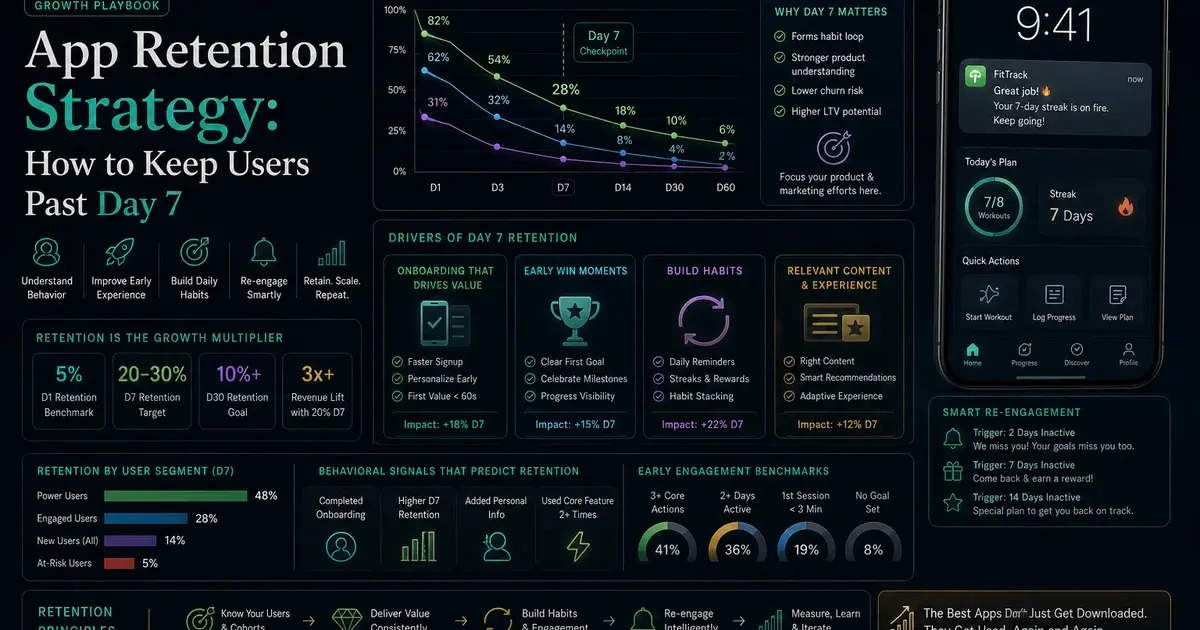
You are acquiring someone in the first week of an intention, and the event that predicts revenue is a maintained streak — not an install, not a signup, not a created habit. Instrument habit_created, then habit_completed, then streak_3 and streak_7. The 3-day streak is your activation event; the 7-day streak is your monetisation predictor.

The reasoning is mechanical. A 3-day streak is the first point at which the user has been through the whole loop: commit, forget, be reminded, return, maintain. Before it they have downloaded a to-do list; after it they have experienced the product.
| Event | What it tells you | Use it for |
|---|---|---|
habit_created |
necessary, weak alone — most installs do it | funnel diagnostics |
habit_completed |
the first check-in; the biggest leak in the category sits between creating a habit and ticking one off | soft-paywall optimisation |
reminder_enabled |
notification permission, mechanically what makes streaks possible | leading indicator and product priority |
streak_3 |
the activation event | primary target on a soft paywall |
streak_7 |
where an upgrade prompt converts | paywall trigger |
trial_start |
fires at install on a hard paywall | primary target on a hard paywall |
subscription_started, renewal_1 |
value events | tROAS |
The 3-day threshold is a practitioner heuristic, not a published benchmark — treat it as the right first hypothesis and check it against your own cohorts in month one. Phase 4 below gives the rate you need to assume in the meantime, and shows what each budget scenario can and cannot optimise to at that rate.
One product note that is really a marketing note: on iOS, ask for notification permission after the first check-in, never on launch. It is the delivery channel for the whole streak mechanic, and asking cold buys a denial you cannot re-request.
What has to be right before you spend anything?
The paywall model, because it determines your optimisation event, your measurement architecture and your media plan. Decide hard or freemium before the first campaign, instrument the streak ladder, then confirm your D7 is survivable.
Three different conversion metrics circulate in this category and they are not the same measure. Getting them confused is how a plan ends up with a target CPA that is off by a factor of five. Label the denominator every time:
| Figure | Denominator | What it actually measures |
|---|---|---|
| Health & Fitness 2.9%, Photo & Video 1.5% | installs (downloads) | share of installs that are paying by D35, by store category |
| North America 2.8%, India/SEA 0.7% | installs (downloads) | the same measure, cut by region. "Download-to-paid" and "install-to-paid" are the same denominator under two labels |
| Hard paywall 10.7%, freemium 2.1% | see below | RevenueCat labels this "trial-to-paid" |
The paywall pair is the one that will not sit still, and here is the honest resolution. A 2.1% trial-to-paid rate for freemium apps cannot coexist with a 2.9% install-to-paid median for Health & Fitness — it would mean a smaller share of trials converts than of installs, which is not possible when trials are a subset of installs. The only reading consistent with RevenueCat's own regional and category cuts is that the 10.7% and 2.1% figures are install-denominated: the share of installs that are paying by D35 under each paywall model. I could not resolve the label definitively from the published report, so treat that as my reading rather than RevenueCat's statement, and use 10.7% and 2.1% as install-to-paid rates by paywall model in any arithmetic. Everything below does.
The paywall data, with its conflict of interest already stated at the top of this post.
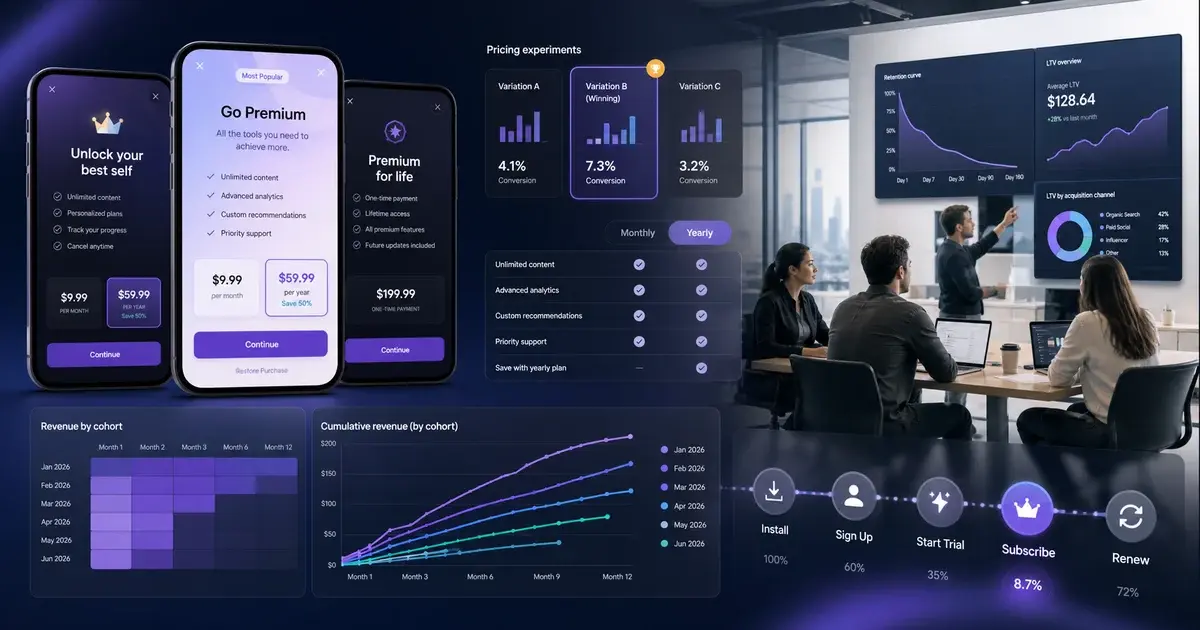
| Metric | Hard paywall | Freemium |
|---|---|---|
| D35 conversion, read as install-denominated | 10.7% | 2.1% |
| D60 revenue per install | $3.09 (₹272) | $0.38 (₹33) |
| One-year subscriber retention | 27% | 28% |
Five times the conversion, eight times the revenue per install — and the conversion advantage is not paid for in churn, since one-year subscriber retention is effectively identical. That last row is what makes the finding credible rather than merely convenient, and it is the reason RevenueCat's commercial interest does not change the recommendation.
Trial length is the other lever. Trials of 17 to 32 days convert at 42.5% against 25.5% for trials under four days, roughly 70% better. A second figure shows the mechanism: 55.4% of three-day-trial cancellations happen on day zero, 84% by day one. Short trials are cancelled at signup, before the product has done anything — close to fatal here, because a streak needs days to exist. A 30-day trial and a 7-day activation event fit each other.
The exception worth naming. Finch runs a soft paywall with a generous free tier against all of this. Its free tier is the growth engine — word of mouth, organic TikTok, a top post at 63.4 million views — and it monetises on attachment accumulated over months. A defensible exception, not a refutation, and it requires the organic engine to work first.
Churn to plan against. Annual Year-1 churn runs around 72%, with 35% of annual cancellations in month one. Read those two together and the planning consequence is blunt: for most payers, your revenue horizon is one annual term, not a multi-year LTV. Any payback tolerance you set has to be recovered inside twelve months of the first charge, and a third of your annual cohort is gone before month two.
Firebase or an MMP. Firebase costs nothing and needs no new event code once the SDK is in, but it reports to Google alone. Because a habit app's ladder runs streak_3 into Meta as well as Google, the schema has to be identical on both sides, and Firebase plus the Meta SDK gives you two definitions of the same streak event. Take an MMP the day the second paid network switches on — the fee buys one definition of streak_3, and this category has no second event to fall back on if that one drifts.
The production gate, which for this category is also your first data. Any personal Play Console account opened after 13 November 2023 has to run a closed test that 12 testers stay opted into for 14 unbroken days before production access can even be requested; organisation accounts skip this. The word doing the work is unbroken — a tester who leaves before day 14 is not counted, and one who leaves and rejoins resets the clock to zero. If a guide tells you 20 testers, it predates the current rule. Start this six weeks out, not two, and instrument it properly: fourteen days with a dozen real users is the earliest honest read you will get on whether anyone reaches streak_3 — the number every budget in this post is built on.
What does store hygiene look like for a habit app?
Two things are category-specific: health language turns a productivity app into a medical app, and your paywall is a review surface with documented rejection patterns on both stores. The copy that converts best is often the copy that gets rejected.
Apple 1.4.1 on health claims, verbatim: "Medical apps that could provide inaccurate data or information, or that could be used for diagnosing or treating patients may be reviewed with greater scrutiny. Apps must clearly disclose data and methodology to support accuracy claims relating to health measurements, and if the level of accuracy or methodology cannot be validated, we will reject your app."
Translated: no clinical claims. "Reduce anxiety", "treat depression", "improve ADHD symptoms" and "clinically proven" each convert a habit tracker into a medical app and invite rejection plus a request for regulatory documentation. Safe framing is behavioural — build routines, stay consistent, track how you feel. This constrains ad copy too. Finch's vocabulary of self-care, self-love and mood journal is careful, deliberately non-clinical, and worth copying.
Apple 3.1.2 and the auto-renew disclosures your paywall must carry. Guideline 3.1.2 requires you to clearly describe what the user gets for the price before they subscribe. The specific disclosures Apple requires an auto-renewable subscription to present, and the ones paywall copy actually gets rejected on:
- The length of the subscription period — weekly, monthly, annual, stated plainly.
- The price of the subscription, and the price per unit where that is meaningful.
- What the subscription provides — the content, services or features included.
- That payment will be charged to the Apple Account at confirmation of purchase.
- That the subscription renews automatically unless auto-renew is turned off at least 24 hours before the end of the current period, and that the account is charged for renewal within 24 hours before the current period ends.
- How the user manages and cancels the subscription, plus in-app links to your Terms of Use and Privacy Policy on the paywall itself.
That 24-hour clause is the specific line paywall copy gets rejected on. Teams write "cancel anytime" and stop. "Cancel anytime" is not the disclosure; "renews automatically unless cancelled at least 24 hours before the end of the current period" is. Put it in the paywall body copy, not in a legal sheet behind a link.
Rejections otherwise cluster on: trials hidden behind a toggle rather than disclosed upfront; a monthly price shown while billing annually; missing Terms of Use and Privacy Policy links on the paywall; a missing Restore Purchases button; exaggerated trial claims.
Hard paywalls are permitted — no guideline prohibits requiring a subscription before use — but they generate 2.1 completeness friction because a reviewer must get past yours. Supply a working demo account or reviewer bypass in App Review notes. That omission is the most common cause of hard-paywall rejection.
Apple 5.1.1(v) requires in-app account deletion if you support account creation — a frequent rejection for indie habit apps. Apple 5.1.2(vi) bars HealthKit-derived data from marketing, advertising or use-based data mining, so keep step and sleep data out of your analytics payloads entirely.
Google Play's subscriptions and cancellations policy, which this post's first draft omitted entirely — in a category whose India volume is Android and whose largest revenue leak is Play billing failures. Three requirements and one configuration:
- Renewal-terms disclosure. Play requires apps selling subscriptions to disclose the subscription terms clearly and accurately before purchase — what is included, the price, the billing frequency, and the fact and timing of automatic renewal. The disclosure has to be on the purchase surface, not in a policy page.
- A cancellation path. Play requires that users can manage and cancel a subscription easily, and that your app does not obstruct or misdirect that path. If you run an in-app cancellation flow, it must actually cancel rather than route to a retention offer with no exit.
- Introductory-offer presentation. Free trials and introductory pricing must state what the price becomes when the offer ends and when that happens, adjacent to the offer itself. A "7 days free" badge with the post-trial price a screen away is the pattern that gets flagged.
- Play Billing recovery configuration — the direct lever on the 31%. Billing failures cause 31% of Google Play cancellations against 14% on the App Store, and most of that is recoverable rather than intentional. In Play Console, configure a grace period so a failed payment keeps entitlement live while Google retries, and account hold so a further failure suspends rather than immediately cancels, giving the user a window to fix the card or mandate. Then configure restore and resubscribe so a recovered user comes back into the same entitlement rather than a fresh purchase. Wire in-app messaging to the payment-issue state so the user is told there is a problem — silent retries recover far less than retries the user knows about. This is a first-order revenue lever on Android India, not a nice-to-have, and it costs engineering days rather than media budget.
India's recurring-payments regime, which is a funnel step and not a footnote. RBI's framework for recurring transactions on cards, prepaid instruments and UPI sets two rules that shape your subscription funnel directly:
- Additional factor of authentication above the ₹15,000 per-transaction threshold. Recurring e-mandate debits below ₹15,000 can process without AFA once the mandate is registered; a debit above ₹15,000 requires the customer to authenticate that individual transaction. For a habit tracker this is a pricing decision as much as a compliance one — an annual plan priced under ₹15,000 stays inside the AFA exemption and renews silently, and essentially every viable India price point does.
- The mandatory pre-debit notification, at least 24 hours before every recurring debit. The issuer or payment operator must notify the customer ahead of each debit, with the option to opt out. That notification is a cancellation prompt arriving on the customer's phone before every renewal you did not send. It is the single biggest structural difference between India and US subscription renewal, and it is why India renewal messaging has to pre-empt the notice rather than react to it: send your own value summary before the pre-debit notice lands, not after.
Add UPI Autopay mandate setup as its own funnel step with its own drop-off, between trial_start and subscription_started. It is a separate app switch, a separate PIN entry and a separate approval screen, and users abandon inside it at a rate you will not see unless you instrument mandate_setup_started and mandate_setup_completed as distinct events. Card-on-file adds its own tokenisation friction. Measure both; they are the reason an India trial-start number can look healthy while subscription starts do not follow.
ASO fields. On iOS you get 30 characters of title, 30 of subtitle, and a hidden 100-character keyword field that should never repeat a word already in the title. Play's fields are weighted differently: a 30-character title, a short description capped at 80 characters that carries disproportionate indexing weight, and a long description of 4,000 indexed characters. HabitNow's short description — "To-do list, Habit Tracker, Routine Planner and Reminders. All in just one app!" — packs four head terms into one sentence and is the best worked example in the category. India head terms observed in listings: daily routine, study planner, study tracker, timetable, planner, habit tracker. US terms, for contrast: habit tracker, routine, streak, goal tracker, self care, mood tracker, journal. Keep "atomic habits" out of your title — high volume, trademark-sensitive. These are observations, not volumes.
India DPDP Rules 2025. A child is anyone under 18, stricter than COPPA or GDPR, and Section 9(3) prohibits outright — not consent-gated — tracking, behavioural monitoring and targeted advertising directed at children. Habit and study apps skew young in India, so if your base includes under-18s you cannot lawfully retarget them once substantive obligations become enforceable on 14 May 2027, with Consent Manager registration expected around November 2026. Design age assurance now, because the study-planner positioning that makes this category work in India is exactly the positioning that pulls in under-18s.
Phase 1, iOS: how do you structure Apple Ads for a habit app?
Run Apple's documented four-campaign structure and size it against the device reality: India iOS is roughly 4–6% of devices. In the weakest India-primary category in this series, an Apple Ads allocation much above 15% of an India-only budget is putting a fifth or a third of your money into a twentieth of your market on the strength of cheap clicks.
AppTweak's 2025 dataset — roughly 3,500 apps, 50,000 campaigns and $1B in spend across 38 countries — puts the global median cost per install at $1.80, India at $0.89 (₹78) and the US at $4.06, with India install-per-tap at 48%. Where that is your planning anchor, carry the cross-panel range: Adapty's panel of 1M+ ad groups across 90 countries puts US cost per tap at $1.58 against AppTweak's $1.91, a 21% spread on the same metric, with no India cut published by Adapty at all. Plan India at ₹78 with an explicit ±20% band, never as a point estimate.
| Campaign | Keywords | Config |
|---|---|---|
| Brand | your app or company name | exact match, Search Match off |
| Category | non-branded terms for what the app does | exact match, Search Match off |
| Competitor | similar apps in the same or related category | exact match, Search Match off |
| Discovery | finds new terms to graduate into the others | broad-match ad group with Search Match off, plus a no-keyword ad group with Search Match on |
Every keyword you run in Brand, Category or Competitor goes into Discovery as an exact-match negative, which is what keeps Discovery spending on terms you have not already bought. The 30/35/30/5 splits that circulate are a convention practitioners repeat, not something Apple has published.
Competitor is unusually productive here because branded demand is concentrated — Finch, Habitica, Streaks, Way of Life, Loop, Habitify — and these are mostly small studios unlikely to defend brand terms with a fintech's budget.
Maximize Conversions arrived on search results on 25 February 2026, and Apple's own guidance around it sets three constraints worth planning against: fund at least five conversions a day, leave it alone for two weeks before judging, and read target CPA as a weekly average rather than a per-query ceiling. Search Match is compulsory on its automatic ad group, which is straightforwardly incompatible with the exact-match discipline the four-campaign structure depends on, and Apple has published nothing reconciling the two — so pick one and give it its own budget. Pre-order campaigns cannot use it at all, so an Apple pre-order launch runs manual CPT.
Since June 2026 the only budget model is daily, lifetime budgets having been paused, and the monthly ceiling is whatever you set times 30.4. Five conversions a day against India's ₹78 CPI is about ₹390 ($4.40) — trivially clearable on installs, and, as Phase 4 shows, not clearable at all on streak_3 at a Validation-sized Apple Ads budget. That distinction is the whole Apple Ads decision in this category.
Use Custom Product Pages — up to 70 per app, search-results ad groups only — to split the study-planner framing from the self-care one. Two products, two people, two screenshot sets.
Phase 2, Android: how do you get an App Campaign to first velocity?
Android carries your India volume. App Campaigns publish their budget floors and most launches breach them anyway, so check yours against the table before you set a bid, not after Google throttles delivery: target CPI needs at least 50 times your bid as a daily budget, target CPA on an in-app action needs 10 times, and Engagement campaigns need 15 times plus 50,000 prior installs before they are available to you at all.
The learning threshold is written as a count and not a period — "Making changes to your in-flight campaign before the first 100 conversions have registered may disrupt learning" — so the question to ask of any budget is how many days it takes to reach 100 of the event you are optimising to. On a habit app optimising to streak_3, that is a slower clock than it looks; Phase 4 works it out.
Google's other documented guidance worth holding to: pick one action for target CPA and no more, bid iOS at roughly 1.5 times Android, add about 20% over baseline target CPI when you target in-app-action users, and keep Ad Strength at "Good" with an approved asset of every type in each ad group.
Asset limits worth checking before your designer starts: between one and five headlines at 30 characters each, one to five descriptions at 90, as many as 20 images per aspect ratio at 5MB apiece, and video between 10 and 60 seconds that has to live on YouTube before Google will accept it. Skip the video and Google assembles one from your store listing — for a habit app that machine-made cut will show screenshots and never show a streak counter climbing, which is the single image that sells this product.
The two deep-link failures that fail silently are worth checking on the day you launch rather than the week after. robots.txt has to let AdsBot-Google and AdsBot-Google-Mobile reach apple-app-site-association and assetlinks.json, and your measurement SDK has to have deferred deep links switched on for Android. Routing matters more in this category than most, because your entire reactivation strategy is a notification that has to land on today's check-in screen and not on a home tab.
Play pre-registration gives launch-day concentration: 90 days maximum per country, two apps at a time, a day-1 push to everyone registered, and exactly one reward for the campaign's lifetime that cannot be edited once created. The automatic install on launch day has size cliffs nobody mentions — apps up to 200MB auto-install on Wi-Fi and cellular, apps from 200MB to 2GB on Wi-Fi only, and apps above 2GB are not eligible at all. A habit tracker will usually sit in the first tier, but confirm your release bundle size rather than assuming it. One claim to resist: Google has never published anything saying pre-registration lifts your ranking. What it demonstrably does is concentrate installs into a single day. Everything beyond that is inference dressed up as mechanism.
Before you buy a burst. Two policy facts decide this, and both are worth reading in the original. Apple's February 2026 Guidelines revision introduced clause 5.6.3, "Discovery Fraud", inside the Developer Code of Conduct — a location that matters, because the remedy there is losing the Developer Program account rather than having one app rejected. The clause reads: "Manipulating any element of the App Store customer experience, such as charts, search, reviews or referrals to your app, erodes customer trust and is not permitted." Hiring someone else to do it does not help; Section 3's preamble reaches "or engage with third-party services to do so on your behalf." On the other store, Google says it strips incentivised installs out of ranking altogether before escalating to top-chart and then store removal, so you can pay in full for a burst that moved nothing — and the penalty does not stop at one listing: "any related Google Play developer accounts will also be permanently suspended." Then there is a cost specific to selling subscriptions. Purchased installs do not check off habits, do not reach
streak_3, and do not start trials. They arrive as a block of negative examples in exactly the signal your bidding runs on, and Meta and Google keep learning from them for weeks after you stop paying.
Everything a burst is supposed to produce, a coordinated launch day produces legitimately: the pre-registration cohort, an email waitlist, a PR embargo lifting, creator posts and the first paid flight all landing inside the same 24 hours. Same install curve, real users, no clause 5.6.3 exposure. On what a burst actually buys, the only independent measurement is an ACM IMC 2020 study of real incentivised campaigns, which found top-chart appearance at 3.1% baseline against 2.5% on unvetted platforms — no detectable benefit at all from the cheap end of the market.
Phase 3: how should Meta be set up for a subscription habit app?
Meta is the volume channel, and the setup decision that matters is which event you optimise to — which your paywall model already decided. App Installs is Meta's default and the right cold start. App Event Optimization is where you move once your event has volume: trial_start on a hard paywall, streak_3 or habit_completed on a soft one.
Do not build a plan around Value Optimization: it wants purchase history you will not have for months, and Meta's own documentation calls it available only to a limited set of partners and advertisers. Link Click Optimization is available and Meta tells you not to use it once the SDK is in the app, which for a subscription funnel is correct — clicks are the one signal in this category that predicts nothing.
About the learning phase: the roughly-50-events-per-ad-set-per-week figure is trade press, repeated consistently but never confirmed by Meta, whose Business Help Center is robots.txt-blocked — so cite it as trade press and never as Meta's own guidance. What matters operationally is that it resets on budget, creative, audience and optimisation-event changes alike, and that a habit app changes all four in its first quarter. The fix is structural rather than financial: run fewer ad sets carrying more budget each, so that a single reset does not idle your whole account.
Meta's Personal Attributes policy is the rule that actually rejects habit and wellness creative, and most teams have never read it. Under Meta's Advertising Standards, ads may not contain content that asserts or implies knowledge of a person's personal attributes — including health conditions, medical conditions, mental or emotional state, and physical characteristics. The test Meta's reviewers apply is a second-person implication test: does the ad, read as addressed to the viewer, imply you already know something personal about them?
That bans the highest-converting copy in this category. "Struggling to stick to anything?" implies you know the reader fails at consistency. "Can't focus?" implies a diagnosis. "Finally beat your procrastination" implies a condition and a history. All three are the copy an untrained writer produces first, and all three are rejections.
The compliant rewrite moves the claim out of the second person:
| Rejected shape | Why | Compliant rewrite |
|---|---|---|
| "Struggling to stick to anything?" | implies knowledge of the viewer's behaviour and state | "I stopped breaking my streaks in week two" — first person, the creator's claim |
| "Can't focus? Fix your ADHD routine" | implies a medical condition, and also breaches Apple 1.4.1 | "A daily routine planner with reminders that actually land" — product description |
| "Beat your anxiety with daily habits" | health claim plus personal attribute | "A calmer daily routine, one check at a time" — outcome without diagnosis |
Write the product, or write the creator's own experience. Never write the viewer's condition.
One iOS constraint sets your event priority permanently. Meta's eight-event limit per app still applies to iOS app campaigns in 2026, even though the standalone ranking tab disappeared for many web accounts, and every reordering costs a 72-hour pause on the ad sets it touches. In this category that means deciding once, before launch, that streak_3 and trial_start sit at the top — you will not want to spend three days of delivery correcting the order in month two. And if App Events reach you through the Conversions API, remember that Meta deduplicates installs automatically for 90 days but leaves post-install events, streaks included, to your own event_id discipline.
Phase 4: how much volume do you need before optimising to each rung?
Start from the published gate and reason backwards to the event, never forwards from the event you wish you could bid on. Your paywall model has already narrowed the choice, which is why that decision came several sections ago. What follows is the piece the first draft of this post was missing entirely: the rate table without which not one of these gates can be checked.

| Platform | Documented gate | Source quality |
|---|---|---|
| Apple Ads Maximize Conversions | budget supporting 5+ conversions/day | Apple, documented |
| Google ACi with tCPI | daily budget ≥ 50× bid | Google, documented |
| Google ACi with tCPA | daily budget ≥ 10× bid | Google, documented |
| Google ACe with tCPA | ≥ 15× bid and 50,000 installs | Google, documented |
| Google, all campaigns | no edits before 100 conversions | Google, documented |
| Meta | roughly 50 events per ad set per 7 days | trade press only |
What fraction of installs reaches each rung?
No published rate exists for any rung in this ladder. Habit tracking has no store category, so no MMP, ad platform or analytics vendor cuts activation data for it. Every rate below except the last is a model assumption — my planning figures, stated so you can argue with them and so you can see exactly which number the whole plan hangs on. Replace them with measured data by week three.
| Rung | Rate of installs | Count from 10,000 installs | Source |
|---|---|---|---|
| Install | — | 10,000 | your spend |
habit_created |
60% | 6,000 | model assumption |
habit_completed, first check-in |
35% | 3,500 | model assumption |
streak_3 |
15% | 1,500 | model assumption — the load-bearing one |
streak_7 |
8% | 800 | model assumption |
trial_start, soft paywall |
4% | 400 | model assumption |
trial_start, hard paywall |
25–40% | 2,500–4,000 | model assumption; the paywall fires at install, so most of the drop-off is at the paywall itself |
subscription_started by D35, India |
0.7% | 70 | RevenueCat, 115,000+ apps, D35 download-to-paid, India and SEA |
At a 15% streak_3 rate and an India Android CPI of ₹35, your effective bid on streak_3 is ₹35 ÷ 0.15 = ₹233. That single derived number is what every gate below is checked against.
Does Validation clear the gates?
On Google, yes, with room — at either split. At the 70% Android allocation this post's first draft used, Validation puts ₹2.1 lakh a month into Android India, which is ₹6,908 a day. Google's target-CPA floor is 10 times bid, and at a ₹233 streak_3 bid that floor is ₹2,333 a day. That clears it about threefold, buying 6,000 installs a month and about 900 streak_3 events a month. At the revised 85% allocation below, it is ₹2.55 lakh a month, ₹8,388 a day, clearing the same ₹2,333 floor 3.6x and buying about 7,286 installs and roughly 1,093 streak_3 a month. Either way the 100-conversion learning threshold clears inside three or four days, so you can stop touching the campaign in week one rather than week six.
On Apple Ads, it is marginal at best, and this is the finding that should change the split. At the 30% Apple Ads allocation the first draft of this post used, Validation would put ₹90,000 a month into Apple Ads India, or ₹2,961 a day. At India's ₹78 CPI that is about 38 installs a day; at a 15% streak_3 rate, about 5.7 streak_3 events a day against Apple's documented floor of 5 a day. It technically clears, by under 15%, on an assumed rate — one bad week, or a streak_3 rate of 13% instead of 15%, and Maximize Conversions is under-fed with no warning in the interface.
So I have cut the Validation Apple Ads allocation from 30% to 15%, matching the casual games and fintech posts. Two reasons, and neither is arithmetic elegance. India iOS is 4–6% of devices, so 30% was already three to seven times device share in the weakest India category in this series. And a gate you clear by 12% on an assumed rate is not a gate you have cleared.
What 15% means operationally: ₹45,000 a month, ₹1,480 a day, about 19 installs a day, about 2.8 streak_3 a day — well under Apple's 5-a-day floor. So at Validation, run Apple Ads on manual CPT optimising to installs, not Maximize Conversions on streak_3. To run Maximize Conversions against streak_3 in India you need about 33 installs a day, which is roughly ₹2,600 a day or ₹79,000 a month on Apple Ads alone — a quarter of a ₹3 lakh budget, into 4–6% of devices. Move to it at Scale, where that same rupee figure is 7% of the budget rather than 26%.
On Meta, Validation has no Meta line at all, which is deliberate: at ₹3 lakh total there is not enough left after Google and Apple to feed even one ad set to 50 streak_3 a week. Meta enters at Scale, where ₹3.6 lakh a month is ₹82,895 a week, buying about 2,368 installs and about 355 streak_3 a week — enough for seven ad sets at Meta's roughly-50 threshold.
What is the bid, and how do you get it from revenue per install?
The plan runs on trial_start as the bid target on a hard paywall, and that bid is only computable if you have a trial-start rate. Nobody publishes one. The derivation, with the assumption flagged:
target trial-start CPA = revenue per install ÷ trial-start rate × payback tolerance
RevenueCat's D60 revenue per install on a hard paywall is $3.09 (₹272) globally. India runs well below it: at roughly a quarter the conversion rate and about 40% of US pricing, India RPI lands near $0.31–0.39, or ₹27–34. Trial-start rate on a hard paywall is a model assumption of 25–40%, centred on 30% — the paywall fires at install, so the loss is at the paywall rather than downstream.
Payback tolerance is the fraction of D60 revenue you are willing to spend to acquire. Full payback at D60 is a tolerance of 1.0; a 2x target ROAS is 0.5.
| Scenario | RPI | Trial-start rate | Tolerance | Target trial-start CPA | Implied target CPI |
|---|---|---|---|---|---|
| Global hard paywall, full D60 payback | $3.09 | 30% | 1.0 | $10.30 (₹906) | $3.09 (₹272) |
| Global hard paywall, 2x ROAS | $3.09 | 30% | 0.5 | $5.15 (₹453) | $1.55 (₹136) |
| India hard paywall, full D60 payback | $0.35 | 30% | 1.0 | $1.17 (₹103) | $0.35 (₹31) |
| India hard paywall, 2x ROAS | $0.35 | 30% | 0.5 | $0.58 (₹51) | $0.18 (₹16) |
Read the bottom two rows against the India Health & Fitness Android CPI band of ₹18–53 and the picture is honest and tight: at full D60 payback you can pay up to ₹31 a install, which sits in the lower half of the band; at a 2x ROAS target you can pay ₹16, which is below the whole band. India habit-tracker UA works at the cheap end of the CPI band or it does not work. That is the same shape as the category's positioning problem, and it is why the study-planner repositioning and aggressive price localisation are media decisions, not brand ones.
Four compounding mechanisms punish optimising deeper than your volume allows, and in this category they arrive in a specific order. Delivery throttles first, because an ad set stuck under 50 streak_3 a week never leaves learning and its CPA drifts up while you watch. Then the model starts fitting noise, which is precisely why Google restricts target CPA to one action. Then your own fixes compound the problem, because each change restarts the count you were trying to accumulate. And underneath all three sits the iOS measurement floor: AdAttributionKit reports fine conversion values only in the first postback and only at crowd-anonymity Tier 2 or 3, so anything you care about that happens after day two comes back coarse, or at Tier 0 does not come back at all.
That last constraint is unusually kind to this category, and it is worth stating as an advantage rather than a caveat. A 3-day streak completes inside the days 0–2 window. A converted trial does not — a 30-day trial converts a month after the postback window has closed. So encode streak_3 as your fine conversion value on iOS, not subscription_started, and measure the streak-to-subscription ratio on Android, where GAID persists and attribution stayed deterministic after Privacy Sandbox was cancelled in October 2025. Then use that Android ratio to value the iOS streaks you can see.
What creative actually works for a habit app?
There is no before-and-after image in this category, and that is the whole creative problem. A photo app shows a transformation, a fitness app shows a body. A habit app has no visual artifact — so the streak counter is your transformation image, and a large number going up is the hook.
Finch's approach is the best available evidence and it is about volume rather than polish: roughly 610 active Meta creatives as of January 2026, an eleven-fold increase in a year, alongside heavy paid TikTok. That velocity is the strategy — high-variant UGC, not brand film. It is also a budget line, and the scenarios below carry it explicitly.
Formats that work in adjacent subscription-wellness categories: screen-recording UGC with a face and voiceover; day-in-my-life and my-routine cuts native to TikTok; the streak-milestone payoff at 100 days; and, with a companion mechanic, the character itself, legible in two seconds. No published creative research breaks out habit or self-care apps, so these are adjacent-category patterns, not measured findings for yours.
Three category-specific rules. Show the check-in interaction, not the settings screen — the appeal is a two-second action, and configuration screens make it look like work. Keep claims behavioural, because Apple 1.4.1 applies to creative and not only to store copy. And run every hook through Meta's personal-attributes test from Phase 3 before it enters production, because the highest-converting first draft in this category is almost always the one that names the viewer's problem in the second person.
What budget do you need, and what should each rung cost?
Plan against revenue per install and the target-CPA derivation in Phase 4, not against CPI in isolation. The India numbers to hold: RPI near ₹27–34 on a hard paywall, a target CPI of ₹16–31 depending on payback tolerance, and a streak_3 bid of about ₹233 at the assumed 15% rate.

Be clear about what does not exist. There is no published CPI benchmark for habit tracking apps, anywhere — no MMP, ad platform or analytics vendor cuts data by a category the stores do not have. Health & Fitness runs directionally $1.50–3 on US Android and $2–5 on US iOS, and India Android is plausibly ₹18–53 ($0.20–0.60), which is inference rather than a sourced number. Validate with a small test. Any CPI quoted with a category label and no named report, period and sample size is marketing.
The India arithmetic, from RevenueCat: India and Southeast Asia convert at 0.7% D35 against North America's 2.8%, with price medians of $3.75 monthly and $18.32 annually — roughly ₹330 and ₹1,600, about 40% of US pricing. India revenue per install therefore lands near an eighth of US. Price localisation is not optional: the viable band is roughly ₹199–399 monthly and ₹999–1,999 annually, and a one-time-purchase tier in the HabitNow mould deserves a real test. Both annual figures sit comfortably under RBI's ₹15,000 AFA threshold, so renewals process without per-transaction authentication.
On timing, AppsFlyer's State of App Monetization 2026 — January 2025 to March 2026, across $900M of in-app purchase, $800M of subscription and $7.2B of ad revenue — reports subscriptions realise only 52% of D60 revenue by day 7, against 89% for in-app advertising. That single figure is why the kill criteria below are built on leading indicators rather than on conversion outcomes: a Scale month cannot produce a D35 read on its own cohort, so any kill line written in D35 terms is a line you cannot check when you need it.
| Validation | Scale in India | India at volume | |
|---|---|---|---|
| Monthly media | ₹3,00,000 ($3,400) | ₹12,00,000 ($13,600) | ₹30,00,000 ($34,100) |
| Split | 85% Android India, 15% Apple Ads India | 55% App Campaigns, 30% Meta, 15% Apple Ads | 50% App Campaigns, 35% Meta, 15% Apple Ads |
| Apple Ads sanity check | India iOS is 4–6% of devices; ₹45,000/month, manual CPT on installs only | ₹1.8L/month clears Maximize Conversions on streak_3 with headroom |
₹4.5L/month |
| Creative production | ₹50,000/month — 25 UGC variants, one creator retainer, in-house edit | ₹1,50,000/month — 60 variants, three creator retainers, one editor | ₹3,50,000/month — 100+ variants, six creators, one editor and one motion designer |
| Android daily budget vs Google floor | ₹8,388/day against a ₹2,333/day tCPA floor at a ₹233 streak_3 bid — clears 3.6x |
₹21,711/day | ₹49,342/day |
streak_3 per month, at the assumed 15% |
~1,093 | ~2,829 | ~6,428 |
| Meta ad sets supportable | none — Meta enters at Scale | ~355 streak_3/week supports ~7 ad sets |
~1,036/week supports ~20, consolidate to 10 |
| Optimisation event | tCPI on Google, manual CPT on Apple Ads, then streak_3 once the rate is measured |
streak_3 across Google and Meta; trial_start on a hard paywall |
tROAS on subscription_started |
| What you buy | a measured streak_3 rate to replace the 15% assumption, and a real India CPI |
first velocity, a working paywall, and a mandate-completion rate | a payback curve |
| Kill criteria | see below | see below | see below |
The creative production line is not optional and is absent from most published budget scenarios. Finch runs 610 active Meta creatives; a media budget with no production line attached is a media budget that spends month three re-running the same six ads at rising frequency.
Kill criteria you can actually measure on the clock you have
The first draft of this post used "D35 trial-to-paid under 5%" for a Scale month and "payback beyond 9 months" at volume. Neither is checkable. A Scale month cannot read D35 on its own cohort, and a 9-month payback was never reconciled with the churn curve. Here is the derivation and the replacement.
The payback tolerance comes from the churn curve, not from a round number. Annual Year-1 churn runs about 72%, and 35% of annual cancellations land in month one. For most payers there is exactly one annual term of revenue, so your CAC must be recovered inside twelve months of the first charge, and you should plan on the assumption that a third of the annual cohort is gone before month two. That is where the ₹16–31 target CPI band in Phase 4 comes from: a 0.5 payback tolerance is the conservative read of a 72% churn curve, and a 1.0 tolerance is the aggressive one. Nine months was neither.
The leading indicator at week four is cost per streak_3, not any conversion metric. At a ₹233 target streak_3 bid derived from a ₹35 CPI and a 15% rate, the week-four lines are:
| Stage | Kill line at week four | Why it is checkable |
|---|---|---|
| Validation | cost per streak_3 above ₹350, or measured streak_3 rate below 9% of installs |
both are visible in week one; ₹350 is 1.5x the target bid, and 9% is 60% of the assumed rate |
| Scale | cost per streak_3 above ₹300 sustained over two weeks, or mandate-completion rate below 60% between trial_start and subscription_started |
the mandate step is where India subscription funnels fail, and it reads in days |
| Volume | blended cost per subscription_started above ₹1,000 against a ₹999–1,999 annual price, or D7 retention below 20% |
at volume you have enough D7 cohorts to read them weekly |
Keep D35 trial-to-paid as a quarterly review metric, which is the only cadence at which it exists. Reviewing it monthly produces decisions made on half a cohort.
The KPI ladder, in weekly checking order: first check-in rate, streak_3 rate, mandate-completion rate, D7 retention, trial start rate, revenue per install, then CPI. CPI is last on purpose. For D7 context, Adjust's combined cross-vertical figures — undated on the source page and matching 2022–23-era data — put D1 at 26%, D7 at 13% and D30 at 7%, with Health & Fitness D1 at 27%. No habit-tracker-specific retention benchmark exists publicly.
One more number if you are adding an AI coach: RevenueCat reports AI-featured apps show 36% worse monthly retention over 12 months but higher Year-1 realised LTV, $30.16 against $21.37. You monetise better and churn faster — in a retention-defined category, a genuine trade rather than a free win.
What breaks, and what does it cost you?
Deciding the paywall model after launch. It sets your optimisation event, so changing it invalidates campaign history and costs a 72-hour Meta cooldown when you reorder AEM events. Cost: roughly a month.

Bidding on streak_3 without measuring the rate. Every gate in Phase 4 is checked against an assumed 15%. If the real rate is 8%, your effective bid nearly doubles to ₹438, Google's target-CPA floor rises to ₹4,375 a day, and a Validation Android line of ₹8,388 a day clears it by 1.9x instead of 3.6x. Measure it in week three. Cost: a quarter of optimising against a number that was never true.
Health claims in store copy or ad creative. Apple 1.4.1 converts a productivity app into a medical app on one line of marketing copy. Cost: rejection plus a demand for accuracy documentation you do not have.
Second-person copy on Meta. "Struggling to stick to anything?" implies knowledge of a personal attribute and is rejected under Meta's Advertising Standards. Cost: the highest-converting creative concept in the category, unless you rewrite it into first person or product description before production.
A hard paywall without a reviewer bypass. The most common cause of hard-paywall rejection, avoidable with a demo account in App Review notes.
A paywall missing the 24-hour auto-renew clause. "Cancel anytime" is not the required disclosure. Cost: a rejection cycle at the point you are trying to launch.
Three-day trials. 55.4% of three-day-trial cancellations happen on day zero and 84% by day one, while 17-to-32-day trials convert at 42.5% against 25.5%. In a category whose value takes a week to appear, the short trial is self-sabotage.
Ignoring involuntary churn on Android. Billing failures cause 31% of Google Play cancellations against 14% on the App Store, and grace period, account hold and restore are configuration rather than engineering. Cost: Android revenue that never shows up in acquisition reports, in the market that carries your volume.
Treating UPI Autopay as a payment detail. Mandate setup is a separate app switch with its own drop-off, and RBI's mandatory 24-hour pre-debit notification is a cancellation prompt before every renewal. Cost: a healthy trial-start number and a subscription line that does not follow it.
Buying media to fix retention. Annual Year-1 churn runs around 72% even for apps that work. Weak D7 plus paid spend is a bigger leak, not a fix.
Frequently Asked Questions
Should I use a hard paywall or freemium for a habit tracker?+
On the data, a hard paywall with a long trial. RevenueCat's 2026 dataset of 115,000-plus apps puts D35 conversion at 10.7% on a hard paywall against 2.1% on freemium, and D60 revenue per install at $3.09 against $0.38, with one-year subscriber retention effectively identical at 27% and 28%. RevenueCat sells subscription infrastructure, so treat the framing as interested — but the identical retention row is what makes the finding hold up regardless of who published it. The exception is a working organic engine, as Finch has; then a generous free tier is a growth asset.
What fraction of installs will reach streak3?+
Nobody publishes it, and this post plans on an assumed 15%. That single number sets your effective bid (₹233 at a ₹35 CPI), Google's target-CPA floor (₹2,333 a day) and how many Meta ad sets your budget can feed. Measure it in your closed test and again in week three, and rebuild the Phase 4 table with the real figure before you scale.
What is a good CPI for a habit tracking app?+
Nobody publishes one, because habit tracking is not a store category. Derive it instead: India revenue per install of about ₹27–34 on a hard paywall, times your payback tolerance, gives a target CPI of ₹16 at a 2x ROAS target and ₹31 at full D60 payback. Against an India Android Health & Fitness band of ₹18–53, that means the cheap end of the band or nothing.
Why is my app getting installs but no subscriptions?+
Check three things in order. The first check-in rate, because the biggest leak sits between creating a habit and ticking one off. The mandate-completion rate between trialstart and subscriptionstarted, because UPI Autopay setup is a separate approval flow that users abandon inside. And whether your trial is three days long — 55.4% of those cancellations happen on day zero.
How much budget do I need to start Apple Ads for a habit app?+
Enough to clear five conversions a day on whatever event you optimise to. On installs at India's ₹78 CPI that is about ₹390 a day. On streak3 at a 15% rate it is about ₹2,600 a day, or ₹79,000 a month — which in a ₹3 lakh Validation budget would be 26% of your money going into 4–6% of India's devices. So run Apple Ads manual CPT on installs at Validation and move to Maximize Conversions on streak3 at Scale.
Is my problem acquisition or retention?+
Retention, until proven otherwise. Your product is repetition, so weak D7 means you have nothing to sell. A habit app with weak D7 cannot be fixed with media, only made more expensive.
Does a habit tracker work as an India-only launch?+
Only with a repositioning and a tight CPI. India and Southeast Asia convert at 0.7% D35 against North America's 2.8% and price at roughly 40% of US levels, but Year-1 LTV per payer is $19.32 against $26.07 — the gap is conversion, not willingness to pay. The India-viable angles are study and exam routine planning, aggressive price localisation, a one-time-purchase tier of the kind HabitNow sells to its 5 million-plus India installs, and Play Billing recovery configured properly so the 31% billing-failure churn is not paid for twice.
Sources
- RevenueCat — State of Subscription Apps 2026
- RevenueCat — 2026 subscription benchmarks summary
- AppsFlyer — State of App Monetization 2026
- AppTweak — Apple Search Ads benchmarks
- Adapty — Apple Ads benchmarks 2026: CPI & CR by niche
- Adjust — mobile app retention benchmarks
- Sensor Tower — India mobile app market Q2 2026, reported via TechCrunch
- Sparrow Apps — Finch teardown, April 2026
- Finch on Google Play India
- HabitNow on Google Play India
- RevenueFlo — common iOS paywall rejections
- Apple — App Review Guidelines
- Apple — auto-renewable subscription requirements
- Apple Ads — help and campaign guidance
- Google Play — subscriptions and cancellations policy
- Google Play — subscription grace period, account hold and restore
- Google Play — testing requirements for production access
- Google — App campaigns budget and bidding guidance
- Meta Business Help — Advertising Standards and personal attributes
- Meta for Developers — App Events and Conversions API
- RBI — processing of e-mandates on recurring transactions
- NPCI — UPI Autopay
- ACM IMC 2020 — measuring incentivized install campaigns
- Biometric Update — India notifies DPDP Rules
About the author
Amol Pomane — Founder, Vmobify
Amol leads Vmobify, a mobile app growth agency that has driven 30M+ downloads and ranked 54K+ keywords across 300+ apps since 2013. He writes about ASO, paid user acquisition, retention, and the operational reality of scaling mobile apps in India and global markets.
Model an install budget
Turn CPI and activation assumptions into acquisition scenarios.
Open free tool