Music and Podcast App Marketing: Beating Spotify in Your Niche
Spotify wins globally, but niche music and podcast apps still dominate categories like Hindi devotional, regional language, and audio-only content. Here is how.
On this page
- What does the Indian audio app market look like in 2026?
- Where do niche audio apps still beat Spotify?
- How does content strategy drive audio app acquisition?
- What is the right paid channel mix for audio apps?
- Which monetisation models work for niche audio apps?
- How do you build daily listening habits that retain?
- Frequently Asked Questions
What does the Indian audio app market look like in 2026?
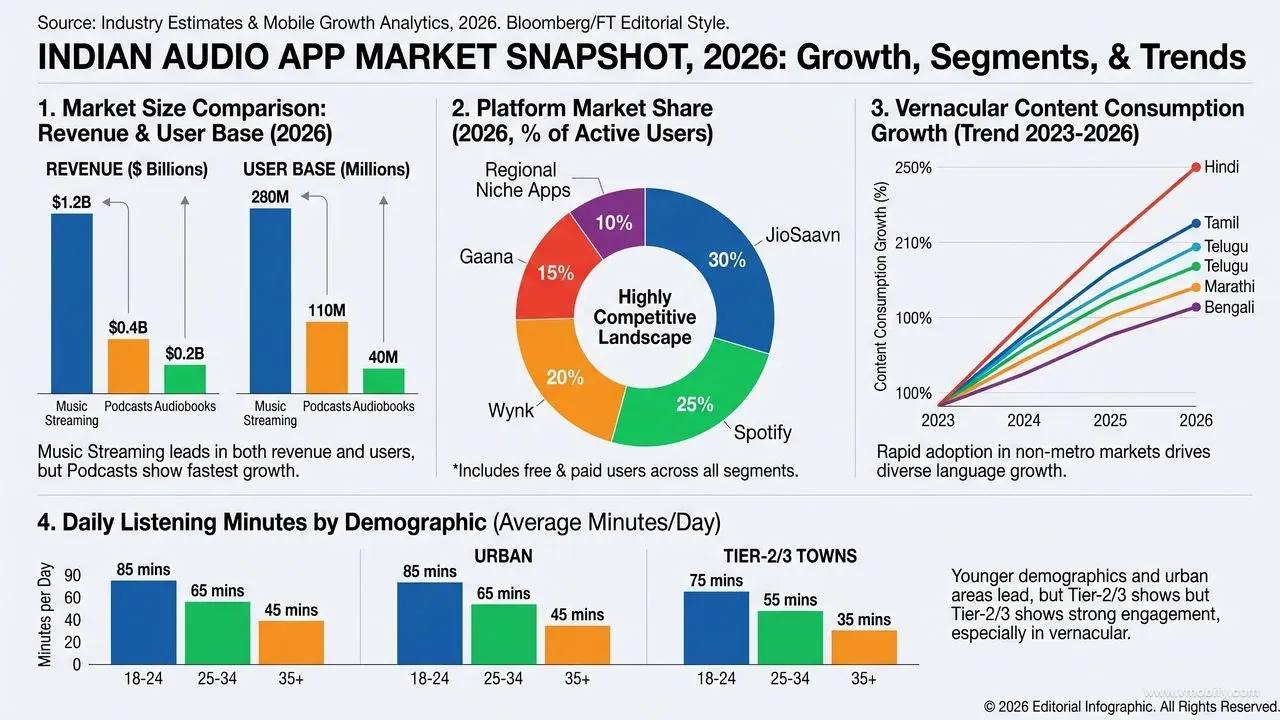
The Indian audio app market is split between four global-scale players — Spotify, JioSaavn, Wynk and Gaana — and a long tail of niche apps that quietly dominate specific categories that the giants under-serve. The niche tail is often the more interesting opportunity from a marketing economics standpoint: lower competition for keywords, clearer monetisation paths, and far less algorithmic dependence on a single playlist editor's mood.
India now has over 750 million smartphone users per Statista's smartphone forecast, and audio consumption per user is climbing faster than video as Jio's data prices stay structurally low and Bluetooth earbuds penetrate Tier-2/3 markets. The result: more listeners, more listening hours, and more demand for content that mainstream apps simply do not carry.
Categories where niche audio apps work in 2026:
- Devotional and religious audio (Hindu bhajans, Sufi qawwali, Christian gospel, Sikh kirtans, Jain stavans)
- Regional language podcasts (Tamil, Telugu, Marathi, Bengali, Malayalam, Kannada, Odia)
- Audiobooks in Indian languages — a category still largely unserved by Audible India
- Live audio rooms and voice-based social (post-Clubhouse, a localised model still works)
- Genre-specific catalogues (Indian folk, Carnatic and Hindustani classical, indie regional)
- Function-specific audio (study music, meditation, sleep stories, white noise, focus loops)
In our portfolio across 300+ apps managed since 2013, the audio apps that built durable businesses in this market did not try to be smaller Spotifys — they picked one of the categories above and went vertical. The rest of this playbook is what those teams did differently.
Two structural tailwinds make 2026 a uniquely good moment to launch a niche audio app. First, audio creator supply has caught up with demand — podcast hosts, voice actors, indie musicians, and devotional reciters all have professional recording setups they did not have five years ago, which means original content production costs have dropped 60-80%. Second, smart speaker and connected-car audio is finally meaningful in urban India; apps with good casting and Auto integration capture listening hours that did not previously exist on mobile-only platforms.
The constraint is not opportunity — it is execution discipline. Most niche audio apps fail not because the category is wrong but because the founders try to compete on Spotify's terms (mainstream catalogue, generic playlists, broad targeting) instead of doubling down on the niche advantage that justified building a separate app in the first place.
Where do niche audio apps still beat Spotify?
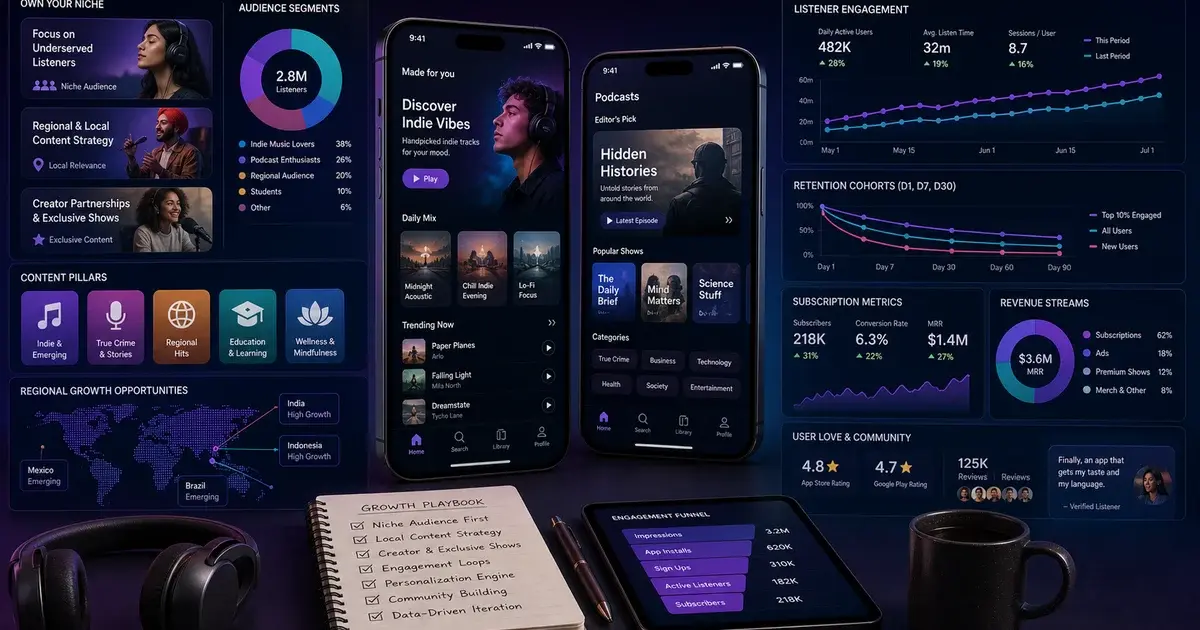
Niche audio apps win in India on four dimensions that Spotify structurally cannot match: content depth in a vertical, cultural and linguistic relevance, specialised playback UX, and a community layer around the content. Any one of these alone is a marketing edge; combining two or three creates a defensible category.
- Content depth in their niche beats Spotify's breadth. A Hindi devotional app with 500,000 bhajans organised by deity, ritual context, and time of day wins over Spotify's "Devotional" playlist of 5,000 songs every time. The user looking for a specific Hanuman Chalisa variant at 5am is not browsing a generic mood playlist — they want the catalogue.
- Cultural and linguistic relevance. A Tamil podcast app with hosts speaking colloquial Tamil retains better than Spotify's mainstream Tamil offering, which is mostly translated or globally formatted shows. Vernacular tone signals "this app is for me" — a signal Spotify's editorial team cannot fake at scale.
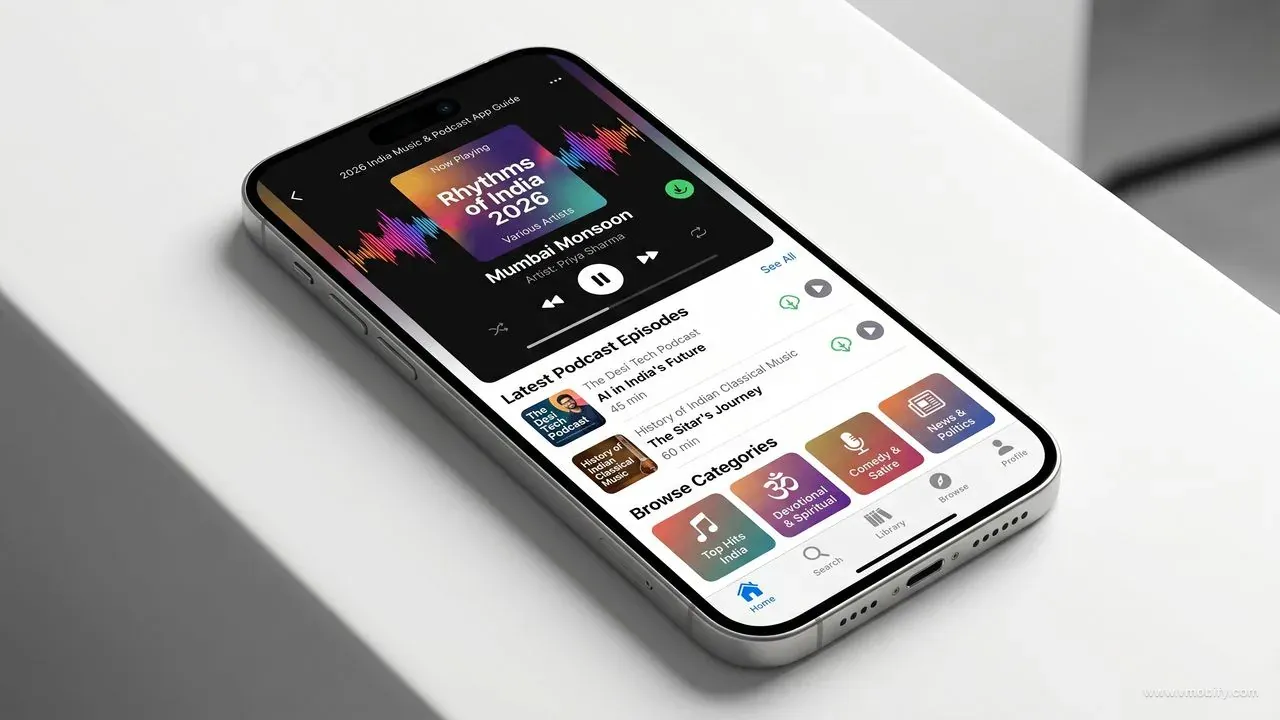
- Specialised playback UX. Devotional apps that surface lyrics, meanings, and recitation guides. Podcast apps with timestamped chapters, transcripts, and AI translation. Audiobook apps with bookmark sync and variable narrator speed. Generic players cannot match vertical-specific UX without bloating the core experience for everyone else.
- Community layer. Audio rooms, listener clubs, episode comment threads, request features, fan-curated playlists. Spotify's single-user playback model cannot compete here. Per Sensor Tower's State of Mobile reports, social audio apps with active community features show 2-3x the session frequency of pure playback apps in the same category.
The marketing implication: positioning for niche audio apps should never be "Spotify alternative." It should be "the only app for X." When we audit positioning across audio apps in our ASO portfolio, the apps with the sharpest vertical claim are the ones converting best on both store listing and paid creative.
A practical positioning test we run with audio app founders: can you finish the sentence "We are the only app where you can _____" with something concrete and verifiable? "We are the only app where you can get the full Hanuman Chalisa in 12 regional variants with lyrics and meaning in your language" passes the test. "We are a music app for India" does not. The first claim writes its own store listing, its own creative hook, and its own influencer brief. The second has to invent positioning for every channel.
Niche depth also changes the competitive dynamic with the giants. Spotify, JioSaavn and Wynk all run on programmatic editorial — their teams cannot afford to curate at vertical-specific depth across hundreds of micro-genres. A vertical app with three editors who actually understand bhajan tradition or Tamil literary podcasts will out-curate the giants' generalist teams every time. That curation gap is the moat.
How does content strategy drive audio app acquisition?
For audio apps, content production and content marketing are the same workflow — every piece of audio you publish is both a retention asset and an acquisition surface. The teams that get this right operate their content calendar as a marketing channel, not as a separate creative function.
Four content-as-marketing patterns that actually move installs:
- SEO-optimised playlist titles and descriptions. "Morning bhajans for puja," "Tamil motivational podcast," "Sleep stories Hindi," "Carnatic violin instrumental" — these long-tail search queries drive App Store search discovery the way blog post titles drive Google search. Per AppTweak's ASO research, in-app content metadata indexed by store search is one of the most underused ranking levers in audio categories.
- Original exclusive content as acquisition hook. An exclusive podcast with a recognised voice, a devotional series narrated by a known temple priest, an audiobook narrated by a film actor — these drive concentrated install bursts around launch events. We have seen exclusive launches drive 30-50K installs in the launch week for mid-sized vernacular apps in our portfolio.
- YouTube + audio crossover. Excerpt 60-90 seconds of audio content into YouTube Shorts and Instagram Reels with a "full version on the app" CTA. This is the single highest-leverage acquisition tactic for audio in 2026 — short-form video discovery is essentially free media that converts directly into app installs. Sensor Tower's State of Mobile coverage repeatedly shows audio apps with active short-form strategies outpacing peers on organic install growth.
- Lyric and transcript SEO. Indexing song lyrics and podcast transcripts (in both English and vernacular scripts) drives substantial long-tail organic search traffic from Google to your app's landing pages and deep links. Audiobook apps that publish chapter summaries similarly capture title-search demand.
Across roughly a dozen vernacular audio apps we have worked on, content-driven channels (ASO + YouTube Shorts + lyric/transcript SEO) routinely deliver 40-60% of total installs at effective CPAs under ₹10 — meaningfully cheaper than any paid channel.
The operational implication is significant: audio apps should staff content teams that own marketing outcomes, not just creative output. A bhajan curator who understands which playlist titles get searched, which clips perform on Reels, and which exclusive releases generate install bursts is worth more than a generalist marketer who does not understand the content. Re-organising the team around content-led growth is usually the highest-leverage internal change a niche audio app can make in its first 18 months.
What is the right paid channel mix for audio apps?
For most niche audio apps, the right paid mix is YouTube + Google UAC heavy for music, Meta + creator partnerships heavy for podcasts and devotional, with ASO and CPI bursts layered around content launches and festivals. Spreading thin across every channel produces noisy data; concentrating on two or three lets each one mature.
- YouTube + Google UAC (35-45% of paid spend): Audio creator content overlaps heavily with YouTube discovery — users searching for songs, bhajans, or podcast clips on YouTube are the highest-intent audience for an audio app. Google's App Campaigns documentation places YouTube placements at the centre of UAC inventory, which makes UAC the natural primary channel. See our user acquisition services for full UAC setup playbooks.
- Meta + Instagram (25-35%): Reels with audio snippets convert exceptionally well for podcast and devotional apps; demographic and language targeting is essential for religious or regional content. Indian audio CPIs on Meta typically run ₹18-45 for devotional, ₹25-55 for vernacular podcasts, ₹30-70 for English podcasts.
- ASO + organic search (not paid, but accounts for 30-50% of installs): "tamil podcast app," "bhajan app," "meditation hindi" — high-intent vertical search queries with low competitor density. Localised metadata in each target language is non-negotiable.
- Influencer and artist partnerships (10-15%): Independent artists releasing exclusive content on the platform, podcast hosts cross-promoting to other hosts' audiences, regional creators producing native-language unboxing of the app. Often the highest LTV cohort.
- CPI bursts (5-10%): Concentrated around major content launches, festivals (Diwali, Ganesh Chaturthi, Christmas, Eid), or category-specific moments. See our CPI network for managed burst execution and our 72-hour install push guide for tactical structure.
One channel-mix mistake we see repeatedly: launching paid before ASO and content infrastructure is ready. Audio apps with weak store listings burn 40-60% of paid spend on install rates below category baseline. Fix the store first, then scale.
A second common mistake: treating every regional language as a separate paid market with its own creative, but using the same English-language store listing for all of them. Localised store listings convert 2-3x better than English-only listings for users searching in Hindi, Tamil, Telugu, Marathi, and Bengali script. The listing is the bottleneck — paid traffic into an unlocalised listing wastes the premium you paid to acquire that user in the first place.
Festival timing deserves its own line item. Diwali, Ganesh Chaturthi, Navratri, Eid, Christmas, Pongal, and regional new year festivals concentrate audio consumption into 3-7 day windows when devotional, classical, and regional content sees 4-8x normal listening volume. Audio apps that pre-stage exclusive content drops, dedicated playlists, and concentrated paid bursts around these moments capture installs at 30-50% lower CPI than off-festival baselines.
Which monetisation models work for niche audio apps?
Four monetisation models work for niche audio apps in India, and the right choice depends on content type, audience price sensitivity, and DAU scale. Most mature apps end up running a hybrid; trying to force a single model usually underperforms.
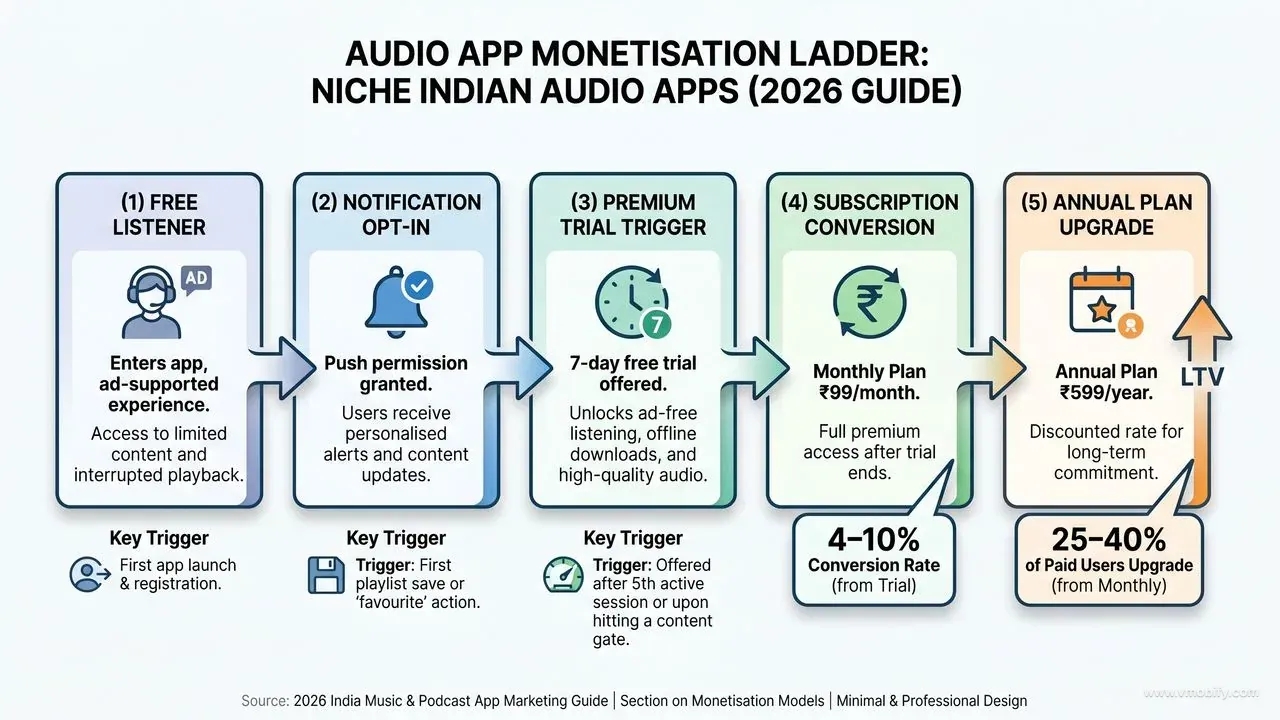
- Freemium subscription (the Spotify model): Free with ads, premium ad-free with offline downloads and exclusive content. Subscription conversion of 4-10% of monthly listeners is healthy. Requires meaningful content scale and disciplined unit economics. Devotional and regional vernacular apps trend lower (2-6%) due to price sensitivity; English podcast apps trend higher (8-15%) due to higher willingness-to-pay.
- Ad-supported only: Pre-roll, mid-roll, banner, and audio-injection ads. ARPU runs low — ₹15-40 per month per active user in India — but the model is viable for high-DAU apps with strong session frequency. Works best for music apps with passive listening; struggles for podcast apps where mid-roll breaks interrupt engagement.
- Tipping and patronage: Direct artist or podcaster support — listeners send small payments to creators they value. Becoming meaningful for indie content apps as UPI removes payment friction. Average tip size in India runs ₹20-100; high-engagement listeners can contribute ₹500-2,000 per month to favourite creators.
- Mixed (subscription + tipping + ads): Used by mature apps with diverse content types. Free listeners see ads, paid listeners get ad-free + exclusives, and tipping operates as a creator economy layer on top of both. Industry benchmarks from AppsFlyer's State of App Marketing show hybrid models delivering 30-50% higher ARPU than single-model peers in audio categories.
Across our audio app portfolio, the sequencing that has worked best is ad-supported in months 1-12 (to build DAU and creator economics), subscription layered in months 12-24 (once content depth is real), tipping added in year 2-3 (once a power-user cohort exists). Launching subscription before content depth is the most common mistake — users will not pay for a thin catalogue, no matter how good the UX.
Pricing matters as much as model selection. Indian audio subscription prices that work in 2026 cluster around ₹99/month or ₹599-799/year for vernacular content, ₹149-199/month or ₹999-1,499/year for premium English podcasts and audiobooks. Annual pricing converts at 25-40% of all paid users in our portfolio — the discount is worth it because annual subscribers churn at roughly half the rate of monthly subscribers and produce predictable revenue that funds further content investment.
The arithmetic is worth doing before you commit to a model. Take a vernacular app with 100,000 monthly listeners. At the 2-6% band devotional and regional apps actually see, that is 2,000-6,000 paid users, or ₹1.98-5.94 lakh of monthly subscription revenue at ₹99. Set that against acquisition: at a ₹25-55 vernacular podcast CPI and an effective CPA of 8-15x CPI per retained subscriber, every paying user costs ₹200-825 to acquire. That gap is why content-driven installs at under ₹10 effective CPA decide whether the payback period is survivable for a bootstrapped team.
Family and creator-shared plans are an under-used lever in Indian audio. A family plan at ₹149/month covering four accounts produces lower per-user ARPU but materially higher household lock-in and significantly higher LTV. Devotional and music apps see the largest family-plan uptake; podcast apps less so because podcast listening is more individual.
How do you build daily listening habits that retain?
Audio app retention is fundamentally a habit-formation problem — the apps that win build themselves into specific moments of the user's day and then defend those moments relentlessly. Catalogue size matters far less than ritual depth.
- Time-of-day push notifications. Morning bhajan reminders for devotional apps. Evening podcast suggestions for commute audio. Late-night sleep stories. Personalised to the user's past listening pattern, not blasted on a flat schedule. Personalised time-of-day push consistently lifts D7 retention by 15-25% in our portfolio.
- Daily and weekly playlist refreshes. The "Discover Weekly" model is borrowed from Spotify because it works — predictable cadence creates anticipation, and the playlist itself is a re-engagement hook. For podcast apps, a "this week's must-listens" digest fills the same role.
- Streaks and listening goals. "5-day listening streak," "completed 10 podcasts this month," "100 minutes of meditation logged." Gamification works in audio because consumption is naturally repetitive — the streak is a true signal of habit depth, not a vanity metric.
- Smart offline downloads. Critical for Indian users on data-conscious plans and for commuters with patchy connectivity. Auto-download of subscribed shows on WiFi, smart prefetch of likely-next tracks, and clear data-saver toggles. Apps without quality offline experiences churn 30-40% faster in Tier-2/3 markets.
- Library building and personalisation. Personal playlists, favourites, listening history, "continue listening" surfaces. Every item a user adds to their library is a switching cost — the more they build, the harder it becomes to leave. This is the single most underrated retention mechanic in audio.
The failure mode to watch here is push fatigue, and it surfaces long before retention numbers move. The sequence is always the same: a team sees personalised time-of-day push lift D7, so they add a second daily send, then a third for new episode alerts, then a fourth for festival content. Notification opt-out rate is the early warning signal — track it weekly, because it deteriorates well ahead of D30, and once a listener disables notifications on a devotional or podcast app you have lost the only reliable way back into their listening ritual. The fix is unglamorous: cap the app at one scheduled daily send, anchor it to the user's observed listening window rather than a marketing calendar, and treat any rise in opt-outs as a spend problem, because every opted-out user has to be re-acquired at full CPI.
For deeper retention frameworks across all categories see our app retention strategy guide. Talk to our team if you want a managed audio app launch or growth programme, or browse our case studies for examples of vernacular content apps we have scaled from launch through subscription rollout.
Frequently Asked Questions
Can a new music app compete with Spotify in India?+
Not on Spotify's terms (mainstream catalogue + global artists). On niche dimensions — devotional, vernacular podcasts, regional music, function-specific audio — yes. Spotify has limited depth in many Indian niches and that gap is durable.
What is a realistic subscription conversion for audio apps?+
4-10% of monthly listeners converting to paid is healthy. Devotional and regional vernacular apps trend lower (2-6%) due to price sensitivity; English podcast apps trend higher (8-15%) due to higher willingness-to-pay among urban listeners.
How important is offline listening for Indian audio apps?+
Critical. Indian listeners use offline mode heavily due to data and connectivity considerations, particularly in Tier-2/3 markets and during commutes. Apps without quality offline downloads and smart prefetch churn 30-40% faster than peers.
Should audio apps invest in original exclusive content?+
Yes, if budget allows. Exclusive content drives concentrated install bursts around launch and reduces churn for committed listeners. Premium podcasts with known voices and exclusive music drops are the highest-ROI exclusive types.
What is the best paid channel for niche audio apps?+
YouTube + Google UAC for music apps because audio search intent overlaps heavily with YouTube. Meta + Instagram Reels for podcasts and devotional content because demographic and language targeting is precise. Most apps end up running both.
How much does it cost to acquire an audio app user in India?+
Indian audio CPIs typically run ₹18-45 for devotional, ₹25-55 for vernacular podcasts, ₹30-70 for English podcasts, and ₹20-40 for music apps. Effective CPA (cost per retained subscriber) typically runs 8-15x CPI depending on conversion funnel quality.
What is the biggest mistake niche audio apps make?+
Launching subscription before content depth is real. Users will not pay for a thin catalogue, no matter how polished the UX. Build ad-supported DAU and content scale first, then layer subscription once the catalogue can justify the price.
Sources
- Statista — Smartphone Users in India Forecast — Total addressable market sizing for Indian audio apps — 750M+ smartphone users in 2026
- Sensor Tower — State of Mobile — Session frequency and engagement benchmarks for social audio vs single-user playback apps
- AppTweak — ASO Blog — In-app content metadata as an under-used App Store search ranking lever
- Sensor Tower — State of Mobile — Short-form video crossover as the leading organic growth driver for audio apps in 2026
- Google Ads — App Campaigns Help — YouTube placement weight inside UAC inventory — primary rationale for UAC-led music UA
- AppsFlyer — State of App Marketing in India — ARPU benchmarks comparing single-model vs hybrid monetisation for audio apps
- Statista — India Mobile Internet Usage — Data-cost trends underpinning audio consumption growth in Tier-2/3 India
About the author
Amol Pomane — Founder, Vmobify
Amol leads Vmobify, a mobile app growth agency that has driven 30M+ downloads and ranked 54K+ keywords across 300+ apps since 2013. He writes about ASO, paid user acquisition, retention, and the operational reality of scaling mobile apps in India and global markets.
Model an install budget
Turn CPI and activation assumptions into acquisition scenarios.
Open free tool