Gaming App Marketing: Complete Guide for Hyper-Casual and Mid-Core
Gaming is the largest mobile category in India by install volume — and the most ruthless on CPI economics. Here is the playbook for hyper-casual, mid-core, and real-money apps.
On this page
- What does the Indian gaming market look like in 2026?
- How do gaming category economics compare?
- How do you market a hyper-casual game in India?
- How does mid-core game marketing differ from hyper-casual?
- How do you market a real-money gaming app inside Indian regulation?
- Which creative formats actually work for Indian gamers?
- How should retention and monetisation be tuned per sub-genre?
- What is the right channel mix for each game type?
- Frequently Asked Questions
What does the Indian gaming market look like in 2026?
India is the world's largest mobile gaming market by user count — over 500 million mobile gamers — but it is one of the toughest for monetisation, with ARPU averaging 5-8x lower than the US and willingness to pay concentrated in a thin top decile. This combination shapes everything about how you market a game here: install volume is cheap, but turning installs into revenue requires precision other markets do not demand.
Three macro trends define 2026. First, hyper-casual is consolidating. The "ship 100 games and see which sticks" model is fading because Indian users have moved up the engagement curve and tolerate fewer shallow titles. Sensor Tower's State of Mobile reporting shows session-length per gamer rising consistently year over year, which favours games with deeper meta-loops over pure single-mechanic titles.
Second, mid-core RPGs and casual strategy games are exploding. Coin Master clones, Mob Control variants, Clash of Clans-style base builders are pulling serious revenue from Indian Tier-1 and Tier-2 players. The audience is now willing to pay ₹100-₹500 monthly on a single title — provided live-ops keep the loop fresh.
Third, real-money gaming has restructured. GST changes in 2023-2024 reshaped unit economics; surviving operators (Dream11, MPL, Junglee, A23) are stronger, more concentrated, and now compete on retention and withdrawal-experience rather than first-deposit bonuses alone. Across our 300+ apps managed since 2013, the gaming portfolio specifically requires sub-genre-specific UA, creative, and retention stacks — there is no "gaming playbook" anymore. There is a hyper-casual playbook, a mid-core playbook, and an RMG playbook, and they share almost nothing.
The smartphone base supporting this market — forecast at 1.1 billion users by 2027 per Statista — continues to expand cheaper install supply into Tier-2/3 geographies, which is why blended CPIs in Indian gaming remain the lowest of any major market. The flip side is that the marginal Tier-3 install monetises far below a Tier-1 install on every category except hyper-casual, where ad-based monetisation is geo-agnostic. Most gaming studios that fail in India fail because they over-acquire the cheap geography for a category that needs the expensive one.
One additional structural shift: short-form video consumption (Reels, Shorts) has rewired discovery for casual gamers. A creative that goes viral on Reels now produces install spikes that rival paid bursts — and the same creative, repurposed as a paid ad, runs cheaper because Meta's signal-density on the organic format transfers into the paid auction. Studios that ignore the organic-to-paid creative pipeline give up a structural cost advantage.
How do gaming category economics compare?
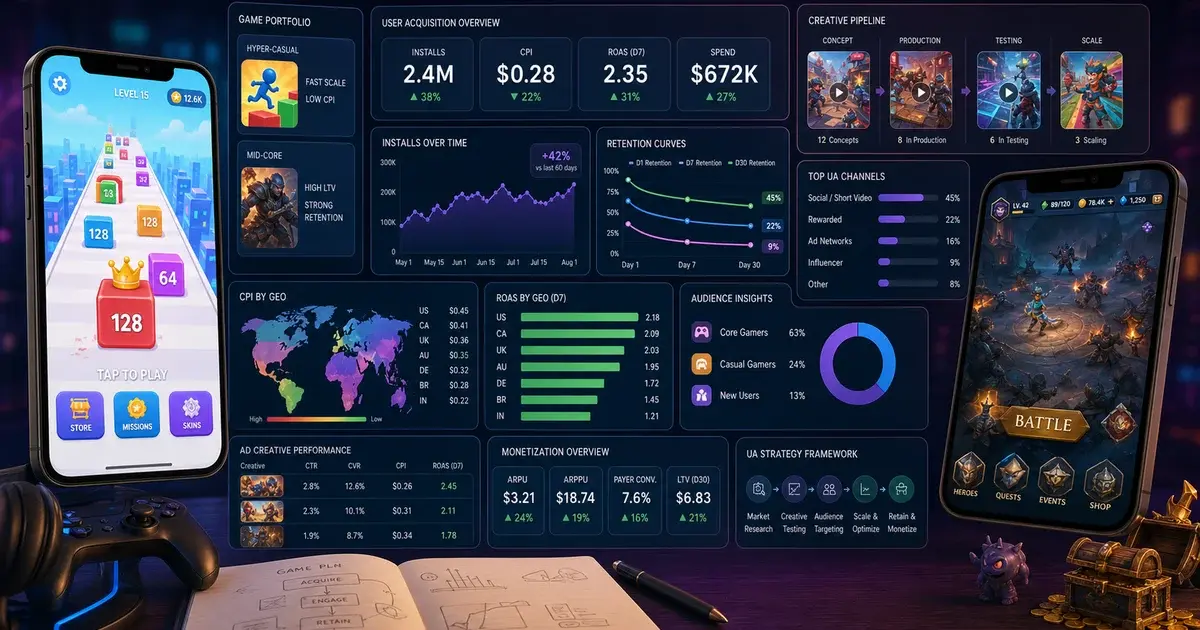
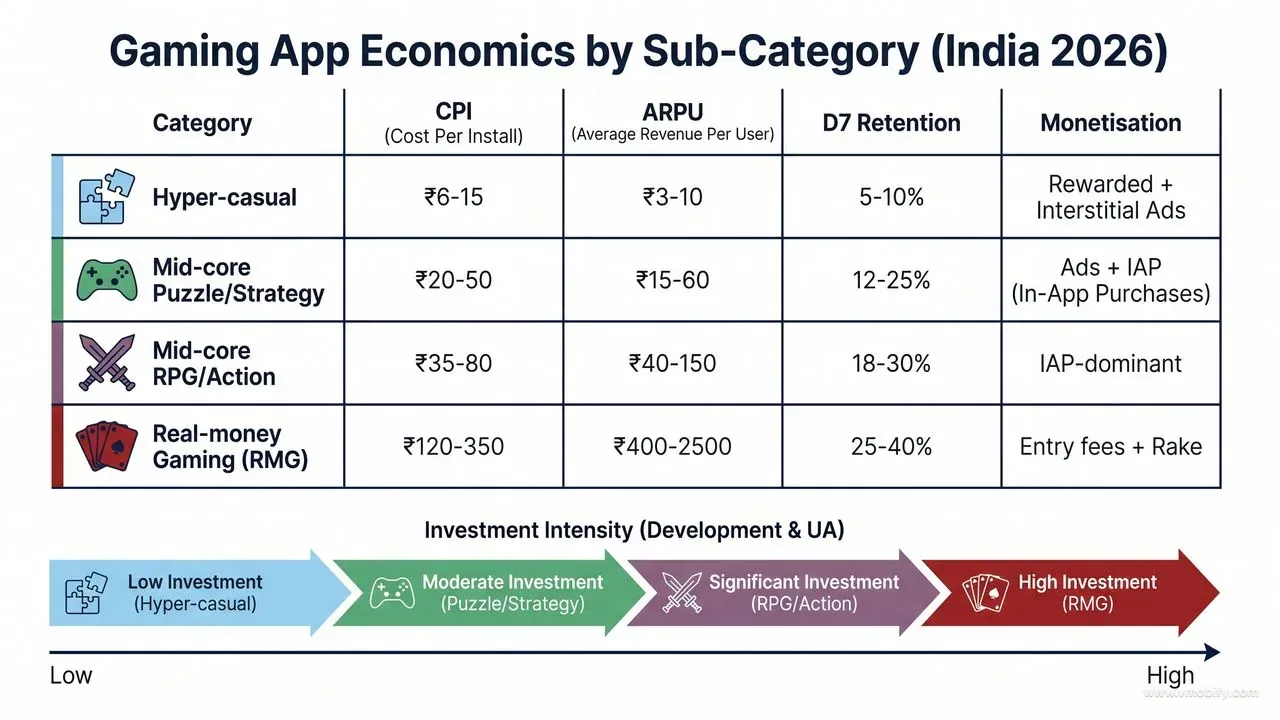
Each gaming sub-category has fundamentally different CPI, ARPU, and retention benchmarks — and a strategy that works for one will lose money in another. Indian benchmarks, current to 2026 across our portfolio and cross-referenced with AppsFlyer's Performance Index:
Hyper-casual
- CPI: ₹6-15
- ARPU: ₹3-10
- Monetisation: rewarded video + interstitial ads
- Retention: D1 25-35%, D7 5-10%
Mid-core casual (puzzle, casual strategy, match-3)
- CPI: ₹20-50
- ARPU: ₹15-60
- Monetisation: ads + IAP
- Retention: D1 35-45%, D7 12-25%
Mid-core RPG / action / multiplayer
- CPI: ₹35-80
- ARPU: ₹40-150
- Monetisation: IAP-dominant with battle-pass and limited-time offers
- Retention: D1 40-55%, D7 18-30%
Real-money gaming (fantasy, rummy, poker, ludo cash)
- CPI: ₹120-350
- ARPU: ₹400-2,500 (heavily concentrated in top 5%)
- Monetisation: entry fees + rake
- Retention: D1 50-65%, D7 25-40%
The strategic question is whether your unit economics work at your category's blended CPI. Hyper-casual lives or dies on creative output volume; mid-core lives or dies on LTV depth; real-money lives or dies on first-deposit conversion rate. Choose the wrong KPI for your category and you will scale a losing business confidently.
One nuance: the CPI ranges above are blended India numbers. Splitting Tier-1 (metros) from Tier-2/3 generally reveals a 2-3x cost gap, meaning Tier-2/3-only campaigns can run at the low end of these ranges or below. See our India CPI benchmark guide for the geo split.
How do you market a hyper-casual game in India?
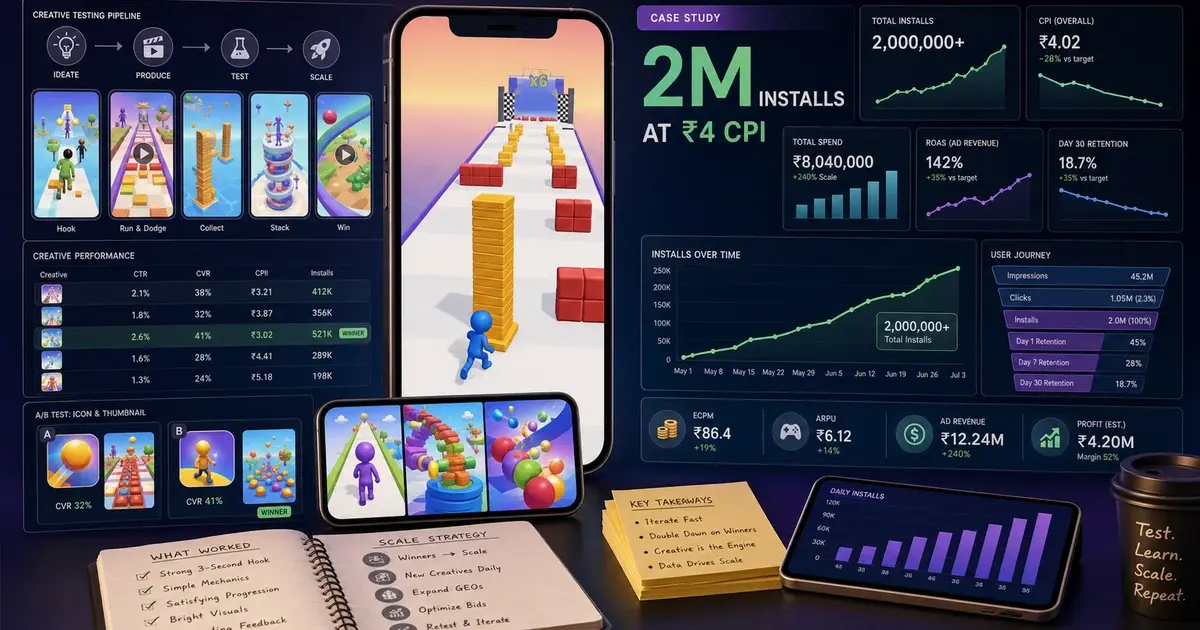
Hyper-casual is a creative-output business disguised as a game studio — the team that ships the most creatives across the most concepts wins, and everything else is downstream of that. The Indian-market playbook we run for hyper-casual portfolios:
- Test 3-5 games per month with minimum viable creatives. Kill anything where D1 retention is below 30% or blended CPI is above ₹15 within the first 5,000 installs. The cost of carrying a losing title is the opportunity cost of the next test.
- Spend 80% of paid budget on Meta, TikTok, and AppLovin — the algorithmic ad networks where hyper-casual creative formats and short attention loops perform best. Meta Advantage+ App Campaigns are the workhorse channel because Meta's signal density on casual gameplay clicks is unmatched.
- Run 30+ creatives per month per surviving game. Hyper-casual creative fatigue is brutal — winning creatives can decay in 7 days as Meta's auction exhausts the impressionable audience. Pipeline output is the bottleneck on scale.
- Monetise via rewarded video first, interstitial second. Indian hyper-casual ARPU is too low for any IAP strategy to dominate; ad waterfall optimisation through AppLovin MAX or LevelPlay is where 70-80% of revenue lives.
- Cut ruthlessly. If a game's blended ROAS at D30 is below 1.2x, kill it and move spend to the next title. The temptation to "fix" a losing hyper-casual game almost never pays off; the fix is the next concept.
The creative pipeline operations matter more than the creative talent. Studios winning at hyper-casual run dedicated motion designers, a brief-to-edit cycle under 48 hours, and a daily creative review meeting where losers are pulled and winners are scaled 2x. In our portfolio, the difference between a profitable hyper-casual studio and an unprofitable one is rarely the game design — it is the velocity of the creative pipeline supporting paid UA.
A second operational reality: hyper-casual measurement runs almost entirely on Android in India because iOS install share is in the low single digits for this category. That means SKAdNetwork complexity is largely sidestepped, but it also means Android fragmentation (low-end devices, RAM constraints, regional OS variants) becomes a creative and product constraint. Games that crash or stutter on sub-2GB-RAM Android handsets will see D1 retention collapse regardless of how good the creative is — QA on the bottom 30% of the device curve is non-negotiable.
How does mid-core game marketing differ from hyper-casual?
Mid-core games can absorb 3-5x higher CPIs because LTV is meaningfully higher — but only if you build cohort LTV models early and optimise paid spend on deep funnel events, not installs. The playbook shifts from "creative volume" to "audience precision and depth":
- Build cohort LTV models early. Know your D30, D90, D180 LTV by acquisition source before scaling spend. A mid-core game scaled on install-CPA alone almost always under-monetises because the source mix skews toward shallow players.
- Optimise on deep events. Train UAC and Meta on "completed tutorial," "reached level 10," "first IAP" — not just install. Google's UAC documentation is explicit that algorithm performance scales with event quality, not event quantity.
- Invest in playables and long-form video creative. 30-60 second narrative videos that show the full gameplay loop convert better than 6-second hooks for mid-core. The player needs to imagine spending hours in the game, not seconds.
- Layer in influencer and community marketing. Mid-core players consume game content on YouTube and Discord; presence in those channels compounds organically and feeds back into paid CPI through branded-search lift.
- Run live-ops aggressively. Events, seasons, limited-time IAPs, battle-passes drive both retention and the revenue ramp that justifies higher acquisition CPIs.
The LTV-to-CAC ratio is the single number that matters. We target 3x LTV:CAC at D90 for mid-core games before allowing major scale-up — anything below 2x signals either a CPI problem (creative or audience), a monetisation problem (IAP funnel), or a retention problem (live-ops cadence). Each of those problems has a different fix, and conflating them is the most common failure mode we see across the mid-core portfolios we audit.
One operational note: mid-core measurement on iOS post-SKAdNetwork is much harder than on Android. SKAdNetwork's conversion-value framework requires careful schema design to capture the deep events your bidding needs. Budget engineering time for this; it is not a "set up your MMP and forget" decision.
How do you market a real-money gaming app inside Indian regulation?
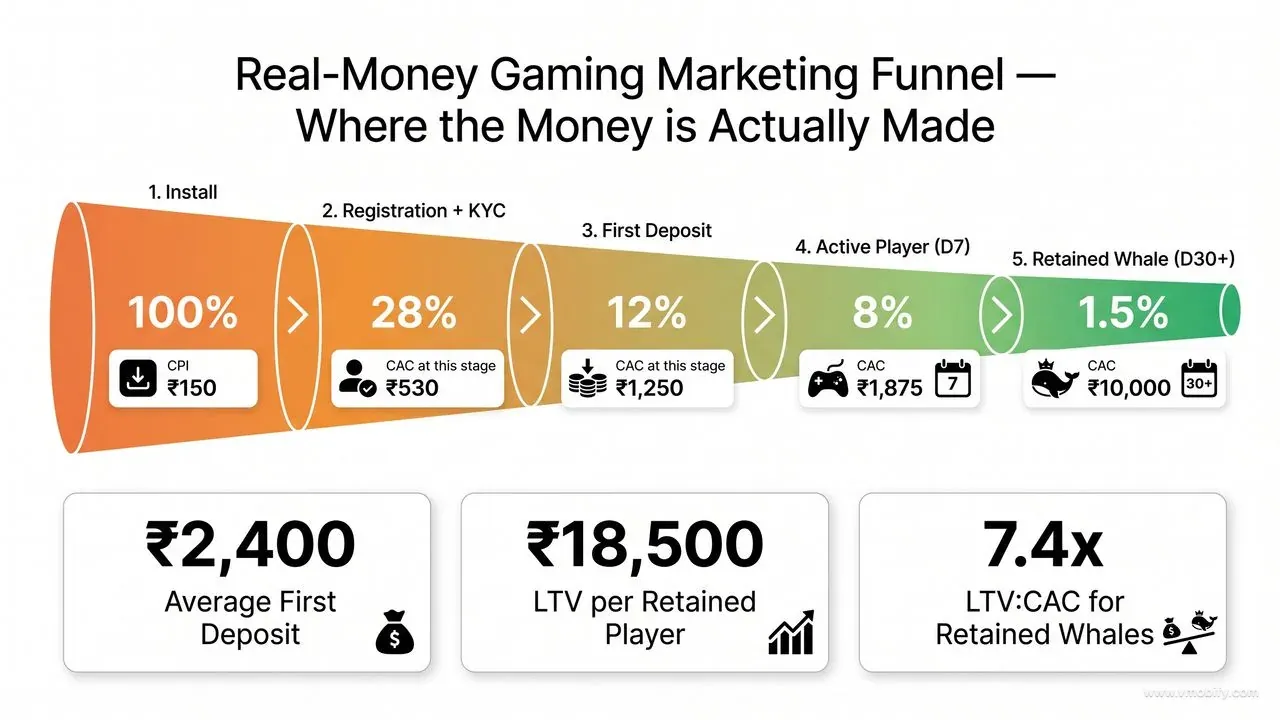
Real-money gaming in India is one of the highest-LTV verticals in mobile globally — and one of the most operationally complex because marketing is shaped by regulation as much as by user psychology. The compliance perimeter, first-deposit funnel, and KYC drop-off rate determine whether the economics close — install volume is noise.
- Compliance is the first hurdle. Different Indian states have different rules; some prohibit specific RMG formats entirely. Marketing must geo-block restricted states cleanly at the campaign level. Both Google and Meta require advance policy registration for RMG advertisers, and Apple's App Store Review Guidelines impose additional restrictions on real-money gaming distribution.
- First-deposit conversion is the metric that matters. Install is cheap noise; first deposit is the real conversion. Tune attribution, creative testing, and bid optimisation around the first-deposit funnel — install-to-deposit ratio in healthy RMG operations runs 8-15%, and a 2-point lift on that ratio is worth more than any CPI improvement.
- Trust signals dominate creative. Withdrawal speed, payment provider logos, RBI-licensed PSPs, KYC simplicity, fairness audits — these convert in RMG creatives more reliably than any "win ₹10 lakh" claim. Indian users are sceptical of RMG promises and reward operators that look operationally serious.
- Retention is everything. RMG LTV is concentrated in players who stay past day 30. Push notifications, withdrawal experience, fair-play perception, and KYC simplicity drive whether a deposited user becomes a sustained payer or churns within 14 days.
- Reactivation campaigns are huge. Lapsed depositors are a major revenue source — re-engagement push + email + WhatsApp + paid reactivation through Meta and Google often beats new acquisition on ROAS by 2-3x.
One under-discussed lever: KYC completion rate. Players who fail KYC the first time rarely come back — the fastest single ROAS improvement we have implemented across RMG clients is reducing KYC friction (Aadhaar e-KYC, document upload UX, instant verification) so that deposit-intent users actually convert. A 10-point lift in KYC pass-rate often outperforms a 30% CPI reduction on overall revenue.
The other structural reality of Indian RMG is the .apk-distribution constraint on Android: most major RMG operators distribute outside the Play Store due to Google Play's RMG policy restrictions in many sub-categories. That makes web-to-app funnels (Meta and Google ads driving to a landing page that hosts the .apk install) the dominant flow. Landing-page conversion rate, .apk download success rate, and first-open rate become the funnel stages that matter — and each needs its own optimisation surface. Studios that try to run RMG marketing as if it were a Play-Store-native funnel consistently under-perform peers that engineer the web-to-app flow end-to-end.
Which creative formats actually work for Indian gamers?
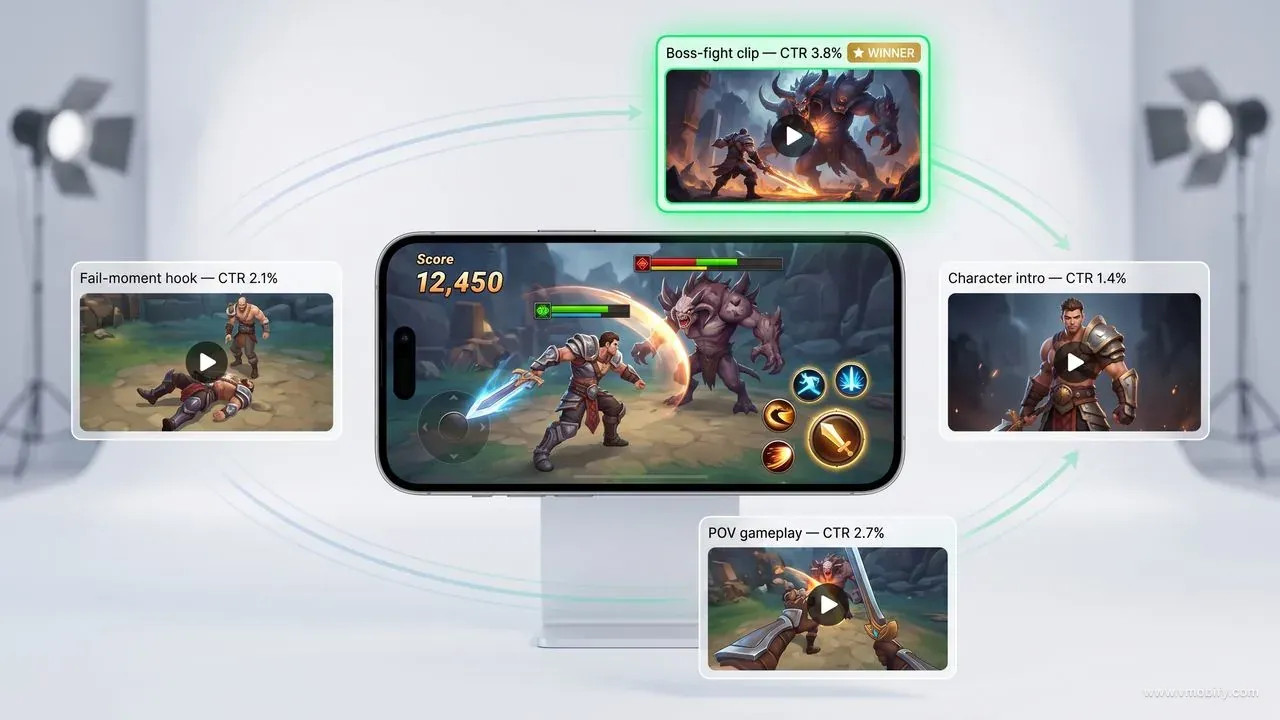
Three creative templates consistently outperform across Indian gaming — and each maps to a specific sub-genre and psychological hook. Generic studio-produced "feature highlight" creatives lose to all three.
- "Fail" hooks for hyper-casual: First 2 seconds show a near-fail or stupid mistake; next 3 seconds show a satisfying win. The cognitive pattern (problem → resolution) drives click-through because viewers instinctively want to "fix" the failure they just watched.
- Playable previews for mid-core: Mini interactive demo of a level, combat encounter, or base-builder loop. Strong for tutorial-completion rate because players have already self-selected by engaging the playable. CPI reductions of 25-40% are typical when a working playable replaces video for mid-core campaigns.
- "User reaction" UGC for RMG: Real (or carefully staged) reactions to wins and successful withdrawals. Builds trust faster than studio-produced creative because RMG users specifically distrust polished marketing claims.
- Vertical 9:16 format dominates Reels, Shorts, TikTok, and in-app rewarded placements. Square (1:1) and landscape (16:9) underperform by 20-40% in Indian gaming auctions across our portfolio.
- Hindi voiceovers + English on-screen text is the highest-converting bilingual format for Tier-2/3 reach. Pure English creatives plateau around metro audiences; pure Hindi creatives miss the English-comfortable Tier-1 segment that pays best in mid-core.
The operational discipline that separates winners from losers is the test-and-pause cycle. Hyper-casual studios run daily pause meetings; mid-core teams run weekly. Either cadence is fine — running neither is the failure mode. Coupling creative iteration to a sharpened ASO listing means paid spike traffic actually converts when it lands on your store page.
How should retention and monetisation be tuned per sub-genre?
Acquisition strategy is downstream of retention and monetisation — the same CPI looks profitable or disastrous depending on what happens after the install. Each sub-genre has a distinct tuning surface:
- Hyper-casual: Optimise ad density and rewarded video frequency. Too few interstitials and ARPU collapses; too many and D7 retention drops 5-10 points. The sweet spot is usually 1 interstitial per 2-3 game-overs plus rewarded video on level rewards. Adjust's mobile app trends reports consistently show this density band as the revenue-maximising configuration.
- Mid-core: Optimise the IAP funnel — first-purchase ratio, average revenue per payer (ARPPU), repeat-purchase rate. Each is a separate experiment surface and each rewards different mechanics: starter packs lift first-purchase ratio; battle-passes lift repeat-purchase; limited-time offers lift ARPPU on the existing payer base.
- Real-money: Optimise withdrawal experience, KYC simplicity, and reactivation triggers. The single highest-ROI investment in most RMG operations is reducing first-withdrawal friction; players who successfully withdraw once become 3-4x more likely to redeposit.
Across all three sub-genres, push notification strategy matters enormously. A well-timed D1 push lifts D7 retention 15-25% for most games — and the cost is zero. The two highest-ROI pushes in our gaming portfolio are: (1) D1 morning push reminding the player about an unfinished session, (2) D3 evening push announcing an event or limited-time reward. Operators that do not run a structured push strategy are leaving 10-20% of LTV on the table.
One final note on monetisation: ad-mediation choice (AppLovin MAX, LevelPlay, AdMob bidding) matters more than most studios realise. We have seen 15-25% ARPU lift purely from migrating a hyper-casual title from a single network to bidding-based mediation. If your monetisation lead has not run a mediation A/B test in the last 6 months, that is usually the first thing to look at.
What is the right channel mix for each game type?
Channel mix should be set per sub-genre, not per studio — running the same Meta/UAC split across hyper-casual and mid-core under-uses the strongest channel for each. The mixes below are starting points we have validated across Indian gaming portfolios; they should be re-tuned monthly based on incremental CPI by channel.
Hyper-casual
- 35% Meta (Advantage+)
- 30% AppLovin/IronSource (network bidding)
- 20% TikTok (rising fast on Indian hyper-casual audiences)
- 10% Google UAC
- 5% other (Mintegral, Unity)
Mid-core casual
- 40% UAC
- 35% Meta
- 15% TikTok
- 10% programmatic (Liftoff, Moloco)
Mid-core RPG/action
- 35% UAC
- 30% Meta
- 20% programmatic
- 10% TikTok
- 5% influencer/community sponsorship
Real-money gaming
- 50% Meta (where category-allowed)
- 25% UAC
- 15% performance affiliate (Indian RMG-specialist networks)
- 10% creator/influencer in regional languages
Two operational principles cut across all four mixes. First, treat each channel as a separate budget with its own CPI ceiling — averaging across channels hides the channel that is leaking. Second, layer a small (5-10%) CPI burst budget on top of the core algorithmic spend during launch weeks and live-ops moments; the velocity signal amplifies organic acquisition for 2-4 weeks after the burst, as covered in our fastest installs playbook.
For sub-genre-specific creative production, MMP setup, and channel management across hyper-casual, mid-core, and RMG, talk to our gaming team. We run published case work across all three sub-genres in our results portfolio.
Frequently Asked Questions
Is hyper-casual still viable in India in 2026?+
Less viable than 2020-2022. Surviving studios run 5+ games concurrently with disciplined kill-criteria (D1 below 30% or CPI above ₹15 = kill). Single-title hyper-casual launches rarely produce positive ROAS now; portfolio-of-bets is the only viable model.
What CPI should I target for a new mid-core game?+
Soft launch target: ₹40-60 blended CPI with D7 retention above 18% and a positive trend on cohort LTV. Scale only when both targets hold over a 14-day window and the LTV:CAC ratio projects above 3x at D90.
Can I run real-money gaming ads on Meta and Google?+
Yes, in approved states with proper licensing and advance policy registration with both platforms. Non-compliance leads to account bans, not just ad rejections — RMG ad policy violations are treated as platform-level offences.
How important are playables for gaming UA?+
For mid-core, very. A working playable can lower CPI by 25-40% and lift D7 retention because users self-select. For hyper-casual, less critical than fast-iterating video creatives because the gameplay is already obvious from a 6-second clip.
Which Indian gaming sub-categories are growing fastest?+
Mid-core RPG, real-money fantasy, narrative casual games (story + match-3 hybrids), and word/trivia games — all growing 30%+ year-over-year in install and revenue terms across our portfolio.
What is the right organisational structure for a hyper-casual studio?+
Dedicated creative pipeline (motion designers + UGC editors), a UA pod per active title, a shared monetisation/ad-mediation lead, and a daily kill-or-scale meeting. The creative pipeline is the bottleneck — over-invest there before adding game designers.
How much should I budget for an RMG launch in India?+
Minimum ₹50L for a credible 90-day launch covering creative production, geo-targeted Meta + UAC + affiliate spend, KYC infrastructure tuning, and reactivation flows. RMG CPIs in the ₹120-350 range mean smaller budgets produce too little signal to optimise on.
Sources
- AppsFlyer Performance Index — Gaming category CPI, retention, and ROAS benchmarks by geography
- Sensor Tower — State of Mobile — Indian gaming session-length, downloads, and revenue trend data
- Statista — Forecast of Smartphone Users in India — Smartphone base sizing — context for Tier-2/3 install supply
- Meta — Advantage+ App Campaigns — Official Meta guidance — primary channel for hyper-casual and casual mid-core in India
- Google Ads — App Campaigns Help — UAC bidding and deep-event optimisation guidance for mid-core
- Adjust — Mobile App Trends — Ad density and rewarded video frequency benchmarks for hyper-casual monetisation
- Apple — SKAdNetwork Documentation — iOS conversion-value schema design for mid-core deep-event measurement
- Apple App Store Review Guidelines — Real-money gaming distribution and approval requirements on iOS
About the author
Amol Pomane — Founder, Vmobify
Amol leads Vmobify, a mobile app growth agency that has driven 30M+ downloads and ranked 54K+ keywords across 300+ apps since 2013. He writes about ASO, paid user acquisition, retention, and the operational reality of scaling mobile apps in India and global markets.
Model an install budget
Turn CPI and activation assumptions into acquisition scenarios.
Open free tool