How to Get Featured on App Store and Google Play
Apple and Google editorial teams pick apps to feature on Today tab and Editor's Choice. Get picked once and you can see 50K-500K incremental installs. Here is how.
On this page
- What does App Store featuring actually mean?
- Who picks the featured apps?
- What does editorial look for in a featured app?
- How does the pitch process work?
- What does a strong featuring pitch actually look like?
- How do you maximise your chances of being featured?
- What should you do when your app gets featured?
- Frequently Asked Questions
What does App Store featuring actually mean?
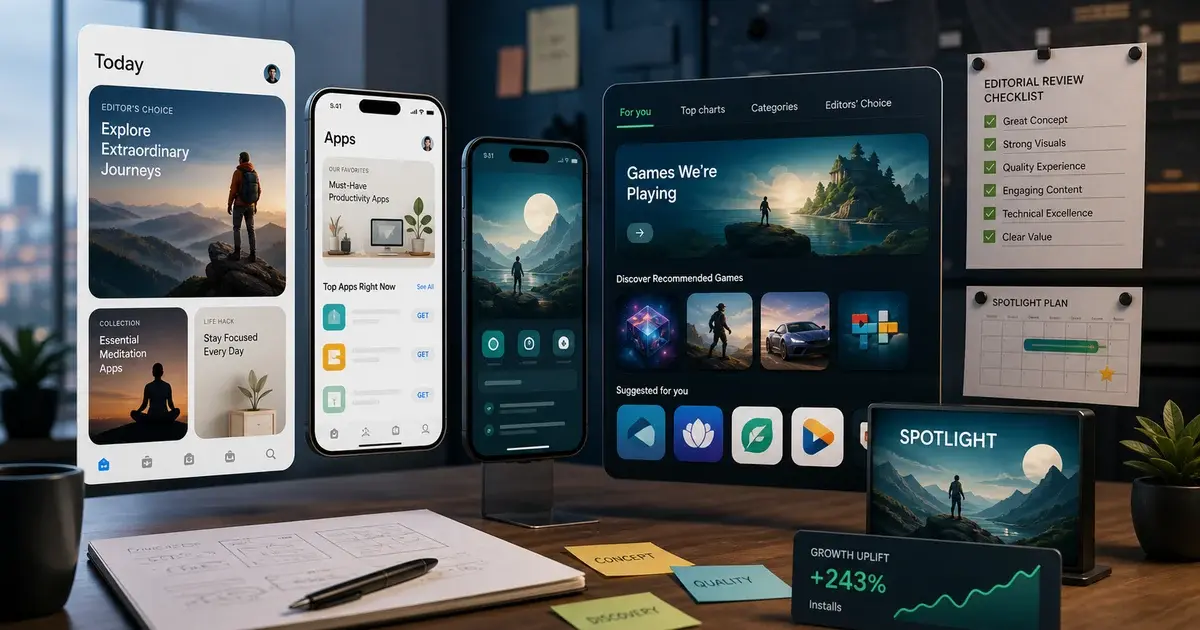
Editorial featuring is the set of human-curated placements that Apple and Google use to surface apps outside of search and category charts — and a single feature can drive more installs in a week than most apps see in a year. Unlike algorithmic ranking, featuring is selected by professional editors who personally review, write about, and curate the apps they pick.
The surfaces that matter:
- App Store Today tab (iOS): Daily editorial picks rendered as full-bleed magazine-style stories. The single highest-traffic discovery surface on iOS, with article-length writeups, custom hero imagery, and a "Get" button placed above the fold.
- App Store category collections: Themed editorial collections like "Apps for Productivity," "Festive Gaming," or "Made in India." These rotate weekly and persist in category pages.
- Google Play Editor's Choice: A curated badge plus dedicated discovery placement in the Editor's Choice section of Play. Apps in the programme also surface in personalised recommendations more often.
- Google Play category collections: Similar to App Store — themed editorial picks rotating across category landing pages.
- Search and category page badges: "Featured by Apple" or "Editor's Choice" badges visible on listings, which lift conversion 5-15% even without dedicated placement.
A single Today tab feature can drive 100K-500K incremental installs over the feature day plus the week after — and crucially, those installs come with category ranking lift that persists for 4-8 weeks. AppsFlyer's State of App Marketing consistently shows featured apps holding above-baseline organic install rates well after the feature ends, because the velocity signal compounds into algorithmic discovery.
In our portfolio across 300+ apps managed since 2013, the install economics of a single Today tab feature regularly exceed ₹40-80L of equivalent paid spend — and the retention curve is closer to organic than paid because the installs come pre-qualified by editorial endorsement. That is the prize worth chasing.
Crucially, featuring is not just about the install day. The downstream effects compound: app charts visibility, increased review velocity (which lifts your average rating), inbound press coverage, investor inbound, and partnership inbound. We routinely see funded rounds, distribution partnerships, and corporate inbound conversations originate from a single Today tab feature — making the strategic value of featuring far higher than the install lift alone would suggest.
Who picks the featured apps?
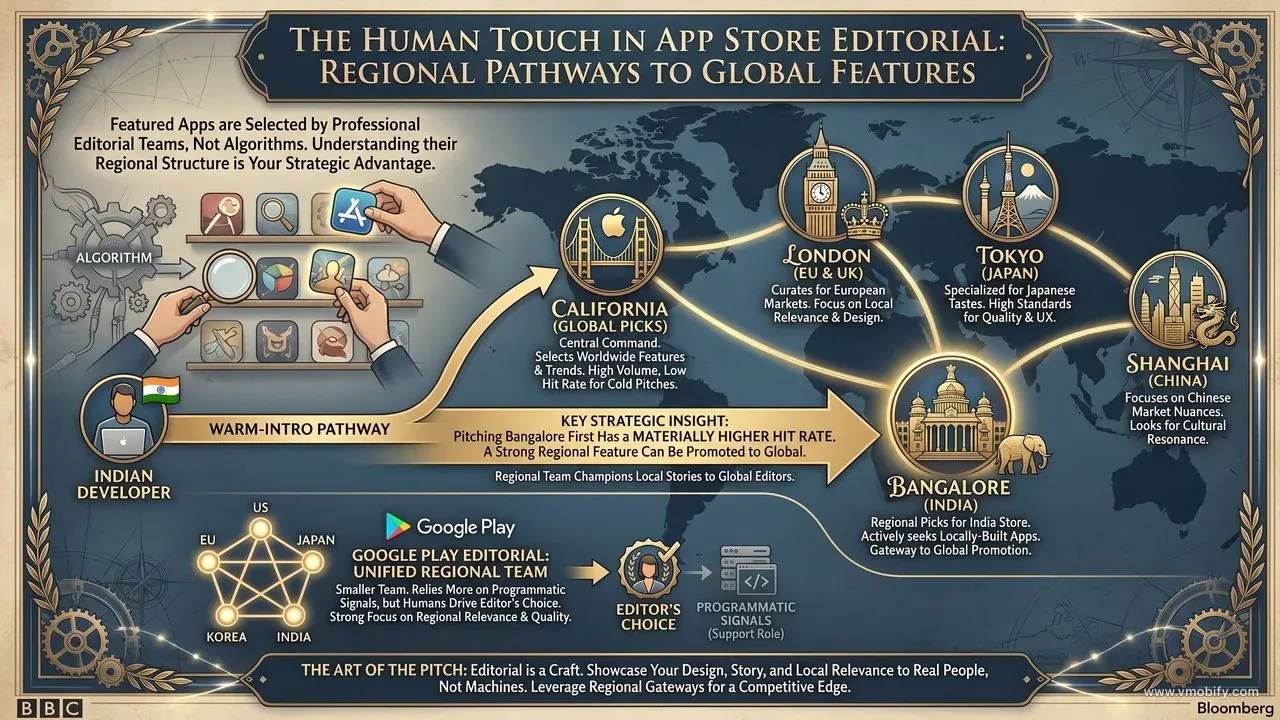
Both Apple and Google staff regional editorial teams of professional editors — not engineers, not algorithms — who personally review apps, write the copy, and curate the collections. Understanding who they are and where they sit is the first step in pitching effectively.
- Apple App Store editorial: Headquartered in California (global picks), with regional teams in London (EU and UK), Tokyo (Japan), Shanghai (China), and Bangalore (India). Each team makes regional picks for their store; the global Today tab pulls from regional submissions plus its own discoveries.
- Google Play editorial: A smaller team than Apple's, with regional editors covering major markets including the US, EU, Japan, Korea, and India. The Play team relies more heavily on programmatic signals than Apple does, but human editors still drive Editor's Choice.
- Both teams are professional editors, not engineers. They review apps personally on real devices, evaluate visual design and copy, write the editorial blurbs, and curate themed collections. Many come from publishing, design, or games journalism backgrounds.
Indian-developed apps have a notable structural advantage in pitching to the Bangalore Apple team — they actively look for locally-built apps with strong regional relevance to feature in the India store and occasionally globally. This matters because the India app market is one of the fastest-growing in the world per Statista's India mobile market data, and editorial is hungry for local stories.
We have shipped pitches into both the global California team and the Bangalore regional team from apps in our portfolio of case studies. The hit rate on regionally-relevant Indian pitches submitted to the Bangalore team is materially higher than blind global submissions — a function of relevance, proximity, and the team's mandate to surface local talent.
One operational detail that catches teams off guard: the regional team that owns your store has primary discretion over your feature, but a strong regional feature can be promoted to global if the global California team picks it up. This means a pitch landed first in Bangalore can travel to the worldwide Today tab — a path that is materially easier than pitching California cold. The implication for Indian developers is clear: pitch Bangalore first, build a regional feature track record, then pursue global. Skipping the regional rung and pitching cold to California is the harder route.
What does editorial look for in a featured app?
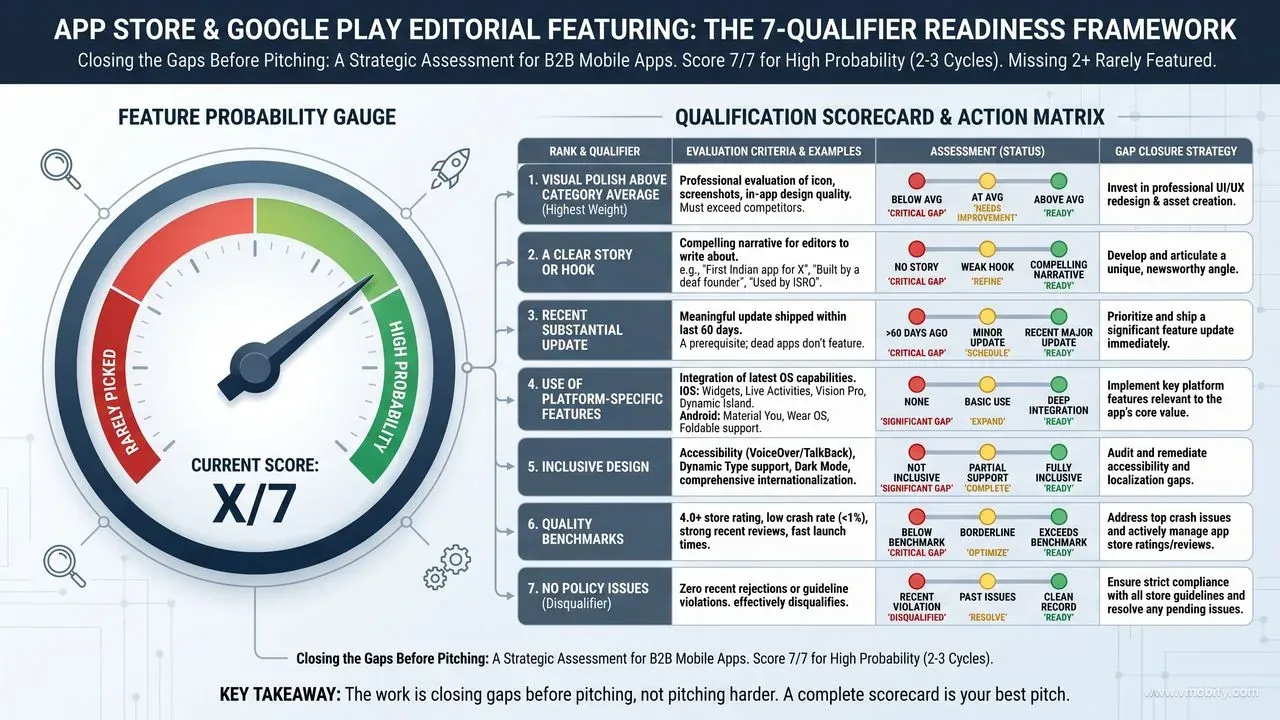
Editorial teams are looking for apps that are visually polished above category average, have a clear story to tell, ship substantial work regularly, and use platform-specific features that show off the OS. The seven qualifiers, in roughly the order they get weighted:
- Visual polish above category average. App icon, screenshots, in-app design quality. Editorial teams are visual people — designers, photographers, art directors. An app that looks better than its category peers gets attention; one that looks generic gets passed over instantly.
- A clear story or hook. "First Indian app for X." "Built by a deaf founder for the deaf community." "10x faster than competitors using on-device AI." "Used by ISRO mission control." Stories give editorial something to write about. No story = no feature.
- Recent substantial update. Editorial features active apps. A meaningful update shipped within the last 60 days is effectively a prerequisite. Dead apps with no recent work do not feature regardless of quality.
- Use of platform-specific features. On iOS: Widgets, Live Activities, Vision Pro, App Clips, Dynamic Island. On Android: Material You theming, Wear OS support, Foldable adaptations, Compose UI. Apps that show off the OS get featured because they make the platform look good.
- Inclusive design. Accessibility support (VoiceOver, TalkBack), Dynamic Type, Dark Mode, internationalisation. Apple and Google both publicly champion accessibility and reward apps that take it seriously.
- Quality benchmarks: 4.0+ store rating, low crash rate, strong recent reviews, fast launch times. Stores will not feature apps that will embarrass them after the feature goes live.
- No policy issues: Recent rejections, warnings, or guideline violations effectively disqualify you. Both teams check policy status before featuring. Apple's App Store Review Guidelines compliance is table stakes.
The pattern across our portfolio is consistent: apps that combine all seven qualifiers get featured within 2-3 pitch cycles. Apps missing two or more of these qualifiers — most commonly story and platform-feature adoption — rarely get picked regardless of how many times they pitch. The work is to close the gaps before pitching, not to pitch harder. A strong ASO foundation is the entry ticket.
How does the pitch process work?
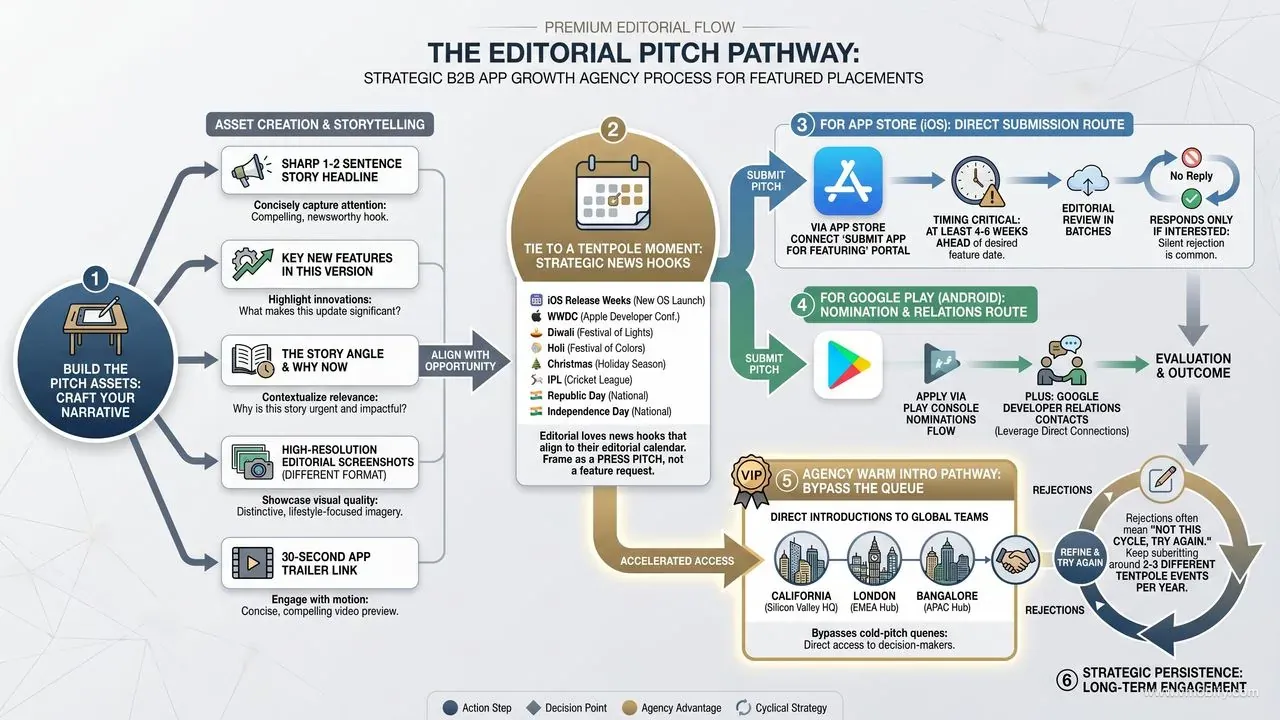
Apple has an official pitch flow inside App Store Connect; Google's surface for direct pitches is smaller and relies more on existing relationships. Both require lead time of 4-6 weeks ahead of your desired feature date.
- App Store Connect → "Submit App for Featuring": Apple's official featuring pitch flow inside App Store Connect. Submit at least 4-6 weeks ahead of your desired feature date. Editorial reviews submissions in batches and responds only if interested.
- What to include in the pitch: A sharp headline (1-2 sentences capturing the hook). The key new features in this version. The story angle and why now. High-resolution screenshots specifically formatted for editorial use (not the same as your store screenshots). A link to a 30-second app trailer if you have one.
- Tie the pitch to a tentpole moment: iOS release weeks, WWDC, the holiday shopping season, festive moments (Diwali, Holi, Christmas), or India-specific events (IPL, Republic Day, Independence Day). Editorial loves features that tie into news cycles because they make the editorial calendar easier to plan.
- Submit In-App Events: Apple's In-App Events programme lets you surface time-bound moments (tournaments, launches, premieres) directly on the App Store. Events appear on Today tab even without specific featuring and signal active engagement to the editorial team — making future featuring pitches more likely.
- Google Play: A smaller surface for direct pitches. Apply for Editor's Choice via the Play Console nominations flow and reach out through any Google Developer Relations contacts you have. Indian developers can also pitch through the India Google Play Developer Lead programme.
- Agency relationships matter. Agencies like Vmobify maintain introductions to editorial teams in California, London, and Bangalore that bypass cold pitching. A warm intro from a trusted agency gets read in days rather than weeks.
A useful framing: think of the pitch as a press pitch to a magazine editor, not a feature request to a platform. Editorial reads dozens of submissions per week. A pitch that opens with a sharp story angle, has a specific tentpole hook, and includes ready-to-use editorial assets gets read first. A pitch that opens with "we built a great app, please feature us" gets archived. For the broader ASO context around this, see our advanced ASO strategies guide.
What does a strong featuring pitch actually look like?
A strong pitch is a short piece of editorial copy, not a product brief — it hands the editor a headline, a story, a reason for the date, and assets they can publish without coming back to you for anything. Those are the pieces the App Store Connect featuring submission asks for, and each one is worth writing deliberately.
- Write the headline in the editor's voice, not yours. The test is whether the line could run on the Today tab unedited. "A Marathi-first budgeting app built for shared family phones" is a headline. "India's leading personal finance super-app" is a press release, and editorial will not rewrite it for you.
- Give the story in three lines. Who built it, why it exists, and what is unusual about how it was built — founder background, the constraint you designed around, the community you serve. This is the paragraph the editor will paraphrase, so write it as though it were already published.
- Justify the date. One line naming the tentpole — an OS release week, WWDC, Diwali, an IPL season — and what ships on it. Without a date your pitch competes with every other submission for the same slot; with one, it drops into an editorial calendar that is planned weeks ahead.
- Prove the recent work. Three or four bullets listing the platform features shipped in the last 60 days — Widgets, Live Activities, Material You, Wear OS — each with the version it landed in. This is the qualifier an editor can verify from your release notes before they ever open the app.
- Attach assets that are ready to publish. Editorial-format screenshots, a short trailer, and a device-accurate hero shot. Assets that need cropping, re-exporting, or chasing over email are the quietest reason a promising pitch stalls.
One check before you submit: if you cannot write the two-sentence editorial blurb yourself, the editor cannot either. In our portfolio the teams that get through write that blurb first and build the pitch backwards from it. If it reads thin, the fix belongs in the app — a sharper story, a platform feature actually shipped, an accessibility pass done properly — not in the pitch document, so run the check against your ASO foundation weeks before the submission window opens.
How do you maximise your chances of being featured?
The single biggest lever is closing the gaps in your app before pitching, not pitching more often. Editorial decisions are made on the app as it exists today — pitching a mediocre app into editorial just confirms the rejection.
- Polish the icon and screenshots before pitching. Editorial sees these first. An icon and screenshot set that looks bespoke and considered passes the first filter; generic templates fail it. We typically rebuild store creative entirely before submitting a featuring pitch — see our complete ASO guide for the creative-quality benchmarks editorial uses implicitly.
- Build a memorable founder or team story. Diversity of background, geography, mission, lived experience — anything that makes you a "story" rather than just a product. Editorial blurbs are easier to write about people than features. TechCrunch's app coverage is a good model for the kind of story angles that resonate.
- Adopt new platform features immediately on launch. The week of iOS or Android release is the highest-leverage window. Editorial loves apps that show off new OS features quickly — Live Activities, Vision Pro support, Dynamic Island, Material You theming. WWDC and Google I/O announcements are the calendar to plan around.
- Be visible in the Indian developer community. Speaking at events (Droidcon, App Engineering, NASSCOM Product Conclave), writing about your tech choices, contributing to open source, being known to local Apple and Google contacts. Visibility creates the warm-intro pathway that bypasses cold pitching.
- Submit In-App Events even without featuring intent. They appear on Today tab independent of featuring and signal active engagement to editorial. Apps that ship 4-6 In-App Events per year stay top of mind with the editorial team.
- Do not ask only once. Pitch around 2-3 different tentpole events per year. Rejections are not personal — they often mean "not this cycle, try again." Persistent quality apps eventually break through.
- Keep your rating above 4.3 and crash rate below 1%. These are the implicit bars editorial uses to filter pitches before reading them. An app at 3.8 stars will not be featured regardless of how good the pitch is.
Across our portfolio of featured apps, the common pattern is that the successful pitch comes after 6-12 months of foundational work on the app itself — not after 6-12 months of pitching. The work is the strategy. Pair this with a strong user acquisition foundation so featuring amplifies an already-healthy growth curve rather than masking a broken one.
What should you do when your app gets featured?
The week of a feature is high-stakes operational territory — most of the install economics depend on what you do (and crucially do not do) during the feature window itself. The five rules:
- Be ready for the traffic spike. Servers, payment processors, customer support, push notification infrastructure, analytics pipelines — confirm in advance that everything can handle 10-50x normal load. A feature that lands during a server outage is a feature wasted, and editorial notices.
- Do not change anything mid-feature. No icon swaps, no screenshot changes, no description edits, no price changes, no metadata adjustments. The version live during the feature should be the version pitched, period. Mid-feature changes also risk triggering re-review delays that can interrupt the surge.
- Pause aggressive paid campaigns. Conserve budget — the organic surge during featuring is dramatically more efficient than paid acquisition during the same window. Pull back Meta Advantage+ and Google App Campaigns to maintenance levels and let the organic wave run. Our Meta App Install Campaigns playbook covers how to throttle and resume cleanly.
- Capture social proof aggressively. Screenshot the feature page, the Today tab placement, the Editor's Choice badge. These become permanent marketing assets — "As featured by Apple" copy lifts conversion across landing pages, paid ads, investor decks, and PR for years. Push press coverage out the same day the feature goes live for maximum compounding effect.
- Plan a meaningful follow-up update for 4-6 weeks later. Editorial often re-features apps that ship substantial work after their first feature — because it confirms the team is active and the original feature was justified. The follow-up update is the highest-leverage moment to pitch your second feature.
Operationally, treat feature week like a launch. Run a war-room schedule with hourly check-ins on infrastructure, retention, store ranking, and review velocity. The 7-day window after a feature ends is when the algorithmic compounding either takes hold or fades — install quality and retention during this window determine whether you sustain at 2-3x baseline or revert to your pre-feature install rate.
One pattern from our portfolio worth flagging: teams who pre-build a "feature-week kit" before they get featured execute dramatically better than teams who scramble after the email lands. The kit includes a press release draft, a social asset pack, an investor and partner update template, a press list of relevant tech journalists, a customer-support FAQ for the expected surge in support tickets, and an infrastructure runbook for the on-call team. Building this kit takes a few days; assembling it during feature week is impossible. The teams that win editorial featuring treat the operational follow-through with the same seriousness as the pitch itself. Talk to our team if you want a managed featuring strategy and operational support for your next pitch cycle, or explore our CPI network for complementary post-feature scale.
Frequently Asked Questions
How often can an app be featured?+
2-4 times per year is realistic for active apps that keep shipping. Apple specifically tries to give regional surface to multiple apps, so back-to-back featuring of the same app is unusual — but consistent quality work over 12-18 months can produce repeat features.
What is the install lift from a Today tab feature?+
100K-500K incremental installs over feature day plus the week after is typical for the global Today tab. Smaller categories or regional features may see 30K-100K. Sub-category placements typically see 10K-50K. The ranking lift in your category often persists for 4-8 weeks beyond the install spike itself.
Does Apple pick apps that pay for promotion?+
No — Apple's editorial team is structurally independent of paid relationships. Apple Search Ads spend, developer programme tier, or commercial relationships do not influence editorial selection. Editorial selection is purely based on app quality, story, and platform-feature adoption.
Can I get featured without an agency relationship?+
Yes. The App Store Connect "Submit App for Featuring" flow is open to every developer and is read by the editorial team. Agency relationships accelerate the process and bypass cold-pitch queues, but they are not required. The fundamentals — app quality, story, recent updates, platform-feature adoption — matter more than the introduction path.
What happens after my feature ends?+
Installs typically drop to roughly 2-3x baseline organically for the following 2-4 weeks, then settle to a new baseline that is usually 30-50% above pre-feature levels. The ranking lift in your primary category typically persists for 4-8 weeks. Retention from feature-driven installs is closer to organic than paid because users came pre-qualified by editorial endorsement.
Do In-App Events count as featuring?+
Not exactly — In-App Events are a separate Apple programme that surfaces time-bound moments on the App Store. But they do appear on Today tab placements, do drive incremental installs, and signal to editorial that your app is active and worth featuring later. Treat In-App Events as both their own discovery channel and a long-term setup for a full editorial feature.
How important is Google Play Editor's Choice compared to App Store featuring?+
Editor's Choice is meaningful but typically drives 30-60% of the install volume of an equivalent Apple feature, because Google Play relies more on algorithmic discovery and less on editorial surface area. The badge itself lifts conversion 5-15% on every listing impression, which compounds over months. Worth pursuing — but prioritise App Store featuring for raw install volume.
Sources
- Apple App Store Review Guidelines — Official Apple policy framework — compliance is a precondition for editorial featuring
- Apple App Store Connect Documentation — Official Apple developer console where the "Submit App for Featuring" flow lives
- Apple In-App Events Programme — Apple's programme for surfacing time-bound moments on Today tab — adjacent to editorial featuring
- Apple WWDC Sessions — Annual platform announcements — timing pitches to WWDC features is high-leverage
- Google I/O — Annual Android platform announcements — timing pitches to new Android features lifts editorial interest
- AppsFlyer — State of App Marketing in India — Industry benchmarks on featured-app install velocity and post-feature retention curves
- Statista India Mobile Market — India market sizing data — context for regional editorial team priorities
- TechCrunch Apps Coverage — Reference for the kind of story angles that resonate with editorial teams
About the author
Amol Pomane — Founder, Vmobify
Amol leads Vmobify, a mobile app growth agency that has driven 30M+ downloads and ranked 54K+ keywords across 300+ apps since 2013. He writes about ASO, paid user acquisition, retention, and the operational reality of scaling mobile apps in India and global markets.
Prepare app icon exports
Create selected store-ready raster sizes from an approved source.
Open free tool