App Store Algorithm 2026: iOS Ranking Factors Decoded
The iOS App Store algorithm rewards different signals than Play Store. Here is what we know about iOS ranking in 2026 — based on our experiment portfolio and Apple's published documentation.
On this page
- What does Apple tell us directly about ranking?
- How are metadata signals weighted on iOS?
- How does iOS search ranking actually work?
- How are category charts calculated?
- How does the Today tab and editorial surfaces work?
- Which post-install signals does Apple use?
- How do you rewrite iOS metadata without losing rank?
- What changed in iOS App Store ranking recently?
- Frequently Asked Questions
What does Apple tell us directly about ranking?
Apple publishes substantially more about App Store ranking than Google does about Play — which means iOS ASO is more knowable, less superstitious, and easier to plan against than its Android counterpart. The official guidance is scattered across developer documentation, App Store Connect help, and WWDC sessions, but the picture it paints is consistent.
What Apple states explicitly across App Store Connect documentation and the App Store Review Guidelines:
- App name and subtitle carry the most weight in search ranking.
- The 100-character keyword field is indexed but not displayed to users.
- Ratings and reviews matter for both ranking and conversion.
- Apple Search Ads spend does not directly affect organic ranking.
- In-app purchase names are indexed for keyword search.
- App quality — crashes, performance, responsiveness — affects discovery surface impressions.
Beyond that documented core, the rest of the algorithm is reverse-engineered from observed behaviour across thousands of apps. In our portfolio of 300+ apps managed since 2013, the picture below has held up across category and geography with remarkable consistency. The good news: iOS rewards work that is genuinely good for users — the algorithm and the user interest curve are aligned. See our iOS ASO service page for our complete optimisation framework.
How are metadata signals weighted on iOS?
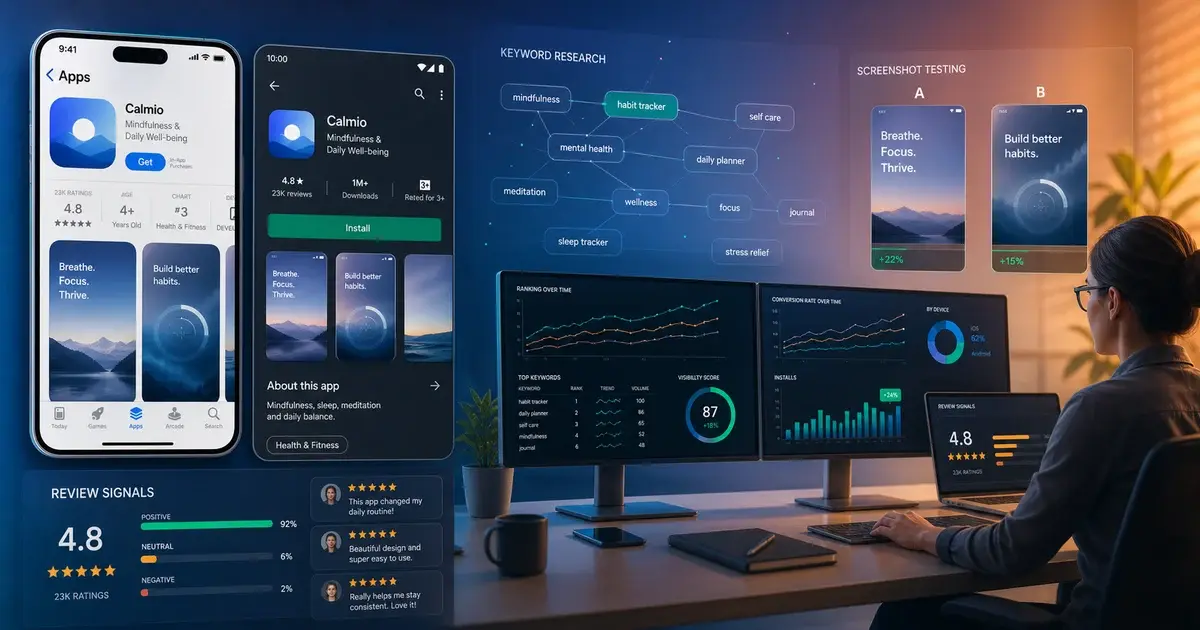
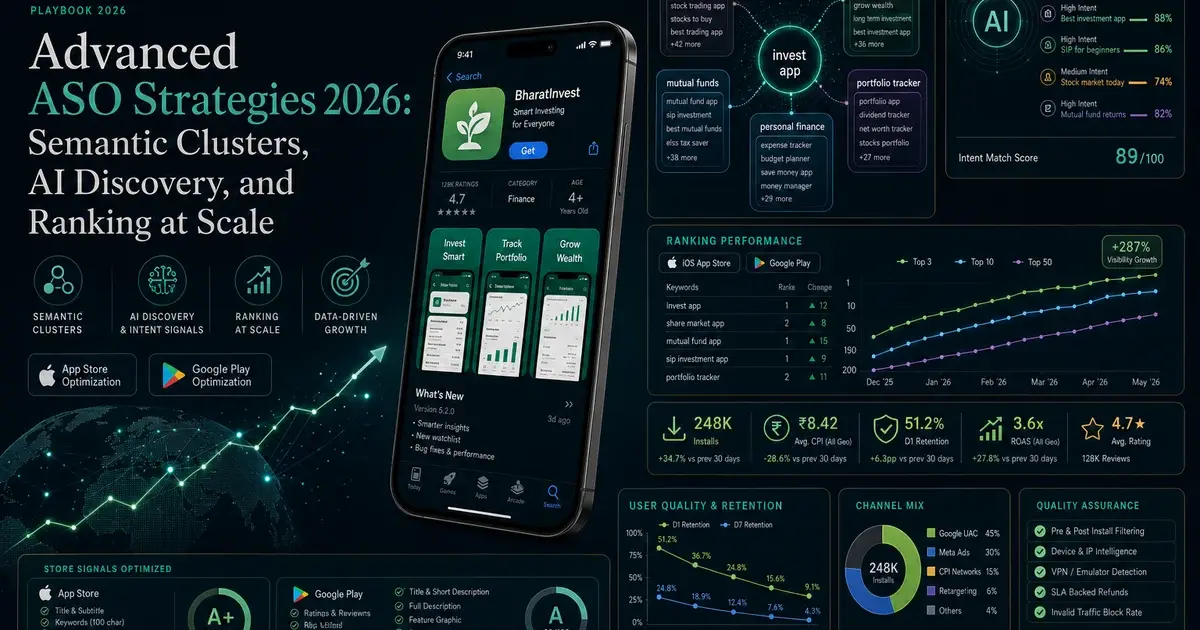
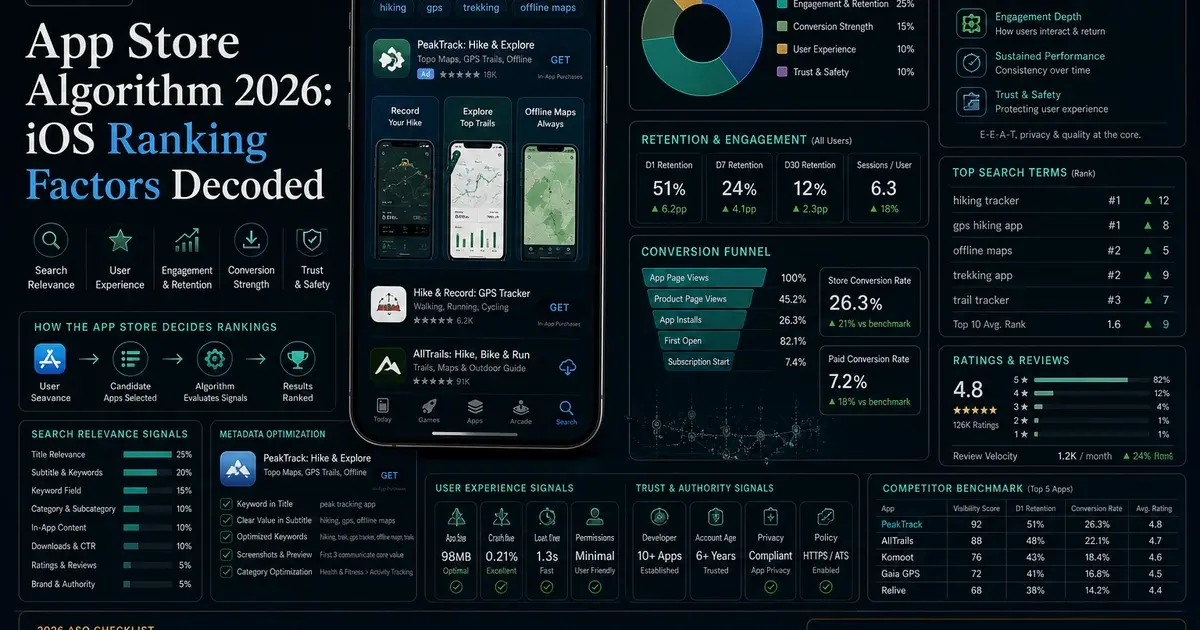
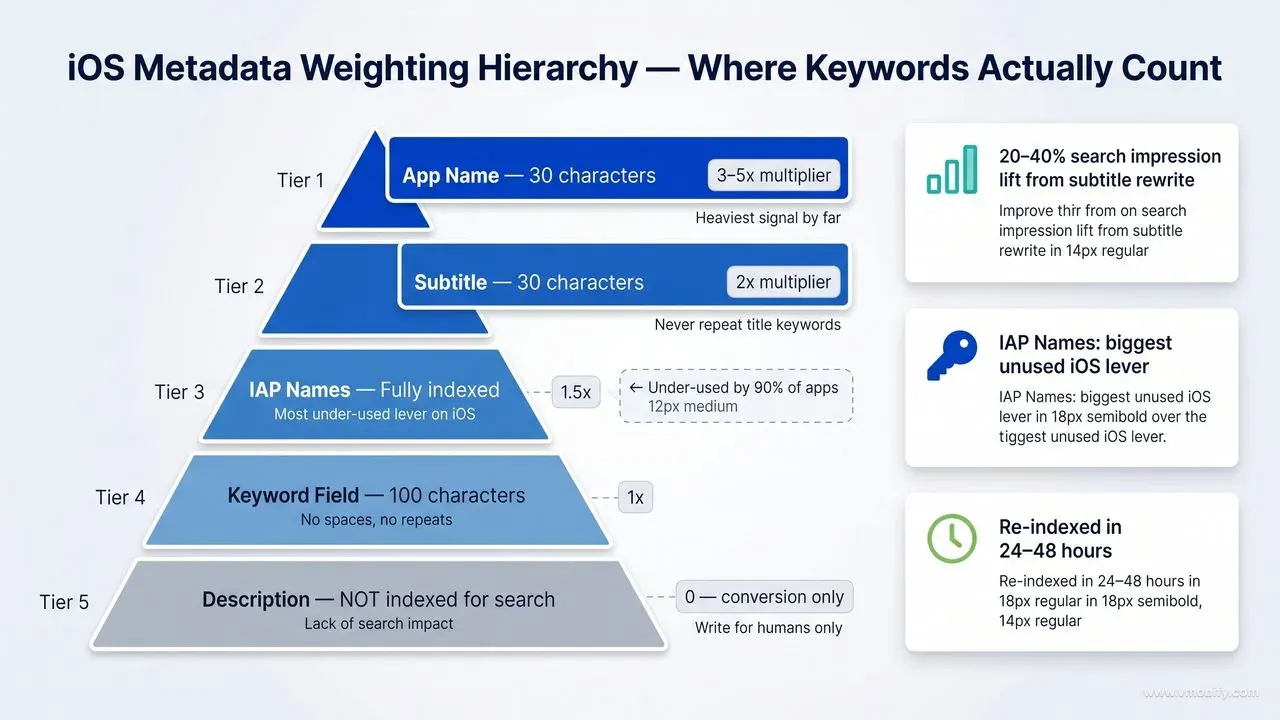
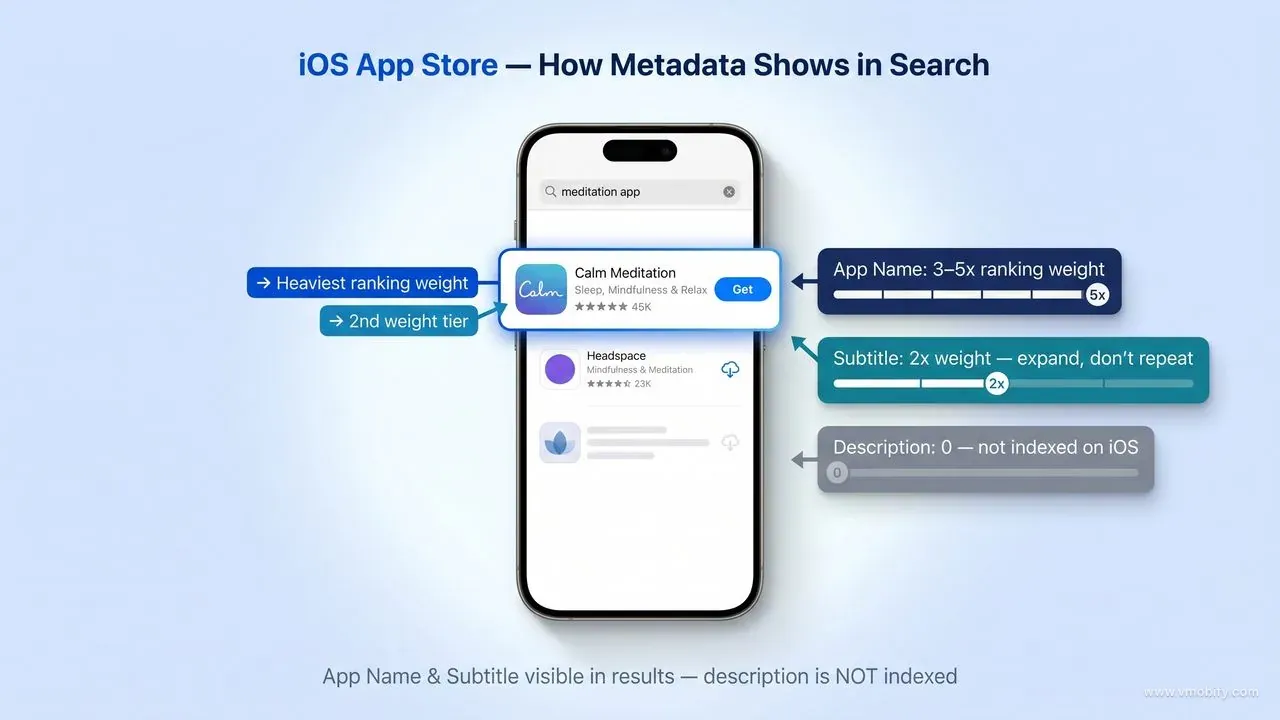
iOS metadata weighting is steeply hierarchical: the app name carries roughly 3-5x the ranking weight of the keyword field, with subtitle sitting in between. Description is irrelevant for search. Get this hierarchy wrong and no amount of off-page work will move you.
- App name (30 characters): Heaviest weight by an order of magnitude. A keyword placed in the app name will outrank the same keyword in the subtitle, and dramatically outrank it in the keyword field. The trade-off is brand vs discovery — but a well-crafted "Brand: Keyword Hook" structure captures both.
- Subtitle (30 characters): Second-heaviest. Critical rule — do not repeat the app name's keywords here. Expand the keyword universe. The subtitle is wasted real estate if it merely restates the title.
- Keyword field (100 characters): Indexed at lower weight. Comma-separated, no spaces (saves characters). Apple's algorithm performs stemming so plurals waste characters. Avoid duplicating any word already in name or subtitle.
- In-app purchase names: Fully indexed for search. This is the single most under-used lever in iOS ASO. Naming IAPs with intent-loaded phrases ("Premium Yoga Workouts", "30-Day Beginner Fitness Plan") can rank the parent app for those queries — even when those phrases are nowhere else in the listing.
- App description: Not indexed for search ranking on iOS. (This is a hard divergence from Play, where description heavily influences ranking.) Description affects conversion only — it is your sales letter, not your SEO surface.
Across our portfolio we routinely see 20-40% search-impression lifts simply from rewriting subtitle and IAP names with this hierarchy in mind. The work is free, reversible, and re-indexed within 24-48 hours of submission.
A note on localisation, which functionally multiplies the metadata surface: each App Store localisation is indexed as a separate metadata bundle. An app with English (US), Hindi (India), and Tamil (India) localisations effectively has three independent name + subtitle + keyword fields competing in their respective search markets. For India-targeted apps this is the single highest-ROI ASO move we recommend after the basic hierarchy is right — Hindi and Tamil localised keyword fields typically face an order of magnitude less competition than their English equivalents, and the install conversion from native-language users sits 30-60% above English-only listings in the same market.
How does iOS search ranking actually work?
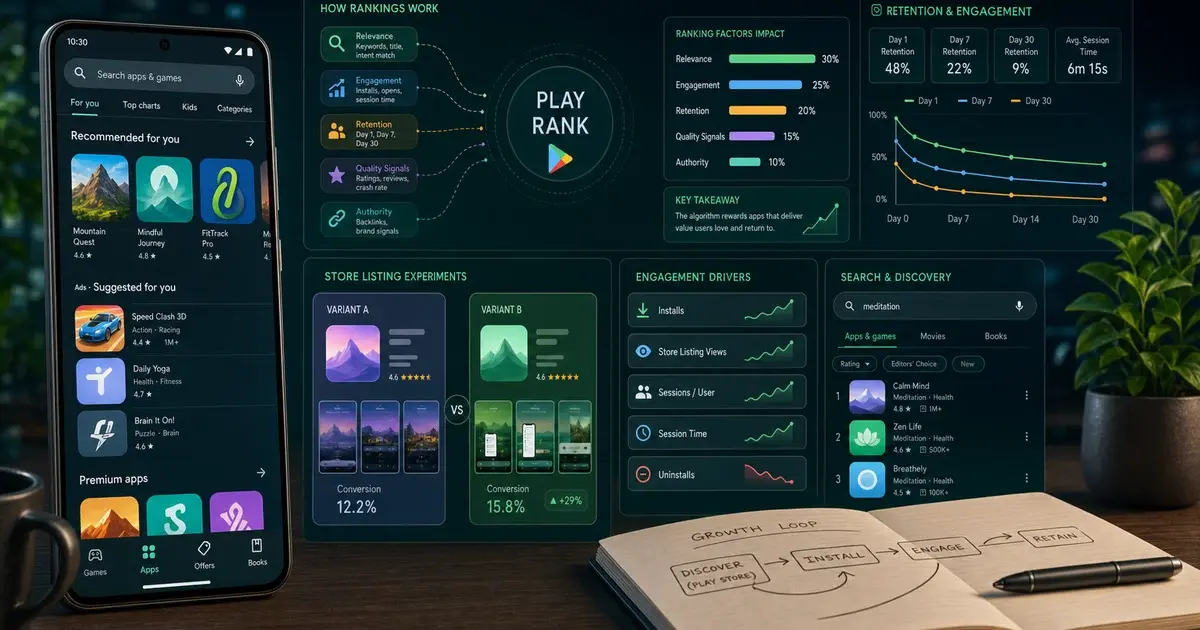
iOS search ranking is a blend of relevance signals (metadata) and behavioural signals (downloads, conversion, retention) — and behavioural signals can override metadata once they accumulate. A new app perfectly optimised for "meditation" will not outrank an established app with weaker metadata but a strong conversion history for that query.
The signals influencing iOS search ranking, ordered roughly by weight:
- Keyword relevance: Presence and position in name, subtitle, IAP names, and keyword field.
- Total downloads: Lifetime install count, weighted toward recent activity.
- Recent install velocity: Concentrated installs for the keyword cluster over the past 7-14 days.
- Conversion rate from search: Apps that get installed when shown for "X" rank higher for "X". This is the heaviest under-appreciated signal in iOS search.
- Average rating and rating count: Both number and recency matter. Apple visibly down-weights apps with declining ratings.
- Retention after install from search: Apple has this data via App Analytics for users who installed from a search context. Search-sourced users who churn quickly tell Apple the match was wrong.
The conversion-from-search signal is the lever most teams miss. AppTweak's research on conversion-correlated ranking lift confirms the pattern at scale: apps with above-category-baseline search conversion gain rank materially faster than apps with higher install volume from non-search sources. Practically, this means your screenshots, icon, and first impression frame are search-ranking infrastructure, not just conversion infrastructure.
One operational corollary: Apple Search Ads spend does not directly affect organic rank, but the installs it generates do count in install velocity and retention signals like any other installs. Strategically, ASA functions as a controlled velocity injector for keywords you already have metadata relevance for.
How are category charts calculated?
The Top Free, Top Paid, and Top Grossing charts are three separate leaderboards calculated on different inputs — and ranking in one tells you almost nothing about your position in the others. Treating them as a single "charts" surface is the most common strategic error we see.
- Top Free: Heavily weighted on recent install velocity within the past 24-72 hours. A concentrated burst can move a small app several hundred positions in a day. This is the leaderboard most install-burst campaigns target.
- Top Grossing: Recent in-app purchase revenue plus subscription revenue. Completely independent from install volume. An app with 1/20th the installs of a chart neighbour can outrank it here if monetisation per user is higher.
- Top Paid: Recent purchase volume for paid apps specifically. Smaller pool, easier to crack with concentrated spend, but a shrinking surface as fewer apps go paid-upfront.
- Sub-categories: Games > Puzzle, Education > Reference, Productivity > Notes — each has its own chart that updates faster than the parent category and represents a much more achievable initial target.
In our portfolio the realistic sequence is: rank in a sub-category top 20 first, use the discovery-surface impressions that unlocks to drive sustained install velocity, then graduate to the parent category chart. Trying to crack a parent category chart directly almost always wastes budget. For execution detail see our user acquisition playbook and our case studies across 300+ shipped apps.
One geography quirk worth knowing: category chart calculation is country-specific. An app at rank 12 in the US Productivity chart may sit at rank 200+ in India and rank 3 in Indonesia simultaneously. Each storefront has its own velocity baseline, so a burst that moves you 50 positions in a small market may not register at all in the US. Planning chart pushes country-by-country with country-specific budgets is materially more effective than treating the chart as a single global surface.
The chart-position halo effect is also real and measurable. Apps that crack a sub-category top 10 typically see a 30-60% lift in organic install rate driven by chart browsers — users who scroll the category as a discovery surface rather than searching for a specific app. That halo lasts as long as the chart position holds, which is why defending a position is often a higher-ROI activity than reaching it in the first place.
How does the Today tab and editorial surfaces work?
The Today tab is 100% editorial — humans at App Store Editorial pick every feature. No algorithmic optimisation touches it. The only path in is being interesting to a small team of regional editors, and the only way to do that is to pitch them well in advance with a sharp angle.
What gets noticed by App Store Editorial in 2026:
- Visual polish: The app icon, screenshots, and in-app design have to clear a high bar. Editorial does not feature ugly apps regardless of how clever the underlying product is.
- Substantial recent update: Editorial loves apps that ship meaningful work — a real new feature, a major UI overhaul, a notable integration. "Bug fixes and performance improvements" never gets featured.
- Platform-feature adoption: Live Activities, Interactive Widgets, Vision Pro support, App Intents, Activity Sharing for fitness apps. Apple visibly rewards apps that demonstrate the platform's newest capabilities. WWDC announcements telegraph what editorial will be hungry to feature in the following 6-12 months — see WWDC sessions for what to build toward.
- Pitch via App Store Connect: Use the feature request form 4-6 weeks ahead of any launch moment. Be specific about what is newsworthy, who it is for, and what makes it timely.
- Build editorial relationships: Regional editorial teams (US, EU, IN, JP) each pick independently. An app featured in India may never appear in the US Today tab, and vice versa. Agency relationships can introduce you regionally.
Editorial featuring drives a 5-20x install spike on the day, with a 2-3x sustained lift in the following weeks as the velocity signal carries through to algorithmic surfaces. It is the highest-leverage single event in iOS ASO.
Beyond the Today tab, App Store Editorial operates several other curated surfaces — themed collections in each category tab, "New Apps We Love" / "New Games We Love" rotations, country-specific spotlight stories, and seasonal collections tied to cultural moments (Diwali, Lunar New Year, Pride, back-to-school). These secondary surfaces are easier to crack than Today and still deliver meaningful spikes. Across our portfolio, a "New Apps We Love" placement reliably drives a 3-8x install lift on the placement day and 1.5-2x sustained for the placement week. They are also the most common entry point for first-time editorial featuring — apps usually get noticed in a collection before they ever appear on Today.
Which post-install signals does Apple use?
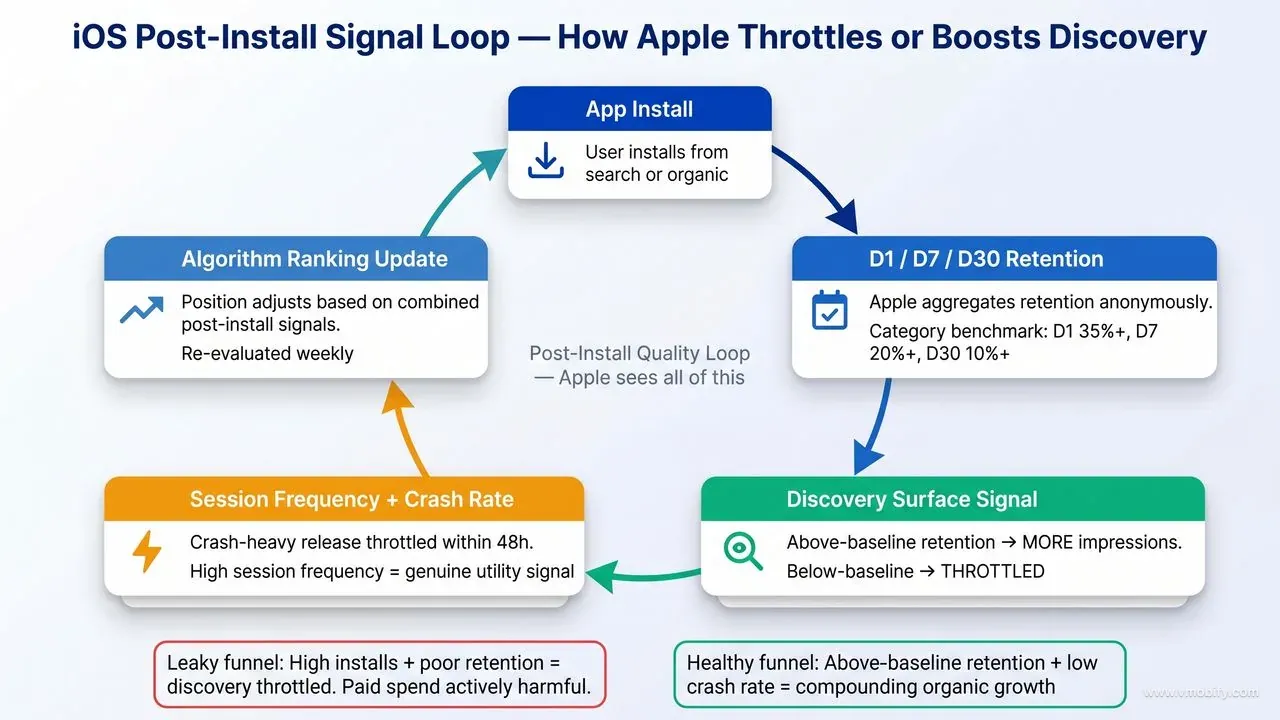
Apple has rich post-install telemetry from every device with your app installed, and it visibly uses that data to throttle discovery for low-quality apps. This is the part of the algorithm most teams underestimate.
- D1 / D7 / D30 retention: Anonymously aggregated across users. Apps with category-baseline-or-better retention get more discovery-surface impressions than apps with stronger install volume but weaker retention.
- Session frequency and duration: Apps that get opened repeatedly are signalled as genuinely useful, regardless of install volume.
- Crash rate: A heavily weighted negative signal. Crash-heavy apps see their discovery throttle within days of a bad release.
- App quality (responsiveness, battery use, memory): All visible to Apple via on-device telemetry. Increasingly used in discovery ranking. Apps that drain battery or run sluggishly on older devices are quietly down-weighted.
The strategic implication: chasing install volume with poor onboarding or fragile builds is actively counter-productive on iOS. Spending heavily into a leaky bucket signals Apple to throttle your future discovery — the opposite of the intended effect. Industry retention benchmarks from sources like AppsFlyer's State of App Marketing are useful for setting realistic D1/D7 targets by category before scaling paid UA — and we walk through the operational fix for leaky onboarding in our fastest way to get app installs guide.
In our portfolio the apps that compound iOS ranking over 6-12 months almost without exception have above-category-baseline retention and below-category-baseline crash rate. The metadata work matters; the product quality matters more.
A practical diagnostic: pull App Store Connect's App Analytics > Metrics > Retention report monthly and benchmark D1, D7, and D30 against the category averages published in industry reports. Any 5+ percentage point gap below baseline is a discovery-throttling risk that no amount of ASO will compensate for. Fix retention before scaling acquisition.
How do you rewrite iOS metadata without losing rank?
Change one metadata field per submission, in ascending order of ranking weight — rewriting name, subtitle and keyword field in the same version makes any rank movement impossible to attribute and forces you to unpick it blind.
- Baseline before you touch anything. Export current keyword rankings, search impressions and product-page conversion rate from App Store Connect. Without a pre-change baseline you cannot tell a rewrite that failed from a category that softened.
- Start with the keyword field. Lowest weight means lowest downside. Strip stems and plurals, remove every word already carried by the name or subtitle, and spend the reclaimed characters on unique terms.
- Rename the in-app purchases in the same pass. IAP names are indexed and carry no brand risk, so they are the only field you can rewrite aggressively without staging.
- Move to the subtitle next. Second-heaviest weight, and the field most often wasted on a restatement of the name. Expand the keyword universe rather than reinforcing it.
- Touch the app name last, and only once the cheaper fields have stopped producing gains. This is where brand recall lives, and it is the one change users notice on their home screen.
- Wait out the window between each step. Apple re-indexes within 24-48 hours, but ranking movement is not trustworthy for 3-10 days. Reading rank on day two is reading noise.
One confounder makes a batched rewrite worse than it looks: a competitor launching in the same window produces the same rank drop as a bad rewrite of your own. Watch search impressions rather than rank position — impressions move as soon as the new metadata is indexed, well before rank settles. The cost of missing it is a second app version, a second re-index, and a second observation cycle stacked on the first, during which the search-conversion signal keeps compounding against you.
The obvious objection: if re-indexing is that fast, why not change everything at once and simply revert if rank drops? Because reverting restores the fields, not the signal history. Conversion from search is measured continuously against whatever listing was live, so weeks of below-baseline conversion keep depressing rank after the metadata is back where it started.
For India-targeted apps, run the same sequence per localisation rather than across all of them at once — and note that a newly added localisation is the exception to the whole procedure. It has no existing ranking to protect, so it can ship complete on day one. Given how heavily India's install base skews to Android, as AppsFlyer's State of App Marketing in India documents, iOS metadata work here is usually starting from a thinner base than the Play listing — which makes the low-competition Hindi and Tamil keyword fields the cheapest first move, not the last. Our Play Store algorithm breakdown covers the Android half of the same rewrite.
What changed in iOS App Store ranking recently?
Five shifts have meaningfully reshaped iOS ASO in the past 18 months — and the apps that adapted to them are pulling away from the apps that haven't.
- Increased editorial weight across discovery surfaces: The Today tab now leans further toward curated picks over algorithmic suggestions. Search results pages also surface more editorial collections. The implication: pitching editorial is no longer optional for apps that want sustained discovery.
- Privacy nutrition labels: Influence both conversion (visibly) and ranking (subtly, in our observations). Cleaner data-collection labels correlate with higher store-page conversion across our portfolio. Apple's stated privacy posture means this signal is only going to gain weight.
- iOS-specific feature use is rewarded: Vision Pro support, Live Activities, Interactive Widgets, App Intents, Activity Sharing for fitness apps. Apple has consistently boosted discovery for apps that adopt the latest platform features within the first quarter of release.
- Custom Product Pages as a major surface: CPPs are not directly a ranking signal, but they enable campaign-matched conversion that feeds the search-conversion signal which IS heavily ranked. Running paid acquisition without CPPs in 2026 leaves ranking ROI on the table. Our UA team ships CPP variants alongside every paid creative test.
- In-App Events are under-used: In-App Events appear in search results and the Today tab, generating a discovery surface most apps still ignore. The competitive lift for being one of the few apps in your category running active In-App Events is currently outsized — that gap will close once adoption normalises.
The throughline across all five shifts: Apple is steadily rewarding apps that look like first-class iOS citizens — apps that build for the platform, ship continuously, and surface their newest work through the App Store's own marketing surfaces. The apps that treat the App Store as a passive distribution channel are losing ground to the apps that treat it as a marketing platform. Get a free iOS ASO audit if you want a custom diagnosis for your app.
Frequently Asked Questions
Does Apple Search Ads spend affect organic ranking?+
Apple states no direct effect. The installs from ASA do count in install velocity and retention signals like any other installs, so there is an indirect feedback effect — particularly useful as a controlled velocity injector for keywords you already have metadata relevance for.
Is the keyword field as important as the title?+
No — the app name carries roughly 3-5x the weight. Use the 100-character keyword field for secondary terms not already covered by the name or subtitle, and do not repeat any word that appears in either of those fields.
How does iOS handle keyword plurals and stems?+
Apple's algorithm performs stemming, so "yoga" matches "yogas" and "run" matches "running" in most cases. Repeating plurals or stems in the keyword field wastes characters that could be spent on additional unique terms.
How important is the app description for ranking?+
Not directly — the description is not indexed for iOS search ranking (this is a hard divergence from Google Play). It does affect conversion rate, which feeds the search-conversion signal that IS heavily ranked, so it matters indirectly.
Do localized App Store pages improve ranking?+
Yes — each localisation is indexed separately. A Hindi-localised page can rank for Hindi queries even if the original is English-only. Adding localisations is one of the highest-ROI ASO actions for apps targeting multi-language markets like India.
How long do iOS metadata changes take to re-index?+
Apple typically re-indexes metadata within 24-48 hours of a new app version going live. Ranking movement for newly inserted keywords usually follows within 3-10 days as the algorithm gathers conversion data for the new metadata.
Are In-App Events worth the effort to set up?+
Yes — In-App Events are currently under-used and surface in both search results and the Today tab. For apps in categories where competitors are not running events, the discovery-surface lift is currently outsized. Adoption will normalise over time and the gap will close.
Sources
- Apple — App Store Connect documentation — Official guidance on metadata fields, indexing, and submission
- Apple App Store Review Guidelines — Official policy framework for what affects review, ranking, and removal
- Apple — Custom Product Pages — Official documentation for CPPs as a paid-acquisition conversion surface
- Apple — In-App Events — Official setup guidance for In-App Events on the App Store
- Apple Search Ads documentation — Official ASA documentation, including statement on no direct organic ranking effect
- WWDC Sessions — Annual Apple developer announcements telegraphing what editorial will reward
- AppTweak ASO blog — Third-party research on conversion-correlated ranking lift on iOS
- AppsFlyer — State of App Marketing in India — Industry retention benchmarks by category and geography
About the author
Amol Pomane — Founder, Vmobify
Amol leads Vmobify, a mobile app growth agency that has driven 30M+ downloads and ranked 54K+ keywords across 300+ apps since 2013. He writes about ASO, paid user acquisition, retention, and the operational reality of scaling mobile apps in India and global markets.
Check your store metadata
Run your current App Store or Play metadata through the free checker.
Open free tool