Google Play Store Algorithm 2026: What Actually Drives Rankings
No one outside Google knows the exact Play Store algorithm — but five years of experiments across our portfolio give a clear-enough picture of what moves rankings.
On this page
- What do we actually know about the Play algorithm?
- How does Play Store weight metadata signals?
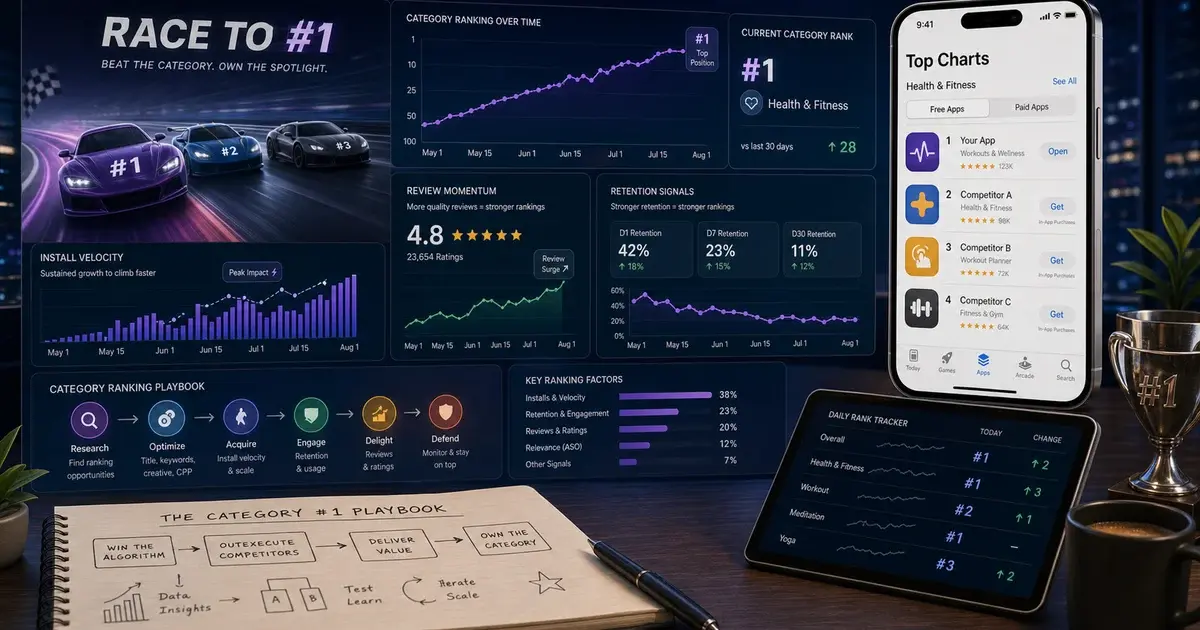
- Why is install velocity the heaviest non-metadata signal?
- How do engagement and retention signals affect ranking?
- What rating and review signals matter most?
- Which negative signals silently suppress your ranking?
- What has changed in the Play algorithm in 2024-2026?
- How should you adapt your ASO strategy to the 2026 algorithm?
- Frequently Asked Questions
What do we actually know about the Play algorithm?
Google does not publish the Play Store ranking algorithm, and they never will — but a combination of published developer console signals, documented platform behaviour, and five years of controlled experiments across our portfolio give a clear-enough picture to act on.
Three sources of truth shape our model. First, Google's own Play launch best practices and Play Console documentation explicitly name install velocity, retention, ratings, and Android Vitals as inputs they care about. Second, the broader logic Google applies to ranking problems on Search and YouTube — ML-driven, behaviour-weighted, anti-spam by design — applies almost identically here. Third, our own experiments across 300+ live apps consistently show the same signals moving rankings in predictable ways.
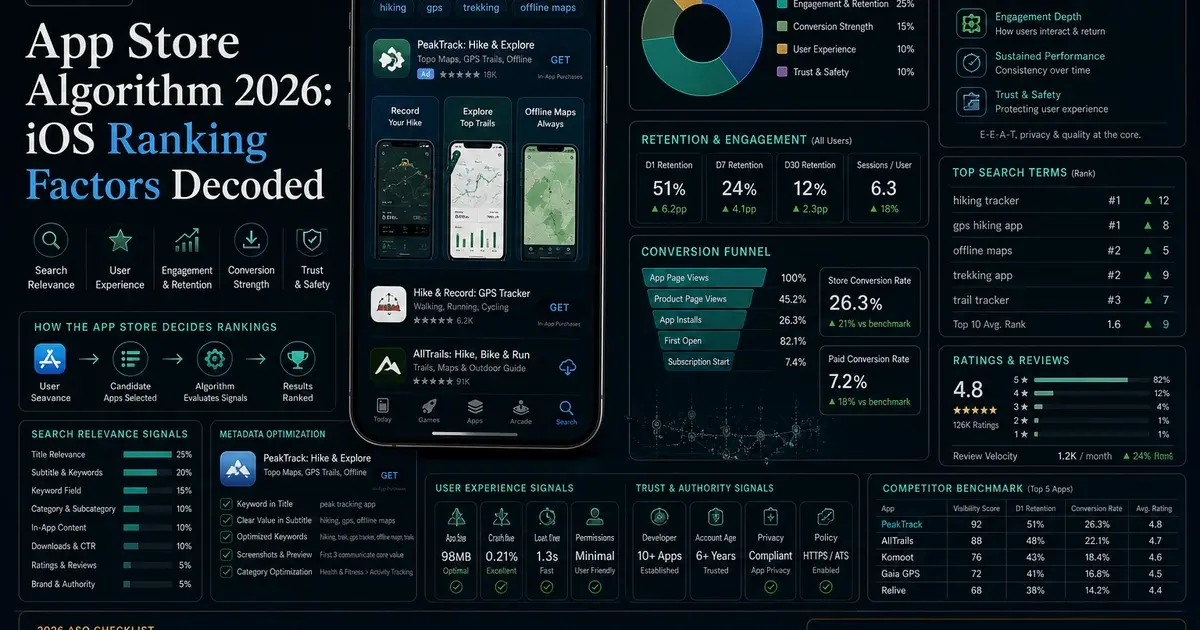
The model below is what we believe drives 90%+ of Play Store ranking behaviour in 2026. It is approximate, but it is actionable — and it has held up against every algorithm tweak we have observed for the last three years. For broader ASO fundamentals, see our complete ASO optimisation guide; for the iOS counterpart, see our App Store algorithm breakdown.
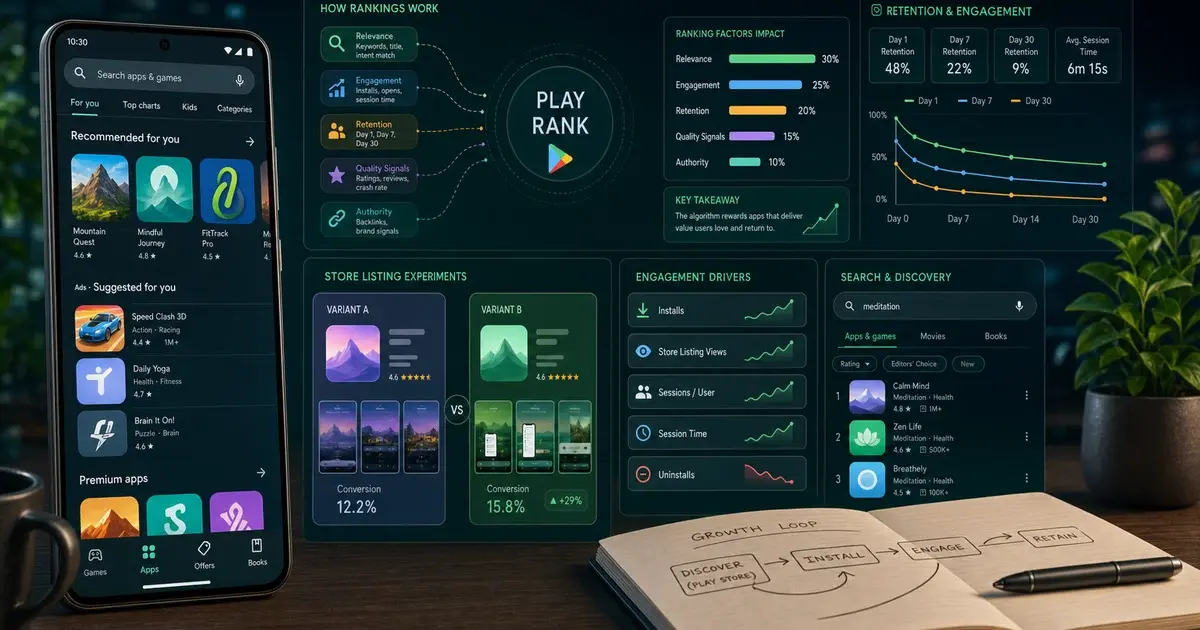
One framing point before the signals themselves: Google's algorithm is fundamentally a two-stage system. Stage one is metadata-based candidate selection — does your app match the query at all? Stage two is behaviour-based ranking — among the candidates, which apps will users actually keep using? Most teams over-invest in stage one and underinvest in stage two, which is exactly backwards for 2026.
A second framing point: the Play algorithm is contextual. The same app, with the same signals, ranks differently for the same keyword depending on the searching user's device, locale, language, install history, and Play Store engagement pattern. What you see in your own Play Store search is not what your prospective users see. Always benchmark rankings via a tool like AppTweak, SensorTower, or a clean device pool per market — never via your own logged-in device.
How does Play Store weight metadata signals?
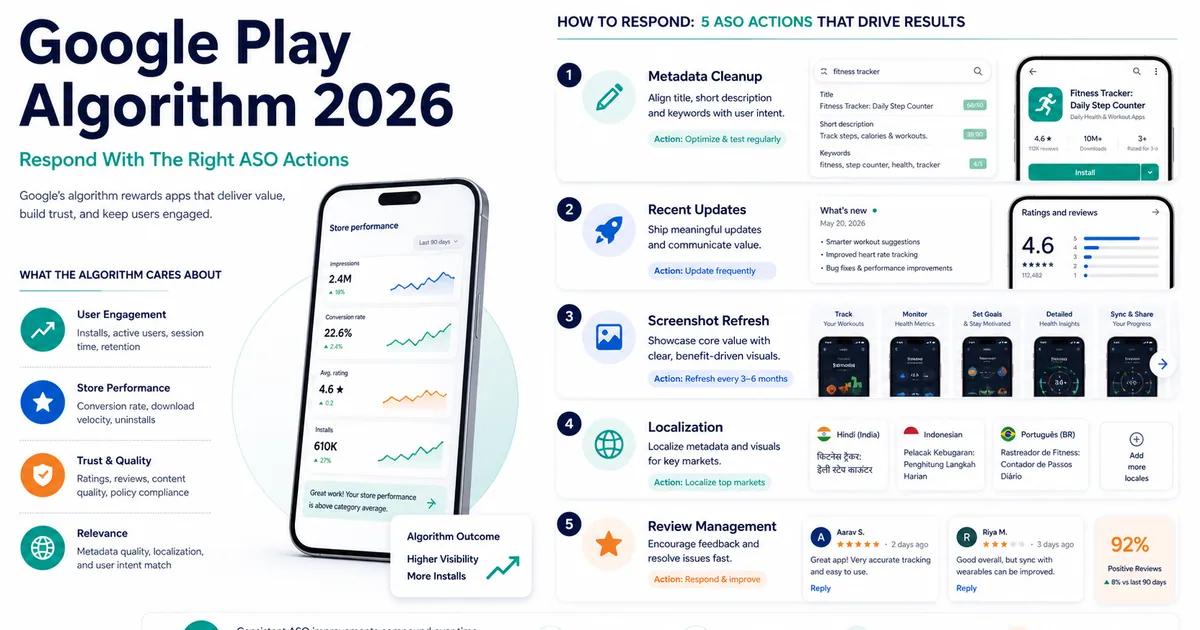
Metadata gets you into the candidate pool for a keyword. It almost never wins the ranking on its own. Play Store's metadata indexing is more forgiving than iOS App Store's tight 30-character title constraint, but it still rewards precision over volume.
- App title (50 character limit): Heaviest metadata weight by a wide margin. The single keyword Google considers most "what your app is." Brand + primary category keyword (e.g. "Expensee — Budget & Expense Tracker") consistently outperforms either alone.
- Short description (80 characters): Second-heaviest. Should contain your strongest secondary keywords. Often overlooked because it doubles as marketing copy — write it as both.
- Full description (4000 characters): Indexed but lower weight than it once was. Google's ML stack now understands semantic context, so keyword density above ~2-3% triggers suppression rather than boosting. Write for humans first; the algorithm rewards readable, structured descriptions.
- Package name: Surprisingly weighted. Including a keyword in your package name (com.yourbrand.expensetracker) provides a small but persistent lift — typically 3-7% for the matched keyword across our portfolio. Cannot be changed post-launch, so worth getting right at v1.
- Developer name: Indexed. Branded developer names that include category keywords help cross-app ranking — if your studio publishes 5 fitness apps under "FitLabs," every app benefits from the keyword association.
The biggest 2026 shift in metadata behaviour is the diminished return on keyword stuffing the full description. Five years ago, a 4000-character description packed with category keywords measurably moved rankings. Today, that same description triggers Google's quality classifier and either neutralises the boost or actively suppresses the app. We have run this experiment across roughly 40 apps in the last two years; the result is consistent.
For the Android-specific tactical playbook, see our Android ASO hacks guide.
Why is install velocity the heaviest non-metadata signal?
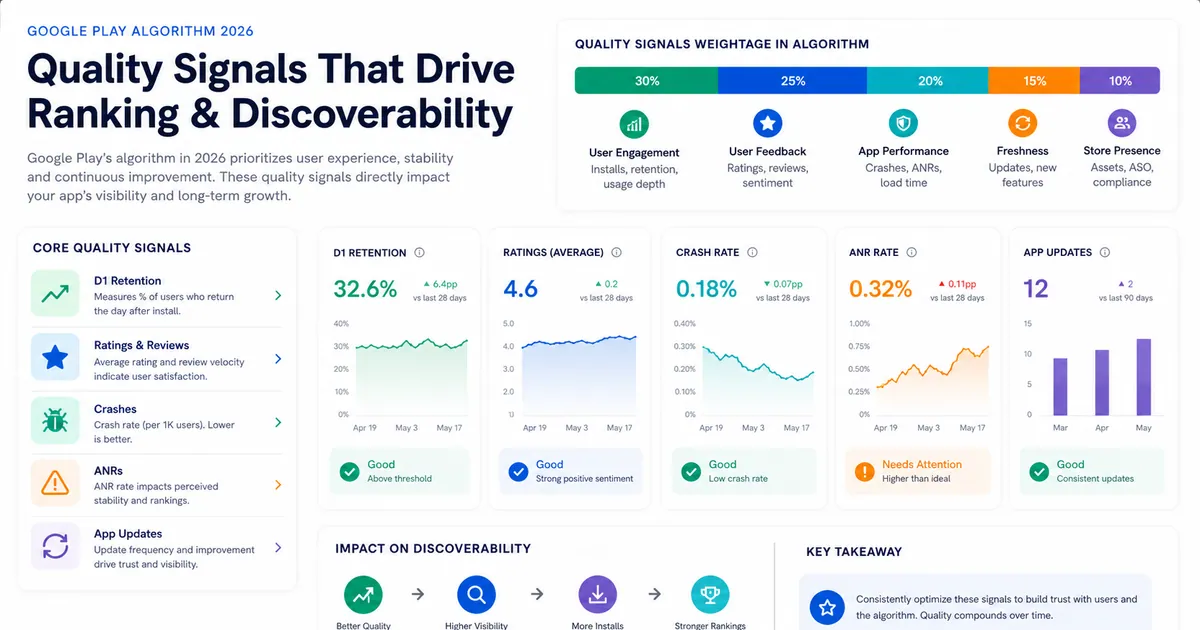
Install velocity — the rate at which your app accumulates installs over a rolling window — is the single heaviest non-metadata input into Play Store ranking, and arguably the heaviest signal overall once an app has cleared metadata candidate selection.
- Day-over-day growth rate matters more than absolute install count. An app gaining 30% week-over-week ranks faster than one with 10x the install volume but flat growth. The algorithm rewards momentum, not size.
- Geographic concentration: Rapid install growth in a specific country lifts ranking in that country specifically. Play Store rankings are localised; a velocity spike in India does not move your ranking in Brazil. This is why the cheapest path to category ranking is often a concentrated geo push rather than a global one — see our CPI network service for how we structure these.
- Source diversity: Installs from many sources (organic + paid + referral + Play Store search itself) are weighted more than installs concentrated in a single channel. An app with 80% of installs from a single Google UAC campaign signals "advertising spike" rather than "rising in popularity." Source diversity is one of the few signals Google's App Campaigns documentation hints at directly.
- Velocity decay penalty: When install rate drops sharply (post-burst), ranking drops correspondingly within 5-10 days. The implication: a 72-hour install burst with no follow-up plan often nets zero or negative ranking over a month.
In our portfolio, the apps that successfully translate install velocity into durable ranking gains do three things: they ramp velocity over 7-14 days rather than spiking in 24 hours, they diversify install sources across paid + organic + referral, and they pair the velocity push with a creative and ASO refresh so the new traffic actually converts. AppsFlyer's State of App Marketing data consistently shows the same pattern at industry scale.
For the operational mechanics of running an install velocity push, see our fastest way to get installs guide.
How do engagement and retention signals affect ranking?
Google has a unique structural advantage on Android: Play Services and the Play app are installed on virtually every Android device, which means Google can observe post-install behaviour in a way Apple cannot match. The 2024-2026 algorithm increasingly uses that visibility.
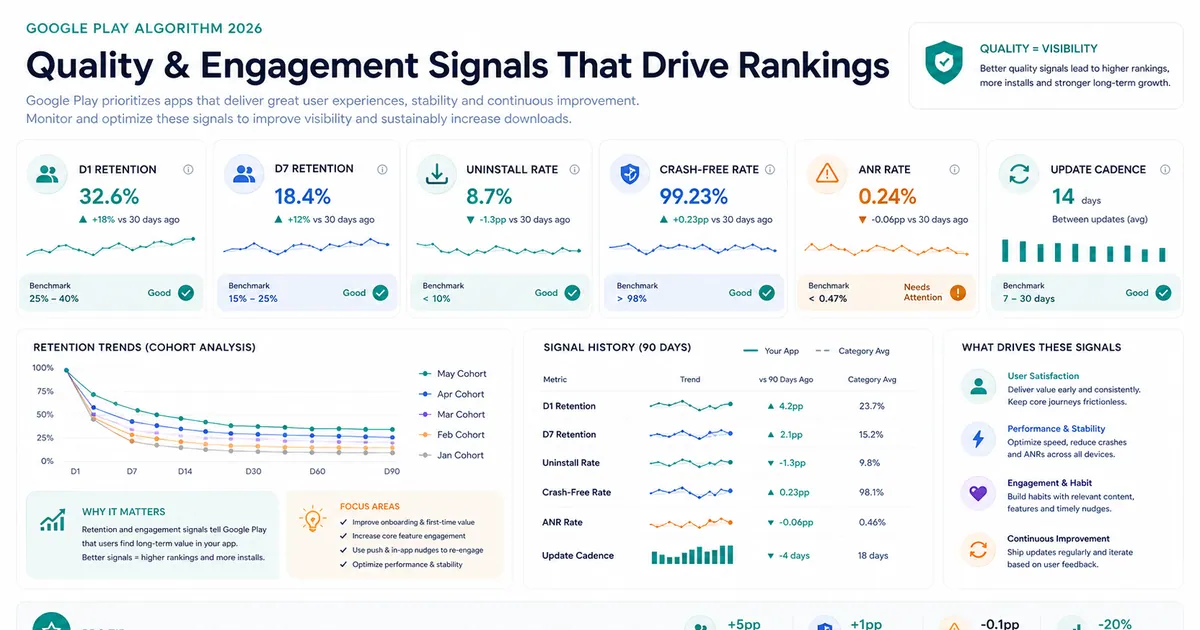
- Uninstall rate is the single most weighted negative engagement signal. High uninstall rate within 7 days suppresses ranking dramatically — in our portfolio we have seen uninstall rates above category baseline cap an otherwise-healthy app's discovery for 3-4 weeks until the cohort cycles out of the measurement window.
- D7 and D30 retention: Both explicitly reported in Play Console and almost certainly used in ranking. Apps in the top quartile of category retention consistently outrank apps in the bottom quartile, even when the lower-retention app has higher install volume.
- Session frequency and duration: Apps that get opened daily rank above apps opened weekly, all else equal. For utilities and productivity apps this is a structural ceiling — design for the daily open even if your core use case is occasional.
- Crash-free rate: Below approximately 99.5% crash-free starts to materially affect ranking. Android Vitals documentation sets the "bad behaviour threshold" at 1.09% crash rate, which is roughly where the ranking suppression kicks in across our tests.
- ANR (Application Not Responding) rate: Heavily weighted on Android specifically. ANR rate above 0.47% (Google's published bad-behaviour threshold) consistently suppresses discovery in our experiments. Most teams under-monitor this.
The strategic takeaway: every rupee spent on improving D7 retention or fixing crash rate has compounding ranking ROI in addition to the direct LTV improvement. The teams that consistently win on Play Store treat performance engineering and retention design as ASO work, because in 2026 that is exactly what it is.
One pattern worth flagging: in our portfolio, the apps that aggressively monitor and act on the Play Console "bad behaviour" reports outperform peers by 15-25% on category discovery over a 6-month window — independent of any metadata or paid changes. The signal is that direct.
What rating and review signals matter most?
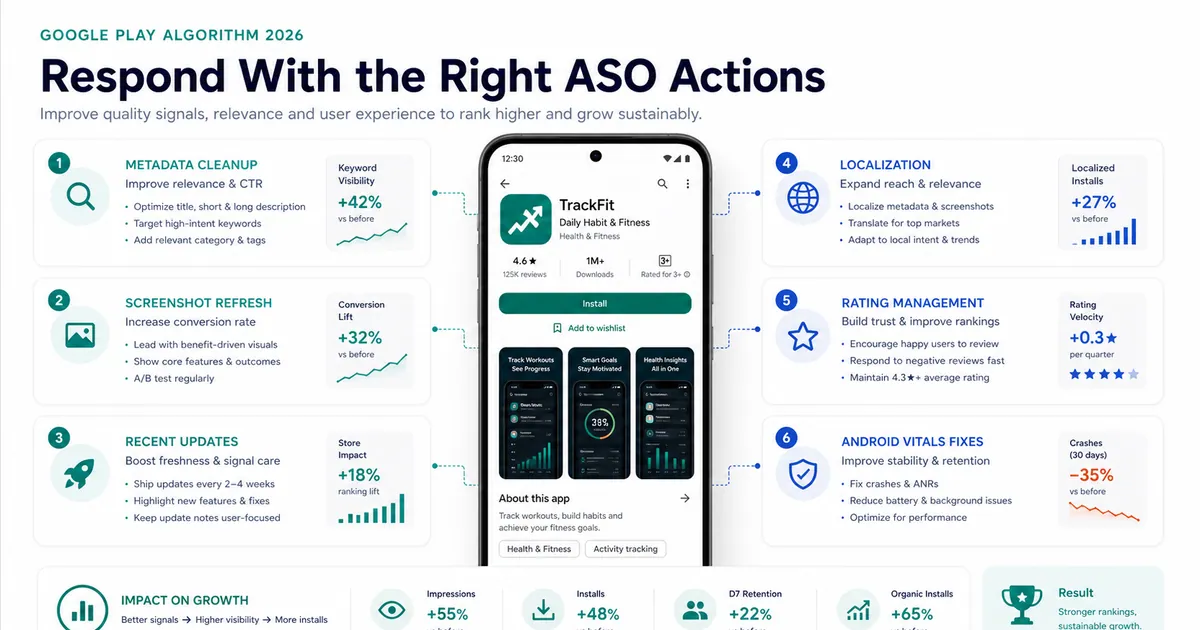
Ratings and reviews are the most user-visible ranking signal — and Google weights them accordingly, but with more nuance than the raw 1-5 star average suggests.
- Average rating: Below 4.0 caps your discovery ceiling significantly. Between 4.0 and 4.4 is "normal" — minor differences here matter less than people assume. Above 4.5 you start to earn meaningful editorial and recommendation surface inclusion.
- Rating volume: Apps with 10K+ ratings outrank apps with 100 ratings even at the same average. Volume is a confidence signal — Google's algorithm trusts a 4.3 average from 50,000 raters far more than a 4.7 from 80 raters.
- Rating velocity: Recent rating velocity matters as much as average. A burst of 5-star ratings in the last 7 days lifts ranking even before the lifetime average shifts meaningfully. This is one of the strongest arguments for in-app rating prompts during peak satisfaction moments.
- Review sentiment analysis: Google reads review content with ML, not just the star value. Negative themes (crashes, bugs, scams, deceptive billing) suppress ranking beyond just the star rating. We have seen 4.3-rated apps with high "crash" sentiment outranked by 4.1-rated apps with clean sentiment.
- Developer responses: Apps that respond to reviews are weighted slightly higher — both as an engagement signal directly and because users update ratings post-response. Across our portfolio, consistent responses to 1- and 2-star reviews lift the lifetime rating by 0.1-0.3 points within 6 months.
The single highest-leverage rating tactic for most apps is fixing review velocity rather than chasing a higher average. A consistent flow of new 4- and 5-star reviews signals "this app is being actively loved right now," which the algorithm rewards more than a static high average.
One often-missed nuance: Google weights reviews from users with longer engagement histories more heavily than reviews from users who rated in the first session. The implication is that the best time to prompt for a rating is after the user has experienced the core value loop multiple times — not on first launch. Across our portfolio, moving the rating prompt from session 1 to session 3-5 typically raises both the average rating and the algorithmic weight of the resulting reviews.
Which negative signals silently suppress your ranking?
Negative signals are where most apps lose ranking without realising it — they tend to be silent, gradual, and structural rather than acute.
- Policy violations at any tier suppress ranking globally for the app, not just for the violating market or feature. Even a resolved warning shows as a long-tail suppression in our experience. Google's developer content policy is worth re-reading quarterly because the surface area expands every year.
- High uninstall rate within 7 days of install is the most common silent killer. It often results from misleading creatives or store listings overpromising relative to actual app experience — the algorithm catches the mismatch via the uninstall pattern.
- Frequent crashes / ANRs above the category baseline. Android Vitals reports both; Google's algorithm uses both as ranking inputs, not just user-facing quality warnings.
- Stale app: No updates in 6+ months actively suppresses ranking. The "recently updated" signal has strengthened materially in 2024-2026 — even a small bug-fix release every 4-6 weeks measurably helps discovery.
- Fake install detection: Google's fraud detection catches device farm and emulator installs at a deeper signal level than any MMP. Caught apps lose ranking and may be removed. The economics of fake installs have been a losing trade for years — see how we structure clean install velocity in our CPI network service.
- Review manipulation: Buying reviews, paid-review networks, incentivised review prompts. Removed and penalised — and Google's detection has improved noticeably since 2023.
- Deceptive billing or subscription patterns: User reports of "scam" or "tricked into subscription" in reviews are now category-level suppression triggers, not just rating impacts.
The pattern across all of these: Google has years of data on what user-harming apps look like, and the algorithm is increasingly tuned to pattern-match those signatures pre-emptively rather than reactively.
What has changed in the Play algorithm in 2024-2026?
Five algorithm shifts have meaningfully changed how Play Store ranks apps between 2024 and 2026 — all of them moving toward "user behaviour and quality matter more than metadata gaming."
- Increased weight on accessibility: Apps following Google's accessibility guidelines rank slightly higher in categories with accessibility-relevant audiences. The lift is small but consistent, and accessibility-friendly apps also appear more often in Google's curated collections.
- Privacy and data-safety disclosure: Apps with cleaner data-safety declarations rank higher than equivalent apps with extensive data collection. The Data Safety section, introduced in 2022, is now a measurable ranking input — not just a transparency requirement.
- Performance metrics (Android Vitals) more visible in ranking: Slow startup, jank, excessive wakeups, and battery drain all now affect discovery, not just user satisfaction scoring. The visibility increase since 2024 is one of the clearest deltas in our experiments.
- "Recently updated" signal stronger: Apps updated in the last 30 days outrank stale apps on otherwise-equal signals. We have measured the gap as roughly 8-15% ranking position lift for active vs. stale apps in the same category.
- Less weight on description keyword density: Google's ML stack can understand context far better than rule-based indexing ever could. Keyword stuffing is increasingly ineffective — and at high densities, actively penalised. Write the full description as marketing copy first, keyword vehicle second.
The meta-shift behind all five changes: Google's ranking algorithm is becoming more like Google Search's ranking algorithm — ML-driven, behaviour-weighted, anti-manipulation by default. The era of "ASO is metadata optimisation" is closing. The era of "ASO is product quality + retention + structured launch velocity, with metadata as table stakes" is here.
How should you adapt your ASO strategy to the 2026 algorithm?
Given the model above, here is the prioritised order of investment for 2026 Play Store ranking work — based on what actually moves rankings across the apps we manage today.
- First, fix retention and Android Vitals. Every other ranking lever caps out against a leaky retention curve or a crash rate above category baseline. This is where 50-70% of typical ASO ROI now lives, not in metadata edits.
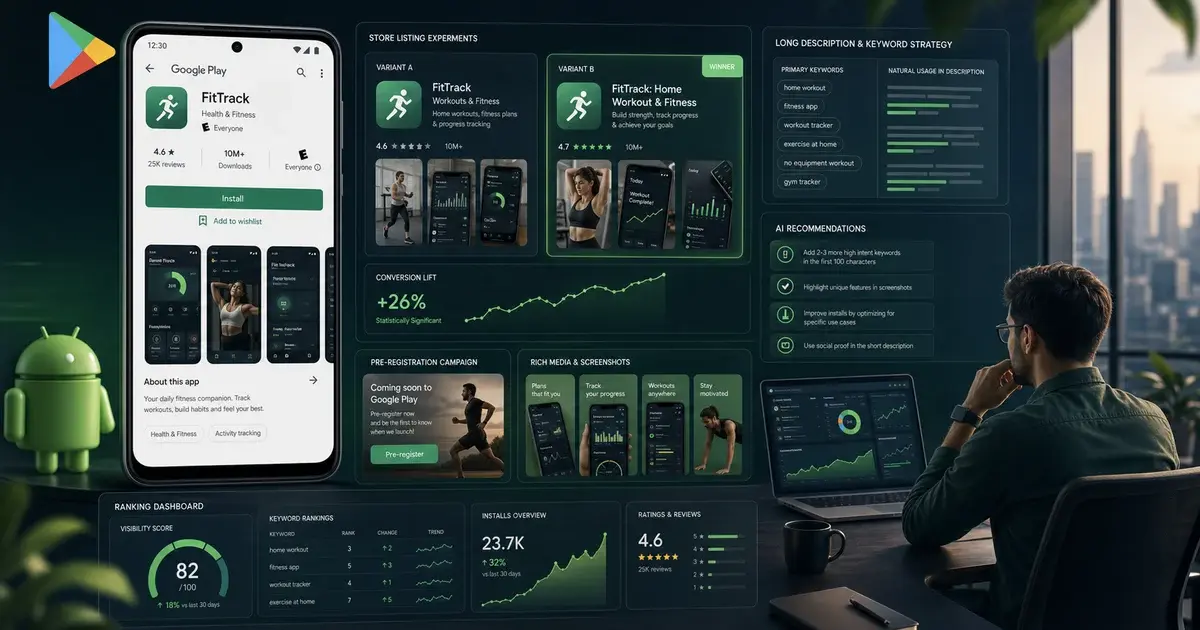
- Second, get the title and short description right. Lock in brand + primary category keyword in the title, strongest secondaries in the short description. Test variants quarterly via store listing experiments rather than rewriting based on intuition.
- Third, build a sustained install velocity engine. Diversified paid + organic + referral + targeted CPI bursts on launch moments. Velocity should ramp over 7-14 days, not spike in 24 hours, and it should be paired with a creative refresh so the new traffic converts. Our UA service structures this end-to-end.
- Fourth, engineer a review velocity flow. In-app prompts at peak satisfaction moments, fast responses to negative reviews, and a process to follow up with users whose issues got resolved. Recent rating velocity is one of the strongest non-velocity signals available.
- Fifth, update the app every 4-6 weeks even if it is just bug fixes. The "recently updated" signal is now strong enough to justify a cadence release schedule independent of feature development.
- Sixth, audit data-safety and accessibility declarations. Small but free wins that compound. Most teams ship these once at launch and never revisit — both deserve a quarterly review.
The teams that win at Play Store ranking in 2026 are not the teams with the best metadata. They are the teams with the best products, the most disciplined update cadence, and a launch system that ramps velocity without creating a decay cliff. Talk to our team if you want a Play Store audit that maps your app against every signal above and ranks the fixes by expected ranking impact. For category-specific case studies, see our results page.
Frequently Asked Questions
Does Google use the "Featured by Google" tag as a ranking signal?+
Editorial featuring drives traffic and install velocity, which then feeds back into ranking. It is not a direct signal but its second-order effects via velocity and retention are large.
How often does the Play Store algorithm update?+
Minor adjustments continuously. Major changes 2-4 times per year. Most do not warrant tactical changes — the fundamentals of velocity, retention, ratings, and Android Vitals persist across updates.
Why are some of my keywords ranking worse after an update?+
Usually one of four causes: competitor activity (new entrants in your keyword set), seasonal demand shift, your install velocity slowed relative to peers, or your recent uninstall rate spiked. Diagnose in that order.
Does Google penalise apps for buying installs?+
Yes — fraudulent installs specifically (bot, emulator, incentivised non-disclosed). Legitimate ad-network installs from real users via Google UAC, Meta Advantage+, or vetted CPI networks are explicitly fine and widely used.
How important is the package name keyword?+
Modest but real — typically 3-7% ranking lift for keywords matched in the package name across our portfolio. Cannot be changed post-launch, so worth getting right at v1 even if it constrains your naming options slightly.
How much does Android Vitals actually affect ranking?+
More than most teams realise. Crash rate above 1.09% or ANR rate above 0.47% (Google's published bad-behaviour thresholds) consistently suppresses discovery in our experiments — independent of any user-facing warnings shown in Play Console.
Is the full description still worth optimising in 2026?+
Yes, but as readable marketing copy with natural keyword inclusion — not as a keyword-density vehicle. ML-based context understanding has neutralised stuffing, and high densities now trigger suppression rather than boost ranking.
Sources
- Google Play — Launch Best Practices — Official documentation on install velocity and launch quality signals
- Google Play Developer Content Policy — Policy surface that drives suppression and removal decisions
- Android Vitals — Performance Thresholds — Official bad-behaviour thresholds for crash rate and ANR rate
- Google Ads — App Campaigns Help — UAC documentation referencing install diversification and conversion quality
- AppsFlyer — State of App Marketing in India — Industry-scale data on install velocity and retention by category
- AppsFlyer Performance Index — Quarterly benchmarks for paid install quality and retention by source
- Android Accessibility Guidelines — Accessibility implementation guidance now correlated with ranking lift
- AppTweak ASO Blog — Third-party ASO research that consistently mirrors our portfolio observations
About the author
Amol Pomane — Founder, Vmobify
Amol leads Vmobify, a mobile app growth agency that has driven 30M+ downloads and ranked 54K+ keywords across 300+ apps since 2013. He writes about ASO, paid user acquisition, retention, and the operational reality of scaling mobile apps in India and global markets.
Check your store metadata
Run your current App Store or Play metadata through the free checker.
Open free tool