Huawei AppGallery ASO: Reaching 580M Users Outside Google
Huawei AppGallery reaches a large Google-less audience, but it carries a stale myth and low India relevance. We debunk the dead '100% revenue' promo, explain HMS Core publishing, map the ASO fields that rank, and say plainly where it pays off.
On this page
- What is Huawei AppGallery and who still uses it in 2026?
- How large is AppGallery reach today?
- What does it cost, and what about the "100% revenue" claim?
- How do you publish to AppGallery, and what is HMS Core?
- Which ASO fields drive ranking on AppGallery?
- Is Huawei AppGallery worth it for an India-focused app?
- Where does AppGallery genuinely pay off?
- Frequently Asked Questions
What is Huawei AppGallery and who still uses it in 2026?
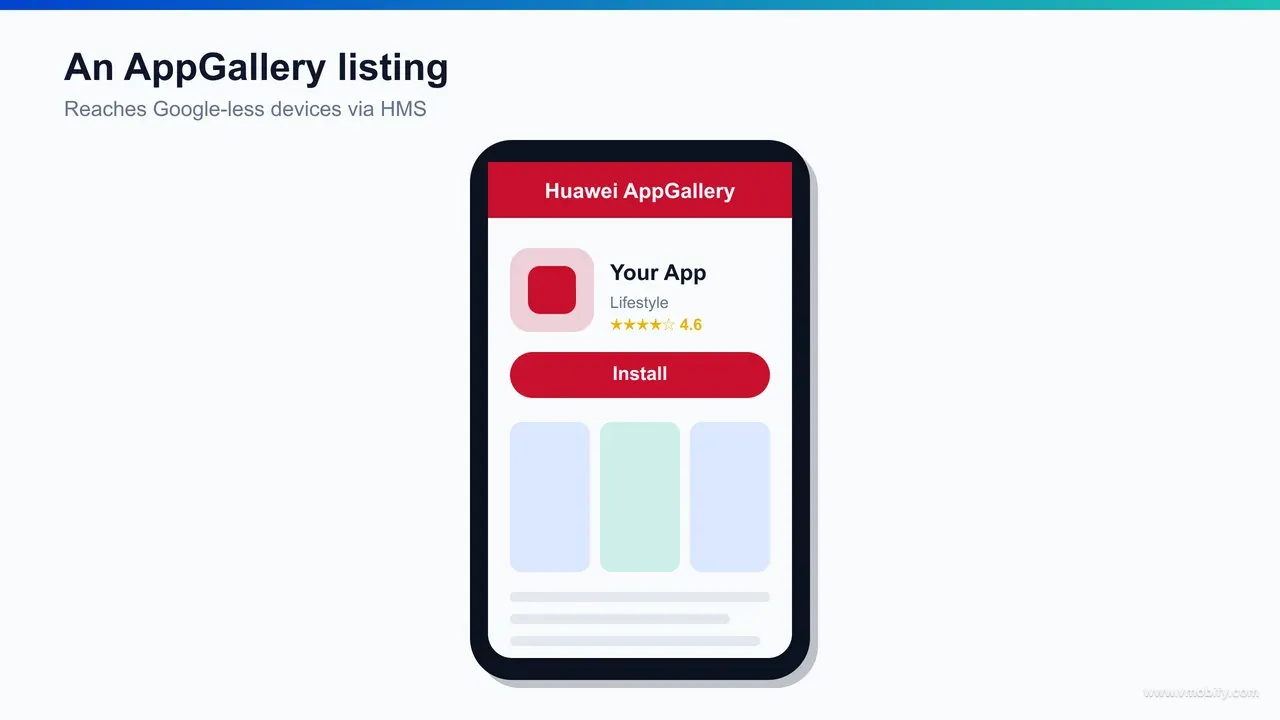
Huawei AppGallery is Huawei's official app store and the default distribution channel on Huawei and Honor-era devices that ship without Google services — making it the primary way to reach the Google-less Android audience that the 2019 US sanctions created. It is one of the largest app stores in the world by registered users, but its audience is shaped almost entirely by where Huawei still sells phones.
The store exists in its current strategic form because of a single event: in 2019, US trade restrictions cut Huawei off from Google Mobile Services. New Huawei devices could no longer ship with Google Play, Gmail, or the Google APIs most Android apps quietly depend on. Huawei's answer was to build out its own ecosystem — Huawei Mobile Services (HMS Core) as the API layer, and AppGallery as the storefront — and to court developers hard to fill the catalogue.
Who actually uses it in 2026 follows directly from that. The base is concentrated in China, the Middle East, Africa, and pockets of Europe and Latin America, plus a long tail of users on older Huawei hardware. It is genuinely large in those regions. It is also, for reasons we will be blunt about later, largely irrelevant to an India-only growth plan.
Across our 300+ apps managed since 2013, the question we field about AppGallery is almost never "how do we rank there" — it is "should we be there at all". For most of our India-first clients the honest answer is no. This guide is written to help you make that call with current facts rather than the recycled, years-out-of-date claims that dominate the search results — starting with the biggest one, the "100% revenue" myth that refuses to die.
How large is AppGallery reach today?
Huawei has reported more than 580 million monthly active users across 170-plus countries and over 6 million registered developers — but that figure dates to 2022-23, and the reach is heavily skewed toward China, the Middle East, Africa and Europe rather than spread evenly worldwide. The number is real; the framing matters more than the number.
The headline metric circulates everywhere as if it were current, so be precise about it. The most-cited 580 million-plus MAU and 170-plus-country figures come from Huawei's own communications around 2022-23, reported via outlets such as HuaweiCentral. Huawei has not refreshed a comparable global MAU headline since then in a way that has cleanly superseded it, so any post that quotes "580 million" without dating it is presenting a three-to-four-year-old snapshot as today's reality.
The geographic skew is the part that changes your decision. A user base of 580 million sounds like a Play-scale opportunity until you see where those users are: Huawei's strongest consumer markets are China, the Middle East, Africa, parts of Europe, and Latin America. China alone accounts for an enormous share, and China is a market with its own distribution, payment, and compliance realities. The "170-plus countries" line describes availability, not even distribution — your app being installable in a country is not the same as users there choosing AppGallery over the store preinstalled on their phone.
For the wider context on how AppGallery sits against the other non-Play channels, our guide to alternative app stores in 2026 maps reach and revenue economics across the major options side by side. The pattern there is consistent: raw user-count headlines are the least useful number for a distribution decision. Where the users are, and whether they are your users, is what counts.
What does it cost, and what about the "100% revenue" claim?
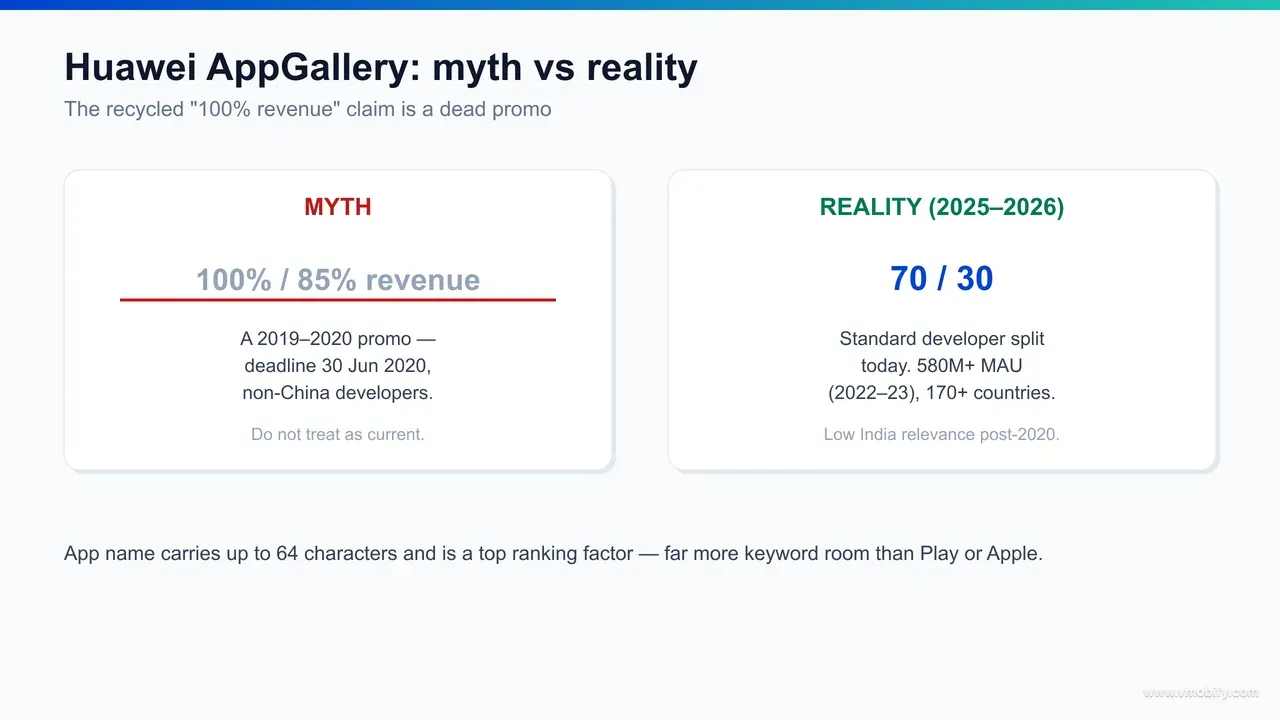
AppGallery's current standard revenue share is 70/30 — the developer keeps 70%, Huawei takes 30%, the same default split as Google Play and the App Store. The widely repeated "100% of first-year revenue, 85% on games" line is an expired 2019-2020 launch promotion and is no longer in effect; treat any source quoting it as current as out of date. This is the single most important correction in this entire guide.
Here is what actually happened. When Huawei was racing to fill AppGallery after losing Google services, it ran an aggressive developer-acquisition incentive: for a limited window, eligible non-China developers could keep 100% of their first-year revenue, with elevated splits on games. That promotion had a hard deadline — 30 June 2020 — and it was exactly that, a time-boxed promotion to bootstrap the catalogue. It expired. It has not been the standard for years.
The problem is that the "100% revenue" headline was catnip for blog posts and listicles in 2019-2020, and those posts were never updated. So in 2026 you can still find "AppGallery pays you 100%" repeated across the search results as if it were a live benefit. It is not. If you model your AppGallery economics on a 100% take rate, you will build a business case on a number that has been false for over five years.
The current reality, per Huawei's developer documentation, is the standard 70/30 split. That puts AppGallery's commission in line with the platforms you already know — not better, not a magic margin. Any genuine advantage AppGallery offers comes from reaching an audience Google Play cannot, not from a revenue share that beats it.
It is worth being just as careful about Huawei's strategic direction, because that shapes how much to invest. Huawei's newer push is HarmonyOS NEXT — a native ecosystem that drops the Android runtime entirely in favour of Huawei's own app model, a direction it pressed hard at its 2025 developer conference. For a developer, that signals two things: AppGallery remains the storefront, but the underlying app technology Huawei wants you to build on is moving, and a Google-less AppGallery listing today may eventually need a separate HarmonyOS-native build to stay first-class. None of that changes the 70/30 economics — it just means you should treat AppGallery as a moving platform, not a settled one, and weigh the ongoing maintenance, not only the one-off port.
We have seen the "100% revenue" myth shape real decisions in our portfolio — a client convinced AppGallery was a free-money channel because of a stale blog post, only to rebuild the model once we showed them the actual 70/30 terms. Get the economics right first: AppGallery is a reach play, not a take-rate play. If you want the commission edge, that lives on stores like the Samsung Galaxy Store, whose 80/20 split we cover in our Galaxy Store optimisation guide — not here.
How do you publish to AppGallery, and what is HMS Core?
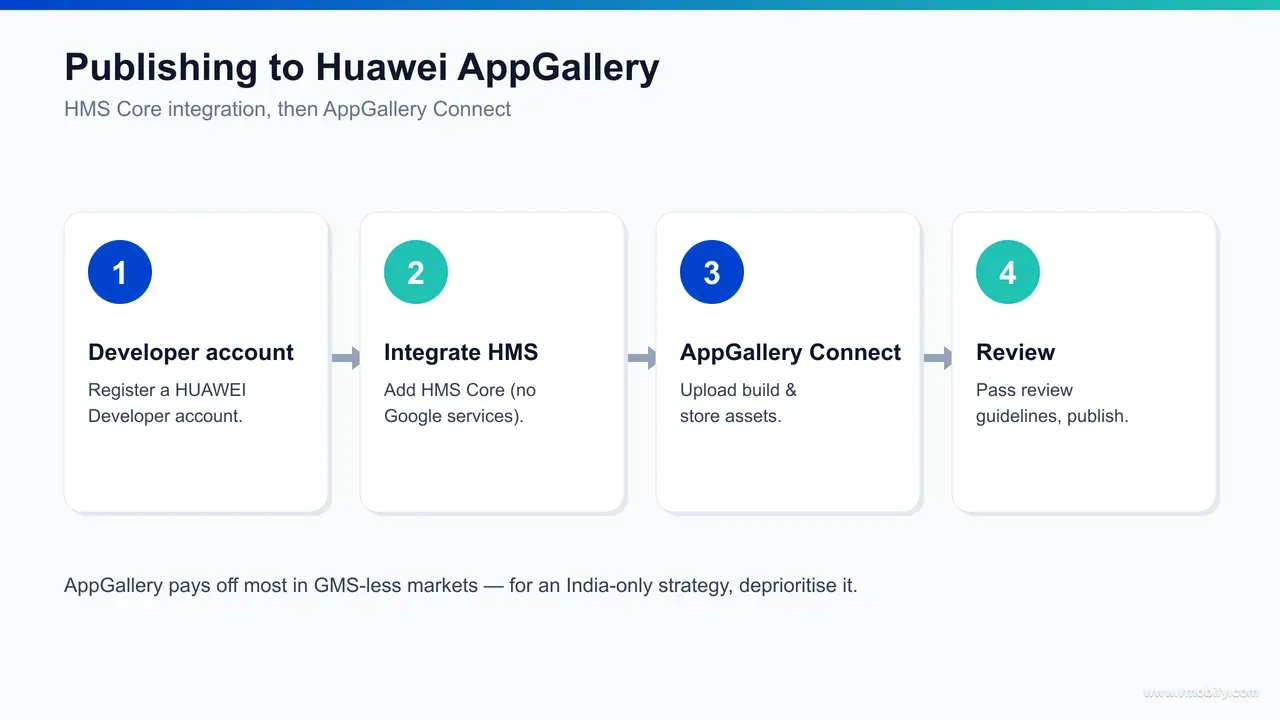
Publishing to AppGallery means registering as a Huawei developer, then submitting your app through AppGallery Connect — but the real work is HMS Core: because Huawei devices have no Google Mobile Services, any app that relies on Google APIs has to integrate Huawei's equivalents first, which makes this an engineering project, not a metadata upload. This is the step most "how to publish" articles skip, and it is the one that actually determines whether you can ship.
HMS Core (Huawei Mobile Services) is Huawei's replacement for the Google Mobile Services layer that ships on standard Android. Anything your app calls from Google — Maps, push via Firebase Cloud Messaging, Google Sign-In, in-app billing, location, ML Kit, safety/integrity APIs — does not exist on a Google-less Huawei device. HMS Core provides Huawei's parallel APIs (HMS Map Kit, Push Kit, Account Kit, IAP, Location Kit, and so on), and the porting effort is proportional to how deeply your app leans on Google services.
- Register a Huawei developer account: create and verify an account on the Huawei Developer portal. Verification for a company account requires business documents, so start this early — it is not instant.
- Audit your Google dependencies: before anything else, list every Google Mobile Services API your app uses. A purely self-contained app may run on a Huawei device as-is; an app built on Firebase, Google Maps and Google Sign-In needs HMS equivalents wired in. This audit decides your timeline.
- Integrate HMS Core where needed: swap or dual-path the Google APIs your app depends on for their HMS Kit counterparts. Many teams ship a single build that detects which mobile-services layer is present and routes accordingly.
- Submit through AppGallery Connect: upload your build, store listing, screenshots and ratings information in AppGallery Connect, set your countries and pricing, then submit for Huawei's review. As with any store, clean metadata and accurate declarations reduce rejection risk.
One detail teams underestimate is review and account verification. Huawei runs a real human review, and company-account verification can require business documents and a wait measured in days rather than minutes — Huawei does not publish a fixed service-level for either, so plan for a buffer rather than a same-day go-live. Treat your first submission the way you would a Play submission: accurate screenshots that match the current build, honest content rating and category, and data declarations that reflect what the app actually does. A young-to-you store still rejects sloppy submissions, and a day-one rejection delays the regional installs that were the whole reason to list.
The practical takeaway: scope the HMS integration before you commit. If your app is light on Google dependencies, publishing is genuinely straightforward. If it is built around Firebase and Google APIs, budget engineering time — this is closer to a platform port than a second-store listing, and that cost has to be weighed against the regional reach you are buying. In our portfolio, the apps that handled AppGallery well were the ones that ran the dependency audit and verification in parallel with the build work, rather than discovering a six-week HMS port after they had already committed a launch date.
Which ASO fields drive ranking on AppGallery?
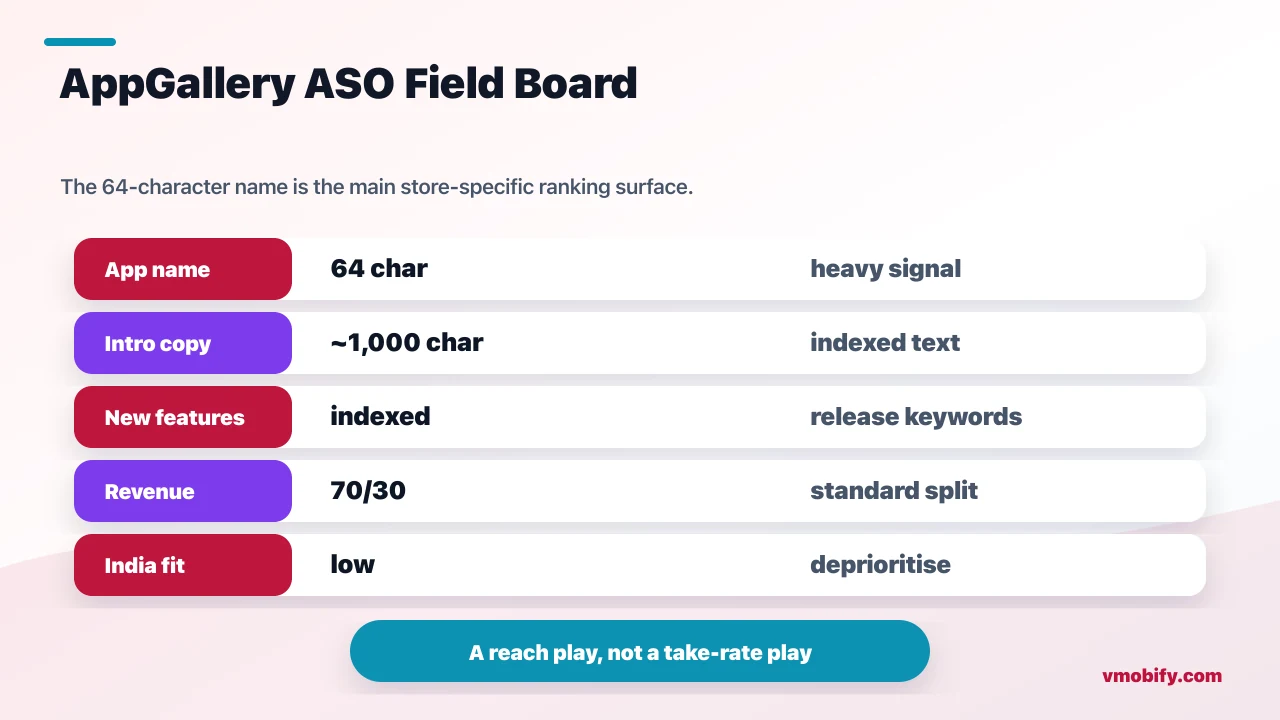
AppGallery's standout ASO lever is the app name field, which accepts up to 64 characters and is weighted heavily in ranking — meaningfully more indexed keyword room than Google Play's 30-character title or the App Store's 30-character name — alongside the indexed Introduction and "New features" copy. If you list on AppGallery, the app name is where most of your ranking opportunity sits.
Per ASO analyses of the store from ShyftUp and App Radar, the fields that matter most are:
- App name (up to 64 characters): the heaviest single ranking input and far longer than Play or Apple allow. This is room to pair your brand with high-intent keywords in one field — use it deliberately, not as a place to dump your brand name and stop.
- Introduction and "New features" text (up to roughly 1,000 characters): indexed descriptive copy where your secondary keywords belong. Treat it the way you would a keyword-bearing Play long description, not boilerplate.
- Category and tags: correct categorisation affects which browse and discovery surfaces you appear in. Mis-categorising costs you the lowest-effort visibility there is.
- Ratings, downloads and download velocity: as on every store, install volume, the rate of recent installs, and rating quality feed ranking. Huawei does not publish the exact algorithm, so treat these as best-practice signals rather than a documented formula.
Two cautions keep you honest. First, AppGallery does not publish its ranking algorithm, so the field weights above are informed inference from ASO practitioners, not a Huawei specification — write to them as strong defaults, then read your own install data. Second, the 64-character app name is a genuine opportunity, but it is also a place teams over-optimise into keyword soup that hurts conversion. The same conversion-versus-discoverability balance we apply in our core ASO work applies here: rank for the term, but keep the name readable enough to earn the tap.
Is Huawei AppGallery worth it for an India-focused app?
For a purely India-focused strategy, no — AppGallery should be deprioritised. The same 2019-2020 US sanctions that removed Google services from Huawei phones also stalled Huawei's smartphone momentum in India, so the Google-less Huawei install base there is small and the realistic install upside from AppGallery is thin. We would rather say that plainly than pad a case for a channel that will not move your India numbers.
The logic is straightforward. AppGallery's value proposition is reaching users whose phones cannot use Google Play — and that audience barely exists in India at scale. Huawei was never the dominant handset brand in India that it is in China or parts of the Middle East and Africa, and the post-2019 loss of Google services made new Huawei devices a hard sell in a Google-Play-centric market. So the very devices that make AppGallery worthwhile elsewhere are simply not in many Indian pockets.
If your audience is Indian, your distribution effort is far better spent on channels built for that market. India-native and India-strong stores like Indus Appstore and Xiaomi's GetApps reach the Tier-2/3 and vernacular audiences that actually define India's next wave of users — our Xiaomi GetApps ASO guide covers one of those device-channel plays in depth, and it will return more installs per hour of effort than AppGallery for an India-only app.
We flag this directly because pretending otherwise would be the kind of inflated, evergreen-sounding advice that fills the alt-store search results and helps nobody. In our portfolio, the India-first apps that asked us about AppGallery were almost always better served redirecting that energy to Play optimisation plus an India-native second store. The exception is a genuinely global app — and that is a different decision, which the next section addresses. If you are weighing platform-level reach trade-offs more broadly, our breakdown of iOS versus Android launch strategy frames how to prioritise channels by where your users actually are.
Where does AppGallery genuinely pay off?
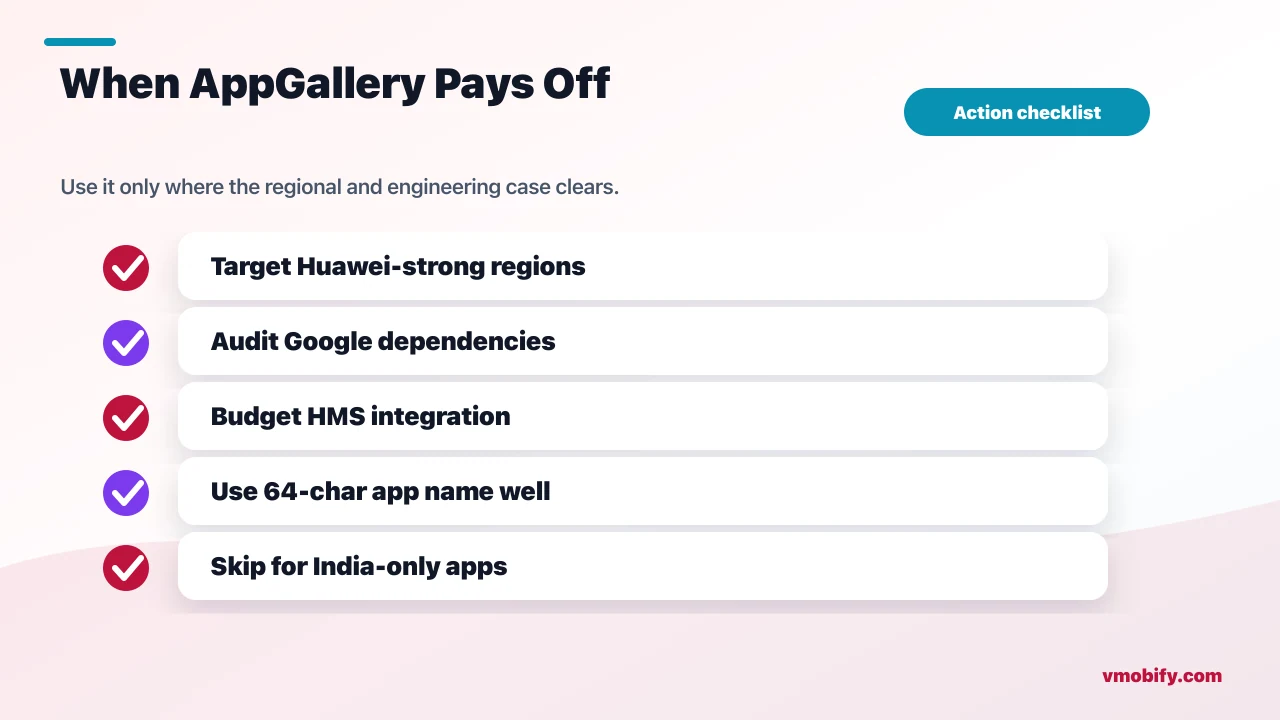
AppGallery pays off for genuinely global apps — especially games — that want low-competition featuring and incremental reach in Huawei-strong markets like China, the Middle East, Africa and parts of Europe, and that have either light Google dependencies or the engineering budget to integrate HMS Core. Used for that, it is a sensible targeted channel; used as a Play replacement or an India play, it disappoints.
The strongest fit is games. Huawei actively courts game developers, the catalogue is thinner than Play in many categories, and a thinner catalogue means the featuring and discovery competition is lower — a well-optimised game can earn visibility on AppGallery that would be far harder to win on a saturated store. Combine that with the 64-character app name advantage and the right title can punch above its weight.
- Global games chasing featuring: lower competition for editorial and discovery slots in Huawei-strong regions is the clearest upside.
- Apps with regional users where Huawei is strong: if you already have a Middle East, Africa, China or European user base on Huawei hardware, AppGallery captures installs Play cannot serve those users.
- Apps with light Google dependencies: the less your app leans on Google Mobile Services, the cheaper the HMS integration, and the better the effort-to-reach ratio.
And the clear "do not bother" cases, stated as plainly: an India-only app, a metro-English Western app with no Huawei-region users, or any app so deeply built on Firebase and Google APIs that the HMS port costs more than the incremental reach is worth. For those, AppGallery is overhead, not opportunity — and across our portfolio we have advised against listing far more often than for it.
The honest bottom line: AppGallery is a real channel for a specific profile of app, not a universal one. Decide it on your actual user geography and your HMS integration cost, not on a 580-million headline or a dead 100%-revenue promo. If you want help mapping which stores — Play, Galaxy Store, Indus, GetApps, AppGallery — are worth the effort for your specific app and audience, that multi-store prioritisation is exactly the work our ASO team runs; you can see the outcomes across our case studies or talk to us directly.
Frequently Asked Questions
Does Huawei AppGallery still pay developers 100% of revenue?+
No. The "100% first-year revenue" line was a 2019-2020 launch promotion with a 30 June 2020 deadline for non-China developers, and it has long expired. The current standard revenue share is 70/30, the same default as Google Play and the App Store.
What is the Huawei AppGallery commission in 2026?+
AppGallery uses the standard 70/30 revenue share — you keep 70%, Huawei takes 30%. Always confirm the current terms in Huawei's developer documentation, as platform policies can change.
How do you publish an app on AppGallery without Google services?+
You register a Huawei developer account, audit your app for Google Mobile Services dependencies, integrate the matching HMS Core APIs (Push Kit, Map Kit, Account Kit, IAP and so on) where needed, then submit through AppGallery Connect for review.
How long can an app name be for AppGallery ASO?+
The app name field accepts up to 64 characters and is a heavy ranking factor — far more indexed keyword room than Google Play's 30 characters or the App Store's 30. It is the single biggest store-specific ASO lever on AppGallery.
Is Huawei AppGallery worth it for an India-focused app?+
Generally no. The 2020 US sanctions stalled Huawei's India smartphone momentum, so the Google-less Huawei base in India is small. India-first apps get a better return from Play optimisation plus India-native stores like Indus Appstore or Xiaomi GetApps.
How many users does Huawei AppGallery have?+
Huawei reported more than 580 million monthly active users across 170-plus countries — but that is a 2022-23 figure, and the base is concentrated in China, the Middle East, Africa and parts of Europe rather than spread evenly worldwide.
What is HMS Core?+
HMS Core (Huawei Mobile Services) is Huawei's replacement for Google Mobile Services on Google-less Huawei devices. It provides parallel APIs — push, maps, sign-in, in-app billing, location — that your app must integrate if it relies on the Google equivalents.
Sources
- HuaweiCentral — AppGallery exceeds 580 million users — MAU, country and developer figures (2022-23 reporting)
- Huawei Developer — AppGallery distribution documentation — Current standard 70/30 revenue share and publishing terms
- ShyftUp — ASO on Huawei AppGallery — 64-character app name and indexed metadata fields
- App Radar — Huawei AppGallery app store optimisation — AppGallery ASO ranking factors and listing best practice
- Huawei Developer — HMS Core — The Huawei Mobile Services API layer that replaces Google Mobile Services
- Huawei Developer — AppGallery Connect — The console used to submit, distribute and review AppGallery apps
About the author
Amol Pomane — Founder, Vmobify
Amol leads Vmobify, a mobile app growth agency that has driven 30M+ downloads and ranked 54K+ keywords across 300+ apps since 2013. He writes about ASO, paid user acquisition, retention, and the operational reality of scaling mobile apps in India and global markets.
Check your store metadata
Run your current App Store or Play metadata through the free checker.
Open free tool