iOS vs Android: Where Should You Launch Your App First?
The iOS-vs-Android launch decision is rarely simple. Here is the decision framework — based on market share, monetisation, geography, development cost, and store policy.
On this page
- What is the quick iOS-vs-Android decision?
- How does the iOS-vs-Android split work in India?
- When should you launch iOS first?
- When should you launch Android first?
- When does it make sense to launch both simultaneously?
- How do you spot a wrong platform choice early?
- How do development and marketing costs compare?
- How do App Store and Play Store policies shape the decision?
- Frequently Asked Questions
What is the quick iOS-vs-Android decision?
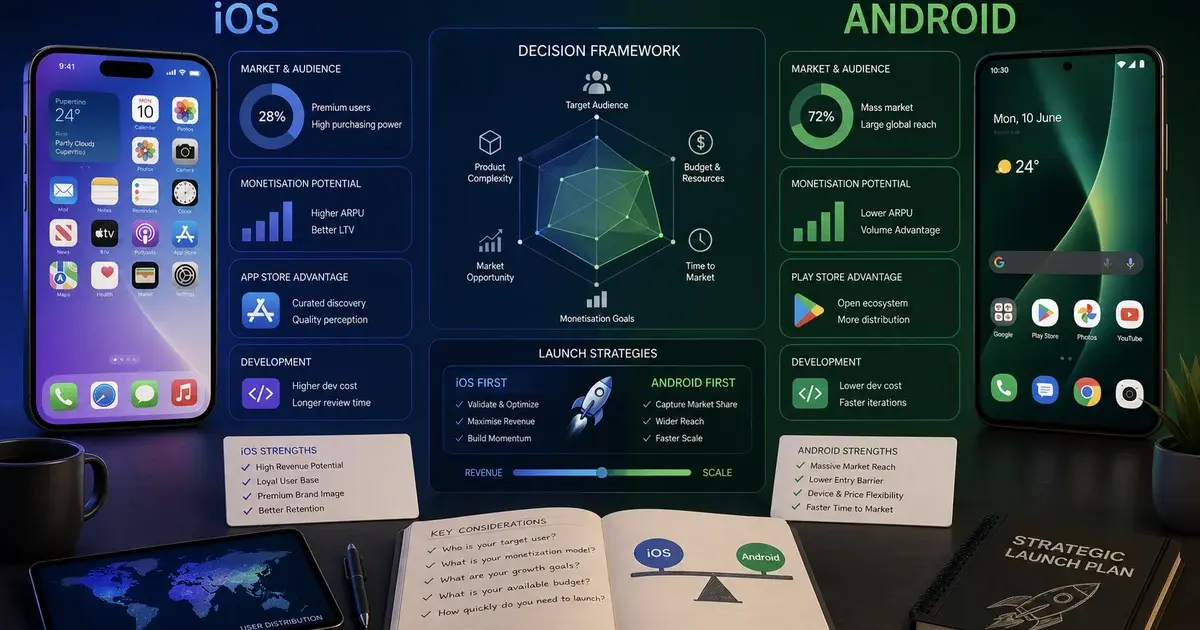
The honest answer is that "iOS or Android first" depends on five variables — target geography, monetisation model, audience income bracket, platform-specific feature dependency, and your team's operational capacity — and the right choice changes every time one of them changes. Here is the cheat-sheet we use internally before any deeper analysis:
- India-targeted consumer app: Android first. ~97% install share. CPIs 3-5x lower than iOS.
- US, UK, AU, or EU-targeted premium app: iOS first. Higher LTV, higher engagement, more subscription conversion.
- B2B SaaS or productivity: iOS first or both. iOS over-indexes in business buyers and enterprise pilots.
- Fintech, premium ecommerce, or subscription content in India: Both — Android brings volume, iOS brings revenue.
- Hyper-casual or volume-driven ad-monetised app: Android only initially. Add iOS only when the LTV economics actually work.
Across our 300+ apps managed since 2013, we have watched the same wrong decision destroy launch after launch: a founder picks the platform they personally use rather than the platform their target user lives on. The cost shows up six months later when CPIs come in 3x forecast and the team has burned runway proving a thesis that the platform-mix data could have ruled out on day one.
The rest of this post unpacks the reasoning behind each branch, what the India data actually says, and how store policies and dev cost should feed back into the decision. If you want a fast second opinion on your specific app, our UA team runs platform-mix audits for early-stage launches.
How does the iOS-vs-Android split work in India?
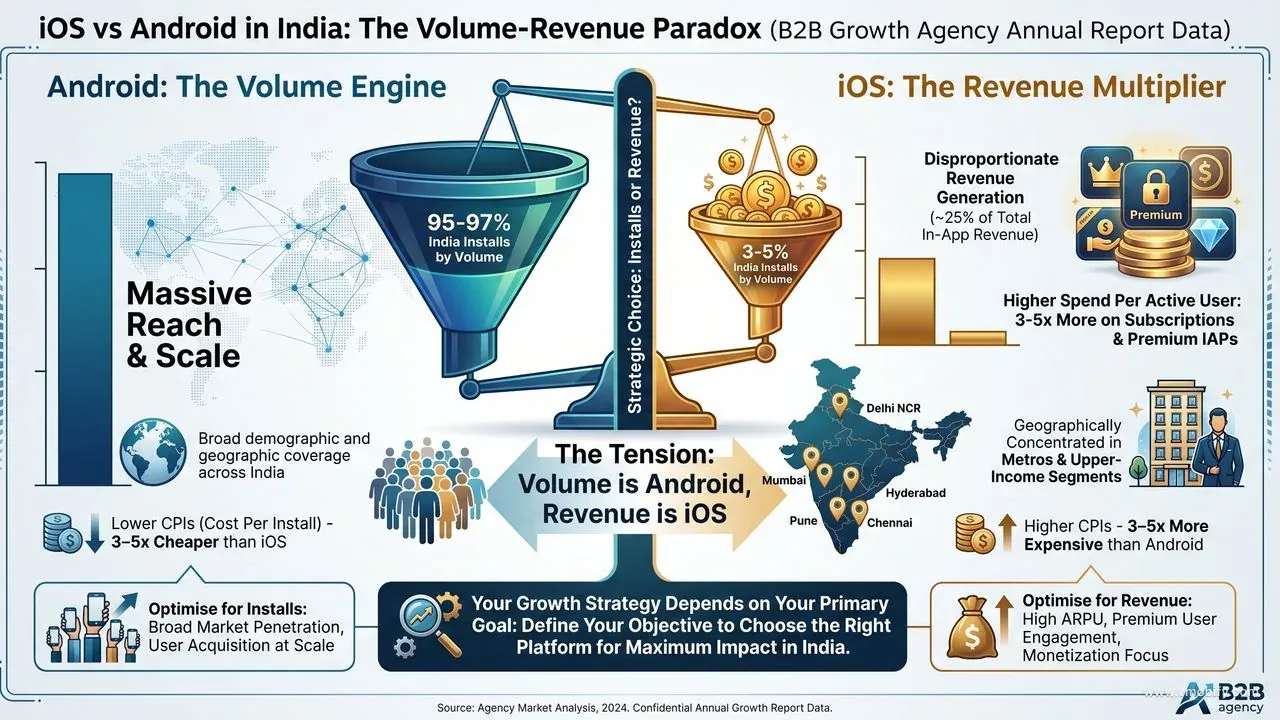
India is the most extreme Android-dominant major market on the planet — Android sits at roughly 97% of installed base and 95%+ of new-install volume — yet iOS users in India consistently generate 3-5x more revenue per user in fintech, premium content, productivity, and subscription verticals. The headline number and the revenue number both matter, and they pull in opposite directions.
What the data actually says about India:
- Install share: Android dominates roughly 95-97% of monthly active devices, according to Statista's India mobile usage data. The iOS base sits in single digits but is growing roughly 15-20% year-over-year as the iPhone SE and used-iPhone market expands into Tier-1 metros.
- Geographic concentration: iOS in India is heavily concentrated in Mumbai, Delhi NCR, Bangalore, Hyderabad, Pune, and Chennai — and within those cities, in the upper-income deciles. A "national India" iOS strategy is really a "top six metros + diaspora" strategy.
- Spending behaviour: Our portfolio data across fintech, edtech, and premium content apps consistently shows iOS users in India transacting at 3-5x the rate of Android users on a per-MAU basis. AppsFlyer's State of App Marketing report shows similar patterns for South Asia.
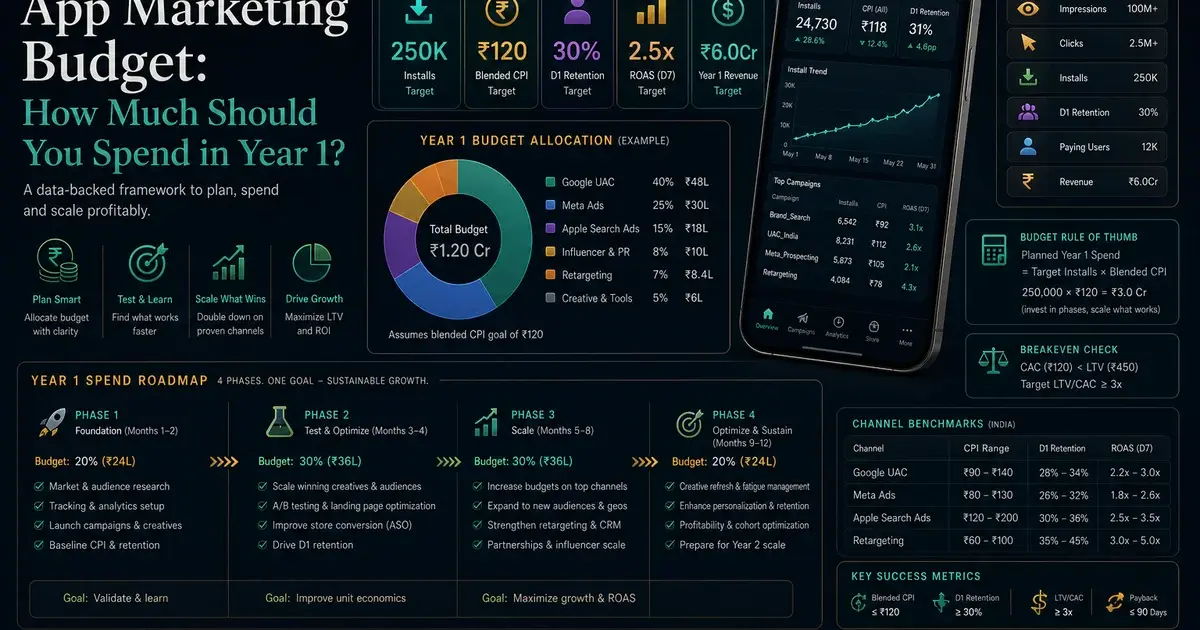
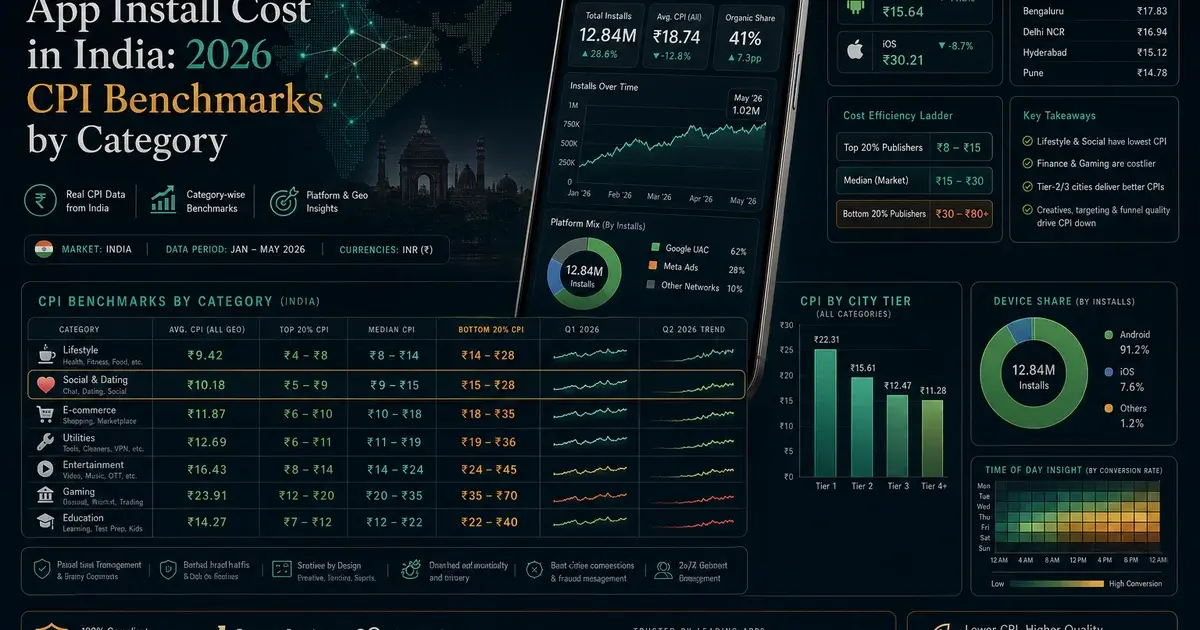
- UA cost: iOS CPIs in India run 3-5x higher than Android CPIs in the same vertical and audience. The smaller iOS auction pool plus higher advertiser competition for premium audiences keeps prices structurally elevated.
The practical implication: for a mass-market India app — utilities, regional content, hyper-casual games, social, anything monetised through ads or volume — Android-only for the first 12-24 months is almost always the right call. The iOS market is too small relative to dev and UA cost to justify the parallel build. We have seen multiple India consumer apps cross 10M Android installs before launching an iOS app at all, and the delayed iOS launch performed better than a same-day launch would have because the team had hardened the product on Android first.
For premium or B2B India apps — wealth-tech, premium productivity, professional networking, enterprise tooling — iOS-first or simultaneous is defensible because the target audience is iOS-skewed even though the country isn't. The audience question always beats the country question.
When should you launch iOS first?
Launch iOS first when your target user is higher-income, your monetisation depends on subscriptions or in-app purchases, your geography is US/UK/AU/EU, or your app depends on iOS-specific platform features. Each of these tilts the math toward iOS even when raw install volume favours Android.
- Higher-income target audience: Premium fitness, meditation, productivity, finance, and B2B SaaS audiences over-index heavily on iOS globally. The audience is where the money is, and that audience disproportionately carries an iPhone.
- iOS-specific platform features: Apps that rely on ARKit, HealthKit, CallKit, Live Activities, Widgets, Dynamic Island, SharePlay, or deep Apple Watch integration ship faster and better on iOS-first. Apple's App Store Connect docs outline the platform-feature surface that is genuinely hard to replicate on Android.
- Target geography is US/UK/AU/EU: iOS share is roughly 55-60% in the US, 50% in the UK and Australia, and 25-40% across major EU markets. For these markets, the iOS audience is large enough to support a meaningful launch on its own.
- Subscription-heavy monetisation: iOS users are 2-3x more likely to start a paid subscription and 3-5x more likely to retain past month three than Android users, according to AppsFlyer's subscription benchmarks. Sensor Tower consistently reports App Store consumer spend at roughly 1.6-1.8x Play Store spend on a global basis despite a much smaller install base.
- Polish-before-scale strategy: A smaller iOS user base is easier to iterate against in beta. TestFlight gives a clean 10,000-user beta channel that is operationally simpler than Google Play's open/closed testing tracks for early polish work.
In our portfolio, the apps that successfully ran iOS-first into US/UK markets shared a pattern: a clear subscription or premium IAP economic model, a single sharp target persona, and feature dependencies that were genuinely better on iOS. When all three are true, iOS-first wins even when it means walking past 90% of the global device base.
The trap to avoid: launching iOS-first in India "because the product feels premium." Premium feel doesn't pay rent — audience density does. If your target persona is 90% Android, iOS-first is a vanity choice. See our India CPI benchmark guide for the cost-per-install numbers by vertical before committing.
When should you launch Android first?
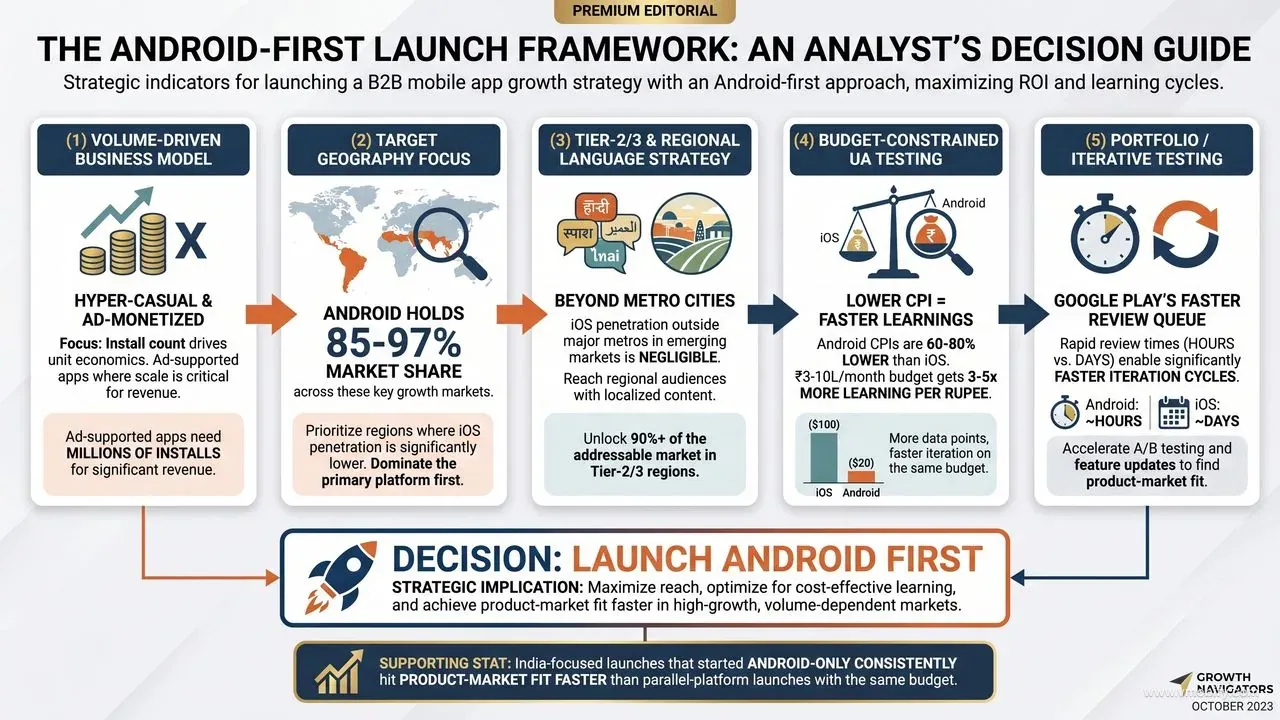
Launch Android first when your business model depends on volume, your geography is India / SEA / LATAM / MENA, your monetisation runs on ads, or you need cheap iteration cycles to test product-market fit. Android's dominance outside the rich-world bubble plus its dramatically lower acquisition cost makes it the right starting point for most non-Western consumer launches.
- Volume-driven business model: Hyper-casual gaming, ad-monetised content, news, video, and any app where install count drives the unit economics belongs on Android first. The cost of acquiring 1M installs on Android is typically 3-5x cheaper than on iOS, and the ad RPMs are closer than the CPI gap suggests.
- Target geography is India, Southeast Asia, LATAM, or MENA: Android holds 85-97% of installed base across these markets. Indonesia, Vietnam, Philippines, Brazil, Mexico, Nigeria, Egypt — all Android-dominant by wide margins.
- Tier-2/3 and regional language strategy: Almost universally Android-first. iOS penetration outside metros in emerging markets is negligible.
- Cheaper UA testing budget: Android CPIs are 60-80% lower than iOS in most categories. For early-stage teams running ₹3-10L per month of UA experiments, Android delivers 3-5x more learning per rupee.
- Cross-app portfolio testing: Studios shipping a portfolio of test apps move faster on Android because the Google Play developer policies allow faster iteration and Google Play's review queue is typically hours rather than days.
One under-discussed Android-first advantage is data resolution. Android Advertising ID (when present) and Google Play Install Referrer give MMP platforms significantly cleaner attribution than iOS post-ATT and SKAdNetwork. SKAdNetwork's privacy-preserving model is great for users and difficult for marketers — you simply learn faster on Android.
In our portfolio, India-focused launches that started Android-only consistently hit product-market fit faster than parallel-platform launches with the same total budget. Concentrating spend in one ecosystem produced cleaner cohorts, faster creative learning, and clearer retention diagnostics. For deeper Android-specific tactics see our Android ASO hacks and ASO service overview.
When does it make sense to launch both simultaneously?
Launch both platforms simultaneously only when you are well-funded, your app has true network effects, your value proposition genuinely differs by platform, or you are shipping a cross-platform framework that makes the second build nearly free. For most early-stage startups, simultaneous launch is harder than it looks and slows learning by splitting attention across two distinct ecosystems.
- Well-funded venture launches: If you have operational capacity to run two separate UA stacks, two creative pipelines, two ASO programmes, and two analytics dashboards, simultaneous launch maximises addressable audience from day one. This usually means a team of 4+ on the marketing side alone.
- Network-effect apps: Social, dating, marketplaces, multiplayer games — anything where user density drives the experience — should not split density across platforms. A simultaneous launch keeps the network whole.
- Platform-specific value-prop differentiation: Some apps have a genuinely different proposition per platform — for example, a premium iOS-first experience with an Android lite version targeting different income tiers. This is rare but powerful when it fits.
- Cross-platform framework parity: If you are shipping React Native, Flutter, or Kotlin Multiplatform Mobile, the marginal cost of adding the second platform is small enough that you should usually ship both.
The hidden cost of simultaneous launch is operational, not technical. Two store relationships, two review timelines, two crash-reporting setups, two attribution configurations, two creative localisations, two beta programmes. We have watched teams underestimate this cost repeatedly — and the result is usually that both platforms launch weakly rather than one platform launching strongly.
Our default recommendation for funded but not lavish early-stage teams: pick one platform based on the framework above, ship cleanly, learn for 4-6 months, then ship the second platform with everything you learned baked in. The follow-up launch typically outperforms what a same-day parallel launch would have produced — and the team is in a much better state to operate two platforms by then.
How do you spot a wrong platform choice early?
A wrong platform choice announces itself inside the first UA cycle: cost per install refuses to move toward your model however many creatives you rotate, and the installs you do buy land in the wrong cities and the wrong income bands. Founders rarely lose a year to the original decision. They lose it to re-testing creative against an audience that was never on that platform in the first place.
This is the diagnostic sequence our analytics team runs when an early launch is underperforming, in order:
- Compare actual CPI against your own model, not a public benchmark. A benchmark tells you what the market costs; your model tells you what your unit economics need. If actual CPI sits well above your model on the same targeting while every creative variant lands inside a narrow band of the others, the constraint is audience density, not the message.
- Pull installs by city tier and by language. On an India Android launch, installs that never leave the top six metros mean your targeting or your vernacular coverage is doing the limiting. Tier-2 and Tier-3 volume is where Android's cost advantage actually pays off — if you are not reaching it, you are paying Android prices for a metro-only audience.
- Check whether retention moves with creative. If day-7 retention stays flat while CPI swings across variants, you are buying different people at different prices with the same poor fit. That is a platform-audience mismatch, not a creative problem, and no amount of further creative testing will resolve it.
- Decide before the next quarter of spend. Either fix targeting inside the current platform or commit to the second-platform build. Stop funding the middle position — a half-supported first platform alongside an unfunded plan for the second is where most wasted runway actually goes.
The sceptical objection here is fair: isn't this just an argument for launching both and skipping the diagnosis? No — running both platforms doubles the surface you have to diagnose without telling you which one your audience lives on.
The cost of catching this late is not only wasted media spend. It is a store listing tuned to the wrong audience, a creative library built on the wrong personas, and a retention baseline you cannot trust when the second platform finally ships. Caught inside the first UA cycle, the fix is a targeting and listing rebuild. Caught a year in, you are re-running the launch.
How do development and marketing costs compare?
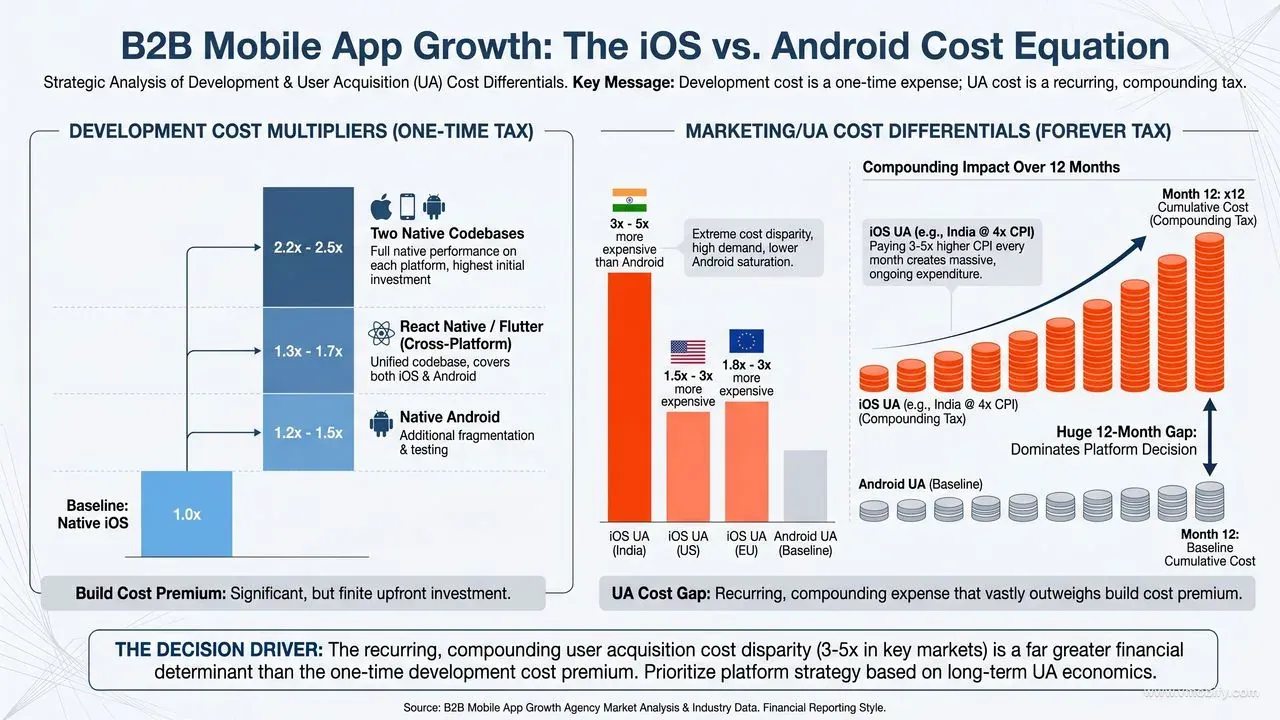
Native iOS is the cheapest single-platform build; native Android runs 20-50% more because of fragmentation; cross-platform frameworks add 30-70% to base iOS cost but cover both stores — almost always cheaper than two parallel native codebases when feature surface is shared. Marketing cost differences are usually larger than dev cost differences, and they should drive the platform decision more than build cost does.
Approximate cost multipliers (using native iOS as the 1.0x baseline):
- Native iOS development: 1.0x base cost.
- Native Android development: 1.2-1.5x iOS, mostly because of device-and-OS fragmentation testing.
- React Native / Flutter: 1.3-1.7x base, covers both platforms. Net cheaper than two natives for most CRUD-style apps.
- Two native codebases (iOS + Android): 2.2-2.5x base. Worth it only when platform-specific feature use is heavy.
Marketing cost differentials usually dwarf these:
- iOS UA in India: 3-5x more expensive than Android. Smaller audience, more competitive auctions, ATT-driven measurement loss.
- iOS UA in US: 1.5-3x more expensive than Android depending on vertical.
- iOS UA in EU: 1.8-3x more expensive than Android with significant variance by country.
- Apple developer fee: $99 per year. App Store Review Guidelines apply. 15-30% revenue share (15% for the small-business programme, 30% otherwise, 15% on renewing subscriptions after year one).
- Google developer fee: $25 one-time. 15-30% revenue share with the same small-business and subscription discounts.
The store fee structures are now closer than the conventional wisdom suggests — both stores moved to 15% baseline for the first $1M of developer revenue and on subscription renewals. The bigger commercial difference is in alternative payment options and sideloading, which Google permits more freely (outside India for some categories) and Apple still restricts heavily despite EU DMA changes.
Bottom line: dev cost is a tax you pay once; UA cost is a tax you pay forever. The UA cost gap should usually dominate your platform-mix decision over dev cost — which is exactly why audience and geography matter more than framework choice. Talk to our team if you want a costed model for your specific launch.
How do App Store and Play Store policies shape the decision?
Store policy differences are large enough to change the launch decision for entire categories — particularly fintech, content moderation, alternative payments, and anything touching crypto, gambling, or health claims. The platform that lets you ship your category cleanly is almost always the right place to start.
- Review timelines: Apple averages 24-48 hours for first submissions and 4-24 hours for updates per Apple's published review metrics. Google Play averages 1-7 days for first submissions and a few hours for updates in most cases. Apple is faster on updates; Google is often faster on first review.
- Content policy strictness: Apple's App Store Review Guidelines are stricter on adult, gambling, dating, and finance categories than Google's. If you operate in a borderline category, Android is usually the lower-friction starting point.
- Fintech and financial-services review: Both stores have hardened policies. In India, RBI guidance, SEBI rules for broking apps, and IRDAI rules for insurance apply on top of store policy. Get regulatory clearance before betting on either store's review.
- Alternative payments: Apple permits external link entitlements only in limited regions; Google permits them more broadly. If your monetisation depends on routing payments outside the store's billing system, Android is materially easier.
- Update cadence: Apple's faster update review supports rapid post-launch iteration; Google's slower review with more rollback flexibility supports staged rollouts. Both models work; the operational rhythm differs.
One genuinely underrated Apple advantage for early launches: Custom Product Pages and In-App Events. Both surfaces let you tailor the store listing per campaign or audience segment in ways Google Play store listings don't fully match yet. For premium subscription apps testing multiple value props, this alone can swing the platform decision toward iOS-first.
In our portfolio across fintech, gaming, and content apps, store-policy fit predicts launch friction more reliably than any other variable. The right move is to read both Apple's guidelines and Google's developer policies end-to-end for your category before you build, not after you submit. Read more launch-prep tactics in our pre-launch marketing playbook or browse our case studies for category-specific examples.
Frequently Asked Questions
Should I use React Native or native Swift/Kotlin?+
React Native or Flutter for most consumer apps where time-to-launch matters and shared business logic dominates the codebase. Native Swift/Kotlin for apps with heavy platform-feature use, complex performance needs, or a single-platform launch strategy.
What is the cost gap between iOS UA and Android UA in India?+
iOS CPIs typically run 3-5x higher than Android CPIs for the same vertical and audience. However, iOS LTV is often 3-8x higher in subscription, fintech, and premium content categories — so the unit economics frequently work out favourably for iOS despite the higher CPI.
Can I launch on App Store without launching on Play Store?+
Yes. Apple and Google are entirely separate ecosystems with separate developer accounts, review processes, and policies. An App Store launch does not require a Play Store launch and vice versa.
Should TestFlight beta come before public launch?+
Yes — a TestFlight beta with 500-2,000 invited users for 4-8 weeks before public launch is standard practice for serious iOS launches. It surfaces crashes, onboarding friction, and conversion issues before they affect your launch-day metrics.
Does Apple's 30% commission affect launch decisions?+
For subscription apps, yes. Apple's 30% (15% after year one or under the small-business programme) compounds across the subscription lifetime in a way that can shave 5-15% off blended LTV vs Android, where alternative payment routes are slightly more permissive in some markets.
How long should I run on one platform before adding the second?+
Most early-stage teams should run 4-6 months on the first platform — enough time to harden onboarding, prove retention, find product-market fit signals, and build a creative library — before opening the second platform. Earlier than that usually splits attention before the first platform is stable.
Does ATT and SKAdNetwork make iOS unworkable for performance marketing?+
No — but it does make iOS UA slower and noisier to optimise than it was pre-iOS 14.5. Most well-run iOS campaigns now blend SKAdNetwork postbacks with probabilistic and CRM-based attribution. The data is workable; it just takes longer to learn from each test.
Sources
- Apple App Store Review Guidelines — Category-specific rules that frequently shape platform launch decisions for fintech, gaming, and content apps
- Google Play Developer Policy Center — Google Play's content, monetisation, and behaviour policies for Android app launches
- AppsFlyer — State of App Marketing in India — Benchmarks for iOS vs Android retention, conversion, and subscription rates by region
- Sensor Tower State of Mobile — App Store vs Play Store consumer spending data showing iOS revenue dominance despite smaller install base
- Apple App Store Connect Documentation — Official iOS launch, review, and Custom Product Page documentation
- Statista — Smartphone Market in India — India device-mix, smartphone penetration, and Android dominance data
- SKAdNetwork Documentation — Apple's privacy-preserving attribution framework that shapes iOS UA measurement
- Apple Custom Product Pages — Per-campaign tailored App Store listings — a meaningful iOS-only growth lever
About the author
Amol Pomane — Founder, Vmobify
Amol leads Vmobify, a mobile app growth agency that has driven 30M+ downloads and ranked 54K+ keywords across 300+ apps since 2013. He writes about ASO, paid user acquisition, retention, and the operational reality of scaling mobile apps in India and global markets.