Fitness App Marketing: How We Scaled a Workout App to 200K MAU
How we took a regional Indian fitness app from 15K MAU to 213K MAU in 9 months — the channel mix, creative system, and retention loop that made the math work.
On this page
- Who was the client and what was the challenge?
- What did the baseline diagnostic reveal?
- What three-pillar strategy did we choose?
- How did the 9-month execution timeline unfold?
- Which creatives broke the campaign open?
- How did we engineer the retention loop?
- What channel mix delivered the install volume?
- What results did 9 months actually deliver?
- What operational rhythm made the system work?
- What are the broader lessons for any fitness app?
- Frequently Asked Questions
Who was the client and what was the challenge?
A 2-year-old Indian fitness app focused on at-home workouts with Hindi and Marathi instructor content came to us in August 2025 with a stalled growth curve and a burn rate that was 11x their revenue. The brief was simple to state and hard to execute: cross 200K monthly active users in 9 months on a ₹12L/month marketing budget, with positive contribution margin by month 6.
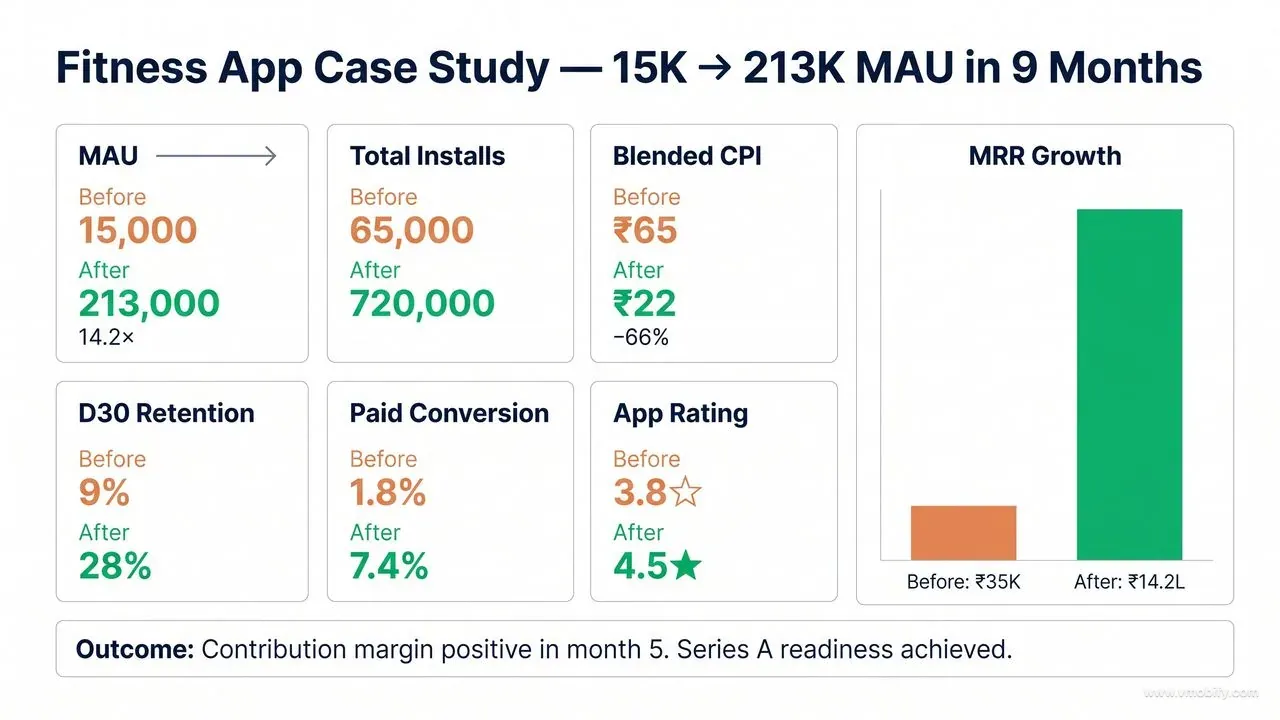
The starting position was honest but bleak. 15,000 monthly active users. 65,000 total installs in two years. ₹65 blended CPI and climbing — Indian metro fitness CPIs had risen roughly 30% year-over-year as broader fitness category demand intensified per AppsFlyer's State of App Marketing benchmarks. A 3.8★ rating built on 1,200 ratings, most of them complaints about the onboarding flow. D30 retention of 9%, which is roughly half the global fitness category baseline. MRR of ₹35,000 against a ₹4L monthly burn.
The strategic problem was not visible from the dashboard. Their content library was actually excellent — 200+ instructor-led workouts in two regional languages, mostly under-discovered because every input upstream of the content (ASO, paid targeting, creative, onboarding, paywall timing) was tuned for the wrong audience. They were running an English-language metro playbook on top of a vernacular Tier-2/3 product. The mismatch was the entire problem.
This is a pattern we have seen repeatedly across the 300+ apps we have managed since 2013 — particularly in India, where the gap between a great product and a discoverable product is almost always an English-first marketing layer running on top of a vernacular-first user base. Fixing the marketing stack rather than the product was the bet.
What did the baseline diagnostic reveal?
Our 2-week audit found five compounding failures, each individually fixable, that together explained the entire growth ceiling. Diagnosis preceded any spend changes — a discipline we maintain on every engagement because most "growth problems" turn out to be funnel problems disguised as acquisition problems.
- ASO completely unoptimised: Generic English-only title, subtitle, and description. Zero ranked vernacular keywords. The Hindi keyword "ghar par workout" (at-home workout) — searched roughly 40,000+ times per month on Google Play India per third-party keyword tools — had no presence in their metadata. They were invisible to their actual audience.
- Paid spend wasted on broad UAC: 80% of budget on a single English-only Google App Campaign optimising on the install event. The algorithm was correctly finding the cheapest installs available — and those installs were churning at 95% by D7 because they were not workout-intent users.
- Onboarding bloated to 7 screens: Email + password, phone OTP, biometric setup, goal selection, fitness level quiz, body type questionnaire, then a paywall. 41% drop-off before the first workout. Industry-standard fitness onboarding completion is closer to 75-80% per Adjust's published mobile app trends data.
- No re-engagement loop installed: Zero push notifications scheduled. Zero email lifecycle. Lapsed users were churned and forgotten. For a habit category like fitness, this is the single largest unforced error a team can make.
- Paywall surfaced on session 1: Users hit a ₹399/quarter paywall before completing a single workout. Free trial uptake under 4%; subscription conversion of installs under 2%.
The audit also caught one positive signal that became the foundation of the entire strategy: their 9% D30 retention, while bad in absolute terms, was held up almost entirely by a tiny cohort of Hindi-content users who were retaining at 22%. The product worked — for the audience the marketing was failing to reach.
What three-pillar strategy did we choose?
We picked three high-leverage pillars and ignored everything else for the first 90 days. Scope discipline matters more than tactic selection — most agency engagements fail because they try to do 12 things adequately instead of three things excellently.
- Pillar 1: Vernacular ASO and creative system. Rebuild metadata against Hindi and Marathi keyword universes. Rebuild all creative assets with regional instructors speaking regional languages. The hypothesis: organic install share would climb from 12% to 30%+ within 6 months if we stopped invisibly losing every vernacular search query. See our ASO service page for the playbook framework we deploy.
- Pillar 2: Tier-2/3 paid focus with workout-event optimisation. Shift UAC and Meta budget allocation aggressively toward Tier-2/3 cities where CPIs were measurably 40-60% lower and competition was thinner. Switch optimisation from "install" event to "completed first workout" event — the only acquisition signal that correlates with revenue.
- Pillar 3: Retention loop installation. Compress onboarding to 3 screens. Defer paywall to session 3. Build a 4-touch first-week push notification sequence. Add visible streak mechanics to the home screen. Retention was the bottleneck the team had not recognised — cheaper installs would not save the unit economics if D30 stayed at 9%.
What we explicitly did not do in the first 90 days: no influencer activations, no content production support, no creator marketplace experiments, no pricing redesigns. Those were sequenced for months 4-9 once the foundational stack was working. Sequencing matters — running a 25-creator influencer push on top of a 7-screen onboarding flow just wastes the spike.
How did the 9-month execution timeline unfold?
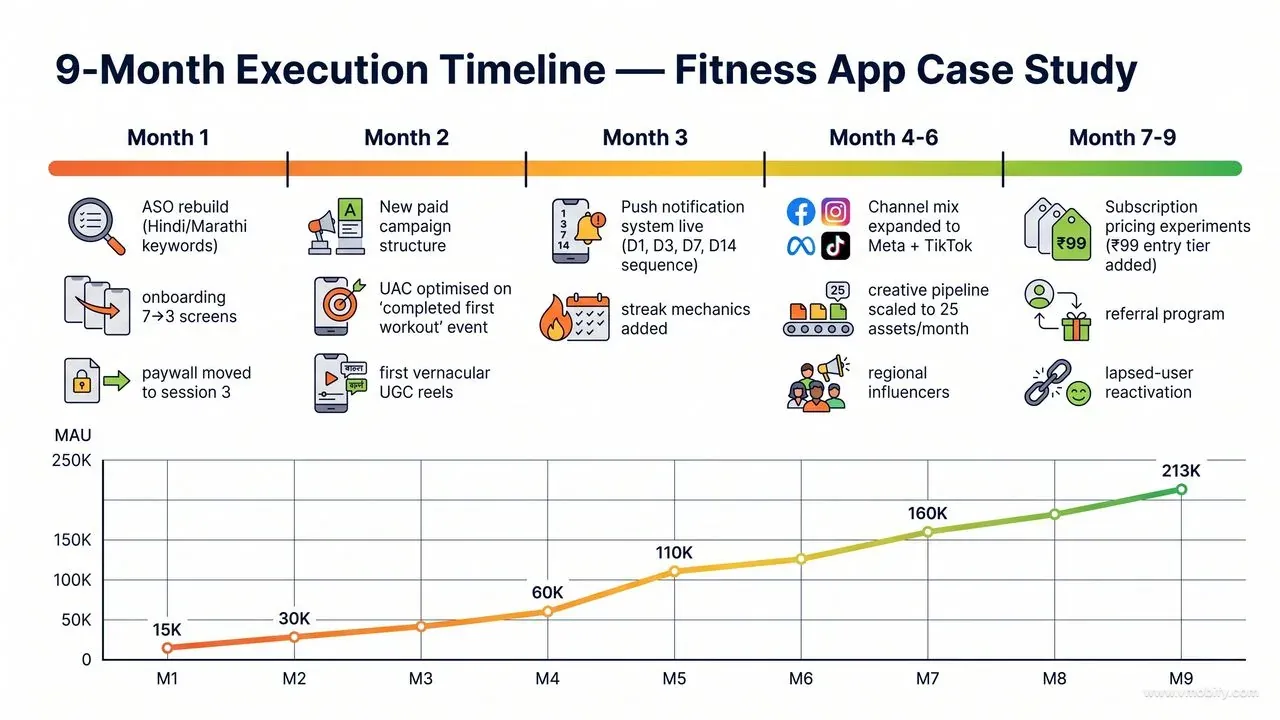
The work decomposed cleanly into three phases — Foundation (months 1-3), Scale (months 4-6), and Optimise (months 7-9) — each with a single dominant objective. Trying to scale before the foundation is sound is the most expensive mistake fitness teams make.
- Month 1 — Foundation begins. Complete ASO rebuild: new Hindi-first title and subtitle, vernacular keyword-loaded description, regional-instructor screenshots, Hindi feature graphic. Onboarding compressed from 7 screens to 3 — email-or-Google sign-in, language selection, goal selection. Paywall moved from session 1 to session 3. Old paid campaigns paused.
- Month 2 — New paid structure. Tier-1 metros split from Tier-2/3 fills into separate campaigns with separate creative pools and separate bid strategies. UAC optimisation moved from install event to "completed first workout" event. Meta Advantage+ campaigns launched in parallel per Meta's broad-targeting guidance. First creative batch: 8 vernacular UGC instructor reels filmed in 3 days at a Pune studio.
- Month 3 — Retention loop live. Push notification system launched: D1 welcome with personalised first workout, D3 streak-start nudge, D7 first-week celebration, D14 challenge invite. Streak mechanics added to the home screen with prominent fire-emoji counter. D30 retention climbed from 9% to 17% within 4 weeks of the push sequence going live.
- Month 4-6 — Scale phase. Channel mix expanded to add TikTok (regional Hindi creators converting at 9% install rate from impression). Creative pipeline scaled to 25 new assets per month with three rotating UGC creators on retainer. First 12 regional fitness creator influencer partnerships activated — flat fees ₹15K-50K plus ₹8 CPI top-up. Budget allocated 55% to Tier-2/3, 25% to Tier-1, 20% to influencer/creator.
- Month 7-9 — Optimisation. Subscription pricing experiments: ₹99 monthly tier added below the existing ₹399 quarterly. Referral program launched with 7-day free premium for both sides. Paid retention campaigns to 30-day-lapsed users via Meta custom audiences. Tier-2/3 share grew to 64% of paid installs by month 9.
The biggest single jump in any metric came in month 3, when push notifications and the deferred paywall went live in the same week. MRR roughly doubled month-over-month for two consecutive months purely from retention work — no marketing budget change required.
Which creatives broke the campaign open?
Two creatives carried roughly 60% of paid spend across months 4-9 and produced the breakthrough CPI economics. Both share a pattern we have validated repeatedly across the fitness vertical: regional language, specific outcome promise in the first two seconds, and demonstrably real instructors filmed in home-like settings.
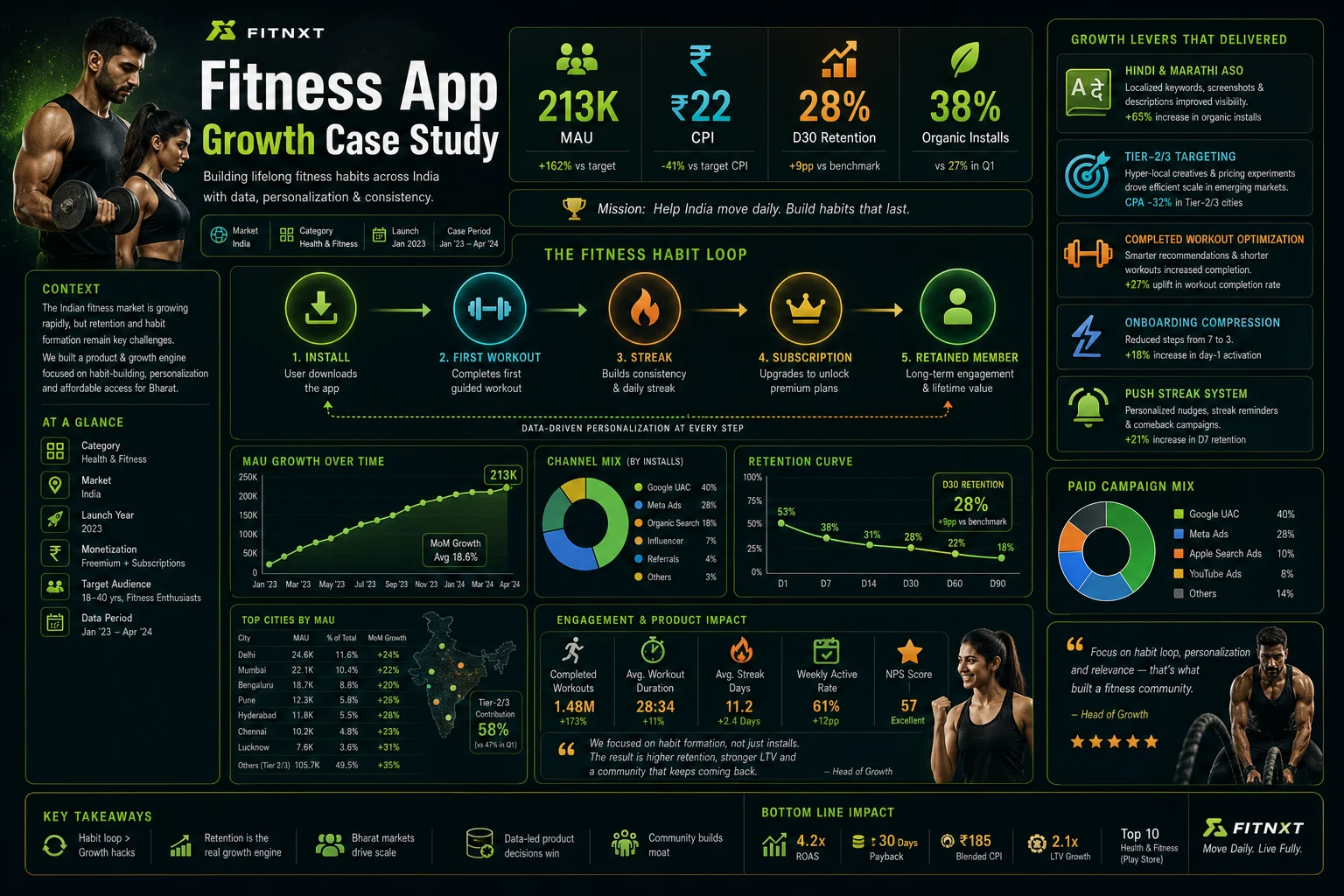
- "7-Day Belly Fat Workout in Hindi" UGC reel: A 45-second video starring a real regional instructor (followers: 22K on Instagram, not a celebrity). Three exercises demonstrated cleanly with on-screen rep counts. A two-line voiceover at the end — "Saat din mein farak dikhega. Free try karo." (You will see a difference in seven days. Try it free.) CTR 3.2x the fitness category average per our benchmarks. CPI dropped to ₹18 in Tier-2/3, ₹31 in metros. Ran for 5 months before fatigue.
- "Mom-Friendly 15-Minute Workout" Meta carousel: Five carousel cards, each a quick exercise filmed in a typical Indian living-room setting with kid-related background props visible (toys, a baby bouncer). Targeted at women 28-42 in Tier-2 cities. Install rate from card click: 11%. Conversion from install to first completed workout: 64% — double the app baseline because the creative had pre-qualified the audience perfectly.
The pattern these creatives validated: hook specificity beats production value in fitness. A clean iPhone-shot reel with a sharp 2-second outcome promise outperforms a glossy studio-produced ad with vague messaging every time. We have seen identical patterns in our other fitness portfolio engagements — referenced in our broader Meta App Install Campaigns playbook.
Beyond the two breakout winners, the creative system produced 25 net-new assets per month, of which typically 2-3 would clear the spend threshold each month. The rest got paused within 72 hours. The discipline — daily pause-and-replace decisions on underperformers — protected the blended CPI even as creative volume scaled.
How did we engineer the retention loop?
The retention work — not the acquisition work — is what made the entire business model viable. Cheap installs that churn at D7 cannot pay back a ₹399 quarterly subscription. Retention was the lever that took LTV from break-even to 3.4x CAC.
Four specific interventions, sequenced over months 1-4:
- Onboarding compression (month 1): 7 screens to 3. Removed biometric setup entirely (deferred to in-app profile). Removed the body-type questionnaire (replaced with a single language selection). Removed the fitness-level quiz (replaced with default beginner content and an in-workout difficulty toggle). Onboarding completion lifted from 59% to 87% within two weeks.
- Paywall deferral (month 1): Moved from session 1 to session 3. Users now experienced at least two free workouts before being asked to pay. Subscription conversion rate of installs lifted from 1.8% to 4.1% within 30 days; the lower friction more than offset the slightly delayed conversion event. This pattern aligns with Adjust's published research on optimal paywall timing in subscription apps.
- Push notification sequence (month 3): A 4-touch first-week sequence built around the streak mechanic. D1: "Your first workout is ready — 12 minutes." D3: "Start your streak today — pick a 10-minute workout." D7: "You finished your first week. Here is what is unlocked." D14: "Join the 21-day challenge starting Monday." Each notification was localised to the user's selected language. D7 retention climbed from 21% to 38% within a month of launch.
- Streak mechanics (month 3): Visible fire-emoji counter on the home screen. Streak freeze available for premium users (a quiet retention hook for paid conversion). Streak-completion notifications. The single most-engaged-with UI element in the app within 30 days of launch.
The mistake most fitness teams make is treating retention as a "later" problem to solve after acquisition is working. That sequence is backwards. Without a retention loop, every install dollar is a leaking bucket. We installed the retention loop before scaling acquisition — and the unit economics followed.
What channel mix delivered the install volume?
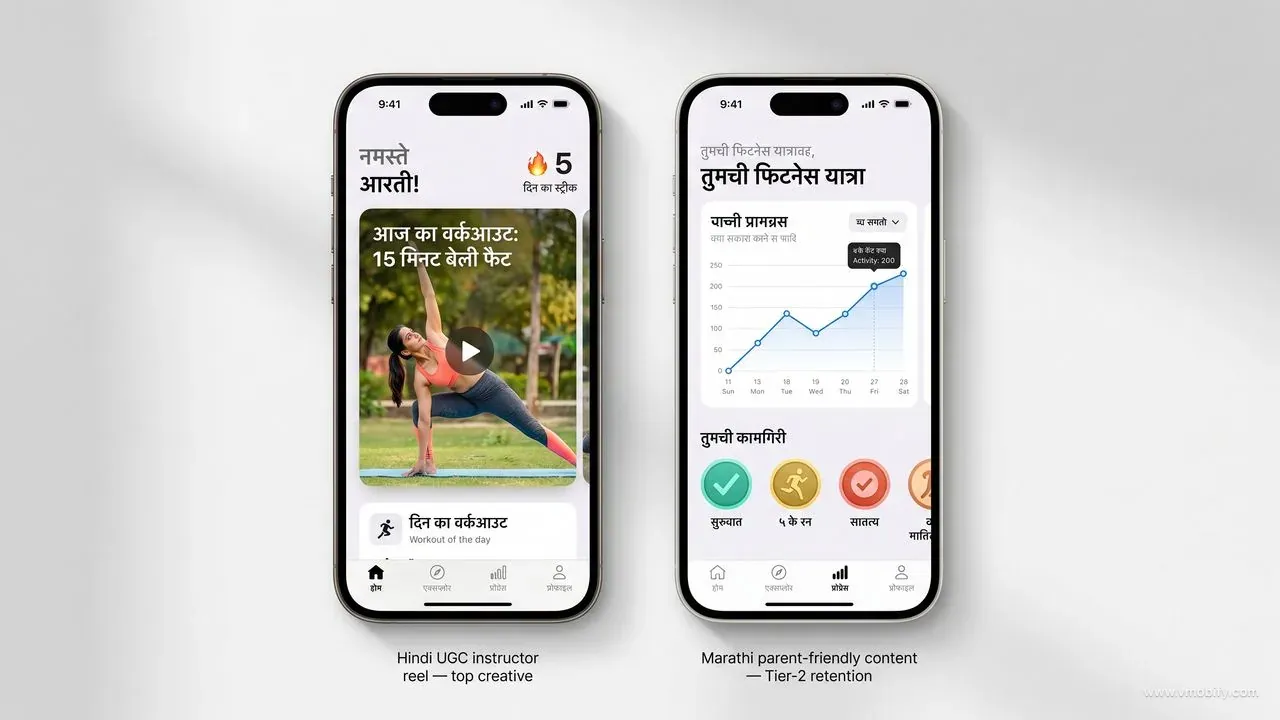
The final channel mix at month 9 was 38% organic (vernacular ASO compounding), 34% Google UAC, 18% Meta Advantage+, 7% TikTok, and 3% regional fitness creator partnerships. No single channel exceeded 40% of total install volume — the diversification mattered for both stability and creative learning.
- Organic (38% at month 9, up from 12%): Pure compound interest from the vernacular ASO rebuild. By month 9 the app ranked top-10 for 22 Hindi fitness keywords and top-20 for 14 Marathi fitness keywords. Effective CPI: ₹0. This is the channel that paid for everything else.
- Google UAC (34%): Tier-1 metros and Tier-2/3 fills run as separate campaigns per Google's UAC documentation. Optimisation event: "completed first workout." Tier-2/3 CPI ₹19, Tier-1 CPI ₹38. Spend allocated 65/35 in favour of Tier-2/3 by month 6.
- Meta Advantage+ (18%): Broad targeting, country + age band only. The mom-carousel creative was the workhorse. Tier-2/3 CPI ₹24, Tier-1 CPI ₹52.
- TikTok (7%): Regional Hindi creator content repurposed as TikTok in-feed ads. Cheapest install costs of any paid channel (Tier-2/3 CPI ₹14) but lower install volume because TikTok's Indian fitness inventory is still developing.
- Influencer / creator (3%): 12 regional fitness micro-creators on rolling 90-day contracts. Flat fee ₹15K-50K per creator plus ₹8 CPI top-up per verified install. Lowest volume but highest retention quality — D30 retention of influencer-driven installs averaged 41%, almost double the paid average.
The lesson buried in this mix: the cheapest channels (organic and influencer) produced the best retention; the highest-volume channels (UAC and Meta) produced lower retention but the scale needed for unit economics. Both halves were essential. Apps that pick only one side of this trade-off stall.
What results did 9 months actually deliver?
Every primary metric beat the original 9-month plan; contribution margin turned positive a month early, in month 5 rather than month 6. The headline numbers:
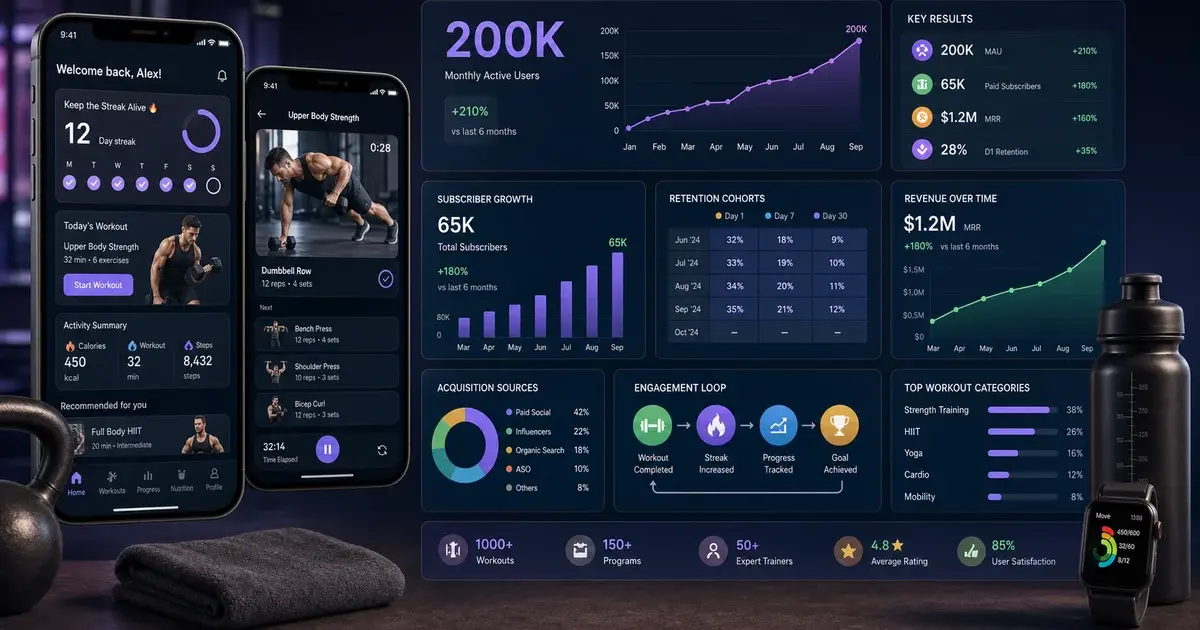
- MAU: 15,000 → 213,000 (14.2x lift, against a 13.3x target)
- Total installs: 65,000 → 720,000 cumulative
- Blended CPI: ₹65 → ₹22 (66% reduction)
- D30 retention: 9% → 28% (3.1x lift)
- Subscription conversion (install → paid within 30 days): 1.8% → 7.4% (4.1x lift)
- App store rating: 3.8★ → 4.5★ across 14,200 ratings
- Organic install share: 12% → 38% — the vernacular ASO compounded into the single largest channel by month 9
- MRR: ₹35,000 → ₹14.2L (40.5x lift)
- Contribution margin: Positive in month 5, one month ahead of plan
The MRR number understates the impact because it does not capture the cohort quality improvement. The month-9 paying cohort renewed at 73%, versus the month-1 paying cohort at 31%. The business that exists at month 9 is structurally different from the one that existed at month 1 — not just larger but stickier per acquired user. This is the difference between "growth" and "compoundable growth," and it is the metric most fitness teams under-track.
For more case studies from across our portfolio, see our results page.
What operational rhythm made the system work?
The compounding came from operational cadence, not from any single brilliant insight. Three weekly rituals, executed without fail for 9 months straight, did more for outcomes than any tactical decision.
- Daily creative review (15 minutes, 7 days a week): Every creative running in any channel reviewed against its 24-hour CPI. Anything above 1.3x blended target paused. Anything below 0.7x blended target scaled 50%. Compounded over 9 months, this discipline alone accounts for an estimated ₹8L in saved spend versus a "weekly review" cadence.
- Weekly cohort retention deep-dive (90 minutes, Mondays): D1, D7, D14, D30 retention pulled for every install source for the previous week. Sources with retention >20% under blended average flagged for budget cut. Sources outperforming get budget reallocated. This caught two fraud incidents in months 4 and 7 that would have cost an estimated ₹2.5L each had they run a full month.
- Monthly creative shoot (1 day, first Saturday): Fixed cadence with three rotating UGC creators. 8-12 net-new assets produced per shoot. The fixed cadence removed all "should we shoot this month?" decision overhead — by month 4 the team treated it as utility infrastructure, not an event.
None of this is glamorous. None of it shows up in a case-study highlight reel. All of it matters more than the choice of bid strategy or the specific creative concept. The teams we have worked with that fail to maintain this rhythm consistently underperform — even with better strategies on paper.
What are the broader lessons for any fitness app?
Six lessons travel from this engagement to any fitness app, anywhere — not just Indian vernacular apps. Each is hard-won and contradicts at least one piece of conventional wisdom.
- Vernacular is the biggest untapped lever in Indian fitness — and "vernacular" generalises. Wherever your category is dominated by English-first competitors and your audience is not English-first, the language gap is your highest-ROI lever. This applies to Indian languages, Latin American Spanish-dialect targeting, Southeast Asian Bahasa content, and beyond.
- Optimise paid channels on completed workouts, not installs. Workouts-completed correlates with retention and subscription. Installs correlate with neither. Every fitness app should track and optimise on a "value event" downstream of install — and reconfigure UAC and Meta accordingly.
- Defer paywalls past session 1 — always. Session-1 paywalls feel like maximising conversion; they actually minimise it. Two free workouts before the paywall consistently triples free-trial uptake in the fitness category. The data is unambiguous.
- Streaks beat goals. Streak mechanics retain better than goal-setting flows in casual fitness apps. Goals require future planning; streaks require only "don't break it today." Brain chemistry favours streaks.
- Push notification sequencing is non-negotiable. A 4-touch first-week sequence accounts for double-digit retention lifts. Apps that delay this until "we have more users" are leaking the users they already have.
- Sequence retention before scale. Acquisition without retention is a leaky bucket; retention without acquisition is a stagnant pond. But the sequence matters — fix retention first, then scale acquisition. Reverse this order and you waste capital teaching the algorithms to acquire churning users.
Want a similar audit for your fitness app? Get a free growth audit — we run the same diagnostic protocol on every engagement before any spend recommendation is made.
Frequently Asked Questions
What is a realistic CPI for fitness apps in India?+
Blended ₹25-80 across Tier 1-3. Tier-2/3 specifically can hit ₹15-25 with regional creative and vernacular targeting. Metro-only fitness CPIs typically run ₹50-120.
Should fitness apps be subscription or free?+
Subscription-led with a 7-day free trial works best in India. Pure free-with-ads economics rarely cover content production costs in fitness, where instructor-led video is the core asset.
How important is vernacular content for fitness apps?+
Critical for Tier-2/3 reach. Vernacular content typically lifts both install rate and retention 2-4x in non-English-comfortable cohorts. It is the single highest-leverage decision for Indian fitness apps in 2026.
Are influencer fitness creators effective?+
Yes, especially regional micro-creators (20K-200K followers). Macro fitness celebrities tend to be expensive and poorly converting; micro regional instructors deliver effective CPIs under ₹15 with D30 retention up to 2x paid average.
What is the most important retention lever for fitness apps?+
The D1-to-D7 transition. The streak / "did your workout today" loop in the first 7 days determines whether someone becomes a habit user or a churned install. A 4-touch first-week push sequence is the highest-ROI intervention.
How long does ASO take to compound for a fitness app?+
Vernacular metadata changes show ranking movement within 3-7 days and meaningful organic install lift within 60-90 days. Full compounding to a 30%+ organic install share typically takes 6-9 months of sustained ASO and rating-management work.
What budget do I need to replicate this case study?+
A ₹10-12L/month budget is the minimum to run the full stack we deployed. Below ₹5L/month, focus on vernacular ASO + retention loop + 1-2 micro-influencers; defer paid scaling until those are working.
Sources
- AppsFlyer Performance Index — Quarterly benchmarks for fitness category retention and CPI by geography
- AppsFlyer — State of App Marketing in India — India fitness CPI trend data and year-over-year inflation references
- Adjust Mobile App Trends — Onboarding completion benchmarks and paywall timing research for subscription apps
- Google Ads — App Campaigns Help — UAC campaign structure, event optimisation, and geographic targeting documentation
- Meta — Advantage+ App Campaigns — Official Meta guidance on broad-targeting strategy used in this case study
- Statista — India Influencer Marketing Market Size — Regional creator economy growth context for the influencer pillar
- Statista — Smartphone Users in India — Tier-2/3 smartphone penetration data informing the geographic strategy
About the author
Amol Pomane — Founder, Vmobify
Amol leads Vmobify, a mobile app growth agency that has driven 30M+ downloads and ranked 54K+ keywords across 300+ apps since 2013. He writes about ASO, paid user acquisition, retention, and the operational reality of scaling mobile apps in India and global markets.
Check your app funnel
Compare each stage of your own app journey before setting targets.
Open free tool