Best Push Notification & Engagement Services Compared (Free to Scale)
The right messaging tool is not the most powerful one — it is the one that matches your stage and budget. This vendor-neutral guide compares raw push delivery (FCM, APNs), all-in-one push services like OneSignal, full CRM suites like CleverTap, MoEngage, Braze and WebEngage, and the India must-have — WhatsApp Business API — so you can start free, spend nothing until you need to, and graduate deliberately.
On this page
- Why does the right messaging tool depend on your stage and budget?
- What do FCM and APNs do, and when is free raw delivery enough?
- What do all-in-one push services like OneSignal add?
- What do full engagement suites — CleverTap, MoEngage, Braze, WebEngage — add?
- Why is WhatsApp Business API a must-have for India?
- How do you choose a messaging tool by stage and budget?
- What does a genuinely free starter stack look like?
- When should you graduate to a full CRM suite?
- What deliverability and opt-in factors decide whether messages land?
- How does the India and vernacular lens change the choice?
- Which mistakes — over-buying, ignoring WhatsApp — cost teams the most?
- Frequently Asked Questions
Why does the right messaging tool depend on your stage and budget?
There is no single best push or engagement service — there is only the right tool for your stage, your data maturity, and your budget, and the gap between those tools is measured in thousands of rupees a month, not features on a comparison grid. The same dashboard that is indispensable for a 5-million-user fintech is dead weight on a 5,000-user app that has not yet found product-market fit.
The mistake we see most often is teams shopping for tooling the way they shop for a phone — picking the most capable option they can afford and assuming more features means better outcomes. Messaging tools do not work like that. A full customer-engagement suite gives you journey builders, predictive churn models and cross-channel orchestration, but every one of those features is only as good as the event data feeding it. Point a journey builder at an app with no instrumented events and you have bought a Formula 1 car to drive to the corner shop.
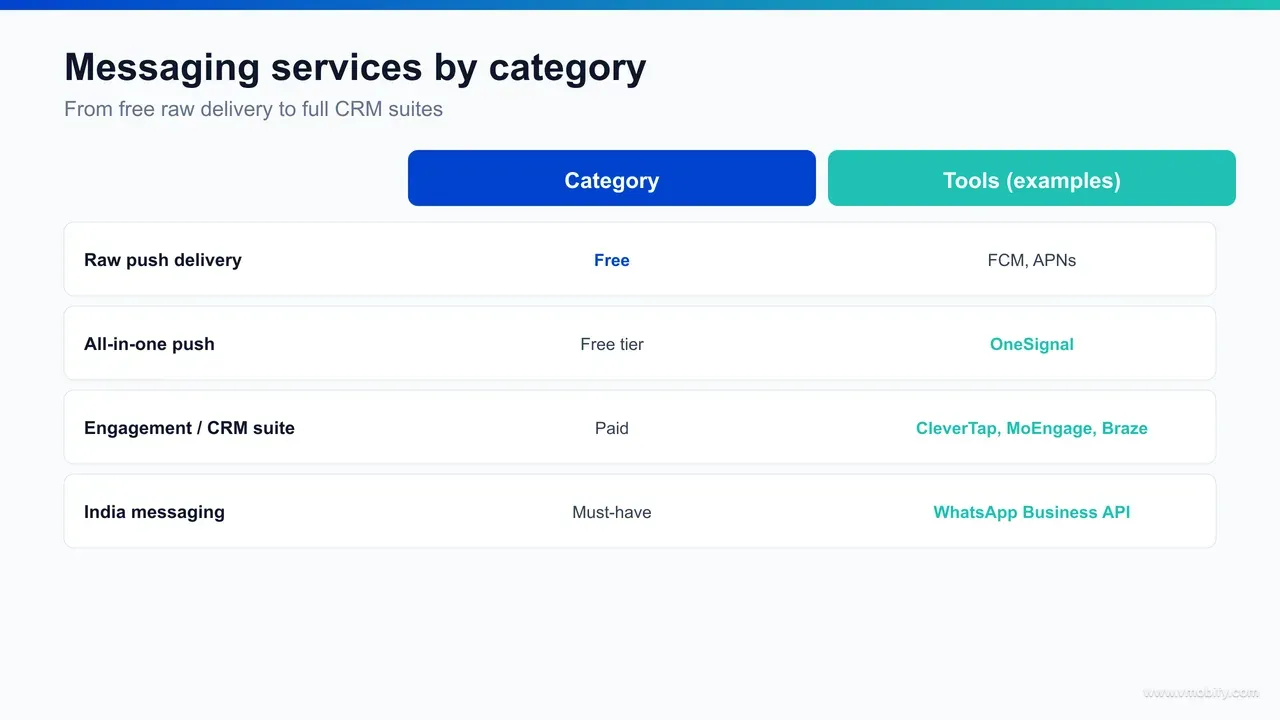
The honest framing is a ladder. At the bottom sits raw delivery — Firebase Cloud Messaging and Apple Push Notification service — which is free, reliable and entirely sufficient to send a notification to a device. One rung up sit all-in-one push services like OneSignal that wrap that delivery in a usable dashboard. Above that sit full engagement suites — CleverTap, MoEngage, Braze, WebEngage — that turn messaging into lifecycle marketing. And running alongside the whole ladder, especially in India, is WhatsApp Business API, a channel rather than a tier.
Across our 300+ apps managed since 2013, the pattern is consistent: the apps that win are not the ones that bought the most powerful tool earliest — they are the ones that matched the tool to the job, spent nothing until spending was justified, and graduated deliberately. This guide is the decision framework we use, not a vendor leaderboard. For the strategy that sits on top of any of these tools, read our push notification strategy guide; this post is about the plumbing underneath it.
What do FCM and APNs do, and when is free raw delivery enough?
Firebase Cloud Messaging (FCM) and Apple Push Notification service (APNs) are the free, unlimited transport layers that physically deliver a notification to an Android or iOS device — and for an early-stage app sending simple, code-triggered messages, they are genuinely all you need. Every other tool on this page ultimately hands its payload to FCM and APNs; nobody bypasses them.
APNs is Apple's notification gateway. Your server sends an authenticated request to Apple, and Apple delivers it to the device — the mechanics are documented in Apple's User Notifications framework. FCM is Google's cross-platform equivalent: it can deliver to Android directly and to iOS by relaying through APNs, which is why most teams adopt FCM as a single API for both platforms, as set out in the Firebase Cloud Messaging documentation. Both are free at any volume. There is no per-message charge, no monthly minimum, and no cap that a normal app will hit.
So when is raw delivery enough? More often than founders assume. Raw FCM/APNs is sufficient when:
- Your sends are transactional and code-triggered: an OTP, an order-confirmed alert, a payment receipt, a "your ride is here" ping. These fire from your backend in response to an event; you do not need a marketing dashboard to send them.
- You do not yet need segmentation: if you are sending the same message to everyone, or routing by a database query you already run, the segmentation engine of a CRM suite adds nothing.
- You have engineering capacity but not a CRM budget: a developer can wire FCM in a day. The cost is engineering time, not licence fees.
The ceiling arrives quickly, though, and it is worth naming. Raw FCM/APNs gives you no scheduling UI, no built-in audience segmentation, thin delivery analytics, no A/B testing, no rich-message composer, and no non-technical way for a marketer to send a campaign. Every one of those becomes a code change. The moment your growth or marketing team wants to send a behavioural campaign without filing an engineering ticket, you have outgrown raw delivery — and that is exactly the gap the next tier fills. In our portfolio, the cleanest early stacks start here and stay here far longer than the team initially expects.
What do all-in-one push services like OneSignal add?
All-in-one push services — OneSignal is the best-known, alongside options like Pushwoosh — sit on top of FCM and APNs and add the dashboard layer raw delivery lacks: segmentation, scheduling, a rich-message composer, basic A/B testing and delivery analytics, usually with a generous free tier that covers early-stage apps entirely. They are the natural second rung on the ladder.
The value here is operational, not technical. OneSignal does not deliver notifications any better than FCM does — it cannot, because it uses FCM and APNs underneath like everyone else. What it changes is who can send. A marketer can log in, build a segment ("users who installed in the last 7 days but have not completed onboarding"), compose a notification with an image and buttons, schedule it, and read open rates the next morning — none of which requires an engineer. That shift, from engineering-gated sends to self-serve campaigns, is the entire reason this tier exists.
What you typically get at this tier:
- Audience segmentation by device, behaviour, tags and custom properties, without writing queries.
- Scheduling and time-zone delivery so a campaign lands at a sensible local hour.
- A/B testing on copy and timing, so open-rate gains compound instead of relying on guesswork.
- Rich notifications — images, action buttons, deep links — composed in a UI rather than in code.
- Web push and email in some plans, broadening the channel mix without a second vendor.
On pricing, these services generally offer a free tier that comfortably covers tens of thousands of subscribers for mobile push, with paid plans scaling on contact volume and advanced features — but tiers and limits change, so check current pricing on the vendor's own page before you commit. The strategic point is that an app can run a real, segmented push programme at this tier for ₹0, which is why we so often recommend it as the first paid-grade capability that costs nothing. The limitation is depth: these tools are push-and-broadcast specialists, not lifecycle platforms. They give you campaigns; they do not give you multi-step, multi-channel customer journeys driven by a unified behavioural profile. When you need that, you are looking at the next tier — and you should read our breakdown of in-app messaging versus push before assuming push alone covers your engagement needs.
What do full engagement suites — CleverTap, MoEngage, Braze, WebEngage — add?
Full customer-engagement suites turn messaging from a send tool into a lifecycle system: they unify every user's behaviour into a single profile, then orchestrate multi-step journeys across push, in-app, email, SMS and WhatsApp, with the analytics, segmentation depth and personalisation that broadcast tools cannot match — at a price that only pays off once you have the data and the team to use them. This is the tier where messaging becomes marketing.
The four names worth knowing as subject matter, treated neutrally:
CleverTap
- A India-origin, now-global engagement and analytics platform strong on behavioural segmentation, real-time journeys and retention analytics; widely adopted across Indian consumer apps.
MoEngage
- Another India-founded suite known for cross-channel orchestration, an emphasis on AI-driven send-time and content optimisation, and deep penetration in Indian fintech, e-commerce and media.
Braze
- A US-origin enterprise platform respected for journey orchestration (Canvas), scale and a strong developer/data ecosystem; common among larger, globally-minded apps.
WebEngage
- A India-built marketing-automation suite popular with mid-market e-commerce and edtech for its journey designer and channel breadth.
What they add over the broadcast tier is fourfold. First, a unified user profile that stitches every event — sessions, purchases, screen views, attributes — into one record, so a message can reference what the user actually did. Second, journey orchestration: multi-step, branching flows ("if user opened but did not buy in 24h, send in-app nudge; else send WhatsApp on day 3") rather than one-off blasts. Third, cross-channel reach from one platform — push, in-app, email, SMS and WhatsApp coordinated so a user is not hit on five channels at once. Fourth, analytics and prediction — funnels, cohort retention, RFM segments, and in some cases churn-prediction models that feed the journeys automatically.
The catch is cost and prerequisite. These suites are priced on monthly tracked users (MTUs) or events and typically start in the meaningful-monthly-spend range and climb fast with scale and add-on modules — always request current pricing, because public numbers go stale and most are quote-based. More important than the rupee figure is the prerequisite: a suite is only as valuable as the event data and the operating team behind it. We have seen apps sign six-figure annual contracts and then use the platform as an expensive broadcast tool because nobody instrumented the events the journeys depend on. The platform did not fail; the readiness did. The right time for this tier is covered in the upgrade section below — and the broader stack it fits into is mapped in our app growth tools stack guide.
Why is WhatsApp Business API a must-have for India?
In India, WhatsApp Business API is not a nice-to-have alongside push — it is frequently the highest-reach engagement channel you have, because it reaches the large share of users who never granted push permission, never check email, and live their digital lives inside WhatsApp. Any India-focused engagement plan that ignores it is leaving its most reachable audience untouched.
The logic is structural. Push depends on an opt-in that a meaningful share of users decline, and on the app being installed and not force-stopped. Email in India is, for a large consumer cohort, an account you created to sign up for things and rarely open. WhatsApp is different: it is the default messaging surface for hundreds of millions of Indians, it is checked constantly, and a business message there arrives in the same inbox as messages from family. That is why a WhatsApp message can see open and read rates far above email and often above push for the same audience.
The mechanics matter, and they are governed by Meta's own rules. WhatsApp Business Platform messaging requires explicit user opt-in before you can message someone, as Meta sets out in its WhatsApp Cloud API documentation, and business-initiated messages use pre-approved message templates in defined categories (utility, authentication, marketing). Pricing moved to a per-message model for template categories — you pay per delivered template message, with rates varying by category and country — so unlike a flat push send, WhatsApp scales in cost with usage; check Meta's current WhatsApp pricing documentation before you model it, because the rate card changes.
The practical consequence: WhatsApp is the channel you reserve for high-value, high-intent moments where its reach justifies the per-message cost — OTPs and authentication, order and delivery updates, abandoned-cart and payment-due nudges, and re-engagement of users who have gone dark on push. Most of the CRM suites above integrate WhatsApp as a channel inside their journeys, which is the cleanest way to run it; you can also use it directly via a Business Solution Provider. In our portfolio, the India apps with the strongest re-engagement numbers almost always have WhatsApp wired in as a deliberate, opt-in-respecting tier — not as a spam hose. The vernacular angle, which compounds this, gets its own section below.
How do you choose a messaging tool by stage and budget?
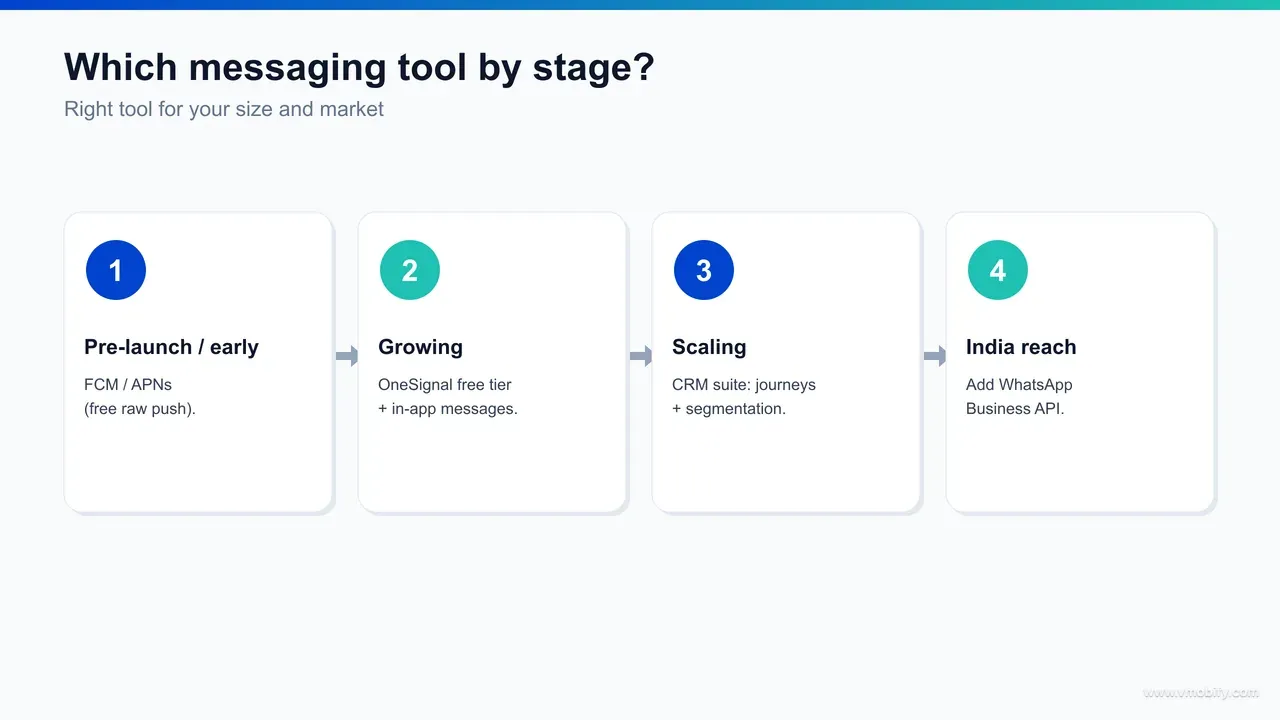
Choose by the bottleneck you actually have, not the features you might one day use: pre-product-market-fit apps need free transactional delivery, growing apps need self-serve campaigns, and scaled apps with a retention problem need a CRM suite — and almost nobody needs to skip a rung. The decision compresses to a few honest questions.
Ask yourself, in order:
- Are my sends mostly transactional and code-triggered? If yes, and you have no marketer who needs to send campaigns, raw FCM/APNs is enough. Spend ₹0 and move on.
- Does a non-engineer need to send segmented campaigns? If yes, step up to an all-in-one push service like OneSignal — still likely free at your volume, and it removes the engineering bottleneck on sends.
- Is retention — not acquisition — now my growth ceiling? If you are acquiring users fine but losing them, and you have instrumented behavioural events, that is the signal for a CRM suite. Not before.
- Is my audience India-first? If yes, add WhatsApp Business API as a channel regardless of which tier you sit on — it is orthogonal to the push ladder.
Budget maps cleanly onto this. The transactional/early stage costs nothing but engineering time. The self-serve campaign stage costs nothing to low monthly fees, because the free tiers are generous. The CRM-suite stage is where real money enters — typically a meaningful monthly or annual commitment that should be justified by a measurable retention problem and the team to act on it. WhatsApp is usage-priced on top of whichever tier you run.
The framing we give clients is blunt: every rung you climb should be pulled by a problem you can name, not pushed by a feature you admired in a demo. If you cannot articulate the specific limitation of your current tier that is costing you users, you are not ready to pay for the next one. This same discipline — instrument first, then buy capability against a named gap — is the spine of how we build a measurement stack, which is why our analytics service almost always precedes a CRM-suite recommendation rather than following it.
What does a genuinely free starter stack look like?
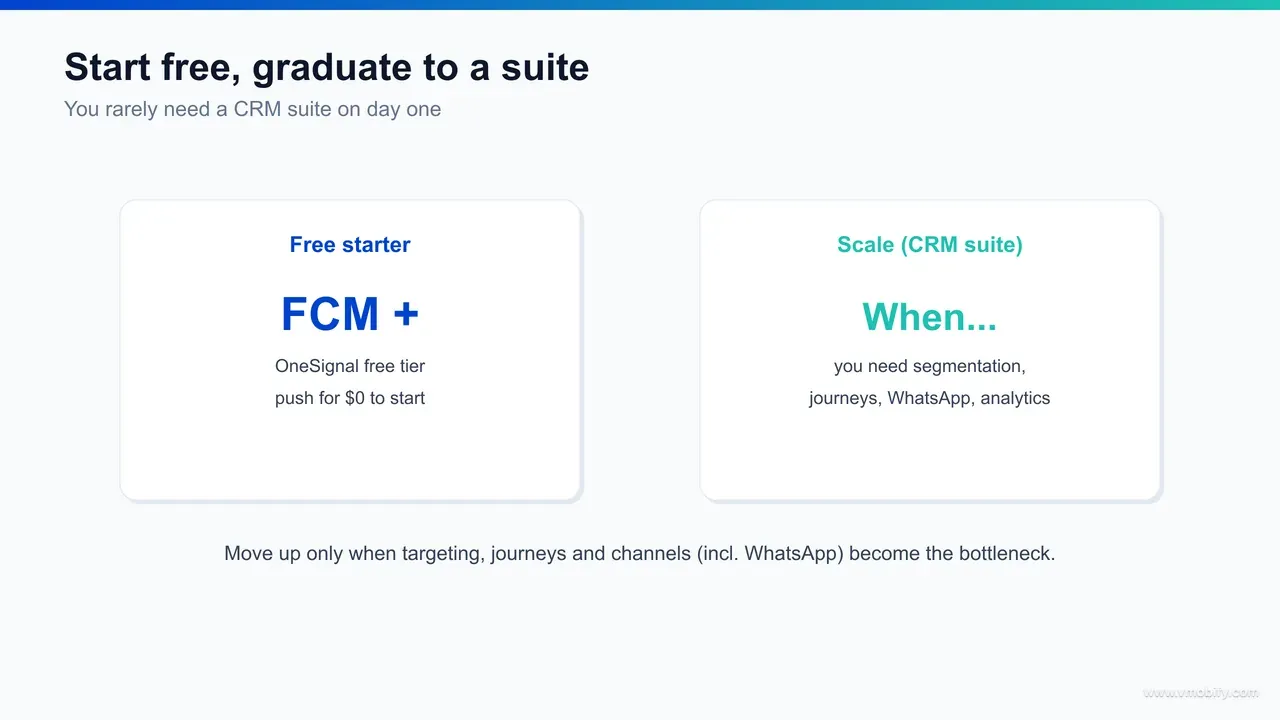
A genuinely free starter stack is FCM and APNs for transactional delivery, an all-in-one push service like OneSignal on its free tier for segmented campaigns, your store-and-platform analytics for basic measurement, and a WhatsApp opt-in captured from day one even before you switch the channel on — total recurring cost ₹0, and it covers most apps well past their first 100,000 users. You do not need to spend money to run a competent engagement programme early.
Concretely, the stack looks like this:
- Delivery layer — FCM + APNs (free): wire FCM as your single API for Android and iOS push. Use it for every transactional message — OTPs, confirmations, alerts — fired straight from your backend.
- Campaign layer — OneSignal free tier (₹0): connect it on top of FCM/APNs so your growth person can build segments, schedule sends, run A/B tests and read open rates without an engineering ticket. This is the layer that makes push a marketing channel rather than a plumbing detail.
- Measurement layer — platform + product analytics: at minimum, track installs, opt-in rate, opens and the one or two activation events that define a retained user. You cannot improve what you cannot see, and the events you instrument now are the same events a future CRM suite will need.
- WhatsApp opt-in — captured now, switched on later: add a clear, explicit WhatsApp opt-in to your onboarding the day you launch. Even if you do not send via WhatsApp Business API yet, the opt-in is the asset; collecting consent early means the channel is ready the moment you need it.
The discipline that makes this stack work is instrumentation, not spend. An app on this free stack that has cleanly tracked its events and captured opt-ins is in a far stronger position than an app that bought a CRM suite but never instrumented the behaviours its journeys depend on. We have repeatedly seen early teams get more retention lift from tightening opt-in timing and segmenting their free OneSignal sends than they would have from a paid suite they were not ready to operate. Start here, prove the channel works, and let the limitations of the free stack — not a sales demo — tell you when to upgrade.
When should you graduate to a full CRM suite?
Graduate to a CRM suite when retention is your binding constraint, your free stack's limitations are demonstrably costing you users, and you have both the instrumented event data and the operating team to run multi-step journeys — usually, not before you are past meaningful scale and have a dedicated growth or CRM owner. The upgrade is a response to a problem, never a pre-emptive purchase.
The concrete signals that you are ready:
- You are running into the broadcast ceiling: you want branching, multi-step journeys across channels — "push, then if no open, in-app, then WhatsApp on day 3" — and your current tool can only blast. That orchestration gap is the clearest buy signal.
- You have the event data: your activation, purchase and engagement events are cleanly instrumented, so a unified profile and journey builder will have something real to act on. No data, no suite.
- You have an owner: a person whose job is lifecycle and retention. A CRM suite without an operator is shelfware — the platform amplifies a team that exists; it does not replace one that does not.
- Retention, not acquisition, is the ceiling: your funnel acquires users adequately but loses them after install. A suite moves retention; it does not fix a top-of-funnel problem.
When you do evaluate the suites, compare on three axes that actually differentiate them: the depth and ease of the journey/orchestration builder, the strength of the behavioural analytics and segmentation, and the native channel breadth — specifically whether WhatsApp and SMS are first-class inside the platform, which matters disproportionately in India. Run a paid pilot against one real retention use case with a measurable target before signing an annual contract; a platform that cannot move one well-chosen metric in a pilot will not move ten in production.
The graduation also belongs inside a wider lifecycle view, not just a tooling swap. A CRM suite is the engine for the kind of stage-based programme we describe in our app lifecycle marketing for India guide — onboarding, activation, retention and win-back as distinct phases. Buy the suite to run that programme, not to own the logo. In our portfolio, the suite purchases that paid off were the ones made against a named retention metric with a team ready to operate them; the ones that disappointed were bought on capability, not on a problem.
What deliverability and opt-in factors decide whether messages land?
The best tool cannot rescue a broken opt-in or a channel users have learned to ignore: deliverability in messaging is decided far more by permission discipline, frequency restraint and platform-policy compliance than by which vendor you chose. The plumbing is rarely the problem; the permission and the relevance are.
The factors that actually decide whether a message lands and gets seen:
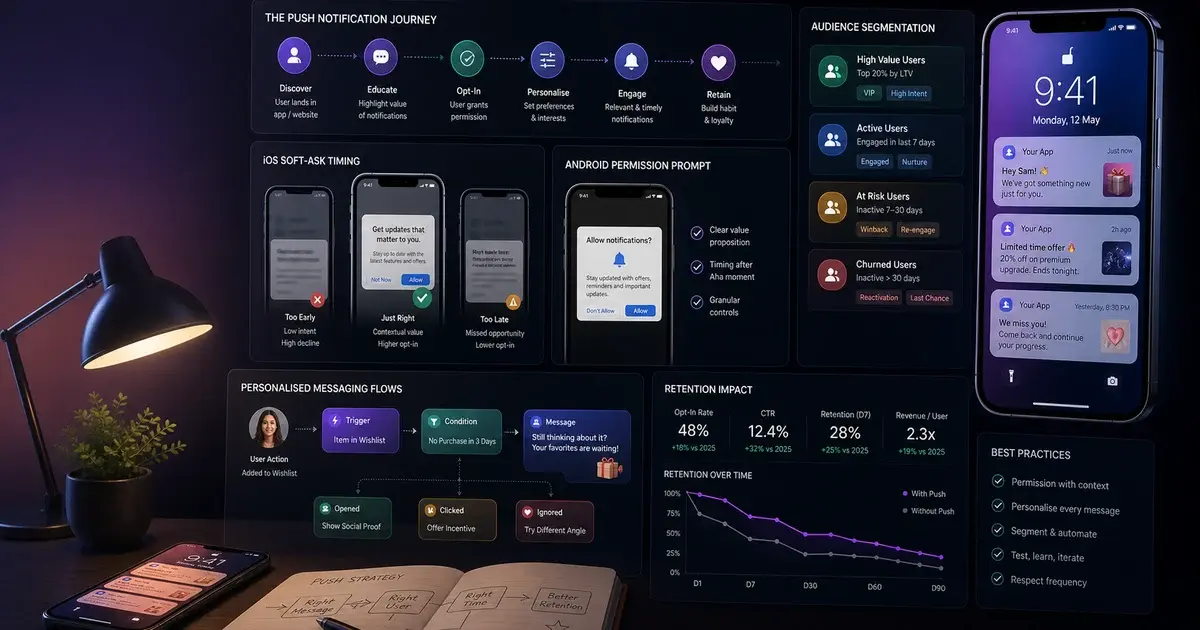
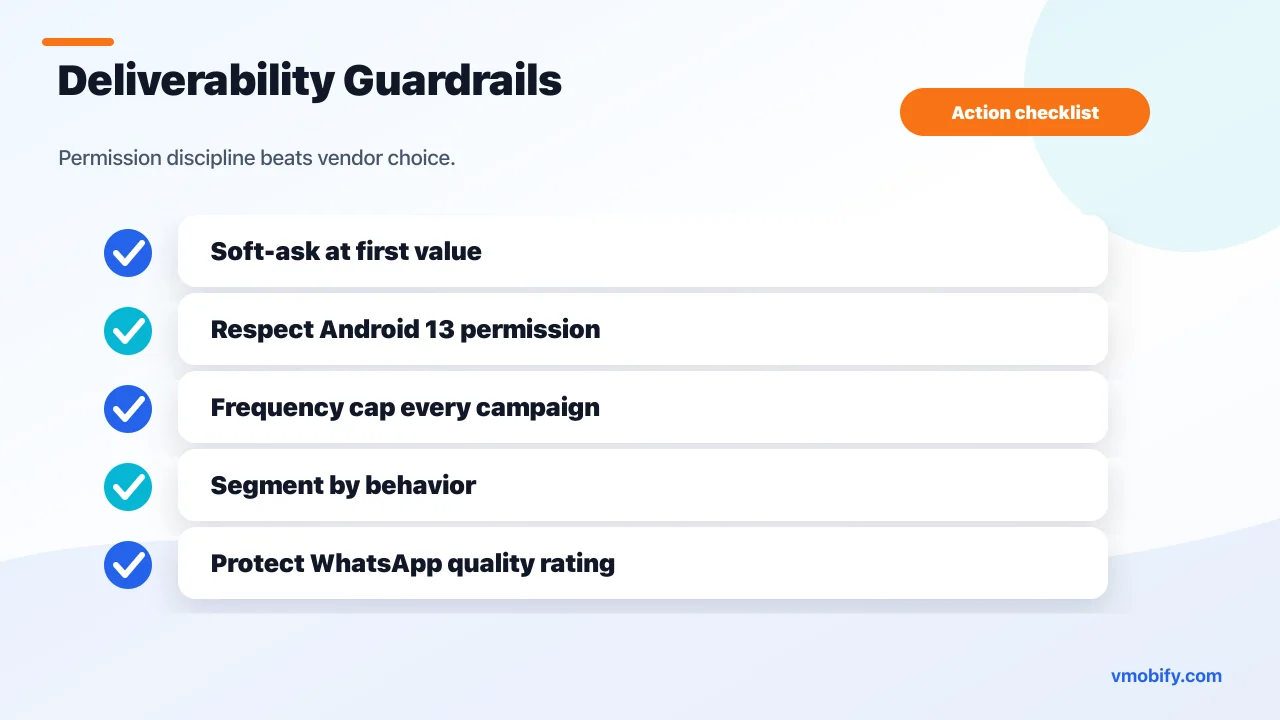
- Opt-in capture and timing: on iOS you get one system push prompt, and on Android 13 and above you now must request the notification permission explicitly via Android's POST_NOTIFICATIONS runtime permission rather than being opted in by default. A soft-ask at the moment of first value, before the system prompt, is the single biggest lever on how many users you can ever reach — no tool can message a user who declined permission.
- Frequency and fatigue: over-sending does not just lower open rates, it trains users to swipe away your notifications unread and, at the extreme, to disable them or uninstall. Frequency caps and suppression rules protect the channel's credibility, which is the asset every send draws down.
- Relevance and segmentation: an irrelevant notification is worse than none — it is a reason to opt out. Behavioural targeting is a deliverability factor, not just a performance one, because it preserves the permission you worked to earn.
- Platform-policy compliance: both stores prohibit using notifications for spam or unrelated promotion, and Google sets this out in its Play developer policy. WhatsApp adds a stricter layer: explicit opt-in, approved templates, and category rules, with quality ratings that throttle senders who generate blocks and reports.
WhatsApp deserves its own caution because the consequence of getting opt-in wrong there is harsher than on push. Message users who did not consent, or send marketing dressed as utility, and Meta's quality system lowers your number's rating and caps your sending — a self-inflicted deliverability wound that no amount of spend reverses quickly. The rule across every channel is the same: permission is the product. Tools differ at the margins on delivery reliability, but the order-of-magnitude differences in whether your messages get seen come from opt-in discipline, frequency restraint and relevance — which are strategy choices, not procurement ones. Our push notification strategy guide covers the opt-in and frequency mechanics in full.
How does the India and vernacular lens change the choice?
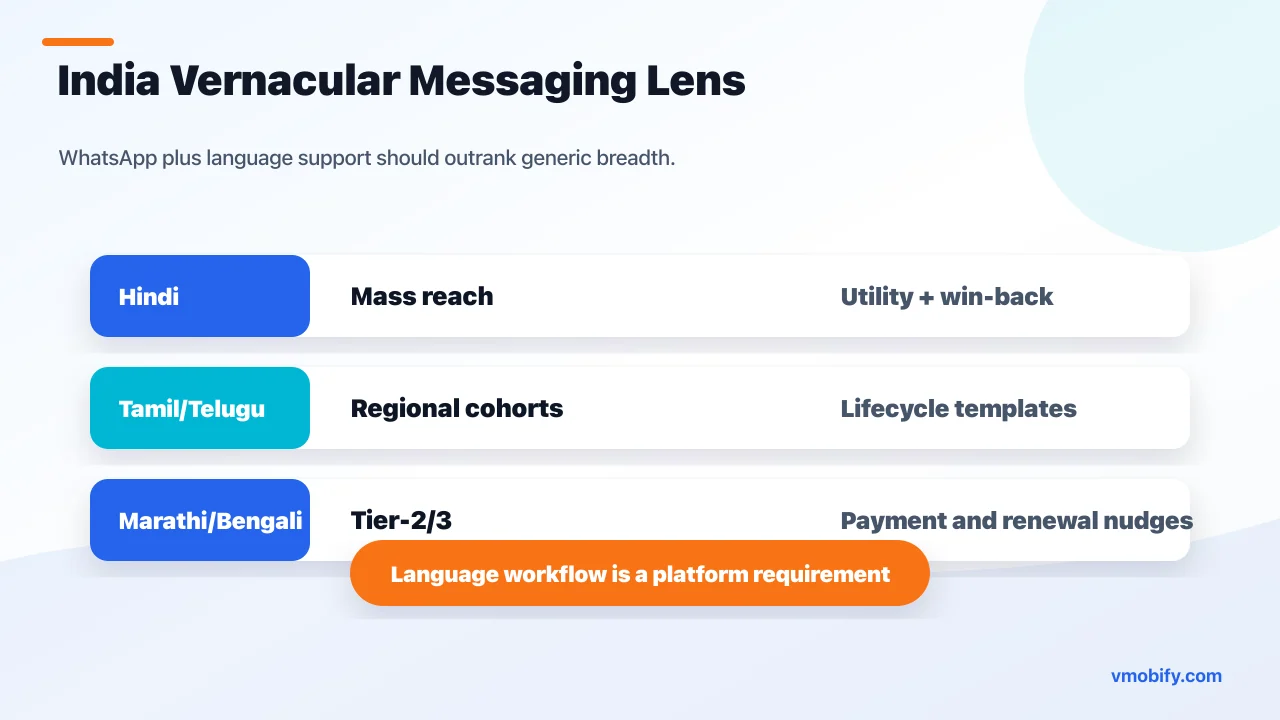
For an India-first app, the tool decision is dominated by two India-specific realities — WhatsApp is often your highest-reach channel, and a large share of your users engage in a regional language, not English — which together push WhatsApp support and content-localisation capability to the top of your evaluation criteria. A globally-built playbook that optimises only push and email under-serves the Indian user.
The vernacular point is the one most global tooling comparisons miss entirely. The next several hundred million Indian internet users are overwhelmingly Tier-2 and Tier-3, price-sensitive, and far more comfortable in Hindi, Tamil, Telugu, Marathi, Bengali or another regional language than in English. A notification or WhatsApp template written only in English is, for a large slice of your base, a message in a foreign language — technically delivered, functionally ignored. The engagement lift from sending the right message in the user's own language is not marginal; it is the difference between a message that converts and one that is swiped away.
That reshapes the evaluation in concrete ways:
- WhatsApp must be first-class, not bolted on: when comparing CRM suites for an India audience, weight native WhatsApp orchestration heavily. A suite that treats WhatsApp as an afterthought is the wrong suite for India regardless of how strong its push features are.
- Localisation has to be operational: you need the ability to store, manage and target content by language and segment — sending the Hindi template to the Hindi cohort and the Tamil template to the Tamil cohort — which is a real workflow, not a one-time translation.
- Template approval and language coverage on WhatsApp: because business-initiated WhatsApp messages use pre-approved templates, your localisation has to flow through that approval process per language, which favours tools that make multi-language template management manageable.
This is also why two of the four major engagement suites — CleverTap and MoEngage — were founded in India and built deep WhatsApp and India-channel support early: they were solving for this reality from the start. That origin is a genuine consideration for an India-first app, not a nationalistic one — the channel mix they default to matches the channel mix Indian users actually live in. We unpack the broader vernacular and Tier-2/3 dynamics in our India lifecycle marketing guide; for tool selection, the takeaway is simply that WhatsApp reach and language workflow should outrank feature breadth that your audience will never experience in their own language.
Which mistakes — over-buying, ignoring WhatsApp — cost teams the most?
The two most expensive mistakes are opposite errors: over-buying a CRM suite before you have the data or team to use it, and under-investing in WhatsApp in a market where it is your highest-reach channel — and both come from choosing tools by feature list rather than by stage and audience. Avoid these two and most of the rest take care of themselves.
- Over-buying tooling early: signing a CRM-suite contract before retention is your bottleneck, before events are instrumented, and before you have an owner to run journeys. The platform becomes an expensive broadcast tool, and the spend buys nothing the free stack would not have. Fix: climb the ladder one justified rung at a time.
- Ignoring WhatsApp in India: running a push-and-email-only programme for an Indian audience and wondering why re-engagement is weak. You are skipping the channel where your users actually are. Fix: capture opt-in from day one and wire WhatsApp Business API in for high-value moments.
- Instrumenting nothing, then buying capability: purchasing a suite to fix retention without tracking the events that retention journeys depend on. The tool cannot act on data that does not exist. Fix: instrument the funnel on the free stack first.
- Treating opt-in as a checkbox: firing the iOS or Android permission prompt on first launch, or assuming users are opted in, and permanently capping the audience you can ever reach. Fix: soft-ask at first value, respect the WhatsApp consent rules.
- Sending more because the tool lets you: mistaking a powerful platform for a licence to increase frequency, and training users to ignore or disable you. Fix: frequency caps and relevance are non-negotiable at every tier.
The thread running through all five is the same: the tool is downstream of the strategy. In our portfolio we have seen apps on free FCM and a tight WhatsApp opt-in out-retain better-funded competitors running expensive suites badly — because the cheaper stack was matched to its stage and the costly one was not. Pick the tool your stage and audience demand, instrument before you spend, and graduate against named problems.
If you want help mapping your stage to the right stack, instrumenting the events a future suite will need, or wiring WhatsApp into an India-first lifecycle programme, that is exactly the work our team does — see how we approach measurement on our analytics service, or talk to us directly about your specific app and stage.
Frequently Asked Questions
Is Firebase Cloud Messaging really free?+
Yes. FCM is free at any volume — there is no per-message charge, monthly minimum, or realistic cap for a normal app. It delivers to Android directly and to iOS by relaying through Apple Push Notification service, which is also free. You only pay for engineering time to integrate it.
OneSignal or a CRM suite like CleverTap — which should I start with?+
Start with OneSignal (or a similar all-in-one push service) on its free tier. It gives a non-engineer self-serve segmented campaigns on top of FCM/APNs at ₹0. Move to a CRM suite like CleverTap or MoEngage only when retention is your bottleneck, your events are instrumented, and you have someone to run multi-step journeys.
How much does a full engagement suite cost?+
CRM suites like CleverTap, MoEngage, Braze and WebEngage are typically priced on monthly tracked users or events and are usually quote-based, starting at a meaningful monthly or annual commitment and climbing with scale and add-on modules. Always request current pricing directly, because public figures go stale quickly.
Do I need WhatsApp Business API if I already send push notifications?+
In India, almost certainly yes. WhatsApp reaches users who declined push permission and never check email, on the channel they use most. It is conversation/template-priced and requires explicit opt-in and approved templates, so reserve it for high-value moments — OTPs, order updates, payment nudges and re-engagement.
Can I just use raw FCM and APNs and skip every paid tool?+
For a transactional, code-triggered app with no marketer who needs to send campaigns, yes — raw FCM and APNs are genuinely enough. You outgrow them the moment someone needs self-serve segmentation, scheduling, A/B testing or analytics without filing an engineering ticket, at which point an all-in-one push service is the cheap next step.
What changed with Android 13 for push notifications?+
Android 13 introduced the POST_NOTIFICATIONS runtime permission, so apps must now request notification permission explicitly rather than having users opted in by default — mirroring iOS. New installs require a deliberate soft-ask strategy to maximise opt-in, the same as on iOS.
What does Vmobify do here specifically?+
We map your stage to the right messaging stack, instrument the funnel and events a future CRM suite depends on, and wire WhatsApp into an India-first lifecycle programme — measured properly rather than bought on a feature demo. See our analytics service at /services/analytics or contact us to discuss your app.
Sources
- Firebase Cloud Messaging documentation — Free cross-platform push delivery; Android direct and iOS via APNs
- Apple — User Notifications framework — How APNs delivers remote notifications to iOS devices
- WhatsApp Cloud API documentation — Opt-in requirement and message-template rules for business messaging
- WhatsApp Business pricing documentation — Per-message template pricing by category and country
- Android — notification runtime permission — POST_NOTIFICATIONS explicit opt-in from Android 13
- Apple — Human Interface Guidelines: Notifications — Apple guidance on notification permission and relevance
- Google Play — Developer content policy — Policy prohibiting notification spam and unrelated promotion
About the author
Amol Pomane — Founder, Vmobify
Amol leads Vmobify, a mobile app growth agency that has driven 30M+ downloads and ranked 54K+ keywords across 300+ apps since 2013. He writes about ASO, paid user acquisition, retention, and the operational reality of scaling mobile apps in India and global markets.