App Lifecycle Marketing: A WhatsApp-First CRM That Retains (India)
Most apps still treat engagement as a calendar of broadcast blasts. Lifecycle marketing replaces that with orchestrated messaging across the user journey — onboard, activate, engage, retain, resurrect — delivered through the right channel at the right stage. This guide covers the stages, channel orchestration, segmentation and triggers, and why, in India, WhatsApp is the backbone the whole programme should be built around.
On this page
- What is app lifecycle marketing and why does it beat one-off blasts?
- What are the lifecycle stages and what message does each one need?
- How do you segment users and fire behavioural triggers?
- How do you govern frequency and consent without choking the channel?
- Which channel should carry which stage of the journey?
- Why is WhatsApp the backbone of an India lifecycle programme?
- How do you actually build the journey, and what tooling do you need?
- How do you measure whether a lifecycle programme is working?
- How do you personalise vernacular and regional messaging for India?
- Which lifecycle marketing pitfalls quietly cost teams the most?
- Frequently Asked Questions
What Is App Lifecycle Marketing and Why Does It Beat One-Off Blasts?
App lifecycle marketing is the practice of orchestrating messages across the entire user journey — onboard, activate, engage, retain, resurrect — through a central engagement platform, so that what a user receives is determined by where they actually are in their relationship with your app rather than by what the marketing team scheduled this week. It is the difference between a system and a campaign calendar.
The one-off blast is still the default at most apps, and it is structurally broken. A broadcast push sent to the entire base on a Tuesday lands identically on a user who installed yesterday, a power user who opens the app daily, and someone who has not opened it in six weeks — three people with nothing in common except that they once downloaded the same icon. The new user is confused, the power user is mildly annoyed, and the lapsing user is reminded the app exists just long enough to uninstall it. The same message does three different kinds of damage because it ignores stage entirely.
Lifecycle marketing inverts that. Instead of asking "what do we want to say this week," it asks "what does this user need to hear at this moment to move to the next stage." A user who just installed needs help reaching first value; a user who reached it needs the habit reinforced; a user whose sessions are decaying needs relevance restored before they go dark. Each of those is a different trigger, a different message, and often a different channel — and an engagement platform fires them automatically off behaviour, not off a calendar. Lifecycle-marketing platforms such as WebEngage, MoEngage and CleverTap have built their entire category around exactly this orchestration.
The reason it beats blasting is compounding. A broadcast is consumed once and forgotten; a lifecycle programme keeps moving each cohort forward every time they hit a trigger, so the retention it builds accumulates across cohorts instead of resetting every campaign. Across our 300+ apps managed since 2013, the apps that treat engagement as an orchestrated lifecycle, not a broadcast schedule, consistently hold a materially higher share of their installed base active month over month — and they do it on a smaller message volume, because relevance does the work that frequency was failing to do. The rest of this guide is about how to build that system, and how to calibrate it specifically for the India market, where the channel mix looks nothing like the Western default.
What Are the Lifecycle Stages and What Message Does Each One Need?
There are five stages every user moves through — onboard, activate, engage, retain, resurrect — and each one has a distinct job, so the message that belongs in one stage actively harms the programme if it leaks into another. Mapping your messaging to these stages is the single most important structural decision in lifecycle marketing, because it determines what gets sent to whom and, just as importantly, what does not.
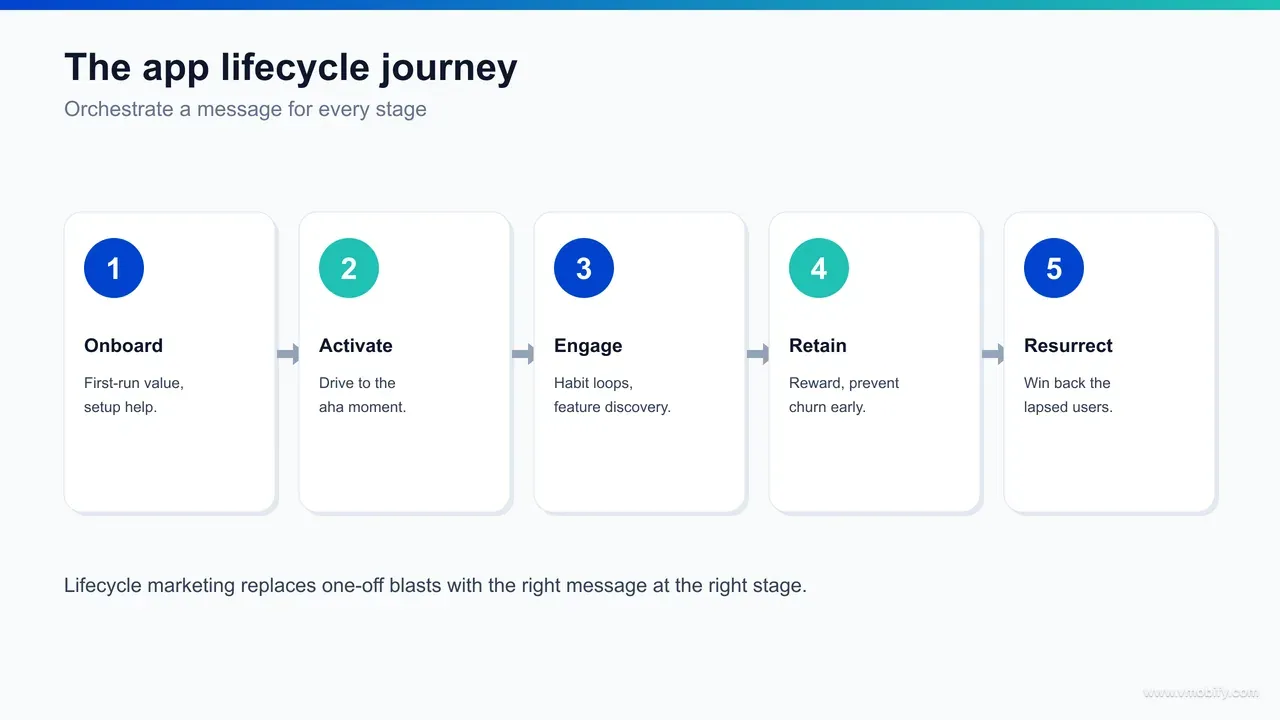
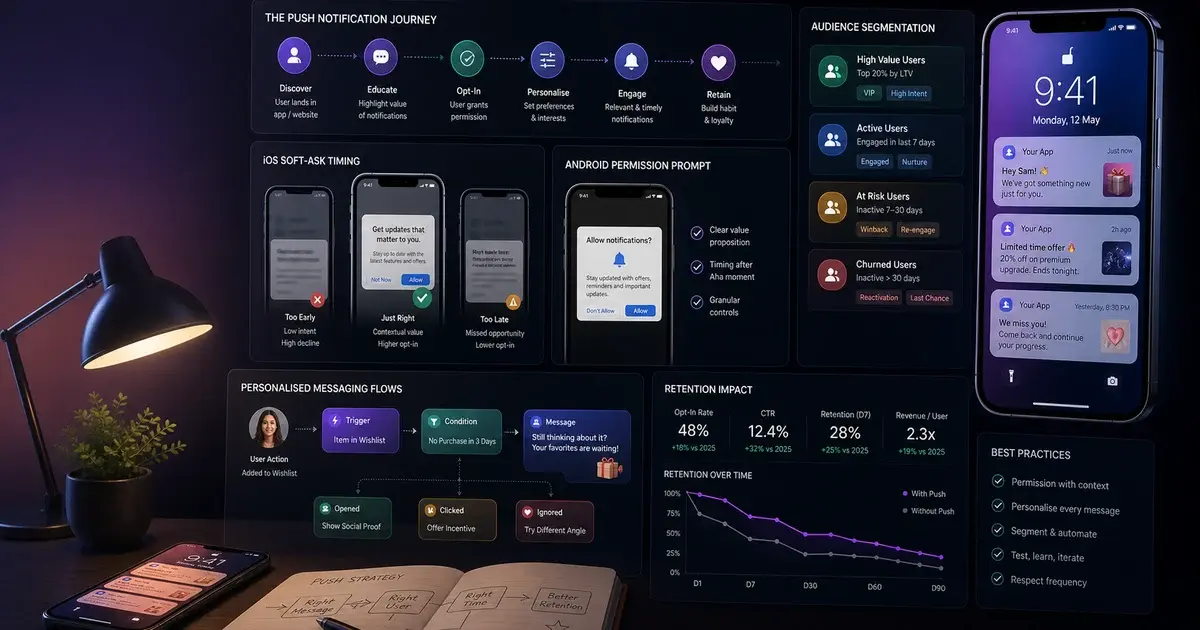
- Onboard (the first session and first days). The job is to get the user to understand and reach the core value as fast as possible. Messages here are educational and frictionless: complete your profile, grant the permission that unlocks value, finish the setup step you abandoned. This is where you earn the push opt-in with a well-timed soft ask — covered in depth in our push notification strategy guide — because the audience you can reach later is decided here.
- Activate (reaching the first meaningful value action). The job is the single most important conversion in the whole journey: the first real action that proves the product works for this person — the first order, first transfer, first lesson, first match. Every message in this stage should remove friction from that one action. Nothing else matters until it happens, because a user who never activates almost never retains.
- Engage (building the habit). Once a user has activated, the job shifts to repetition: turn one valuable action into a recurring one. Behavioural triggers, streaks, progress nudges, relevant recommendations and social signals all live here. This is the stage where lifecycle marketing quietly builds the retention curve that acquisition spending depends on.
- Retain (protecting the habit and deepening value). For your active base, the job is to keep the habit intact and expand it — new features, deeper use cases, and for monetised apps, the upgrade and renewal moments. Messaging here is selective and value-led, not promotional noise.
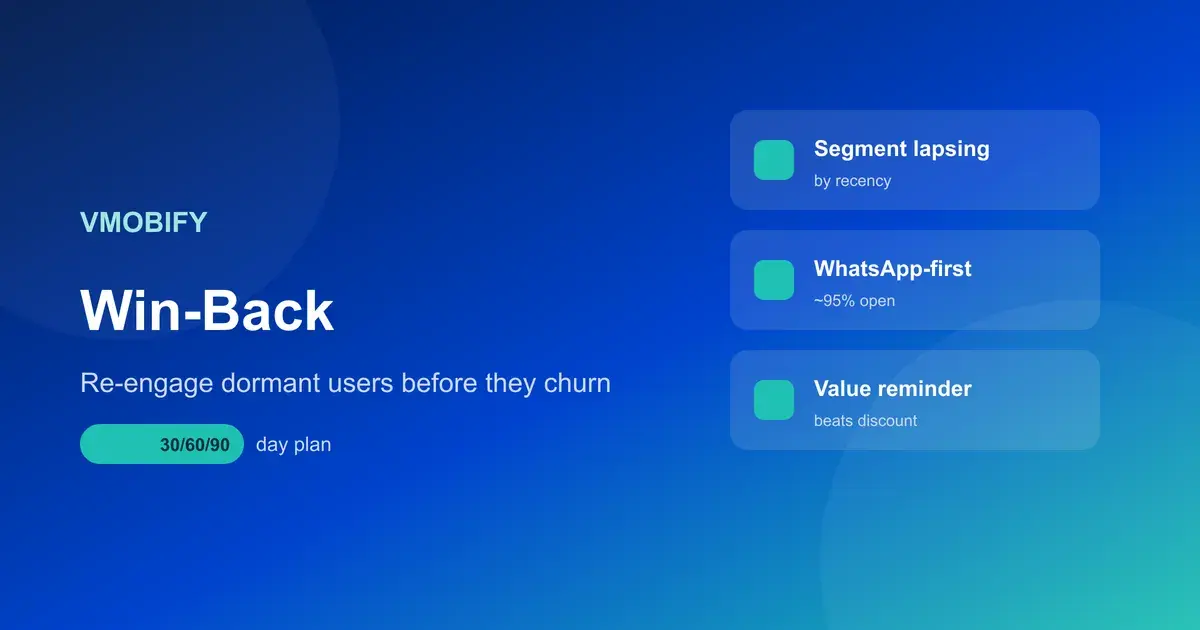
- Resurrect (recovering users who are slipping or gone). When session frequency decays, the job becomes recovery before the uninstall. This is win-back, and the recovery probability collapses the longer you wait — our win-back playbook covers the graduated sequence and exit rules in full.
The discipline that separates a real lifecycle programme from a relabelled blast calendar is stage suppression: a new user in onboarding should never receive a promotional renewal push, and a lapsing user should never get a generic feature broadcast. Each stage gates which message types are even eligible. Get that gating right and the same message volume that used to drive uninstalls starts driving progression instead.
How Do You Segment Users and Fire Behavioural Triggers?
Segmentation and behavioural triggers are the engine room of lifecycle marketing: segmentation decides who is eligible for a message, and triggers decide when it fires — and a programme that gets both right feels personal, while one that gets either wrong feels like spam. The shift from scheduled broadcasts to triggered messaging is the technical heart of the whole discipline.
Start with segmentation along the axes that actually predict behaviour, not the demographic fields that are merely easy to filter on:
- Lifecycle stage. The primary axis — onboarding, activated, engaged, at-risk, lapsed. Every other segment sits inside a stage, because stage gates which message types are eligible in the first place.
- Behavioural depth. What the user has actually done — features used, actions completed, value reached. A user who activated and used three core features is a different target from one who installed and poked around once, and they need opposite messages.
- Recency and frequency. How recently and how often they engage, measured against your app’s natural rhythm. A daily app and a monthly app have completely different definitions of "slipping," and a generic 30-day rule mis-times the intervention for both.
- Value and intent. High-LTV users, users near a conversion milestone, and users showing purchase intent warrant richer, sometimes incentivised treatment; never-activated users warrant low-cost automation and nothing more.
Triggers then turn those segments into action. A behavioural trigger fires off something the user did — or pointedly did not do: completed onboarding, abandoned a cart, hit a streak risk, started but bailed on a high-intent flow, stopped opening pushes they used to tap. These messages outperform scheduled broadcasts by a wide margin precisely because they respond to the individual’s own behaviour rather than the CRM team’s calendar. The most valuable triggers are often inaction triggers — the silence before churn — because catching a user while they are still openable is far cheaper than recovering them after they go dark.
The tooling for this exists natively in every major engagement platform; the bottleneck is never the platform, it is the event taxonomy. If your product is not instrumented so that "activated," "core action" and "at-risk" mean something precise, no amount of segmentation UI will save you. That instrumentation — defining the events, the value moments and the decay signals — is exactly the work our analytics practice builds, because a lifecycle programme is only ever as good as the behavioural data feeding its triggers.
How Do You Govern Frequency and Consent Without Choking the Channel?
Frequency and consent governance is the guardrail that keeps a lifecycle programme from manufacturing the exact churn it was built to prevent — and the rule is simple: set hard frequency caps and respect consent before you plan a single campaign, not after opt-out rates start climbing. Relevance earns attention; volume without relevance spends it, and once a user trains themselves to swipe-dismiss everything from your app, the channel is structurally hard to rebuild.
A frequency architecture that holds up across verticals separates message types by value:
- Transactional — always send, exempt from caps. Payment confirmations, order updates, security alerts and booking confirmations are expected and trusted; suppressing them damages the relationship more than any over-send. They must sit outside promotional frequency logic entirely.
- Behavioural triggers — capped but generous. Higher value than promotions, but still subject to a daily ceiling and a minimum gap between sends, so a user who simultaneously abandons a cart, risks a streak and gets a social signal does not receive all three in the same hour.
- Promotional — tightly capped. For most consumer apps one promotional message a day is the practical ceiling before unsubscribe rates rise; fintech and productivity apps should sit well below that, while news and sports apps with explicit opt-in can sustain more.
- Global cap across all discretionary types. A hard ceiling on total non-transactional messages per day, built into the platform’s suppression rules rather than into each individual campaign, so no single team can blow the budget on the user’s attention.
Consent governance carries extra weight in India because the highest-reach channels are also the most strictly regulated. WhatsApp Business requires opt-in and enforces template approval and quality ratings; SMS in India runs through DLT registration and consent rules. Treat consent as a first-class data point collected at registration and respected per channel — a user can be opted in to transactional WhatsApp and out of promotional, and your platform must honour that granularity. The payoff for getting governance right is not just compliance; it is deliverability, because WhatsApp and SMS both degrade your reach when quality and consent signals slip.
The other half of governance is the silent opt-out: a user who has received several consecutive messages without opening any has effectively withdrawn, even if they never tapped "disable." Suppress discretionary messaging to that cohort immediately and route them into a recovery sequence instead. Across our portfolio, the teams with the healthiest long-term engagement are not the ones who send the most — they are the ones whose caps and suppression rules protect the channel so that when they do send, it lands.
Which Channel Should Carry Which Stage of the Journey?
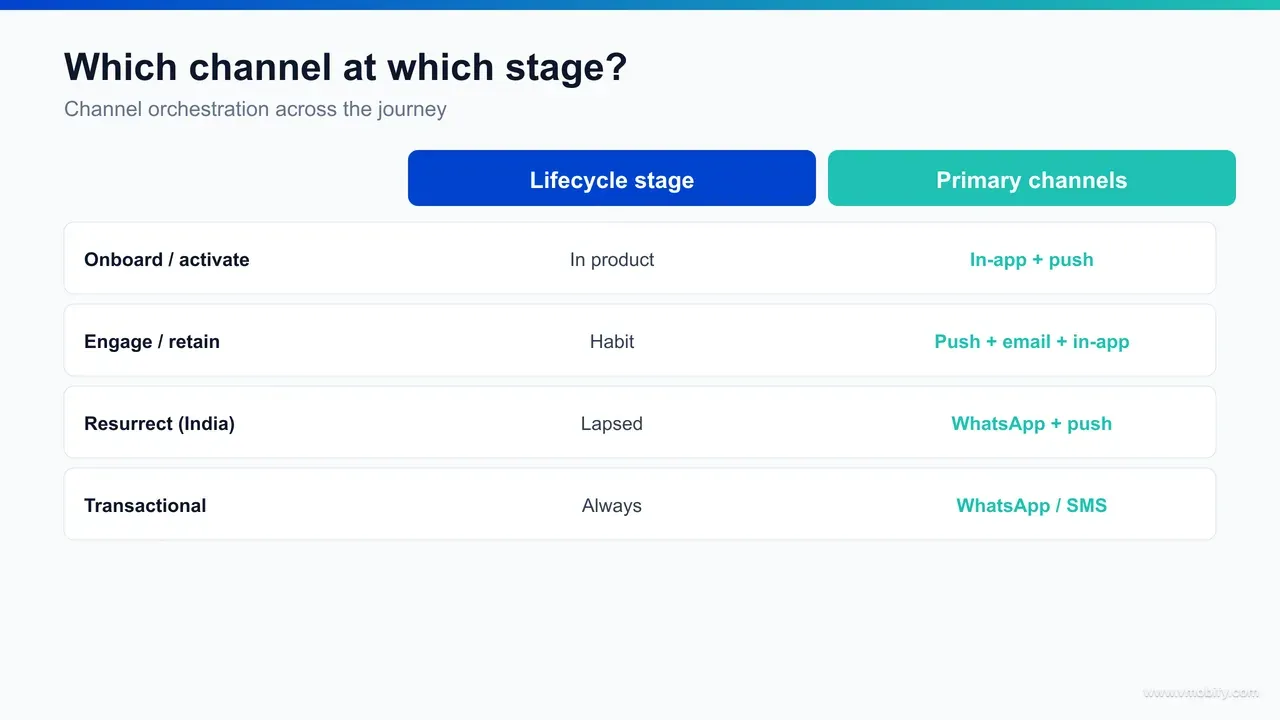
Channel orchestration — not channel choice — is where lifecycle programmes are won: the goal is to match push, in-app, email, SMS and WhatsApp to the stage, the message type, and the user’s reachability, rather than picking a favourite channel and over-using it everywhere. Each channel has a shape, and the art is routing the right message to the channel that fits it.
- In-app messages — for users already in the app. The highest-context channel, perfect for onboarding guidance, feature discovery, upsell prompts and surveys, because the user is present and engaged. Its limit is also its definition: it cannot pull anyone back, so it carries the engage and retain stages from inside the session, never the resurrect stage.
- Push notifications — immediate, free, but permission-gated. The workhorse of engagement and retention for opted-in users: behavioural triggers, streaks, progress, time-sensitive nudges. The catch is reach — push only works for users who opted in and have not muted you, which is exactly the cohort that erodes as users slip toward dormancy.
- Email — cheap, rich, low open rate. No character limit and near-zero cost make email good for content-heavy value restatement, receipts and digests. But in India especially, open rates are low, so email is a supporting channel — useful for depth, unreliable as a primary reach mechanism.
- SMS — universal reach, high cost, strict rules. SMS reaches any phone and is read fast, which makes it strong for OTPs, critical alerts and high-value time-sensitive nudges. Per-message cost and DLT consent rules mean you reserve it for messages that justify the price.
- WhatsApp — the India reach leader. Conversational, vernacular-friendly, and read on a surface users check constantly, WhatsApp reaches people that push and email no longer can — the structural reason it anchors the India stack, covered in the next section.
Orchestration ties these together into a cascade rather than five parallel blasts. A typical pattern: lead engagement with push for opted-in users, fall back to WhatsApp for the reachable-but-not-opted-in, reserve SMS for genuinely critical or high-value moments, use email for the low-cost long tail, and let in-app capitalise the moment the user returns. The same message is routed differently depending on who the user is and how reachable they are — and that routing logic, more than any single channel’s open rate, is what separates a lifecycle programme that retains from one that merely sends.
Why Is WhatsApp the Backbone of an India Lifecycle Programme?
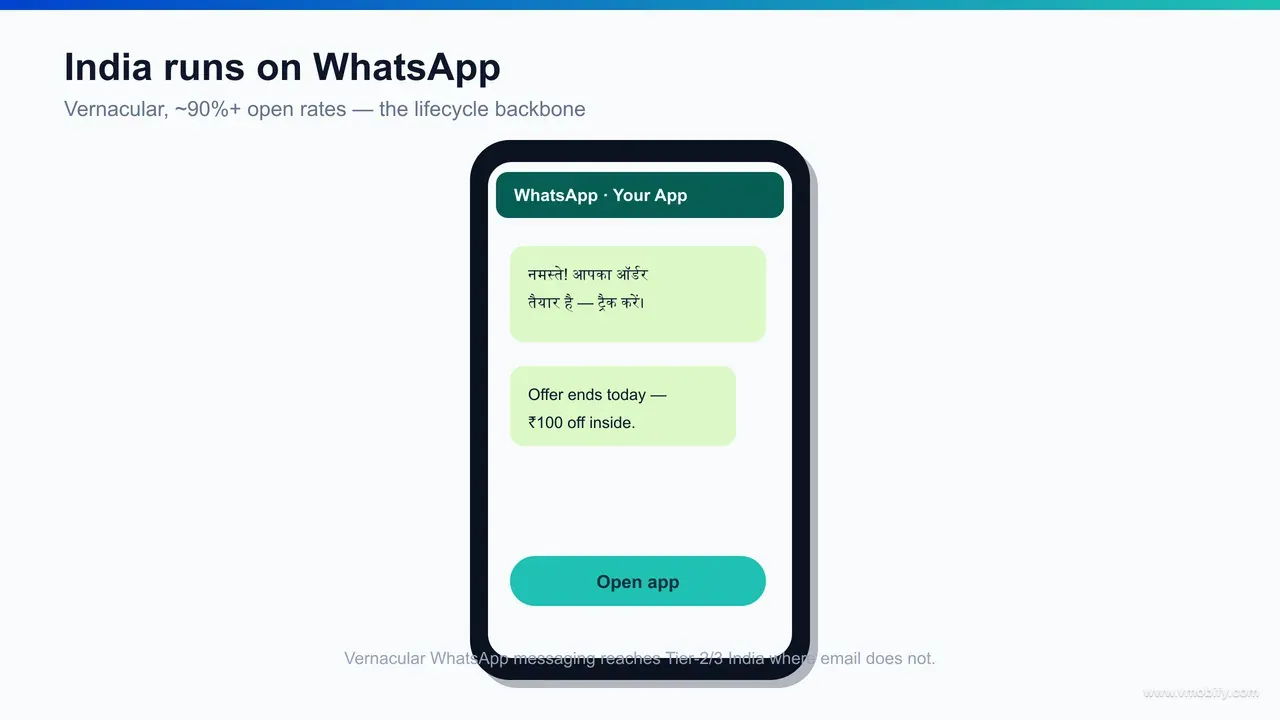
For India-focused apps, WhatsApp is the backbone of the lifecycle stack because it combines near-universal penetration with open rates far above any other channel — directional reports from lifecycle vendors consistently put WhatsApp around 90%+ open rates, against email engagement in the low double digits — and it reaches users on a surface they check dozens of times a day regardless of your app’s notification status. A lifecycle programme designed for a Western push-and-email stack systematically under-performs in India for the simple reason that it ignores the channel Indian users actually live in.
Three structural realities make WhatsApp the anchor rather than just another channel:
- Reach where push and email fail. India has large cohorts with structurally lower push opt-in, and the users most likely to have muted notifications are precisely the ones drifting toward churn. Email open rates in the market are low enough that it cannot be a primary reach channel. WhatsApp routes around both, delivering to a surface the user opens constantly no matter what their in-app notification settings say.
- A conversational, vernacular-native format. WhatsApp messages read like a conversation, not a broadcast, which makes vernacular and regional copy feel natural rather than templated. For the Tier-2 and Tier-3 audiences driving India’s next wave of mobile growth, that conversational vernacular tone is a meaningful conversion advantage.
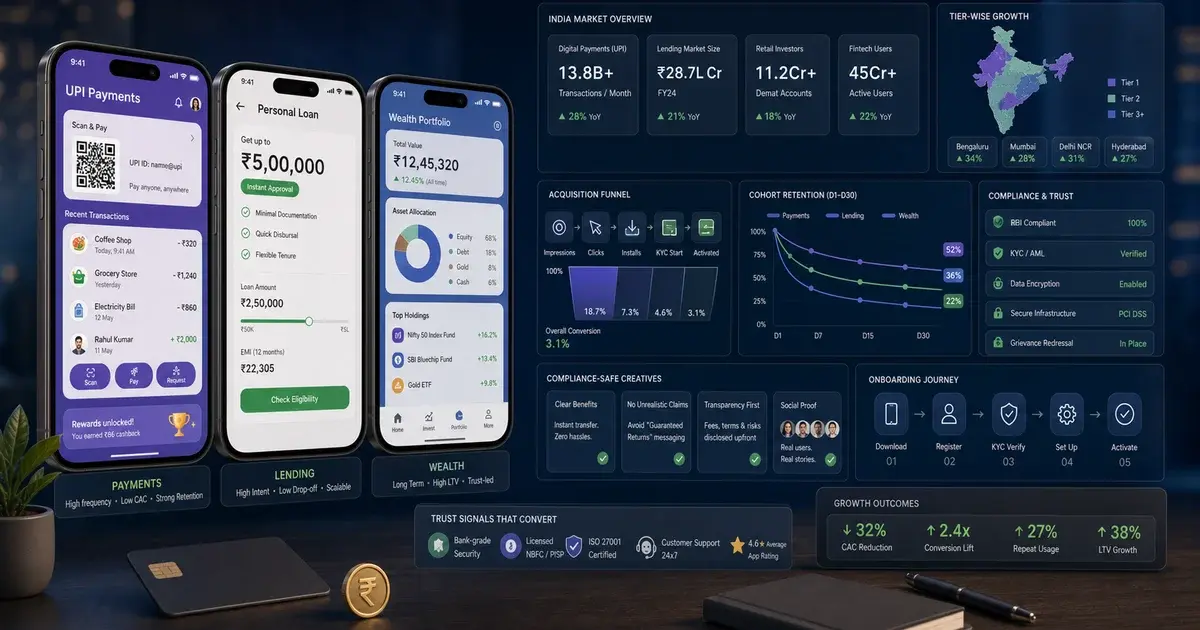
- Payment and transactional trust. UPI has normalised receiving important, action-oriented messages on the phone, so a relevant WhatsApp message from a known app is read as useful rather than intrusive — a trust foundation that does not exist for cold email. This is why WhatsApp is so effective for the transactional and high-relevance messages that anchor fintech lifecycle programmes, as our fintech app marketing guide for India details.
The discipline that keeps WhatsApp-first lifecycle marketing effective rather than spammy is consent and relevance. You need opt-in collected at registration, you must respect WhatsApp Business template approval and quality-rating rules, and you should reserve the channel for messages worth its per-message cost — a personalised, vernacular, deep-linked nudge to a user worth reaching, not a broadcast blast that gets your number blocked and your quality rating downgraded. Used well, WhatsApp is not a bolt-on to a push programme; it is the channel the India lifecycle is built around, with push, SMS and email arranged as the supporting cast. CleverTap’s India engagement research repeatedly underlines this inversion of the Western channel hierarchy.
How Do You Actually Build the Journey, and What Tooling Do You Need?
You build a lifecycle journey by combining three layers — an event and identity foundation, a journey-orchestration engine that fires messages off behaviour, and a multi-channel delivery layer that includes WhatsApp — and the platform you choose matters far less than the behavioural taxonomy and journey logic you build on top of it. Teams routinely over-index on platform selection and under-invest in the data model that actually determines whether the programme works.
The category of tool you need is a mobile-first customer engagement platform — sometimes called a mobile CRM or lifecycle-marketing platform. In the India context the leading options are purpose-built for exactly this:
India-native engagement platforms
- MoEngage, CleverTap and WebEngage are the platforms most India-focused apps standardise on, because they ship strong native WhatsApp Business integration, regional-language support, India data-residency options, and local teams who understand the market. Their published lifecycle playbooks are themselves a useful reference for journey design.
Global enterprise platforms
- Braze and similar tools offer best-in-class segmentation, journey building and experimentation infrastructure, and are a strong fit for apps with large global footprints — though WhatsApp and India-specific channel handling often need more configuration than the India-native tools provide out of the box.
The free/basic layer
- Firebase Cloud Messaging and similar handle raw push delivery but lack the orchestration, segmentation and multi-channel features a real lifecycle programme needs; they are a starting point, not a destination, for any app past early traction.
Whichever platform you pick, the build sequence is the same. First, instrument the events — the value moments, core actions and decay signals — and unify them under a single user identity across devices and channels. Second, design the journeys: the onboarding flow, the activation nudge, the engagement triggers, the at-risk intervention and the resurrection sequence, each with its own entry condition, message, channel cascade and exit rule. Third, wire in measurement with holdouts from day one (covered next), because a journey you cannot measure is a journey you cannot improve.
The hard part, in our experience across 300+ apps, is never clicking through the platform UI — it is the upstream taxonomy and the journey logic that product, analytics and CRM teams have to design together. That cross-functional build is exactly the work we run through our analytics and lifecycle practice, and it pairs directly with the user acquisition side so that the installs you pay for are handed into a journey designed to retain them, rather than dropped into a broadcast list and quietly lost.
How Do You Measure Whether a Lifecycle Programme Is Working?
You measure a lifecycle programme not by sends, deliveries or opens, but by whether it moves users forward through stages and keeps them active — stage-progression rates, retention curves, and above all the incremental lift measured against a holdout, are the only metrics that prove the programme creates value rather than just activity. Vanity metrics tell you the plumbing works; they do not tell you the programme works.
The metrics that actually matter:
- Stage-progression rate. Of users entering onboarding, what share activate? Of activated users, what share become habitual? Track conversion between stages, because that is the mechanism the whole programme exists to improve — and a stalled progression rate tells you exactly which journey to fix.
- Retention curves by cohort. D1, D7, D30 retention is the headline outcome of lifecycle work. Compare cohorts before and after a journey change, and watch whether the curve flattens higher — a flatter, higher retention curve is what a working lifecycle programme produces.
- Reactivation and post-reactivation retention. For the resurrect stage, measure not just how many lapsed users returned but whether they stayed active afterwards. A user who opens once and lapses again was poked, not reactivated — durable return is the goal.
- Incremental lift versus a holdout. The most important discipline in the entire programme. Always withhold a control group that receives nothing, and measure the difference in behaviour between treated users and the holdout. Some users would have progressed or returned on their own; the holdout is what separates the outcomes you caused from the ones you merely co-occurred with. Without it, you cannot honestly claim the programme drove anything.
Lifecycle-marketing studies from the major vendors put well-run programmes at meaningful double-digit engagement lifts — MoEngage’s lifecycle research and similar sources are useful for directional benchmarks — but those figures are only credible measured against your own holdout, on your own app, in your own market. Treat external numbers as proof the lever exists, then prove your specific programme works on your own control group.
The reporting frame that wins budget is cost-and-outcome, not activity. Report lifecycle marketing on incremental retained users and incremental revenue per cohort, benchmarked against the cost of replacing those users through paid acquisition — which is almost always far higher. Built this way, the programme stops being a line item the finance team questions and becomes the highest-ROI lever in the growth stack, because it compounds the acquisition you already paid for instead of paying for the same user twice. Building exactly this holdout-based measurement frame is core to how our analytics practice reports lifecycle work.
How Do You Personalise Vernacular and Regional Messaging for India?
Vernacular and regional personalisation means sending each user lifecycle messages in the language they actually think and transact in — not English by default — because messages in a user’s own language consistently outperform English equivalents for Tier-2 and Tier-3 cohorts, and in India that is the majority of the addressable base. Treating language as a personalisation variable, not an afterthought, is one of the highest-ROI moves available to an India lifecycle programme.
India has 22 officially recognised languages, and a large and growing share of internet users navigate, search and transact primarily in a regional language rather than English. A lifecycle programme whose templates exist only in English is, in effect, sending a degraded message to that entire cohort — the content may be relevant, but the language friction suppresses the open and the action. Push and especially WhatsApp both support Unicode and regional content natively; the bottleneck is having localised templates per language and per stage, which is a one-time build with a permanent per-cohort performance lift.
The discipline that makes vernacular work is doing it properly rather than literally:
- Localise the real spoken phrase, not the dictionary translation. The Hindi or Tamil term a user actually uses for "money transfer," "movie tickets" or "study" is rarely the literal translation of your English copy. Word-for-word translation reads as stilted; native phrasing reads as a brand that belongs in the user’s world.
- Segment language as a first-class user attribute. Capture preferred language early — at registration or from device locale — and store it on the user so every journey routes the right template automatically, rather than guessing per send.
- Align timing and context with regional reality. Festival calendars, regional events and local payment rhythms differ across India; a message that lands with Onam context in Kerala or Pongal context in Tamil Nadu outperforms a generic national broadcast. Regional personalisation is timing and cultural context, not just language.
WhatsApp is where this pays off most, because its conversational format makes vernacular feel like a message from a person rather than a templated push — which is exactly why it anchors the India stack. In our portfolio, swapping English-only lifecycle templates for properly localised vernacular copy, routed by a stored language attribute, is one of the most reliable single upgrades to an under-performing India engagement programme — the content does not change, only the language and context, and the cohort that was quietly ignoring you starts responding.
Which Lifecycle Marketing Pitfalls Quietly Cost Teams the Most?
The most expensive lifecycle mistakes are not dramatic failures — they are quiet structural errors that look like activity while corroding the channel: over-messaging without relevance, building journeys without an exit rule, ignoring the India channel reality, and reporting on opens instead of incremental retained value. Each one converts a programme that should compound retention into one that slowly manufactures churn.
The pitfalls that cost teams the most:
- Relabelling broadcasts as "lifecycle." The most common failure is keeping the same calendar of mass sends and simply renaming the team. If your messages are still triggered by the calendar rather than by user behaviour and stage, you have a broadcast programme with a new label, and it carries all the same uninstall risk.
- No frequency caps or exit rules. Journeys that keep firing at a user who has stopped responding do not recover them — they earn the block. Every journey needs a global frequency cap and a "go quiet after no response" exit, built into the automation rather than left to someone’s good judgement.
- Defaulting to a Western channel mix. Building the programme around push and email and treating WhatsApp as an afterthought systematically under-reaches the India base. In this market the channel hierarchy inverts, and a programme that ignores that is leaving most of its reach on the table.
- English-only templates. Sending the entire base English copy when a large share thinks in a regional language quietly suppresses every metric for that cohort. It looks like the content is under-performing when the real problem is language friction.
- Broken or missing deep links. A message that opens the app to a generic home screen wastes the hardest-won tap in the lifecycle. Every message should route to the exact in-app state that makes it actionable, or the recovery dies at the final step.
- Measuring sends and opens instead of lift. Reporting on delivery and open rate proves the plumbing works, not the programme. Without a holdout, you cannot tell the retention you caused from the retention that would have happened anyway — and you will eventually lose the budget argument because you cannot prove incremental value.
The thread running through all of these is respect for the user’s attention and honesty about results. Across our 300+ apps, the teams that build the most durable retention are not the ones who send the most messages or own the fanciest platform — they are the ones who orchestrate the right message, to the right segment, on the right channel, at the right stage, and then measure it against a holdout. If you want this built as a structured, India-calibrated, WhatsApp-first lifecycle programme — with the event taxonomy, journey orchestration, vernacular templates and holdout measurement wired in — that is exactly the lifecycle work our team runs. You can see how it fits the wider growth picture across our acquisition and retention services, or talk to us directly about auditing where your users are quietly slipping through the journey.
Frequently Asked Questions
What is app lifecycle marketing?+
App lifecycle marketing is the practice of orchestrating messages across the whole user journey — onboard, activate, engage, retain, resurrect — through a central engagement platform, so each user receives what fits their stage and behaviour rather than a one-size-fits-all broadcast. It replaces a calendar of mass blasts with behaviour-triggered journeys that move each cohort forward automatically.
How is lifecycle marketing different from sending push campaigns?+
A push campaign is a single channel and usually a scheduled broadcast; lifecycle marketing is the orchestration layer above it. It decides which message a user gets based on their stage and behaviour, then routes it through the best channel for that user — push, in-app, email, SMS or WhatsApp — and fires it off a trigger rather than a calendar date.
Why is WhatsApp so important for lifecycle marketing in India?+
WhatsApp has near-universal penetration in India and open rates far above email — directional vendor reports put it around 90%+ — and it reaches users even when push notifications are muted. Its conversational format also makes vernacular messaging feel natural, which is why it anchors the India lifecycle stack rather than acting as a bolt-on, provided you have proper opt-in and respect WhatsApp Business template rules.
What are the stages of the app user lifecycle?+
The five stages are onboard (reach first value fast), activate (complete the first meaningful action), engage (build the habit with triggers and reinforcement), retain (protect and deepen the habit, including upgrades and renewals), and resurrect (recover users who are slipping before they uninstall). Each stage needs a distinct message, and messages from one stage should be suppressed in another.
Which platform should I use for app lifecycle marketing in India?+
MoEngage, CleverTap and WebEngage are the platforms most India-focused apps standardise on, because they ship native WhatsApp Business integration, regional-language support and India data-residency options. Braze is a strong global enterprise option. The platform matters far less than the event taxonomy and journey logic you build on top of it — that is where programmes succeed or fail.
How do you measure whether lifecycle marketing is working?+
Measure stage-progression rates, cohort retention curves (D1/D7/D30), reactivation and post-reactivation retention, and above all incremental lift against a holdout group that receives nothing. Sends, deliveries and opens only prove the plumbing works; the holdout is what proves the programme actually caused the retention rather than co-occurring with it.
What is the biggest mistake teams make with lifecycle marketing?+
Relabelling the same broadcast calendar as "lifecycle" without making messages behaviour- and stage-triggered, and over-messaging without frequency caps, exit rules or a holdout to measure lift. In India, a close second is defaulting to a push-and-email mix and treating WhatsApp and vernacular copy as afterthoughts, which systematically under-reaches the majority of the base.
Sources
- WebEngage — Lifecycle Marketing Blog — Journey orchestration, lifecycle stage playbooks and India engagement patterns
- MoEngage — Lifecycle Marketing Blog — Segmentation, behavioural triggers, and directional engagement-lift benchmarks for India
- CleverTap — Engagement and Retention Blog — India channel hierarchy, WhatsApp engagement and vernacular messaging research
- Braze — Customer Engagement Resources — Journey orchestration, segmentation and holdout-based incrementality measurement
- Amplitude — Re-Engage Dormant Users — Segmenting by engagement depth and the efficiency of reactivation versus acquisition
- AppsFlyer — State of App Marketing in India — Retention benchmarks and India market lifecycle data by vertical
- Adjust — Mobile Measurement Resources — Deep linking and deferred deep linking for routing lifecycle messages to the right screen
About the author
Amol Pomane — Founder, Vmobify
Amol leads Vmobify, a mobile app growth agency that has driven 30M+ downloads and ranked 54K+ keywords across 300+ apps since 2013. He writes about ASO, paid user acquisition, retention, and the operational reality of scaling mobile apps in India and global markets.