The App Win-Back Playbook: Re-Engage Dormant Users Before They Churn
Most apps spend heavily to acquire users and almost nothing to keep the ones quietly slipping away. This playbook covers how to define dormancy, segment lapsing users, run a 30/60/90-day re-engagement sequence, pick the right channel — push, email, in-app, and WhatsApp-first for India — and measure reactivation without spamming your way to an uninstall.
On this page
- Why does winning back a dormant user beat buying a fresh install?
- What does a 30/60/90-day re-engagement sequence look like?
- How do you define "dormant" and segment lapsing users?
- How do you predict churn before a user goes dark?
- Which channels win — push, email, in-app, or WhatsApp/SMS?
- What should win-back messages actually say?
- How does deep-linking make re-engagement actually convert?
- How do you measure whether reactivation is working?
- How does WhatsApp-first win-back work for India?
- Which win-back pitfalls quietly trigger uninstalls?
- Frequently Asked Questions
Why Does Winning Back a Dormant User Beat Buying a Fresh Install?
Winning back a dormant user is dramatically cheaper than acquiring a new one, because the dormant user has already cleared every expensive step in the funnel — they know your brand, the app is still installed, and they have already shown intent at least once. A fresh install has to be paid for, onboarded, convinced, and habit-formed from zero. A lapsing user only needs a reason to come back.
The economics are lopsided. To acquire a net-new install you pay a cost-per-install on a paid channel, absorb the share of installs that never open the app a second time, and then carry the onboarding cost of teaching a stranger what your product does. A re-engagement message, by contrast, lands on a device that already has your icon on it, reaching a person whose intent you have historical data on. As Amplitude's guidance on re-engaging dormant users frames it, the user who already activated once is the single most efficient audience a growth team has — and the one most teams ignore in favour of topping up the acquisition funnel.
This is the strategic blind spot we see most often. Across our 300+ apps managed since 2013, the default reflex when growth stalls is to spend more on user acquisition. But pouring fresh installs into a leaky bucket simply raises the volume of users who lapse three weeks later. The bucket — retention and reactivation — is almost always the higher-ROI place to spend the next rupee, because it compounds the acquisition you already paid for instead of paying for the same user twice.
Re-engagement also protects the metric that actually drives sustainable growth: the ratio of active users you keep versus the installs you buy. If you treat win-back as a structured, always-on programme rather than an occasional "we miss you" blast, you convert a meaningful share of would-be churn back into active sessions every month — and that recovered cohort costs a fraction of replacing it through paid acquisition. Our user acquisition practice exists precisely so that the installs you pay for do not silently evaporate before they ever become revenue, and it pairs directly with the reactivation work this playbook describes.
One framing helps internal buy-in: a win-back campaign is not a marketing nicety, it is a recovery of sunk cost. Every dormant user represents money already spent on acquisition and onboarding. Letting that user churn without a single recovery attempt is writing off the investment. The question is never "should we run win-back?" — it is "how late are we already running it?"
What Does a 30/60/90-Day Re-Engagement Sequence Look Like?
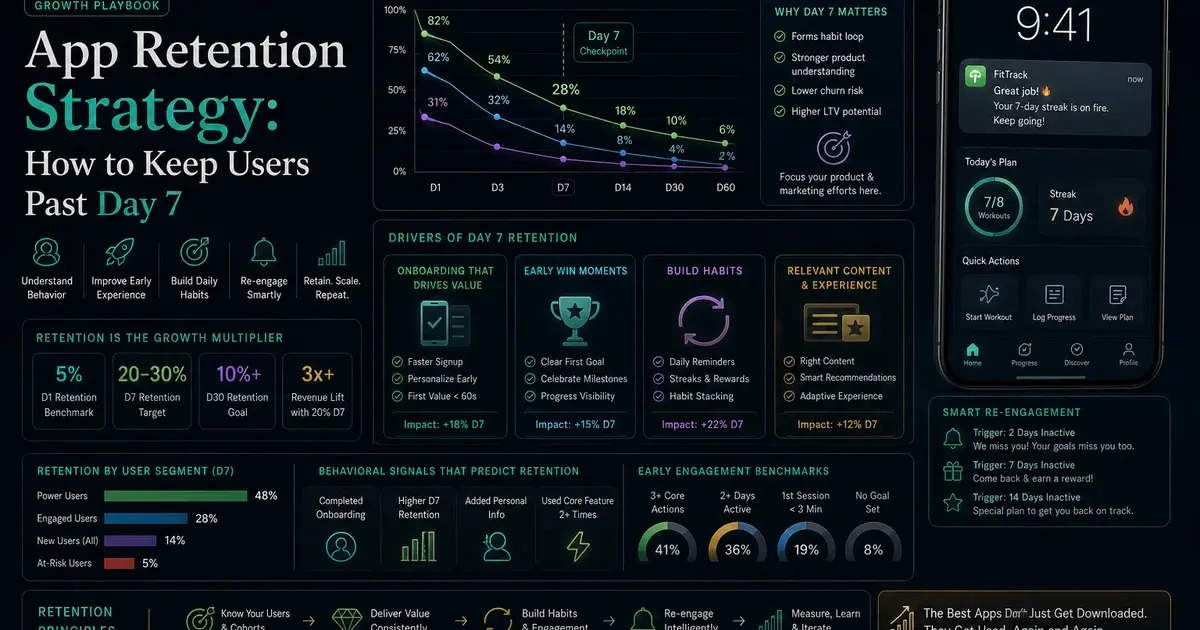
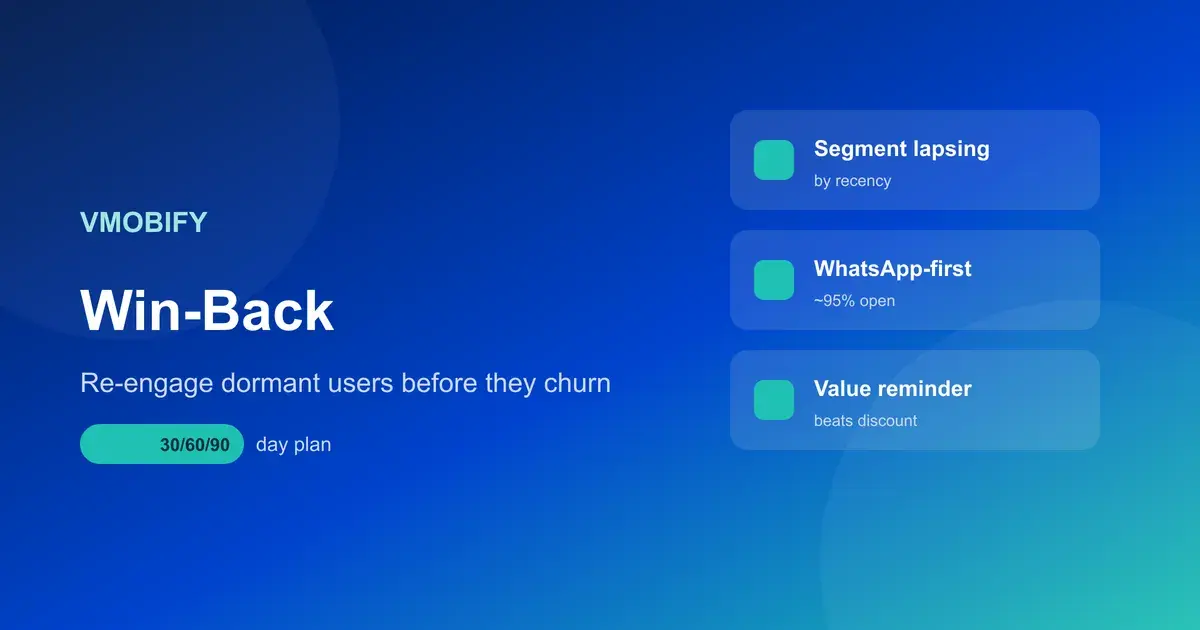
An effective re-engagement sequence is not a single 30-day "come back" message — it is a graduated ladder that starts within days of inactivity and escalates its framing as the user drifts further from the habit, because the recovery probability collapses the longer you wait. The "30/60/90" name describes the outer milestones, but the highest-value work happens far earlier than 30 days.
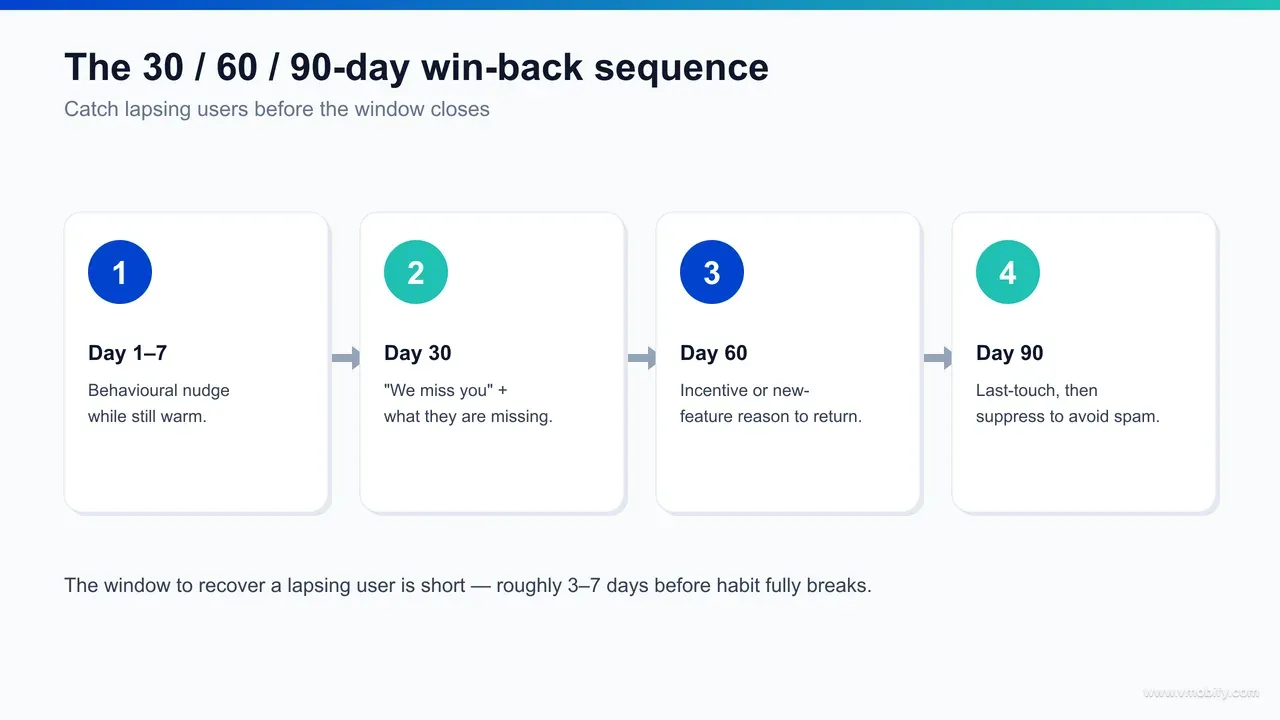
The structure that works in our portfolio runs in three tiers, each with a distinct job:
- Early window (roughly day 3–7 of inactivity) — gentle reminder. This is the highest-recovery interval by a wide margin. The user has not yet mentally filed your app under "apps I no longer use." A light, personalised nudge — "You left off at [specific point] — pick up where you stopped" — deep-linked to exactly that state recovers the largest share of the cohort. No urgency, no guilt, no discount. Braze's win-back guidance stresses that the earlier the touch, the more the user remembers why they cared.
- Mid window (roughly day 14–30) — value restatement. The framing shifts from "you paused" to "here is what you have been missing." Surface new content, a feature they never tried, a social signal from their network, or a progress summary that makes returning feel worthwhile rather than remedial. Recovery rates here are lower than the early window but still material, especially for higher-value users.
- Late window (roughly day 60–90) — genuine win-back. This is the last meaningful attempt before the user is effectively gone or uninstalls. Acknowledge the gap directly — "It's been a while; here's what's changed" — and, where the unit economics justify it, attach a concrete incentive: a trial extension, a personalised offer, or a fresh-start reset. Expect modest recovery, but for subscription apps a single reactivated user can be worth months of retained revenue, so the near-zero cost of one more message is easily justified.
The non-obvious discipline is the exit rule. After the 90-day window closes without a response, stop the standard cadence and move the user to a low-frequency, monthly touchpoint. Continuing to hammer a thrice-ignored user with escalating messages does not recover them — it converts dormancy into an active uninstall. The sequence has to know when to go quiet.
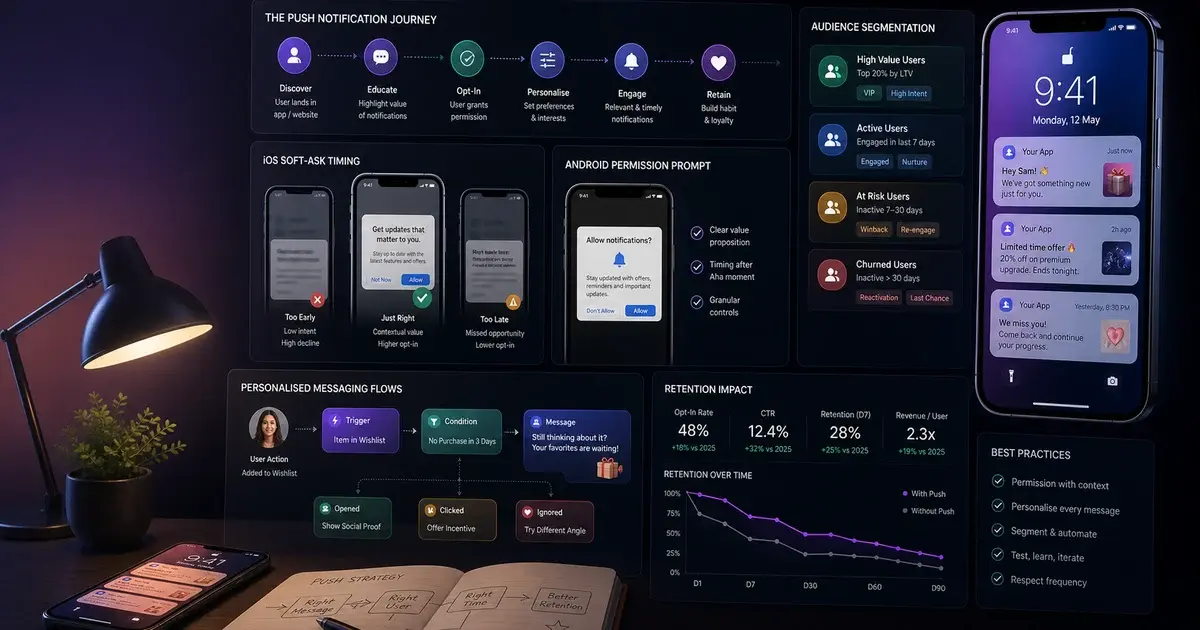
This ladder is the natural extension of the lifecycle messaging covered in our push notification strategy guide, which goes deep on the permission and segmentation mechanics that make these sends deliverable in the first place. Win-back is the last act of that lifecycle — and the one most teams never script.
How Do You Define "Dormant" and Segment Lapsing Users?
"Dormant" is not a universal number of days — it is defined relative to each app's natural usage rhythm, and getting that definition right is the difference between catching users while they are recoverable and noticing them only after they are gone. A daily fitness app and a quarterly tax-filing app have completely different dormancy thresholds, and applying a generic "inactive for 30 days" rule to both guarantees you intervene too late for one and too early for the other.
Start by establishing the app's expected session interval. If a healthy active user of your app opens it every two or three days, then a user who has not opened it in seven days is already a strong lapsing signal — long before any 30-day clock would fire. Define your dormancy bands against that baseline, not against a calendar convention borrowed from another category.
From there, segment along two axes that matter far more than raw recency alone:
- Recency — how long since the last meaningful session. Bucket users into early-lapsing, mid-lapsing, and deeply lapsed bands tied to your usage rhythm. The early band is where almost all recoverable value sits, so it deserves the most precise, most personalised treatment.
- Behaviour — what the user did before they went quiet. A user who completed onboarding, made a purchase, and used three core features is a fundamentally different recovery target from a user who installed, poked around once, and never activated. The former gets a "we kept your progress" message; the latter needs a first-value message they never received. Segmenting by depth of prior engagement, as Amplitude recommends, is what makes a win-back feel personal rather than generic.
Layering value on top of these two axes sharpens prioritisation further. A lapsing high-LTV subscriber or a user who was close to a key conversion milestone warrants a richer, possibly incentivised intervention; a never-activated tyre-kicker warrants a low-cost automated nudge and nothing more. Spending your most generous offers on users who were never going to monetise is one of the quiet ways win-back programmes waste budget.
The tooling for this segmentation exists natively in every major mobile CRM — Braze, CleverTap, and MoEngage all support recency-and-behaviour cohorts out of the box. The bottleneck is almost never the platform; it is the event taxonomy your product and analytics teams need to define so that "meaningful session" and "core action" actually mean something. Our analytics practice specialises in building exactly that instrumentation, because a win-back programme is only as good as the dormancy signal feeding it.
How Do You Predict Churn Before a User Goes Dark?
The most effective win-back happens before the user ever becomes dormant — by reading the leading indicators of disengagement and intervening while the user is still technically active, you sidestep the steep recovery curve entirely. Waiting for inactivity to cross a threshold means you are always reacting; predicting it means you are preventing.
Churn rarely happens suddenly. It shows up first as a gradual decline in the signals that precede silence:
- Falling session frequency. A user who opened the app daily and now opens it twice a week is decaying, even though they are not yet "inactive" by any threshold. This declining-frequency curve is the single most reliable early-warning sign.
- Shrinking session depth. Sessions that get shorter, or that stop reaching the core value action, signal waning intent before the sessions stop entirely.
- Abandoned high-intent flows. A user who starts checkout, a subscription upgrade, or a key task and bails repeatedly is signalling friction that, left unaddressed, becomes churn.
- Notification disengagement. A user who stops opening pushes they previously tapped is withdrawing attention — a precursor to withdrawing the app.
Modern mobile CRMs and analytics platforms can score these signals into a predictive churn-risk band, flagging at-risk users while they are still openable. The intervention for an at-risk-but-active user looks different from a win-back: it is a relevance restorer, not a "we miss you." Surface the feature they have not discovered, restate the value tied to what they were doing, or remove the friction in the flow they keep abandoning — all while the habit is merely fraying rather than broken.
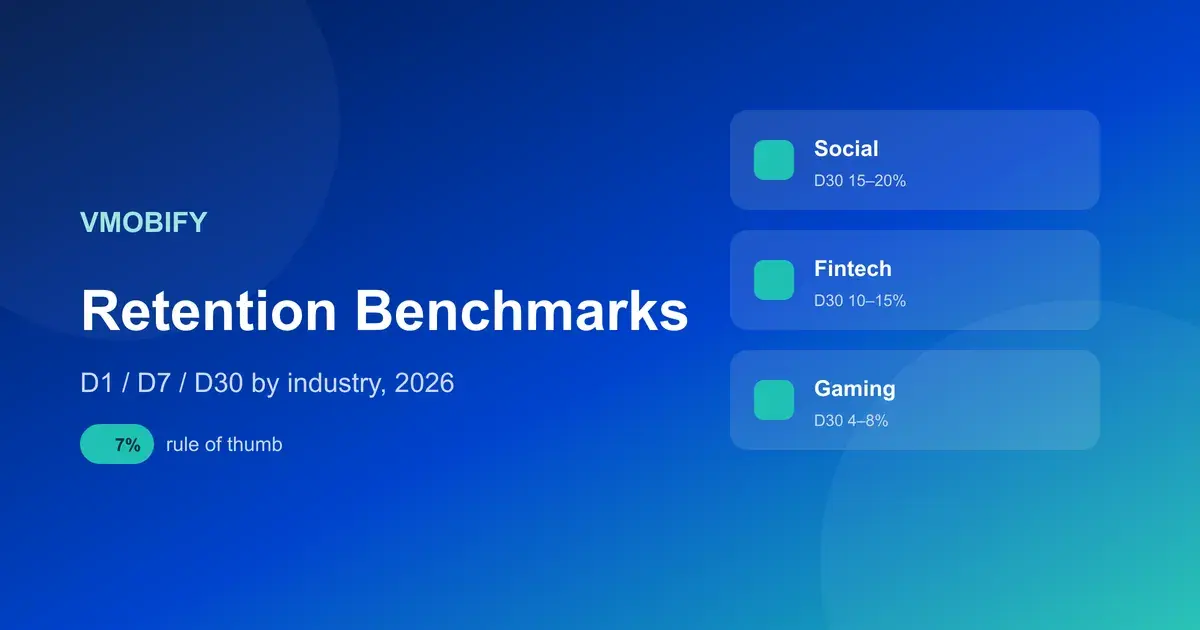
This is why we treat churn prediction and re-engagement as one continuous system rather than two campaigns. The same behavioural taxonomy that defines dormancy also defines pre-dormancy risk; you are simply reading it earlier. For the benchmarks that tell you whether your decline curves are normal or alarming for your category, our app retention benchmarks guide is the reference we point clients to — without a benchmark, you cannot tell a healthy plateau from the start of a churn spiral.
Which Channels Win — Push, Email, In-App, or WhatsApp/SMS?
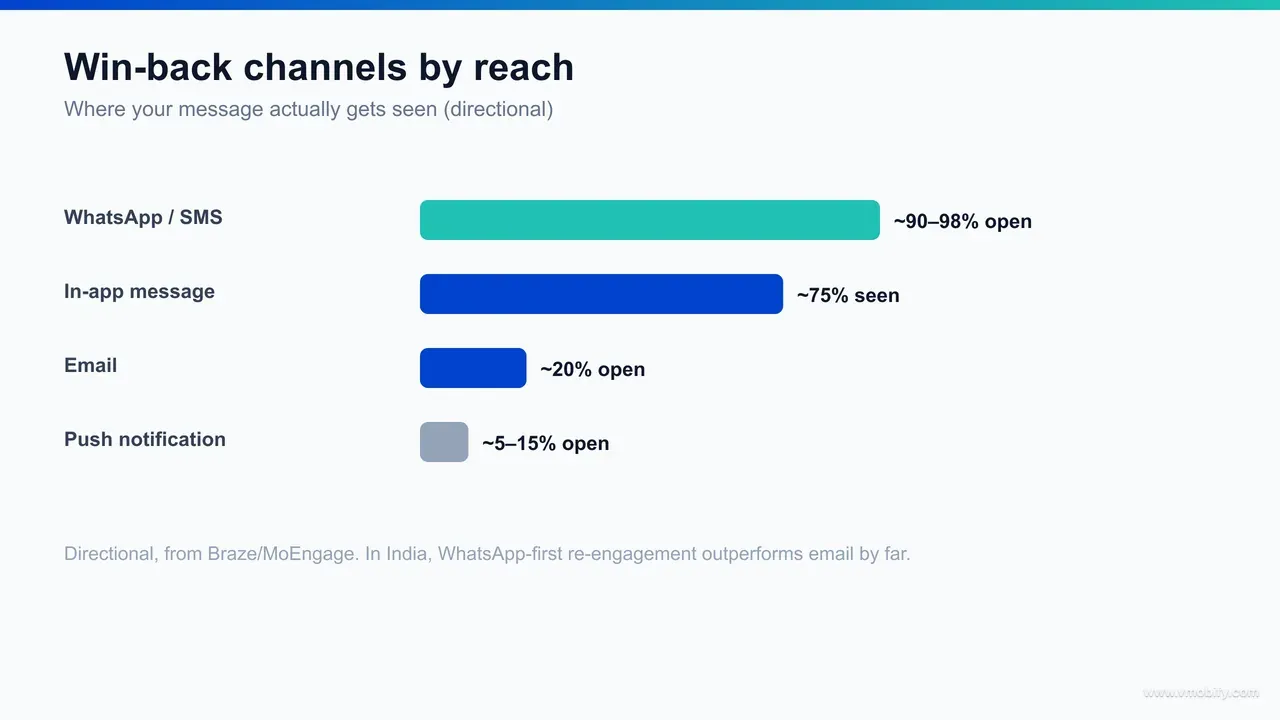
No single channel wins outright — the channel that recovers a dormant user is whichever one they will actually see, and for a dormant user that ranking inverts the convenient defaults: WhatsApp and SMS reach them when push and email no longer can. The cruel irony of re-engagement is that the channel you most want to use — push — is often already broken for the exact users you are trying to win back, because a dormant user has frequently muted, ignored, or revoked notifications.
Here is how the channels rank for a dormant audience specifically:
WhatsApp and SMS
- Highest reach. Open rates for these channels in India sit in the region of 90–98%, far above email, and crucially they reach the user even when in-app notifications are off. For a genuinely dormant user, this is often the only channel with a real chance of being seen. The trade-off is cost-per-message and strict consent and template rules, so reserve them for users worth recovering.
Push notifications
- High value when still live. For users who remain opted in, push is immediate and free, and Braze's push best practices show how much well-timed, personalised pushes lift re-entry. But for the deeply dormant, opt-out and notification fatigue erode push reach exactly when you need it most.
- Cheap and rich, but low open rates. Email carries no character limit and costs almost nothing, which makes it useful for value-restatement content. But open rates are a fraction of WhatsApp's, so email is a supporting channel for win-back, not the lead.
In-app messaging
- Only works once they are back. An in-app message is powerful for converting a returning user during the session, but it cannot pull a dormant user back because they are, by definition, not in the app. Use it to capitalise on a reactivation, not to cause one.
The practical model is a channel cascade: lead with the channel most likely to be seen for that user's dormancy depth, fall back to the next, and reserve in-app for the moment they return. A lightly lapsing user with push still enabled gets a push first; a deeply dormant high-value user gets a WhatsApp message because nothing else will land. Matching channel to recoverability, rather than blasting every channel at once, is what keeps win-back from tipping into spam.
What Should Win-Back Messages Actually Say?
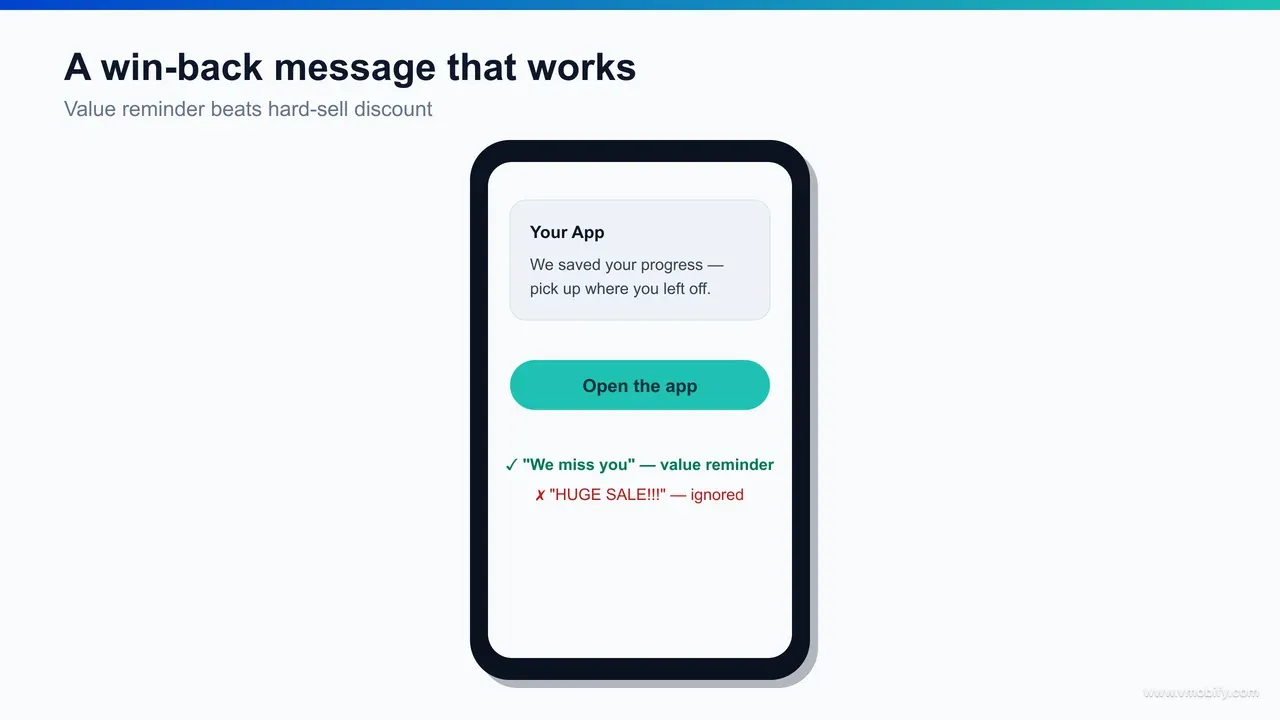
The messaging that wins dormant users back is value-reminder and "we miss you" framing — not the hard-sell "HUGE SALE" blast most teams reach for — because a dormant user has lost the relationship, and you cannot discount your way back into a relationship that no longer feels relevant. The job of a win-back message is to rebuild a reason to care, and a price cut alone rarely supplies one.
The framings that consistently outperform, in roughly the order you should deploy them across the sequence:
- Personalised continuity — "pick up where you left off." Reference the user's specific prior state: their saved cart, their half-finished course, their streak, the playlist they built. This says "your progress is still here," which lowers the psychological cost of returning. It is the highest-performing framing for early-window lapsing users.
- Value restatement — "here's what you've been missing." Surface what is new or what they never discovered: a feature, fresh content, a social update from their network. This works for mid-window users who need a fresh reason rather than just a reminder.
- Genuine "we miss you" — warmth, not desperation. A sincere, human message acknowledging the absence outperforms a transactional one. The tone matters: it should feel like a brand that values the user, not one panicking about a metric.
- Incentive — last, and only where it pays. A discount or trial extension belongs in the late window, targeted at users whose value justifies it. Leading with the offer trains users that ignoring you is rewarded with deals, and burns margin on users who would have returned for free.
What backfires is just as important to name. Generic "HUGE SALE" broadcasts to dormant users read as noise from an app they had already half-forgotten, and they are a leading cause of the notification or message that tips a dormant user into an uninstall or block. Manufactured urgency — fake countdowns, false scarcity — corrodes trust permanently once the user notices the timer resets. And guilt-based copy ("we noticed you've been ignoring us") creates resentment, not re-engagement.
Keep the copy short, lead with the specific personal hook in the first few words, and make the value unmistakable before any ask. MoEngage's lifecycle-marketing resources repeatedly show that relevance and personalisation, not discount size, drive the open and the return. In our portfolio, the single most reliable upgrade to an underperforming win-back programme is swapping broadcast promotional copy for personalised continuity messaging tied to what the user was actually doing when they drifted away.
How Does Deep-Linking Make Re-Engagement Actually Convert?
A win-back message that opens the app to a generic home screen is a broken message — deep-linking each message to the exact in-app state it references is what converts a tap into a completed action rather than a confused exit. The user tapped because of a specific promise; landing them somewhere they then have to navigate from breaks that promise and squanders the hardest-won click in the entire lifecycle.
The principle is simple and the impact is large: every re-engagement message should route directly to the screen that makes it actionable. If the copy says "your cart is waiting," the tap must open that cart. If it says "finish lesson 4," it must open lesson 4. If it says "your friend just posted," it must open that post. The friction of making the user find the thing themselves is enough to lose a meaningful share of the users you just spent a channel and a message to recover.
This matters doubly for dormant users because their motivation is fragile. A net-new user fired up about your product will tolerate a little navigation friction; a user you just coaxed back from weeks of silence will not. They are testing whether returning was worth it, and a mis-landed deep link answers "no" in the first two seconds. Precise routing turns the message from a reminder that something exists into a one-tap path to re-experiencing the value.
Deferred deep linking deserves a specific mention for win-back, because some lapsing users will have the app present but in a stale state, and a portion of recovery flows route through a re-install. A deferred deep link preserves the destination through an install or update so that a user who taps "resume your plan" still lands on their plan, not a cold home screen, even if the app had to update first. Getting this right is a one-time engineering investment that pays off on every campaign you run afterwards.
Set the routing up once, instrument it so you can see tap-to-action completion, and you have removed the most common silent failure in re-engagement. Many programmes that look like a copy or channel problem are actually a deep-link problem — the message worked, the landing did not. It is the same discipline we apply across lifecycle work in our app retention strategy guide: the message and the destination are a single unit, and optimising one without the other leaves most of the gain on the table.
How Do You Measure Whether Reactivation Is Working?
You measure reactivation not by how many messages you sent or even how many users opened them, but by how many genuinely dormant users returned, took a meaningful action, and stayed active afterwards — the reactivation rate and the post-reactivation retention curve are the only metrics that prove the programme is creating value rather than just activity. Vanity metrics like delivery and open rate tell you the plumbing works, not that the programme works.
The metrics that actually matter:
- Reactivation rate. Of the dormant users you targeted, what share returned and completed a meaningful action within the attribution window? This is your headline number, and you should track it per recency band — early-window reactivation will be far higher than deeply-dormant reactivation, and blending them hides where the value is.
- Post-reactivation retention. The critical follow-through metric. A user who opens once because of a message and lapses again the next day was not truly reactivated — they were briefly poked. Track whether reactivated users are still active 7, 14, and 30 days later. Durable reactivation is the goal; a one-session bounce is a false positive.
- Incremental lift versus a holdout. The most important discipline in the whole programme. Always withhold a control group of dormant users who receive nothing, and measure the difference in return rate between the treated group and the holdout. Some dormant users would have returned on their own; the holdout is what separates the reactivations you caused from the ones you merely co-occurred with. Without it, you cannot honestly claim the programme drove the result.
- Cost per reactivation versus cost per fresh install. Divide programme cost by genuine reactivations and compare to your blended acquisition cost. This is the number that wins budget, because in almost every case it lands well below what a new install costs — which is the entire economic argument for the programme.
Lifecycle-marketing studies from Braze and Amplitude put well-run reactivation campaigns at roughly a 30–60% lift in engagement for the treated cohort — but that figure is only meaningful measured against a holdout, and only durable if post-reactivation retention holds. Treat those numbers as directional proof that the lever works, then measure your own programme on your own holdout rather than borrowing someone else's headline. Our analytics practice builds exactly this measurement frame so that win-back is reported on incremental, retained value rather than on raw opens.
How Does WhatsApp-First Win-Back Work for India?
For India-focused apps, the most effective win-back channel is usually WhatsApp, not push or email — because WhatsApp has near-universal penetration, open rates around 90–98%, and it reaches dormant users in their own language on a surface they check constantly. A win-back strategy designed for a Western push-and-email stack systematically under-performs in India for the simple reason that it ignores the channel Indian users actually live in.
Several structural factors make the WhatsApp-first model work in India specifically:
- Reach where push fails. India has large cohorts with structurally lower push opt-in — and dormant users are precisely the ones most likely to have muted notifications. WhatsApp routes around that entirely, delivering to a surface the user opens dozens of times a day regardless of your app's notification status.
- Vernacular by default. A win-back message in Hindi, Tamil, Telugu, Kannada, Bengali, or Marathi consistently outperforms an English equivalent for users in those language cohorts. WhatsApp's conversational format makes vernacular messaging feel natural rather than templated, which matters most for the Tier-2/3 audiences driving India's next wave of mobile growth.
- Payment and transactional trust. UPI has normalised receiving important, action-oriented messages on the phone, so a relevant WhatsApp message from a known app is read as useful rather than intrusive — provided it is genuinely relevant and properly consented.
The discipline that keeps WhatsApp-first win-back effective rather than spammy is consent and relevance. You need opt-in collected at registration, you must respect WhatsApp Business template and quality rules, and you should reserve the channel for users and messages worth its per-message cost. Used that way — a personalised, vernacular, deep-linked nudge to a dormant high-value user — it is the most effective single recovery channel available to an India app. Used as a broadcast blast, it gets your number blocked and your template quality rating downgraded, which is far more damaging than a wasted push.
The model that performs is a layered one: WhatsApp leads for India dormant users worth recovering, push backs it up for those still opted in, and email carries the lower-cost long tail. This India-calibrated channel mix, paired with the vernacular and festival-aware timing we cover in our push notification strategy guide, is what turns a generic global win-back template into one that actually fits the market.
Which Win-Back Pitfalls Quietly Trigger Uninstalls?
The most damaging win-back mistakes do not just fail to recover the user — they actively accelerate the churn they were meant to prevent, converting a passive, recoverable dormant user into an active uninstall or a blocked number. A win-back programme run badly is worse than no programme at all, because dormancy is reversible and an uninstall is not.
The pitfalls that cost teams the most:
- Spamming the dormant user. Treating re-engagement as "send more messages until they come back" is the fastest route from dormant to uninstalled. Frequency without relevance is the single most reliable predictor of opt-out across every vertical. Cap the cadence, and never let three ignored messages become thirty.
- Starting too late. Waiting until a user is 30 or 60 days inactive to send the first message means the highest-recovery window has already closed. By the time most "win-back" campaigns fire, the user has already mentally uninstalled. The first touch belongs in the early window, not the late one.
- No exit rule. A sequence that does not stop after repeated non-response keeps poking a user who has clearly decided. This is the message that earns the block. Build the "go quiet after no response" rule into the automation, not into someone's good intentions.
- Leading with discounts. Hard-sell offers to dormant users train your base to lapse on purpose and burn margin on users who would have returned for free. Save incentives for the late window and for users whose value justifies them.
- Generic, un-segmented blasts. One "we miss you" message to every dormant user ignores the difference between a high-LTV subscriber and a never-activated tyre-kicker, and between a 5-day and a 90-day lapse. Un-segmented win-back reads as noise and performs like it.
- Broken deep links. Recovering the tap and then dropping the user on a generic home screen wastes the entire effort at the final step. The destination is part of the message.
The thread running through all of these is respect for the user's attention. Win-back works when it feels like a relevant, well-timed reason to return; it backfires when it feels like an app refusing to take the hint. In our portfolio, the teams that recover the most dormant users are not the ones who send the most messages — they are the ones who send the right message, to the right segment, at the right moment, and then know when to stop.
If you want this built as a structured, measured, always-on programme rather than an occasional blast — with the dormancy instrumentation, channel cascade, India-calibrated WhatsApp layer, and holdout-based measurement wired in — that is exactly the lifecycle work our team runs. You can see how it fits the wider growth picture across our acquisition and retention services, or talk to us directly about auditing where your users are quietly slipping away.
Frequently Asked Questions
What is an app win-back campaign?+
A win-back campaign is a structured set of messages aimed at users who have stopped using your app, designed to bring them back to active use before they churn or uninstall. It typically runs as a graduated sequence — a gentle reminder early, a value restatement next, and a genuine win-back offer last — across whichever channels the dormant user is most likely to see.
When should you start re-engaging a dormant user?+
Far earlier than most teams think. The highest-recovery window is usually the first 3 to 7 days of inactivity, because the habit and the memory of why the user downloaded are still intact. Waiting until 30 or 60 days means the highest-value window has already closed, so the first touch should fire as soon as a user crosses your app-specific lapsing threshold.
How much can a re-engagement campaign lift engagement?+
Well-segmented, well-timed reactivation campaigns can lift engagement by roughly 30 to 60% for the treated cohort, according to lifecycle-marketing studies from Braze and Amplitude. That figure is only meaningful when measured against a holdout group, and only valuable when post-reactivation retention holds rather than bouncing after a single session.
Is win-back really cheaper than acquiring new users?+
Almost always. A dormant user has already cleared the expensive parts of the funnel — they know your brand, have the app installed, and activated at least once. A re-engagement message skips the cost-per-install, the onboarding, and the convincing that a fresh acquisition requires, so cost per reactivation typically lands well below cost per fresh install.
Why is WhatsApp better than push for win-back in India?+
Because dormant users are exactly the cohort most likely to have muted or revoked push notifications, while WhatsApp open rates in India sit around 90 to 98% and reach the user regardless of in-app notification status. WhatsApp also supports natural vernacular messaging, which outperforms English for Tier-2 and Tier-3 audiences — provided you have proper opt-in and respect template rules.
What does Vmobify do for app re-engagement?+
We build win-back as a structured, always-on programme: dormancy instrumentation and segmentation through our analytics practice, a 30/60/90-day sequence, an India-calibrated channel cascade including WhatsApp, precise deep-linking, and holdout-based measurement so reactivation is reported on incremental, retained value. See /services/analytics and /services/user-acquisition for how it fits the wider growth stack.
What is the biggest mistake teams make with win-back?+
Spamming dormant users with frequent, generic, discount-led messages and no exit rule. This does not recover them — it converts a passive, recoverable dormant user into an active uninstall or a blocked number. The fix is segmentation by recency and behaviour, personalised value-reminder copy, precise deep links, and the discipline to go quiet once a user has clearly ignored the sequence.
Sources
- Braze — What Is a Win-Back Campaign Anyway? — Win-back sequence structure, timing, and why earlier touches recover more users
- Braze — Push Notification Best Practices — Timing, personalisation, and frequency discipline for re-engagement pushes
- Amplitude — Re-Engage Dormant Users — Segmenting by prior engagement depth and the efficiency of reactivation versus acquisition
- MoEngage — Lifecycle Marketing Blog — Relevance and personalisation over discount size; India lifecycle and vernacular messaging
- AppsFlyer — State of App Marketing in India — Early-abandonment rates that define the dormancy window and recovery economics
- Adjust — Mobile Measurement Resources — Deep linking and deferred deep linking for routing re-engagement to the right screen
- CleverTap — Re-Engagement and Win-Back Resources — Recency-and-behaviour segmentation and channel cascade for dormant-user recovery
About the author
Amol Pomane — Founder, Vmobify
Amol leads Vmobify, a mobile app growth agency that has driven 30M+ downloads and ranked 54K+ keywords across 300+ apps since 2013. He writes about ASO, paid user acquisition, retention, and the operational reality of scaling mobile apps in India and global markets.