App Promotion Companies in India: How to Pick the Right One
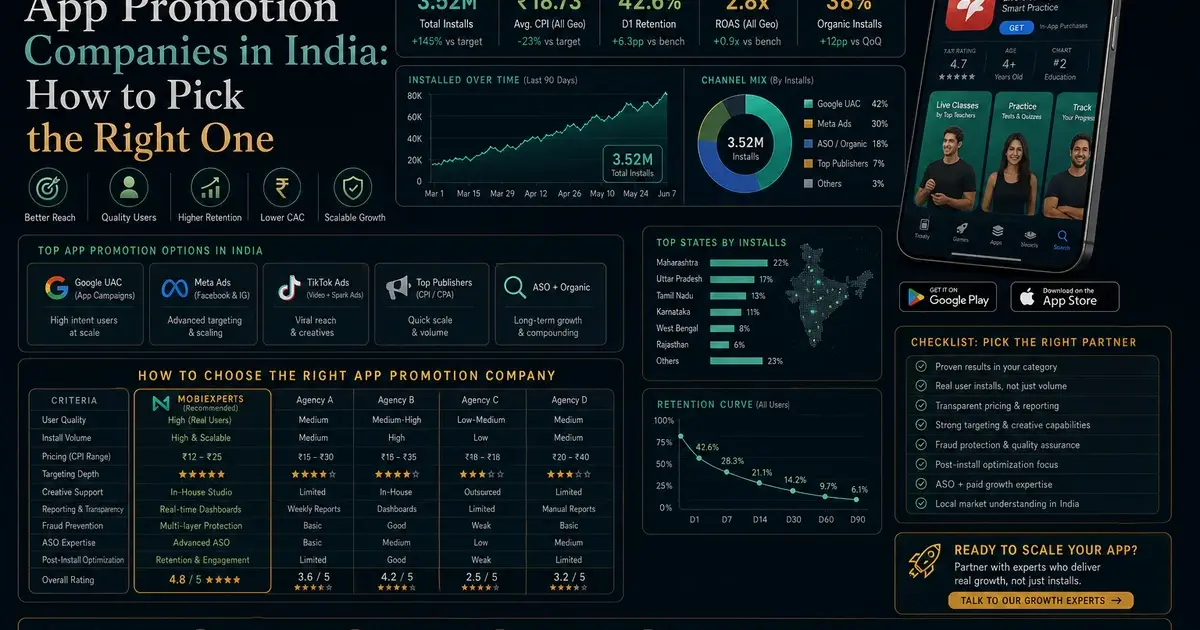
App promotion companies in India range from single-channel specialists to full-stack growth partners. This guide shows how to choose the right model for your app stage and avoid expensive mistakes.
On this page
- What types of app promotion companies operate in India?
- Should you choose organic promotion, paid promotion, or both?
- How do app promotion companies in India price their work?
- What results should you realistically expect, and by when?
- Which questions should you ask before hiring an app promotion company?
- What are the early warning signs that an engagement is going wrong?
- Why does an integrated partner beat hiring specialists?
- What makes app promotion in India different?
- Is an app promotion company worth it compared with hiring in-house?
- How does Vmobify run app promotion?
- How do you get started with app promotion in India?
- Frequently Asked Questions
What types of app promotion companies operate in India?
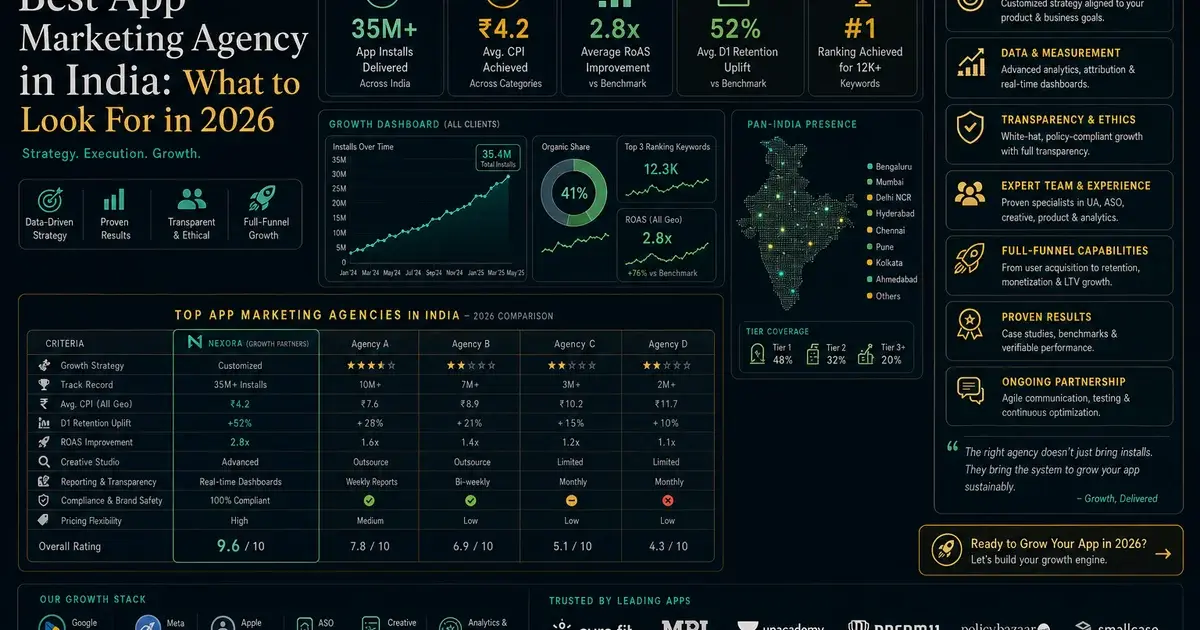
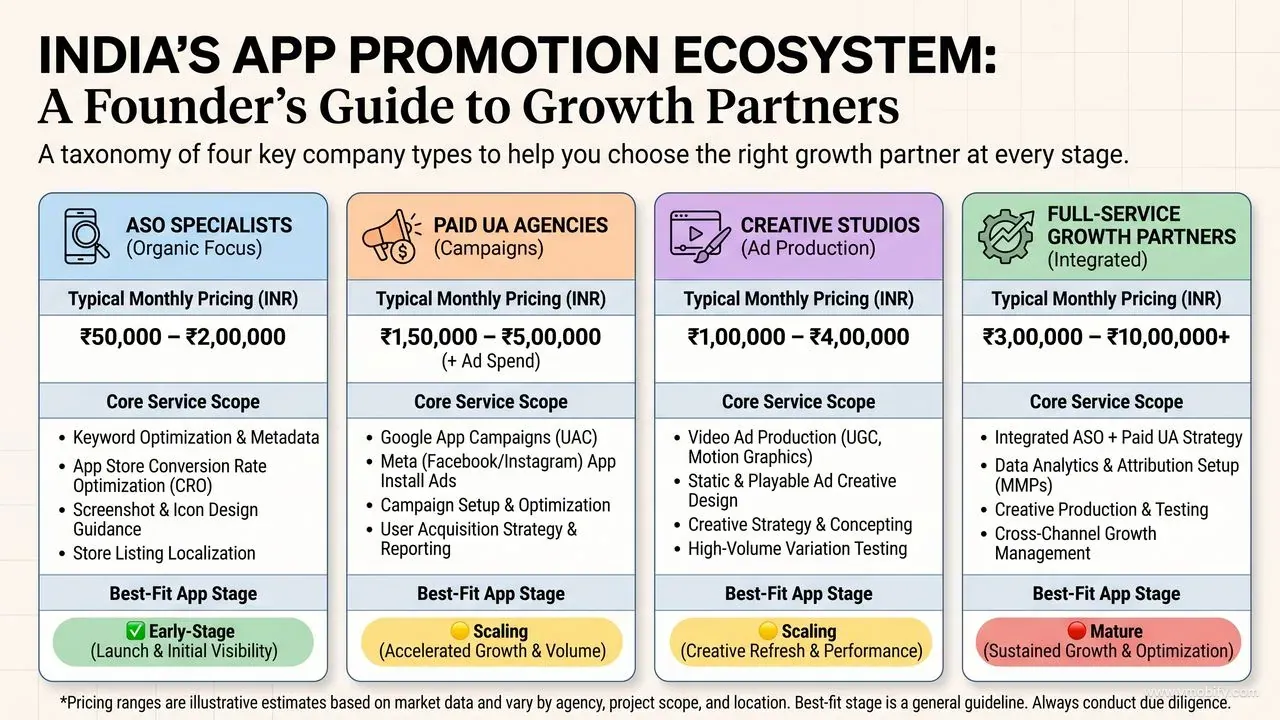
There are five distinct business models hiding behind the phrase "app promotion company", and they differ so much in capability and pricing that choosing the wrong category is more expensive than choosing a weak vendor inside the right one. Understanding the landscape prevents costly mistakes.
- Full-stack growth agencies: Handle ASO, paid UA, creative production, and analytics as an integrated service. These are the most expensive option but deliver the most sustainable growth because every channel reinforces the others.
- ASO specialists: Focus exclusively on App Store Optimisation — keyword research, metadata optimisation, screenshot testing. Strong at improving organic rankings but cannot drive paid volume.
- CPI networks and install marketplaces: Deliver install volume through publisher networks, often on a cost-per-install model. Useful for burst campaigns and chart climbing, but quality varies widely and must be managed carefully to avoid fraud.
- Performance agencies: Run Google and Meta campaigns but treat the app like a website — without platform-specific expertise in MMP setup, creative formats for app install ads, or store conversion optimisation.
- Freelancers and consultants: Individual practitioners who can be excellent for specific tasks (ASO audits, campaign audits) but rarely have the bandwidth to own a full growth system.
For most apps past their initial launch, a full-stack partner is the right choice. Piecemeal specialists can supplement an in-house team, but they rarely produce cohesive growth strategies.
The practical way to choose is by stage, not by sales deck. Pre-launch and immediately post-launch, the binding constraint is almost always store conversion and product readiness, so an ASO specialist or a focused audit buys more than a retainer with four workstreams. Once you have a working funnel and repeatable retention, the constraint moves to volume and creative throughput, which is where full-stack or performance partners earn their fee. CPI networks belong to a narrower job still — a launch burst, a chart defence, a featuring window — and should be treated as a tactic inside a plan, never as the plan. Anything that sells installs disconnected from intent also carries policy risk: Apple's App Store Review Guidelines explicitly prohibit manipulating installs, charts and reviews, and enforcement lands on your developer account, not on the vendor's.
Across the 300+ apps we have managed since 2013, the most common structural mistake is not hiring badly — it is hiring the right category at the wrong time. A large paid programme attached to an app with weak D1 retention buys an expensive lesson that a two-week audit would have delivered for a fraction of the cost. If you are still deciding between vendor types, our comparison of app marketing agencies in India covers how the same categories position themselves.
Should you choose organic promotion, paid promotion, or both?
Both — because they are the same system observed at two points, not two competing budgets. Every app promotion strategy sits somewhere on the spectrum between fully organic and fully paid. Understanding where your app should sit — and why — is fundamental to choosing the right company to help you.
Organic promotion is anchored in App Store Optimisation. This includes keyword research and title/subtitle optimisation so your app ranks for high-intent searches, screenshot and creative optimisation to improve conversion rate, and review management to build overall rating. Organic installs have zero marginal cost once the optimisation work is done — making them the highest-ROI channel for most apps.
Paid promotion through Google App Campaigns, Meta App Install ads, and CPI networks delivers volume on demand. The trade-off is cost — CPIs in India range from ₹10–15 for casual games to ₹200+ for finance apps. Paid is essential for rapid scaling, category launches, and apps that haven't yet built organic traction.
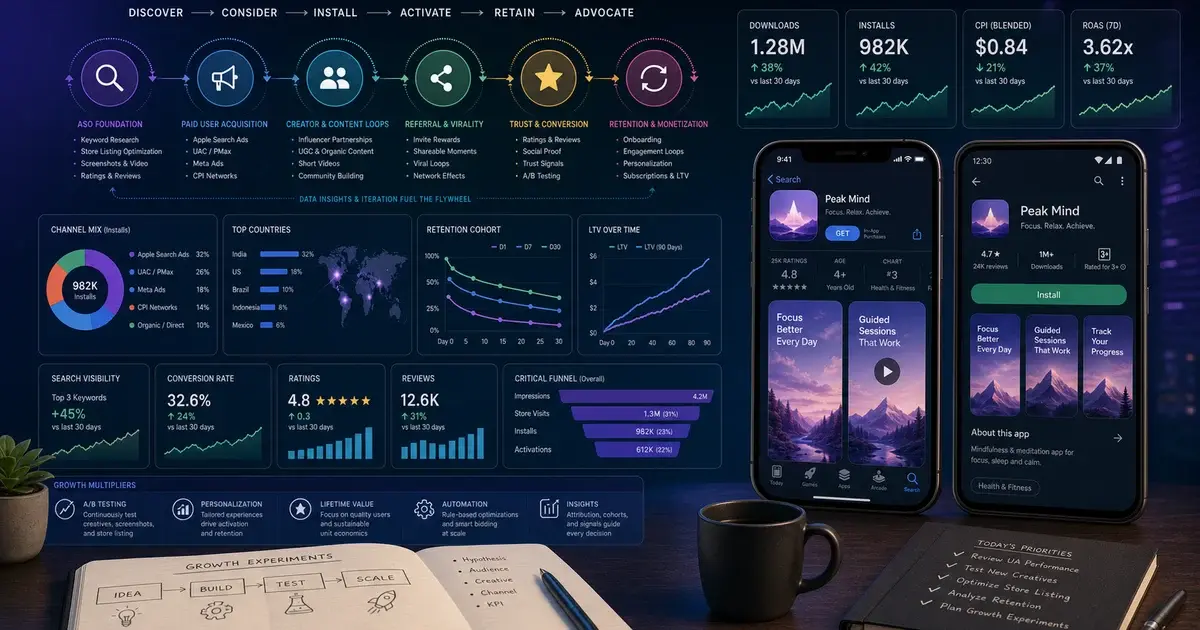
The best app promotion companies in India understand that organic and paid are not competing strategies — they are complementary. Paid UA drives download velocity, which improves app store rankings, which drives more organic installs, which brings down blended CAC. This flywheel is how apps reach millions of users cost-effectively.
The flywheel is not agency folklore. Google's own Play launch best-practices documentation treats install velocity and early engagement as launch-quality signals, which is precisely why a paid burst into an unoptimised listing wastes twice: once on the media, and again on the ranking lift you fail to convert. The correct sequencing is almost always store page first, paid second — and any partner who proposes the reverse is optimising for how quickly they can start spending your money.
One nuance worth pressing a vendor on: the split changes with stage. Early on, organic work has the better return because the fixes are cheap and permanent. Once your listing is genuinely competitive, incremental ASO gets slow and paid becomes the growth lever — but only if the ratio is deliberate. In our portfolio, the teams that plateau are usually the ones who never revisited a split they set in month one and then defended for a year.
How do app promotion companies in India price their work?
Four pricing models dominate the Indian market — monthly retainer, percentage of media spend, cost-per-install, and fixed-scope project — and each one creates a different incentive that will show up in the work within about six weeks.
- Monthly retainer: A flat fee for a defined scope and team. Predictable, easiest to hold accountable, and the model that survives a bad month without the agency quietly reallocating your people. The risk is scope drift, so insist the retainer names deliverables, not hours.
- Percentage of media spend: Simple to sign, but it pays the agency more for spending more. That is tolerable when you are genuinely in a scaling phase and dangerous when the honest recommendation is to cut spend and fix retention. If you use this model, cap it or pair it with an efficiency target.
- Cost-per-install: The vendor carries media risk and you pay per delivered install. Attractive on paper, and the model most exposed to quality problems — because the cheapest way to hit a CPI target is to source worse traffic. Only workable with independent attribution and a retention clause.
- Fixed-scope project: An ASO overhaul, a creative batch, a measurement rebuild. The right shape for a specific known gap, the wrong shape for ongoing growth that needs weekly decisions.
The arithmetic that actually decides your budget is media, not fees. Using the CPI ranges quoted above: at ₹10–15 for a casual game, 10,000 installs in a month is roughly ₹1–1.5L of media; at ₹200+ for a finance app, those same 10,000 installs cost more than ₹20L. Two founders quoted the identical retainer can therefore be running completely different businesses, and a fee that looks expensive next to a casual game's media budget is a rounding error next to a lending app's. Work out your category's media requirement first, then decide what management overhead is proportionate to it. Our India CPI benchmark guide breaks the ranges down by vertical.
Two contract details matter more than the headline number. First, who owns the ad accounts, the MMP account and the creative files when the engagement ends — if the answer is the agency, you are renting your own growth history. Second, what the notice period buys you: a 30-day exit with account handover is a healthy relationship; a 90-day lock with no handover clause is a retention mechanism dressed as a contract.
What results should you realistically expect, and by when?
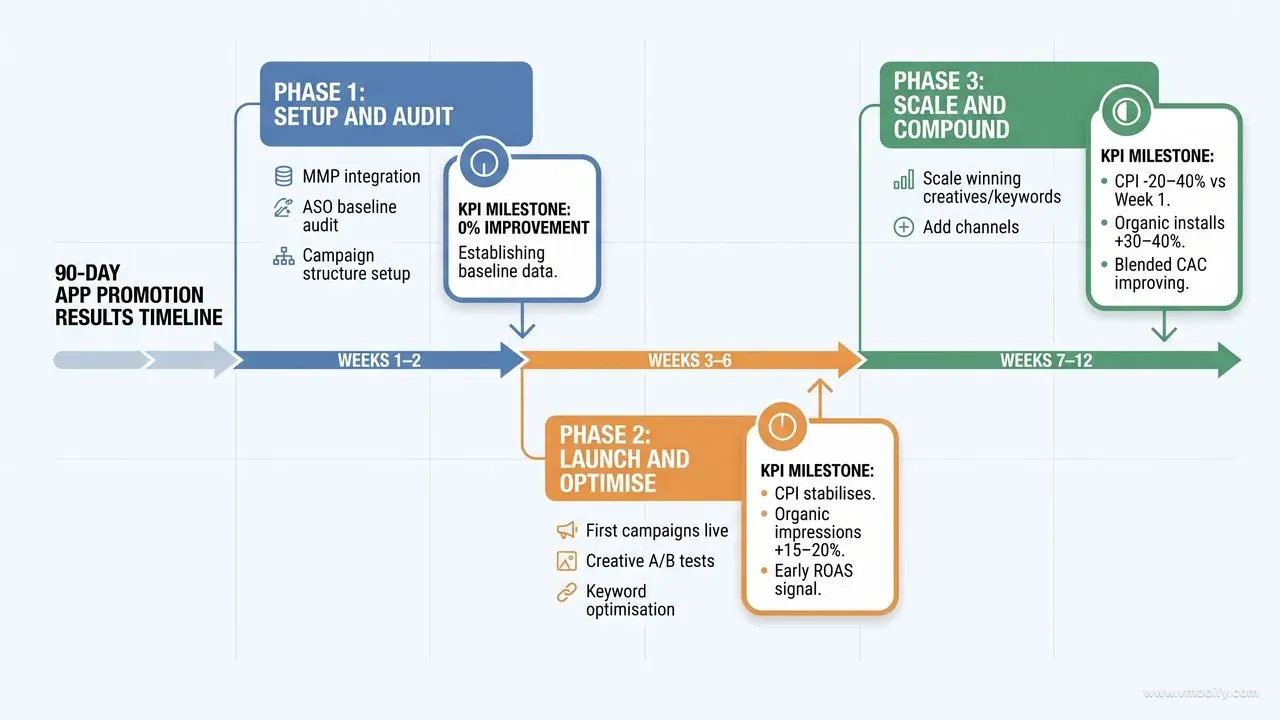
Ranking movement in 4–8 weeks, paid efficiency gains between weeks 1 and 8, and genuine compounding from month 3 — anything faster is either a burst that will decay or a number that will not survive audit. One of the biggest sources of frustration between app owners and promotion companies is misaligned expectations. Here is what the data actually shows:
- ASO: Ranking improvements typically appear in 4–8 weeks after metadata changes. Moving from unranked to top 10 for a competitive keyword takes 2–4 months of consistent work. Expect 20–40% growth in organic installs within 3 months of a comprehensive ASO engagement.
- Paid UA: Results are visible in week 1, but meaningful optimisation requires 2–4 weeks of data. CPI typically decreases 20–40% between week 1 and week 8 as the algorithm learns and creatives are refined.
- CPI burst campaigns: Install spikes are immediate, but chart ranking boosts last only as long as the campaign runs and for 1–2 weeks afterward. Plan for diminishing returns after the first burst unless supported by strong retention.
- Combined strategy: An integrated ASO + paid UA strategy typically shows compounding results from month 3 onward. By month 6, a well-executed campaign can deliver 3–5x the install volume of month 1 at the same or lower blended CAC.
Be sceptical of companies that promise results in 7 days or guarantee specific install numbers. Real growth takes disciplined execution over several months. Review our case studies for examples of realistic timelines and outcomes.
The more useful question is which metric you agree to be judged on before the work starts. Installs are the easiest number to move and the least informative; a partner who accepts accountability for retained users, cost per retained user, or a downstream event such as first transaction is telling you something about their confidence. Ask, too, which independent benchmark they check a proposed channel mix against — the answer separates teams working from an outside reference point for your category from teams quoting their own portfolio averages back at you.
Set the review cadence at the same time. Weekly reporting is for operations; the decision points that matter are the 30-day channel verdict, the 60-day creative verdict, and the 90-day scale-or-stop decision. Writing those three dates into the engagement before anyone spends money is the cheapest governance available to you.
Which questions should you ask before hiring an app promotion company?
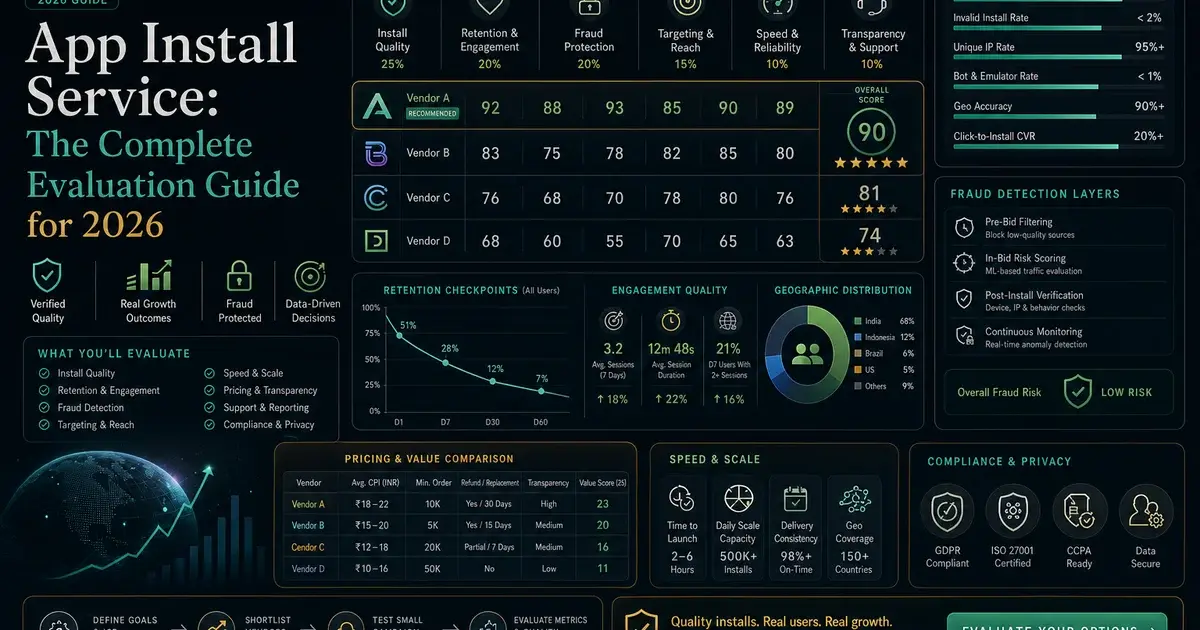
Seven questions separate a partner who runs a growth system from a vendor who runs campaigns — and every one of them can be asked before you sign anything. The difference between a great promotion partner and a mediocre one often comes down to asking the right questions during the sales process:
- "Show me case studies from apps in my category." Category-specific experience matters. A company that has grown 20 fintech apps has benchmarks, creative insights, and audience knowledge that a generalist does not.
- "How do you attribute installs?" The correct answer involves a mobile measurement partner (AppsFlyer, Adjust, or Branch). Any agency that attributes installs through the store console alone is working with incomplete data.
- "What happens when performance dips?" How an agency responds to underperformance is as important as how they perform when things go well. Look for structured troubleshooting processes, not defensive excuses.
- "Who actually works on my account?" Many agencies sell with senior talent and deliver with juniors. Ask who will be the day-to-day contact, their experience level, and how many accounts they manage simultaneously.
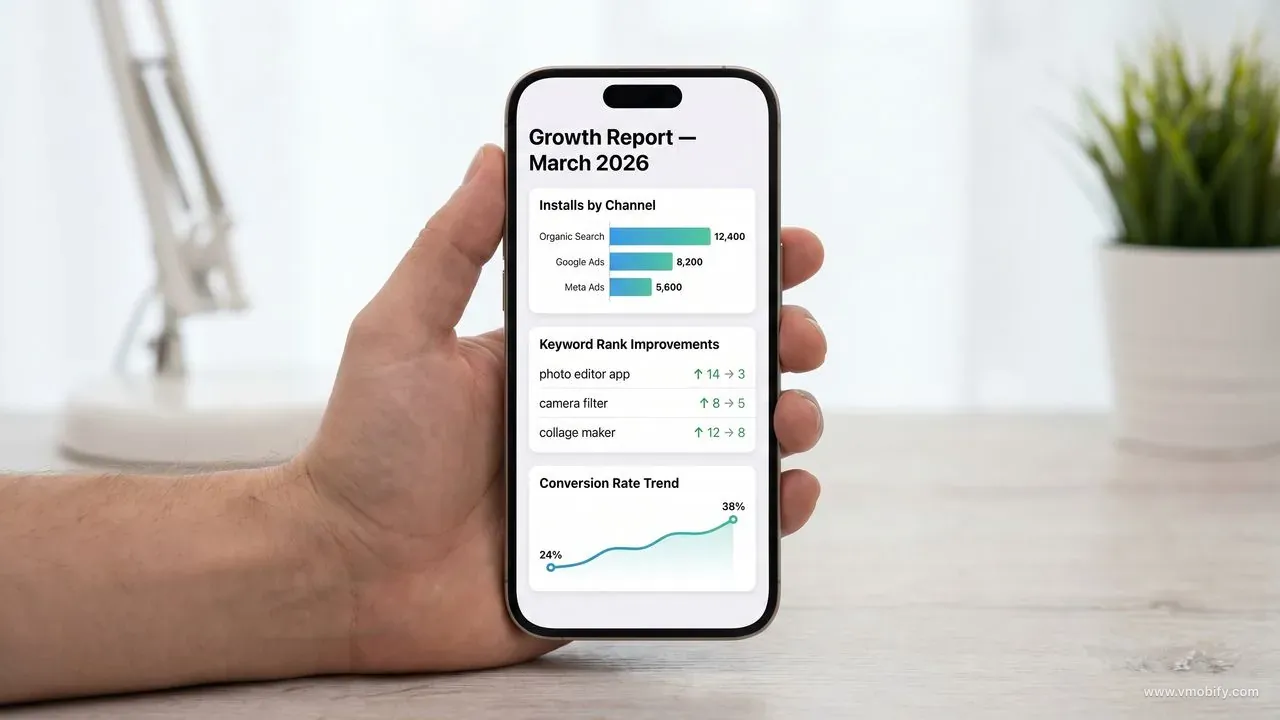
- "What does your reporting look like?" Request a sample report or dashboard. Weekly or bi-weekly reports with clear KPI tracking and recommended next actions are the standard for quality agencies.
- "How do you handle iOS measurement after ATT?" A credible answer references SKAdNetwork or AdAttributionKit, conversion-value mapping, and the fact that iOS reporting is modelled and delayed rather than user-level. Adjust's 2025 ATT opt-in research puts opt-in around 35%, which means anyone quoting precise iOS user-level ROAS is either misreading the data or presenting Android numbers as though they covered both platforms. Our mobile attribution guide covers what a correct setup looks like.
- "How many creatives will you ship per month, and who makes them?" Creative throughput is the real ceiling on paid scale. An agency that outsources every asset and ships two variants a month cannot feed a modern app campaign, regardless of how good its media buying is.
Ask the attribution and creative questions early. They are the two answers that most reliably predict how the engagement goes, and both are difficult to fake in a first call.
What are the early warning signs that an engagement is going wrong?
A failing app promotion engagement is almost always visible by week six, and the signals are behavioural before they are numerical. Knowing what to watch for lets you correct course while the budget is still recoverable.
- Reporting drifts from outcomes to activity. When the weekly deck starts leading with impressions, reach and "optimisations made" instead of installs, cost per retained user and store conversion, the underlying numbers have usually stopped cooperating.
- Install volume rises while retention falls. The classic signature of traffic quality being sacrificed to hit a volume target. Watch D1 and D7 by media source, not blended — the blend hides it for weeks.
- A single publisher or sub-publisher dominates delivery. Sudden concentration in one source, especially with abnormally fast click-to-install times, is the standard fraud pattern. Our ad fraud prevention guide covers the checks that catch it early, and a good CPI network partner will surface source-level data without being asked.
- Creative refresh stalls. If the same three assets have been running for a month, CPI is about to rise no matter what the media buyer does. Fatigue is a supply problem, not a bidding problem.
- Store listing work quietly stops. Many engagements begin with an ASO sprint and then never touch the listing again. Ranking decays, paid conversion decays with it, and the agency reports rising CPIs as a market condition.
- Nobody can answer "what did we learn last month?" An engagement without accumulating knowledge is just media buying. If the month-three answer is the same as the month-one answer, you are paying a retainer for maintenance.
The fix is rarely to fire the agency immediately. In most cases we have seen, a written 30-day corrective plan — specific metric, specific owner, specific date — either restores the engagement or makes the decision to end it obvious and unarguable.
Why does an integrated partner beat hiring specialists?
Because store algorithms reward holistic signals, and specialists working in silos optimise their own metric at the expense of yours. It might seem logical to hire the best ASO specialist for organic and the best paid UA agency for ads. In practice, this fragmented approach consistently underperforms an integrated partner.
Here is why: App store algorithms reward holistic signals. Install velocity, engagement rate, keyword relevance, and conversion rate all interact. A paid UA agency driving high-volume, low-quality installs can actually hurt your organic rankings. An ASO specialist optimising keywords without understanding your paid UA targeting creates misalignment between who you are reaching and what your store page promises.
An integrated app promotion company can establish feedback loops that specialists working in silos cannot. Paid UA creative insights inform ASO screenshot testing. Keyword data from ASO informs audience targeting on paid. Attribution data identifies which channels produce retained users, not just installs. These feedback loops compound over time.
The two stores also behave differently enough that split ownership creates real errors. Apple and Google index metadata differently, expose different listing fields, and offer different experimentation tools, so a keyword or screenshot decision that helps on Play can be neutral or actively harmful on iOS. When one team owns the listing and another owns the traffic pointed at it, nobody is accountable for that interaction — and it is usually the interaction, not either discipline on its own, that decides blended CAC.
The coordination overhead of managing multiple specialist vendors also adds up — multiple weekly calls, inconsistent reporting formats, finger-pointing when results disappoint. A single integrated partner creates accountability and efficiency. Talk to Vmobify about how our integrated approach works in practice, or review the proof on our results page.
What makes app promotion in India different?
India is an Android-first, Tier-2/3-driven, multi-language market with an unusually wide CPI spread — and a promotion plan built on Western, iOS-first assumptions will underperform here regardless of the agency's pedigree elsewhere.
Start with platform mix. India's smartphone base skews heavily to Android, as Statista's India mobile internet data documents, so Play Store mechanics, Android creative formats and Play Console experiments carry most of your growth weight. Revenue skews the other way: RevenueCat's State of Subscription Apps 2025 shows a persistent per-user revenue gap between iOS and Android. The practical consequence is that volume plans should be Android-led and monetisation plans should account for the platform mix rather than assuming a single blended ARPU — a distinction our monetisation work starts from.
Then geography. Metro auctions and Tier-2/3 auctions behave like separate markets, with materially different competition, creative response and price. Agencies that run one national campaign are blending two economies into one CPI number and then wondering why scaling breaks. Splitting the campaign structure is basic hygiene, and it is a reasonable thing to ask a prospective partner to describe before you hire them.
Language is the third axis. English-only creative caps your reachable audience well below the market's size, and translated copy is not the same as creative built for the audience. In our portfolio, regional-language creative is one of the few interventions that changes both cost and retention at once, because the users it brings in actually understood what they were installing.
Finally, the CPI spread quoted earlier — ₹10–15 for casual games against ₹200+ for finance — is wider in India than the equivalent spread in most Western markets. That is why category benchmarks matter more than agency averages, and why a partner who quotes you one "typical CPI" without asking what your app does has already told you how much category-specific work they intend to do. Our user acquisition team plans against category benchmarks for this reason.
Is an app promotion company worth it compared with hiring in-house?
An agency is worth it when you need several scarce skills at once but not full-time — and it stops being worth it the moment your spend is large enough and stable enough to keep specialists busy. That is the honest version of an answer most agencies avoid giving.
Compare what you are actually buying. A growth function needs an ASO practitioner, a media buyer with app-campaign experience, a creative producer shipping assets weekly, and someone who genuinely understands attribution. Hiring all four is a serious payroll commitment, and each of them is underemployed at low spend. An agency exists to sell you fractions of those four people plus the pattern library that comes from running many apps — that is the real product, and it is why category experience is worth paying for.
The sceptical buyer's objection is fair: agencies are incentivised to spend and to stay. Two things defuse it. First, ownership — your ad accounts, your MMP, your creative source files, with handover written into the contract, so the agency's leverage is performance rather than lock-in. Second, an explicit graduation plan. A partner who is comfortable saying "at this spend level you should bring media buying in-house and keep us for ASO and creative" is a partner whose advice you can trust in the months before that point.
The hybrid is usually the most efficient shape in practice: an internal owner who holds strategy, budget and the retention roadmap, and an external team that supplies execution depth and cross-portfolio pattern recognition. What does not work is the arrangement with no internal owner at all — nobody inside the company able to challenge a report, approve a creative direction, or connect growth decisions to the product roadmap. Every engagement we have seen fail on the client side failed that way, and no agency, however good, can fix it from outside.
How does Vmobify run app promotion?
As one system with a single owner: ASO, paid acquisition, creative, analytics and lifecycle messaging all feed the same growth loop, and the audit comes before the budget. That matters because installs do not compound unless the channels are learning from each other.
Our first step is always a growth audit. We look at store conversion, channel mix, attribution, creative output, and retention quality before we recommend any budget shift. That keeps the engagement focused on the highest-leverage work first.
The audit exists to answer one question: where is the binding constraint right now? Sometimes it is the listing, sometimes it is a broken measurement setup that makes every subsequent decision guesswork, sometimes it is a retention problem that no amount of acquisition will outrun. Recommending spend before that question is answered is how agencies produce months of activity with nothing compounding behind it.
If you want that style of execution, start with our services overview, then review ASO, user acquisition, and analytics. Those are the three pieces that turn app promotion from media buying into a growth system.
How do you get started with app promotion in India?
In four steps, in this order — audit, fix the foundation, prove one paid channel, then scale — because reversing any two of them costs money you will not get back. If you are ready to invest in professional app promotion, here is a practical starting sequence that minimises risk and maximises early learning:
- Step 1 — Get a baseline audit: Before spending on promotion, understand where your app stands today. An ASO audit will surface quick wins that improve organic conversion immediately. A paid UA audit (if you are running any campaigns) will identify waste and opportunities.
- Step 2 — Fix the foundation: Ensure your store listing is optimised, your onboarding converts, and your D1 retention is above category average before scaling paid spend. Pouring paid budget into a leaky funnel is expensive.
- Step 3 — Start with one paid channel: Google App Campaigns or Meta — not both simultaneously. Prove your CPI economics on one channel before expanding. This keeps the data clean and the learning fast.
- Step 4 — Scale what works: Once you have a channel with stable CPI below your LTV threshold, scale spend systematically. This is when to add additional channels and creative formats.
Two things belong in place before step 3, and both are routinely skipped. Your MMP should be live and validated with test installs on both platforms, and your in-app events should be defined beyond "install" — registration, activation, first transaction, whatever your business actually runs on. Google's App Campaigns documentation is explicit that the campaign optimises toward the conversion event you give it, so an app reporting only installs will be sold exactly that: installs, from wherever they are cheapest.
Vmobify offers a free growth audit that covers all four of these areas. Request yours today — it takes 20 minutes and typically surfaces at least 2–3 immediately actionable insights. You can also compare the operating model against our case studies.
Frequently Asked Questions
What should an app promotion company deliver in the first 90 days?+
A baseline audit, store fixes, a channel test plan, and reporting that shows whether installs, conversion, and retention are moving in the right direction. By day 90 you should also have a clear verdict on at least one paid channel — whether its economics work at your LTV — rather than a plan that is still "warming up".
Should I hire a specialist or a full-stack partner?+
If your growth levers influence each other, full-stack usually wins. Specialist vendors can be useful, but only when an internal growth lead is already coordinating the system. Without that internal owner, specialists optimise their own metric and nobody is accountable for the interaction between them.
What is the biggest mistake when hiring an app promotion company?+
Choosing on install volume alone. If the partner cannot explain attribution quality, retention, and real business outcomes, the install numbers are not enough. Ask what they would be judged on if installs were removed from the report entirely — the answer tells you how they think.
How much should I budget for app promotion in India?+
Work from media, not fees. Using the CPI ranges in this guide, 10,000 monthly installs is roughly ₹1–1.5L of media for a casual game at ₹10–15 CPI, and over ₹20L for a finance app at ₹200+. Establish your category cost first, then decide what level of management overhead is proportionate to that media budget.
How do I check whether the installs I am paying for are genuine?+
Look at source-level data rather than blended totals. Concentration in one publisher, abnormally short click-to-install times, and a widening gap between install volume and D1 retention are the standard fraud signatures. An independent MMP is what makes those checks possible, which is why store-console-only attribution is a red flag.
Do app promotion companies work for pre-launch apps?+
Partially. Before launch the useful work is positioning, store listing construction, keyword strategy and measurement setup — not media buying, because there is no retention data to optimise against. Paying a full performance retainer pre-launch generally buys activity rather than growth.
What should I own when the engagement ends?+
Your ad accounts, your MMP account and historical data, your creative source files, and your store listing assets. Write handover into the contract at signature. If an agency resists that, the relationship is being held together by lock-in rather than by performance.
Sources
- Apple App Store Review Guidelines — Official rules on install, chart and review manipulation — enforcement lands on the developer account
- Google Play — Launch Best Practices — Google's own guidance on install velocity and launch-quality signals
- Google Ads — App Campaigns Help — How App Campaigns optimise toward the conversion event you define
- AppsFlyer Performance Index — Independent media-source rankings by category and region for sanity-checking a proposed channel mix
- Adjust — ATT Opt-In Rates 2025 — Opt-in around 35%, and what that means for iOS measurement claims
- RevenueCat — State of Subscription Apps 2025 — Per-user revenue benchmarks and the iOS-versus-Android gap
- AppTweak — Apple App Store vs Google Play ASO Differences — How metadata and indexing differ between the two stores
- Statista — Mobile Internet Usage in India — India platform mix and mobile internet adoption context
About the author
Amol Pomane — Founder, Vmobify
Amol leads Vmobify, a mobile app growth agency that has driven 30M+ downloads and ranked 54K+ keywords across 300+ apps since 2013. He writes about ASO, paid user acquisition, retention, and the operational reality of scaling mobile apps in India and global markets.